Online Driving License in Nepal (2026): Apply & Renew via eDLVRS

Online Driving License in Nepal (2026): The Complete eDLVRS Guide to Applying, Renewing and Actually Getting Your Card
Last updated: 17 September 2026 (1 Ashoj 2083) · Covers all 7 provincial eDLVRS portals, the revised FY 2083/84 fee schedule, the new online licence correction service, and the current smart-card printing situation.

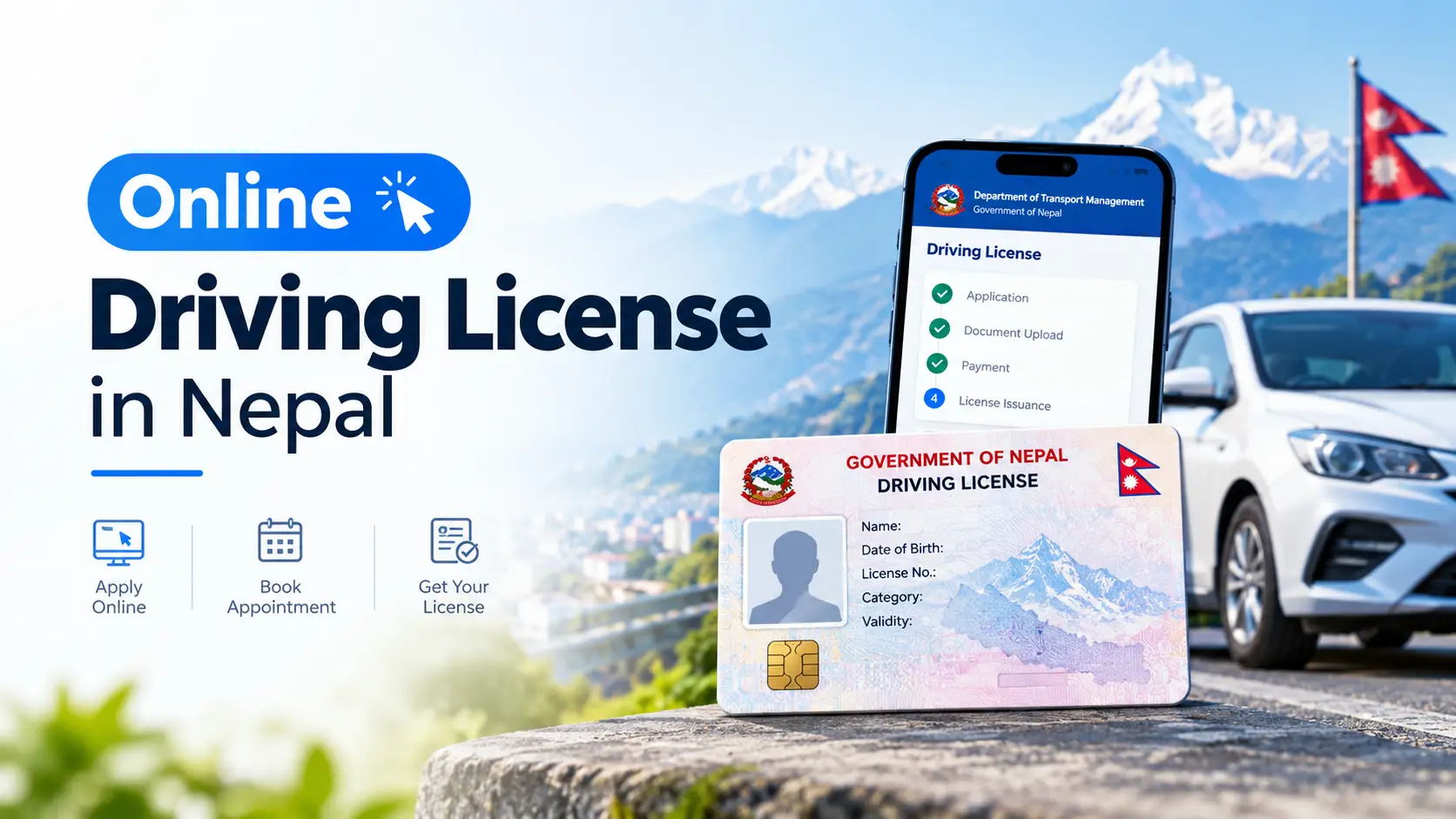
Online driving license in Nepal 2026 — applying through the eDLVRS portal on a laptop and mobile
Nepal's driving licence process moved to the province-based eDLVRS system on 1 Shrawan 2083 (17 July 2026).
⚠️ Read this before you apply: smart-card printing is currently stalled

Driving licence printing across Nepal has been suspended since 14 August 2026. When DoTM handed printing responsibility to the provinces on 17 July 2026, six of the seven provinces (all except Madhesh) had not yet signed agreements with the Security Printing Centre — mostly over unallocated budget. As of mid-September 2026, roughly 250,000 licences are sitting unprinted, and the 24-hour emergency card service for people flying out for work, study or peacekeeping has also stopped. DoTM has asked the Ministry of Physical Infrastructure and Transport for permission to resume printing temporarily.

What this means for you: you can still apply and renew online normally, still sit your exams, and still receive a valid temporary slip. You just cannot rely on a fast physical card right now. If you need the card by a fixed date, read the realistic timeline section before you pay anything.

The short answer
  • Where to apply: your province's own eDLVRS portal — not one national website. Start at edlvrs.dotm.gov.np and pick your province.
  • What's online: form filling, category selection, office and appointment booking, government fee payment, PDF licence download, and (new this month) correcting errors on your licence.
  • What still needs an office visit: biometrics, document verification, the written (likhit) exam, the trial, and collecting the card.
  • Cost: fees changed in FY 2083/84 and now differ by province. Category A/K is Rs 3,000; Category B is Rs 4,000 (Rs 5,000 in Madhesh). Application fee ranges Rs 500–1,000. Full table below.
  • Login: scan the QR on your National ID card or use the Nagarik App to auto-fill your details.

What eDLVRS is, and why the old portal stopped working

The Department of Transport Management (DoTM) switched Nepal's driving licence services to eDLVRS — the Electronic Driving Licence and Vehicle Registration System — on 1 Shrawan 2083 (17 July 2026). If you last applied a year or two ago and are wondering why your bookmarked link is dead, that's why: the old central portal at applydlnew.dotm.gov.np has been retired, and the central data-centre issues in August 2026 finished it off.

The structural change matters more than the new interface. Under Schedule 6 of Nepal's Constitution, vehicle taxes, registration and driving licences are provincial subjects. eDLVRS finally reflects that: instead of one national system, each of the seven provinces now runs its own portal on its own gov.np domain, with its own fee schedule, its own budget and its own printing arrangements.

That's the reason for almost every quirk in this guide — why fees differ between Bagmati and Madhesh, why you choose a portal by exam location rather than home district, and why printing stalled the moment responsibility moved down a level.

Step 1: pick the correct provincial portal

Use the portal for the province where you will sit your written exam and trial — not necessarily the province on your citizenship certificate. If you live and work in Kathmandu but hold a Dhanusha citizenship, you want Bagmati.

Official eDLVRS portals, as listed on DoTM's central hub.
ProvinceOfficial eDLVRS portalApplication fee (FY 2083/84)
Koshiedlvrs.koshi.gov.npRs 1,000
Madheshedlvrs.madhesh.gov.npRs 500
Bagmatiedlvrs.bagamati.gov.npRs 1,000
Gandakiedlvrs.gandaki.gov.npRs 1,000
Lumbiniedlvrs.lumbini.gov.npRs 500
Karnaliedlvrs.karnali.gov.npRs 1,000
Sudurpashchimedlvrs.sudurpashchim.gov.npRs 750
Note the spelling

Bagmati's domain is bagamati.gov.np (with the extra "a") and Sudurpashchim's is sudurpashchim.gov.np. Typo-squatting sites already exist for both. If you are ever unsure, go through the government hub at edlvrs.dotm.gov.np and click through — never pay a fee on a portal you reached from a Facebook post or a YouTube description.

What you can and cannot do online (the honest boundary)

Most guides describe eDLVRS as "fully online." That's the press-release framing. Here is the working reality:

✅ Genuinely online now

  • New licence application form
  • Renewal request
  • Adding a vehicle category (श्रेणी थप)
  • Government revenue / fee payment
  • Transport office and appointment selection
  • Health check submitted by any NMC-registered doctor via the doctor portal
  • PDF copy download of an issued licence
  • Correcting personal details (new, Sept 2026)

❌ Still requires you in person

  • Biometric capture (photo, fingerprints, signature)
  • Original document verification
  • Written (likhit) exam
  • Practical trial
  • Physical smart-card collection

So the honest saving is roughly this: the old process cost you a full day queuing for a form and a payment counter before you ever sat an exam. eDLVRS removes that day. It does not remove the exam day, and it does not remove the collection trip.

Eligibility and documents: what stops applications before they start

Minimum age by category

CategoryVehicles coveredMinimum age
A / KMotorcycle, scooter16 years
BCar, jeep, van, pickup18 years
C / DTempo, auto-rickshaw / power tiller18 years
E / FTractor / minibus, mini truck18 years
G / H / I / JTruck, bus, road roller, dozer, crane, fire engine, excavator, backhoe loader21 years (heavy and commercial)

There is no shortcut from A to B. Holding a Category A licence since 16 does not let you sit the Category B trial before 18. There is also no upper age limit — a question that comes up constantly and that almost no competing guide answers directly.

Documents checklist

  • National ID card with a readable QR code, or the Nagarik App installed and logged in. NID has effectively become mandatory for licence services under eDLVRS.
  • Original citizenship certificate plus a photocopy (both sides). A photocopy alone will get you turned away.
  • Blood group report. It is asked for and printed on the card. "I think I'm O positive" is not an answer that works at the counter.
  • Passport-size photograph, recent.
  • Existing licence number if you are renewing or adding a category.
  • Working mobile number and email — every OTP, booking confirmation and payment receipt goes there.
  • A funded online payment method (eSewa, Khalti, ConnectIPS or bank) ready before you start.
The single most common reason applications get stuck

Your name spelling on the form must match your citizenship certificate character for character. Not "close enough." A Shrestha spelled "Shreshtha" on one document and "Shrestha" on the other is the most frequent cause of a rejected or frozen application, and it is painful to unwind after payment. Since the NID auto-fill pulls from a different database than your citizenship, check the auto-filled fields rather than trusting them.

How to apply for a new driving licence online in Nepal


  1. Prepare everything first — the session times out

    A genuinely large share of the frustration people report with eDLVRS is starting the form and then hunting for a blood group report or a payment top-up while the session expires. Ten minutes of preparation saves a full restart. Lay out the documents above on the desk before you open the browser.


  2. Open your province's portal and authenticate

    Go to your provincial eDLVRS site, choose New Licence Application, then scan the QR code on your National ID card or log in through the Nagarik App. Your name, date of birth, parents' names and permanent address should auto-fill.


  3. Fill the form and select your category

    Pick the category carefully — fees and minimum ages differ, and changing it later is a correction request, not an edit. If you want a field-by-field walkthrough of every entry on the form, we've covered it separately in our guide to the DoTM online driving licence form.


  4. Choose your transport office and health-check location

    Since Asar 2083, DoTM has instructed all seven provinces to accept a medical certificate from any doctor registered with the Nepal Medical Council, submitted through a dedicated doctor portal that verifies the NMC licence number in real time. You are no longer tied to a short list of clinics beside the transport office — which was the main choke point where middlemen operated.


  5. Pay the government fee online

    Pay through the eDLVRS gateway using eSewa, Khalti, ConnectIPS or a bank. Save the digital receipt — screenshot it and download the PDF. You will need it at the office, and portal outages at exactly the wrong moment are not rare.


  6. Book your appointment

    Select an available date for biometric enrolment and document verification. Slots go quickly in Bagmati and Lumbini; in Karnali and Sudurpashchim they are usually easy to get.


  7. Attend in person with originals

    Arrive with your original citizenship, National ID, application printout and payment receipt. Biometrics and verification happen here, and you'll be given your written exam date.


  8. Pass the written (likhit) exam

    Multiple-choice, drawn from DoTM's published question bank of roughly 500 questions, available in Nepali and English. The bank is public, which makes this one of the few exams in Nepal you can genuinely cover end to end. Practise the real DoTM questions free on our online likhit exam tool — aim for three full mock tests before exam day.


  9. Pass the trial

    Category A is the figure-of-eight track: control and balance, feet up throughout. Category B is a track section plus a road section, judged on control, observation and traffic-rule compliance. The trial, not the written exam, is where most people fail.


  10. Collect your temporary slip — then track the card

    After passing, you get a temporary driving slip that is legally valid until the smart card is issued. Given the current printing suspension, treat that slip as your licence for now and keep it safe. Do not travel to the office to "check" — check status online or by SMS first.

On exam format numbers you'll see online

You will find guides confidently stating 20 questions, 25 questions and 50 questions, with pass marks of 50%, 52% and 80%. They cannot all be right. The format varies by category and by office, and some pages are simply recycling pre-2026 figures. The reliable facts are: the questions come from the official DoTM bank, the paper is MCQ, and you can take it in Nepali or English. Confirm the exact count and pass mark on your booking confirmation or at your transport office — and prepare from the full bank, which makes the question count irrelevant anyway.

How to renew your driving licence online

Renewal is the process that benefits most from eDLVRS, because it used to be almost entirely queuing.

  1. Log in and choose Licence Renewal

    Authenticate via NID QR or Nagarik App, then enter your existing licence number to link the record. The system pulls up your categories so you can confirm you're renewing the right ones.

  2. Confirm and update your details

    If your address or citizenship details have changed since your original application, update them here with supporting documents.

  3. Select health-check location and transport office

    Same NMC-doctor arrangement as a new application.

  4. Pay — including any penalty

    If you are past the grace period, the system calculates the late penalty and adds it automatically. The total you see already includes the fine.

  5. Attend your appointment

    Medical check, biometric capture and document verification with originals.

We've written a dedicated walkthrough with screenshots of each renewal screen in our online driving licence renewal guide.

Validity, grace period and penalties

  • Validity is now 10 years for new and renewed licences under the FY 2083/84 provincial Economic Acts — up from the long-standing 5 years. If your existing card was issued before this change, it still shows 5 years. Trust the expiry date printed on your card, not a general rule you read somewhere.
  • Renew early if you can. The new validity period runs from your existing expiry date, not your renewal date, so renewing a month early costs you nothing.
  • There is a grace period after expiry before penalties start, but reported figures vary (35 days and 90 days are both circulating) and penalty schedules now sit with each province. Check your own province's current schedule rather than assuming.
  • Driving on an expired licence is illegal even inside the grace period. The grace period waives the renewal penalty; it does not authorise you to drive.

New in September 2026: fix errors on your licence online

This is the most useful eDLVRS addition since launch, and as of this writing almost no other guide in Nepal has covered it. DoTM has added a Licence Correction Application module, so minor personal-detail errors no longer require a trip to the transport office.

What you can correct: first name, surname, date of birth, parents' names, permanent address, mobile number and email address.

How it works:

  • Open your province's eDLVRS homepage and click "License Correction Application" at the bottom left.
  • Enter your name, National ID number, a photo of your National ID card, your licence number, mobile number and email.
  • Click Continue — an OTP arrives on your registered mobile. Enter it.
  • From the dashboard, select the fields you want corrected and enter the correct values.
  • Confirm the details are accurate and click Submit Update Request. The system shows a final review screen; cancel if anything is wrong, or click Yes, Submit.
  • The request routes to your transport office for verification and approval. Once approved, the corrected details appear in the online system.
The one hard constraint

Your corrected details must match your National Identity Card. The correction service is a reconciliation tool against NID data, not a free-text edit. If your NID itself carries the error, fix the NID first — otherwise the request will be rejected and you will have spent the effort twice.

Driving licence fees in Nepal 2083/84 — and why they differ by province

This is where most articles you'll find online are now actively wrong. Many still quote Rs 1,500 for a bike and Rs 2,000 for a car, and several state that "fees have not changed, they've only moved online." Fees roughly doubled from 17 July 2026 when each province enacted its own Economic Act 2083.

New licence and renewal fees

CategoryVehiclesSix provincesMadheshPrevious (FY 2082/83)
A / KMotorcycle, scooterRs 3,000Rs 3,000Rs 1,500
B / E / FCar, jeep, van / tractor / minibus, mini truckRs 4,000Rs 5,000Rs 2,000
C / DTempo, auto-rickshaw / power tillerRs 4,000Rs 4,000Rs 2,000
G / H / I / JTruck, bus, lorry, road roller, dozer, crane, fire engine, loader, excavator, backhoeRs 6,000Rs 7,000Rs 3,000

Application and category-addition fees

ProvinceApplication feeAdd category A–FAdd category G–J
Madhesh, LumbiniRs 500 (unchanged)Rs 1,000Rs 2,000
SudurpashchimRs 750 (+50%)Rs 750Rs 750
Koshi, Bagmati, Gandaki, KarnaliRs 1,000 (doubled)Rs 1,000Rs 2,000

Why the same service costs different amounts in different provinces

Because the federal government cannot set these rates. Under Schedule 6 of the Constitution, provinces hold exclusive authority over vehicle taxes, registration fees, service charges and penalties. DoTM officials have said plainly that they have no power to alter provincial fees or to interfere with those decisions. Provinces could coordinate on a uniform national schedule if they chose to — so far they have not.

Practical consequence: a Category B licence costs Rs 4,000 in Bagmati and Rs 5,000 in Madhesh, and the application fee is double in Bagmati what it is in Lumbini. Before you assume this creates an arbitrage opportunity: you should apply in the province where you will actually test and collect, and travelling for a trial you then have to repeat is a false economy. But if you genuinely split time between two provinces, it is worth a minute's arithmetic.

How long does it actually take? (A realistic timeline)

StageTypical waitNotes
Online form + payment20–40 minutesSame day, if documents are ready
Biometric / verification appointmentDays to a few weeksSlot availability varies sharply by province
Written examScheduled at verificationResult usually same day or next
TrialBooked after written passRetake possible if you fail; fee applies
Temporary slipImmediately after passing trialLegally valid for driving
Smart card printingCurrently indefiniteNormally 15–30 working days; halted since 14 Aug 2026

The government's promise when eDLVRS launched was a card within 24 hours of data submission — a genuinely ambitious target, and one that had some basis, since the Security Printing Centre had just cleared a backlog of about 2.75 million licences in two phases by the end of Asar 2083. That promise collapsed when printing responsibility transferred to provinces that had not budgeted for it.

Koshi has allocated Rs 20 million and requested printing rates; Gandaki has allocated Rs 50 million and started procurement; Bagmati has requested funds from its Ministry of Economic Affairs and cited technical printing errors in eDLVRS itself; Sudurpashchim is waiting on its budget to pass. Madhesh is the only province that had signed.

If you have a hard deadline — a flight, a job start date, a visa file

The emergency 24-hour card service is suspended and provincial offices have not put an alternative in place. Do not build a travel plan around receiving a physical card in the next few weeks. Options worth pursuing instead: complete your process now so you hold a valid temporary slip and your record exists in the system; download the PDF copy from your provincial portal; and if you have documented urgency, take it to your transport office in person and ask what they can issue in writing. Several offices will produce a temporary permit against supporting documents.

If you're a Nepali living abroad

eDLVRS quietly solved a real problem for the diaspora. Previously, a licence expiring while you were in Qatar, Japan, Australia or the US meant burning vacation days in a Kathmandu queue. Now the renewal request and fee payment can be handled from anywhere with a browser, so the paperwork is done before you land and your in-person step is a single short visit rather than a week of them.

Three caveats that matter more than the convenience:

  • You still need the in-person biometric and verification step in Nepal. Plan one office day into your trip.
  • With printing suspended, the card may not be ready before you fly back out. Ask your office about collection by an authorised family member, and confirm what they'll accept in writing.
  • A Nepali licence alone does not let you drive in most foreign countries. You need an International Driving Permit issued against a valid, unexpired Nepali licence — so if yours is expiring, renew first, then apply for the IDP.

What I'd tell a friend applying this month

Having walked family members through this system in Bagmati since the switch, a few things I'd only know from doing it rather than reading about it:

  • Do the form on a laptop, not a phone. The portals are mobile-responsive in theory. In practice the NID QR scan plus a payment gateway redirect plus a session timer is a combination that fails more often on mobile data than on a desktop with stable wi-fi.
  • Screenshot every screen after you hit submit. Payment receipt, application number, appointment confirmation. When a portal has an off day — and they do — the screenshot is what gets you taken seriously at the counter.
  • The NID auto-fill is a starting point, not gospel. Read every auto-filled field before you continue. I've seen a correct NID auto-fill a middle name that the citizenship certificate does not carry, which then has to be unwound through the correction module.
  • Book the earliest appointment slot of the day. Biometric queues compound through the morning and a 10 AM slot can become a 1 PM reality.
  • For Category B, practise the road section, not just the track. Everyone drills the figure-of-eight. The road portion — mirror checks, indicating properly, holding lane discipline at a junction — is where examiners actually fail people who can clearly drive.
  • Do the full question bank once. It sounds like a lot for a 20-something-question paper. It takes about three focused evenings and it removes the entire category of "I got unlucky with the questions."

Ready to sit the likhit? Run through the real DoTM question bank free — in Nepali or English, with mock-exam timing and instant scoring. No login, works on mobile data.

Start free practice exam →

Common mistakes that cost people time and money

  • Name mismatch with citizenship. The number-one cause of frozen applications.
  • Applying for Category B before turning 18. There is no early route, no exception, and the fee is not refunded cleanly.
  • Bringing only a photocopy of citizenship. Originals, every time.
  • Not knowing your blood group. It goes on the card and it will be asked.
  • Using the wrong province's portal. Choose by where you will test, not where you were born.
  • Quoting last year's fee to yourself and not funding your wallet. Category B is Rs 4,000 now, not Rs 2,000, plus the application fee.
  • Paying on a lookalike domain. Only gov.np addresses reached via the official hub.
  • Assuming the PDF copy is a licence. It's a convenience copy — currently not accepted as valid identification during traffic checks. Carry the physical card or your temporary slip.

Frequently asked questions

Can I get a driving licence in Nepal completely online without visiting an office?

No. The form, fee payment, appointment booking, health-check submission and licence correction are online. Biometric capture, document verification, the written exam, the trial and card collection all still require you to attend in person. For a new licence, expect at least two office visits — verification/written exam, then trial.

Which eDLVRS portal should I use?

The portal for the province where you will take your written exam and trial. That's usually where you live and work, not necessarily where your citizenship was issued. Start at edlvrs.dotm.gov.np and click through to the correct province.

Why did applydlnew.dotm.gov.np stop working?

The old central portal was retired when eDLVRS launched on 17 July 2026, and it was fully suspended in August 2026 after technical problems at DoTM's central data centre. The provincial eDLVRS portals run on separate infrastructure and are the correct route now.

How much does a driving licence cost in Nepal in 2026?

Category A/K (motorcycle, scooter) is Rs 3,000. Category B, E and F is Rs 4,000 in six provinces and Rs 5,000 in Madhesh. Heavy categories G to J are Rs 6,000 (Rs 7,000 in Madhesh). On top of that, the application fee is Rs 500 in Madhesh and Lumbini, Rs 750 in Sudurpashchim, and Rs 1,000 in Koshi, Bagmati, Gandaki and Karnali. These rates took effect on 17 July 2026 under each province's Economic Act 2083.

Why are driving licence fees different in different provinces?

Schedule 6 of Nepal's Constitution gives provinces exclusive authority over vehicle taxes and transport service fees. Each province set its own rates in its FY 2083/84 Economic Act. DoTM has stated it has no power to change or override provincial fee decisions.

Is my driving licence valid for 5 years or 10 years?

New and renewed licences under the FY 2083/84 provincial Economic Acts carry 10-year validity, up from the previous 5 years. Cards issued before this change still show 5 years. The expiry date printed on your card and shown in your eDLVRS profile is authoritative — go by that.

My smart card hasn't been printed. What's going on?

Printing has been suspended nationwide since 14 August 2026 because six of the seven provinces had not completed printing agreements with the Security Printing Centre after responsibility transferred to them. Around 250,000 licences are pending. DoTM has requested ministerial approval to resume printing temporarily. Your temporary slip remains legally valid for driving in the meantime.

Can I fix a spelling mistake on my licence without going to the office?

Yes, as of September 2026. Use the "License Correction Application" link on your province's eDLVRS homepage to correct your first name, surname, date of birth, parents' names, permanent address, mobile number or email. The corrected details must match your National Identity Card, and the request is verified and approved by your transport office.

Do I need a National ID card to apply?

Effectively yes — NID has been made compulsory for driving licence services under eDLVRS, and the correction module explicitly validates against NID data. You can authenticate either by scanning the QR on the physical card or through the Nagarik App.

Can any doctor do my medical check now?

Any doctor registered with the Nepal Medical Council can submit your health verification through the eDLVRS doctor portal, which verifies the NMC licence number in real time. DoTM circulated a directive to all seven provinces to recognise these certificates, specifically to break the clinic bottleneck near transport offices.

Is the downloadable PDF licence legally valid?

Not as identification during traffic checks. It's a convenience copy. Keep carrying your physical smart card, or your temporary slip if the card hasn't printed yet.

Can I renew from abroad?

You can complete the renewal request and fee payment from abroad. The biometric and verification step still requires one in-person visit in Nepal, so the practical benefit is having everything else done before you land. Note that with printing currently suspended, the card may not be ready within a short trip.

About this guide. Written and maintained by Wilson Shrestha, a Kathmandu-based web developer who has walked family members and clients through the eDLVRS process since it went live in Shrawan 2083. This is an independent explainer, not a government publication, and it does not act as an agent for any licence service.

Verify before you pay. Nepal's licence rules are moving quickly right now — fees changed in July, the medical arrangement changed in Asar, the correction module appeared in September, and printing is in flux as of this update. Always cross-check current fees and requirements on your provincial eDLVRS portal or DoTM's official notice board before making a payment.

Sources

  • Department of Transport Management — official eDLVRS portal hub: edlvrs.dotm.gov.np
  • DoTM notice on eDLVRS online operation, 32 Asar 2083; NMC doctor-portal directive, Asar 2083
  • Provincial Economic Acts 2083 (FY 2083/84) fee schedules, as reported 23 July 2026
  • DoTM statements on the printing suspension and pending licence volume, 16 September 2026
  • DoTM announcement of the eDLVRS licence correction module, 15 September 2026
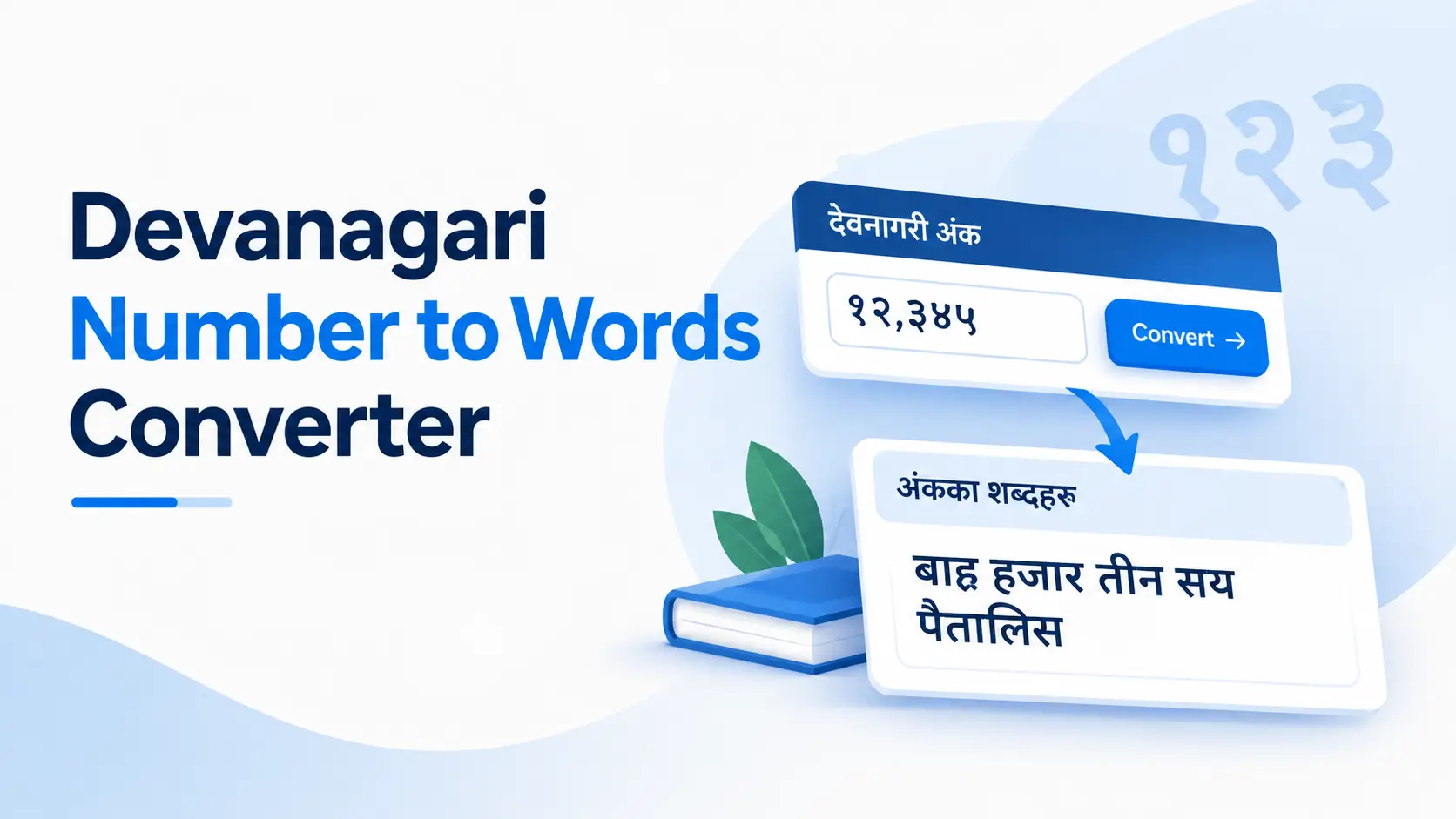
Devanagari Number-to-Words Converter: Convert Any Number to Nepali Words

Devanagari Number to Words Converter: Convert Any Number to Nepali Words & Digits Instantly

Enter a number once and get four results at the same time — formatted English digits, Devanagari (Nepali) digits, English words, and Nepali words including लाख, करोड, अर्ब and खर्ब. Built for cheque writing, invoices, school homework, and anyone typing official Nepali documents.

Devanagari Number to Words Converter tool showing English digits, Nepali digits, English words and Nepali words

Try the Devanagari Number to Words Converter

Type any number below — using English digits (123456) or Nepali digits (१२३४५६) — and every format updates as you type. Everything runs locally in your browser, so nothing you type is ever sent anywhere.

✦ Free Online Tool

Devanagari Number to Words

Convert English or Nepali numbers into formatted digits, Devanagari numerals, English words, and Nepali words instantly.

English or Nepali digits
Supports up to 13 digits + decimals Ready
Please enter a valid number.
01 English Digits
०१ Nepali Digits
Aa English Words
अ Nepali Words

How to Use the Converter

  1. Type your number. Use either English digits (e.g. 250000) or Nepali digits (e.g. २५०००० ) directly in the input box — the tool detects both automatically.
  2. Read the four outputs. The card below instantly shows the number formatted with commas, its Devanagari digit form, its English word form, and its Nepali word form using लाख/करोड grouping.
  3. Add a decimal if you need one. Type a point, e.g. 4599.50 — the tool reads the decimal part digit-by-digit with "दशमलव" (English: "Point"), which is exactly how amounts are read in Nepali banking documents.
  4. Copy the field you need. Tap the "Copy" button beside any result to copy just that line — useful when you only need the Nepali words for a cheque, not all four formats.

How the Nepali Number System Actually Works

This is the part most converters skip, and it's exactly where people get stuck. English and Nepali don't just use different words for numbers — they group the digits differently, which changes where the commas go and which "large number" word applies.

Western grouping vs. Nepali (South Asian) grouping
ValueWestern systemNepali systemNepali term
1,000One Thousand१,०००हजार (Hazar)
100,000One Hundred Thousand१,००,०००लाख (Lakh)
10,000,000Ten Million१,००,००,०००करोड (Crore)
1,000,000,000One Billion१,००,००,००,०००अर्ब (Arab)
100,000,000,000One Hundred Billion१,००,००,००,००,०००खर्ब (Kharab)

Notice the comma pattern on the Nepali side: after the first three digits from the right, Nepali groups every two digits instead of three (1,00,000 rather than 100,000). That's the single biggest source of "off by one zero" mistakes when people convert numbers by hand — and it's exactly what this tool automates for you.

Rule of thumb: if a number has 6 zeros in the English system, it's roughly in Lakh–Crore territory in Nepali — but the comma placement, not the zero count, is what actually changes. Let the converter do the grouping so you don't have to recount digits under pressure at a bank counter.

A Full Worked Example, Step by Step

Most tools show you a finished answer with no explanation of how it got there. Here's the actual breakdown for a mid-size amount, the kind you'd write on a cheque or a VAT invoice:

Step 1 — Start with the number

Rs. 1,245,750 (One million two hundred forty-five thousand seven hundred fifty)

Step 2 — Regroup in Nepali style

Reformatted as १२,४५,७५० — grouped in twos after the first three digits.

Step 3 — Split into scale blocks

१२ लाख (12 Lakh) + ४५ हजार (45 Thousand) + ७५० (750)

Step 4 — Read each block in words

बाह्र लाख + पैँतालीस हजार + सात सय पचास

Step 5 — Final Nepali words

बाह्र लाख पैँतालीस हजार सात सय पचास

Step 6 — Verify with the tool

Type 1245750 into the converter above and confirm it matches — this is the fastest way to build confidence before you write it on an actual document.

Numbers 1 to 100 in Nepali Words and Digits

Nepali doesn't build numbers from smaller parts the way English does ("twenty-one" = "twenty" + "one"). Every number from 1 to 99 has its own distinct word, inherited from Sanskrit — so 21 is एक्काइस, not a combination of "बीस" (twenty) and "एक" (one). That makes a complete reference table genuinely useful rather than a formality. Here is the full list, with real Devanagari digits and words rather than placeholders:

Complete reference: 1–100 in Nepali digits, Nepali words, and English words
#Nepali DigitNepali WordEnglish Word
1१एकOne
2२दुईTwo
3३तीनThree
4४चारFour
5५पाँचFive
6६छSix
7७सातSeven
8८आठEight
9९नौNine
10१०दसTen
11११एघारEleven
12१२बाह्रTwelve
13१३तेह्रThirteen
14१४चौधFourteen
15१५पन्ध्रFifteen
16१६सोह्रSixteen
17१७सत्रSeventeen
18१८अठारEighteen
19१९उन्नाइसNineteen
20२०बीसTwenty
21२१एक्काइसTwenty-One
22२२बाइसTwenty-Two
23२३तेइसTwenty-Three
24२४चौबीसTwenty-Four
25२५पच्चीसTwenty-Five
26२६छब्बीसTwenty-Six
27२७सत्ताइसTwenty-Seven
28२८अट्ठाइसTwenty-Eight
29२९उनन्तीसTwenty-Nine
30३०तीसThirty
31३१एकतीसThirty-One
32३२बत्तीसThirty-Two
33३३तेत्तीसThirty-Three
34३४चौँतीसThirty-Four
35३५पैँतीसThirty-Five
36३६छत्तीसThirty-Six
37३७सैँतीसThirty-Seven
38३८अठतीसThirty-Eight
39३९उनन्चालीसThirty-Nine
40४०चालीसForty
41४१एकचालीसForty-One
42४२बयालीसForty-Two
43४३त्रिचालीसForty-Three
44४४चवालीसForty-Four
45४५पैँतालीसForty-Five
46४६छयालीसForty-Six
47४७सच्चालीसForty-Seven
48४८अठचालीसForty-Eight
49४९उनन्चासForty-Nine
50५०पचासFifty
51५१एकाउन्नFifty-One
52५२बाउन्नFifty-Two
53५३त्रिपन्नFifty-Three
54५४चौवन्नFifty-Four
55५५पचपन्नFifty-Five
56५६छपन्नFifty-Six
57५७सन्ताउन्नFifty-Seven
58५८अन्ठाउन्नFifty-Eight
59५९उनन्साठीFifty-Nine
60६०साठीSixty
61६१एकसट्ठीSixty-One
62६२बासट्ठीSixty-Two
63६३त्रिसट्ठीSixty-Three
64६४चौँसट्ठीSixty-Four
65६५पैँसट्ठीSixty-Five
66६६छयसट्ठीSixty-Six
67६७सतसट्ठीSixty-Seven
68६८अठसट्ठीSixty-Eight
69६९उनन्सत्तरीSixty-Nine
70७०सत्तरीSeventy
71७१एकहत्तरSeventy-One
72७२बहत्तरSeventy-Two
73७३त्रिहत्तरSeventy-Three
74७४चौहत्तरSeventy-Four
75७५पचहत्तरSeventy-Five
76७६छयहत्तरSeventy-Six
77७७सतहत्तरSeventy-Seven
78७८अठहत्तरSeventy-Eight
79७९उनासीSeventy-Nine
80८०असीEighty
81८१एकासीEighty-One
82८२बयासीEighty-Two
83८३त्रियासीEighty-Three
84८४चौरासीEighty-Four
85८५पचासीEighty-Five
86८६छयासीEighty-Six
87८७सतासीEighty-Seven
88८८अठासीEighty-Eight
89८९उनान्नब्बेEighty-Nine
90९०नब्बेNinety
91९१एकान्नब्बेNinety-One
92९२बयानब्बेNinety-Two
93९३त्रियान्नब्बेNinety-Three
94९४चौरान्नब्बेNinety-Four
95९५पन्चानब्बेNinety-Five
96९६छयान्नब्बेNinety-Six
97९७सन्तानब्बेNinety-Seven
98९८अन्ठान्नब्बेNinety-Eight
99९९उनान्सयNinety-Nine
100१००एक सयOne Hundred

Lakh, Crore, Arab, Kharab — The Full Scale Table

Once you're past 100, the Nepali system is really just this small set of scale words repeating. Memorize this table once and you can read almost any figure you'll encounter in real life, from a grocery bill to a government tender:

Nepali number scale from Ten to One Trillion
ZerosEnglish NumberNepali DigitNepali WordNepali Scale Term
110१०दस—
2100१००एक सयसय (Hundred)
31,000१,०००एक हजारहजार (Thousand)
51,00,000१,००,०००एक लाखलाख (Lakh)
71,00,00,000१,००,००,०००एक करोडकरोड (Crore)
91,00,00,00,000१,००,००,००,०००एक अर्बअर्ब (Arab)
111,00,00,00,00,000१,००,००,००,००,०००एक खर्बखर्ब (Kharab)
131,00,00,00,00,00,000१,००,००,००,००,००,०००एक नीलनील (Neel)

Common Mistakes People Make When Converting Numbers to Nepali

These are the errors that actually cause rejected cheques and rewritten invoices — worth knowing even if you use the converter every time:

  • Miscounting zeros between Lakh and Crore. One Crore has two more zeros than one Lakh, not one — a single missed zero on a cheque can mean a hundred-fold error.
  • Writing "दशमलब" instead of "दशमलव". The correct spelling for "decimal point" uses व, not ब. It's a common typo that looks fine at a glance but is technically incorrect in formal documents.
  • Reading paisa as a plain decimal. For money, ".50" is usually read as "पचास पैसा" (fifty paisa) in banking contexts, not "point five zero" — the digit-by-digit decimal reading in this tool is correct for general numbers, but for cheque amounts, mention "पैसा" for the fractional part when writing manually.
  • Assuming Nepali uses the same comma placement as English. Copy-pasting a number straight from an English spreadsheet (1,245,750) into a Nepali document without re-grouping it (१२,४५,७५०) is one of the most frequent formatting mistakes in Nepali accounting software.
  • Confusing "उनान्सय" (99) with "उनन्सय". Several of the numbers in the 90s and the "one-less-than" numbers (29, 39, 49...) have similar-looking spellings — always double check against a verified table like the one above rather than typing from memory.

Who Actually Needs This Tool

Cheque Writing and Banking

Nepali banks require the amount in words to match the amount in figures exactly — any mismatch and the cheque bounces. Type the amount once, copy the Nepali words field, and you have the exact wording your bank expects, formatted the same way every time.

Invoices, VAT Bills, and Receipts

Every formal invoice and VAT bill in Nepal needs an "Amount in Words" line. Doing this by hand for dozens of invoices a day is where typos creep in — running the total through the converter keeps every invoice consistent.

Students and Lok Sewa Aayog Preparation

If you're learning Devanagari numerals or preparing for a Nepali-language exam, typing in a number and immediately seeing the correct spelling reinforces the pattern faster than memorizing a static list. Use the 1–100 table above as a study sheet and the tool itself as a self-quiz.

Developers Building Nepali-Language Apps

If you're implementing this logic yourself in a billing system or government portal, the trickiest part isn't the word list — it's the Lakh/Crore grouping logic and where scale terms stack for very large numbers. Treat the worked example above as a spec to test your own implementation against.

From experience

Building and testing a Nepali number-to-words converter looks simple until you hit numbers like 100, 1000, or 100000 exactly — where a naive implementation prints an extra space, drops "एक" before "सय," or breaks on the boundary between "उनान्सय" (99) and "एक सय" (100). Most of the visible bugs in Nepali fintech tools live at these round-number edges, not in the middle of the range. If you're testing your own converter, deliberately try 100, 1000, 100000, 10000000, and their neighbours (99, 101, 999, 1001) — that's where real-world implementations tend to fail first.

Typing and Font Issues After You Copy the Result

Getting the correct Devanagari text is only half the job — the other half is making sure it displays correctly wherever you paste it. This is a step most number-converter guides skip entirely, but it's where a lot of people get stuck next:

  • If you paste the Nepali words into an old desktop publishing file or a printed form template, it may have been built for a legacy font rather than Unicode. See our guide to free Nepali fonts if the text looks like garbled boxes or symbols instead of Devanagari script.
  • Government and printing-press documents in Nepal often still specify Kalimati for headers and labels — if a form you're filling out needs that specific typeface, grab it from our Kalimati font download page.
  • If you're integrating this kind of Nepali-language conversion logic into your own website, invoicing tool, or internal software rather than just using it as a one-off converter, our technical solutions page covers how we approach that kind of build.

Frequently Asked Questions

What is a Devanagari Number to Words Converter?

It's a tool that turns a plain number (like 45000) into its Devanagari digit form (४५०००), its Nepali word form (पैँतालीस हजार), and equivalent English digits and words — all at once, so you don't have to look up or hand-write the spelling yourself.

How is the Nepali number system different from the international system?

English groups large numbers in threes (thousand, million, billion). Nepali groups the first three digits together and then in twos after that, using लाख (100,000), करोड (10,000,000), अर्ब (1,000,000,000), and खर्ब (100,000,000,000) as the scale words instead of million/billion/trillion.

How do I write a cheque amount in Nepali words?

Type the exact amount into the converter, then copy the "Nepali Words" output directly into the "In Words" field on the cheque. Make sure the figure written in numerals and the words match exactly, since banks reject cheques where the two don't correspond.

Can this tool convert decimal numbers?

Yes. Type a number with a decimal point, such as 2599.75, and the tool reads the decimal portion digit by digit after "दशमलव" — for example, "दुई हजार पाँच सय उनान्सय दशमलव सात पाँच."

What's the largest number this converter supports?

Up to 13 digits, which covers figures into the trillions/नील range — far beyond what's needed for everyday cheques, invoices, or land transactions.

Why does every number from 1 to 99 have a completely different word in Nepali?

Nepali inherited its number words from Sanskrit, where each number up to 99 developed its own distinct term rather than being built compositionally the way English combines "twenty" and "one" into "twenty-one." That's why a full reference table (like the one on this page) is genuinely useful rather than something you can reliably guess.

Is my data safe when I use this converter?

Yes. All the conversion logic runs directly in your browser using JavaScript — nothing you type is sent to a server, logged, or stored anywhere.

Check SIM Owner Name in Nepal: NTC & NCELL USSD Codes

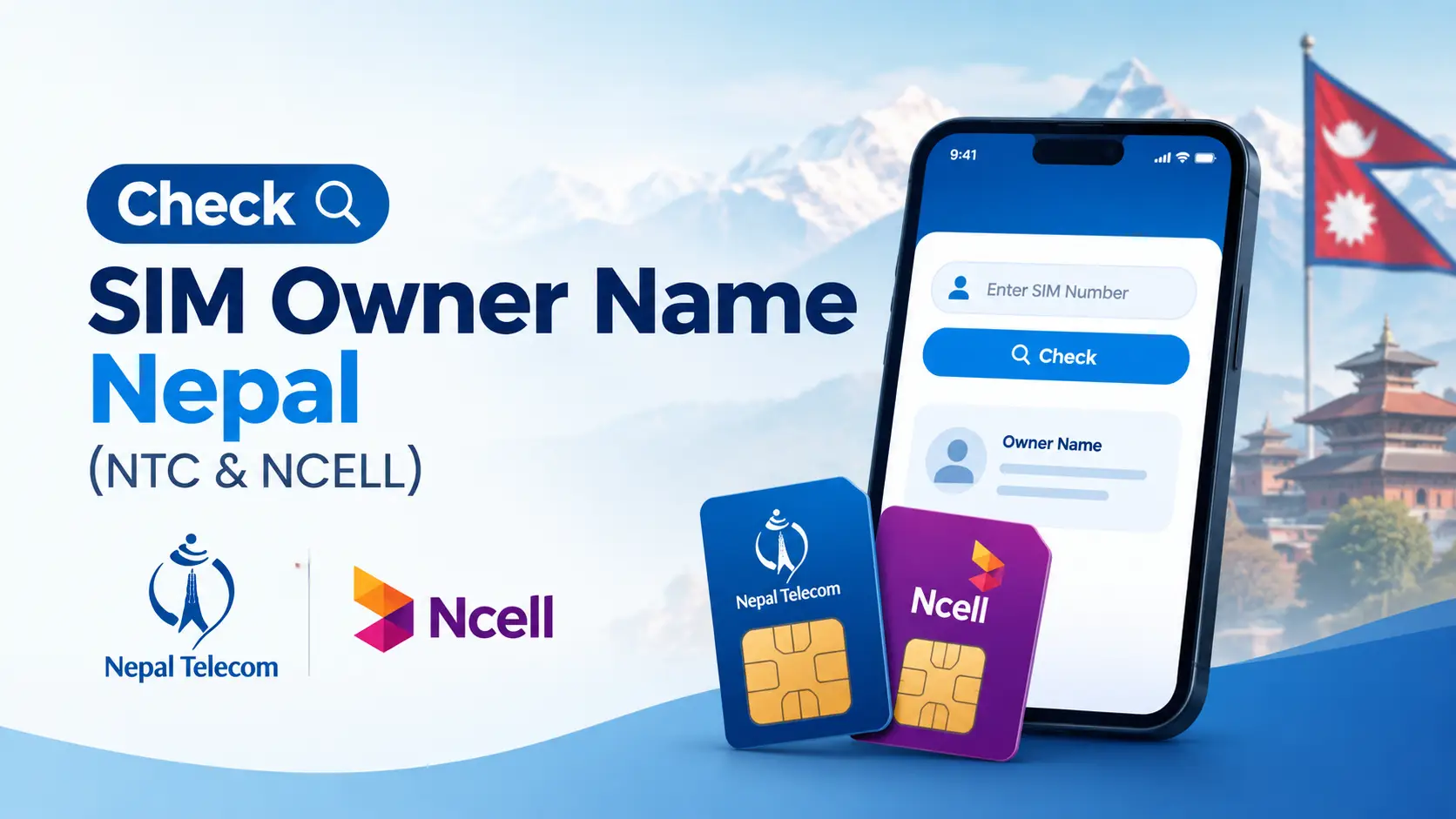
Check SIM owner name in Nepal for NTC and NCELL using USSD codes *922# and *9966#

Check SIM Owner Name in Nepal: NTC & NCELL USSD Codes (2026 Guide)

If you've ever picked up an old SIM, bought a "pre-used" number from a shop, or simply forgot whose name your own NTC or NCELL number is registered under, you can find out in under 10 seconds — no app, no login, and no data cost. Just dial one short USSD code from the SIM you want to check.

NTC (Namaste / Nepal Telecom)

*922#
Dial Now

NCELL

*9966#
Dial Now

Both codes are free to use and work directly through your phone's dialer — no internet connection required. Below, we'll walk through the exact steps for each operator, explain why the name shown might look shortened or unfamiliar, what to do if your SIM isn't registered under your own name, and how to avoid the fake "SIM owner lookup" websites that have been circulating on Facebook and Google.

How to Check NTC SIM Owner Name (*922#)

Nepal Telecom officially lists this code under its "Useful Short Codes" page as the way to check your registered SIM owner. It works on any NTC prepaid or postpaid number.

  1. Insert or select the NTC SIM in your phone (important on dual-SIM phones — see the note below).
  2. Open your phone's dialer app.
  3. Type *922# and press the call/dial button.
  4. A pop-up will appear within a few seconds showing the name registered against that number.

If the SIM is registered correctly, the name that appears should match your citizenship or passport exactly (or very close to it — more on that below).

How to Check NCELL SIM Owner Name (*9966#)

NCELL uses a similar self-service USSD code for owner verification. It's just as quick and works on any active NCELL SIM.

  1. Make sure the NCELL SIM you want to check is the one currently active/selected in your phone.
  2. Open the dialer.
  3. Dial *9966# and hit call.
  4. The response screen will display the registered owner's name for that number.
Dual-SIM phone tip: If your phone has two SIM slots, most dialers will ask you to choose which SIM to dial from before the code goes through. Always confirm you've selected the correct SIM — a common mistake is accidentally checking the wrong number's owner name because the phone defaulted to "SIM 1" instead of "SIM 2".

Why You Should Check Your SIM Owner Name

This isn't just a curiosity check — it has real, practical consequences in Nepal:

  • Legal compliance: The Nepal Telecommunications Authority (NTA) requires every active SIM to be linked to the actual user's citizenship, passport, or valid ID. Using a SIM registered under someone else's name technically violates this requirement.
  • Avoiding service suspension: Operators periodically run KYC (Know Your Customer) verification drives. Numbers with mismatched or incomplete registration details risk temporary deactivation.
  • Buying a second-hand or "old" number: If you bought a number from a shop or a friend, checking the owner name confirms whether the registration was actually transferred — many resellers skip this step.
  • Loan and VAS eligibility: Services like Namaste Credit (emergency balance loan) and certain NTC offers are tied to KYC status, so a mismatched name can occasionally cause eligibility issues.
  • Fraud prevention: If a lost or stolen SIM gets reactivated, checking ownership is the fastest way to confirm whether it's still legitimately yours.

What the Result Actually Means (Read This Before You Panic)

A detail most guides skip: the name shown by *922# or *9966# is often abbreviated or truncated because USSD replies have strict character limits. Don't assume something is wrong just because the display looks slightly off. Here's what's normal and what isn't:

  • Normal: Middle names shortened to initials (e.g., "Ram B Thapa" instead of "Ram Bahadur Thapa").
  • Normal: Titles or honorifics dropped entirely.
  • Normal: Minor spelling variations if your ID was transliterated from Nepali to English at the point of sale.
  • Not normal: A completely different first and last name that isn't yours, a shop/business name, or a family member's name you didn't authorize.

If it falls into the "not normal" category, treat it as a genuine mismatch and follow the re-registration steps further down this page.

Code Not Working? Troubleshoot It First

Before assuming your SIM has a problem, rule out these common causes — something none of the existing guides on this topic actually cover:

  • No or weak network signal: USSD codes need at least a basic 2G/GSM signal to process. Move to an open area or near a window and retry.
  • Wrong SIM selected: On dual-SIM and eSIM-enabled phones, double-check the dial confirmation prompt before hitting call.
  • Network congestion: USSD gateways occasionally get overloaded during peak hours (evenings, festival periods). Wait a minute and try again.
  • Airplane mode or Wi-Fi calling only: USSD requires an active cellular connection, not just internet/Wi-Fi.
  • Very new SIM: If you activated the SIM in the last few hours, registration data may still be syncing across the operator's system. Give it up to 24 hours.
  • Still failing? Call customer care directly — 1498 for NTC or 9005 for NCELL — and ask them to verify your registration over the phone with your ID details.

SIM Not Registered in Your Name? Here's How to Fix It

If the check shows someone else's name — a shop, a reseller, a relative, or a stranger — you can legally re-register the SIM in your own name. This is a free process at both operators.

  1. Carry the physical SIM, your original citizenship certificate, passport, or driving license, and one passport-size photo.
  2. Visit the nearest Namaste (NTC) customer service center or NCELL care/dealer outlet.
  3. Request a KYC update / re-registration for the number.
  4. For NCELL specifically, be ready to list several frequently dialed numbers from that SIM over the past few months — this helps the operator confirm you're the genuine, ongoing user of the number.
  5. Fill out the new KYC form on the spot; the update usually reflects within a few hours to a day.
  6. Re-dial *922# or *9966# afterward to confirm the name has updated correctly.
Personal tip: Bring a photocopy of your ID in addition to the original — some smaller franchise outlets outside Kathmandu still ask for one to keep on file, and it saves you a second trip if their scanner is down.

Beware: Fake "SIM Owner Lookup" Websites

Important: There is no legitimate website, app, or public code that lets you look up the registered owner name of someone else's phone number in Nepal. SIM registration data is protected as private information under NTA regulations, and operators only reveal it to the verified holder of that specific SIM.

Be cautious of pages that promise to reveal "any number's owner name" for a fee, after watching an ad, or after you enter your own phone number and OTP. These are almost always data-harvesting or phishing attempts designed to steal your personal number, OTP codes, or ID photos. The only two working checks are the official codes above, and they only work on the SIM currently inside your own phone.

Quick Reference Table: NTC vs NCELL Owner Check

DetailNTCNCELL
Owner name check code*922#*9966#
CostFreeFree
Internet requiredNoNo
Works on other people's numbersNoNo
Customer care for issues14989005
Re-registration costFreeFree

Frequently Asked Questions

Can I check any random NTC or NCELL number's owner name?

No. Both *922# and *9966# only return results for the SIM physically active in your own phone at the time of dialing. There's no way to check ownership of a number you don't hold, and any service claiming otherwise should be avoided.

Is checking my SIM owner name free?

Yes, both USSD codes are completely free and don't deduct any balance or data.

Why does my SIM show a shortened or slightly different name?

USSD replies have a limited character count, so middle names are often abbreviated to initials and honorifics are dropped. This is normal as long as the first and last name clearly match yours.

What if the owner name shown is completely wrong?

Visit the nearest NTC or NCELL service center with your original ID and a passport-size photo to re-register the SIM under your name, free of charge.

Does this work on eSIMs too?

Yes. Both codes work the same way whether you're using a physical SIM or an eSIM profile, as long as that eSIM line is active and selected for calls.

My number shows "no response" or fails to load — what now?

Check your signal strength, confirm you dialed from the correct SIM, and retry after a minute. If it still fails, call 1498 (NTC) or 9005 (NCELL) for manual verification.

Proven On-Page SEO Techniques for Better Rankings

Proven On-Page SEO Techniques for Better Rankings

Optimizing your website’s on-page SEO techniques is crucial for achieving higher search engine rankings and increasing online visibility. In the ever-evolving digital landscape, mastering these techniques not only enhances your website’s performance but also ensures it stands out in the crowded search results. This comprehensive guide will walk you through the essential elements of on-page SEO, offering actionable strategies and insights to boost your site’s ranking potential.

📌 Key Takeaways

  • Understand the core elements of on-page SEO to boost visibility.
  • Learn practical steps to optimize content and meta tags effectively.
  • Explore the latest trends and best practices in on-page SEO.
id=”understanding-on-page-seo-basics” class=”autoblogger-h2″ style=”font-size: 1.75rem; font-weight: 800; color: #0f172a; margin: 2.5rem 0 1.25rem 0; border-bottom: 2px solid #e2e8f0; padding-bottom: 0.5rem;”>Understanding On-Page SEO Basics

What is On-Page SEO?

On-page SEO refers to the practice of optimizing individual web pages to rank higher and earn more relevant traffic in search engines. This involves a variety of elements, including optimizing meta tags, content, internal links, and HTML tags. Essentially, on-page SEO is all about making your website more accessible and understandable to search engines like Google.

Importance of On-Page SEO

On-page SEO is critical for search rankings because it helps search engines understand your website’s content and context. By optimizing elements such as title tags and content, you make it easier for search engines to index your site, which can lead to better visibility and higher rankings. Effective on-page SEO can significantly improve a site’s credibility and user experience, both of which are key factors in search engine algorithms. For a detailed understanding, you can refer to [Google’s SEO Starter Guide](https://developers.google.com/search/docs/fundamentals/seo-starter-guide).

Key On-Page SEO Techniques

Optimizing Meta Tags

Meta tags, including title tags and meta descriptions, play a pivotal role in on-page SEO.

  1. Craft Compelling Title Tags: Ensure your title tags are descriptive, concise, and include your target keywords. They should accurately reflect the content of your page while enticing users to click.
  1. Write Effective Meta Descriptions: Although not a direct ranking factor, meta descriptions influence click-through rates. Write clear and persuasive descriptions that summarize the page content and include relevant keywords.

Effective Keyword Placement

Strategic keyword placement is vital for optimizing content. Here’s how you can do it:

  1. Incorporate Keywords Naturally: Place primary keywords in the first 100 words, headers, and throughout the content. Avoid keyword stuffing, which can lead to penalties.
  1. Use Semantic Variations: Include related terms and phrases to help search engines understand the context of your content. This approach supports semantic search and improves content relevance.

For an in-depth exploration of these elements, check out [Moz’s On-Page SEO Guide](https://moz.com/beginners-guide-to-seo/on-page-seo).

Enhancing User Experience for SEO - on-page SEO techniques
Enhancing User Experience for SEO

Enhancing User Experience for SEO

Improving Site Speed

Site speed is a crucial ranking factor. A fast-loading website provides a better user experience and can lead to lower bounce rates. To enhance site speed:

  1. Optimize Images: Compress images to reduce load times without sacrificing quality.
  1. Minimize HTTP Requests: Limit the number of elements on a page to reduce load times.
  1. Use Browser Caching: Enable caching to store parts of your website in a user’s browser for faster access on subsequent visits.

Mobile-Friendly Design

With an increasing number of users accessing websites via mobile devices, mobile-friendliness is essential.

  1. Responsive Design: Ensure your website adapts to different screen sizes and provides a seamless experience across devices.
  1. Test Mobile Usability: Use tools like Google’s Mobile-Friendly Test to identify and fix issues affecting mobile user experience.

⚠️ Important Note: Google prioritizes mobile-first indexing, meaning the mobile version of your site is considered the primary version for ranking purposes.

Content Strategy for On-Page SEO - on-page SEO techniques
Content Strategy for On-Page SEO

Content Strategy for On-Page SEO

Creating Quality Content

High-quality, relevant content is the foundation of on-page SEO.

  1. Focus on User Intent: Write content that answers questions and solves problems for your audience.
  1. Ensure Readability: Use short paragraphs, bullet points, and subheadings to make content easily scannable.
  1. Update Regularly: Refresh and update content to maintain relevance and accuracy.

Utilizing Internal Linking

Internal linking helps distribute page authority and improves site navigation.

  1. Link to Related Content: Guide users to other valuable pages on your site to keep them engaged longer.
  1. Use Descriptive Anchor Text: Ensure links are meaningful and contextually relevant to the content they lead to.

💡 Pro Tip: A well-structured internal linking strategy can significantly enhance your site’s authority and improve search rankings.

Voice Search Optimization

With the rise of voice-activated devices, optimizing for voice search is becoming increasingly important.

  1. Use Natural Language: Write content in a conversational tone to align with how users speak their queries.
  1. Focus on Long-Tail Keywords: Voice searches tend to be longer and more specific, so target long-tail keywords.

Semantic search focuses on understanding the intent behind search queries rather than just matching keywords.

  1. Create Contextual Content: Write content that answers related questions and provides comprehensive information on a topic.
  1. Utilize Structured Data: Implement schema markup to help search engines understand your content’s context better.

By staying abreast of these trends, you can ensure your on-page SEO techniques remain effective and future-proof.

In conclusion, mastering on-page SEO techniques is an ongoing process that requires attention to detail and a willingness to adapt to new trends. By focusing on optimizing meta tags, enhancing user experience, and developing a robust content strategy, you can significantly improve your website’s search rankings and visibility.

Frequently Asked Questions

What are the most important on-page SEO elements?

Title tags, meta descriptions, and content quality are key elements.

How does internal linking affect SEO?

Internal linking helps distribute page authority and improve navigation.

Why is mobile-friendliness important for SEO?

Mobile-friendly sites enhance user experience and are favored by search engines.

Nonchalant, Chaos, Cringe & Bruh Meanings in Nepali (2026)

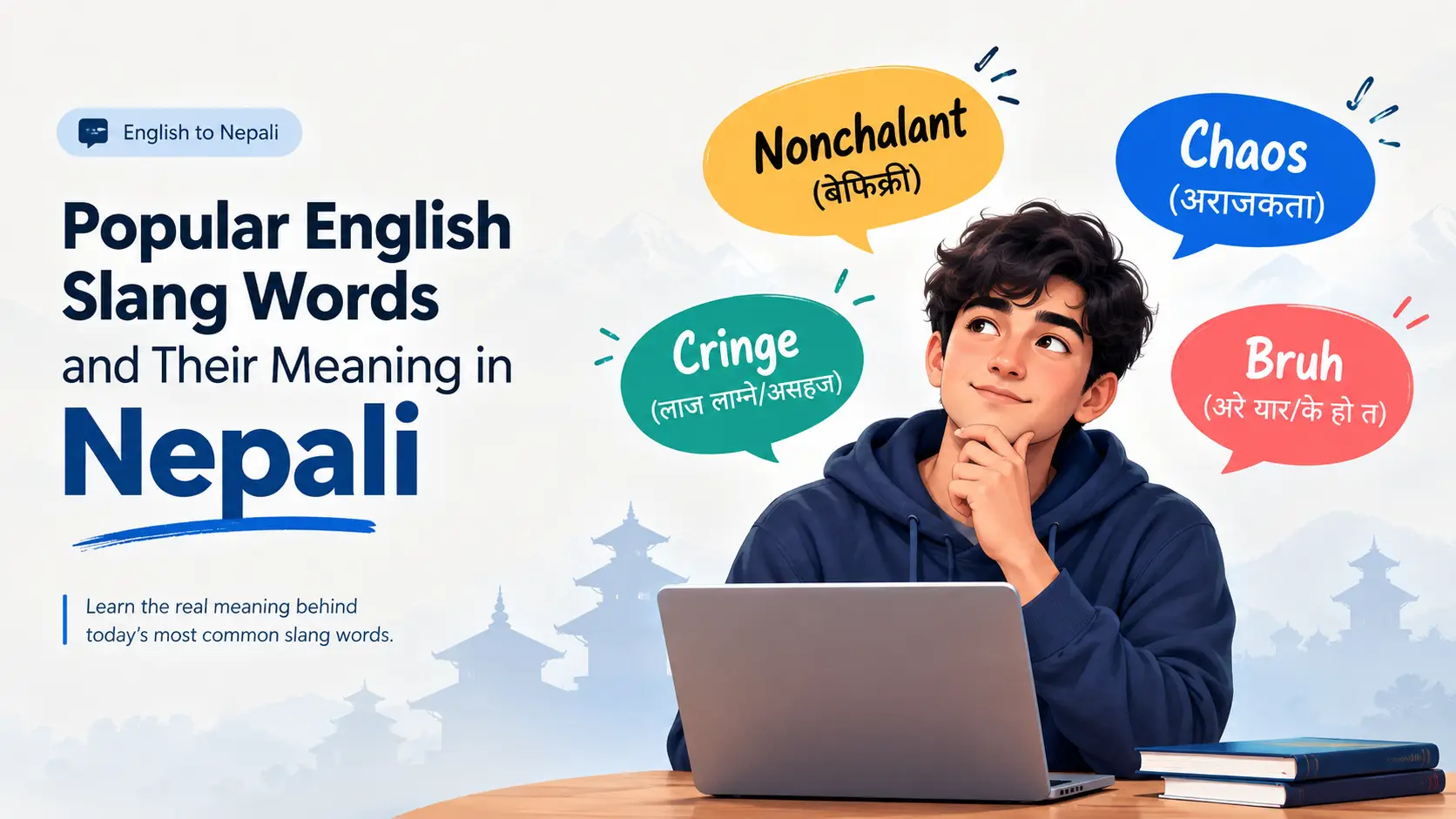
Popular English slang words and their meaning in Nepali — nonchalant, chaos, cringe and bruh explained in Nepali

Nonchalant, Chaos, Cringe & Bruh Meaning in Nepali: The Slang Guide Dictionaries Get Wrong

Type "bruh meaning in Nepali" into Google and almost every result tells you the same thing: भाइ, यार, साथी. Brother. Friend. Buddy.

That answer is wrong roughly 80% of the time — and if you actually use it that way in a conversation, you will sound strange.

Here's why. When a Nepali teenager sends "bruh" after seeing their exam result, they are not calling anyone "brother." They are expressing disbelief. The closest honest Nepali translation is हैट! or के हो यार! — not भाइ. Standard dictionary entries translate the word and completely miss the function.

This guide fixes that. For each of the four words — nonchalant, chaos, cringe and bruh — you'll get the literal Nepali meaning, the natural Nepali meaning that people in Kathmandu actually say, correct pronunciation (most Nepali speakers mispronounce two of these four), real example sentences in Devanagari and Roman Nepali, and a clear warning about where the standard translation will embarrass you.

Quick Answer: All Four Words at a Glance

If you only need the fast version, this table covers it. The column that matters most is the third one — that's the word an actual Nepali speaker would choose in conversation, which is usually not the dictionary word.

English wordDictionary NepaliWhat Nepali speakers actually sayType
Nonchalantबेपर्वाह, निश्चिन्त, उदासीनवास्तै नगर्ने (wastai nagarne) — "acts like it doesn't matter"Adjective
Chaosअराजकता, अव्यवस्थाभद्रगोल (bhadragol) — "total mess"Noun
Cringeलजाउनु, खुम्चिनुलाजमर्दो (lajmardo) — "shameful to watch"Verb + adjective
Bruhभाइ, यार, साथीहैट! (hait!) — reaction, not a nameInterjection
The core insight Three of these four words changed meaning in the last decade. Dictionaries recorded the old meaning. "Nonchalant" used to simply mean calm; now it describes a deliberate performance of not caring. "Cringe" used to be only a verb; now it's mostly an adjective. "Chaos" used to be purely negative; now it can be a compliment. If you translate from a dictionary, you translate the 2005 meaning.

Nonchalant Meaning in Nepali

Nonchalant (नन्शलान्ट) means appearing calm, casual and unbothered — showing no anxiety, excitement or concern, whether or not you actually feel it.

Nepali meanings, ranked by how natural they sound

Most sources dump five Nepali words at you with no explanation, as if they were interchangeable. They aren't. Each one carries a different attitude, and picking the wrong one changes whether you're complimenting someone or insulting them.

Nepali wordRomanWhat it really impliesUse for "nonchalant"?
वास्तै नगर्नेwastai nagarnePays it no attention; unbothered. Everyday, conversational.Best
निश्चिन्तnishchintaFree of worry, relaxed. Positive, gentle.Good
बेफिक्रीbefikriCarefree, light-hearted. Slightly playful.Good
बेपर्वाहbeparwahCareless, reckless. Leans negative — suggests irresponsibility.Careful
उदासीनudasinApathetic, indifferent, emotionally withdrawn. Often sad or cold.Usually wrong
निर्लिप्तnirliptaDetached, unattached. Literary/spiritual register — Gita vocabulary.Too formal
Content gap #1 — competitors list उदासीन as a plain synonym It isn't one. उदासीन describes someone emotionally flat or withdrawn — it has a shadow of sadness on it. A nonchalant person is cool; an उदासीन person is checked out. Calling a confident, relaxed friend उदासीन sounds like you're saying something is wrong with them. Similarly, बेपर्वाह carries a charge of irresponsibility — "he was nonchalant about the deadline" translates fine with बेपर्वाह, but "she walked in nonchalantly" does not.

How to pronounce "nonchalant" (most Nepali speakers get this wrong)

Say it like this:

non-shuh-LAANT  ·  नन्-शु-लान्ट

Not non-CHA-lent  ·  नन्-च-लेन्ट

This word came into English from French, and the French ch is pronounced like English sh — the same way "machine" and "Chicago" work. Because Nepali is written phonetically, Nepali speakers naturally read the letters ch as च, producing "non-cha-lant." It's one of the most common English pronunciation slips in Nepali classrooms and offices, and it's completely invisible in every competing dictionary entry.

The Gen Z "nonchalant" — a meaning no dictionary has caught up to

Since around 2023, "nonchalant" stopped being a neutral description and became a personality label, especially on TikTok and Instagram. Phrases like "the nonchalant boyfriend," "nonchalant era" and "stay nonchalant" describe someone who deliberately performs indifference — replying late on purpose, never showing excitement, acting unimpressed as a strategy.

The Nepali equivalent isn't a single word. It's a phrase:

  • केही मतलब नभएको जस्तो गर्ने — kehi matlab nabhaeko jasto garne — "acts like nothing matters to them"
  • पर्वाह नगरे जस्तो देखाउने — parwaha nagare jasto dekhaune — "shows off not caring"
  • चिल गरेको — chill gareko — the code-mixed version young Nepalis genuinely use

Note that all three contain a word meaning "acts like" or "shows." That's the whole point of the modern sense: it's a performance, and any translation that leaves out the performance loses the meaning.

Nonchalant: example sentences in English and Nepali

EnglishNepaliRoman Nepali
She stayed nonchalant even after the results came out.नतिजा आएपछि पनि उनी निश्चिन्त नै रहिन्।Natija aaepachhi pani uni nishchinta nai rahin.
Stop being so nonchalant about your studies.पढाइप्रति यति बेपर्वाह नबन।Padhai prati yati beparwah naban.
He replied with a nonchalant shrug.उसले वास्तै नगरी काँध उचाल्यो।Usle wastai nagari kaandh uchalyo.
Her nonchalant attitude is just an act.उनको वास्ता नगर्ने बानी त नाटक मात्रै हो।Unko wasta nagarne baani ta natak matrai ho.

Chaos Meaning in Nepali

Chaos (केअस) means complete disorder and confusion — a situation with no order, no control and no plan.

The अराजकता problem

Every competing page leads with अराजकता (arajakta) as the primary translation of "chaos." For everyday use, this is the single worst choice on the list.

अराजकता is built from अ (without) + राज (rule/governance). It literally means anarchy — the collapse of authority. It's a political and legal term. In Nepali newspapers it appears in articles about state failure, lawlessness and breakdown of governance.

So if your kitchen is a mess after a party and you say भान्सामा अराजकता छ, you have just announced that your kitchen has overthrown its government. It's the register equivalent of saying "the kitchen is in a state of insurrection."

Content gap #2 — the word competitors never mention The natural, everyday Nepali word for chaos is भद्रगोल (bhadragol) — total mess, disorder, everything jumbled. It is what a Nepali speaker will actually say, and it appears in none of the top-ranking dictionary entries for this keyword. Also missing: अफरातफरी (aphratafari) for panicked commotion, and हल्लाखल्ला (hallakhalla) for noisy disorder.

Choosing the right Nepali word for "chaos"

Nepali wordRomanUse it when the chaos is…Example context
भद्रगोलbhadragolMessy, disorganised, jumbledA room, a schedule, a plan
अव्यवस्थाavyavasthaPoorly managed, badly runTraffic, an office, an event
अफरातफरीaphratafariPanicked, people scramblingA fire alarm, a stampede
हल्लाखल्लाhallakhallaLoud, noisy, rowdyA crowd, a classroom
गडबडीgadbadiSomething went wrong, a mix-upAn error, a malfunction
उथलपुथलuthalputhalTurbulent, upheaval, dramatic changePolitics, markets, life events
अराजकताarajaktaLawless, no authority at allOnly politics and governance

How to pronounce "chaos"

Say it like this:

KAY-oss  ·  के-अस

Not CHA-os  ·  चा-ओस

The ch in "chaos" is pronounced as a hard k, because the word came into English through Greek. The same rule governs "chemistry," "character," "chorus," "echo" and "architect" — all क, never च. If you've been saying चाओस, you're in extremely large company across Nepal, and fixing this one rule corrects a dozen words at once.

When "chaos" is actually a compliment

Modern internet English has flipped part of this word's meaning. "Chaotic energy," "we love chaos," "chaotic good," "chaos gremlin" — these are affectionate. They describe someone unpredictable and fun, not someone destructive.

No Nepali word carries this positive charge, which is exactly why Nepali speakers borrow the English word instead of translating it. The nearest native options are बबाल (babal) for something wildly good, or describing someone as कुनै ठेगान नभएको (kunai thegan nabhaeko) — "completely unpredictable" — but neither is a true match.

Chaos: example sentences in English and Nepali

EnglishNepaliRoman Nepali
The whole house was in chaos before the wedding.बिहे अघि सारा घर भद्रगोल थियो।Bihe aghi sara ghar bhadragol thiyo.
There was chaos on the road after the accident.दुर्घटना पछि सडकमा अफरातफरी मच्चियो।Durghatana pachhi sadakma aphratafari machchiyo.
Load-shedding created chaos in the exam hall.लोडसेडिङले परीक्षा हलमा हल्लाखल्ला मच्चायो।Loadshedding le pariksha hall ma hallakhalla machchayo.
Political chaos continued for months.राजनीतिक अराजकता महिनौंसम्म कायम रह्यो।Rajnitik arajakta mahinaunsamma kayam rahyo.

Cringe Meaning in Nepali

Cringe (क्रिन्ज) has two separate lives, and confusing them is the most common mistake with this word.

Cringe as a verb (the original meaning)

To cringe is to physically flinch or shrink back — from fear, pain or embarrassment. Your shoulders pull in, your face tightens.

  • खुम्चिनु (khumchinu) — to shrink, contract
  • लाजले खुम्चिनु (laajle khumchinu) — to shrink with embarrassment
  • सर्नु (sarnu) — to recoil, move back

Cringe as an adjective (the meaning people actually search for)

Since roughly 2016, "cringe" became an adjective: "that's so cringe," "his post is cringe," "cringe behaviour." Here it means embarrassing to witness — awkward, try-hard, secondhand-embarrassing.

  • लाजमर्दो (lajmardo) — shameful, embarrassing. Closest single word.
  • अप्ठ्यारो (apthyaro) — awkward, uncomfortable
  • नमज्जा (namajja) — unpleasant, off-putting (casual)
  • छ्या! (chhya!) — an exclamation of distaste; what you'd actually blurt out
Content gap #3 — Nepali has no word for secondhand embarrassment This is the heart of "cringe," and it's a genuine lexical gap. Cringe is not embarrassment you feel about yourself — it's embarrassment you feel on behalf of someone else, usually someone who doesn't realise they should be embarrassed. Nepali has लाज for your own shame, but no single word for absorbing another person's. You have to build the phrase: अरूको हर्कत देखेर आफूलाई लाज लाग्नु (aruko harkat dekhera aafulai laaj laagnu) — "to feel ashamed yourself on seeing someone else's behaviour." That missing word is precisely why "cringe" entered Nepali untranslated.

Cringe: example sentences in English and Nepali

EnglishNepaliRoman Nepali
His speech was so cringe.उसको भाषण साह्रै लाजमर्दो थियो।Usko bhashan saahrai lajmardo thiyo.
I cringed watching that video.त्यो भिडियो हेर्दा मलाई अप्ठ्यारो लाग्यो।Tyo video herda malai apthyaro laagyo.
Those old photos of mine are pure cringe.मेरा ती पुराना फोटो त साँच्चै लाजमर्दो छन्।Mera ti purana photo ta saanchchai lajmardo chhan.
Don't do that, it's cringe.त्यसो नगर, नमज्जा देखिन्छ।Tyaso nagara, namajja dekhinchha.

Bruh Meaning in Nepali

This is the word every competing page gets wrong, so let's be precise.

Bruh (ब्र) started as a lazy pronunciation of "bro," and yes, it can be used to address someone. But that's now the minority use. In the overwhelming majority of real messages, bruh is an interjection — a complete reaction that stands alone, addressed to nobody.

The four functions of "bruh" — and the Nepali word for each

FunctionEnglish exampleNatural NepaliRoman
Disbelief
Most common
"Bruh, you're joking."के हो यार! / ओहो!Ke ho yaar! / Oho!
Disappointment"Bruh. We lost again."हैट! / धत्!Hait! / Dhat!
Exasperation"Bruh, seriously?"ला, अनि? / छ्या!La, ani? / Chhya!
Address
Least common
"Bruh, pass the ball."ए भाइ / ए दाइ / यारE bhai / E dai / Yaar
Content gap #4 — भाइ carries a hierarchy that "bruh" doesn't This is the most important cultural point on this page. English "bruh" is flat — you can say it to anyone your age or younger, and to plenty of people older. Nepali kinship terms are not flat. भाइ means younger brother and दाइ / दाजु means elder brother, and the choice is compulsory. Calling someone older than you भाइ is not casual — it is a status claim, and it will land as disrespect. Every competing dictionary lists भाइ, दाजु and दाइ together in one comma-separated line as if you could pick freely. You cannot. If you're curious how deep this naming system goes, our guide to Nepali boy names and their meanings shows how much relationship and status Nepali encodes into names and address terms.

How to pronounce "bruh"

Say it like this:

bruh — rhymes with "duh"  ·  ब्र

Not broo  ·  ब्रुह

The h is silent — it's there to stretch the vowel, not to be pronounced. The vowel is short and flat, and in real speech it's often drawn out for effect: "bruhhhh." The longer the vowel, the stronger the disbelief.

From working with Nepali content In four years of building and writing for Nepali-language websites, the pattern I see repeatedly in comment sections and Messenger threads is that "bruh" almost never appears at the start of a sentence in Nepali usage. It appears alone, as its own message — a single line, sent by itself, after something absurd. In English it often opens a sentence ("Bruh, did you see that?"). In Nepali chats it functions the way हैट does: a full reaction, needing no sentence around it. That's a meaningful difference, and it's why the competitor's example sentence — "Bruh, did you see that amazing goal?" — reads as textbook English rather than anything a Nepali speaker would send.

Bruh: example sentences in English and Nepali

EnglishNepaliRoman Nepali
Bruh, I failed the exam.हैट, म परीक्षामा फेल भएँ।Hait, ma parikshama fail bhaen.
Bruh, are you serious right now?ए यार, साँच्चै भनेको?E yaar, saanchchai bhaneko?
Bruh… I have no words.ला… भन्नै केही छैन।La… bhannai kehi chhaina.
Bruh, let's go now.ए भाइ, अब जाऔं।E bhai, aba jaaun.

Formality Guide: Which Word Is Safe to Use Where

None of the competing pages mention register at all, which is a real problem — these words are not equally safe in every situation. Here's where each one belongs.

SituationNonchalantChaosCringeBruh
School / college essayYesYesVerb onlyNever
Office emailYesYesNoNever
Talking to eldersYesYesNoNever
Friends, chat, social mediaYesYesYesYes
News writing / journalismYesYesNoNever

The short version: nonchalant and chaos are standard English and work anywhere. Cringe and bruh are slang and belong only in casual conversation. "Cringe" as a verb is acceptable in formal writing ("the audience cringed"); "cringe" as an adjective is not.

Why Nepali Youth Don't Translate These Words at All

Here's something no dictionary will tell you: in actual Nepali conversation, young people mostly don't translate these words. They drop the English word straight into a Nepali sentence.

  • कस्तो cringe छ यार। — Kasto cringe chha yaar. — "So cringe, man."
  • आज त पूरै chaos भयो। — Aaja ta purai chaos bhayo. — "Today was total chaos."
  • ऊ त एकदम nonchalant छ। — U ta ekdam nonchalant chha. — "He's completely nonchalant."

This is code-switching, and it isn't laziness or poor Nepali. It happens for a specific linguistic reason: the English word carries connotations the Nepali word doesn't. लाजमर्दो is a heavy, serious word — it means genuinely shameful. "Cringe" is light and comic. When a Nepali speaker wants the light, joking version, लाजमर्दो overshoots, so they reach for English instead.

Understanding this matters for your own use of these words. If you are speaking casually, use the English word. If you're writing formally, translating for school, or explaining to someone who doesn't speak English, use the Nepali equivalent. Both are correct — for different jobs.

Nepal's linguistic layering goes further than Nepali and English, of course. Kathmandu Valley speech mixes in Newari vocabulary constantly, often without speakers noticing — if that interests you, see our guide on how to translate the Newari language to English.

Bonus: 25 More English Slang Words and Their Nepali Meanings

These four words rarely get searched alone — people who look up one slang term usually need several. Here's a reference table of the slang most commonly heard in Nepal right now.

SlangMeaningNepaliRoman
RizzCharm, flirting skillपट्याउने कलाpatyaune kala
AuraPresence, coolnessरवाफrawaf
SlayTo do brilliantlyबबाल गर्नुbabal garnu
SusSuspiciousशंकास्पदshankaspad
FlexTo show offफुर्ती लगाउनुphurti lagaunu
SaltyBitter, resentfulरिसाएकोrisaeko
GhostingDisappearing without replyबेपत्ता हुनुbepatta hunu
SimpOverly devoted admirerलत्तो छाडेकोlatto chhadeko
VibeMood, feelingमाहोलmahol
MidMediocre, averageठिकैthikai
LowkeySlightly, secretlyअलिअलिali-ali
HighkeyOpenly, definitelyखुलेरkhulera
No capNo lie, seriouslyसाँच्चैsaanchchai
BetOkay, agreedहुन्छhunchha
DeluluDelusionalभ्रममा परेकोbhram ma pareko
YapTo talk too muchबकबक गर्नुbakbak garnu
IckSudden turn-offदिक्क लाग्नुdikka laagnu
SavageBrutally bluntनिर्ममnirmam
HypeExcitement, buzzचर्चाcharcha
CloutInfluence, fameप्रभावprabhav
ShookShockedछक्क परेकोchhakka pareko
ToxicHarmful, drainingहानिकारकhanikarak
GaslightTo manipulate someone's realityभ्रमित पार्नुbhramit parnu
SituationshipUndefined relationshipअनिश्चित सम्बन्धanishchit sambandha
Glow upDramatic improvementकायापलटkayapalat

How to Type These Words in Nepali Devanagari

If you want to write any of these Nepali equivalents — भद्रगोल, लाजमर्दो, वास्तै नगर्ने — you'll need Devanagari input, and most people don't have a Nepali keyboard installed.

The simplest method is Roman-to-Unicode conversion: you type the sound in English letters and it converts to Devanagari. Type bhadragol, get भद्रगोल. Our free English to Nepali Unicode type converter does this in the browser with no installation, and the output is standard Unicode — so it pastes correctly into Facebook, Word, WhatsApp and any website, unlike older Preeti font text which turns into gibberish outside its own font.

Quick tip Always check whether text is Unicode or Preeti before sharing it. Preeti-encoded Nepali looks perfect on your screen and completely broken on everyone else's. Unicode works everywhere.

Frequently Asked Questions

What is the exact Nepali meaning of nonchalant?

Nonchalant means वास्तै नगर्ने (wastai nagarne), निश्चिन्त (nishchinta) or बेफिक्री (befikri) — calm and unbothered. Use बेपर्वाह only when you mean carelessly irresponsible, and avoid उदासीन, which suggests emotional withdrawal rather than coolness.

Is अराजकता the correct Nepali word for chaos?

Only for political chaos. अराजकता literally means anarchy — the absence of governance. For everyday chaos like a messy room or a disorganised event, use भद्रगोल (bhadragol) or अव्यवस्था (avyavastha).

How do you pronounce "nonchalant" correctly?

Say non-shuh-LAANT (नन्-शु-लान्ट). The "ch" is pronounced like "sh" because the word comes from French. "Non-cha-lant" with a hard च sound is incorrect.

Does bruh mean brother in Nepali?

Not usually. Although bruh comes from "bro," in most real usage it's a standalone interjection expressing disbelief or disappointment — closest to हैट! or के हो यार! in Nepali. It only means भाइ or दाइ when directly addressing someone, which is the less common use.

Can I call someone older than me भाइ the way English speakers say "bruh"?

No. भाइ means younger brother and implies you hold the senior position. For someone older, use दाइ or दाजु. Unlike English "bruh," Nepali address terms are not age-neutral, and getting this wrong reads as disrespect.

What is the Nepali word for cringe?

As an adjective, लाजमर्दो (lajmardo) is closest. As a verb, खुम्चिनु (khumchinu) or अप्ठ्यारो लाग्नु (apthyaro laagnu). Nepali has no single word for the secondhand embarrassment cringe describes, which is why the English word is widely borrowed.

Is it wrong to mix English slang into Nepali sentences?

No. Code-switching is normal and linguistically valid — Nepali speakers do it because English slang carries lighter, more comic connotations than the heavier Nepali equivalents. Use English slang in casual speech and Nepali equivalents in formal writing, exams or conversation with elders.

Why is "chaos" pronounced with a K sound?

Because it entered English from Greek, where the letters "ch" represent a hard K. The same applies to chemistry, character, chorus, echo and architect. The correct pronunciation is KAY-oss (केअस), not चाओस.

Final Takeaway

The reason standard dictionary entries fail with slang is that they translate words in isolation while slang lives entirely in context. Bruh isn't a noun, it's a reaction. Cringe isn't only a verb any more. Chaos in Nepali splits into at least six different words depending on whether the disorder is messy, noisy, panicked or political. And nonchalant now describes a performance of not caring, not simply a calm temperament.

If you remember only four things from this guide: say non-shuh-LAANT and KAY-oss; use भद्रगोल rather than अराजकता for everyday chaos; never call an older person भाइ; and treat "bruh" as a full sentence, not a form of address.

About this guide
Written and researched by the editorial team at wilson.com.np, working with Nepali-language web content and translation tools from Kathmandu. Nepali equivalents here are checked against everyday conversational usage rather than dictionary listings alone, and pronunciation notes reflect the specific errors most commonly heard among Nepali English speakers. Last updated: September 2026.