
Devanagari Number to Words Converter: Convert Any Number to Nepali Words & Digits Instantly
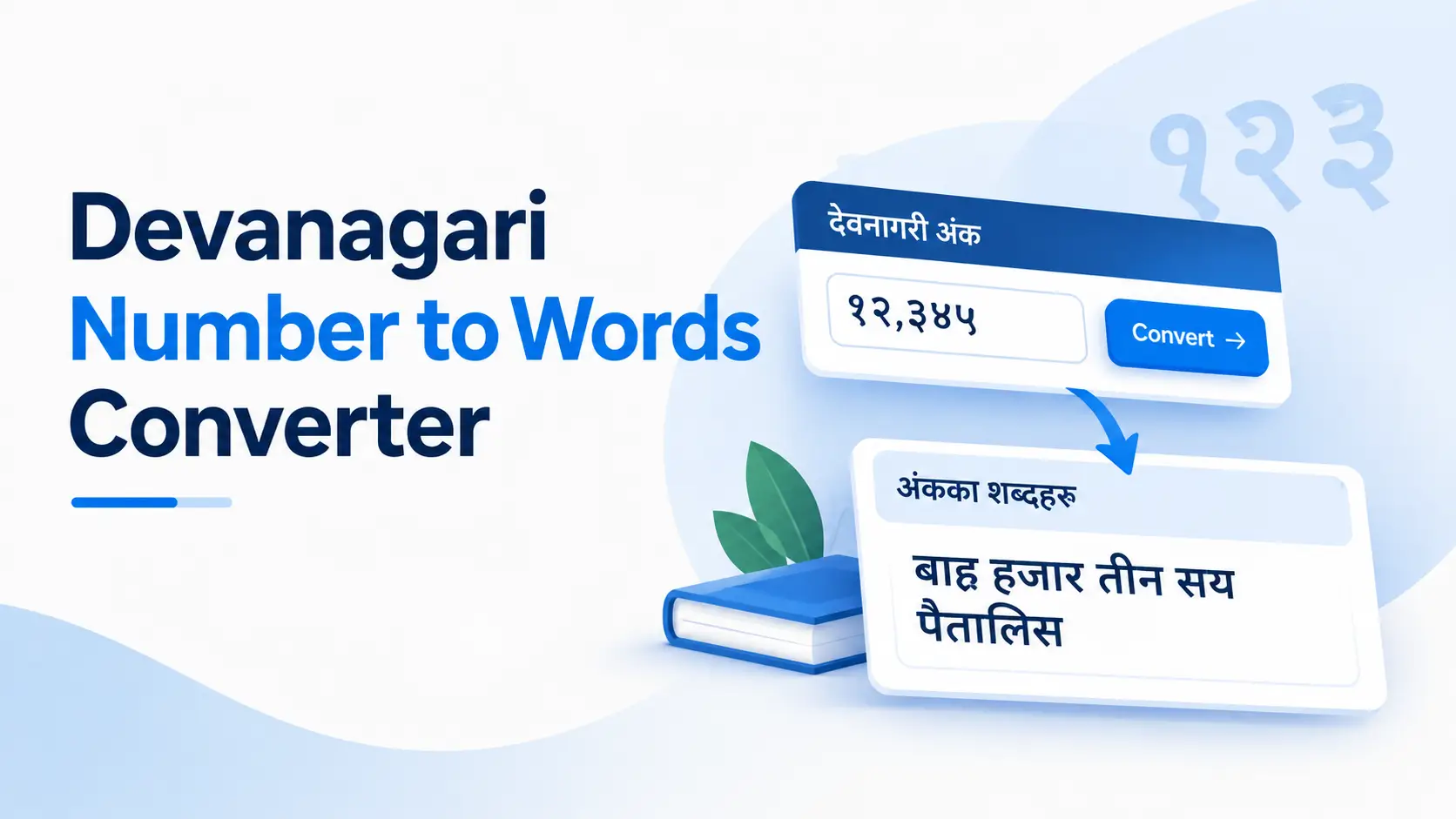
Enter a number once and get four results at the same time — formatted English digits, Devanagari (Nepali) digits, English words, and Nepali words including लाख, करोड, अर्ब and खर्ब. Built for cheque writing, invoices, school homework, and anyone typing official Nepali documents.
On this page
- Try the converter
- How to use the converter
- How the Nepali number system actually works
- A full worked example, step by step
- Numbers 1 to 100 in Nepali words and digits
- Lakh, Crore, Arab, Kharab — the full scale table
- Common mistakes people make
- Who actually needs this tool
- Typing and font issues after you copy the result
- Frequently asked questions
Try the Devanagari Number to Words Converter
Type any number below — using English digits (123456) or Nepali digits (१२३४५६) — and every format updates as you type. Everything runs locally in your browser, so nothing you type is ever sent anywhere.
Devanagari Number to Words
Convert English or Nepali numbers into formatted digits, Devanagari numerals, English words, and Nepali words instantly.
How to Use the Converter
- Type your number. Use either English digits (e.g. 250000) or Nepali digits (e.g. २५०००० ) directly in the input box — the tool detects both automatically.
- Read the four outputs. The card below instantly shows the number formatted with commas, its Devanagari digit form, its English word form, and its Nepali word form using लाख/करोड grouping.
- Add a decimal if you need one. Type a point, e.g. 4599.50 — the tool reads the decimal part digit-by-digit with "दशमलव" (English: "Point"), which is exactly how amounts are read in Nepali banking documents.
- Copy the field you need. Tap the "Copy" button beside any result to copy just that line — useful when you only need the Nepali words for a cheque, not all four formats.
How the Nepali Number System Actually Works
This is the part most converters skip, and it's exactly where people get stuck. English and Nepali don't just use different words for numbers — they group the digits differently, which changes where the commas go and which "large number" word applies.
| Value | Western system | Nepali system | Nepali term |
|---|---|---|---|
| 1,000 | One Thousand | १,००० | हजार (Hazar) |
| 100,000 | One Hundred Thousand | १,००,००० | लाख (Lakh) |
| 10,000,000 | Ten Million | १,००,००,००० | करोड (Crore) |
| 1,000,000,000 | One Billion | १,००,००,००,००० | अर्ब (Arab) |
| 100,000,000,000 | One Hundred Billion | १,००,००,००,००,००० | खर्ब (Kharab) |
Notice the comma pattern on the Nepali side: after the first three digits from the right, Nepali groups every two digits instead of three (1,00,000 rather than 100,000). That's the single biggest source of "off by one zero" mistakes when people convert numbers by hand — and it's exactly what this tool automates for you.
A Full Worked Example, Step by Step
Most tools show you a finished answer with no explanation of how it got there. Here's the actual breakdown for a mid-size amount, the kind you'd write on a cheque or a VAT invoice:
Step 1 — Start with the number
Rs. 1,245,750 (One million two hundred forty-five thousand seven hundred fifty)
Step 2 — Regroup in Nepali style
Reformatted as १२,४५,७५० — grouped in twos after the first three digits.
Step 3 — Split into scale blocks
१२ लाख (12 Lakh) + ४५ हजार (45 Thousand) + ७५० (750)
Step 4 — Read each block in words
बाह्र लाख + पैँतालीस हजार + सात सय पचास
Step 5 — Final Nepali words
बाह्र लाख पैँतालीस हजार सात सय पचास
Step 6 — Verify with the tool
Type 1245750 into the converter above and confirm it matches — this is the fastest way to build confidence before you write it on an actual document.
Numbers 1 to 100 in Nepali Words and Digits
Nepali doesn't build numbers from smaller parts the way English does ("twenty-one" = "twenty" + "one"). Every number from 1 to 99 has its own distinct word, inherited from Sanskrit — so 21 is एक्काइस, not a combination of "बीस" (twenty) and "एक" (one). That makes a complete reference table genuinely useful rather than a formality. Here is the full list, with real Devanagari digits and words rather than placeholders:
| # | Nepali Digit | Nepali Word | English Word |
|---|---|---|---|
| 1 | १ | एक | One |
| 2 | २ | दुई | Two |
| 3 | ३ | तीन | Three |
| 4 | ४ | चार | Four |
| 5 | ५ | पाँच | Five |
| 6 | ६ | छ | Six |
| 7 | ७ | सात | Seven |
| 8 | ८ | आठ | Eight |
| 9 | ९ | नौ | Nine |
| 10 | १० | दस | Ten |
| 11 | ११ | एघार | Eleven |
| 12 | १२ | बाह्र | Twelve |
| 13 | १३ | तेह्र | Thirteen |
| 14 | १४ | चौध | Fourteen |
| 15 | १५ | पन्ध्र | Fifteen |
| 16 | १६ | सोह्र | Sixteen |
| 17 | १७ | सत्र | Seventeen |
| 18 | १८ | अठार | Eighteen |
| 19 | १९ | उन्नाइस | Nineteen |
| 20 | २० | बीस | Twenty |
| 21 | २१ | एक्काइस | Twenty-One |
| 22 | २२ | बाइस | Twenty-Two |
| 23 | २३ | तेइस | Twenty-Three |
| 24 | २४ | चौबीस | Twenty-Four |
| 25 | २५ | पच्चीस | Twenty-Five |
| 26 | २६ | छब्बीस | Twenty-Six |
| 27 | २७ | सत्ताइस | Twenty-Seven |
| 28 | २८ | अट्ठाइस | Twenty-Eight |
| 29 | २९ | उनन्तीस | Twenty-Nine |
| 30 | ३० | तीस | Thirty |
| 31 | ३१ | एकतीस | Thirty-One |
| 32 | ३२ | बत्तीस | Thirty-Two |
| 33 | ३३ | तेत्तीस | Thirty-Three |
| 34 | ३४ | चौँतीस | Thirty-Four |
| 35 | ३५ | पैँतीस | Thirty-Five |
| 36 | ३६ | छत्तीस | Thirty-Six |
| 37 | ३७ | सैँतीस | Thirty-Seven |
| 38 | ३८ | अठतीस | Thirty-Eight |
| 39 | ३९ | उनन्चालीस | Thirty-Nine |
| 40 | ४० | चालीस | Forty |
| 41 | ४१ | एकचालीस | Forty-One |
| 42 | ४२ | बयालीस | Forty-Two |
| 43 | ४३ | त्रिचालीस | Forty-Three |
| 44 | ४४ | चवालीस | Forty-Four |
| 45 | ४५ | पैँतालीस | Forty-Five |
| 46 | ४६ | छयालीस | Forty-Six |
| 47 | ४७ | सच्चालीस | Forty-Seven |
| 48 | ४८ | अठचालीस | Forty-Eight |
| 49 | ४९ | उनन्चास | Forty-Nine |
| 50 | ५० | पचास | Fifty |
| 51 | ५१ | एकाउन्न | Fifty-One |
| 52 | ५२ | बाउन्न | Fifty-Two |
| 53 | ५३ | त्रिपन्न | Fifty-Three |
| 54 | ५४ | चौवन्न | Fifty-Four |
| 55 | ५५ | पचपन्न | Fifty-Five |
| 56 | ५६ | छपन्न | Fifty-Six |
| 57 | ५७ | सन्ताउन्न | Fifty-Seven |
| 58 | ५८ | अन्ठाउन्न | Fifty-Eight |
| 59 | ५९ | उनन्साठी | Fifty-Nine |
| 60 | ६० | साठी | Sixty |
| 61 | ६१ | एकसट्ठी | Sixty-One |
| 62 | ६२ | बासट्ठी | Sixty-Two |
| 63 | ६३ | त्रिसट्ठी | Sixty-Three |
| 64 | ६४ | चौँसट्ठी | Sixty-Four |
| 65 | ६५ | पैँसट्ठी | Sixty-Five |
| 66 | ६६ | छयसट्ठी | Sixty-Six |
| 67 | ६७ | सतसट्ठी | Sixty-Seven |
| 68 | ६८ | अठसट्ठी | Sixty-Eight |
| 69 | ६९ | उनन्सत्तरी | Sixty-Nine |
| 70 | ७० | सत्तरी | Seventy |
| 71 | ७१ | एकहत्तर | Seventy-One |
| 72 | ७२ | बहत्तर | Seventy-Two |
| 73 | ७३ | त्रिहत्तर | Seventy-Three |
| 74 | ७४ | चौहत्तर | Seventy-Four |
| 75 | ७५ | पचहत्तर | Seventy-Five |
| 76 | ७६ | छयहत्तर | Seventy-Six |
| 77 | ७७ | सतहत्तर | Seventy-Seven |
| 78 | ७८ | अठहत्तर | Seventy-Eight |
| 79 | ७९ | उनासी | Seventy-Nine |
| 80 | ८० | असी | Eighty |
| 81 | ८१ | एकासी | Eighty-One |
| 82 | ८२ | बयासी | Eighty-Two |
| 83 | ८३ | त्रियासी | Eighty-Three |
| 84 | ८४ | चौरासी | Eighty-Four |
| 85 | ८५ | पचासी | Eighty-Five |
| 86 | ८६ | छयासी | Eighty-Six |
| 87 | ८७ | सतासी | Eighty-Seven |
| 88 | ८८ | अठासी | Eighty-Eight |
| 89 | ८९ | उनान्नब्बे | Eighty-Nine |
| 90 | ९० | नब्बे | Ninety |
| 91 | ९१ | एकान्नब्बे | Ninety-One |
| 92 | ९२ | बयानब्बे | Ninety-Two |
| 93 | ९३ | त्रियान्नब्बे | Ninety-Three |
| 94 | ९४ | चौरान्नब्बे | Ninety-Four |
| 95 | ९५ | पन्चानब्बे | Ninety-Five |
| 96 | ९६ | छयान्नब्बे | Ninety-Six |
| 97 | ९७ | सन्तानब्बे | Ninety-Seven |
| 98 | ९८ | अन्ठान्नब्बे | Ninety-Eight |
| 99 | ९९ | उनान्सय | Ninety-Nine |
| 100 | १०० | एक सय | One Hundred |
Lakh, Crore, Arab, Kharab — The Full Scale Table
Once you're past 100, the Nepali system is really just this small set of scale words repeating. Memorize this table once and you can read almost any figure you'll encounter in real life, from a grocery bill to a government tender:
| Zeros | English Number | Nepali Digit | Nepali Word | Nepali Scale Term |
|---|---|---|---|---|
| 1 | 10 | १० | दस | — |
| 2 | 100 | १०० | एक सय | सय (Hundred) |
| 3 | 1,000 | १,००० | एक हजार | हजार (Thousand) |
| 5 | 1,00,000 | १,००,००० | एक लाख | लाख (Lakh) |
| 7 | 1,00,00,000 | १,००,००,००० | एक करोड | करोड (Crore) |
| 9 | 1,00,00,00,000 | १,००,००,००,००० | एक अर्ब | अर्ब (Arab) |
| 11 | 1,00,00,00,00,000 | १,००,००,००,००,००० | एक खर्ब | खर्ब (Kharab) |
| 13 | 1,00,00,00,00,00,000 | १,००,००,००,००,००,००० | एक नील | नील (Neel) |
Common Mistakes People Make When Converting Numbers to Nepali
These are the errors that actually cause rejected cheques and rewritten invoices — worth knowing even if you use the converter every time:
- Miscounting zeros between Lakh and Crore. One Crore has two more zeros than one Lakh, not one — a single missed zero on a cheque can mean a hundred-fold error.
- Writing "दशमलब" instead of "दशमलव". The correct spelling for "decimal point" uses व, not ब. It's a common typo that looks fine at a glance but is technically incorrect in formal documents.
- Reading paisa as a plain decimal. For money, ".50" is usually read as "पचास पैसा" (fifty paisa) in banking contexts, not "point five zero" — the digit-by-digit decimal reading in this tool is correct for general numbers, but for cheque amounts, mention "पैसा" for the fractional part when writing manually.
- Assuming Nepali uses the same comma placement as English. Copy-pasting a number straight from an English spreadsheet (1,245,750) into a Nepali document without re-grouping it (१२,४५,७५०) is one of the most frequent formatting mistakes in Nepali accounting software.
- Confusing "उनान्सय" (99) with "उनन्सय". Several of the numbers in the 90s and the "one-less-than" numbers (29, 39, 49...) have similar-looking spellings — always double check against a verified table like the one above rather than typing from memory.
Who Actually Needs This Tool
Cheque Writing and Banking
Nepali banks require the amount in words to match the amount in figures exactly — any mismatch and the cheque bounces. Type the amount once, copy the Nepali words field, and you have the exact wording your bank expects, formatted the same way every time.
Invoices, VAT Bills, and Receipts
Every formal invoice and VAT bill in Nepal needs an "Amount in Words" line. Doing this by hand for dozens of invoices a day is where typos creep in — running the total through the converter keeps every invoice consistent.
Students and Lok Sewa Aayog Preparation
If you're learning Devanagari numerals or preparing for a Nepali-language exam, typing in a number and immediately seeing the correct spelling reinforces the pattern faster than memorizing a static list. Use the 1–100 table above as a study sheet and the tool itself as a self-quiz.
Developers Building Nepali-Language Apps
If you're implementing this logic yourself in a billing system or government portal, the trickiest part isn't the word list — it's the Lakh/Crore grouping logic and where scale terms stack for very large numbers. Treat the worked example above as a spec to test your own implementation against.
Building and testing a Nepali number-to-words converter looks simple until you hit numbers like 100, 1000, or 100000 exactly — where a naive implementation prints an extra space, drops "एक" before "सय," or breaks on the boundary between "उनान्सय" (99) and "एक सय" (100). Most of the visible bugs in Nepali fintech tools live at these round-number edges, not in the middle of the range. If you're testing your own converter, deliberately try 100, 1000, 100000, 10000000, and their neighbours (99, 101, 999, 1001) — that's where real-world implementations tend to fail first.
Typing and Font Issues After You Copy the Result
Getting the correct Devanagari text is only half the job — the other half is making sure it displays correctly wherever you paste it. This is a step most number-converter guides skip entirely, but it's where a lot of people get stuck next:
- If you paste the Nepali words into an old desktop publishing file or a printed form template, it may have been built for a legacy font rather than Unicode. See our guide to free Nepali fonts if the text looks like garbled boxes or symbols instead of Devanagari script.
- Government and printing-press documents in Nepal often still specify Kalimati for headers and labels — if a form you're filling out needs that specific typeface, grab it from our Kalimati font download page.
- If you're integrating this kind of Nepali-language conversion logic into your own website, invoicing tool, or internal software rather than just using it as a one-off converter, our technical solutions page covers how we approach that kind of build.
Frequently Asked Questions
What is a Devanagari Number to Words Converter?
It's a tool that turns a plain number (like 45000) into its Devanagari digit form (४५०००), its Nepali word form (पैँतालीस हजार), and equivalent English digits and words — all at once, so you don't have to look up or hand-write the spelling yourself.
How is the Nepali number system different from the international system?
English groups large numbers in threes (thousand, million, billion). Nepali groups the first three digits together and then in twos after that, using लाख (100,000), करोड (10,000,000), अर्ब (1,000,000,000), and खर्ब (100,000,000,000) as the scale words instead of million/billion/trillion.
How do I write a cheque amount in Nepali words?
Type the exact amount into the converter, then copy the "Nepali Words" output directly into the "In Words" field on the cheque. Make sure the figure written in numerals and the words match exactly, since banks reject cheques where the two don't correspond.
Can this tool convert decimal numbers?
Yes. Type a number with a decimal point, such as 2599.75, and the tool reads the decimal portion digit by digit after "दशमलव" — for example, "दुई हजार पाँच सय उनान्सय दशमलव सात पाँच."
What's the largest number this converter supports?
Up to 13 digits, which covers figures into the trillions/नील range — far beyond what's needed for everyday cheques, invoices, or land transactions.
Why does every number from 1 to 99 have a completely different word in Nepali?
Nepali inherited its number words from Sanskrit, where each number up to 99 developed its own distinct term rather than being built compositionally the way English combines "twenty" and "one" into "twenty-one." That's why a full reference table (like the one on this page) is genuinely useful rather than something you can reliably guess.
Is my data safe when I use this converter?
Yes. All the conversion logic runs directly in your browser using JavaScript — nothing you type is sent to a server, logged, or stored anywhere.