Nepali to English Date Converter (BS to AD)
Nepali to English Date Converter (BS to AD): Convert Any Bikram Sambat Date Accurately
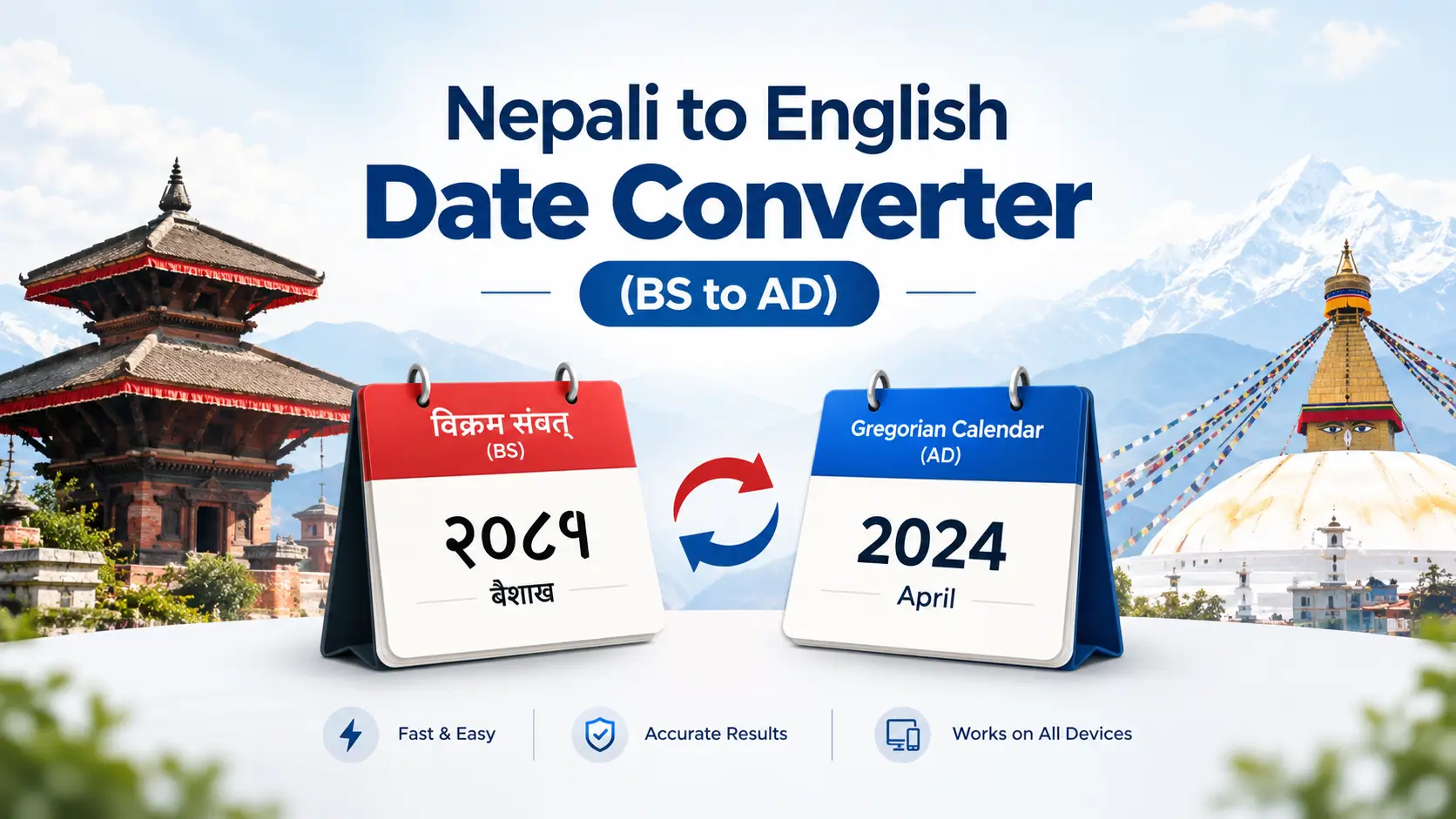 alt="Nepali to English Date Converter showing Bikram Sambat date Ashwin 1, 2083 converted to September 17, 2026 AD"
width="1200" height="675" loading="eager" decoding="async">
alt="Nepali to English Date Converter showing Bikram Sambat date Ashwin 1, 2083 converted to September 17, 2026 AD"
width="1200" height="675" loading="eager" decoding="async">Quick answer: A Nepali to English date converter turns a Bikram Sambat (BS) date into its exact Gregorian (AD) equivalent. Bikram Sambat runs roughly 56 years and 8½ months ahead of the English calendar, so Ashwin 1, 2083 BS = 17 September 2026 AD (Thursday). Because Nepali months vary between 29 and 32 days each year, there is no fixed formula — the conversion has to be read from the published calendar data for that specific year.
If you have ever filled in a passport form, a DV Lottery entry, a foreign university application or a bank KYC form, you already know the problem: your citizenship certificate says 2045 Bhadra 12, and the form wants a day, a month and a year in English. Guessing costs you a rejected application.
I built the converter on this page after watching too many people do the maths by hand and get it wrong by a day or two. This guide explains exactly how BS to AD conversion works, where people slip up, and what most converters on the internet quietly get wrong — including the timezone bug that shows the wrong Nepali date to every Nepali living outside Nepal.
What a Nepali to English Date Converter Actually Does
Nepal runs on two calendars at once. Government offices, courts, land records, school certificates, tax filings and festivals all use Bikram Sambat (BS). Airlines, embassies, foreign universities, banks and virtually every international system use the Gregorian calendar (AD). A date converter — miti pariwartan in Nepali — is the bridge between the two.
A good converter does four things:
- BS → AD: turns a Nepali date such as Ashwin 1, 2083 into 17 September 2026.
- AD → BS: turns an English date back into the Nepali miti, for citizenship records or festival planning.
- Returns the weekday — critical when a deadline falls on a Saturday or a public holiday.
- Outputs in both scripts, so you can paste Devanagari (२०८३ असोज १) into Nepali forms and Roman text into English ones.
The converter above adds two things most tools skip: a Difference tab that counts the days between two dates in either calendar, and an Age tab that calculates exact age from a BS date of birth.
Why Bikram Sambat and Gregorian Dates Never Line Up
Most people assume there is a simple sum: add 57 years, subtract some months, done. There isn't, and understanding why will save you from a lot of bad guesses.
1. The year gap changes twice a year
The Bikram Sambat era begins in 57 BCE, which puts it about 56 years and 8½ months ahead of the Gregorian calendar. But the Nepali year starts in mid-April, not in January. The practical result:
- From mid-April to 31 December, BS year = AD year + 57. (September 2026 → 2083 BS)
- From 1 January to mid-April, BS year = AD year + 56. (February 2027 → still 2083 BS)
This is why a single BS year always straddles two AD years — and why "2083 BS" can't be translated into one English year.
2. Nepali months have no fixed length
In the Gregorian calendar, April always has 30 days. In Bikram Sambat, month lengths are fixed each year by astronomical calculation of the sun's position, so a month can run 29, 30, 31 or 32 days, and the same month can differ from one year to the next. Ashadh might be 31 days one year and 32 the next. A whole BS year is therefore 365 or 366 days, but distributed unpredictably across the twelve months.
That is the real reason a converter needs a lookup table of published month lengths rather than a formula. Anyone claiming a clean arithmetic shortcut is approximating.
3. Every Nepali month spans two English months
Baishakh is not April. Baishakh runs from roughly mid-April to mid-May. Shrawan is not July — it runs mid-July to mid-August. Every single Nepali month cuts across the boundary between two Gregorian months, which is exactly where mental arithmetic falls apart.
2083 BS Month Lengths and Their English Dates
Here is the full mapping for the current Nepali year, 2083 BS. I have cross-checked these against the published patro data and round-tripped every boundary date through the converter.
| Nepali month | Devanagari | Days in 2083 | English (AD) date range |
|---|---|---|---|
| Baishakh | वैशाख | 31 | 14 Apr 2026 – 14 May 2026 |
| Jestha | जेठ | 31 | 15 May 2026 – 14 Jun 2026 |
| Ashadh | असार | 32 | 15 Jun 2026 – 16 Jul 2026 |
| Shrawan | साउन | 31 | 17 Jul 2026 – 16 Aug 2026 |
| Bhadra | भदौ | 31 | 17 Aug 2026 – 16 Sep 2026 |
| Ashwin (Asoj) | असोज | 31 | 17 Sep 2026 – 17 Oct 2026 |
| Kartik | कात्तिक | 30 | 18 Oct 2026 – 16 Nov 2026 |
| Mangsir | मंसिर | 29 | 17 Nov 2026 – 15 Dec 2026 |
| Poush | पुस | 29 | 16 Dec 2026 – 13 Jan 2027 |
| Magh | माघ | 30 | 14 Jan 2027 – 12 Feb 2027 |
| Falgun | फागुन | 30 | 13 Feb 2027 – 14 Mar 2027 |
| Chaitra | चैत | 30 | 15 Mar 2027 – 13 Apr 2027 |
Total: 365 days. Note how Ashadh reaches 32 days while Mangsir and Poush drop to 29 — a 3-day swing between months inside the same year. Do not reuse this table for 2084 BS. The lengths are recalculated every year.
Useful anchor dates to memorise: Baishakh 1, 2083 = 14 April 2026 (Tuesday, Nepali New Year) · Baishakh 1, 2084 = 14 April 2027 · Magh 1, 2083 = 14 January 2027 (Maghe Sankranti).
How to Convert a Nepali Date to English, Step by Step
Converting BS to AD (Nepali date of birth to English)
- Copy the date exactly as printed on your document. Take it from your citizenship certificate, birth registration or SLC/SEE certificate — not from memory, and not from a relative's recollection.
- Set the toggle to BS. This tells the converter you are entering a Bikram Sambat date.
- Select the year first, then the month, then the day. The day dropdown reloads once the month is chosen, because some months offer 32 days and others only 29.
- Read the AD result together with the weekday. The weekday is your free error check — more on that below.
- Copy the result in the format the form asks for. Most Nepali government forms want DD/MM/YYYY; US forms (including the DV Lottery) usually want MM/DD/YYYY. The same date, written the wrong way round, reads as a completely different day.
Converting AD to BS (English date to Nepali miti)
The process is identical in reverse: switch the toggle to AD, pick the Gregorian year, month and day, and read the Bikram Sambat result. This is what you need when a foreign-issued certificate must be entered into a Nepali system, or when you want to know which Nepali miti your English birthday falls on this year.
The round-trip check I always run
This takes ten seconds and catches almost every input error. After converting BS → AD, convert the answer straight back AD → BS. If you don't land on the exact date you started with, something went wrong — usually a mis-picked month, or a BS year typed as an AD year.
The second check is the weekday. If you know your birth certificate or an older family member says you were born on a Friday and the converter returns a Monday, stop and re-check the input before that date goes anywhere official.
The Manual Method (For When You Have No Internet)
You cannot convert exactly by hand, but you can get within a day or two — enough to sanity-check a result:
- Subtract 56 years and 8 months and about 15 days from the BS date.
- Or, faster: identify which half of the Nepali year the date falls in. If the Nepali month is Baishakh through Poush, subtract 57 from the BS year. If it is Magh, Falgun or Chaitra, subtract 56.
- Then shift the day: the 1st of a Nepali month lands somewhere between the 12th and the 18th of the corresponding English month.
Never use the manual method for anything official. It will be off by one to three days. It is a plausibility check, not a conversion. For documents, always use the converter.
Where You Will Actually Need BS to AD Conversion
- Nepali passport applications. The form asks for date of birth in both BS and AD, and the two must agree with your citizenship certificate.
- DV Lottery and visa applications. The US Diversity Visa entry, Schengen applications and most embassy forms accept AD only, and a mismatch against your passport is a hard rejection.
- Lok Sewa Aayog and government exams. Vacancy notices, deadlines and age-eligibility limits are all announced in BS. If you are abroad, you need the AD dates to plan travel and file on time.
- SEE, NEB and university admissions. Registration portals often require AD birth dates even though your school records are all in BS. If you are also working out your grade point average, the SEE GPA calculator handles the other half of that paperwork.
- Foreign employment (EPS Korea, Gulf, Japan). Contracts, medical reports and insurance documents run on AD dates while your source documents are in BS.
- Banking, KYC and remittance. Nepali banks record account opening in BS; international correspondent banks want AD.
- Property and legal documents. Lalpurja, sale deeds and court filings are dated in BS. NRNs handling family property from abroad convert these constantly.
- Business invoicing and VAT. IRD-compliant bills in Nepal carry BS dates, while accounting software and foreign clients expect AD. If you run a shop or a service business, the invoice generator and billing software is built for exactly this dual-date reality.
- Document translation. Certified translators convert every date on a transcript or certificate — and a single wrong digit invalidates the attestation.
7 Conversion Mistakes I See Constantly
These come from real support messages and from watching people use the tool.
1. Treating the BS year as an AD year
Someone born in 2050 BS types "1950" or "2050 AD" into an English form. A BS year in the 2000s corresponds to an AD year in the 1940s–1990s. Always label which calendar you are writing in.
2. Assuming Baishakh = April
The single most common error. A date in late Baishakh falls in May, not April. The same trap applies to every month.
3. The day-32 problem
Nepali months can have 32 days. Plenty of web forms — and plenty of databases — silently reject or truncate day 32 because the Gregorian calendar never goes past 31. If a date in Ashadh or Jestha won't save, this is almost always why.
4. Converting the wrong date of birth
Many Nepalis have two birth dates: the real one, and the one recorded on the birth registration or citizenship certificate (sometimes registered years later, sometimes rounded to Baishakh 1). For any official form, convert the date printed on the document — consistency with your paperwork matters more than biographical accuracy.
5. Mixing up DD/MM and MM/DD
3 May reads as 5 March in the American format. Check which convention the form uses before you type.
6. Trusting a converter for very old dates
Conversions before roughly 1970 BS are reconstructed from historical records rather than from published official patro, and different tools genuinely disagree by a day. For pre-1970 BS dates, check two independent converters and, where a legal document is involved, verify with the issuing office.
7. Copying the date but forgetting the year boundary
Chaitra 30, 2083 is 13 April 2027 — a different AD year from Baishakh 1, 2083 (14 April 2026), even though both sit inside the same Nepali year. When a deadline is announced as "Chaitra 2083", check which English year that lands in.
What Most Nepali Date Converters Don't Tell You
Having built one, here are the things I wish more tools were honest about.
The timezone trap for Nepalis abroad
Nepal Standard Time is UTC+5:45 — a 45-minute offset shared with almost nowhere else on earth. Many converters derive "today's Nepali date" from the visitor's browser clock. If you are in New York, Sydney or Riyadh, that can show you yesterday's or tomorrow's Nepali date. A correctly built converter anchors "today" to Nepal Standard Time regardless of where the visitor sits. It is a small detail that matters enormously when you are checking whether a Lok Sewa deadline has passed.
Adhik Maas does not apply to the Nepali calendar
You will see converters advertising support for Adhik Maas (the extra month). That belongs to the lunar Vikram Samvat used in parts of India. Nepal's Bikram Sambat is a solar calendar — it has no leap month. It absorbs the extra fraction of a day by varying the length of ordinary months, which is exactly why Ashadh sometimes stretches to 32 days. If a tool inserts a thirteenth month into a Nepali year, it is applying the wrong calendar system.
Supported ranges vary wildly — and matter
Different converters cover different spans: some handle roughly 1898–2101 BS, others stretch from 1658 BS onward. Wider isn't automatically better. Anything outside the well-documented modern range (about 1970–2100 BS) is extrapolated. If your date falls outside that window, treat the answer as indicative.
Age in BS is not the same as age in AD
Because the Nepali year starts in mid-April, your "Nepali age" can tick over months before your English birthday. For anything with an age cut-off — Lok Sewa eligibility, driving licence, retirement — calculate it properly rather than subtracting years. The Nepali age calculator works directly from a BS date of birth and gives you exact years, months and days.
The weekday is the feature nobody advertises
Most converters return only a date. The weekday tells you whether a deadline falls on a Saturday (Nepal's weekly holiday), whether an office will be open, and — as described above — gives you a free cross-check against the original document.
BS to AD Year Reference (2080–2084)
| BS year | Starts (Baishakh 1) | Ends (Chaitra last day) | Spans AD years |
|---|---|---|---|
| 2080 | 14 Apr 2023 | 12 Apr 2024 | 2023–2024 |
| 2081 | 13 Apr 2024 | 13 Apr 2025 | 2024–2025 |
| 2082 | 14 Apr 2025 | 13 Apr 2026 | 2025–2026 |
| 2083 (current) | 14 Apr 2026 | 13 Apr 2027 | 2026–2027 |
| 2084 | 14 Apr 2027 | mid-Apr 2028 | 2027–2028 |
Nepali New Year always lands between 12 and 15 April. If you ever see a converter placing Baishakh 1 in March or May, close it.
A Short Note on Why I Built This
I am a web developer based in Kathmandu, and the trigger was mundane: helping a relative fill in a visa application where the existing tools returned three slightly different answers for a 1960s BS birth date. One had the day right and the weekday wrong. One was off by a day. One rejected the 32nd of Ashadh outright.
So the converter on this page was built around three rules: pin "today" to Nepal Standard Time rather than the visitor's clock; allow every valid day including the 32nd; and always show the weekday so users can verify the result themselves. It runs entirely in your browser — nothing you type is sent anywhere or stored.
Other Free Tools You Might Need
Frequently Asked Questions
What is today's Nepali date in English?
Today is Ashwin 1, 2083 BS, which is 17 September 2026 AD (Thursday). Use the converter above for any other date — it anchors "today" to Nepal Standard Time, so the result is correct whether you are in Kathmandu or overseas.
How many years ahead is the Nepali calendar?
About 56 years and 8½ months. In practice, add 57 to the English year between mid-April and December, and 56 between January and mid-April.
How do I convert my Nepali date of birth to English?
Set the toggle to BS, select the year, month and day exactly as printed on your citizenship certificate, and read the AD result. Then convert it back the other way to confirm you land on the same Nepali date.
Is there a formula to convert BS to AD?
No exact one. Nepali month lengths vary from 29 to 32 days and change every year, so conversion relies on published calendar data rather than arithmetic. Subtracting roughly 56 years, 8 months and 15 days gets you close but is usually off by a day or more.
Which year is 2083 BS in AD?
2083 BS runs from 14 April 2026 to 13 April 2027, so it covers parts of both 2026 and 2027. No single English year matches it.
Can a Nepali month really have 32 days?
Yes. Month lengths are set by the sun's position, and months such as Jestha and Ashadh often run to 32 days. In 2083 BS, Ashadh has 32 days while Mangsir and Poush have only 29.
Is this converter accurate enough for a passport or visa application?
Yes, for dates within the modern published range of roughly 1970–2100 BS. For older dates, cross-check against a second converter and, if a legal document depends on it, confirm with the issuing office.
Why do different date converters give different answers?
Almost always for pre-1970 BS dates, where month lengths are reconstructed from historical sources rather than official records. For dates in the modern range, well-built converters agree.
When does the Nepali New Year fall?
Baishakh 1, always between 12 and 15 April. Baishakh 1, 2083 fell on 14 April 2026, and Baishakh 1, 2084 falls on 14 April 2027.
Does the converter work offline or store my data?
The conversion runs in your browser. Nothing you enter is transmitted or saved, which matters when you are converting a date of birth from an identity document.