
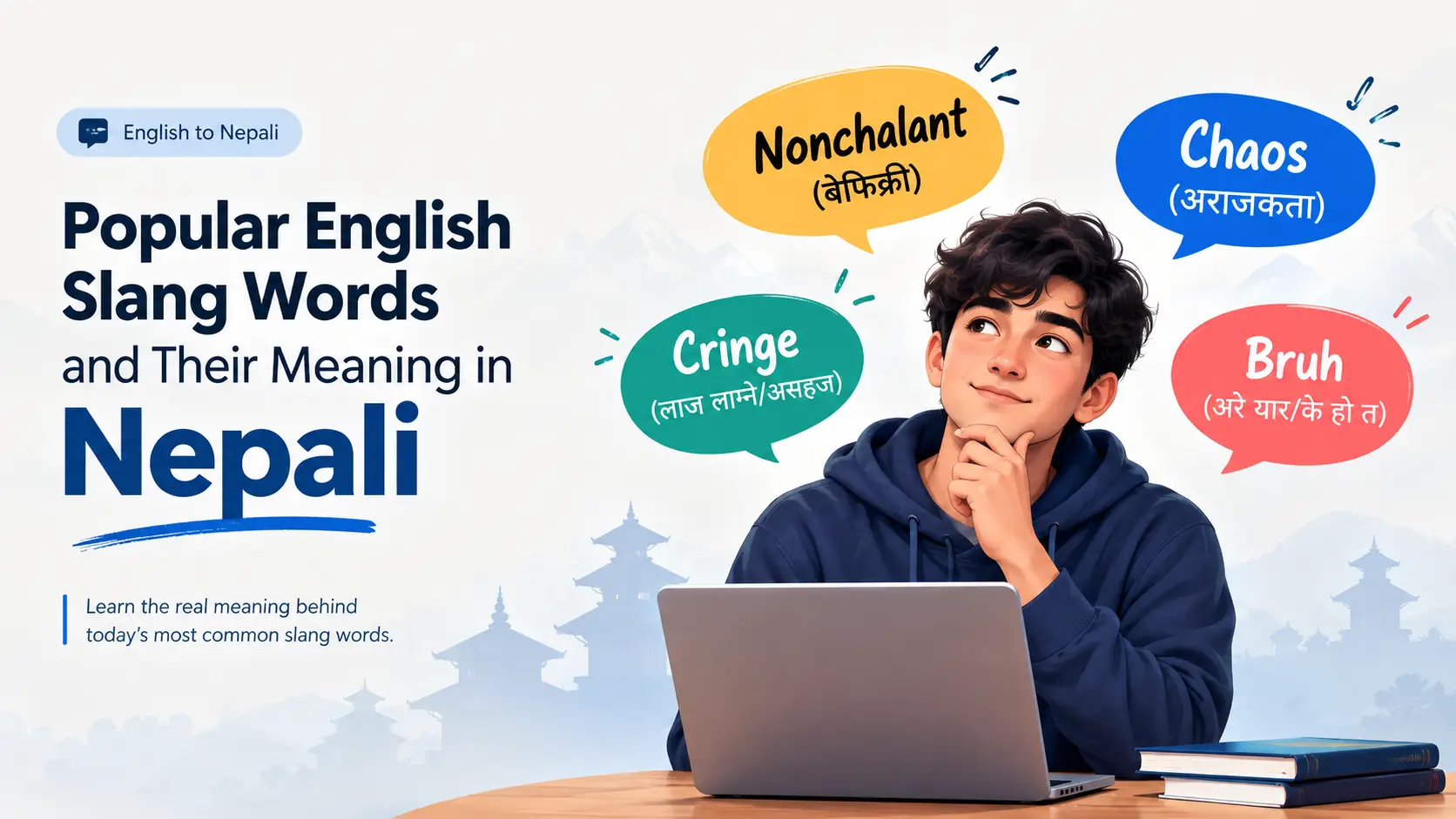
Nonchalant, Chaos, Cringe & Bruh Meaning in Nepali: The Slang Guide Dictionaries Get Wrong
Type "bruh meaning in Nepali" into Google and almost every result tells you the same thing: भाइ, यार, साथी. Brother. Friend. Buddy.
That answer is wrong roughly 80% of the time — and if you actually use it that way in a conversation, you will sound strange.
Here's why. When a Nepali teenager sends "bruh" after seeing their exam result, they are not calling anyone "brother." They are expressing disbelief. The closest honest Nepali translation is हैट! or के हो यार! — not भाइ. Standard dictionary entries translate the word and completely miss the function.
This guide fixes that. For each of the four words — nonchalant, chaos, cringe and bruh — you'll get the literal Nepali meaning, the natural Nepali meaning that people in Kathmandu actually say, correct pronunciation (most Nepali speakers mispronounce two of these four), real example sentences in Devanagari and Roman Nepali, and a clear warning about where the standard translation will embarrass you.
What's in this guide
- Quick answer table — all four words
- Nonchalant meaning in Nepali
- Chaos meaning in Nepali
- Cringe meaning in Nepali
- Bruh meaning in Nepali
- Formality guide: which word is safe with elders
- Why Nepali youth don't translate slang at all
- Bonus: 25 more slang words with Nepali meanings
- How to type these words in Nepali Devanagari
- Frequently asked questions
Quick Answer: All Four Words at a Glance
If you only need the fast version, this table covers it. The column that matters most is the third one — that's the word an actual Nepali speaker would choose in conversation, which is usually not the dictionary word.
| English word | Dictionary Nepali | What Nepali speakers actually say | Type |
|---|---|---|---|
| Nonchalant | बेपर्वाह, निश्चिन्त, उदासीन | वास्तै नगर्ने (wastai nagarne) — "acts like it doesn't matter" | Adjective |
| Chaos | अराजकता, अव्यवस्था | भद्रगोल (bhadragol) — "total mess" | Noun |
| Cringe | लजाउनु, खुम्चिनु | लाजमर्दो (lajmardo) — "shameful to watch" | Verb + adjective |
| Bruh | भाइ, यार, साथी | हैट! (hait!) — reaction, not a name | Interjection |
Nonchalant Meaning in Nepali
Nonchalant (नन्शलान्ट) means appearing calm, casual and unbothered — showing no anxiety, excitement or concern, whether or not you actually feel it.
Nepali meanings, ranked by how natural they sound
Most sources dump five Nepali words at you with no explanation, as if they were interchangeable. They aren't. Each one carries a different attitude, and picking the wrong one changes whether you're complimenting someone or insulting them.
| Nepali word | Roman | What it really implies | Use for "nonchalant"? |
|---|---|---|---|
| वास्तै नगर्ने | wastai nagarne | Pays it no attention; unbothered. Everyday, conversational. | Best |
| निश्चिन्त | nishchinta | Free of worry, relaxed. Positive, gentle. | Good |
| बेफिक्री | befikri | Carefree, light-hearted. Slightly playful. | Good |
| बेपर्वाह | beparwah | Careless, reckless. Leans negative — suggests irresponsibility. | Careful |
| उदासीन | udasin | Apathetic, indifferent, emotionally withdrawn. Often sad or cold. | Usually wrong |
| निर्लिप्त | nirlipta | Detached, unattached. Literary/spiritual register — Gita vocabulary. | Too formal |
How to pronounce "nonchalant" (most Nepali speakers get this wrong)
Say it like this:
non-shuh-LAANT · नन्-शु-लान्ट
Not non-CHA-lent · नन्-च-लेन्ट
This word came into English from French, and the French ch is pronounced like English sh — the same way "machine" and "Chicago" work. Because Nepali is written phonetically, Nepali speakers naturally read the letters ch as च, producing "non-cha-lant." It's one of the most common English pronunciation slips in Nepali classrooms and offices, and it's completely invisible in every competing dictionary entry.
The Gen Z "nonchalant" — a meaning no dictionary has caught up to
Since around 2023, "nonchalant" stopped being a neutral description and became a personality label, especially on TikTok and Instagram. Phrases like "the nonchalant boyfriend," "nonchalant era" and "stay nonchalant" describe someone who deliberately performs indifference — replying late on purpose, never showing excitement, acting unimpressed as a strategy.
The Nepali equivalent isn't a single word. It's a phrase:
- केही मतलब नभएको जस्तो गर्ने — kehi matlab nabhaeko jasto garne — "acts like nothing matters to them"
- पर्वाह नगरे जस्तो देखाउने — parwaha nagare jasto dekhaune — "shows off not caring"
- चिल गरेको — chill gareko — the code-mixed version young Nepalis genuinely use
Note that all three contain a word meaning "acts like" or "shows." That's the whole point of the modern sense: it's a performance, and any translation that leaves out the performance loses the meaning.
Nonchalant: example sentences in English and Nepali
| English | Nepali | Roman Nepali |
|---|---|---|
| She stayed nonchalant even after the results came out. | नतिजा आएपछि पनि उनी निश्चिन्त नै रहिन्। | Natija aaepachhi pani uni nishchinta nai rahin. |
| Stop being so nonchalant about your studies. | पढाइप्रति यति बेपर्वाह नबन। | Padhai prati yati beparwah naban. |
| He replied with a nonchalant shrug. | उसले वास्तै नगरी काँध उचाल्यो। | Usle wastai nagari kaandh uchalyo. |
| Her nonchalant attitude is just an act. | उनको वास्ता नगर्ने बानी त नाटक मात्रै हो। | Unko wasta nagarne baani ta natak matrai ho. |
Chaos Meaning in Nepali
Chaos (केअस) means complete disorder and confusion — a situation with no order, no control and no plan.
The अराजकता problem
Every competing page leads with अराजकता (arajakta) as the primary translation of "chaos." For everyday use, this is the single worst choice on the list.
अराजकता is built from अ (without) + राज (rule/governance). It literally means anarchy — the collapse of authority. It's a political and legal term. In Nepali newspapers it appears in articles about state failure, lawlessness and breakdown of governance.
So if your kitchen is a mess after a party and you say भान्सामा अराजकता छ, you have just announced that your kitchen has overthrown its government. It's the register equivalent of saying "the kitchen is in a state of insurrection."
Choosing the right Nepali word for "chaos"
| Nepali word | Roman | Use it when the chaos is… | Example context |
|---|---|---|---|
| भद्रगोल | bhadragol | Messy, disorganised, jumbled | A room, a schedule, a plan |
| अव्यवस्था | avyavastha | Poorly managed, badly run | Traffic, an office, an event |
| अफरातफरी | aphratafari | Panicked, people scrambling | A fire alarm, a stampede |
| हल्लाखल्ला | hallakhalla | Loud, noisy, rowdy | A crowd, a classroom |
| गडबडी | gadbadi | Something went wrong, a mix-up | An error, a malfunction |
| उथलपुथल | uthalputhal | Turbulent, upheaval, dramatic change | Politics, markets, life events |
| अराजकता | arajakta | Lawless, no authority at all | Only politics and governance |
How to pronounce "chaos"
Say it like this:
KAY-oss · के-अस
Not CHA-os · चा-ओस
The ch in "chaos" is pronounced as a hard k, because the word came into English through Greek. The same rule governs "chemistry," "character," "chorus," "echo" and "architect" — all क, never च. If you've been saying चाओस, you're in extremely large company across Nepal, and fixing this one rule corrects a dozen words at once.
When "chaos" is actually a compliment
Modern internet English has flipped part of this word's meaning. "Chaotic energy," "we love chaos," "chaotic good," "chaos gremlin" — these are affectionate. They describe someone unpredictable and fun, not someone destructive.
No Nepali word carries this positive charge, which is exactly why Nepali speakers borrow the English word instead of translating it. The nearest native options are बबाल (babal) for something wildly good, or describing someone as कुनै ठेगान नभएको (kunai thegan nabhaeko) — "completely unpredictable" — but neither is a true match.
Chaos: example sentences in English and Nepali
| English | Nepali | Roman Nepali |
|---|---|---|
| The whole house was in chaos before the wedding. | बिहे अघि सारा घर भद्रगोल थियो। | Bihe aghi sara ghar bhadragol thiyo. |
| There was chaos on the road after the accident. | दुर्घटना पछि सडकमा अफरातफरी मच्चियो। | Durghatana pachhi sadakma aphratafari machchiyo. |
| Load-shedding created chaos in the exam hall. | लोडसेडिङले परीक्षा हलमा हल्लाखल्ला मच्चायो। | Loadshedding le pariksha hall ma hallakhalla machchayo. |
| Political chaos continued for months. | राजनीतिक अराजकता महिनौंसम्म कायम रह्यो। | Rajnitik arajakta mahinaunsamma kayam rahyo. |
Cringe Meaning in Nepali
Cringe (क्रिन्ज) has two separate lives, and confusing them is the most common mistake with this word.
Cringe as a verb (the original meaning)
To cringe is to physically flinch or shrink back — from fear, pain or embarrassment. Your shoulders pull in, your face tightens.
- खुम्चिनु (khumchinu) — to shrink, contract
- लाजले खुम्चिनु (laajle khumchinu) — to shrink with embarrassment
- सर्नु (sarnu) — to recoil, move back
Cringe as an adjective (the meaning people actually search for)
Since roughly 2016, "cringe" became an adjective: "that's so cringe," "his post is cringe," "cringe behaviour." Here it means embarrassing to witness — awkward, try-hard, secondhand-embarrassing.
- लाजमर्दो (lajmardo) — shameful, embarrassing. Closest single word.
- अप्ठ्यारो (apthyaro) — awkward, uncomfortable
- नमज्जा (namajja) — unpleasant, off-putting (casual)
- छ्या! (chhya!) — an exclamation of distaste; what you'd actually blurt out
Cringe: example sentences in English and Nepali
| English | Nepali | Roman Nepali |
|---|---|---|
| His speech was so cringe. | उसको भाषण साह्रै लाजमर्दो थियो। | Usko bhashan saahrai lajmardo thiyo. |
| I cringed watching that video. | त्यो भिडियो हेर्दा मलाई अप्ठ्यारो लाग्यो। | Tyo video herda malai apthyaro laagyo. |
| Those old photos of mine are pure cringe. | मेरा ती पुराना फोटो त साँच्चै लाजमर्दो छन्। | Mera ti purana photo ta saanchchai lajmardo chhan. |
| Don't do that, it's cringe. | त्यसो नगर, नमज्जा देखिन्छ। | Tyaso nagara, namajja dekhinchha. |
Bruh Meaning in Nepali
This is the word every competing page gets wrong, so let's be precise.
Bruh (ब्र) started as a lazy pronunciation of "bro," and yes, it can be used to address someone. But that's now the minority use. In the overwhelming majority of real messages, bruh is an interjection — a complete reaction that stands alone, addressed to nobody.
The four functions of "bruh" — and the Nepali word for each
| Function | English example | Natural Nepali | Roman |
|---|---|---|---|
| Disbelief Most common | "Bruh, you're joking." | के हो यार! / ओहो! | Ke ho yaar! / Oho! |
| Disappointment | "Bruh. We lost again." | हैट! / धत्! | Hait! / Dhat! |
| Exasperation | "Bruh, seriously?" | ला, अनि? / छ्या! | La, ani? / Chhya! |
| Address Least common | "Bruh, pass the ball." | ए भाइ / ए दाइ / यार | E bhai / E dai / Yaar |
How to pronounce "bruh"
Say it like this:
bruh — rhymes with "duh" · ब्र
Not broo · ब्रुह
The h is silent — it's there to stretch the vowel, not to be pronounced. The vowel is short and flat, and in real speech it's often drawn out for effect: "bruhhhh." The longer the vowel, the stronger the disbelief.
Bruh: example sentences in English and Nepali
| English | Nepali | Roman Nepali |
|---|---|---|
| Bruh, I failed the exam. | हैट, म परीक्षामा फेल भएँ। | Hait, ma parikshama fail bhaen. |
| Bruh, are you serious right now? | ए यार, साँच्चै भनेको? | E yaar, saanchchai bhaneko? |
| Bruh… I have no words. | ला… भन्नै केही छैन। | La… bhannai kehi chhaina. |
| Bruh, let's go now. | ए भाइ, अब जाऔं। | E bhai, aba jaaun. |
Formality Guide: Which Word Is Safe to Use Where
None of the competing pages mention register at all, which is a real problem — these words are not equally safe in every situation. Here's where each one belongs.
| Situation | Nonchalant | Chaos | Cringe | Bruh |
|---|---|---|---|---|
| School / college essay | Yes | Yes | Verb only | Never |
| Office email | Yes | Yes | No | Never |
| Talking to elders | Yes | Yes | No | Never |
| Friends, chat, social media | Yes | Yes | Yes | Yes |
| News writing / journalism | Yes | Yes | No | Never |
The short version: nonchalant and chaos are standard English and work anywhere. Cringe and bruh are slang and belong only in casual conversation. "Cringe" as a verb is acceptable in formal writing ("the audience cringed"); "cringe" as an adjective is not.
Why Nepali Youth Don't Translate These Words at All
Here's something no dictionary will tell you: in actual Nepali conversation, young people mostly don't translate these words. They drop the English word straight into a Nepali sentence.
- कस्तो cringe छ यार। — Kasto cringe chha yaar. — "So cringe, man."
- आज त पूरै chaos भयो। — Aaja ta purai chaos bhayo. — "Today was total chaos."
- ऊ त एकदम nonchalant छ। — U ta ekdam nonchalant chha. — "He's completely nonchalant."
This is code-switching, and it isn't laziness or poor Nepali. It happens for a specific linguistic reason: the English word carries connotations the Nepali word doesn't. लाजमर्दो is a heavy, serious word — it means genuinely shameful. "Cringe" is light and comic. When a Nepali speaker wants the light, joking version, लाजमर्दो overshoots, so they reach for English instead.
Understanding this matters for your own use of these words. If you are speaking casually, use the English word. If you're writing formally, translating for school, or explaining to someone who doesn't speak English, use the Nepali equivalent. Both are correct — for different jobs.
Nepal's linguistic layering goes further than Nepali and English, of course. Kathmandu Valley speech mixes in Newari vocabulary constantly, often without speakers noticing — if that interests you, see our guide on how to translate the Newari language to English.
Bonus: 25 More English Slang Words and Their Nepali Meanings
These four words rarely get searched alone — people who look up one slang term usually need several. Here's a reference table of the slang most commonly heard in Nepal right now.
| Slang | Meaning | Nepali | Roman |
|---|---|---|---|
| Rizz | Charm, flirting skill | पट्याउने कला | patyaune kala |
| Aura | Presence, coolness | रवाफ | rawaf |
| Slay | To do brilliantly | बबाल गर्नु | babal garnu |
| Sus | Suspicious | शंकास्पद | shankaspad |
| Flex | To show off | फुर्ती लगाउनु | phurti lagaunu |
| Salty | Bitter, resentful | रिसाएको | risaeko |
| Ghosting | Disappearing without reply | बेपत्ता हुनु | bepatta hunu |
| Simp | Overly devoted admirer | लत्तो छाडेको | latto chhadeko |
| Vibe | Mood, feeling | माहोल | mahol |
| Mid | Mediocre, average | ठिकै | thikai |
| Lowkey | Slightly, secretly | अलिअलि | ali-ali |
| Highkey | Openly, definitely | खुलेर | khulera |
| No cap | No lie, seriously | साँच्चै | saanchchai |
| Bet | Okay, agreed | हुन्छ | hunchha |
| Delulu | Delusional | भ्रममा परेको | bhram ma pareko |
| Yap | To talk too much | बकबक गर्नु | bakbak garnu |
| Ick | Sudden turn-off | दिक्क लाग्नु | dikka laagnu |
| Savage | Brutally blunt | निर्मम | nirmam |
| Hype | Excitement, buzz | चर्चा | charcha |
| Clout | Influence, fame | प्रभाव | prabhav |
| Shook | Shocked | छक्क परेको | chhakka pareko |
| Toxic | Harmful, draining | हानिकारक | hanikarak |
| Gaslight | To manipulate someone's reality | भ्रमित पार्नु | bhramit parnu |
| Situationship | Undefined relationship | अनिश्चित सम्बन्ध | anishchit sambandha |
| Glow up | Dramatic improvement | कायापलट | kayapalat |
How to Type These Words in Nepali Devanagari
If you want to write any of these Nepali equivalents — भद्रगोल, लाजमर्दो, वास्तै नगर्ने — you'll need Devanagari input, and most people don't have a Nepali keyboard installed.
The simplest method is Roman-to-Unicode conversion: you type the sound in English letters and it converts to Devanagari. Type bhadragol, get भद्रगोल. Our free English to Nepali Unicode type converter does this in the browser with no installation, and the output is standard Unicode — so it pastes correctly into Facebook, Word, WhatsApp and any website, unlike older Preeti font text which turns into gibberish outside its own font.
Frequently Asked Questions
What is the exact Nepali meaning of nonchalant?
Nonchalant means वास्तै नगर्ने (wastai nagarne), निश्चिन्त (nishchinta) or बेफिक्री (befikri) — calm and unbothered. Use बेपर्वाह only when you mean carelessly irresponsible, and avoid उदासीन, which suggests emotional withdrawal rather than coolness.
Is अराजकता the correct Nepali word for chaos?
Only for political chaos. अराजकता literally means anarchy — the absence of governance. For everyday chaos like a messy room or a disorganised event, use भद्रगोल (bhadragol) or अव्यवस्था (avyavastha).
How do you pronounce "nonchalant" correctly?
Say non-shuh-LAANT (नन्-शु-लान्ट). The "ch" is pronounced like "sh" because the word comes from French. "Non-cha-lant" with a hard च sound is incorrect.
Does bruh mean brother in Nepali?
Not usually. Although bruh comes from "bro," in most real usage it's a standalone interjection expressing disbelief or disappointment — closest to हैट! or के हो यार! in Nepali. It only means भाइ or दाइ when directly addressing someone, which is the less common use.
Can I call someone older than me भाइ the way English speakers say "bruh"?
No. भाइ means younger brother and implies you hold the senior position. For someone older, use दाइ or दाजु. Unlike English "bruh," Nepali address terms are not age-neutral, and getting this wrong reads as disrespect.
What is the Nepali word for cringe?
As an adjective, लाजमर्दो (lajmardo) is closest. As a verb, खुम्चिनु (khumchinu) or अप्ठ्यारो लाग्नु (apthyaro laagnu). Nepali has no single word for the secondhand embarrassment cringe describes, which is why the English word is widely borrowed.
Is it wrong to mix English slang into Nepali sentences?
No. Code-switching is normal and linguistically valid — Nepali speakers do it because English slang carries lighter, more comic connotations than the heavier Nepali equivalents. Use English slang in casual speech and Nepali equivalents in formal writing, exams or conversation with elders.
Why is "chaos" pronounced with a K sound?
Because it entered English from Greek, where the letters "ch" represent a hard K. The same applies to chemistry, character, chorus, echo and architect. The correct pronunciation is KAY-oss (केअस), not चाओस.
Final Takeaway
The reason standard dictionary entries fail with slang is that they translate words in isolation while slang lives entirely in context. Bruh isn't a noun, it's a reaction. Cringe isn't only a verb any more. Chaos in Nepali splits into at least six different words depending on whether the disorder is messy, noisy, panicked or political. And nonchalant now describes a performance of not caring, not simply a calm temperament.
If you remember only four things from this guide: say non-shuh-LAANT and KAY-oss; use भद्रगोल rather than अराजकता for everyday chaos; never call an older person भाइ; and treat "bruh" as a full sentence, not a form of address.