
How to Get a Driving Licence in Nepal (2026): The Complete eDLVRS Guide to the Online Form, Likhit Exam, Trial, Fees and Your Card
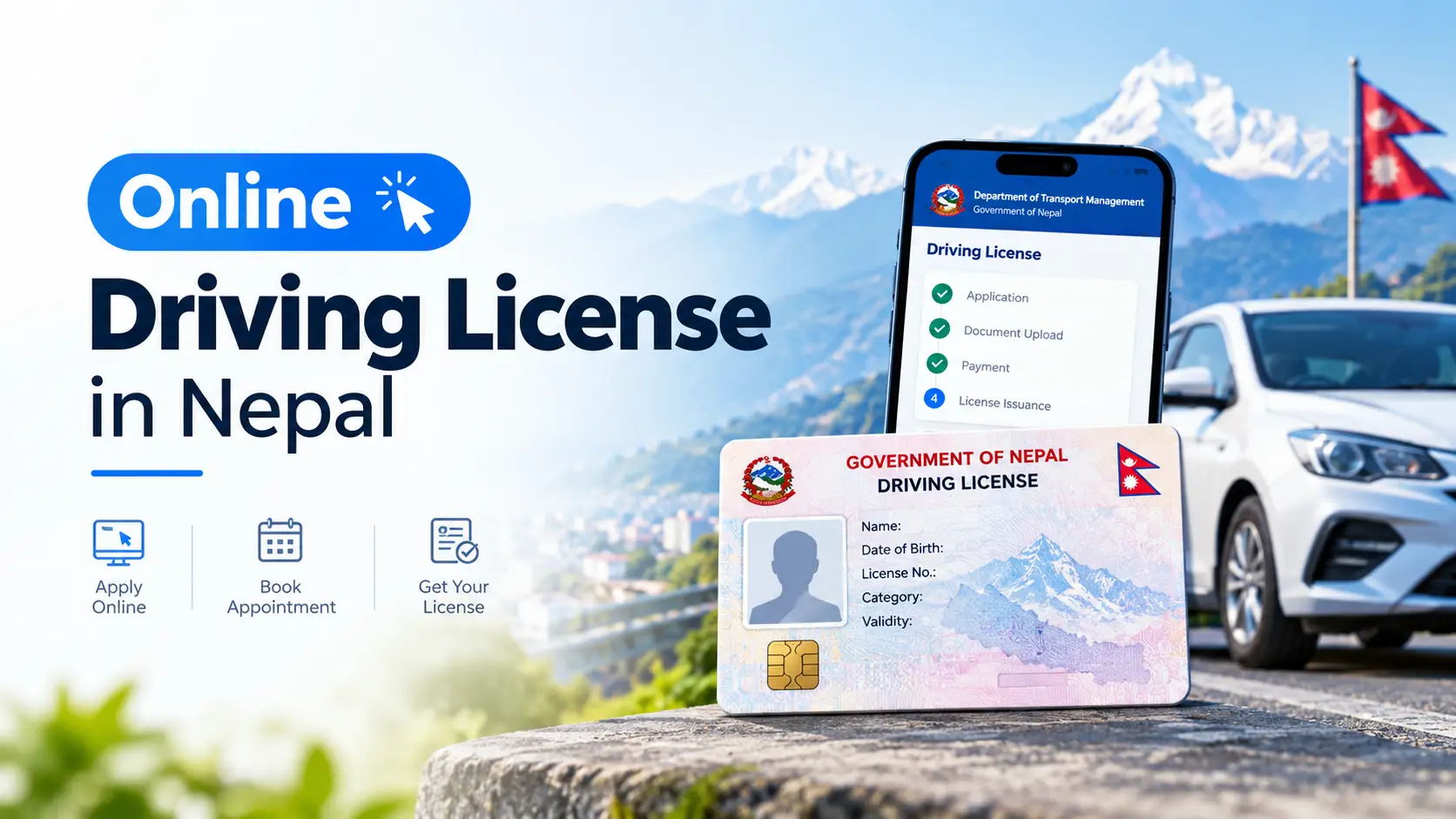
Printing stopped nationwide on 14 August 2026, after printing responsibility moved to the provinces and most of them had no agreement with the Security Printing Centre. It has since restarted under a new arrangement. Madhesh and Lumbini have signed their own agreements and started printing. Madhesh dispatched its first batch of about 3,000 cards in September. For the other five provinces, DoTM announced on 20 September 2026 that it and the Security Printing Centre will handle printing until each province signs its own agreement.
Printed cards now travel by post. Under an agreement signed on 6 Asoj 2083 between DoTM, the Security Printing Centre and the Department of Postal Services, cards go to your transport office, and the eDLVRS form lets you choose normal or express home delivery to your address. What this means for you: apply normally, keep your temporary slip until the card arrives, and check your status online before travelling to an office. We could not confirm that the old 24-hour emergency card service is back, so if you have a fixed travel date, read the realistic timeline section first.
- Where to apply: your province's own eDLVRS portal — not one national website. Start at edlvrs.dotm.gov.np and pick your province.
- The process: online form and fee → office visit for biometrics and documents → written (likhit) exam → trial → temporary slip → smart card by post.
- What's online: form filling, category selection, office and appointment booking, government fee payment, PDF licence download, print-status tracking and correcting errors on your licence.
- What still needs an office visit: biometrics, document verification, the written (likhit) exam and the trial.
- Cost: fees changed in FY 2083/84 and now differ by province. Category A/K is Rs 3,000; Category B is Rs 4,000 (Rs 5,000 in Madhesh). Application fee ranges Rs 500–1,000. Full table below.
- Login: scan the QR on your National ID card or use the Nagarik App to auto-fill your details.
What eDLVRS is, and why the old portal stopped working
The Department of Transport Management (DoTM) switched Nepal's driving licence services to eDLVRS — the Electronic Driving Licence and Vehicle Registration System — on 1 Shrawan 2083 (17 July 2026). If you last applied a year or two ago and are wondering why your bookmarked link is dead, that's why: the old central portal at applydlnew.dotm.gov.np has been retired, and the central data-centre issues in August 2026 finished it off. DoTM's electronic-services directive, in force from 31 Bhadra 2083, now gives eDLVRS its legal basis.
The structural change matters more than the new interface. Under Schedule 6 of Nepal's Constitution, vehicle taxes, registration and driving licences are provincial subjects. eDLVRS finally reflects that: instead of one national system, each of the seven provinces now runs its own portal on its own gov.np domain, with its own fee schedule, its own budget and its own printing arrangements.
That's the reason for almost every quirk in this guide — why fees differ between Bagmati and Madhesh, why you choose a portal by exam location rather than home district, and why printing stalled the moment responsibility moved down a level.
Step 1: pick the correct provincial portal
Use the portal for the province where you will sit your written exam and trial — not necessarily the province on your citizenship certificate. If you live and work in Kathmandu but hold a Dhanusha citizenship, you want Bagmati.
| Province | Official eDLVRS portal | Application fee (FY 2083/84) |
|---|---|---|
| Koshi | edlvrs.koshi.gov.np | Rs 1,000 |
| Madhesh | edlvrs.madhesh.gov.np | Rs 500 |
| Bagmati | edlvrs.bagamati.gov.np | Rs 1,000 |
| Gandaki | edlvrs.gandaki.gov.np | Rs 1,000 |
| Lumbini | edlvrs.lumbini.gov.np | Rs 500 |
| Karnali | edlvrs.karnali.gov.np | Rs 1,000 |
| Sudurpashchim | edlvrs.sudurpashchim.gov.np | Rs 750 |
Bagmati's domain is bagamati.gov.np (with the extra "a") and Sudurpashchim's is sudurpashchim.gov.np. Typo-squatting sites already exist for both. If you are ever unsure, go through the government hub at edlvrs.dotm.gov.np and click through — never pay a fee on a portal you reached from a Facebook post or a YouTube description.
What you can and cannot do online (the honest boundary)
Most guides describe eDLVRS as "fully online." That's the press-release framing. Here is the working reality:
✅ Genuinely online now
- New licence application form
- Renewal request
- Adding a vehicle category (श्रेणी थप)
- Duplicate licence and retrial requests
- Government revenue / fee payment
- Transport office and appointment selection
- Health check submitted by any NMC-registered doctor via the doctor portal
- PDF copy download and print-status tracking
- Choosing normal or express postal delivery of the card
- Correcting personal details (new, Sept 2026)
❌ Still requires you in person
- Biometric capture (photo, fingerprints, signature)
- Original document verification
- Written (likhit) exam
- Practical trial
- Card collection, unless you chose home delivery
So the honest saving is roughly this: the old process cost you a full day queuing for a form and a payment counter before you ever sat an exam. eDLVRS removes that day. It does not remove the exam day or the trial day.
Eligibility and documents: what stops applications before they start
Minimum age by category
| Category | Vehicles covered | Minimum age |
|---|---|---|
| A / K | Motorcycle, scooter | 16 years |
| B | Car, jeep, van, pickup | 18 years |
| C / D | Tempo, auto-rickshaw / power tiller | 18 years |
| E / F | Tractor / minibus, mini truck | 18 years |
| G / H / I / J | Truck, bus, road roller, dozer, crane, fire engine, excavator, backhoe loader | 21 years (heavy and commercial) |
There is no shortcut from A to B. Holding a Category A licence since 16 does not let you sit the Category B trial before 18. There is also no upper age limit — a question that comes up constantly and that almost no competing guide answers directly.
Documents checklist
- National ID card with a readable QR code, or the Nagarik App installed and logged in. NID has effectively become mandatory for licence services under eDLVRS.
- Original citizenship certificate plus a photocopy (both sides). A photocopy alone will get you turned away.
- Blood group report. It is asked for and printed on the card. "I think I'm O positive" is not an answer that works at the counter.
- Passport-size photograph, recent.
- Existing licence number if you are renewing or adding a category. Lost it? Our lost driving licence guide shows how to find your number and get a duplicate.
- Working mobile number and email — every OTP, booking confirmation and payment receipt goes there.
- A funded online payment method (eSewa, Khalti, ConnectIPS or bank) ready before you start.
Your name spelling on the form must match your citizenship certificate character for character. Not "close enough." A Shrestha spelled "Shreshtha" on one document and "Shrestha" on the other is the most frequent cause of a rejected or frozen application, and it is painful to unwind after payment. Since the NID auto-fill pulls from a different database than your citizenship, check the auto-filled fields rather than trusting them.
How to apply for a new driving licence online in Nepal
-
Prepare everything first — the session times out
A genuinely large share of the frustration people report with eDLVRS is starting the form and then hunting for a blood group report or a payment top-up while the session expires. Ten minutes of preparation saves a full restart. Lay out the documents above on the desk before you open the browser.
-
Open your province's portal and authenticate
Go to your provincial eDLVRS site, choose New Licence Application, then scan the QR code on your National ID card or log in through the Nagarik App. Your name, date of birth, parents' names and permanent address should auto-fill.
-
Fill the form and select your category
Pick the category carefully — fees and minimum ages differ, and changing it later is a correction request, not an edit. Choose your card delivery option (collect at the office, or normal or express post to your address) on the same form. Not sure what the trial for your category involves? Read our driving licence trial rules guide before you choose.
-
Choose your transport office and health-check location
Since Asar 2083, DoTM has instructed all seven provinces to accept a medical certificate from any doctor registered with the Nepal Medical Council, submitted through a dedicated doctor portal that verifies the NMC licence number in real time. You are no longer tied to a short list of clinics beside the transport office — which was the main choke point where middlemen operated.
-
Pay the government fee online
Pay through the eDLVRS gateway using eSewa, Khalti, ConnectIPS or a bank. Save the digital receipt — screenshot it and download the PDF. You will need it at the office, and portal outages at exactly the wrong moment are not rare.
-
Book your appointment
Select an available date for biometric enrolment and document verification. Slots go quickly in Bagmati and Lumbini; in Karnali and Sudurpashchim they are usually easy to get.
-
Attend in person with originals
Arrive with your original citizenship, National ID, application printout and payment receipt. Biometrics and verification happen here, and you'll be given your written exam date.
-
Pass the written (likhit) exam
Multiple-choice, drawn from DoTM's published question bank of roughly 500 questions, available in Nepali and English. The bank is public, which makes this one of the few exams in Nepal you can genuinely cover end to end. Read our Nepal driving licence mock test guide for the real exam format and a pass plan, then practise the DoTM questions free on our online likhit tool — aim for three full mock tests before exam day.
-
Pass the trial
Category A is the figure-of-eight track: control and balance, feet up throughout. Category B is a track section plus a road section, judged on control, observation and traffic-rule compliance. The trial, not the written exam, is where most people fail. Our trial rules guide covers the 70-mark sheet, the mistakes that fail you instantly, and how retrials work.
-
Collect your temporary slip — then track the card
After passing, you get a temporary driving slip that is legally valid until the smart card is issued. Keep it safe and carry it while you drive. Do not travel to the office to "check" — use our driving licence print status checker first.
You will find guides confidently stating 20 questions, 25 questions and 50 questions, with pass marks of 50%, 52% and 80%. They cannot all be right. The format varies by category and by office, and some pages are simply recycling pre-2026 figures. The reliable facts are: the questions come from the official DoTM bank, the paper is MCQ, and you can take it in Nepali or English. Confirm the exact count and pass mark on your booking confirmation or at your transport office — and prepare from the full bank, which makes the question count irrelevant anyway.
How to renew your driving licence online
Renewal is the process that benefits most from eDLVRS, because it used to be almost entirely queuing.
Log in and choose Licence Renewal
Authenticate via NID QR or Nagarik App, then enter your existing licence number to link the record. The system pulls up your categories so you can confirm you're renewing the right ones.
Confirm and update your details
If your address or citizenship details have changed since your original application, update them here with supporting documents.
Select health-check location and transport office
Same NMC-doctor arrangement as a new application.
Pay — including any penalty
If you are past the grace period, the system calculates the late penalty and adds it automatically. The total you see already includes the fine.
Attend your appointment
Medical check, biometric capture and document verification with originals.
We've written a dedicated walkthrough with screenshots of each renewal screen in our online driving licence renewal guide.
Validity, grace period and penalties
- Validity is now 10 years for new and renewed licences under the FY 2083/84 provincial Economic Acts — up from the long-standing 5 years. If your existing card was issued before this change, it still shows 5 years. Trust the expiry date printed on your card, not a general rule you read somewhere.
- Renew early if you can. The new validity period runs from your existing expiry date, not your renewal date, so renewing a month early costs you nothing.
- There is a grace period after expiry before penalties start, but reported figures vary (35 days and 90 days are both circulating) and penalty schedules now sit with each province. Our driving licence renewal fine guide has the penalty table; check your own province's current schedule before paying.
- Driving on an expired licence is illegal even inside the grace period. The grace period waives the renewal penalty; it does not authorise you to drive.
New in September 2026: fix errors on your licence online
This is the most useful eDLVRS addition since launch, and as of this writing almost no other guide in Nepal has covered it. DoTM has added a Licence Correction Application module, so minor personal-detail errors no longer require a trip to the transport office.
What you can correct: first name, surname, date of birth, parents' names, permanent address, mobile number and email address.
How it works:
- Open your province's eDLVRS homepage and click "License Correction Application" at the bottom left.
- Enter your name, National ID number, a photo of your National ID card, your licence number, mobile number and email.
- Click Continue — an OTP arrives on your registered mobile. Enter it.
- From the dashboard, select the fields you want corrected and enter the correct values.
- Confirm the details are accurate and click Submit Update Request. The system shows a final review screen; cancel if anything is wrong, or click Yes, Submit.
- The request routes to your transport office for verification and approval. Once approved, the corrected details appear in the online system.
Your corrected details must match your National Identity Card. The correction service is a reconciliation tool against NID data, not a free-text edit. If your NID itself carries the error, fix the NID first — otherwise the request will be rejected and you will have spent the effort twice.
Driving licence fees in Nepal 2083/84 — and why they differ by province
This is where most articles you'll find online are now actively wrong. Many still quote Rs 1,500 for a bike and Rs 2,000 for a car, and several state that "fees have not changed, they've only moved online." Fees roughly doubled from 17 July 2026 when each province enacted its own Economic Act 2083.
New licence and renewal fees
| Category | Vehicles | Six provinces | Madhesh | Previous (FY 2082/83) |
|---|---|---|---|---|
| A / K | Motorcycle, scooter | Rs 3,000 | Rs 3,000 | Rs 1,500 |
| B / E / F | Car, jeep, van / tractor / minibus, mini truck | Rs 4,000 | Rs 5,000 | Rs 2,000 |
| C / D | Tempo, auto-rickshaw / power tiller | Rs 4,000 | Rs 4,000 | Rs 2,000 |
| G / H / I / J | Truck, bus, lorry, road roller, dozer, crane, fire engine, loader, excavator, backhoe | Rs 6,000 | Rs 7,000 | Rs 3,000 |
Application and category-addition fees
| Province | Application fee | Add category A–F | Add category G–J |
|---|---|---|---|
| Madhesh, Lumbini | Rs 500 (unchanged) | Rs 1,000 | Rs 2,000 |
| Sudurpashchim | Rs 750 (+50%) | Rs 750 | Rs 750 |
| Koshi, Bagmati, Gandaki, Karnali | Rs 1,000 (doubled) | Rs 1,000 | Rs 2,000 |
Why the same service costs different amounts in different provinces
Because the federal government cannot set these rates. Under Schedule 6 of the Constitution, provinces hold exclusive authority over vehicle taxes, registration fees, service charges and penalties. DoTM officials have said plainly that they have no power to alter provincial fees or to interfere with those decisions. Provinces could coordinate on a uniform national schedule if they chose to — so far they have not.
Practical consequence: a Category B licence costs Rs 4,000 in Bagmati and Rs 5,000 in Madhesh, and the application fee is double in Bagmati what it is in Lumbini. Before you assume this creates an arbitrage opportunity: you should apply in the province where you will actually test and collect, and travelling for a trial you then have to repeat is a false economy. But if you genuinely split time between two provinces, it is worth a minute's arithmetic.
How long does it actually take? (A realistic timeline)
| Stage | Typical wait | Notes |
|---|---|---|
| Online form + payment | 20–40 minutes | Same day, if documents are ready |
| Biometric / verification appointment | Days to a few weeks | Slot availability varies sharply by province |
| Written exam | Scheduled at verification | Result usually same day or next |
| Trial | Booked after written pass | Retake possible if you fail; fee applies |
| Temporary slip | Immediately after passing trial | Legally valid for driving |
| Smart card printing and delivery | Varies by province | Printing restarted from September 2026; cards go by post to your office or home. Expect delays while the new system settles. |
The government's promise when eDLVRS launched was a card within 24 hours of data submission. That promise collapsed when printing responsibility transferred to provinces that had not budgeted for it, and printing stopped from 14 August 2026.
The current arrangement has three parts. Madhesh and Lumbini have their own agreements with the Security Printing Centre and print cards for their applicants. Koshi, Bagmati, Gandaki, Karnali and Sudurpashchim are covered by a federal arrangement announced on 20 September 2026, under which DoTM and the Security Printing Centre print cards until each province signs its own deal. Printed cards are sent by post to your transport office, or to your home if you chose postal delivery on the form.
We could not confirm that the 24-hour emergency card service has come back under the new system, so do not build a travel plan around receiving a physical card within days. Complete your process early so you hold a valid temporary slip and your record exists in the system, download the PDF copy from your provincial portal, choose express postal delivery if it is offered, and if you have documented urgency, take it to your transport office in person and ask what they can issue in writing.
If you're a Nepali living abroad
eDLVRS quietly solved a real problem for the diaspora. Previously, a licence expiring while you were in Qatar, Japan, Australia or the US meant burning vacation days in a Kathmandu queue. Now the renewal request and fee payment can be handled from anywhere with a browser, so the paperwork is done before you land and your in-person step is a single short visit rather than a week of them.
Three caveats that matter more than the convenience:
- You still need the in-person biometric and verification step in Nepal. Plan one office day into your trip.
- The card may not be printed before you fly back out. Choose postal delivery to a family member's address in Nepal, or ask your office about collection by an authorised family member and confirm what they'll accept in writing.
- A Nepali licence alone does not let you drive in most foreign countries. You need an International Driving Permit issued against a valid, unexpired Nepali licence — so if yours is expiring, renew first, then follow our International Driving Permit guide.
What I'd tell a friend applying this month
Having walked family members through this system in Bagmati since the switch, a few things I'd only know from doing it rather than reading about it:
- Do the form on a laptop, not a phone. The portals are mobile-responsive in theory. In practice the NID QR scan plus a payment gateway redirect plus a session timer is a combination that fails more often on mobile data than on a desktop with stable wi-fi.
- Screenshot every screen after you hit submit. Payment receipt, application number, appointment confirmation. When a portal has an off day — and they do — the screenshot is what gets you taken seriously at the counter.
- The NID auto-fill is a starting point, not gospel. Read every auto-filled field before you continue. I've seen a correct NID auto-fill a middle name that the citizenship certificate does not carry, which then has to be unwound through the correction module.
- Book the earliest appointment slot of the day. Biometric queues compound through the morning and a 10 AM slot can become a 1 PM reality.
- For Category B, practise the road section, not just the track. Everyone drills the figure-of-eight. The road portion — mirror checks, indicating properly, holding lane discipline at a junction — is where examiners actually fail people who can clearly drive.
- Do the full question bank once. It sounds like a lot for a 20-something-question paper. It takes about three focused evenings and it removes the entire category of "I got unlucky with the questions."
Ready to sit the likhit? Run through the real DoTM question bank free — in Nepali or English, with mock-exam timing and instant scoring. No login, works on mobile data.
Start free practice exam →Common mistakes that cost people time and money
- Name mismatch with citizenship. The number-one cause of frozen applications.
- Applying for Category B before turning 18. There is no early route, no exception, and the fee is not refunded cleanly.
- Bringing only a photocopy of citizenship. Originals, every time.
- Not knowing your blood group. It goes on the card and it will be asked.
- Using the wrong province's portal. Choose by where you will test, not where you were born.
- Quoting last year's fee to yourself and not funding your wallet. Category B is Rs 4,000 now, not Rs 2,000, plus the application fee.
- Paying on a lookalike domain. Only
gov.npaddresses reached via the official hub. - Assuming the PDF copy is a licence. It's a convenience copy — currently not accepted as valid identification during traffic checks. Carry the physical card or your temporary slip.
- Nepal Driving Licence Mock Test: free likhit practice and real exam format
- Driving Licence Trial Rules: 70-mark sheet, instant fails and retrial
- Renew Driving Licence Online: step-by-step guide
- Driving Licence Renewal Fine: grace period and penalty table
- Driving Licence Print Status Check Online
- Lost Driving Licence: police report, duplicate licence and finding your number
- International Driving Permit Nepal: documents, fees and process
Frequently asked questions
How do I get a driving licence in Nepal?
Fill the new licence form on your province's eDLVRS portal and pay the fee online, attend your appointment for biometrics and document checks, pass the written (likhit) exam, then pass the trial. You get a temporary slip straight away, and the smart card is printed and sent by post to your transport office or home.
Can I get a driving licence in Nepal completely online without visiting an office?
No. The form, fee payment, appointment booking, health-check submission and licence correction are online. Biometric capture, document verification, the written exam and the trial still require you to attend in person. For a new licence, expect at least two office visits — verification/written exam, then trial.
Which eDLVRS portal should I use?
The portal for the province where you will take your written exam and trial. That's usually where you live and work, not necessarily where your citizenship was issued. Start at edlvrs.dotm.gov.np and click through to the correct province.
Why did applydlnew.dotm.gov.np stop working?
The old central portal was retired when eDLVRS launched on 17 July 2026, and it was fully suspended in August 2026 after technical problems at DoTM's central data centre. The provincial eDLVRS portals run on separate infrastructure and are the correct route now.
How much does a driving licence cost in Nepal in 2026?
Category A/K (motorcycle, scooter) is Rs 3,000. Category B, E and F is Rs 4,000 in six provinces and Rs 5,000 in Madhesh. Heavy categories G to J are Rs 6,000 (Rs 7,000 in Madhesh). On top of that, the application fee is Rs 500 in Madhesh and Lumbini, Rs 750 in Sudurpashchim, and Rs 1,000 in Koshi, Bagmati, Gandaki and Karnali. These rates took effect on 17 July 2026 under each province's Economic Act 2083.
Why are driving licence fees different in different provinces?
Schedule 6 of Nepal's Constitution gives provinces exclusive authority over vehicle taxes and transport service fees. Each province set its own rates in its FY 2083/84 Economic Act. DoTM has stated it has no power to change or override provincial fee decisions.
Is my driving licence valid for 5 years or 10 years?
New and renewed licences under the FY 2083/84 provincial Economic Acts carry 10-year validity, up from the previous 5 years. Cards issued before this change still show 5 years. The expiry date printed on your card and shown in your eDLVRS profile is authoritative — go by that.
Are driving licence cards being printed now?
Yes. Printing stopped from 14 August 2026 and restarted from September under a new arrangement. Madhesh and Lumbini print through their own agreements with the Security Printing Centre, and DoTM handles printing for the other five provinces until they sign their own. Cards are sent by post to your transport office or your home. Your temporary slip stays legally valid for driving until the card arrives.
Can I fix a spelling mistake on my licence without going to the office?
Yes, as of September 2026. Use the "License Correction Application" link on your province's eDLVRS homepage to correct your first name, surname, date of birth, parents' names, permanent address, mobile number or email. The corrected details must match your National Identity Card, and the request is verified and approved by your transport office.
Do I need a National ID card to apply?
Effectively yes — NID has been made compulsory for driving licence services under eDLVRS, and the correction module explicitly validates against NID data. You can authenticate either by scanning the QR on the physical card or through the Nagarik App.
Can any doctor do my medical check now?
Any doctor registered with the Nepal Medical Council can submit your health verification through the eDLVRS doctor portal, which verifies the NMC licence number in real time. DoTM circulated a directive to all seven provinces to recognise these certificates, specifically to break the clinic bottleneck near transport offices.
Is the downloadable PDF licence legally valid?
Not as identification during traffic checks. It's a convenience copy. Keep carrying your physical smart card, or your temporary slip if the card hasn't arrived yet.
Can I renew from abroad?
You can complete the renewal request and fee payment from abroad. The biometric and verification step still requires one in-person visit in Nepal, so the practical benefit is having everything else done before you land. Because the card may not be ready within a short trip, choose postal delivery to an address in Nepal where someone can receive it.
Sources
- Department of Transport Management — official eDLVRS portal hub: edlvrs.dotm.gov.np
- DoTM notice on eDLVRS online operation, 32 Asar 2083; NMC doctor-portal directive, Asar 2083
- DoTM electronic-services directive, in force from 31 Bhadra 2083
- Provincial Economic Acts 2083 (FY 2083/84) fee schedules, as reported 23 July 2026
- DoTM statements on the printing suspension and pending licence volume, 16 September 2026
- DoTM announcement of the eDLVRS licence correction module, 15 September 2026
- DoTM and Security Printing Centre printing arrangement for provinces without agreements, 20 September 2026; Madhesh and Lumbini provincial printing agreements
- DoTM, Security Printing Centre and Department of Postal Services card-distribution agreement, 6 Asoj 2083