No Results Found
The page you requested could not be found. Try refining your search, or use the navigation above to locate the post.


Cash App is a revolutionary payment platform that has taken the world by storm, providing an effortless and seamless means of transferring funds by merely scanning a QR code. With its user-friendly interface and a suite of comprehensive financial services, Cash App is quickly becoming the go-to choice for individuals seeking to manage their finances in a safe, fast, and cost-efficient manner.
In Nepal, the Cash App has found its niche as a platform for purchasing Google Play Store products, such as paid apps, subscriptions, and game coins. Additionally, Cash App can also be used to purchase domains and hosting services. However, it must be noted that using Cash App for boosting purposes on Facebook is discouraged, as this may result in the blacklisting of your account by Facebook. This information is shared from personal experience with the app.
Despite the convenience of transferring money through Cash App, there is one significant disadvantage, as it only facilitates transfers from Cash App to bank accounts, and not vice versa. However, Cash App also offers the unique opportunity to invest in Bitcoin, starting as low as $1, making it an accessible option for those seeking to diversify their investment portfolio. It is imperative to remember that while investing in Bitcoin can be lucrative, it also carries a certain degree of risk, and it is advisable to store it in a secure location to mitigate the possibility of hacking attacks.
In conclusion, Cash App is a pioneering financial platform that offers a multitude of services and benefits, providing an unprecedented level of ease and accessibility in managing one’s finances. However, it must be acknowledged that its use is not legally recognized in Nepal and may involve transactions in digital currency, which are not sanctioned by Nepalese law.
The page you requested could not be found. Try refining your search, or use the navigation above to locate the post.
Are you looking for a Nepali Unicode converter?
You are in the right place, you will find an easy and quick English and Nepali Unicode converter plus a converter for Unicode to Preeti Font. So that you can perform both tasks on the same page. I have created this because it was not available on another site.
I use this page everyday in my day to day life for my work like Graphic designing, blogging, and Nepali Documentation.
Easy way to convert English letters to Nepali letters Unicode. No need to know Nepali Typing, now you can convert English alphabets to Nepali letters. It automatically translates your English letter into Nepali letters.
You can use this in sending messages, Graphic design, Documents, or letter typing.
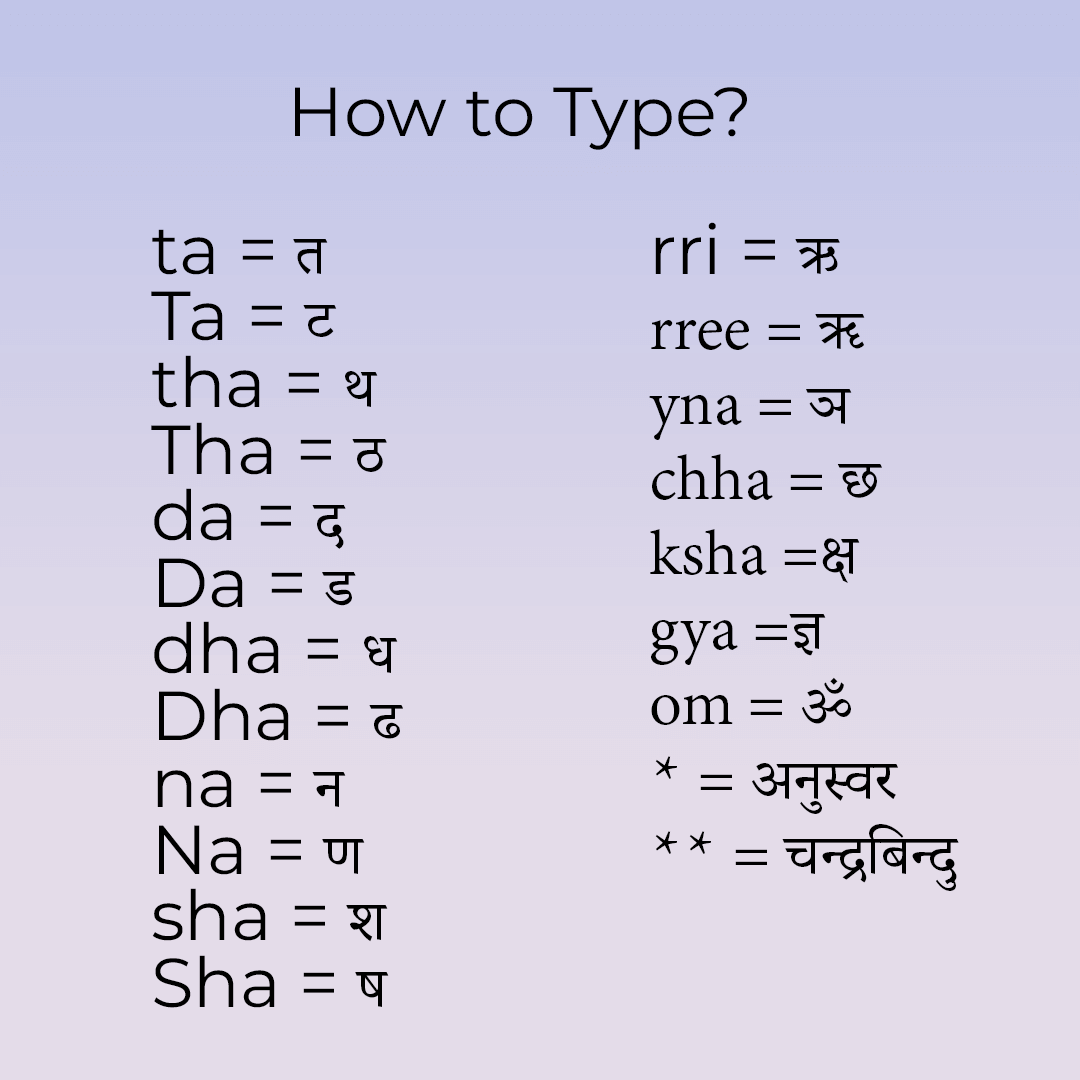
Kalimati Download
Here you can also download the popular fonts for free. this page will help you to save you time.
I think it is the best page or site for Unicode converter. In this page, you will get the following:
Want to type Nepali directly instead of converting text? Learn the Preeti keyboard with Typeshala, the free Nepali typing tutor for Windows.
Laxmi Prasad Devkota Biography in Nepali · लेखक: विल्सन श्रेष्ठ · अद्यावधिक: २०८३ असोज · पढ्न लाग्ने समय: करिब १२ मिनेट
लक्ष्मीप्रसाद देवकोटा (वि.सं. १९६६–२०१६) नेपाली साहित्यका ‘महाकवि’ हुन्। उनले नेपाली भाषाको पहिलो महाकाव्य शाकुन्तल र नेपालमा सबैभन्दा धेरै बिक्री हुने किताब मानिने मुनामदन लेखे। कविता, महाकाव्य, निबन्ध, नाटक र उपन्यास गरेर उनका कृतिहरू सयौँ छन्। उनी त्रिचन्द्र कलेजका प्राध्यापक र वि.सं. २०१४ मा नेपालका शिक्षामन्त्री पनि भए।
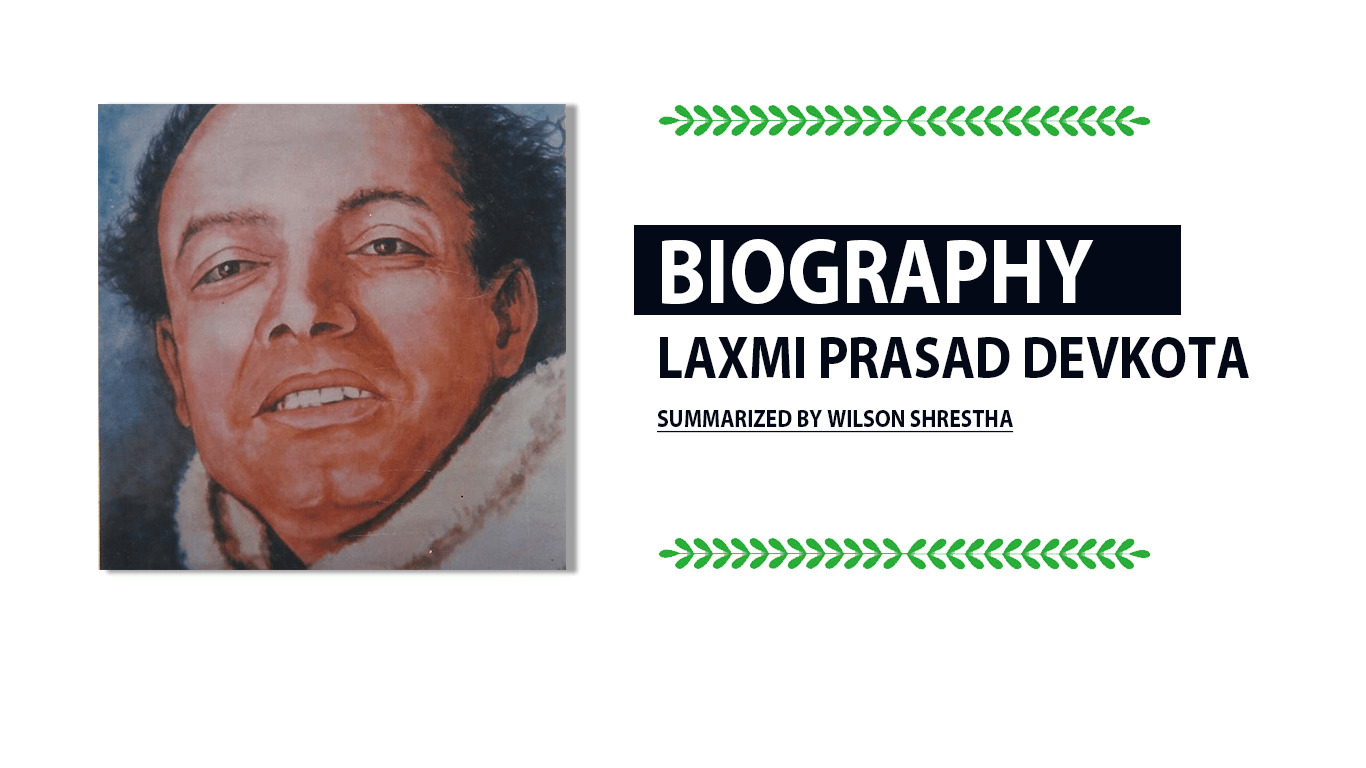
लक्ष्मीप्रसाद देवकोटाको जन्म वि.सं. १९६६ कात्तिक २७ गते (१२ नोभेम्बर १९०९) काठमाडौँको धोबीधारामा भएको थियो। उनका बुबा पण्डित तिलमाधव देवकोटा संस्कृतका विद्वान् र कवि थिए, र आमा अमरराज्यलक्ष्मी देवी थिइन्।
उनी तिहारको लक्ष्मीपूजाको रात जन्मिएका थिए। बुबाले छोरालाई लक्ष्मीको प्रसाद ठानेर ‘लक्ष्मीप्रसाद’ नाम राखिदिए। न्वारानमा भने उनको नाम तीर्थमाधव देवकोटा राखिएको थियो।
परिवारको आर्थिक अवस्था कमजोर थियो। तर घरमा संस्कृत, पुराण र कविताको वातावरण थियो। बुबाबाट पाएको यही साहित्यिक संस्कार नै देवकोटाको पहिलो प्रेरणा बन्यो।
देवकोटाको बाल्यकाल राणा शासनमा बित्यो। त्यतिबेला आम जनतालाई पढ्न दिइँदैनथ्यो। राणाहरूलाई शिक्षित जनताले आफ्नो शासनविरुद्ध आवाज उठाउलान् भन्ने डर थियो। उपत्यकामा पढ्न पाइने औपचारिक विद्यालय प्रायः दरबार हाईस्कुल मात्र थियो। देवकोटाले त्यहीँ संस्कृत व्याकरण र अङ्ग्रेजी पढे।
उनले पटना बोर्डबाट मेट्रिक पास गरे र सन् १९२५ तिर त्रिचन्द्र कलेजमा विज्ञान विषयमा भर्ना भए। पछि उनी कला संकायमा सरे र स्नातक (बी.ए.) पूरा गरे। उनी अङ्ग्रेजीमा स्नातकोत्तर पढ्न चाहन्थे। तर पटनामा अङ्ग्रेजीमा सिट नपाएपछि उनले सन् १९३१ तिर पटना विश्वविद्यालयबाट कानुनमा स्नातक (बी.एल.) गरे। घरको आर्थिक अवस्थाले गर्दा उनले स्नातकोत्तर पढाइ पूरा गर्न सकेनन्।
उनले दस वर्षको उमेरदेखि नै कविता लेख्न थालिसकेका थिए। उनी अङ्ग्रेजी साहित्य, विशेष गरी वर्डस्वर्थ, शेली र बायरनजस्ता रोमान्टिक कविबाट धेरै प्रभावित थिए।
देवकोटाको विवाह सानै उमेरमा, करिब १५ वर्षको हुँदा, मनदेवी चालिसेसँग भएको थियो। उनीहरूका चार छोरा र पाँच छोरी गरी नौ सन्तान भए। तीमध्ये केही सानैमा बिते।
आमाबुबाको निधन र दुई महिनाकी छोरीको मृत्युपछि देवकोटा गहिरो शोकमा परे। सन् १९३९ (वि.सं. १९९६) मा उनी करिब पाँच महिना भारतको राँचीस्थित मानसिक अस्पतालमा उपचाररत रहे। यही अनुभवले पछि उनको चर्चित कविता पागललाई जन्म दियो।
उनका छोरा पद्म देवकोटा पनि कवि र लेखक हुन्। उनले धेरै वर्ष त्रिभुवन विश्वविद्यालयको अङ्ग्रेजी विभागमा प्राध्यापन गरे।
पढाइ सकेपछि देवकोटाले नेपाली भाषा प्रकाशिनी समितिमा जागिर खाए। त्यो संस्थाले प्रकाशन हुने किताबको जाँच र अनुवादको काम गर्थ्यो। उनले त्रिचन्द्र कलेज र पद्मकन्या कलेजमा प्राध्यापन पनि गरे। तर जागिरबाट हुने आम्दानीले घरखर्च मुस्किलले धान्थ्यो।
आर्थिक अभावका बीच पनि उनको लेखन रोकिएन। उनी अत्यन्तै छिटो लेख्थे। भनिन्छ, उनले शाकुन्तल महाकाव्य करिब तीन महिनामा, सुलोचना करिब दस दिनमा र कुञ्जिनी खण्डकाव्य एकै दिनमा लेखे।
“मानिस ठूलो दिलले हुन्छ, जातले हुँदैन”— मुनामदन, लक्ष्मीप्रसाद देवकोटा
मुनामदन देवकोटाको सबैभन्दा चर्चित खण्डकाव्य हो। नेपाली साहित्यको इतिहासमा यसलाई सबैभन्दा धेरै बिक्री भएको किताब मानिन्छ। यो नेवारी लोकगीत ‘जि वया ला लाछि मदुनि’को कथामा आधारित छ र झ्याउरे लयमा लेखिएको छ।
कथामा मदन पैसा कमाउन पत्नी मुनालाई छोडेर ल्हासा जान्छ। फर्कँदा बाटोमा बिरामी पर्छ र एक भोटेले उसको ज्यान बचाउँछ। घर पुग्दा भने मुना र आमा दुवै बितिसकेका हुन्छन्। पैसाभन्दा माया र मानवता ठूलो हुन्छ भन्ने यसको सन्देश आज पनि उत्तिकै सान्दर्भिक छ।
सन् २००३ मा यसैमा आधारित फिल्म मुनामदन बन्यो। त्यो फिल्म ७६औँ एकेडेमी अवार्ड (Oscar) मा नेपालको आधिकारिक प्रविष्टि भएको थियो। पुस्तकको पूरा कथा र समीक्षा पढ्न हाम्रो मुनामदन पुस्तक समीक्षा हेर्नुहोस्।
देवकोटाले साहित्यका लगभग सबै विधामा कलम चलाए। तल विधाअनुसार उनका प्रमुख कृतिहरू दिइएका छन्।
| विधा | प्रमुख कृतिहरू |
|---|---|
| महाकाव्य | शाकुन्तल (वि.सं. २००२), सुलोचना (वि.सं. २००३), वनकुसुम, महाराणा प्रताप, पृथ्वीराज चौहान, प्रमिथस |
| खण्डकाव्य / लामो कविता | मुनामदन, कुञ्जिनी, रावण–जटायु युद्ध, लूनी, राजकुमार प्रभाकर, सीताहरण, म्हेन्दु, धूम्रकेतु, दुष्यन्त–शकुन्तला भेट |
| कविता सङ्ग्रह / फुटकर कविता | भिखारी, पागल, गाइने गीत |
| बाल कविता | पुतली, सुनको बिहान |
| गीतिनाटक | कृषिबाला |
| उपन्यास | चम्पा |
| निबन्ध | लक्ष्मी निबन्धसङ्ग्रह (यसमा ‘भलादमी’ र ‘के नेपाल सानो छ?’ जस्ता चर्चित निबन्ध छन्) |
| अङ्ग्रेजी रचना / अनुवाद | अङ्ग्रेजीमा कविता, निबन्ध र नाटक; The Witch Doctor and Other Essays (मरणोपरान्त सङ्कलन) |
वि.सं. २००२ (सन् १९४५) मा प्रकाशित शाकुन्तललाई नेपाली भाषाको पहिलो महाकाव्य मानिन्छ। यो कालिदासको प्रसिद्ध नाटक अभिज्ञानशाकुन्तलम्मा आधारित छ। यसको भाषा संस्कृतप्रधान छ र छन्दको प्रयोग निकै सशक्त छ।
पागल मुक्तछन्दमा लेखिएको देवकोटाको चर्चित कविता हो। समाजले ‘पागल’ भन्ने मान्छेको नजरबाट यसले पाखण्ड, अन्याय र संवेदनहीनतामाथि प्रहार गर्छ। नेपाली भाषाका उत्कृष्ट कवितामध्ये यसलाई पनि गनिन्छ।
देवकोटा राणा शासनको कडा आलोचक थिए। राणाविरोधी आन्दोलनताका उनी भारतको बनारस (वाराणसी) गए। त्यहाँ उनले नेपाली कांग्रेसको पत्रिका युगवाणीको सम्पादन गरे। राणा शासन अन्त्य भएपछि उनी नेपाल फर्किए।
वि.सं. २००८ मा राजा त्रिभुवनले उनलाई नेपाल सल्लाहकार समितिको सदस्य बनाए। वि.सं. २०१४ साउनदेखि (सन् १९५७ जुलाई २६) करिब दस महिना उनी कुँवर इन्द्रजित सिंहको सरकारमा शिक्षा तथा स्वायत्त शासन मन्त्री भए। उनी नेपाल राजकीय प्रज्ञा-प्रतिष्ठानसँग पनि आबद्ध थिए।
उनको कार्यकालमा त्रिभुवन विश्वविद्यालय स्थापनाको तयारी भइरहेको थियो। तर विश्वविद्यालय औपचारिक रूपमा वि.सं. २०१६ (सन् १९५९) मा मात्र स्थापना भयो, अर्थात् उनको मन्त्री कार्यकाल सकिएपछि।
वि.सं. २०१५ (सन् १९५८) मा देवकोटालाई क्यान्सर भएको पत्ता लाग्यो। उपचारका लागि उनी भारत पनि गए। त्यसै वर्ष उनी ताशकन्दमा भएको एफ्रो-एसियाली लेखक सम्मेलनमा सहभागी भए। अनुमति नलिई गएको भन्दै प्रज्ञा-प्रतिष्ठानले उनको पारिश्रमिक रोक्यो। जीवनको अन्तिम समयमा उनीसँग औषधि र खानाको खर्च जुटाउन समेत पैसा थिएन।
रोगले थलिएका बेला पनि उनले लेख्न छोडेनन्। वि.सं. २०१६ भदौ २९ (१४ सेप्टेम्बर १९५९) मा पशुपतिको आर्यघाटमा ४९ वर्षको उमेरमा उनको निधन भयो।
| वि.सं. | ई.सं. | घटना |
|---|---|---|
| १९६६ कात्तिक २७ | १९०९ | धोबीधारा, काठमाडौँमा जन्म |
| १९७६ तिर | १९१९ | दस वर्षको उमेरदेखि कविता लेखन सुरु |
| १९८२ तिर | १९२५ | त्रिचन्द्र कलेजमा भर्ना |
| १९८८ तिर | १९३१ | पटना विश्वविद्यालयबाट बी.एल. |
| १९९२/९३ | १९३५/३६ | मुनामदन पुस्तकका रूपमा प्रकाशित |
| १९९६ | १९३९ | राँचीमा करिब पाँच महिना उपचार; ‘पागल’ को पृष्ठभूमि |
| २००२ | १९४५ | पहिलो नेपाली महाकाव्य ‘शाकुन्तल’ प्रकाशित |
| २००३ | १९४६ | ‘सुलोचना’ महाकाव्य प्रकाशित |
| २००७ अघि | १९४० को दशक | बनारसमा ‘युगवाणी’ को सम्पादन |
| २००८ | १९५१/५२ | नेपाल सल्लाहकार समितिको सदस्य |
| २०१४ | १९५७ | शिक्षा तथा स्वायत्त शासन मन्त्री |
| २०१५ | १९५८ | ताशकन्द लेखक सम्मेलनमा सहभागी; क्यान्सर पत्ता लाग्यो |
| २०१६ भदौ २९ | १९५९ | आर्यघाट, पशुपतिमा निधन |
SEE, कक्षा ११–१२ र लोकसेवा परीक्षामा बारम्बार सोधिने तथ्यहरू:
वि.सं. १९६६ कात्तिक २७ (१२ नोभेम्बर १९०९) मा, काठमाडौँको धोबीधारामा।
उनले नेपाली भाषाको पहिलो महाकाव्य ‘शाकुन्तल’ सहित धेरै महाकाव्य लेखे। उनले कविता, निबन्ध, नाटक र उपन्यास सबै विधामा असाधारण योगदान दिए। त्यसैले उनलाई ‘महाकवि’ भनिन्छ।
तीर्थमाधव देवकोटा।
लक्ष्मीप्रसाद देवकोटाको ‘शाकुन्तल’ (वि.सं. २००२)।
नेपाली लोकलय झ्याउरेमा।
वि.सं. २०१४ (सन् १९५७) मा, कुँवर इन्द्रजित सिंहको सरकारमा करिब दस महिनाका लागि।
वि.सं. २०१६ भदौ २९ (१४ सेप्टेम्बर १९५९) मा, क्यान्सरका कारण, पशुपतिको आर्यघाटमा।

Human wants are unlimited but resources are limited and those resources are supplied in less amount than the demand. It is known as Scarcity.
Choice refers to the ability of a consumer or producer to decide which good, service, or resource to purchase or provide from a range of possible options.
Human wants are unlimited, but the resources are limited and those resources are supplied in less amount than the demand. It is known as Scarcity.
Scarcity is the central problem of the economy because while resources are limited, we are living in a society with unlimited wants. Therefore we have to choose. We have to make trade-offs. We have to effectively allocate resources. We have to do these things because resources are limited and cannot meet our own unlimited demands. People are creating unlimited demands, but there is less supply than demand so, that’s why scarcity is the central problem of the economy. People have a choice to choose the resources which are available.
In conclusion, Scarcity is the main problem of the economy because we have to choose the limited resources over the unlimited wants.
Human wants are unlimited but resources are available to fulfill those wants are limited, they have alternative uses. The production possibility curve is also known as the production frontier curve or the production boundary curve to the production transformation curve.
Production possibility curve refers to locus focus of various alternative combinations of two commodities that can be produced utilizing the available means and resources and given technology by an economy in a certain time period
| Combinations | Consumer goods | Capital goods | Opportunity Cost |
|---|---|---|---|
| A | 0 | 10 | – |
| B | 1 | 9 | -1:1 |
| C | 2 | 7 | -2:1 |
| D | 3 | 4 | -3:1 |
| E | 4 | 0 | -4:1 |
This table shows combinations, consumer goods, capital goods, opportunity cost. Here, combination A(0, 10) shows 0 MT consumer goods and 10 MT capital goods. Combination B (1,9) shows 1 MT consumer goods and 9 MT capital goods. Combination C (2, 7) shows 2 MT consumer goods and 7 MT capital goods. Combination D(3, 4) shows 3 MT consumer goods and 4 MT capital goods. Combination E(4, 0) shows 4 MT consumer goods and 0 MT capital goods.
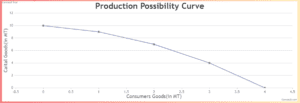
This figure shows that the x-axis measures consumer goods and the y-axis measures capital goods. In order to increase the production of one unit, more and more units of other goods have to be sacrificed since the resources are limited and are not equally efficient in the production of both the goods.
Hence, the resources are limited in order to increase the production of one good to the producer should have to sacrifice the production of other goods. The more unit of one commodity the more sacrifice of another commodity.
The movement of the entire PPC form from its initial position to an inward or outward position, due to various reasons is called a shift in the PPC curve.
If the PPC curve moves upward due to technological progress, the discovery of natural resources, increase in the productivity of human resources, increase in the capital investment and increase in the capital formation, increase in the size of the population, etc is known as a rightward shift in the PPC curve.
If the PPC curve moves backward or inward due to the backwardness in technology, shortage of natural resources, lack of capital investment, lack of machinery, lack of skilled human resources, decrease in size of the population, migration, etc is known as a leftward shift in PPC curve.
Dividing a whole task into different tasks and sub-tasks and done by separate labor according to skills, efficiency, and talent, etc is called division of labor.
If a task or work is entirely completed by a group of person then it will be known as a simple division of labor.
If the people are categorized into various occupational groups like farmers, teachers, carpenters, etc then it is known as occupational division of labor.
Dividing a whole task into different tasks and sub-tasks and done by separate labor according to skills, efficiency, and talent, etc is called complex division of labor.
If some part of the country is specializing in the production of some goods it is known as territorial or geographical division of labor.
The process of concentrating on and becoming an expert in a particular field, subject, or skills is a specialization of labor.
Economy is the system or the set of all activities related to production, consumption, and trade of goods and services in an area.
There are three types of economy. They are:-
The market economy is also known as a capitalist economy or free enterprise economy. In a market economy, all economic activities like production, consumption, distribution, exchange, etc are organized and carried out by private sectors and guided by profit motive through the market forces – demand and supply.
Market forces determine what to produce, how to produce, and whom to produce. Demand or supply of resources determines their respective share in total income. Similarly, demand for and supply of goods and services determine the equilibrium price and quantity in the market. There is no extra tax or subsidy on goods and services. Consumers are free to decide their consumption or saving. There is no control over consumption level from the side of the government. Individuals can conduct international trade themselves. There is no control over export and import. The private sector is the backbone of economic development.
Hence, Government is the monitor and supervisor of the economy, US, UK, Japan, Germany are the example of a market economy.
An economy in which all the economic activities are carried out by the central government for public welfare is called a command economy. A socialist economy is also known as a controlled economy or planned economy. In a socialist economy, resources are controlled by the state or government through the central planner.
In a socialist economy, all the wages, rent, interests, and profit are fixed by the government. The government decides what to produce, how to produce, and whom to produce. There is no existence of private property. In this economy, people are not guided by self-interest. They are guided by the interest of the nation. All the prices are set by the government since there is no private sector.
Hence, consumers are not free to choose goods and services for consumption. The government manages all economic activities. Some of the examples of socialist economies are North Korea, China, and the Former Soviet Union.
An economy in which economic activities are partly conducted by the government and private sector is called a mixed economy.
A mixed economy consists of both features of a socialist economy as well as a capitalist economy. Both government and private sector work together in this mixed economy. Major roles of the government are: providing security, supplying money, maintaining law and order, developing infrastructure, and so on. The private sectors are free to do their activities under the rules and regulations of the government.
Hence, production and distribution are managed and controlled by private sectors for the purpose of self-interest and profit earnings. The government sector prepares and implements policy instruments to control and regulate private enterprises directly and indirectly. Some of the examples of mixed economies are Nepal, India, Pakistan, Bangladesh, etc.
A market is a place or process where buying and selling of goods and services take place.
1) Perfect Competition Market
A market system in which a large number of sellers sell a homogeneous product to a large number of consumers
is known as perfect competition.
Features
2) Monopoly Market
Monopoly is a market system in which there is only one product supplier and a high number of customers.
Features
3) Imperfect Competition Market
I) Duopoly
Duopoly refers to market arrangements in which there are only two sellers of a product.
II) Oligopoly
Oligopoly is a market in which there are few sellers and numerous customers.
III) Monopolistic Competition
The market structure in which a big number of sellers sell differentiated heterogeneous items to a large
number of consumers is referred to as monopolistic competition.
Revenue
Revenue is the monetary value obtained by a company or industry through the selling of goods and services.
Total Revenue
Total revenue is the total amount of sales receipts or money value collected by a business or industry from
the sale of varied amounts of goods within a certain time period.
Average Revenue
The average revenue of a product is the revenue per unit of a product. The ratio of total revenue to quantity
is known as average revenue.
Marginal Revenue
Marginal revenue is the additional income received by a company or industry by selling one more unit of
production. Marginal revenue is defined as the ratio of change in total revenue to change in quantity.
Nature under perfect competition market
Nature under monopoly market
| Units | Price | TR | AR | MR |
|---|---|---|---|---|
| 1 | 5 | 5 | 5 | 5 |
| 2 | 5 | 10 | 5 | 5 |
| 3 | 5 | 15 | 5 | 5 |
| 4 | 5 | 20 | 5 | 5 |
| 5 | 5 | 25 | 5 | 5 |
| 6 | 5 | 30 | 5 | 5 |
| 7 | 5 | 35 | 5 | 5 |
The units of several commodities are shown in the table above. The table also displays the price, TR, MR, and
AR. In a perfect competitive market, the commodity price remains constant. TR is the product of the price and
the number of units. TR and units are averaged to form AR. The MR is the ratio of the change in TR to the
change in quantity.
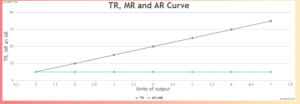
The y-axis in the above table represents TR, MR, and AR, while the x-axis represents the units of output. In
this case, TR increases at a constant rate while MR and AR stay constant.
Relationship between TR, AR, and MR under perfect competition market
| Units | Price | TR | MR | AR |
|---|---|---|---|---|
| 1 | 10 | 10 | 10 | 10 |
| 2 | 9 | 18 | 8 | 9 |
| 3 | 8 | 24 | 6 | 8 |
| 4 | 7 | 28 | 4 | 7 |
| 5 | 6 | 30 | 2 | 6 |
| 6 | 5 | 30 | 0 | 5 |
| 7 | 4 | 28 | -2 | 4 |
The above table shows the units of many commodities. The pricing, Total Revenue (TR), Marginal Revenue (MR),
and Average Revenue (AR) are also included in this table (AR). In a monopolistic market, the price of a
commodity declines. Total Revenue (TR) is calculated as the total of price and unit sales. Average Revenue is
calculated by dividing Total Revenue (TR) by the number of units sold (AR). The ratio of the change in Total
Revenue(TR) to the change in quantity is known as the margin of revenue (MR).


The y-axis in the following table indicates Total Revenue (TR), Marginal Revenue (MR), and Average
Revenue(AR), while the x-axis represents the units of output. Total Revenue (TR) rises at a decreasing rate
until it reaches its maximum and begins to drop, whereas Average Revenue (AR) decreases but never becomes 0
and Marginal Revenue (MR) not only decreases but also becomes 0 and negative.
Relationship between TR and MR under monopoly market
Relationship between AR and MR under monopoly market
Numerical Problems.
1. a) Considered the following table.
| Units | Price | TR | MR | AR |
|---|---|---|---|---|
| 1 | 10 | 10 | 10 | 10 |
| 2 | 8 | 16 | 6 | 8 |
| 3 | 6 | 18 | 2 | 6 |
| 4 | 4 | 16 | -2 | 4 |
| 5 | 2 | 10 | -6 | 2 |
b) What types of market is this?
This is a monopoly market.


2. a) Considered the following table.
| Units | Price | TR | MR | AR |
|---|---|---|---|---|
| 1 | 20 | 20 | 20 | 20 |
| 2 | 20 | 40 | 20 | 20 |
| 3 | 20 | 60 | 20 | 20 |
| 4 | 20 | 80 | 20 | 20 |
| 5 | 20 | 100 | 20 | 20 |
b) What types of market is this? Why?
This is a Perfect Competition Market because price remains constant in perfect competiotion
market.


3. a) You are given following table:
| Units | Price | TR | MR | AR |
|---|---|---|---|---|
| 1 | 10 | 10 | 10 | 10 |
| 2 | 10 | 20 | 10 | 10 |
| 3 | 10 | 30 | 10 | 10 |
| 4 | 10 | 40 | 10 | 10 |
| 5 | 10 | 50 | 10 | 10 |
| 6 | 10 | 60 | 10 | 10 |
| 7 | 10 | 70 | 10 | 10 |
b) Plot TR, MR and AR in Graph


c) What type of market is this?
This is a perfect competition market.
d) What is the nature of TR curve?
TR curve increases at constant rate.
4. a) Consider the following table:
| Units | Price | TR | MR | AR |
|---|---|---|---|---|
| 1 | 10 | 10 | 10 | 10 |
| 2 | 9 | 18 | 8 | 9 |
| 3 | 8 | 24 | 6 | 8 |
| 4 | 7 | 28 | 4 | 7 |
| 5 | 6 | 30 | 2 | 6 |
| 6 | 5 | 30 | 0 | 5 |
| 7 | 4 | 28 | -2 | 4 |
b) Plot TR, MR and AR in Graph


c) What type of market is this?
This is a monopoly market.
Basic concept of Cost
Cost
The sum of the price paid to the inputs like rent, interest, wages, and other by producer to produce goods and services is known as cost
1. Money cost
The value of payment made in terms of money to the inputs used in the production in the form of rent, wages, salaries, allowences, profit, interest and price of raw materials is known as money cost.
2. Real cost
Real cost is a sacrifice made by the producer while producing goods and services. For example, Discomfort, pain are some examples of real cost.
3. Accounting cost
Cost which are necessary for accounting purposes is known as accounting cost.
4. Explict cost
The monetary payment of cash expenditure which a firm makes to those inputs which are not owned by the firm itself are called explict cost.
5. Implict cost
Implict cost ia the contribution made by the producer and his/her family members but not paid to them in monetary terms.
6. Economic cost
Economic cost is the aggregate of explict cost and implict cost.
Economic cost = Explict cost + Implict cost
Short-Run cost
Short-run is a time interval, which is too short to change all factor of production. It means all factor of production are not variable in short-run. Some factors are fixed and some are variable. Cost incurred on both fixed and variable factor of production in the short-run is known as short run cost.
Fixed cost
The cost incurred on the fixed factor used in the process of production is known as fixed cost. In other words, fixed cost are those cost which in total do not change with any changes in output.
Variable cost
Variable cost is the cost incurred on the purchase of variable factors used in the production. In other words, variable cost are those cost which vary directly with production.
Total cost
The overall amount of cost incurred by the producer while producing various units of goods and services in given time period is called total cost.
i.e. TC = TVC + TVC
Marginal cost
Marginal cost is the additional cost on total added by the production of one more unit of output.
Marginal cost is defined as the change in total cost resulting from one unit change in the level of output produced.
Mathematically,
MCn = TCn – TCn-1
Average cost
Average cost is per unit cost of production. Average cost, at each level of output is calculated by dividing total cost by the corresponding level of output/production. Mathematically,
AC =
Short-Run Total cost
1. Total Fixed cost (TFC)
The total amount of cost incurred on the fixed factor in short-run in the production process is known as total fixed cost. The total fixed cost remains constant whatever be the level of output, i.e. zero or more.
2. Total Variable cost (TVC)
The total amount of cost incurred on the variable factors in short-run is known as total variable cost. TVC remains at zero at zero level of output and it increases with increase in output.
3. Total cost (TC)
Total cost is self-defining. It is the sum of total fixed cost and total variable cost at each level of output or production.
Therefore,
TC = TFC + TVC
| Quantity | TFC | TVC | TC |
|---|---|---|---|
| 0 | 10 | 0 | 10 |
| 1 | 10 | 10 | 20 |
| 2 | 10 | 18 | 28 |
| 3 | 10 | 24 | 34 |
| 4 | 10 | 28 | 38 |
| 5 | 10 | 34 | 44 |
| 6 | 10 | 42 | 52 |
| 7 | 10 | 52 | 62 |
Diagram

Nature
1. Average Fixed cost
Mathematically,
AFC =
2. Average Variable cost
3. Average cost
| Quantity | TFC | TVC | AVC | AFC | AC |
|---|---|---|---|---|---|
| 1 | 15 | 25 | 25 | 20 | 45 |
| 2 | 15 | 40 | 20 | 10 | 30 |
| 3 | 15 | 45 | 15 | 6.67 | 21.67 |
| 4 | 15 | 56 | 14 | 5 | 19 |
| 5 | 15 | 75 | 15 | 4 | 19 |
| 6 | 15 | 120 | 20 | 3.33 | 23.33 |
| 7 | 15 | 175 | 25 | 2.85 | 27.85 |
In this above table it shows units, average variable cost, average fixed cost, average cost, total cost and total variable cost where TFC is constant while TVC is increasing at decreasing rate and then it is increasing in increaing rate and AVC is determined by the TVC and units and AFC is determined by the TFC and units and AC is the sum of AVC and AFC.
Diagram

In this table, x-axis represents units y-axis represents AVC, AFC and AC and AVC takes the shape of U while AFC is taking the shape of english letter L.
Reason behind U-shaped AC curve/SAC curve
In the short run production process law of variable proportion operates. According to this law, At first, TP increases at increasing rate while TP of a firm increases at increasing rate. Total cost of firm increases at decreasing rate in this situation per unit production (AC) declines. So, At first SAC curve slopes downward after the certain output level TP increases at the decreasing rate in this situation total cost of the firm increases at the increasing rate and per unit cost also increases by this reason SAC slopes upward and takes the shape of English letter U.
Marginal Cost (MC)
| Units | TC | MC |
|---|---|---|
| 1 | 50 | 50 |
| 2 | 70 | 20 |
| 3 | 80 | 10 |
| 4 | 85 | 5 |
| 5 | 95 | 10 |
| 6 | 115 | 20 |
| 7 | 145 | 30 |
The given above table shows the units, total cost (TC) and marginal cost (MC). Here, TC first increasing at increasing rate then it is increasing at decreasing rate and MC is the change in TC.
Diagram

In this table, x-axis measures the units and y-axis measures the marginal cost. Marginal cost always takes the shape of U.
Relation between AC and MC curve
Equilibrium
Equilibrium is a state of rest, where two opposing forces are in balance.
Equilibrium condition of the firm under TC-TR approach in perfect competition.

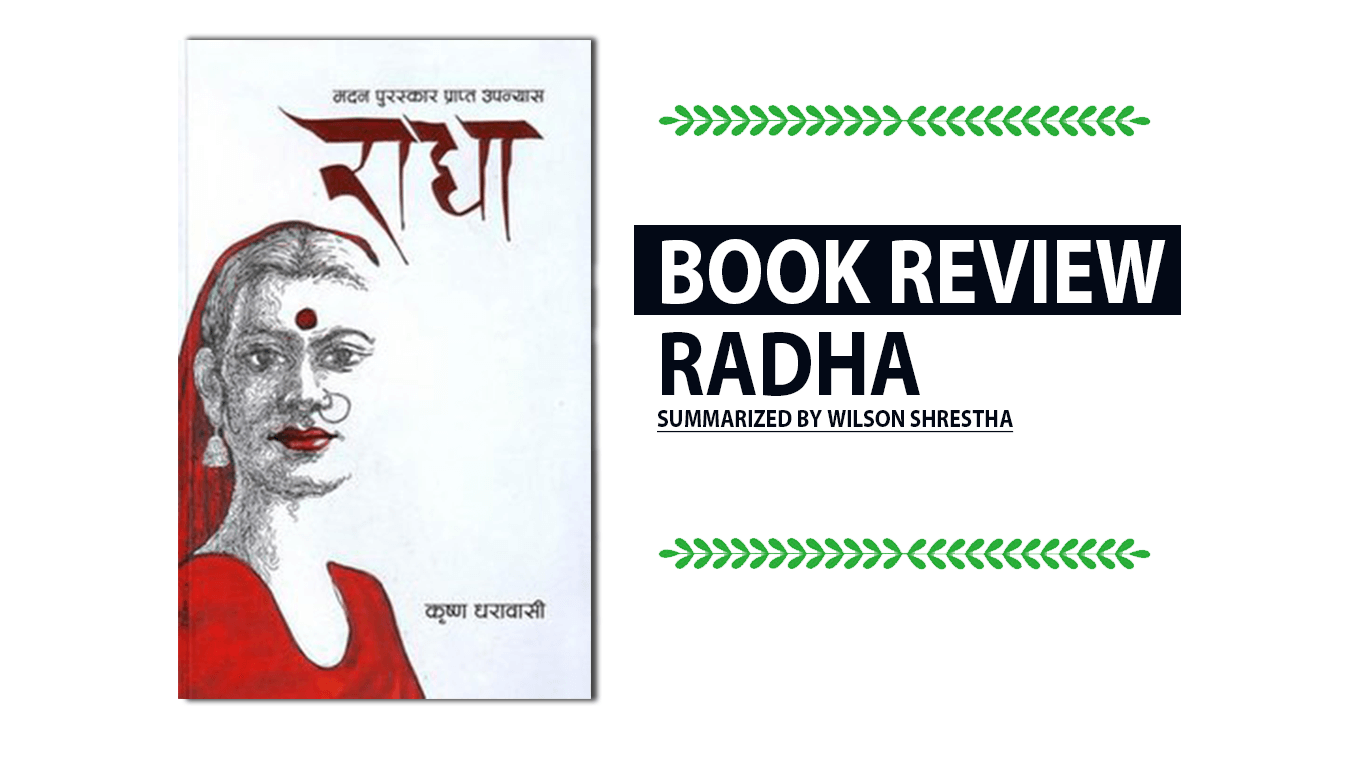
Book: Radha
Author: Krishna Dharabasi
Publisher: XlibrisUS
ISBN: 9781543470109
Genre: Fiction
Pages: 354
Summarized by: Wilson Shrestha
The novel differs from the traditional Krishna fable in two significant ways: first, it is told from the perspective of a woman; and second, the story is moved out of the realm of myth and into a more realistic context. The Mahabharat, an ancient epic text, provides much of the source material for Radha. Readers who are unfamiliar with Radha and Krishna’s love tale may find it difficult to get into the flow of the novel after a few pages. Even those who are unfamiliar with the myth will be lured into the story thanks to Mr. Paudyal’s informative introduction and gripping translation.
An ancient manuscript is discovered at the start of the book. The story of Radha and Krishna begins after some time spent looking for someone who can understand the manuscript. Krishna’s story is a classic Hindu myth, and many readers will be familiar with the fundamental plot. Nonetheless, Radha’s journal swiftly departs from the myth’s depiction of Krishna as a celestial figure. He and Radha live in a world that is as real as possible while remaining true to the myth’s overarching structure. The relationships and the narrative itself take on a whole new meaning with Radha as a guide through this universe. Radha highlights out how society treats women unfairly throughout her writings, and how women are often involved in the treatment they and other women experience. Moreover, despite her affection for Krishna since they were toddlers, she points out his flaws and criticizes the way he is brought up as the potential ruler. She commiserates with his wives, whom he abuses badly at times. Krishna, as seen through Radha’s eyes, becomes human, and his divinity fades away. While Krishna keeps breaking promises to return to Radha, she emerges as a strong woman capable of carving out a life for herself.
Mr. Paudyal feels that Radha belongs to “a Nepali school of critical thinking” that “says life is a leela – a theatre of illusions – as is the life of Krishna himself.” Mr. Paudyal is referring to the deconstruction of the Krishna myth in the book. While adhering to many of the traditional Krishna stories, the work gently questions those stories by its feminine perspective, sly language, and upending of the myth’s traditions. Those who are familiar with the Mahabharat will identify much of this subtle deception right away, while those who are new to the world may need to familiarize themselves with the original narrative.
Radha is a difficult work that will test readers on many levels. People who are familiar with the Krishna tale are encouraged to reconsider their perspectives. People who are unfamiliar with the Krishna narrative are invited to join a realm that may appear to be foreign to them. Dedicated readers, on the other hand, will discover a universality to the story that transcends the specific, as well as a narrative that questions the distinction between reality and illusion.