Schengen Visa from Nepal (2026): Documents, Fees, Bank Balance & Approval Tips

Schengen Visa from Nepal (2026): Documents, Fees, Bank Balance & Approval Tips
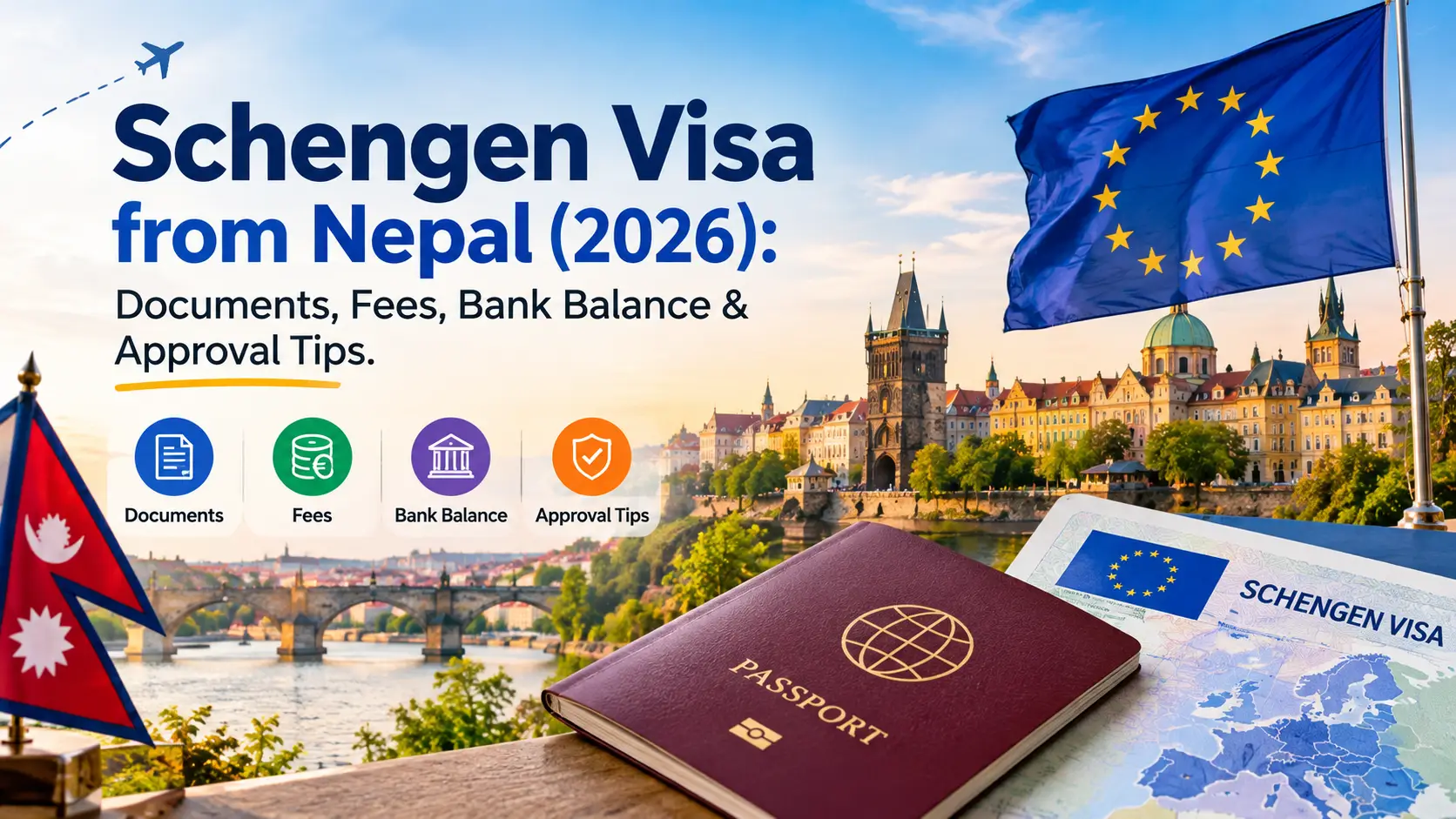
Schengen visa guide from Nepal 2026 showing a Nepali passport, Schengen visa sticker and documents for a Kathmandu application

Last checked: 2 November 2026 (Kartik 2083). Fees, submission channels and document rules below were checked against the embassies’ own pages (German Embassy Kathmandu, Embassy of Switzerland in Nepal, NetherlandsWorldwide, Sweden Abroad and others). Refusal figures come from the European Commission’s 2025 visa statistics, published 28 May 2026. Rupee amounts use about Rs 170 per euro, the rate in late October 2026; check the day’s rate before paying.

A Schengen visa from Nepal is a short-stay visa (type C) that lets a Nepali passport holder visit 29 European countries for up to 90 days in any 180-day period. You apply in Kathmandu to the country where you will spend the most nights, pay a €90 fee (about Rs 15,300), and prove three things: why you are going, that you can pay for the trip, and that you will come back.

Most guides online give a single “VFS Kathmandu” process for everyone. That is not how it works. Germany takes applications inside its own embassy, Switzerland handles five other countries through VFS, several files are decided in New Delhi, and Denmark changed its arrangement on 1 October 2026. This guide covers each route, the real cost in rupees, the bank balance question every Nepali applicant asks, and what the 2025 refusal data says about applying from Kathmandu.

Quick Answers

QuestionAnswer
Visa fee€90 adult (about Rs 15,300), €45 child aged 6–11 (about Rs 7,650), free under 6. Not refunded if refused.
Extra service chargeNone at the German Embassy. At VFS Kathmandu it depends on the country, for example Rs 1,280 (Italy) or €20 (Norway).
Where to applyThe country of your main destination. Germany: German Embassy, Gyaneshwor. Most others: VFS Global Kathmandu.
When to applyAt least 15 days before travel. Up to 6 months ahead at most VFS countries; Germany opens its waiting list 3 months before the trip.
Bank statementsGermany asks for the last 6 months, originals only. Prepare 6 months for any country.
Bank balance to showNo official NPR figure. Show steady funds that cover the whole trip with room to spare. For a 10-day trip, our estimate is Rs 4–6 lakh held for months, not deposited last week.
Travel insuranceAt least €30,000 medical cover, valid in all Schengen states for the whole stay. Germany wants an insurer with an office in a Schengen state.
Refusal rate in Nepal (2025)24.5% of decisions at Schengen consulates in Nepal, against 14.6% worldwide.

What the Schengen Visa Is (and Is Not)

The Schengen area is a group of 29 European countries that share one border system. One short-stay visa covers all of them: Germany, France, Italy, Spain, the Netherlands, Switzerland, the Nordic countries, Poland, Greece, Portugal and the rest. Some older Nepali guides and even some embassy FAQ pages still say 26 or 27 countries; that count is out of date.

✓ A type C Schengen visa is for

  • Tourism and sightseeing
  • Visiting family or friends
  • Business meetings, trade fairs, conferences
  • Short courses, seminars, sports or cultural events

✗ It is not for

  • Working, even for a few weeks
  • Degree study or stays longer than 90 days
  • Moving to Europe and “changing visa there”

Work and long study need a national (type D) visa from one country. If an agent offers you a “Schengen work visa” on a tourist visa, walk away. Legal European work routes for Nepalis, with the DoFE labour permit step, are explained in our Malta, Romania and Poland work visa guide.

The 90/180 rule in one line

On any day you are in Europe, count back 180 days: the days you spent inside the Schengen area in that window must not add up to more than 90. Your visa sticker may also allow fewer days than 90. German missions usually make the visa valid about 15 days longer than the days you are allowed to stay, so you have room to shift flights, but the “duration of stay” number on the sticker is the limit.

Where to Apply for a Schengen Visa in Nepal

Rule one: apply to the country where you will spend the most nights. If nights are equal, apply to the country you enter first. Choosing a country only because it looks easier is a classic refusal reason, and EES now records where you actually go.

Here is where Kathmandu residents submit, as listed on each country’s official page in October 2026:

Main destinationWhere you submitWho decides
Germany (also Slovenia, Luxembourg)German Embassy, Gyaneshwor, in person. Appointment via the embassy’s own waiting list. No VFS.German Embassy Kathmandu
Switzerland (also Liechtenstein, Poland, Belgium, Slovakia, Latvia)VFS Global Kathmandu (since 1 July 2025)Swiss Embassy Kathmandu (may refer files to Switzerland)
NetherlandsVFS Global Kathmandu (only if you live in Nepal)Dutch Embassy, New Delhi
FranceVFS Global Kathmandu (France-Visas form; VFS counter for France opens Tuesday and Friday mornings)French Embassy, New Delhi
ItalyVFS Global KathmanduItalian mission responsible for Nepal (fee paid by demand draft in INR)
FinlandVFS Global Kathmandu (Schengen files Mon, Wed, Fri)Embassy of Finland, Kathmandu
Czech RepublicVFS Global Kathmandu, Thamel. New slots open the second Monday of each month.Czech Embassy, New Delhi
Norway (also Iceland)VFS Global KathmanduNorwegian Embassy, New Delhi (add 2–3 days of courier time each way)
SwedenVFS Global KathmanduSwedish Embassy, New Delhi
Denmark (changed 1 Oct 2026)New arrangement announced on VFS Global Nepal’s Sweden/Denmark pagesDanish Embassy, New Delhi (Sweden no longer represents Denmark)
Spain, Austria, Greece, Portugal and othersCheck the destination ministry’s “apply from Nepal” page before booking. Some route Nepali residents through India or through another Schengen state, and these arrangements change.
Why “decided in New Delhi” matters: your passport travels to India and back, so allow extra days. If the visa sticker has a mistake, you contact the embassy in New Delhi, not VFS. Some appointment lists also fill fast; book as soon as your dates are firm.

How to Apply: Step by Step

STEP 1 · 8–10 WEEKS BEFORE

Fix your main destination and dates

STEP 2

Book the appointment yourself

STEP 3

Fill the online form, gather documents

STEP 4

Attend: documents, fee, fingerprints

STEP 5

Wait and track

STEP 6

Collect passport, check the sticker

Step 1: Fix your main destination and dates

Make a rough day-by-day plan first: which cities, how many nights each, which country you land in. That plan decides your embassy. Make sure your passport was issued within the last 10 years, will still be valid at least 3 months after you leave Europe, and has two blank pages. If not, renew it first using our e-passport Nepal online form guide; the Department’s fast service in Tripureshwor can save weeks.

Step 2: Book the appointment yourself

  • Germany: register on the embassy’s online waiting list (linked from kathmandu.diplo.de). You can register at most 3 months before the trip, and the embassy gives appointments in order of registration. It warns that the earliest date may be 4–6 weeks away. One booking per person, and your passport number must match.
  • VFS countries: create an account on the VFS Global Nepal page for your destination and book one slot per person.

Both the German and Dutch missions tell applicants to book directly and not through intermediaries. The German Embassy states plainly that there is no such thing as a “registered visa agent” for Germany and that agents have no special access to slots. Checklists and appointments are free.

Step 3: Fill the online form and gather documents

Each country has its own online form: VIDEX for Germany, the Dutch consular form with a unique code, France-Visas, and the Swiss online form. Fill it yourself, print it and sign it. Then build your file in the order of that embassy’s checklist (see the full list below). Germany asks for originals plus one A4 copy, with every Nepali-language document translated into English or German.

Step 4: Attend the appointment

You hand in the documents, pay the fee, answer a few questions about the trip and give fingerprints and a photo. At the German Embassy the fee is paid in Nepali rupees in cash, and accompanying people are not allowed inside (except parents of minors). If you gave fingerprints for a Schengen visa within the last 59 months, some countries can reuse them.

Step 5: Wait and track

The legal standard is a decision within 15 calendar days, extendable in individual cases. The German Embassy says its Schengen processing usually takes about five working days; the Swiss Embassy warns it can take longer than 15 days in peak season; files sent to New Delhi need courier time on top. VFS applicants track online with their reference number. Do not buy non-refundable tickets until the decision.

Step 6: Collect and check

Check the name, passport number, validity dates, number of entries and number of days on the sticker before you leave the counter. A wrong date can get you refused at boarding. Mistakes are fixed free if reported quickly.

Schengen Visa Documents Checklist for Nepali Applicants

This list follows the German Embassy Kathmandu checklist, the most detailed public one for Nepal, and adds what the Swiss and Dutch checklists ask for. Always print your own embassy’s checklist and follow its order.

✓ Identity and form

  • Passport (10 years old at most, 3+ months validity after return, 2 blank pages) plus A4 copy of the data page
  • Signed application form and declaration
  • Citizenship certificate, original and copy
  • One recent biometric photo (under 6 months old)
  • Copies of previous Schengen, UK or US visas

✓ Trip

  • Cover letter: who you are, purpose, dates, who pays
  • Day-by-day itinerary
  • Return flight reservation (rail bookings inside Europe if any)
  • Hotel bookings for every night, or host’s invitation
  • Travel medical insurance, original and copy

✓ Money and ties

  • Personal bank statements, last 6 months, original
  • Employed: employer letter with salary and length of service, plus approved leave
  • Self-employed: company registration, PAN and tax payment proof
  • Student: no-objection letter from school or college
  • Marriage and children’s birth certificates, or relationship certificate

Extra documents for specific situations

Your situationAdd this
Visiting family or friendsInvitation letter with travel plan, copy of host’s passport or residence permit, proof of relationship (relationship certificate not older than 6 months for Germany)
Host pays for the tripGermany: formal obligation letter (Verpflichtungserklärung) signed at the host’s local foreigners’ office. Poland, Slovakia, Latvia, Belgium via Swiss Embassy: invitation or sponsorship form legalised by that country’s authority
Business tripInvitation from the European company, meeting schedule, company bank statements (6 months for Germany), trade fair pass if relevant
Child travellingBirth certificate, both parents’ consent and signatures, parents’ passport or citizenship copies. Germany asks parents to be present at the appointment
Freelancer or remote workerPAN, tax returns or tax clearance, client contracts, statements showing foreign income arriving through banks. Our freelance tax in Nepal guide explains the 5% filing that gives you this paper trail
RetiredPension book or retirement proof, plus statements
Multiple-entry visa request (Germany)Signed Declaration on Health Insurance from the embassy website
Nepal-specific tip: citizenship, relationship and tax papers carry Bikram Sambat dates while your form and passport use AD. A one-day mismatch looks careless to an officer. Convert every date with our BS to AD date converter and make the translations match. If you need your PAN number for the employer letter or tax papers, check your PAN online.

Flight bookings: reservation, not a paid ticket

Germany asks for a flight reservation and Switzerland for a round-trip booking with your name. You do not need a paid, non-refundable ticket. Use a real, verifiable reservation (a refundable fare or an airline hold). Fake “dummy ticket” PDFs can be checked and count as unreliable documents, which is a refusal ground on its own.

Schengen Visa Fee from Nepal and Total Cost in NPR

The visa fee is the same for every Schengen country: €90 for adults since 11 June 2024. An EU working group discussed another increase in September 2026, but no change has been adopted, so €90 still applies.

ApplicantFee (EUR)Approx. NPR
Adult (12 and over)€90Rs 15,300
Child 6–11€45Rs 7,650
Child under 6FreeRs 0
Spouse of an EU citizen; minor child or parent of a minor EU citizen (Germany)FreeRs 0

Because the fee is fixed in euros, the rupee amount moves with the exchange rate. The euro traded around Rs 174 in early October 2026 and around Rs 170 at the end of the month, so the same €90 cost roughly Rs 360 less in four weeks.

Service charges on top

  • German Embassy: no service charge. The visa fee is the only cost, paid in NPR cash.
  • Italy at VFS Kathmandu: Rs 1,280 per applicant, cash only. Optional extras such as form filling, SMS and document checks cost more.
  • Norway at VFS Kathmandu: €20 (listed as Rs 2,921).
  • Other VFS countries: check the fee page for your destination. Courier, SMS, photos and lounge services are optional.

What a 10-day trip to Germany really costs (our estimate)

Consulates compare your money with the cost of the trip you describe, so you need this number before you look at your bank balance. Here is a realistic budget for one adult, using fares and rates seen in October 2026.

ItemAssumptionNPR
Return flight KTM–FrankfurtEconomy, one stop; off-peak fares from about €750 return1,00,000 – 1,60,000
Hotels9 nights at €70–1101,07,000 – 1,68,000
Food, local transport, entry tickets10 days at €45–6076,500 – 1,02,000
Visa fee, insurance, translations, photos€90 fee plus paperwork20,000 – 30,000
TotalAbout Rs 3 – 4.6 lakh

These are planning estimates at about Rs 170 per euro, not official figures. Summer and Christmas fares run higher. Staying with family cuts the hotel line to almost nothing, which is why a host’s invitation changes how much money you need to show.

How Much Bank Balance Do You Need for a Schengen Visa from Nepal?

There is no fixed rupee amount for Nepali applicants. No embassy in Kathmandu publishes “Rs 5 lakh” or “Rs 10 lakh”. What exists is a daily reference amount each Schengen state reports to the European Commission, and the officer’s judgement of whether your money, income and trip fit together.

Daily reference amounts by country

CountryReference amount10 days in NPR (approx.)
GermanyAbout €45/day, assessed case by caseRs 76,500
France€120/day without accommodation proof; €65 with hotel; €32.50 with a host’s attestationRs 1.1 – 2 lakh
SwitzerlandCHF 100/day (CHF 30 for students)Rs 1.8 lakh
Netherlands€55/day, applied flexiblyRs 93,500
Belgium€95/day in a hotel; €45 with a hostRs 76,500 – 1.6 lakh
Finland€50/day plus accommodation and ticketsRs 85,000 + stay
ItalySliding scale: €44.93/day for a solo trip of 6–10 daysRs 76,400
PolandPLN 75/day, minimum PLN 300About Rs 30,000

Reference amounts as compiled from the European Commission’s Annex 25 list (May 2026). These cover daily spending on top of flights and, for most countries, on top of accommodation. CHF converted at about Rs 180.

A practical target for Nepali applicants

The daily minimum is the floor, not the target. Use this simple rule:

Balance to show

Full trip cost × 1.3 to 1.5, held steadily for 3–6 months

For the 10-day Germany example above (Rs 3–4.6 lakh), that means roughly Rs 4–6 lakh in your own account. If a host covers your stay and you show a German formal obligation letter, the amount you need personally falls a lot. If you are going for three weeks with hotels in Switzerland and France, it rises.

What officers actually look at

Same balance, different story

Strong file

Rs 5 lakh balance built over a year. Monthly salary of Rs 85,000 arrives from the employer named in the letter. Leave approved. Hotel bookings match the itinerary.

Weak file

Balance of Rs 40,000 for five months, then a cash deposit of Rs 5 lakh two weeks before the appointment. Salary of Rs 30,000 paid in cash. No explanation of where the money came from.

  • Consistency: a balance that grows slowly from salary or business income is believable. A sudden lump sum is the most common red flag.
  • Source: if a big deposit is genuine (land sale, FD maturity, loan disbursement, gift from parents), attach the paper that proves it, and mention it in the cover letter.
  • Income match: the salary in your employer letter should be visible in your statement. Cash salaries are hard to verify, so add a tax or SSF record if you have one.
  • Originals: Germany accepts only original statements. Ask your bank branch for stamped, signed statements and a balance certificate.
  • Extra assets help, but are secondary: FDs, property (lalpurja) and shares show roots in Nepal, but officers want spendable money first.

Getting euros legally once you have the visa

Your balance is proof, not travel money. To carry cash or load a travel card, Nepal Rastra Bank’s passport facility lets Nepalis going to countries other than India buy foreign currency worth up to USD 3,000 per person per trip from a bank or licensed money changer. You need the passport, the issued visa and a confirmed ticket, so this happens after approval, not before. Your dollar card is separate: its USD 500 yearly limit is for paying foreign websites, which includes booking hotels online, and an international USD credit card can help with hotel deposits.

Schengen Travel Insurance from Nepal

Every Schengen applicant needs travel medical insurance. The common rules:

  • At least €30,000 cover for emergency medical treatment, hospital care and medical repatriation
  • Valid in all Schengen states, not just your main destination
  • Covering every day of the stay, from departure to return

Where embassies differ is which insurer they accept, and this is where many Nepali files go wrong:

EmbassyInsurer requirement
German Embassy KathmanduThe insurance company must have an office in a Schengen state or Liechtenstein
Swiss Embassy (and the 5 states it represents)€30,000 / USD 50,000 / CHF 50,000 minimum, from an approved insurer in a Schengen state or in Nepal
OthersCheck the VFS checklist for your destination before buying

So a policy from a Nepali insurer may be fine for a Swiss application and still be rejected for Germany. Before paying, ask the insurer two questions: is this policy accepted by my specific embassy, and is the premium refunded if the visa is refused? Many visa-specific policies refund on refusal if you send the refusal letter before the cover start date. For how Nepali insurers and the regulator work, see our insurance in Nepal guide.

Schengen Visa Refusal Rates for Nepal (2025 Data)

The European Commission published its 2025 visa statistics on 28 May 2026. Worldwide, about 12.2 million short-stay applications were filed and 14.6% were refused. At Schengen consulates in Nepal, 7,059 decisions were taken and 24.5% were refused, a much tougher picture.

Refusal rate, 2025 (% of decisions)

Worldwide average
14.6%
Finland, Kathmandu (793)
19.2%
Germany, Kathmandu (3,685)
20.8%
All consulates in Nepal (7,059)
24.5%
Switzerland, Kathmandu (2,581)
31.2%

Numbers in brackets are 2025 decisions. Source: European Commission consulate statistics 2025, as compiled by SchengenDoc. Only posts with 500+ decisions shown.

How to read these numbers

  • They count where the consulate sits, not your passport. Files lodged at VFS Kathmandu but decided in New Delhi (Netherlands, France, Norway, Sweden, Czech Republic) are most likely counted under India, which is why only three states appear for Nepal.
  • Switzerland’s higher rate partly reflects its role. It also decides files for Poland, Belgium, Slovakia and Latvia from Kathmandu, and in 2024 Belgium had one of the highest refusal rates of any Schengen state (24.6%).
  • Do not shop for the “easiest” country. Applying to a state that is not your main destination is itself a refusal reason. Data helps you prepare harder, not switch embassies.

Why Schengen visas get refused

Refusal letters use a standard EU form with ticked reasons. The ones Nepali applicants see most:

Reason on the letterWhat usually caused it
Purpose and conditions of stay not justifiedVague itinerary, bookings that do not match the plan, invitation that does not explain the visit
Insufficient means of subsistenceLow or recently inflated balance, income that cannot be traced
Doubts about intention to leave before the visa expiresWeak job or family ties, unemployed, first trip abroad combined with a long stay
Documents false or unreliableFake flight or hotel PDFs, edited statements, agent-made employer letters
No valid travel medical insuranceWrong insurer for that embassy, short cover period, cover below €30,000
Already used 90 days in 180Previous long stay or overstay on record

12 Approval Tips for a Schengen Visa from Nepal

  1. Apply to the right country. Most nights decides it. Your hotel bookings must show it.
  2. Tell one consistent story. Cover letter, form, itinerary, bookings, leave letter and insurance dates must all match to the day.
  3. Prepare 6 months of original, stamped statements. Do not move money in just before the appointment. If you must, document the source.
  4. Make your employer letter specific. Letterhead, your position, start date, salary, approved leave dates, and a line that you will return to work.
  5. Show your ties to Nepal. Job, business, family, property, ongoing studies. Put them in the cover letter in two or three sentences.
  6. Keep a first trip modest. A 10–14 day tourist trip is easier to justify than 60 days on a first application.
  7. Use refundable, real bookings. Refundable hotels and a held or refundable fare. Never fake documents.
  8. Buy insurance your embassy accepts. For Germany, an insurer with an office in a Schengen state.
  9. Translate everything in Nepali into English (or German for Germany) and match every BS date to AD.
  10. Include past visas. Copies of earlier Schengen, UK, US, Japan or Australia visas show you travelled and returned.
  11. Book the appointment yourself. Agents cannot buy slots or influence decisions, and a polished file made by an agent that does not sound like you can hurt more than help. If you use an education or visa consultancy, check its licence first; our guide to choosing a licensed consultancy shows how.
  12. Answer the questions yourself, honestly. Know your own itinerary and who pays for what.

After the Decision: Refusal, Travel and the New EES Border Checks

If your visa is refused

  • Read the ticked reasons on the refusal letter. It also states how and by when you can appeal; follow that exact address and deadline.
  • You can usually reapply at any time instead. The German Embassy invites a new application with complete, verifiable documents. Fix the specific reason first, or the second application will fail the same way.
  • The €90 fee is not refunded. Claim your insurance premium back straight away if your policy offers a refusal refund.
  • Complaints about staff conduct or the process (not the decision itself) go through the embassy’s complaint form.

At the European border: EES

Since 10 April 2026, the EU Entry/Exit System is fully operational. On your first entry, border police scan your passport, take your fingerprints and a facial photo, and record your entry and exit dates digitally instead of stamping your passport. Expect longer queues at big airports, and carry copies of your hotel bookings, insurance, invitation and money proof, because border police can still ask for them. A visa allows you to request entry; the final decision is made at the border.

ETIAS is not for you. ETIAS is the travel authorisation for visa-free nationalities (US, UK and similar). Nepali passport holders need the full Schengen visa, and ETIAS’s delayed launch changes nothing for Nepalis.

Frequently Asked Questions

How much is the Schengen visa fee in Nepali rupees?

€90 for adults, which is about Rs 15,300 at late-October 2026 rates. Children aged 6–11 pay €45 (about Rs 7,650) and children under 6 pay nothing. VFS countries add a service charge; the German Embassy does not.

How much bank balance is required for a Schengen visa from Nepal?

No embassy sets a fixed NPR amount. Show funds that cover the whole trip with a margin, kept steadily for months, plus income that explains them. For a 10-day trip with hotels, Rs 4–6 lakh is a sensible planning target; a host who pays and gives a formal invitation lowers it.

Does the German Embassy in Kathmandu use VFS Global?

No. You book through the embassy’s own online waiting list and submit in person at the embassy in Gyaneshwor. The visa fee is paid there in NPR cash, and there is no service charge.

How long does a Schengen visa take from Nepal?

The legal standard is 15 calendar days, extendable. Germany usually decides in about five working days after submission, but its appointments can be 4–6 weeks away. Files decided in New Delhi take a few extra days. Plan 6–8 weeks from booking to visa.

Can I apply for a Schengen visa online from Nepal?

You fill the form online, but you must still submit in person because fingerprints are taken. The EU’s fully digital Schengen visa has not launched yet.

Which Schengen country is easiest for Nepalis?

The one that is genuinely your main destination. In 2025, Finland (19.2%) and Germany (20.8%) refused fewer applications in Kathmandu than Switzerland (31.2%), but applying to a country you are not mainly visiting is itself a refusal reason.

Is Nepali travel insurance accepted for a Schengen visa?

It depends on the embassy. The Swiss Embassy accepts approved insurers in Nepal. The German Embassy wants an insurer with an office in a Schengen state. Check your destination’s checklist before buying.

Can I work in Europe on a Schengen visit visa?

No. A type C visa does not allow work. Work needs a national work visa and, from Nepal, a DoFE labour permit before departure.

Do I need a police report for a Schengen tourist visa?

It is not on the standard tourist checklists of the German, Swiss or Dutch missions. It is usually needed for long-stay work or study visas; if your embassy asks, see our police clearance certificate guide.

Can I get a multiple-entry Schengen visa on my first application?

You can ask, but first-time applicants usually get a visa for the trip dates only. A clean travel record on earlier visas is what leads to longer multiple-entry visas later.

Conclusion

A Schengen visa from Nepal is very possible, but Kathmandu refuses about one in four applications, so preparation matters more than in most countries. Pick the embassy by where you will spend most nights, book the slot yourself, show six months of steady funds that fit the trip you describe, buy insurance your embassy accepts, and make every date in your file agree. Do that, and the officer has no reason to doubt you.

Sources

Wilson is an independent publisher and is not affiliated with any embassy, VFS Global or the European Union. Visa rules, fees and submission channels change; confirm with your destination’s official page before booking or paying.

International Tour Packages from Nepal (2026): Real Costs for Thailand, Dubai, Europe & Honeymoon Trips

International Tour Packages from Nepal (2026): Real Costs for Thailand, Dubai, Europe & Honeymoon Trips

By Wilson Shrestha · Updated 2 November 2026 · Prices in NPR at Nepal Rastra Bank rates of 30 October 2026

International tour packages from Nepal: Thailand, Dubai, Europe and honeymoon trip costs in NPR

Quick answer

Counting flights, visa, hotels, sightseeing, food and insurance, a trip from Kathmandu in late 2026 costs roughly Rs 1.05–1.9 lakh per person for 6 days in Thailand, Rs 1.5–2.4 lakh for 5 days in Dubai, and Rs 3.5–7.1 lakh for 9 days in Europe (Paris + Switzerland, DIY at the low end, escorted package at the top). A honeymoon costs about Rs 3–6 lakh per couple in Thailand, Bali or Dubai, and Rs 5 lakh to well over Rs 10 lakh in a Maldives resort. Agency “package” prices you see advertised are usually land only and per person on twin sharing, so the real bill is often double the headline.

Key takeaways

  • Flights are the biggest single cost for Thailand and Dubai — often more than the hotel package itself. Dashain–Tihar and December fares can be 40–80% higher.
  • Nepalis still need a visa before flying to Thailand. Thailand’s new entry rules from 15 September 2026 did not add Nepal to any visa-free or visa-on-arrival list.
  • There is no Dubai visa on arrival for Nepali passports — you need a UAE eVisa (about AED 350, roughly Rs 14,500) before departure.
  • Schengen visa: €90 (about Rs 15,300) plus the VFS service charge, and the fee is not refunded if you are refused.
  • Bali is not visa-on-arrival for Nepalis; the Maldives is (free, 30 days).
  • Nepal Rastra Bank lets you buy up to USD 3,000 per passport per trip (outside India). Plan your spending money around that.

International tour package costs from Nepal at a glance

These are all-in totals per person from Kathmandu, sharing a twin room: return flight, visa, hotels, transfers, the usual sightseeing, food, local transport and basic travel insurance. Shopping is not included. “Budget” assumes cheap flight dates and 3-star hotels; “comfortable” assumes peak dates and better hotels.

TripLengthBudgetTypicalComfortable
Thailand (Bangkok + Pattaya)5N / 6DRs 1.05 lakhRs 1.4 lakhRs 1.9 lakh
Dubai4N / 5DRs 1.5 lakhRs 1.8 lakhRs 2.4 lakh
Europe, DIY (Paris + Switzerland)8N / 9DRs 3.5 lakhRs 4.5 lakhRs 5.6 lakh
Europe, escorted package8N / 9DRs 4.5 lakhRs 5.7 lakhRs 7.1 lakh
Honeymoon (Thailand islands / Bali / Dubai)4–5 nightsRs 3–6 lakh per couple; Maldives resort Rs 5–12.6 lakh per couple

Typical all-in cost per person (NPR)

Thailand, 6 days

Rs 1.4 lakh

Dubai, 5 days

Rs 1.8 lakh

Europe DIY, 9 days

Rs 4.5 lakh

Europe escorted package, 9 days

Rs 5.7 lakh

Calculated from the line-by-line tables below. NRB selling rates, 30 Oct 2026: USD 152.72, EUR 170.09, THB 4.52; AED about 41.6 (pegged to the dollar).

What a “tour package” from Nepal really includes

When a Kathmandu agency advertises “Dubai 4N/5D from NPR 37,200” or “Thailand from NPR 21,450”, that is almost always the land package: hotel, airport transfers and a few tours. Three things to check before comparing two quotes:

  1. Is the flight included? Many listings say “extra airfare” in small print. One Kathmandu operator’s Dubai page, for example, quotes the 3-star land package at Rs 46,000 and adds about Rs 40,000 for airfare separately.
  2. Per person or per couple, and on what sharing basis? Prices are normally per person on twin sharing. A solo traveller pays a single supplement, often 40–70% more for the hotel part.
  3. Is the visa fee inside the price, or only “visa assistance”? Assistance means they fill the form; you still pay the embassy fee.

✔ Usually included

  • Hotel nights with breakfast
  • Airport pick-up and drop
  • Headline tours (city tour, desert safari, Coral Island, Mt Titlis)
  • Some dinners (dhow cruise, cruise dinner)

✘ Usually extra

  • International flights
  • Visa fee and travel insurance
  • Lunches, most dinners, local taxis
  • City and tourism taxes paid at the hotel
  • “Optional” tours sold on the spot

Thailand tour package from Nepal: real cost in 2026

Thailand is still the most-booked foreign holiday from Kathmandu. Thai Airways, Nepal Airlines and Thai AirAsia fly Kathmandu–Bangkok direct in about 3.5 hours. The standard package is 2 nights Bangkok + 3 nights Pattaya, or Bangkok + Phuket for beaches.

Thailand 5N/6D: cost per person

ItemBudgetTypicalComfortable
Return flight Kathmandu–BangkokRs 55,000Rs 70,000Rs 90,000
Thai tourist visa (embassy fee; agent fee in last column)Rs 5,000Rs 5,000Rs 8,000
Land package: 5 nights 3★, transfers, city tour, Coral IslandRs 22,000Rs 32,000Rs 45,000
Food, local transport, extras (THB 800–1,500 a day)Rs 22,000Rs 30,000Rs 40,000
Travel insuranceRs 1,500Rs 2,500Rs 4,000
TotalRs 1,05,500Rs 1,39,500Rs 1,87,000

Flight: Thai Airways’ Nepal fare page showed Kathmandu–Bangkok returns from about Rs 54,900 on cheaper Oct–Nov 2026 dates and above Rs 1 lakh on busy dates. Land package range is based on advertised Kathmandu agency prices (one 4N/5D listing at Rs 21,450 in the 2025 low season). Food and insurance are my estimates.

What changed for Nepalis visiting Thailand in 2026

  • The new visa-free list does not include Nepal. From 15 September 2026, Thailand replaced its 60-day exemption with a 30-day exemption for 60 countries and visa on arrival for only three (Azerbaijan, Belarus, Serbia). India, Bhutan and the Maldives are on the 30-day list; Nepal is not.
  • Apply online, pay by bank cheque. You apply on the official Thai e-Visa site, but the Kathmandu embassy still takes the fee as a Global IME Bank manager’s cheque. The single-entry tourist visa fee on the embassy’s schedule is NPR 5,000. Processing is at least 7 working days, so apply about a month ahead.
  • Show funds on arrival. Thai immigration can ask for THB 20,000 per person (THB 40,000 per family), about Rs 90,000 per person.
  • Don’t plan on extending. An independent visa guide citing Thai Immigration criteria reports that tourist extensions for Nepalis are capped at 7 days. Get a visa that covers your whole stay.
  • Embassy holidays bite in peak season. The Thai embassy in Kathmandu was closed for Tihar on 9–11 November 2026. Submit your cheque before festival closures.

Dubai tour package from Nepal: real cost in 2026

Dubai is a 4½-hour direct flight on flydubai. Most packages are 4N/5D with a city tour, a dhow cruise dinner and a desert safari. The flight and visa make Dubai dearer than Thailand even though the land package is similar.

Dubai 4N/5D: cost per person

ItemBudgetTypicalComfortable
Return flight Kathmandu–DubaiRs 72,000Rs 85,000Rs 1,05,000
UAE 30-day tourist eVisaRs 13,000Rs 14,500Rs 18,000
Land package: 4 nights 3★, transfers, city tour, dhow cruise, desert safariRs 37,000Rs 46,000Rs 60,000
Food, metro and taxis, Burj Khalifa and other add-onsRs 25,000Rs 35,000Rs 52,000
Travel insuranceRs 1,500Rs 2,500Rs 4,000
TotalRs 1,48,500Rs 1,83,000Rs 2,39,000

Flight: flydubai’s route pages show Kathmandu–Dubai returns from roughly Rs 70,000–80,000 in January–March, and above Rs 1 lakh for November–December travel. Land package: Kathmandu listings at Rs 37,200 (4N/5D) and Rs 46,000 (3★, twin sharing). Visa: about AED 350 for a 30-day single-entry eVisa; agencies add their own service charge.

Dubai visa and costs Nepalis often miss

  • No visa on arrival for Nepali passports. Apply for the eVisa through the airline, a UAE-licensed agency or your Kathmandu travel agent before you fly.
  • Tourism Dirham fee. Dubai hotels charge a fee per room per night (roughly AED 7–20 depending on hotel class), usually at check-out and outside your package price.
  • December is the expensive month. Fares jump for Christmas and New Year, exactly when the weather is best.
  • A tourist visa is not a work visa. Never accept a “visit visa, then convert to a job” offer. Legal work abroad from Nepal goes through a Department of Foreign Employment labour permit, not a holiday package.

Europe tour package from Nepal: real cost in 2026

Europe is a different budget league. The most popular first trip is Paris + Switzerland (Lucerne, Interlaken, Mt Titlis), 8–9 days. There are no direct flights; Qatar Airways, Emirates, Turkish Airlines, flydubai and Air India all connect Kathmandu to Paris or Zurich with one stop.

Europe 8N/9D (escorted package): cost per person

ItemBudgetTypicalComfortable
Return flight Kathmandu–Paris/ZurichRs 1,30,000Rs 1,50,000Rs 1,80,000
Schengen visa fee (€90)Rs 15,300Rs 15,300Rs 15,300
VFS service charge (about €27–42)Rs 4,600Rs 5,500Rs 7,100
Schengen travel insurance (€30,000 cover)Rs 3,000Rs 5,000Rs 8,000
Land package: 8 nights, coach/rail, guide, breakfasts, Titlis and main entriesRs 2,50,000Rs 3,20,000Rs 4,00,000
Meals not included, local transport, extrasRs 50,000Rs 70,000Rs 1,00,000
TotalRs 4,52,900Rs 5,65,800Rs 7,10,400

Flight: Kathmandu–Paris economy returns are commonly listed around US$850–1,200 (about Rs 1.3–1.8 lakh). Land package: big South Asian operators sell Paris + Switzerland land-only tours at roughly INR 1.6–2.5 lakh (about Rs 2.5–4 lakh) per person on twin sharing. VFS charge: reported at €27 (Norway) to about €42 per applicant in Nepal, depending on the country.

The DIY version: about Rs 3.5–5.6 lakh

Book flights, 3-star hotels and trains yourself and the land part drops to roughly Rs 2–3.5 lakh: hotels about €45–80 per person per night, Swiss and French transport €350–600, food €35–60 a day and €150–300 of entry tickets. Add flights, visa and insurance and the total is about Rs 3.5–5.6 lakh. The catch: you must build the visa file (hotel bookings, day-by-day itinerary, bank statements) yourself, and a refusal costs you the fee.

Schengen visa from Nepal: the essentials

  • Fee: €90 for adults and €45 for children 6–11 (under 6 free), the same for all Schengen countries since June 2024. It is not refunded if you are refused.
  • Where: the embassy of your main destination, usually through VFS Global in Kathmandu. Some countries route Nepali applications through New Delhi, so check before booking.
  • When: standard processing is 15 days but can stretch to 45. Apply at least 6 weeks before travel.
  • Insurance: medical cover of at least €30,000 for the whole stay is mandatory.
  • Refusals are common. The global Schengen refusal rate was 14.6% in 2025; third-party analyses of EU data put Nepal’s rate noticeably higher, around one in five. Weak finances, insurance that doesn’t meet the rules and doubts about your return are the top reasons.

Honeymoon packages from Nepal: cost per couple

For honeymoons I’ve priced the couple total, because rooms are shared and that’s how most people budget. All include return flights for two, visas, 4–5 nights, transfers, a few tours and food.

DestinationNightsPer couple, all-inVisa for NepalisBest for
Thailand islands (Phuket / Krabi)5Rs 3.0–5.8 lakhVisa before travel, NPR 5,000 eachBeaches + nightlife on a budget
Bali5Rs 3.1–6.0 lakhe-Visa before travel; no VoAPrivate pool villas, culture
Dubai4Rs 3.0–4.8 lakheVisa before travelShort trip, shopping, desert
Maldives – local-island guesthouse4Rs 3.2–5.6 lakhFree on arrival, 30 daysMaldives water on a budget
Maldives – resort4Rs 5.0–12.6 lakhFree on arrival, 30 daysThe classic water-villa honeymoon

How the honeymoon numbers break down

  • Thailand islands: flights Rs 1.4–2.5 lakh for two (Thai Airways listed Kathmandu–Phuket returns from about Rs 1.25 lakh per person; flying into Bangkok and connecting can be cheaper), resort THB 2,500–6,000 a night (Rs 56,000–1.36 lakh for 5 nights), island tours Rs 36,000–68,000, food Rs 54,000–1.08 lakh.
  • Bali: flights connect via Kuala Lumpur, Bangkok or Singapore; I’ve budgeted Rs 85,000–1.3 lakh per person, so check live fares. The C1 tourist e-Visa is officially IDR 1,000,000 (about Rs 9,300) each, more through an agent. Bali also charges a one-time tourist levy of IDR 150,000 (about Rs 1,400) per person. Villas run US$60–200 a night.
  • Maldives: flydubai showed Kathmandu–Malé returns from about Rs 97,000 for November and over Rs 1.5 lakh for December. The economy departure tax plus airport development fee is US$100 per foreign passenger (usually already in your ticket). Resorts add a green tax of up to US$12 per person per night. The real swing factor is the transfer: a speedboat is cheap, while a seaplane commonly costs several hundred dollars per person.
  • Dubai: simply two people on the Dubai table above.

If the numbers feel heavy, a Pokhara or Chitwan honeymoon costs a fraction of any of these. My Pokhara month-by-month guide shows when the lake and mountain views are at their best, and the Himalayan travel guide covers Bhutan as a short foreign option.

Visa rules for Nepali passports (late 2026)

DestinationTypeOfficial feeTimeWatch out for
Thailande-Visa before travelNPR 5,000 (single entry)7+ working daysFee by Global IME manager’s cheque; THB 20,000 proof of funds
UAE (Dubai)eVisa before travelAbout AED 350 (~Rs 14,500)A few working daysNo visa on arrival; agency prices vary
Schengen (Europe)Type C, embassy / VFS€90 (~Rs 15,300) + VFS fee15–45 days€30,000 insurance; non-refundable on refusal
Indonesia (Bali)C1 e-Visa before travelIDR 1,000,000 (~Rs 9,300)About 5 working daysNepal not eligible for visa on arrival; Bali levy extra
MaldivesVisa on arrivalFreeAt the airportConfirmed hotel booking and return ticket needed

Every one of these needs a passport valid for at least six months. If yours is close to expiry, sort it first with my e-passport online form guide, because a new passport can take longer than any of the visas above.

Paying for your trip: NRB’s $3,000 rule and which card to use

Nepal’s foreign-exchange rules shape how you pay for a holiday abroad:

  • Passport facility: up to USD 3,000 per trip. Since July 2025, a Nepali travelling to any country except India can buy foreign currency worth up to US$3,000 per passport per visit (up from $2,500). Banks ask for your passport, valid visa and confirmed ticket. That’s about Rs 4.58 lakh at today’s rate — plenty for Thailand or Dubai spending, but tight for a DIY Europe trip.
  • Take some as cash, load the rest on a travel card. Ask your bank how much of the facility it will give as notes and how much on a prepaid travel card. Banks set their own limits on the cash portion.
  • Your dollar card won’t cover the trip. The personal dollar card limit is still $500 a year and it’s for online payments, not ATM cash abroad. It is handy for paying a Bali e-Visa or a hotel deposit online — see how to pay online from Nepal.
  • USD credit cards issued by Nepali banks work for hotel deposits and emergencies abroad within their own limits. Compare fees in my credit card in Nepal guide.
  • Buying a package means paying in rupees. When you book through a licensed Nepali agency, you normally pay them in NPR and they settle with hotels abroad. Your $3,000 facility then only has to cover spending money — a real advantage for Europe.

Check the day’s rate before you exchange; I track it in the USD to NPR rate page.

Package or DIY: which is cheaper from Nepal?

Thailand: about the same

Agencies buy Pattaya hotels and Coral Island tours in bulk, so a package is rarely more than Rs 5,000–10,000 dearer than DIY. Book the package if you want the visa handled.

Dubai: package usually wins

Desert safari, dhow cruise and transfers are cheaper bundled, and the agency arranges the eVisa you can’t get on arrival anyway.

Europe: DIY saves Rs 1 lakh+

DIY is about Rs 1–1.5 lakh cheaper per person, but an escorted group gives first-timers a ready visa file, a guide and payment in rupees.

Best months to go (and when it’s cheapest)

DestinationBest weatherCheapestAvoid / book early
ThailandNov–FebJun–AugDashain–Tihar dates; Songkran (April) fills hotels
DubaiNov–MarJan–Feb (good weather and lower fares)Jun–Sep heat; December fares
EuropeMay–Jun, SepShoulder months, Oct–NovJul–Aug crowds; start the visa 6+ weeks out
BaliApr–Oct (dry season)Nov–Mar (wet)July–August peak
MaldivesDec–Apr (dry)May–Oct resort discountsChristmas–New Year

How to check a travel agency before you pay

1 · Ask for the registration and licence

A genuine travel agency is registered with the Department of Tourism and has a PAN/VAT number. NATTA (Nepal Association of Tour & Travel Agents) membership is a good extra sign.

2 · Get the itinerary in writing

It should name each hotel (or say “or similar” with a star rating), list every inclusion and exclusion, and say whether the price is per person on twin sharing.

3 · Verify the flight booking yourself

Take the PNR and check it on the airline’s own “Manage booking” page before the final payment.

4 · Walk away from “visa guaranteed”

Only the embassy decides. A promise of a guaranteed Schengen or UAE visa — or a tourist visa “convertible to a job” — is a red flag.

5 · Pay by bank and get a VAT bill

Avoid cash with no receipt, and read the cancellation terms. Ask what happens if your visa is refused.

Hidden costs checklist

  • Single-room supplement if you travel alone
  • Hotel taxes paid on arrival or check-out (Dubai Tourism Dirham, European city taxes, Maldives green tax)
  • Bali tourist levy (IDR 150,000 per person)
  • Checked baggage on low-cost carriers
  • Exchange-rate margin and foreign-transaction fees on cards
  • Visa fees lost if you are refused
  • Travel insurance — see my overview of insurance in Nepal for which insurers to ask

Frequently asked questions

How much does an international tour package from Nepal cost?

All-in, per person: about Rs 1.05–1.9 lakh for 6 days in Thailand, Rs 1.5–2.4 lakh for 5 days in Dubai and Rs 3.5–7.1 lakh for 9 days in Europe. Advertised package prices are lower because they usually exclude flights and visas.

What is the cheapest international trip from Nepal?

Among the popular flight trips, Thailand is the cheapest: short direct flights, an NPR 5,000 visa and low hotel and food costs. Dubai is close if you catch a cheap January–March fare.

Do Nepalis need a visa for Thailand in 2026?

Yes. Thailand’s rules from 15 September 2026 give Nepal no visa-free or visa-on-arrival route. Apply for an e-Visa before travel; the single-entry tourist visa is NPR 5,000.

Can Nepalis get a Dubai visa on arrival?

No. Nepali passport holders need a UAE eVisa before flying, about AED 350 (roughly Rs 14,500) for 30 days, usually arranged by the airline or a travel agency.

How much does a Schengen visa cost from Nepal?

€90 (about Rs 15,300) for adults, plus a VFS service charge of roughly €27–42 and mandatory €30,000 travel insurance. Budget about Rs 23,000–30,000 in total.

How much foreign currency can I take from Nepal for a holiday?

Up to US$3,000 equivalent per passport per trip to any country except India, against your passport, visa and confirmed ticket. Ask your bank how much it will give in cash.

Is it cheaper to book flights and hotels myself?

For Europe, yes — often Rs 1 lakh or more per person. For Thailand and Dubai the saving is small, and a package handles the visa and tours.

Which is the best budget honeymoon destination from Nepal?

Thailand’s islands or Bali, at about Rs 3–6 lakh per couple. The Maldives is possible from about Rs 3.2 lakh if you stay in a local-island guesthouse rather than a resort.

Disclaimer: Prices and rules were checked on 2 November 2026. Airfares change daily, agencies revise package prices each season and embassies change fees without notice, so treat these totals as a planning budget and confirm current figures before you pay. Food, insurance, Bali flight and hotel ranges are my estimates. Have a question about your own trip? Contact me.

EDV Disqualification in Nepal: 17 Mistakes That Cost You the Green Card (and the Agent Scams to Avoid)

EDV disqualification in Nepal: common DV lottery mistakes and agent scams to avoid, with a rejected entry form and warning signs

EDV Disqualification in Nepal: 17 Mistakes That Cost You the Green Card (and the Agent Scams to Avoid)

Updated: 7 November 2026 (Kartik 21, 2083) · Checked against the official DV instructions, the Federal Register, US Embassy Kathmandu warnings and Nepal Police cases · Reading time: about 13 minutes

Around 3,900 Nepalis are selected in a normal DV lottery year. Far fewer end up in America. Some never had a valid entry in the first place. Others are selected, pay the visa fee, travel to the embassy in Maharajgunj, and are refused because of a photo, a missing child, a +2 certificate they could not prove, or a document an agent “arranged” for them.

This guide covers every common way a Nepali EDV entry gets disqualified or a DV case gets refused, split by stage so you know when each mistake bites. It then explains, scam by scam, how EDV agents and fixers in Nepal take people’s money, and what to do if it has already happened to you.

Quick answer

  • At entry, the big killers are: more than one entry, a photo that is old, edited or reused, a missing (or invented) spouse or child, the wrong country of eligibility, and, from DV-2027, bad passport details.
  • At the interview, cases fail when you cannot prove 12 years of education, when any document is fake, when your answers do not match your entry, when the officer thinks you may need public benefits, or when 30 September arrives first.
  • Fake documents are the worst mistake of all. They can bring a permanent US visa ban and arrest in Nepal.
  • Agent scams include holding your confirmation number for ransom, selling “EDV 2028” slots, fake winner messages, sham-marriage deals and fake +2 packages.
  • The only official site is dvprogram.state.gov. As of 7 November 2026 the DV-2027 form is not open. See our DV Lottery Nepal status guide for the latest.

Disqualification vs refusal: the two places you can lose

Most Nepali articles lump everything together as “EDV disqualification”. In practice there are two separate checkpoints, run by different people, with different costs.

STEP 1

Online entry

Risk: duplicate, photo, family, passport

STEP 2

Random selection

Pure luck; nobody can influence it

STEP 3

DS-260 & documents

Risk: mismatched answers, weak papers

STEP 4

Embassy interview

Risk: education proof, fraud, public charge

STEP 5

Visa by 30 Sept

Risk: running out of time or visas

Entry disqualificationVisa refusal at interview
WhenDuring screening of entries, or later when a selected entry is checkedAt the US Embassy in Kathmandu (or the embassy where you live)
Who decidesState Department systems and staffA consular officer
Money lostThe US$1 entry fee (from DV-2027) plus any agent feeUS$330 per person (about Rs 50,000), not refundable, plus medicals and documents
Family impactSpouse and children on the entry lose with youIf the main applicant is refused, the family cannot get DV visas either
Second chance?Only by entering again in a future yearSometimes, if a missing document arrives before 30 Sept; never after fraud

One detail catches people out: many entry mistakes are not noticed when you press Submit. You still get a confirmation number, you may even be “selected”, and the problem only surfaces when an officer compares your entry with your real documents. That is why an entry that looks fine can still fail a year later.

Entry-stage mistakes (before results)

1. Two entries for the same person

US law allows one entry per person per year, and the State Department says it uses software to detect duplicates. If it finds more than one entry in your name, all of them are disqualified, no matter who submitted them.

In Nepal this usually happens by accident: you fill the form at a cyber café, a brother in Qatar “also fills one to be safe”, or an agent submits one after you already did. Agree within the family who submits for whom.

Two things that are allowed

If the site fails and you never got a confirmation number, your entry was not recorded, so trying again is not a duplicate. And a husband and wife who both qualify may each submit their own entry, listing each other, which legally gives the family two chances.

2. A photo that is old, edited or reused

The DV instructions are blunt: a photo that does not meet the specifications, has been manipulated, or was used in a previous year’s entry can make you ineligible. The last published rules (DV-2026) required:

RequirementRule
FileJPEG, square, 600 x 600 pixels, 240 kB or less
Age of photoTaken within the last six months
BackgroundPlain white or off-white
FaceFacing the camera, neutral expression, both eyes open; head 50–69% of image height
Not allowedGlasses, uniforms, headphones, hats (except daily religious wear), photos copied from an ID card

Nepal-specific traps: studio “beauty” or skin-whitening filters, a background swapped in software, scanning the photo from your citizenship card or old passport, and re-using last year’s file because “it was accepted before”. Ask the studio for an untouched photo and keep the original file with its date.

3. Leaving out your husband or wife

If you are married, your spouse must be on the entry even if they will not move, even if you live apart, and even if you plan to divorce. The only exceptions are a spouse who is already a US citizen or green card holder (do not list them), or a separation ordered by a court. Leaving out an eligible spouse can make the whole family ineligible.

This bites in Nepal because many couples married by custom never registered the marriage at the ward office. On a DV form, treat yourself as married if you went through a marriage, and get the marriage registered before any interview. Officers also notice when a “single” entrant’s documents later show a wedding date before the entry.

4. Listing someone who is not your spouse

The opposite error is just as fatal. A fiancé(e), a partner you plan to marry next Magh, or anyone you are not legally married to on the day you submit must not be listed. The instructions say this would make you ineligible. If you marry later, the new spouse can be added after selection (see mistake 13).

5. Missing a child

You must list every living, unmarried child under 21 on the date you submit, whether or not they live with you or will travel. That includes:

  • children from an earlier marriage or relationship
  • stepchildren, even if you are now divorced from their parent
  • legally adopted children
  • children living with grandparents in the village or studying in India

Children who are already married or already 21 are not listed. If a child is under 21 when you enter but turns 21 during processing, the Child Status Protection Act may still protect them, so list them. Do not add nephews, nieces or siblings; they cannot be DV dependants.

6. Choosing the wrong country of eligibility

Your DV country is normally your country of birth, not your citizenship or where you live. A Nepali working in Dubai still enters under Nepal. But a Nepali citizen who was born in India is, for DV purposes, a native of India, which has been ineligible in recent years.

Such a person can still claim Nepal in two narrow ways: through a spouse born in Nepal (both must be on the entry and travel together), or through a parent, but only if neither parent was born in or legally resident in India at the time of birth. Claiming a country you cannot legally prove will make you ineligible. If this applies to you, read the official FAQ on “chargeability” before entering.

7. Name and date-of-birth mismatches

Your name must be typed exactly as in your passport, surname first. Two Nepal-specific problems cause trouble later:

  • BS to AD conversion. Your citizenship and SEE certificate show a Bikram Sambat date; the DV form needs the AD date in your passport. A wrong conversion creates a mismatch across documents. Check it with our Nepali to English date converter, then use the passport date.
  • Spelling drift. “Laxmi” on the SEE certificate, “Lakshmi” on the passport, a missing middle name on the +2 transcript. Small differences are explainable at interview; an entry that matches none of your documents is not. Use the passport version and carry papers that explain any old spelling.

8. Passport problems (new from DV-2027)

Under a rule in force since 10 April 2026, the main entrant must give details from a valid, unexpired passport and upload a JPEG scan of its biographic and signature page (5 MB or smaller), with narrow exemptions such as stateless people. An expired passport, a relative’s passport, or a blurry scan is exactly what this anti-fraud rule is built to catch. If you do not have a passport yet, start with our e-passport Nepal online form guide.

9. An email you do not control, or a lost confirmation number

This is not a disqualification on paper, but it has the same effect. The State Department never emails or posts results; you can only check through Entrant Status Check with your confirmation number. The only official way to recover a lost number is a retrieval tool that sends it to the email on your entry. If that email belongs to an agent, you are now dependent on that agent.

10. Overstating your education

The form asks for your highest education. Ticking “high school diploma” when you only passed SEE does not get you rejected on the day, but it becomes a false statement the moment you are selected and must prove it. If you have not completed Class 12 and do not have qualifying work experience, do not enter.

Interview-stage mistakes (after you are selected)

Being selected only means you may apply. Every selectee, including family members, still has to qualify and be admissible under US law. This is where most Nepali DV hopes are actually lost.

11. Not being able to prove 12 years of education

The rule is a completed 12-year course of formal schooling. In Nepal that normally means a genuine Class 12 (NEB / +2) certificate and transcript. SEE alone is not enough. Equivalency certificates and correspondence courses do not count. If you studied through an older or technical route, such as the old Proficiency Certificate Level or a CTEVT programme, bring every official record; the consular officer decides whether it is equivalent.

The other route, two years of work in the last five years, only works for jobs rated SVP 7.0 or higher in the US Labor Department’s O*NET database. Most driver, security, factory and construction jobs in the Gulf and Malaysia do not qualify, whatever an agent says.

12. Fake +2 certificates and other forged documents

This is the single most damaging mistake, and it is common enough in Nepal to have its own police record. The embassy sends education documents for verification, and Nepal Police have repeatedly arrested DV selectees and the people who made their papers:

2019

A Chitwan DV applicant is arrested for a forged Grade 12 certificate.

September 2022

Nine people detained over fake 10+2 transcripts for DV-2021 applications.

September 2024

Four arrested near the embassy with fake SEE and higher-level certificates and transcripts.

February 2026

Seven arrested in Kathmandu, including a 19-year-old selectee, after the National Examination Board confirmed a Grade 12 certificate was forged.

Beyond arrest under Nepali law, lying to get a US visa, or presenting a forged document, can make a person permanently ineligible for US visas under the misrepresentation rule in US immigration law (INA section 212(a)(6)(C)(i)), with only narrow waivers. The US Embassy in Kathmandu has publicly warned that visa fraud can mean never being allowed into the United States. A refused DV case can be replaced by another chance next year; a fraud finding usually cannot.

13. Handling family changes after entry the wrong way

The listing rule applies to people who were your family on the day you entered. That means:

  • If you marry after entering, your new spouse can be added to the case later.
  • A child born after the entry can be added too.
  • A divorce after entry simply removes that spouse from the case.

What does not work is a marriage arranged for money with a selectee. Officers interview couples separately and look for evidence of a real relationship. A sham marriage is visa fraud for both people (see the scam section below).

14. Failing the “public charge” test

Before a visa is issued, you must show you are not likely to depend on US public benefits. The US government does not pay for your ticket, housing or healthcare. This check has extra weight for Nepalis: in January 2026 Nepal was among 75 countries whose immigrant visas were paused over public-benefit concerns. Prepare real evidence: bank statements in your own name with an explainable history, property papers, a credible job offer if you have one, and a financial-support form from a relative in the US if they are willing. Sudden large deposits a week before the interview raise questions rather than answer them.

15. Weak or questionable police and civil documents

Every adult needs a police certificate, plus birth and marriage records. In early 2026 the US side raised concerns with Nepali officials about the quality of Nepal Police character certificates, and the Nepal government warned citizens against submitting false information for visas. Get your certificate through the official process only; our police clearance certificate guide shows how. Never pay a middleman to “clean” a record.

16. Answers that do not match your entry

Your E-DV entry, your DS-260 application and what you say at the window must tell the same story: same marital status, same children, same education, same birth date. When an agent filled your entry from guesses (“just put unmarried, it’s easier”), you discover it here. Before the interview, read your original confirmation page and your DS-260 side by side.

17. Running out of time

Every DV programme has a hard end: visas must be issued by 30 September of that programme year, or earlier if the 55,000 visas run out. Nothing carries over, and family members cannot follow after the deadline. Late DS-260s, missing translations and slow police reports are how selectees lose a valid case. Submit everything as soon as your Entrant Status Check page tells you to.

Which mistakes can be fixed? Quick reference

MistakeStageFixable this year?What to do
Duplicate entriesEntryNoEnter once, correctly, next year
Bad or reused photoEntryNoNew, unedited photo every year
Missing spouse or childEntryNoList everyone next time
Wrong country of eligibilityEntryNoCheck chargeability rules first
Lost confirmation numberResultsUsuallyRetrieval tool on dvprogram.state.gov, via your entry email
Missing documentInterviewSometimesSubmit it quickly, well before 30 September
New spouse or baby after entryAfter selectionYesAdd them to the case with proper records
No +2 or qualifying workInterviewNoDo not enter until you qualify
Fake document or false statementInterviewNo, and it can follow you for lifeNever do it; get legal advice if it has happened

EDV agent scams in Nepal: how each one works

The State Department’s own instructions warn that dishonest visa facilitators help people enter, keep the confirmation page, and then demand more money. The US Embassy in Kathmandu has warned about fraudulent consultants and fake DV emails for years. These are the patterns to know.

1. The confirmation-number hostage

How it works: the agent submits your entry with their email and keeps the confirmation page. If you are selected, the number is suddenly worth lakhs.

Protect yourself: your email, your printout, before you leave the shop.

2. “EDV 2028 form open” booking

How it works: Facebook and TikTok posts collect advance money and passport copies for a form that is not open.

Protect yourself: if dvprogram.state.gov is not taking entries, nobody can submit for you.

3. “Congratulations, you won”

How it works: an email, SMS or Viber message says you won and must pay a processing fee by transfer.

Protect yourself: the US government has never emailed winners and never asks for money through Western Union-type transfers.

4. “Guaranteed” or “VIP” entry

How it works: extra fees to “raise your chances”, sometimes by filing several entries for you.

Protect yourself: the draw is random by computer, and multiple entries get you disqualified.

5. The +2 certificate package

How it works: after selection, someone offers to “arrange” a Class 12 certificate and transcript from a real-sounding school.

Protect yourself: the embassy verifies with the exam board. This ends in refusal, and often arrest.

6. The paid DV marriage

How it works: a selectee is offered money to marry someone who wants to go to the US. The State Department has cited South Asian fixers charging US$5,000–30,000 for fraudulent DV cases, including staged wedding photos.

Protect yourself: both people risk a permanent ban.

7. The “embassy contact”

How it works: a fixer claims to know someone inside who can “pass” your interview or speed up your case number.

Protect yourself: case numbers follow the Visa Bulletin, and DV fees are paid to the embassy cashier, not to people.

8. Lookalike websites

How it works: “dv-lottery” or “greencard” .com sites charge for entry, forms or “checking”.

Protect yourself: only addresses ending in .gov are official.

9. Document harvesting

How it works: the “agent” keeps scans of your passport, citizenship and photos, which can be reused for loans, SIMs or other fraud.

Protect yourself: share scans only on the official form, and ask the shop to delete them.

Why scams rise when the form is closed

DV-2027 has been delayed since November 2025 and tied up in US courts. Uncertainty is ideal cover: “the court has opened it, pay now to be first” is a typical line. Real dates will appear on travel.state.gov and dvprogram.state.gov, and we track them in our DV Lottery Nepal update.

How to use a cyber café or agent safely

Getting help is legal. The instructions encourage you to fill the form yourself, but allow someone else to do it, as long as you stay responsible for every answer. If you use a shop, insist on these conditions:

Green flags

  • You sit beside them and can see dvprogram.state.gov in the address bar
  • They use your email address
  • They tell you their service charge before starting
  • You leave with the printed confirmation page and number
  • They return or delete your scans and photos

Walk away if they

  • Want to keep the confirmation number “for you”
  • Ask for your original passport book
  • Sell a “result checking” or “winning” package
  • Suggest changing your marital status or education
  • Take money for a form that is not open

Already paid an agent or lost your confirmation number?

Recover your confirmation number

When results are live, Entrant Status Check on dvprogram.state.gov has a tool that sends the number to the email used in the entry after you confirm your details. US embassies cannot look it up for you. If the agent’s email was used, ask them in writing for the number, and keep that message.

Report the fraud in Nepal

  1. Collect evidence: receipts, Viber or Messenger chats, the agent’s name, phone number, office address, and any bank or wallet transfer slips.
  2. If you paid by bank or wallet, call your bank or wallet provider straight away to flag the transaction.
  3. For online fraud, complain to the Nepal Police Cyber Bureau at Bhotahiti through its online portal (cyberbureau.nepalpolice.gov.np) or by email at cyberbureau@nepalpolice.gov.np. Check the portal for current contact details first.
  4. For an office-based agent, file a complaint at your nearest District Police Office.

The DV instructions also point victims of internet fraud to econsumer.gov and the FBI’s Internet Crime Complaint Center.

If a fake document has already been submitted

Do not add more false papers to “fix” it. Speak to a qualified US immigration lawyer about your options before you do anything else. This is general information, not legal advice.

10-point check before you press Submit

  1. I meet the education rule (Class 12 passed) or have two years of qualifying O*NET work in the last five years.
  2. Nobody else has submitted or will submit an entry in my name this year.
  3. My passport is valid, and the scan is a clear JPEG under 5 MB.
  4. My name and AD birth date match the passport exactly.
  5. My country of eligibility is my country of birth (or a chargeability claim I can prove).
  6. My spouse is listed (unless a US citizen or green card holder, or court-separated); no fiancé(e) is listed.
  7. Every unmarried child under 21, including step and adopted children, is listed.
  8. Every photo is new (under six months), unedited and meets the specification.
  9. The email on the form is mine, and I can open it for at least the next two years.
  10. I will print, screenshot and email myself the confirmation page before closing the browser.

Want a back-up plan while the lottery is uncertain? See our guides to studying in the USA from Nepal and legal ways to go abroad from Nepal, which also covers manpower and consultancy scam checks.

Frequently asked questions

What are the most common reasons for EDV disqualification?

Multiple entries for one person, photos that are old, edited or reused, missing or wrongly listed family members, and an incorrect country of eligibility. From DV-2027, invalid passport details are added to that list. At the interview stage, the main reasons are lack of education proof and false documents.

Can I reuse last year’s DV photo?

No. The instructions say a photo used in a previous year’s entry can make you ineligible. Take a new photo, within six months of the entry, every year.

I got married after submitting my EDV. Will I be disqualified?

No. You only had to list people who were your family on the day you entered. If you are selected, your new spouse can be added to the case, with proper marriage records and evidence of a genuine relationship.

My spouse and I live separately. Do I still list them?

Yes, unless a court has ordered a legal separation or your spouse is already a US citizen or green card holder. Living apart or planning a divorce does not change the requirement.

Is SEE enough to qualify for the DV lottery?

No. You need a completed 12-year education, which in Nepal normally means passing Class 12, or two years of qualifying work experience in the past five years in a job rated SVP 7.0 or higher on O*NET.

Is it illegal to use an agent for the EDV form?

No. Someone else may submit your entry, but you remain responsible for it, and you should keep your own confirmation number and email access. Paying an agent never improves your odds.

Will the US Embassy call or email me if I win?

No. Results are only shown on Entrant Status Check at dvprogram.state.gov. Any call, email or message claiming you won and asking for money is a scam.

What happens if I submit a fake +2 certificate?

Your visa will be refused, you can be found permanently ineligible for US visas for fraud, and Nepal Police have arrested DV selectees and certificate makers in several cases, most recently in February 2026.

I am a Nepali citizen born in India. Can I enter under Nepal?

Only through a spouse born in Nepal, or through a parent if neither parent was born in or legally resident in India when you were born. Otherwise you are treated as a native of India, which has been ineligible in recent programmes.

Is the DV visa fee refundable if I am refused?

No. The US$330 per-person DV fee (about Rs 50,000 at around Rs 152 per dollar) is not refunded if the officer finds you ineligible. Check today’s rate in our USD to NPR guide.

The bottom line

The lottery itself is luck, but almost everything around it is in your hands. Enter once, with a fresh photo, your real family, your real education and your own email. Keep the confirmation number yourself. Treat anyone who offers certainty, shortcuts or certificates as a threat to your case, not a helper. And until dvprogram.state.gov actually opens, there is nothing to pay anyone for.

Related guides

Sources

  • US Department of State, Diversity Visa Instructions for DV-2026 (Federal Register, Public Notice 12558, 1 October 2024), including photo rules, family listing rules and the fraud FAQ; entry site dvprogram.state.gov
  • Federal Register: US$1 registration fee (90 FR 44524, 16 September 2025); passport requirement, “Enhancing Vetting and Combatting Fraud in the Diversity Immigrant Visa Program” (91 FR 11891, effective 10 April 2026)
  • Nepal Police arrests: Nepal News (1 February 2026), Republica (9 September 2024), NepYork reporting on 2019–2026 cases
  • US Embassy Kathmandu fraud warnings as reported by NepYork and Republica; Kathmandu Post (2 February 2026) on police-report concerns and the 75-country immigrant visa pause
  • DV-2027 status: USVisa.com (2 November 2026) and court reporting on Red Eagle Law v. Rubio
  • Nepal Police Cyber Bureau complaint channels: cyberbureau.nepalpolice.gov.np

This guide is general information, not legal or immigration advice. DV rules, fees and dates are set by the US government and can change at short notice. Always follow the instructions published for your programme year on dvprogram.state.gov and travel.state.gov.

How to Send Money Abroad from Nepal (2026): NRB Rules, Limits, SWIFT & Can You Use MoneyGram?

How to Send Money Abroad from Nepal (2026): NRB Rules, Limits, SWIFT & Can You Use MoneyGram?

Last updated: 2 November 2026 (Kartik 2083) · Rules checked against NRB circulars up to amendment 2/2083-84 (5 October 2026) · Reading time: about 14 minutes

Sending money abroad from Nepal through a bank SWIFT transfer under NRB rules

Sending money into Nepal takes two minutes on an app. Sending money out of Nepal is a completely different job. You cannot walk into a MoneyGram agent in New Road and send dollars to your son in Sydney, and you cannot open Wise and transfer rupees to a London account. Every rupee that leaves Nepal as foreign currency has to fit a purpose that Nepal Rastra Bank (NRB) allows, go through a licensed bank, and stay within that purpose’s limit.

This guide explains exactly how that works in 2026: which purposes are allowed, the current limit for each (including the medical limit NRB doubled on 5 October 2026), how a SWIFT transfer from a Nepali bank actually works and what it costs, how sending to India is different, and why MoneyGram, Western Union, IME and Wise only work in one direction.

Quick answer

You can send money abroad from Nepal only for a purpose NRB permits (study, medical treatment, travel, imports, approved service payments and a few others), only through an NRB-licensed bank (usually by SWIFT), and only with documents that prove the purpose. Each purpose has its own limit: for example USD 3,000 per trip for travel, USD 30,000 a year for medical treatment, and the amount on your university’s invoice (with a Ministry of Education NOC) for tuition.

MoneyGram cannot be used to send money out of Nepal. NRB’s remittance bylaws bar remittance companies from outward remittance, so MoneyGram, Western Union, IME and Prabhu agents in Nepal can only pay out money coming in. Wise also does not allow transfers that start in Nepal.

Yes, but only for a permitted purpose. Nepal runs a closed capital account. The Nepali rupee is not freely convertible, so whenever rupees become dollars, pounds or euros and leave the country, the conversion must happen at an NRB-licensed institution and fit a category in NRB’s Unified Foreign Exchange Circular. The core law is the Foreign Exchange (Regulation) Act; its Section 10A stops Nepali residents from investing abroad and from sending funds abroad by any channel NRB has not authorised (ShareSansar).

That one rule explains everything else in this guide:

  • Owning the money is not enough. Legally earned rupees in your account still need a permitted purpose before a bank will convert and send them.
  • The purpose decides the limit. There is no single "Nepal outward remittance limit". Study, medical, travel and business each have their own figure.
  • The bank is the gatekeeper. It checks your documents, converts at its selling rate, reports the transaction to NRB and sends the payment, usually by SWIFT.
  • Anything above a limit goes to NRB. NRB’s Foreign Exchange Management Department (FXMD) in Baluwatar decides case-by-case requests.

Why outward money is treated so differently

Money coming in adds to Nepal’s foreign exchange reserves; money going out spends them. Education is now Nepal’s largest service import, which is why NRB watches student payments closely (Kathmandu Post). Limits are loosened when reserves are comfortable and tightened when they fall, so always check the date on any figure you read.

Can You Use MoneyGram, Western Union, IME or Wise to Send Money from Nepal?

No. This is the most common misunderstanding, and it is a reasonable one: you see MoneyGram and Western Union signs on every street, so it feels natural that they work both ways. They do not.

Why MoneyGram only works one way in Nepal

MoneyGram does not operate its own counters in Nepal. It works through Nepali remittance companies that pay out its transfers. MoneyGram’s Nepal page lists partners such as eSewa Money Transfer, City Express Money Transfer, United Remit and Samsara Remit as places to receive money (MoneyGram Nepal). The 2021 MoneyGram–eSewa partnership was set up so senders abroad could pay into Nepali bank accounts and eSewa wallets, not the reverse (Nepali Times).

Those remittance companies are licensed under NRB’s Remittance Bylaws, and the bylaws list outward remittance — sending foreign currency from Nepal to abroad — as a function remittance companies may not carry out. Their job is inbound remittance only. The same clause adds that this does not stop licensed banks from making international payments under the normal rules (NRB Remittance Bylaws, unofficial translation).

So the answer is not about MoneyGram’s app or its fees. Any company working under a Nepali remittance licence — MoneyGram’s agents, Western Union’s agents, IME, Prabhu, City Express — is legally a one-way door. If you see an old MoneyGram investor statement suggesting Nepalis could send money to relatives abroad, it predates the current bylaws and does not describe a service you can use today.

What about Wise, PayPal and Remitly?

  • Wise: its own help centre says you cannot currently send money from NPR, and that a transfer’s origin country cannot be Nepal (Wise). Our Wise Nepal review covers the inbound side.
  • PayPal: Nepali bank accounts cannot be linked, so it is not a funding route out of Nepal.
  • Remitly, Western Union online, Xoom: they let senders abroad pay into Nepal. None offers Nepal as a sending country.
ServiceInto NepalOut of NepalWhy
MoneyGram (via eSewa, City Express etc.)✓ Yes✗ NoRemittance licence is inbound only
Western Union agents✓ Yes✗ NoSame bylaw; see our Western Union Nepal guide
IME, Prabhu, other remit firms✓ Yes✗ NoSame bylaw
Wise✓ Yes (bank accounts)✗ NoNPR is a destination currency only
PayPal✗ No✗ NoNepali banks cannot be linked
Licensed Nepali bank (SWIFT)✓ Yes✓ Yes, for permitted purposesBanks hold the forex licence for outward payments

NRB Limits for Sending Money Abroad in 2026

These are the limits that matter most to individuals and small businesses, checked against NRB’s Unified Circular 2082 and its amendments up to circular 2/2083-84 of 19 Asoj 2083 (5 October 2026).

PurposeCurrent limitKey documents / conditions
Travel by air (all countries except India)USD 3,000 per trip (max USD 500 in cash)Passport, confirmed ticket, visa where needed; endorsed in passport
Overland to China or SAARC (not India)USD 1,000 per trip, USD 2,000 per fiscal yearPassport endorsement
Business promotion / trade fairUSD 5,000 per tripProof of purpose of the visit
Foreign employmentUSD 500 (Japan, Korea, Europe, USA, Canada, Australia); USD 200 elsewhereLabour permit, passport
Medical treatment abroad, medicines & equipmentUSD 30,000 a year (was USD 15,000)Hospital estimate/invoice, medical records; above USD 30,000 needs NRB approval
Study abroad: tuition & living costsAs shown in the institution’s documentsMoEST NOC, offer/CoE/CAS/I-20, invoice; 3% education service fee; same bank for later payments
Online courses, technical & vocational trainingUSD 5,000 a yearPaid directly to the foreign institution
Dollar card (online purchases)USD 500 a yearOne card per person across all banks; PAN
Dollar card for people earning from online service exportsUSD 10,000 a year (was USD 500)Proof of foreign-currency earnings
IT services bought by individual forex earnersUSD 25,000 a yearThrough banking channel, related to their work
Indian citizens working in Nepal, sending homeINR 15,000 a day, INR 100,000 a monthBank app via NPI–UPI link
Foreign cash you may carry outUSD 5,000 total, endorsed in passportIncludes leftover cash from earlier trips

Sources: NRB Unified Circular 2082 as summarised by Gomayu (checked 8 Oct 2026); October 2026 amendment reported by Nepal News and Onlinekhabar; April 2026 amendment summarised by PKF TR Upadhya; online-course limit reported by New Business Age; India limits from Kathmandu Post.

How the main individual limits compare (USD per year or per trip)

Dollar card, ordinary user (per year)

500

Travel passport facility (per trip)

3,000

Online courses / vocational training (per year)

5,000

Dollar card for online service exporters (per year)

10,000

IT services for individual forex earners (per year)

25,000

Medical treatment abroad (per year)

30,000

Education is not shown because it has no fixed personal ceiling: it follows the institution’s documented fees and costs.

What changed on 5 October 2026

  • Medical treatment abroad: USD 15,000 → USD 30,000 a year. Above that, NRB’s FXMD must approve, with a recommendation from the relevant regulator (Ratopati).
  • Online service exporters: card purchase facility USD 500 → USD 10,000 a year.
  • Payments by Nepal-registered firms to Indian companies: INR 4 million → INR 6 million per transaction.
  • Advance payments for service imports need a foreign bank guarantee only above USD 30,000 (was USD 15,000).

The travel passport facility (USD 3,000) did not change.

How to Send Money Abroad from Nepal by SWIFT: Step by Step

For almost every permitted purpose except cash for travel, the money goes out as a SWIFT transfer (banks also call it a TT, telegraphic transfer, or outward wire). SWIFT is the messaging network banks use to instruct each other to move money across borders. Most Nepali banks do not hold accounts with every foreign bank, so the payment often passes through a correspondent bank in New York, London or Singapore on the way.

You
NPR + documents
→
Nepali bank
checks purpose, converts
→
Correspondent bank
may deduct a fee
→
Receiving bank
credits the beneficiary
1

Confirm your purpose fits an NRB category

Study, medical, travel, import, approved service payment. If it does not fit, stop here and read the family and savings section.

2

Collect the purpose documents

NOC and invoice for study; hospital estimate for medical; invoice and contract for a service payment. Originals plus copies.

3

Get the beneficiary’s exact bank details in writing

Take them from the university’s or hospital’s official payment instructions, never from a forwarded WhatsApp message.

4

Visit your bank’s forex or remittance desk

Fill in the outward remittance (TT) application. Many banks now accept the request through a branch only for education and medical payments, so call first.

5

Choose who pays the charges: OUR, SHA or BEN

For tuition or hospital bills, choose OUR so the full invoice amount arrives.

6

Pay in rupees

The bank debits your account at its selling rate for that day, plus its charges (and the 3% education service fee for tuition).

7

Ask for the SWIFT copy (MT103)

It carries the reference number the receiving bank needs to trace the payment. Send the PDF to the university or hospital.

Beneficiary details your bank will ask for

Every transfer needs the beneficiary’s full name and address, bank name and address, account number, and the receiving bank’s SWIFT/BIC code. Many countries also need a local routing code:

DestinationExtra code usually needed
USAABA routing number (9 digits)
UKSort code, and IBAN
EuropeIBAN
AustraliaBSB number (6 digits)
CanadaInstitution and transit number
Japan / KoreaBranch name and code
IndiaIFSC code (bank-to-bank INR payments)

If money ever comes back to you — a university refund, a returned transfer — the sender will need your own bank’s code. Keep our list of Nepali bank SWIFT codes handy.

OUR, SHA or BEN: who pays the fees?

OUR

You pay all charges. The beneficiary gets the full amount. Best for tuition and hospital invoices.

SHA

You pay your bank; intermediary and receiving fees come off the amount. Common default; can leave an invoice short.

BEN

The beneficiary bears all charges, including yours. Rarely sensible for personal payments.

Timing: transfers sent before the bank’s cut-off usually leave the same working day. Arrival typically takes one to four working days depending on the correspondent route and time zones. Nepali bank holidays, and Saturdays, add delay on this side; weekends and public holidays in the destination add delay on the other.

What a SWIFT Transfer from Nepal Really Costs

The advertised charge is only one layer. The real cost has up to five parts:

Cost layerWhat it is
Exchange-rate spreadYou buy at the bank’s selling rate, which sits above the NRB middle rate. Usually the biggest cost on large amounts.
Bank commissionA flat or percentage fee in rupees for the outward transfer.
SWIFT / cable chargeA separate message fee many banks list on their tariff.
Correspondent & receiving feesDeducted on the way unless you choose OUR. US banks often charge about USD 15–25 for an incoming wire (ClimbTheLadder).
Education service fee3% of the foreign exchange provided to students going abroad; refundable through the bank if the student cannot go (Edusanjal).

Worked example: paying a USD 10,000 tuition invoice from Kathmandu

Illustration only. Exchange rate is NRB’s USD selling rate of NPR 152.21 on 25 October 2026 (see our USD to NPR rate guide); your bank’s rate and charges will differ.

USD 10,000 × NPR 152.21NPR 1,522,100
3% education service feeNPR 45,663
Bank commission + SWIFT charge (assumed)NPR 3,000
OUR charge to cover intermediary/receiving fees (assumed USD 30)NPR 4,566
Total debited from the family’s account≈ NPR 1,575,329

The 3% fee is by far the largest add-on, about NPR 45,700 on every USD 10,000 of tuition. Budget for it from day one, and see our education loan guide if you are financing fees.

Three ways to pay less

  • Compare selling rates the same morning. A 50-paisa difference is NPR 5,000 on USD 10,000.
  • Send fewer, larger payments. Flat commissions and SWIFT charges hit every transfer.
  • Pay in the invoice currency. If the university bills in AUD or GBP, ask the bank to send AUD or GBP rather than USD, to avoid a second conversion at the receiving end.

Sending Money Abroad for Education

This is the most common reason Nepali families send money out, and the route is well defined:

  1. Get the No Objection Certificate (NOC) from the Ministry of Education, Science and Technology. Banks will not release education foreign exchange without it, and it names one institution.
  2. Pay tuition directly to the institution by SWIFT, using the offer letter, CoE, CAS, I-20 or invoice as support.
  3. Send living costs as the institution’s documents estimate them, either to the student’s account abroad or onto a forex prepaid card.
  4. Use the same bank every time. Since NRB’s April 2026 amendment, later tuition and living-cost payments must go through the bank that made the first payment, with the original NOC, to stop double payments (PKF TR Upadhya).

About the "USD 25,000 education limit" you may have read

Many guides quote USD 25,000 as Nepal’s education limit. The April 2026 amendment describes a USD 25,000 ceiling for affiliation, examination and related fees paid to foreign universities and raised it to USD 500,000 per transaction, with an auditor’s certificate needed once annual payments pass USD 300,000. Individual students’ tuition and living costs are tied to the NOC and the institution’s documents. Because bank desks interpret these clauses slightly differently, ask your bank which clause it will use for your payment before you plan your budget.

Before admission, application fees, IELTS/PTE bookings and SEVIS-type fees are usually paid with the USD 500 dollar card. For short online courses, technical or vocational training, NRB allows up to USD 5,000 a year to be paid straight to the foreign institution.

Country-specific costs and fund rules are in our guides to studying in the UK, Australia and Canada. If a consultancy offers to "handle the payment" for you, read our guide to choosing a licensed education consultancy first; tuition should always go from your bank to the institution’s own account.

Sending Money Abroad for Medical Treatment

Since 5 October 2026, banks can provide Nepali citizens up to USD 30,000 a year for treatment at hospitals abroad and for buying medicines and medical equipment, double the previous USD 15,000 (People’s Review).

Documents banks usually ask for

  • ✓ Patient’s passport and citizenship
  • ✓ Referral or recommendation from a Nepali doctor
  • ✓ Foreign hospital’s appointment letter and cost estimate or invoice
  • ✓ Hospital’s bank details on its letterhead
  • ✓ Visa and ticket if paying travel costs

Good practice

  • Pay the hospital directly by SWIFT with OUR charges.
  • Carry only the passport-facility cash for daily costs.
  • If the bill will exceed USD 30,000, apply to NRB’s FXMD early with the hospital estimate; do not wait until discharge.

Treatment in India is handled differently: it is paid in Indian rupees, not dollars, so ask your bank about INR payment to the hospital before you travel.

Sending Money from Nepal to India

India sits outside the dollar framework. The passport facility does not cover India, and Indian rupee transactions follow their own rules:

  • Cash for travel: under NRB rules reissued in July 2026, a person may carry INR 200 and INR 500 notes up to INR 25,000; INR 2,000 notes remain barred (Gomayu).
  • Indian workers in Nepal sending home: since June 2026, Nepal’s NPI and India’s UPI are linked, so bank apps such as Nabil’s nBank can send to India up to INR 15,000 per transaction and INR 100,000 a month (Kathmandu Post; Onlinekhabar).
  • Nepali businesses paying Indian companies: up to INR 6 million per transaction through commercial banks, under the October 2026 amendment.
  • Tuition and hospital bills in India: paid bank-to-bank in INR against the institution’s or hospital’s documents.

The UPI link does not create a general route for Nepali citizens to send gifts or savings to India; it was built for cross-border workers. For the other direction, our guide to sending money to Nepal covers India-to-Nepal options.

Gifts, Family Support and Moving Your Savings Abroad

This is where most people get stuck, so it is worth being direct.

What you want to doIs there a standard bank route?What to do instead
Support a child who is studying abroadYes — the education routeNOC + institution documents, same bank
Send a gift to a son or daughter who works or lives abroadNo general categoryAsk your bank; anything outside a category needs an NRB FXMD application
Buy property or shares abroadNoSection 10A bars Nepali residents from investing abroad without NRB approval
Move your own savings after emigratingNot automaticallyDepends on the source of funds and your status; apply to NRB FXMD through your bank
Send land-sale proceeds abroadNot automaticallyTax clearance, proof of sale and NRB approval are separate steps

If your children abroad want to help you rather than the other way round, that direction is easy and legal: see our country guides, such as USA to Nepal and UK to Nepal. Nepalis who already live abroad can keep funds in Nepal productively through an NRN account and foreign-currency fixed deposits, which have their own repatriation rules.

How to apply to NRB for a case outside the limits

Write to the Foreign Exchange Management Department through your bank, stating the purpose, the amount, the beneficiary, and the source of the rupees, with supporting documents and your PAN (or a family member’s). The bank forwards it with its own recommendation. Approval is case-by-case and not guaranteed, so start weeks before the payment is due. Contact details are on the NRB FXMD page.

Freelancers and Businesses Paying Abroad

NRB has been widening outward payments for people who earn foreign currency, on the logic that they bring in the dollars they spend:

  • Online service exporters (freelancers, developers, designers paid from abroad) can now hold up to USD 10,000 on their card and spend up to USD 10,000 a year abroad, up from USD 500 (Nepal News).
  • Individual forex earners can pay up to USD 25,000 a year through banks for IT services related to their work.
  • IT and communication companies can get a prepaid card of up to USD 3,000 a year, or USD 5,000 if they export services.
  • Registered firms paying for imports and services abroad work through LC, draft or TT with invoices and contracts; advance payments need a foreign bank guarantee only above USD 30,000.

If you are a freelancer, start with how the money comes in: our guides to freelance payments to Nepal and Payoneer Nepal show how to build the documented foreign income these higher limits depend on. For paying software subscriptions, see how to pay online from Nepal.

What Not to Do

Hundi / hawala

Paying someone in Nepal to have money released abroad is an unauthorised channel. You get no receipt, no recourse if it disappears, and it can be treated as a foreign exchange and money-laundering offence.

Crypto

NRB prohibits cryptocurrency transactions in Nepal, so buying crypto with rupees to move value abroad is illegal, not a loophole.

Dollar-card tricks

Using the card to pay a relative through a fake merchant or gift-card resale breaks the card’s purpose; banks can block it and report the holder.

Also avoid carrying undeclared cash over the limit. Foreign cash leaving with a Nepali citizen should be endorsed in the passport, up to USD 5,000 in total; excess undeclared currency risks seizure and fines.

Which Route Fits Your Situation?

If you need to…UseLimit
Pay university tuitionBank SWIFT (OUR) with NOCInstitution’s invoice
Give a student money for the first weeksForex prepaid travel card + up to USD 500 cashPassport facility / education quota
Pay a foreign hospitalBank SWIFT with hospital estimateUSD 30,000 / year
Spend on a holidayPassport facility (cash + travel card)USD 3,000 / trip
Pay an app, course or exam fee onlineDollar cardUSD 500 / year (USD 10,000 for service exporters)
Send to a person via MoneyGram, Western Union or WiseNot possible from Nepal—
Anything outside these categoriesNRB FXMD application via your bankCase by case

Frequently Asked Questions

Can I send money from Nepal through MoneyGram?

No. MoneyGram’s partners in Nepal are remittance companies licensed only for inbound remittance, and NRB’s remittance bylaws prohibit them from sending money out of Nepal. MoneyGram in Nepal is for receiving money only.

What is the maximum amount I can send abroad from Nepal?

There is no single maximum. It depends on the purpose: USD 3,000 per trip for travel, USD 30,000 a year for medical treatment, the institution’s documented fees for education, USD 500 a year on a dollar card. Amounts above a limit need NRB approval.

Can I send money from Nepal to the USA, UK or Australia?

Yes, through a licensed Nepali bank by SWIFT, for a permitted purpose such as tuition or medical treatment, with the required documents. The destination country matters less than the purpose.

Can I use Wise to send money out of Nepal?

No. Wise states that you cannot send money from NPR and that a transfer’s origin country cannot be Nepal. Wise only works for sending money into Nepal.

How long does a SWIFT transfer from Nepal take?

Usually one to four working days after the bank sends it, depending on the correspondent bank and time zones. Submit before your bank’s cut-off time and avoid Fridays before long holidays.

Do I pay tax when sending tuition abroad?

Yes. A 3% education service fee is collected on foreign exchange provided to students going abroad, and the 2083/84 budget kept it in place. It is refundable through the bank if the student cannot travel.

Can parents send money to a child who works abroad?

There is no general gift or family-support category for outward payments. If the child is a student, use the education route. Otherwise, ask your bank and, if needed, apply to NRB’s Foreign Exchange Management Department.

Can I send money from Nepal to India?

Through specific routes only. Indian citizens working in Nepal can send up to INR 15,000 per transaction and INR 100,000 a month via linked bank apps; businesses can pay Indian firms up to INR 6 million per transaction; travellers may carry up to INR 25,000 in INR 200 and 500 notes.

Can I transfer my savings abroad after I emigrate?

Not automatically. Owning the rupees does not give you the right to convert and remit them. The answer depends on the source of the money and your status, and usually needs an NRB application through your bank.

The Bottom Line

Sending money abroad from Nepal is a purpose first, paperwork second, bank third process. Work out which NRB category your payment fits, collect the documents that prove it, and send it from one licensed bank by SWIFT with the right charge option. Ignore anyone who tells you MoneyGram, Western Union, Wise or an agent in Thamel can do it faster: legally, they cannot.

The limits moved twice in 2026 (April and October), so check the date on any figure, including ours, and confirm with your bank’s forex desk before you plan a large payment.

Disclaimer: This article is general information, not legal or financial advice. NRB limits, bank charges and documentation requirements change through circulars and bank tariffs. Confirm the current rule for your specific payment with a licensed bank or NRB’s Foreign Exchange Management Department before you send money.

Pay Internet Bill & DTH/SimTV Recharge Online from India or Nepal (2026)

Pay internet bill and DTH or SimTV recharge online from India or Nepal

How to Pay Internet Bill & DTH/SimTV Recharge Online from India or Nepal (2026)

The WorldLink line is about to expire and the DishHome box is showing “please recharge” – while you are in Delhi, Pune or Kolkata. Or you are in Kathmandu and simply tired of the counter queue.

This guide covers internet bills (WorldLink, Vianet, Subisu, Classic Tech, NT FTTH, DishHome Fibernet) and DTH or cable TV recharge (DishHome, SimTV, NetTV and others). You get the steps inside Nepal first, then the four routes that actually work from India, including the UPI–NPI link that went live in June 2026, and what each costs in Indian rupees.

Quick answer

  • In Nepal: open eSewa, Khalti or your bank app → Internet / TV → enter the ID from your bill → confirm with MPIN or fingerprint.
  • From India: your own Nepali wallet still works if you can get the OTP; otherwise send money by UPI to a Nepali bank account (up to ₹2 lakh per transfer) and let family pay, or use an Indian bill-pay site that accepts UPI.
  • No data in the village? DishHome and SimTV can be recharged by SMS with eSewa.
  • Fair INR price: 1 INR = 1.60 NPR, so a Rs 2,000 bill = ₹1,250. Anything above that is a fee or margin.

Checked on 12 November 2026 (Kartik 2083). wilson.com.np is not affiliated with any wallet, ISP, TV operator or recharge site named here. App menus change – the field names (Username, Customer ID, CAS ID) stay the same.

Which Method Fits You?

Every bill below can be paid with the same handful of tools. What changes is where you are and what you still have: a Nepali wallet, a Nepali bank account, or only an Indian UPI app.

Your situationBest methodCostSpeed
In Nepal, have eSewa / Khalti / bank appPay directly in the appFace valueInstant
In India, still have a Nepali wallet or bank appSame app, from India (OTP needed)Face valueInstant
In India, only UPI, and family in Nepal has a bank accountUPI–NPI transfer, family paysYour Indian bank’s fee onlyReal time
In India, only UPI, no one to help in NepalIndian bill-pay site (e.g. Exikart)Fee or margin shown at checkoutUsually minutes
In India, no UPI-NPI bank, prefer a branchIndo-Nepal Remittance (NEFT via SBI), family paysSmall per-transfer chargeSame or next day

The ID You Need for Each Bill

Most failed payments come from entering the wrong number, not from the app. Find the right ID before you open any app – and if you are in India, ask family to send a photo of the bill or the set-top box label.

BillWhat the app asks forWhere to find it
WorldLinkUsernamemyWorldLink app, installation slip or the SMS sent at connection
Vianet, Subisu, Classic TechCustomer ID or usernameThe ISP’s app, invoice or welcome SMS
NT FTTH / ADSLUsername or landline numberNepal Telecom app or bill
DishHome TVCAS ID / Chip ID (or account number)Label on the back of the set-top box, or press the CAS / info button on the remote
DishHome FibernetCustomer IDInstallation documents or DishHome app
SimTVCustomer IDSimTV card / receipt, or the information screen on the TV
NetTV, Prabhu TV, Mero TV, Max TVCustomer / user ID, sometimes smart card numberOperator receipt or app
NEA electricityCounter, SC No., Customer IDCovered in our NEA bill guide

Tip: after the first successful payment, save the biller as a favourite in eSewa, Khalti or your bank app. Next month it is two taps, and family members can use the same saved details.

Paying the NEA electricity bill too?

Everything in this guide – the wallets, the bank apps and all four India routes – works for the NEA electricity bill as well. The NEA-specific details (your SC No. and Customer ID, how to check the amount, the early-payment rebate and fines, tariff and VAT) live in one place so they stay up to date.

NEA online bill check and payment guideNEA Online Bill Check and Payment Guide (2083)Check your bill, pay it, get the rebate and verify it against the tariff.Read the NEA guide →

How to Pay Internet Bill Online (WorldLink, Vianet, Subisu & More)

Internet bills are simple because the amount is your package price. The steps are the same in eSewa, Khalti and bank apps:

Step 1

Tap Internet (eSewa: Utility & Bills Payment → Internet; Khalti: Internet icon).

Step 2

Choose your ISP: WorldLink, Vianet, Subisu, Classic Tech, NT FTTH, DishHome Fibernet, Techminds, WebSurfer and others.

Step 3

Enter the username or customer ID and tap Get Details / Proceed.

Step 4

Pick the renewal package (1, 3, 6 or 12 months where offered) and confirm.

Khalti says it does not add a charge for ISP payments. Many ISPs also accept payment inside their own apps (myWorldLink, Vianet’s app), which is handy for checking the due date and FUP at the same time.

Before you renew, check the price

Long renewals often come with free months or extra speed. Compare current plans: WorldLink packages, Vianet prices, Subisu packages, Classic Tech plans, NTC FTTH packages and DishHome Fibernet prices. Thinking of switching? See the best internet in Nepal compared.

DishHome, SimTV & DTH Recharge Online

TV recharge works the same way across operators. Wallets list DishHome, SimTV, NetTV, Mero TV, Clear TV, Max TV, Prabhu TV and several local cable networks.

In the app (eSewa or Khalti)

Step 1

Tap TV under Utility & Bills (eSewa) or the TV / DTH icon (Khalti). DishHome sometimes has its own icon.

Step 2

Choose the operator.

Step 3

Enter the ID: CAS ID / Chip ID for DishHome, Customer ID for SimTV.

Step 4

Select the package or amount, verify the name shown, then confirm with MPIN or biometrics.

No data? Recharge DishHome or SimTV by SMS with eSewa

If your eSewa account is registered to a Nepali number and has balance, you can pay by plain SMS to 32121, which helps in villages with weak data:

ServiceSMS format (send to 32121)
SimTVMPIN PAY SIMTV Amount CustomerID
e.g. 1234 PAY SIMTV 500 1000xxxxxx
DishHomeMPIN PAY DH Amount AccountNumber
e.g. 1234 PAY DH 300 7190xxxxxxx

Replace 1234 with your own MPIN. Never forward these SMS to anyone, and delete them afterwards.

Paying Nepal Bills from India: 4 Routes That Work

First, what does not work: Indian UPI apps (Google Pay, PhonePe, BHIM, Paytm) do not list Nepali ISPs, TV operators or the NEA as billers. UPI’s Nepal link is for scanning Fonepay merchant QR codes while you are physically in Nepal, and for person-to-person transfers – not for paying a Nepali bill straight from India. So you need one of these four routes.

Route 1: Use your own Nepali wallet or bank app from India

eSewa, Khalti and Nepali bank apps work over Indian mobile data or Wi-Fi. If your wallet has balance, every step above works exactly the same from Delhi as from Dharan. The usual blocker is the OTP:

  • Keep your Nepali SIM alive on roaming so login and new-device OTPs arrive. Nepal Telecom turns prepaid roaming on automatically in most countries but not India – you must activate India roaming yourself, ideally before you travel. Ncell users can switch it on in the Ncell app.
  • Load the wallet from your Nepali bank app when it runs low. A Nepali wallet cannot be topped up from an Indian bank directly.
  • To keep the number active cheaply, recharge it from India – see how to recharge NTC from abroad or India to Nepal Ncell recharge.

This is the cheapest route: you pay face value and nothing more.

Route 2: Send money by UPI to Nepal (UPI–NPI), then pay in Nepal

Since 9 June 2026, India’s UPI is linked to Nepal’s National Payments Interface run by Nepal Clearing House (NCHL). Both Indian and Nepali citizens can send money from a participating Indian bank or payment app to a participating Nepali bank account in real time, using the receiver’s mobile number or payment address. Sender and receiver each give a one-time consent for cross-border transfers.

DetailIndia → NepalNepal → India
Per transactionUp to ₹2,00,000Up to ₹15,000
Monthly limitNone set by NCHL₹1,00,000
FeeSet by your Indian bank or appNPR 240 flat
Nepali banks (receive)Everest, Global IME, Machhapuchchhre, Nabil, Nepal SBI, connectIPS; Himalayan and NMB for receiving only
Indian banks (send)Includes SBI (BHIM SBI Pay), HDFC, ICICI, Axis, Kotak, PNB, Bank of Baroda, Canara, Bank of India, IDFC FIRST, IndusInd, Federal and others

The money lands in a bank account, not in eSewa. Your family then pays the internet and TV bills (and the electricity bill) from that bank’s app, or loads eSewa/Khalti from it. One transfer can cover a whole month: Wi-Fi, TV, electricity and mobile recharge. Lists change as banks join; check NCHL’s India UPI page or your bank app for the cross-border option.

Route 3: Indian bill-pay websites that accept UPI

Private Indian sellers such as Exikart (exikart.in) list Nepal internet bills (including WorldLink and Vianet), DTH recharge such as DishHome, and electricity bills, payable by UPI, RuPay, Visa or Mastercard. You enter the Nepali account details, see the INR total, pay, and they settle the bill in Nepal.

  • Check the INR total against the fixed rate (bill ÷ 1.6). The difference is the seller’s fee.
  • Try a small TV recharge first before trusting a site with a large payment.
  • Ask family for the receipt in Nepal (ISP renewal message or the TV coming back on), not just the seller’s “success” page.
  • These are third-party sellers, not WorldLink, DishHome or NEA.

Route 4: Indo-Nepal Remittance Facility (NEFT)

The older RBI scheme still works from any NEFT-enabled branch in India. Money goes through SBI to Nepal SBI Bank, which credits the receiver’s Nepal SBI account or pays cash through Prabhu Money Transfer. Account holders can send up to ₹2 lakh per transaction; walk-in customers up to ₹50,000, twelve times a year. It is slower than UPI–NPI and best if your Indian bank is not on the UPI–NPI list yet. For bigger family support, see our full send money to Nepal guide.

✓ Monthly bills for the family

Route 2: one UPI–NPI transfer, family pays everything on time.

✓ Your own house, you manage it

Route 1: keep eSewa or your bank app active and your Nepali SIM on roaming.

✓ One-off, urgent, no help in Nepal

Route 3: an Indian bill-pay site with UPI, after checking the INR total.

No Nepali bank account at all? Some banks now open accounts for Nepalis abroad with video KYC – see how to open a bank account in Nepal from abroad.

What Nepal Bills Cost in Indian Rupees

The Nepali rupee is pegged to the Indian rupee at 1 INR = 1.60 NPR. Use this as your benchmark on any India-side checkout.

Bill in NPRFair INR priceTypical bill
Rs 500₹312.50Monthly TV recharge
Rs 1,000₹625Basic monthly internet
Rs 2,000₹1,250Mid-tier internet or family electricity bill
Rs 5,000₹3,1253-month internet renewal
Rs 12,000₹7,50012-month internet or TV renewal

Payment Failed or Not Showing? Problems and Fixes

ProblemWhat to do
Money debited, bill still shows dueWait up to 24 hours, then contact the wallet with the transaction ID. Wallets refund if the bill was not posted. Do not pay twice.
“Invalid customer” or wrong name appearsThe ID is mistyped or you picked the wrong operator. Copy it again from the bill or box label. Never pay if the name shown is not yours.
Internet renewed but still not workingRestart the router. If it stays down, call the ISP with the receipt; the renewal sometimes needs a manual refresh.
TV still says “recharge”Leave the box on the subscribed channel for a few minutes so it receives the activation signal. Check the CAS/Chip ID was correct.
No OTP in IndiaActivate roaming on the Nepali SIM (NTC needs manual activation for India), or ask family in Nepal to pay via Route 2.
UPI cross-border option missingYour bank or the receiver’s Nepali bank may not be live yet. Use Route 3 or 4 meanwhile.
Indian site took payment, bill not paidContact the seller with the order ID and UPI reference. Pay the bill another way if the deadline is close; chase the refund separately.
Electricity bill problems (no due amount, wrong bill)See the troubleshooting table in our NEA bill guide.

Safety Checklist

✗ Red flags

  • “eSewa” or “ISP” caller asking for your OTP or MPIN
  • SMS links saying your service will be cut today
  • Paying a personal UPI ID on WhatsApp for a “Nepal bill”
  • INR price far below bill ÷ 1.6

✓ Good habits

  • Check the customer name before confirming
  • Screenshot every receipt with the transaction ID
  • Renew before the expiry date, not on it
  • Save billers as favourites to avoid typos

Frequently Asked Questions

Can I pay a Nepal internet bill from India?

Yes. Use your own eSewa, Khalti or Nepali bank app from India, send money by UPI to a family member’s Nepali bank account so they can pay, or use an Indian bill-pay site that lists Nepali ISPs and accepts UPI.

Can I pay Nepal bills directly with Google Pay or PhonePe?

No. Indian UPI apps do not list Nepali billers. UPI works in Nepal for scanning Fonepay QR codes in shops and for UPI–NPI money transfers to Nepali bank accounts.

Can I pay my electricity bill the same way?

Yes, the same wallets and India routes work. For SC No., Customer ID, rebates and tariff, read our NEA bill guide.

How do I recharge SimTV without internet?

If you have eSewa on a Nepali number, send MPIN PAY SIMTV Amount CustomerID to 32121. DishHome uses MPIN PAY DH Amount AccountNumber.

Where do I find my DishHome CAS ID?

On the label at the back of the set-top box, or by pressing the CAS / info button on the remote.

Can an Indian citizen open eSewa or Khalti?

Registration is tied to a Nepali mobile number, and higher limits need KYC. Indians living in Nepal with a Nepali SIM can usually register; from India, Route 2 or Route 3 is easier.

Is my Indian bank on the UPI–NPI list?

Many large Indian banks are, including SBI, HDFC, ICICI, Axis and Kotak, but the receiver’s Nepali bank must also be live. Look for a cross-border or Nepal transfer option in your bank’s UPI app.

Sources: Nepal Clearing House India UPI page (limits, fees, participating banks); RBI Indo-Nepal Remittance Facility FAQs; eSewa and Khalti help blogs (internet and TV steps, eSewa SMS syntax); Fonepay internet bill guide; Nepal Telecom roaming update; Exikart website. Checked 12 November 2026. Fees, limits and bank lists change – confirm on the payment screen.

How to Get a Nepal Police Report from Abroad (2026): Online Steps, Attestation & Embassy Verification

How to Get a Nepal Police Report from Abroad (2026): Online Steps, Attestation & Embassy Verification

Updated: 1 November 2026 · By Wilson Shrestha, Kathmandu · Checked against Nepal Police OPCR, the Department of Consular Services, Nepali embassy pages in London, Washington and Copenhagen, and Nepali news reports up to October 2026How to get a Nepal police report from abroad - applying online to Nepal Police from outside Nepal

You are in Doha, Sydney, Toronto or Lisbon, and an immigration officer or employer wants a police report from Nepal. Do you have to fly home? No. Nepal Police issues the report online, it is free, and you can apply from any country with an email address and scans of your documents.

The part that trips people up is not the application. It is the stamp that comes after it: does your country accept the self-printed PDF with its QR code, or does it want Nepal's Department of Consular Services stamp, or the Nepali embassy where you live? Choose the wrong one and you either pay for nothing or get your file returned. In 2026 hundreds of Nepalis in Portugal learned how much worse it gets when the stamp is fake. This guide walks you through the application and then helps you pick the right verification route for where you are.

Quick answer: how to get a Nepal police report from abroad

  1. Register at opcr.nepalpolice.gov.np with your email (no Nepali SIM needed) and apply. It is free.
  2. Upload your citizenship (both sides), passport bio page and a recent photo, and give your current address abroad.
  3. Download the PDF once approved, usually in 2–3 working days.
  4. Ask the authority that wants it which stamp it needs: none (QR copy), Nepal's Department of Consular Services (Rs 500, online via NEATS since August 2026), or the Nepali embassy in your country.
  5. Never buy a stamp from an agent or “cyber”. Only the offices above can attest it.
Rs 0
Nepal Police fee for the online report
2–3 days
Typical working days for a clean record
Rs 500
Consular attestation, only if asked
3 routes
QR copy, Kathmandu stamp, or local embassy

Can you get a Nepal police report without going back to Nepal?

Yes. The police report (officially a Police Clearance Certificate or character certificate, “chalchalan” in everyday Nepali) is issued by Nepal Police Headquarters in Naxal through the Online Police Clearance Registration system (OPCR). OPCR works from anywhere. Canada's immigration department, for example, simply tells Nepali applicants to apply online through OPCR, with no mention of travel or an in-person step.

It is also free. Nepal Police issues it without charge under the National Criminal Record and Police Clearance Certificate Distribution Directive, 2080, and it handles huge volume: more than 526,000 certificates were issued online in the first half of fiscal year 2082/83 alone. Nothing about the online route depends on you being in Nepal.

Two other routes exist but are rarely needed now. Nepal Police once ran an email address for applications from abroad, and District Police Offices still take paper applications. For anyone with scans and internet, OPCR is faster and leaves a record you can track. A family member walking into a police office for you is no longer necessary.

Which route fits you?

Start here, because the documents and the verification step differ depending on who you are:

Your situationHow you applyWatch out for
Nepali citizen working abroad (Gulf, Malaysia, Korea, Japan)OPCR, Nepali category, with citizenship and passportEmployer may want consular and embassy stamps; validity clock
Nepali student or PR applicant (Australia, UK, Canada, USA)OPCR, Nepali categoryMost immigration departments accept the PDF; check before paying for stamps
Former Nepali who now holds another passportOPCR with your old citizenship and your current foreign passportName and date of birth must line up across both; keep your renunciation or NRN papers ready
Foreign national who lived, worked or studied in NepalOPCR, foreigner category, with passport and Nepal visa pagesSome countries also ask for fingerprints (see below)

What you need before you start

Abroad, the problem is usually not the form. It is that your citizenship is in a drawer in Nepal, or your passport has been renewed since your last visa. Sort these first:

ItemAbroad-specific tip
Citizenship certificate, both sidesIf the original is in Nepal, ask family to scan it flat in daylight, all four corners showing. A WhatsApp-compressed photo is often too blurry.
Passport bio pageUse the passport the foreign authority has on file. Renewed recently? Use the new one.
Recent passport-style photoPlain light background, both ears visible. A photo-booth shot abroad is fine.
Email you will keepOPCR sends login details by email. Use a personal address, not an agent's or employer's.
Residence card or visa pageNot always requested, but keep a scan ready to support your address abroad.
Marriage or migration certificateOnly if your surname or permanent district changed. Prevents a mismatch hold.

Website or Nagarik App? Use the OPCR website. The Nagarik App also offers the police report, but it needs a Nepali SIM registered in your own name to receive the OTP. Many people abroad no longer have an active one, and roaming OTPs are unreliable.

Step by step: apply for a Nepal police report from abroad on OPCR

STEP 1
Register by email
STEP 2
Set password
STEP 3
Form + abroad address
STEP 4
Upload & submit
STEP 5
Download PDF
STEP 6
Verify if required

Step 1: Register with your email

Open opcr.nepalpolice.gov.np (check the address ends in nepalpolice.gov.np) and click Register. Choose your category (Nepali or foreigner), enter your name, email and phone, and complete the CAPTCHA. You can enter your foreign mobile number; the login details arrive by email.

Step 2: Log in and set your password

Nepal Police emails a temporary password. Log in and set your own. If nothing arrives within a few minutes, check spam and promotions folders; Gmail and Outlook abroad often filter government mail.

Step 3: Fill the form, with your address abroad

  • Permanent address: exactly as written on your citizenship, including the old VDC name if that is what it shows.
  • Current address: your address in the country where you live now. This is how the police know you are applying from abroad.
  • Purpose and country: pick the real reason (employment, study, immigration) and the destination country. Some authorities read this line.
  • Date of birth in AD: convert from your citizenship's BS date carefully and match your passport to the day.

Step 4: Upload, declare and submit

Upload the scans and photo, answer the self-declaration honestly, and submit. Save the confirmation email and application number. Submit once; a second application while the first is processing is a common cause of delay.

Step 5: Track and download

Log in to follow the status. When it shows approved or completed, download the PDF. It carries a QR code that lets anyone check it against Nepal Police records, and a dispatch number you will need for attestation. Keep the original PDF unedited and print in colour on A4 if you need paper.

The full form walkthrough, photo rules and what each status means are in our police clearance certificate online guide.

Getting it accepted abroad: the three verification routes

This is the decision most guides skip. A Nepal police report can be presented abroad in three ways, and Nepal's own rules allow all three. Pick the one the receiving authority asks for, not the most expensive one.

ROUTE A · Free

Self-printed QR copy

Submit the downloaded PDF or a colour print. The authority checks it through the QR code. Many immigration departments work this way.

ROUTE B · Rs 500

Department of Consular Services

Kathmandu's Ministry of Foreign Affairs stamp. Applied for online. Usually needed when a foreign embassy will add its own stamp next.

ROUTE C · Local fee

Nepali embassy where you live

The embassy or consulate in your country verifies your colour copy. Used when a local authority wants a stamp it recognises.

The rule most people don't know: you can skip Kathmandu

A Department of Consular Services notice, issued after a ministry-level decision in 2020, set out how online police reports are handled. It says Nepalis abroad can submit a self-printed colour copy and point the authority to its online authenticity check. If the authority insists on a certified copy from the Nepali mission, you can apply to the Nepali embassy in your country of residence for verification without first getting the Kathmandu stamp. The department said it had sent a circular on this to all Nepali missions.

Embassy pages still reflect this. The Embassy of Nepal in Denmark, for example, lists online-issued police reports as an exception that can come straight to the embassy for attestation without the department's stamp. Practice varies by mission and changes, so read your embassy's page or email it before you pay anyone.

Route B from abroad: NEATS, the new online attestation system

When the receiving side does want the Department of Consular Services stamp, it is now easier from overseas. The Ministry of Foreign Affairs launched the Nepal e-Attestation System (NEATS) on 6 August 2026, and it went live on 17 August (1 Bhadra 2083). It lets applicants anywhere in the world submit attestation requests, track them and pay the fee online, then book an appointment if a final visit is needed.

  1. Download your approved report from OPCR and note the dispatch number.
  2. Apply on the Department of Consular Services portal (att.nepalconsular.gov.np), entering the dispatch number and your date of birth.
  3. Pay Rs 500 with the digital options shown. From abroad, a family member's eSewa or Khalti, or a Nepali bank account, makes this simple. See our guide to opening a bank account in Nepal from abroad if you don't have one.
  4. Track the status and download the attested report with your reference and dispatch numbers, usually within about a working day.
  5. If the system asks for a counter visit, ask the department whether a family member can complete it for you and what authority letter they need.

Nepal is not in the Apostille Convention. Nobody can give you an “apostille” on a Nepal police report. If an authority asks for one, tell it Nepal uses consular attestation and, if needed, legalisation by that country's embassy.

Route C: what Nepali embassies charge (examples)

Fees and paperwork are set by each mission. Two published examples show the range:

  • Embassy of Nepal, London: verifies a police clearance certificate for £75, from your colour copy plus a photocopy, by card payment. Postal applicants get a payment link by email.
  • Embassy of Nepal, Washington DC: attests documents that already carry the Department of Consular Services seal for $50, paid by money order or cashier's check.

Notice the difference: London works from your self-printed copy; Washington's published procedure starts from a document already attested in Kathmandu. That is exactly why you check your own mission's page first.

Country quick guide: what is usually asked

This is a starting point, not a rulebook. Employers, universities and visa categories inside the same country can ask for different things. Always confirm with whoever asked for the report.

Where you are applyingWhat is usually expectedNotes
Canada (IRCC)OPCR reportIRCC's Nepal page points applicants to OPCR. See study in Canada.
Australia (Home Affairs)OPCR report covering your time in NepalYour Australian years need a separate AFP check. Certificates are generally treated as current for about 12 months. See study in Australia.
United KingdomOPCR report; embassy verification if a body asksLondon embassy verification £75. See study in the UK.
United StatesCheck the State Department's Nepal reciprocity page for your visa typeUS officials raised concerns about Nepali police report quality in early 2026. Make sure details match exactly.
UAE and other Gulf statesOften a stamped chain: Nepal Police, Department of Consular Services, then the destination embassyThe UAE has required an attested Nepal Police report for Nepali work visas since late 2025. Your sponsor will tell you which stamps.
Portugal and other EU statesAttested report, verified through official channels onlyUse the Nepali embassy in Lisbon (consular services since February 2025). Read the fake-stamp warning. See Europe work visas.
Korea and JapanUsually part of the file prepared in Nepal before departureFor visa changes inside Korea or Japan, ask your employer or immigration office. See Korea EPS and Japan SSW.

Validity is set by the receiving authority, not by Nepal. Gulf files often treat a report as current for about three months; immigration departments tend to allow longer. Apply only once your file date is in sight.

How much it costs and how long it takes from abroad

ItemCostWhen you pay it
Nepal Police report (OPCR)FreeNever
Department of Consular Services attestationRs 500Only for Route B
Nepali embassy verification abroadVaries (e.g. £75 London, $50 Washington)Only for Route C
Destination country's embassy stampVariesMostly Gulf work visas
Translation, courier, postageVariesIf the receiving body asks

Typical working days for a clean record. Bars are illustrative.

Register and fill the formunder 1 hour
Nepal Police verification2–3 working days
Consular attestation via NEATS (Route B)about 1 working day
Nepali embassy verification (Route C)same day to a week+, by post longer
If the report goes On Hold+5 working days or more

Plan for about two weeks from application to a verified report in hand, so a hold does not cost you a deadline.

Calling the OPCR helpline from your time zone

If your report goes On Hold, the fix is usually a phone call or email with your application number. The OPCR helpline (01-5719865, +977 9851285920, opcr@nepalpolice.gov.np) works roughly 10:00 to 17:00 Nepal time on government working days; Saturday is always closed. Here is that window in local time, November to March:

Where you areCall between (local time)
UAE, Oman08:15 – 15:15
Qatar, Saudi Arabia, Kuwait07:15 – 14:15
Malaysia12:15 – 19:15
Japan, South Korea13:15 – 20:15
Sydney, Melbourne15:15 – 22:15
UK, Portugal04:15 – 11:15
New York, Toronto23:15 (previous night) – 06:15

Nepal does not change its clocks, so shift these by an hour when your country moves to or from summer time. In North America, email is often the more practical channel.

Foreigners who used to live in Nepal

Expats, volunteers, former students and anyone else who lived in Nepal can also get a Nepal police report from abroad. OPCR has a foreigner category: register, upload your passport bio page and the Nepal visa or residence pages that show your stay, and give your current address.

  • Fingerprints: some destination authorities expect a fingerprint card with the request. If yours does, have prints taken by your local police or an approved provider and keep the original card. Do not add fingerprints unless someone actually asks for them.
  • Your own embassy in Kathmandu may know the current process for your nationality. Nepal's embassy in London, for instance, suggests British citizens also contact the British Embassy in Kathmandu.
  • Verification: the same three routes above apply. The Nepali embassy in your country can verify the report for a fee if a local authority asks.

Problems Nepalis abroad run into, and the fixes

ProblemLikely causeFix
No login emailSpam filter, typo in emailCheck spam; try again with a Gmail address you control
Nagarik App OTP never arrivesNepali SIM inactive or not in your nameSwitch to the OPCR website, which uses email
Status stuck On HoldName match in records, or mismatched detailsEmail or call the helpline with your application number; it does not mean you have a record. See our status guide
Passport renewed abroad after the reportOld passport number on the reportApply again with the new passport. Renew first if you can (e-passport guide)
Authority says the report is too oldTheir validity window passedApply for a fresh one; it is free
Asked for an “apostille”Nepal is not in the Apostille ConventionOffer consular attestation plus embassy verification instead
Can't pay Rs 500 from abroadNo Nepali wallet or bankAsk family to pay through eSewa or Khalti; or use Route C if your embassy accepts it

Fake stamps: the Portugal warning every Nepali abroad should read

In February 2026 the Kathmandu Post reported that hundreds of Nepalis in Portugal had their temporary residence applications halted. Their police reports were genuine Nepal Police documents, but the attestation stamps on them, in the names of the Portuguese Embassy and the Nepali Embassy in New Delhi, were forged. The Nepali embassy in Lisbon said about 1,250 genuine reports carried the fake stamps, and some people received emails telling them to leave the country.

How it happened matters. Lisbon had no working Nepali consular service for about ten months, and middlemen and cyber operators reportedly charged 150 to 200 euros to “arrange” the stamps online. People paid because they had a deadline and no obvious official route.

Three rules that would have prevented it

  • A stamp only counts if you applied to the office that gives it: OPCR, the Department of Consular Services, a Nepali embassy, or the destination country's embassy.
  • No one can stamp a document “online” for you through WhatsApp or Telegram. If they offer, it is fake.
  • If your local Nepali mission is closed or overloaded, email the nearest one that is responsible for your country and wait. A late genuine report beats a fast fake one.

There is a second reason to be careful in 2026. In January, after the US flagged weaknesses in background checks on Nepali applicants, Nepal's Home Ministry warned that criminal details will be shown on police certificates and that falsifying or misusing a certificate will be prosecuted under the forgery provisions of the Criminal Code. Foreign authorities now look harder at Nepali reports, so the cleanest file is one you made yourself on official portals.

Frequently asked questions

Can I get a Nepal police report from abroad without coming to Nepal?

Yes. Apply online at opcr.nepalpolice.gov.np from any country, download the approved PDF, and use online attestation or your local Nepali embassy if a stamp is required. No step needs you in Nepal.

How much does a Nepal police report cost from abroad?

The report itself is free. Department of Consular Services attestation costs Rs 500 if you need it, and a Nepali embassy abroad charges its own verification fee, for example £75 in London.

How long does it take to get a Nepal police report online from abroad?

Usually 2 to 3 working days for Nepal Police, plus about one working day for consular attestation if needed. Embassy verification abroad depends on the mission and postage. Allow about two weeks to be safe.

Do I need a Nepali SIM card to apply?

Not on the OPCR website, which sends your login by email. The Nagarik App needs a Nepali SIM registered in your name, so the website is the better choice abroad.

Does my police report need the Kathmandu consular stamp before my local Nepali embassy verifies it?

Under a 2020 Department of Consular Services notice, Nepalis abroad can take a self-printed colour copy of an online report straight to the Nepali mission where they live, without the Kathmandu stamp first. Missions apply this differently, so check your embassy's current page.

Can a foreigner who lived in Nepal get a police report from abroad?

Yes. Choose the foreigner category on OPCR and upload your passport and the Nepal visa pages that show your stay. Some destination authorities also ask for fingerprints, which you can have taken locally.

How long is a Nepal police report valid abroad?

Nepal sets no single validity. The authority receiving it decides; Gulf employers often expect it to be under about three months old, while immigration departments such as Australia's generally allow longer.

Can I get an apostille on a Nepal police report?

No. Nepal is not part of the Apostille Convention. It uses consular attestation by the Ministry of Foreign Affairs, followed where needed by the destination country's embassy or the Nepali embassy abroad.

Bottom line

Getting a Nepal police report from abroad is free and fully online: apply on OPCR with your email, download the PDF in a few working days, and you are done for many immigration files. Only add a stamp when the receiving authority asks, and choose the cheapest valid route: the QR copy, Rs 500 consular attestation through NEATS, or your local Nepali embassy. Whatever you do, never pay a middleman for a stamp.

If your embassy or employer asked you for something not covered here, tell us in the comments so we can add it for the next person in your country.

Sources: Nepal Police OPCR · Department of Consular Services attestation · DoCS notice on online police reports (2020) · Kathmandu Post on NEATS (Aug 2026) · Embassy of Nepal, London · Embassy of Nepal, Washington DC · Embassy of Nepal, Denmark · IRCC: police certificate, Nepal · The Himalayan Times (Jan 2026) · Kathmandu Post on Portugal fake stamps (Feb 2026) · NepYork on the January 2026 Home Ministry notice · Kathmandu Post on UAE requirement (Nov 2025)

Embassy fees, attestation steps and destination-country rules change without notice. Confirm with the authority that asked for your report and with your nearest Nepali mission before paying. This guide is informational and not legal advice.