Ahrefs vs Semrush vs Ubersuggest (2026): Prices & Verdict

By Wilson Shrestha, Kathmandu-based web developer and freelancer (Next.js and Node.js) who runs wilson.com.np, a WordPress blog with 200+ published posts grown through SEO Last updated: 27 September 2026

Choosing an SEO tool is a bill you pay every month, so the choice should rest on current facts. This Ahrefs vs Semrush vs Ubersuggest (2026) comparison re-checks every price and plan limit on the vendors’ own pricing pages in September 2026 — because most comparison posts still quote 2024 prices, and all three tools changed a lot this year.

Ahrefs added a $29 Starter plan. Semrush, now owned by Adobe, replaced its Pro/Guru/Business plans with new SEO + AI Search plans. And all three now track how brands appear in ChatGPT and Google’s AI answers.

Short answer

Pick Ubersuggest if you want cheap, simple keyword ideas. Pick Ahrefs if backlinks and content research drive your growth. Pick Semrush if you run SEO and Google Ads together or need daily rank tracking.

Ahrefs

Best for: Link building and content research

From $29/month (Starter)

Ahrefs Free for your own sites

No free trial

Semrush

Best for: SEO + Google Ads, daily rank tracking

From $139/month (SEO plan)

Free plan, 10 reports/day

7-day free trial

Ubersuggest

Best for: Beginners on a budget

From $29/month or $290 lifetime

3 free searches/day

7-day free trial

Quick verdict

If you are…PickWhy
New to SEO, budget under $30/monthUbersuggest Individual or Ahrefs StarterLow cost, easy interface, lifetime option
A blogger moving to competitive keywordsAhrefs StandardContent Explorer, unlimited credits, 2 years of history
Running SEO plus Google AdsSemrush Starter or Pro+Best competitor ad and PPC data, daily tracking
An agency with many clientsSemrush Pro+/Advanced or Ahrefs Standard+More projects, reporting and seats
Focused on link buildingAhrefsLargest, freshest live backlink index
Tracking visibility in AI searchSemrush SEO + AI Search plans or Ahrefs Brand RadarBoth monitor ChatGPT, Perplexity and AI Overviews
On zero budgetSearch Console + Ahrefs Free + Semrush FreeReal data on your own site at no cost

Which tool fits you? A 4-question flowchart

Answer from the top and stop at your first “yes”.

1Is your budget under $30 a month?
Yes →
Ubersuggest or Ahrefs Starter$29 a month, easy to learn
No ↓
2Do you also run Google Ads?
Yes →
Semrush Starter or Pro+Deepest PPC and competitor ad data
No ↓
3Are you building links or content?
Yes →
Ahrefs StandardContent Explorer and freshest link data
No ↓
4Do you need AI-search tracking?
Yes →
Semrush or Ahrefs Brand RadarTracks ChatGPT and AI Overviews
No ↓
Start freeGoogle Search Console plus Ahrefs Free

Pricing in September 2026

The cheapest way into each tool is now $29 a month — Ahrefs Starter or Ubersuggest Individual — or $0 with Semrush’s free plan. All prices below are US list prices with monthly billing, checked on each vendor’s pricing page.

Monthly price of every paid plan (USD)

Ahrefs, Semrush and Ubersuggest list prices, monthly billing, September 2026.

Ubersuggest Individual
$29
Ahrefs Starter
$29
Ubersuggest Business
$49
Ubersuggest Enterprise
$99
Ahrefs Lite
$129
Semrush SEO
$139
Semrush Starter
$199
Ahrefs Standard
$249
Semrush Pro+
$299
Ahrefs Advanced
$449
Semrush Advanced
$549
Ahrefs Semrush Ubersuggest

Ahrefs plans

PlanMonthlyProjectsHistoryTracked keywordsReport credits
Ahrefs Free$0Your own verified sitesLimited—Site Explorer + Site Audit on your site only
Starter$29LimitedLimited—Keyword and competitor lookups
Lite$12956 months7501,000 per user
Standard$249202 years2,000Unlimited
Advanced$449505 years5,000Unlimited
Enterprise$1,499100Unlimited10,000+Unlimited, annual only
  • Annual billing saves up to 17%. Ahrefs says it never runs discounts or free trials.
  • Content Explorer, Batch Analysis, keyword clusters and search-intent labels start at Standard, not Lite.
  • API and MCP access now start at Lite. Extra users cost $40–$100/month each, depending on plan.
  • Brand Radar AI (AI-search visibility) is also sold on its own, from $199/month.

Semrush plans

PlanMonthlyAnnual (per month)WebsitesTracked keywordsAI prompts tracked daily
Free$0$01 demo project—Limited AI visibility
SEO$139$117.335500Basic AI reports
Starter (SEO + AI Search)$199$165.17550050
Pro+ (SEO + AI Search)$299$248.17151,500100
Advanced (SEO + AI Search)$549$455.67405,000200
  • 7-day free trial on paid plans; data exports are disabled during the trial.
  • Historical data and content optimization start at Pro+. API access starts at Advanced.
  • Local, Content, Social, Advertising and AI PR are separate add-on toolkits. Extra users start at $45/month.

Ubersuggest plans

PlanMonthly (US)LifetimeReports/dayProjectsTracked keywords per project
Free$0—3 searches——
Individual$29$2901501125
Business$49$4903007150
Enterprise$99$99090015300
  • 7-day free trial on monthly plans only. Lifetime plans are non-refundable.
  • No API on any plan. Add-ons cost $5/month each (extra searches, users, keywords).
  • Ubersuggest shows prices in local currency by location, and some listings quote lower $12/$20/$40 prices — check the pricing page from your own country before you buy.

Price at a glance

AhrefsSemrushUbersuggest
Free optionAhrefs Free (own sites)Free plan (10 reports/day)3 searches/day
Cheapest paid$29 Starter$139 SEO$29 Individual
Main pro tier$249 Standard$299 Pro+$99 Enterprise
Free trialNone7 days7 days
Lifetime dealNoNoYes, from $290

Total cost of ownership

The sticker price is rarely what you pay. Extra users, add-ons and the billing cycle can add 40–60% to a year’s bill, and the gap compounds over three years. NPR figures use US$1 = Rs 153.27 (27 September 2026, Nepal Rastra Bank); your bank adds its own card and forex fees on top.

What one user pays over 3 years (USD)

Single-user setups, no add-ons. Annual = paid once a year at the discounted rate.

Ubersuggest Individual, lifetime
$290
Ubersuggest Individual, monthly
$1,044
Ahrefs Starter, monthly
$1,044
Ahrefs Standard, annual
$7,470
Semrush Pro+, annual
$8,934
Ahrefs Standard, monthly
$8,964
Semrush Pro+, monthly
$10,764
Ahrefs Semrush Ubersuggest
Setup12 months (USD)12 months (NPR)3 years (USD)3 years (NPR)
Ubersuggest Individual, lifetime$290Rs 44,448$290Rs 44,448
Ubersuggest Individual, monthly$348Rs 53,338$1,044Rs 160,014
Ahrefs Starter, monthly$348Rs 53,338$1,044Rs 160,014
Ahrefs Standard, annual$2,490Rs 381,642$7,470Rs 1,144,927
Semrush Pro+, annual$2,978Rs 456,444$8,934Rs 1,369,333
Ahrefs Standard, monthly$2,988Rs 457,971$8,964Rs 1,373,912
Semrush Pro+, monthly$3,588Rs 549,933$10,764Rs 1,649,798
Ahrefs Standard + Content Kit, monthly$4,176Rs 640,056$12,528Rs 1,920,167
Semrush Pro+ + Content Toolkit, monthly$4,308Rs 660,287$12,924Rs 1,980,861
3-person team: Ahrefs Standard + 2 users$4,428Rs 678,680$13,284Rs 2,036,039
3-person team: Semrush Pro+ + 2 users (from)$4,668Rs 715,464$14,004Rs 2,146,393
3-person team: Ubersuggest Enterprise lifetime + 2 users$1,110Rs 170,130$1,350Rs 206,914

Add-ons that change the math

  • Ahrefs: extra users $40–$100/month each, Content Kit from $99/month, Report Builder $99/month, Brand Radar AI from $199/month, pay-as-you-go credits once you exceed plan limits.
  • Semrush: extra users from $45/month (rising with plan tier), Content Toolkit $60/month, My Reports $10–$20 per report per month; Local, Social, Advertising and AI PR toolkits billed separately.
  • Ubersuggest: each add-on $5/month (500 extra daily searches, a project, 250 tracked keywords, a competitor, a user, or 5 AI prompts).

The Semrush team figure is a floor: its additional-user price starts at $45 and rises on higher plans.

Keyword research

Ahrefs and Semrush are now effectively tied on database size, and both are far ahead of Ubersuggest. The old claim that Semrush has “the biggest keyword database” no longer holds.

Ahrefs

28.7B

keywords across 217 locations

Semrush

27–28B

keywords across 142 databases

Ubersuggest

Not published

uses third-party data providers

Ahrefs Keywords ExplorerSemrush Keyword Magic ToolUbersuggest
Unique strengthTraffic Potential, Parent Topic, Clicks metricIntent labels, auto-grouping, CPC and ad data side by sideSimple difficulty score, mobile vs desktop volume
Search enginesGoogle plus YouTube, Amazon, Bing and othersGoogleGoogle
AI-search dataAI prompt suggestions; AI Overview and ChatGPT visibility via Brand RadarPrompt research in every SEO + AI Search planAI Overview and ChatGPT insights on all paid plans
Plan catchClusters and intent labels need Standard ($249)Historical data needs Pro+ ($299)150 reports/day on Individual
  • Ahrefs is best when you are choosing which topic to write about. Traffic Potential estimates what a top page earns across all its ranking terms, so you stop chasing one narrow keyword.
  • Semrush is best when you also buy ads: CPC, competition and competitor ad copy sit in the same view as organic data.
  • Ubersuggest is fine for idea generation and sanity checks. Treat its volumes as direction, not forecast.

Every tool models search volume from clickstream and sample data. None of them is exact — compare against your own Google Search Console numbers before betting a content calendar on them.

Ahrefs still wins for link research, but not for the reason most articles give. Semrush reports a larger raw link count (about 43 trillion) than Ahrefs’ 35 trillion historical records. What matters more is how many unique, live referring domains a tool finds and how fast it refreshes — and there Ahrefs leads, with a live index refreshed every 15–30 minutes and 209.5 million vetted domains.

AhrefsSemrushUbersuggest
Index size (vendor-reported)35T link records, 493.9B pages, 209.5M domainsAbout 43T linksNot published; 2,000–10,000 rows per report
Authority metricDomain Rating (DR)Authority ScoreDomain Authority-style score
Best featureLink Intersect, broken backlinks, 16 years of historyBacklink Audit for toxic links and disavow files, Backlink Gap across 5 domainsNew and lost links (30 days), 3 years of link history
Best forLink building and competitor link teardownsCleaning up a spammy profile, broad prospectingChecking your own site’s basic profile

Vendor numbers measure different things, so don’t compare them head to head. The practical test: run your own domain through each tool and count how many referring domains each finds that you can confirm in Google Search Console. On Ahrefs, broken-backlink and outgoing-link reports need Standard or higher.

Site audit and technical SEO

Semrush has the easiest audit to act on; Ahrefs has the best free one. Semrush explains each issue in plain language, ranks fixes by priority, and from Starter adds an “AI-ready” audit that checks whether AI crawlers can read your pages. Ahrefs Free gives any verified site owner Site Audit at no cost, which covers most small blogs.

AhrefsSemrushUbersuggest
Crawl limit (entry paid plan)100,000 crawl credits/month, 25,000 pages per project (Lite)Scales by plan1,000 pages per weekly crawl (Individual)
Top tier limit1.5M credits, 250,000 pages per project (Advanced)Higher on Pro+ and Advanced10,000 pages/week (Enterprise)
Free optionFull Site Audit on verified sites via Ahrefs FreeLimited on the Free planLimited
StandoutAlways-on audit, JavaScript rendering, IndexNow auto-submit (add-on)Plain-language fixes, AI-crawler readiness checksVery simple checklist view

For a WordPress site under 10,000 pages, all three catch the issues that matter: broken links, missing titles, duplicate content, slow pages and redirect chains. Pay for a bigger audit only when your site outgrows the free crawl limits.

Rank tracking

Semrush is the only one of the three that updates rankings daily; Ahrefs and Ubersuggest update weekly on every plan. If you need to catch a ranking drop the morning after a Google update, that difference matters more than any keyword count.

Semrush

Daily

7 updates a week

Ahrefs

Weekly

1 update a week

Ubersuggest

Weekly

1 update a week

Ahrefs Rank TrackerSemrush Position TrackingUbersuggest
Update frequencyWeekly, all plans including EnterpriseDaily, all paid plansWeekly
Tracked keywords750 (Lite) / 2,000 (Standard) / 5,000 (Advanced) / 10,000+ (Enterprise)500 (SEO, Starter) / 1,500 (Pro+) / 5,000 (Advanced)125 / 150 / 300 per project
Mobile trackingYesYes, all plansYes
Multiple locations or devicesYesMulti-location and device tracking from Pro+20 locations (Individual), unlimited on Business and Enterprise
AI answer tracking5–20 tracked AI prompts (daily)50–200 tracked prompts (daily)10–20 prompts per brand, monthly to weekly

Ahrefs softens its weekly cadence with GSC Insights, which pulls your own site’s positions straight from Google Search Console. That covers your site well, but not your competitors.

Content research and AI writing

Ahrefs is best at finding what to write, Semrush is best at writing and publishing it, and Ubersuggest bundles basic AI help into the base price. The strongest content features on Ahrefs and Semrush are now paid add-ons, not part of the main plan.

AhrefsSemrushUbersuggest
Topic researchContent Explorer: searches 22.2B indexed pages for the most-linked and most-shared content on a topic (Standard and up)Topic Finder (Content Toolkit)Content ideas: 2,000 / 5,000 / 10,000 per month by plan
AI writingAI Content Helper and Grader in the Content Kit add-on, from $99/monthContent Toolkit, $60/month: unlimited standard AI articles, 5 SEO-boosted articles, SEO briefs, 50 brand voicesAI Chat and AI Writer included in paid plans
Optimizing existing postsAI Content Grader (add-on)Content Optimizer (Toolkit); content optimization also included from Pro+Basic on-page suggestions
WordPress publishingNoOne-click export to up to 100 WordPress sitesNo
Free trialNone7 days on the Content Toolkit7 days on monthly plans

Advice for bloggers

Use Ahrefs or Semrush to decide which topic can rank, then write it yourself or with any AI tool. Paying for a second AI writer inside an SEO suite only makes sense if you publish at volume.

Competitor research, PPC and AI visibility

Semrush is still the strongest for studying competitors’ paid ads; AI-search tracking is the new battleground where all three now compete. Ahrefs does have paid-search data — 7.1 billion ads and 6 million paid keywords — so older articles saying it has “no PPC data” are wrong, but Semrush’s Advertising Toolkit goes much deeper.

AhrefsSemrushUbersuggest
Organic competitor keywordsYes, Content GapYes, Keyword Gap across 5 domainsYes, 5–15 tracked competitors
Paid ads and ad copyPaid keywords, ads, landing pagesDeepest: Advertising Toolkit (paid add-on), PLA dataBasic
AI-search trackingBrand Radar: 449M monthly prompts across AI Overviews, AI Mode, ChatGPT, Gemini, Perplexity and Copilot; 5–20 custom prompts per plan50–200 tracked prompts daily on SEO + AI Search plans; sentiment tracking10–20 prompts per brand, monthly to weekly
AI assistant accessAPI and MCP from LiteMCP from Starter, API from AdvancedNo API

Why AI visibility matters now

Adobe bought Semrush for about $1.9 billion, closing on 28 April 2026, and positioned it as a brand-visibility platform for AI answers. If ChatGPT or Google’s AI Overview answers your target queries, you now need to know whether your site is cited — not just where it ranks.

Local SEO

Semrush is the only one of the three with a complete local SEO product, but it costs extra per location. Ahrefs is just entering local SEO, and Ubersuggest only covers location-based rank tracking.

AhrefsSemrushUbersuggest
Google Business Profile toolsGBP Monitor (beta, included from Lite)GBP audit, AI agent that posts and replies to reviewsNo
Map / local-pack trackingLocation-based Rank TrackerMap Rank Tracker with heatmapsRank tracking by location
Listing managementNo70+ directories on Local Pro (varies by country)No
Review managementNoYes, on Local ProNo
PriceIncluded in planLocal Base $30, Local Pro $60 per location per monthIncluded in plan

For Nepali businesses

Semrush’s directory list varies by country and may not cover Nepal, so check availability before paying for Local Pro. For a single-location business, Local Base ($30) or managing your Google Business Profile by hand is usually enough.

Integrations and client reporting

Semrush is the cheapest route to white-label client reports; Ahrefs has the widest API and AI-assistant access at a lower tier; Ubersuggest has no API at all.

AhrefsSemrushUbersuggest
Google Search ConsoleGSC Insights built inIntegrated with Site Audit, Position Tracking and reportsSign in with Google to connect
Google AnalyticsOwn Web Analytics toolGA integration in My ReportsNo
Looker StudioFrom Advanced ($449)Via connectorsNo
APIFrom Lite ($129)From Advanced ($549)None
MCP (use data inside AI assistants)From LiteFrom Starter ($199)None
Client reportsReport Builder: 5–25 reports included; add-on $99/month for 50 with schedulingMy Reports: $10/report; $20/report adds white-label, branding and a custom domainBasic PDF exports
Browser extensionFree SEO ToolbarExtension for the Content ToolkitChrome extension

For agencies: if clients expect branded monthly PDFs, Semrush’s $20 Pro Report is hard to beat. If you build your own dashboards or automate with AI agents, Ahrefs’ API and MCP access from Lite is the better base.

Ease of use and support

Ubersuggest is the easiest to learn, Ahrefs is the cleanest once learned, and Semrush packs the most onto each screen.

Learning curveWhat it feels like
UbersuggestHoursOne search box, a few clear numbers and a plain “can you rank for this?” signal.
Ahrefs2–4 weeksTidy layout, but every report has many filters. Free Ahrefs Academy courses help a lot.
Semrush1–3 weeksDense screens with more data per view; the modular toolkits add menu complexity.

The credit system is the hidden usability trap. Ahrefs Starter and Lite cap report credits (1,000 per user on Lite), so heavy research days can run you out; Standard and above are unlimited. Ubersuggest caps reports per day instead (150 on Individual).

AhrefsSemrushUbersuggest
Free coursesAhrefs Academy, YouTube channelSemrush Academy, webinars20 hours of video lessons in paid plans
CertificationAhrefs CertificationSemrush Academy certificatesNo
HelpHelp Center, tutorialsKnowledge Base, contact teamEmail support; templates and worksheets
RefundsGenerally none; unused monthly plans may qualifyCancel during the 7-day trial at no chargeLifetime plans are final

Pros and cons of each tool

Ahrefs

Best for link building and content research

Pros

  • Freshest live backlink index, refreshed every 15–30 minutes
  • Largest keyword index: 28.7B keywords in 217 locations
  • Content Explorer is the best topic-research tool (Standard+)
  • Cheap way in: Ahrefs Free and a $29 Starter plan
  • API and MCP access from the $129 Lite plan

Cons

  • No free trial and generally no refunds
  • Lite caps credits and lacks Content Explorer, clusters and intent labels
  • Rank tracking updates only weekly
  • Content Kit, Report Builder and Brand Radar cost extra

Semrush

Best all-in-one for SEO plus ads

Pros

  • Daily rank tracking on every paid plan
  • Deepest PPC and competitor ad intelligence
  • Most actionable site audit, with AI-crawler checks from Starter
  • AI-visibility tracking (50–200 prompts daily) built in
  • Free plan plus a 7-day trial

Cons

  • Most expensive: $139–$549/month before add-ons
  • Local, Content, Social and Advertising are separate paid toolkits
  • Historical data needs Pro+; API needs Advanced
  • Dense interface with a real learning curve

Ubersuggest

Best for beginners on a budget

Pros

  • $29/month, or a one-time lifetime payment from $290
  • Easiest interface; productive in one session
  • AI writing, AI-search insights and a video course included
  • Cheap add-ons at $5/month each

Cons

  • Much smaller backlink and keyword data; volumes are directional
  • No API or MCP access on any plan
  • Weekly rank tracking and small audit limits (1,000 pages on Individual)
  • Lifetime plans are non-refundable

How to test the tools on your own site

No tool’s numbers are exact, and the gap is biggest for small markets like Nepal. Before you pay, spend one afternoon checking each tool against Google Search Console — the only source of real Google data for your site. All three can be tested free: Ahrefs Free, Semrush’s free plan or 7-day trial, and Ubersuggest’s 7-day trial.

1

Pick 5 keywords you already rank for

Include at least one written in Devanagari (for example नेपाली टाइपिङ) to see whether each tool handles Nepali script.

2

Compare search volume with real impressions

In Search Console, open Performance, filter Country = Nepal and note each keyword’s monthly impressions. Look up the same keywords in each tool with Nepal selected. The tool closest to your impressions is the one to trust for your market.

3

Compare difficulty with your actual position

If a tool rates a keyword “hard” but you already rank in the top 5, its difficulty score is too pessimistic for your niche.

4

Count real backlinks

Enter your domain in each tool and note the referring domains it finds. Check a sample against Search Console’s Links report. More domains is only better if they are real.

5

Check Nepal coverage

Confirm each tool lets you pick Nepal as a location, and how many results your plan shows for it.

What we already know about Nepal coverage

  • Semrush has a dedicated Nepal (NP) database, but it is not one of Semrush’s original 28 regional databases, so check how many rows your plan shows.
  • Ahrefs covers 217 keyword locations, and Nepal is selectable in its free Keyword Generator.
  • Ubersuggest does not publish its country list; check during the free trial.

Expect small Nepali keywords to show “0–10” or no volume in all three tools even when Search Console shows real impressions. That is a limit of sampled data, not proof the keyword is worthless. For the bigger picture of what to do with the data once you trust it, see our SEO strategies guide.

Which one should you choose?

Match the tool to the job you will do every week, not to the longest feature list.

Beginner, blogger or small business under $30/month

Start free, then Ubersuggest ($29) or Ahrefs Starter ($29)

Buy Ubersuggest lifetime ($290) only after the 7-day trial — lifetime plans can’t be refunded.

Content site moving to competitive keywords

Ahrefs Standard ($249)

Lite ($129) lacks Content Explorer, keyword clusters and intent labels, and caps credits.

Freelancer running SEO and Google Ads

Semrush Starter ($199) or Pro+ ($299)

Add the Advertising Toolkit if paid search is a core service.

Agency with 10+ clients

Semrush Pro+/Advanced or Ahrefs Standard/Advanced

Many agencies run one of each: Ahrefs for links, Semrush for PPC and reporting.

Brand worried about AI answers

Semrush Starter+ or Ahrefs Brand Radar (from $199)

Ubersuggest’s AI tracking is a cheap first look.

Buying from Nepal and South Asia

  • All three bill in US dollars by card. Check your bank’s annual dollar-card limit before choosing an annual plan — a $2,000+ upfront charge can hit it.
  • Ubersuggest accepts PayPal and shows local-currency pricing in some countries, which can be lower than the US $29.
  • Ahrefs accepts Visa, Mastercard, Amex and UnionPay, and gives no trials or refunds on used plans — test with Starter ($29, monthly) first.
  • Keyword volumes for Nepal are small in every tool. For local Nepali queries, trust Search Console and Google Trends over any tool’s estimate.

Using them together: budget stacks

You rarely need all three. Most sites get the best value from one paid tool plus the free tiers of the others.

Step 1: $0/month

Search Console + Ahrefs Free + Semrush Free + Ubersuggest free searches

Search Console for real clicks and positions; Ahrefs Free for audits and your own backlinks; free lookups for quick competitor checks.

Step 2: $29/month

Ubersuggest Individual or Ahrefs Starter, plus the free stack

Paid tool for keyword ideas and competitor keywords; Search Console stays the source of truth.

Step 3: $250–$300/month

Ahrefs Standard ($249) or Semrush Pro+ ($299), plus Search Console

Ahrefs if content and links drive growth; Semrush if you run Google Ads or need daily rank tracking.

Step 4: $450+/month

Ahrefs Standard + Semrush SEO plan ($139)

Ahrefs for links and topics; Semrush for daily tracking, PPC and client reports — the setup many agencies run.

Whichever you pick, keep Google Search Console as the tie-breaker: it is the only source of real Google data, and every tool’s numbers are estimates. To see how the right data turns into results, read our breakdown of successful SEO campaigns.

Alternatives worth considering

If none of the three fits, these are the credible middle-ground options. SE Ranking is the closest like-for-like alternative, Mangools is the simplest, and Moz Pro is best known for its Domain Authority metric. For a wider field, see our full comparison of the best SEO tools.

ToolEntry price (monthly billing)Free trialBest for
SE Ranking$129/month Core ($103.20/month billed annually); Growth $27914 days, no cardDaily rank tracking (2,000 keywords on Core) and client reporting at a lower price than Semrush
Moz Pro$49 Starter; $99 Standard; $179 Medium; $299 LargeYes, card requiredDomain Authority and beginner-friendly link research; Moz Local sold separately
Mangools$49 Basic; $69 Premium; $129 Agency (about 35% off annually)10 days, no cardSimple keyword research (KWFinder) for bloggers

Moz and Mangools prices come from third-party checks dated July–September 2026, because their official pricing pages could not be read directly. Confirm on each vendor’s site before buying.

Frequently asked questions

Is Ahrefs better than Semrush?

Neither wins outright. Ahrefs leads on backlink discovery and content research; Semrush leads on PPC intelligence, audit clarity and bundled AI-visibility tracking. Their keyword databases are now about the same size.

Does Ahrefs have a free trial?

No. Ahrefs says it never runs discounts or trials. The low-risk options are Ahrefs Free (your own verified sites) and the $29 Starter plan, billed monthly.

How much does Semrush cost in 2026?

$139/month for the SEO plan, $199 for Starter, $299 for Pro+ and $549 for Advanced, with up to 17% off annually. A free plan gives 10 reports per day, and paid plans have a 7-day trial.

Is Ubersuggest worth paying for?

Yes, if you run one to a few small sites and mostly need keyword ideas, rank tracking and a basic audit. No, if you need API access, deep backlink data or client-grade reports.

Is the Ubersuggest lifetime deal worth it?

Each lifetime price equals 10 months of the monthly plan, so it pays off after month 10. The risk: it is non-refundable and depends on the product continuing to improve.

Did Adobe buy Semrush?

Yes. Adobe completed the acquisition on 28 April 2026. Semrush still sells its own plans under the Semrush name.

Can I get by with free tools?

For your own site, yes: Google Search Console, Ahrefs Free and Semrush Free cover the basics. You need a paid tool once competitor research becomes a weekly task.

Which tool updates rankings daily?

Semrush, on every paid plan. Ahrefs and Ubersuggest update tracked rankings weekly.

Do these tools have keyword data for Nepal?

Semrush has a dedicated Nepal database, and Ahrefs covers 217 locations. Nepali search volumes are small in every tool, so check them against your own Search Console data.

What is the cheapest alternative to Ahrefs and Semrush?

Ubersuggest at $29/month or $290 lifetime, Ahrefs Starter at $29/month, or Mangools from $49/month. SE Ranking ($129/month) is the closest full-featured alternative.

Sources

All prices and limits were checked on 27 September 2026.

Disclosure: This article contains no affiliate links. Every price was checked on the vendor’s own pricing page on the date above.


Facebook Advertising in Nepal (2026): Boost Cost Calculator & Prices

Facebook Advertising in Nepal (2026): Boost Cost Calculator, Prices & How It Works

By Wilson Shrestha, web developer & Facebook ads freelancer in Kathmandu · Boosting for Nepali pages since 2019 · Last updated: September 27, 2026

Facebook advertising in Nepal 2026 guide with boost cost calculator in Nepali rupees

Want to run Facebook advertising in Nepal but your Nepali debit card keeps getting declined? You are not alone. Facebook ads are billed in US dollars, and most rupee cards issued in Nepal cannot pay Meta directly. That is why most Nepali businesses either get a dollar card or boost through a local service.

This guide gives you the real numbers: Rs. 175 per $1 of boost, an estimated 1,500+ views for every dollar, a ready-made cost calculator, the exact details you need to send before a boost, and the step-by-step process I use to manage campaigns for Nepali clients.

Quick answer: Facebook boost price in Nepal

  • Rate: Rs. 175 for every $1 of Facebook boost budget.
  • Estimated reach: 1,500+ views per $1 (actual results depend on targeting, creative and season).
  • Smallest useful test: $5 (Rs. 875) spread over 5 days, which is roughly 7,500+ views.
  • No dollar card needed: send your boost details on WhatsApp and I run the boost for you.
  • Contact: WhatsApp 9708919577

Why Facebook Advertising Still Matters in Nepal in 2026

Facebook is still the biggest place to reach Nepali customers. According to NapoleonCat, Nepal had about 18.4 million Facebook users in June 2026, which is roughly 57% of the population. People aged 25 to 34 form the largest group, and just over half of users are men. DataReportal’s Digital 2026 report, based on Meta’s own ad tools, put Facebook’s ad reach in Nepal at 14.8 million people in late 2025.

The catch is organic reach. A normal post from a business page reaches only a small slice of its own followers. Paying even a few dollars puts the same post in front of thousands of people you choose by age, location, gender and interest.

One 2025 lesson worth remembering: in September 2025 the government ordered unregistered platforms, including Facebook, to be blocked over the social media registration rules, and access came back within days. Facebook ads work, but do not put your whole business on one platform. Keep a simple website and your customers’ phone numbers too.

Facebook Boost Cost Calculator for Nepal (Rs. 175 per Dollar)

Use this calculator to plan your boost budget in Nepali rupees before you message me. The two numbers behind it are fixed: Rs. 175 per $1 and an estimated 1,500+ views per $1.

Cost in rupees

Dollars × 175

Estimated views

Dollars × 1,500+

Dollars from rupees

Rupees ÷ 175

Dollar budget to rupees and views

Boost budgetCost in NPREstimated viewsSuggested schedule
$1Rs. 1751,500+1 day test
$3Rs. 5254,500+3 days × $1
$5Rs. 8757,500+5 days × $1 (best first test)
$10Rs. 1,75015,000+5 days × $2
$15Rs. 2,62522,500+5 days × $3
$20Rs. 3,50030,000+10 days × $2
$30Rs. 5,25045,000+10 days × $3
$50Rs. 8,75075,000+10 days × $5
$100Rs. 17,500150,000+20 days × $5

Rupee budget to dollars and views

Already know how much you want to spend in rupees? Find your budget below.

Your budget (NPR)Boost amount (USD)Estimated views
Rs. 1,000$5.718,500+
Rs. 2,000$11.4317,100+
Rs. 5,000$28.5742,800+
Rs. 10,000$57.1485,700+
Rs. 25,000$142.86214,200+

Worked example

A momo shop in Lalitpur wants a 7-day boost at $3 per day. Total budget: 7 × $3 = $21. Cost: $21 × 175 = Rs. 3,675. Estimated views: $21 × 1,500 = 31,500+.

Note on “views”: views here means the number of times your ad appears on screen (impressions). The same person can see an ad more than once, so unique reach is usually lower. Video ads, very narrow audiences and festival seasons such as Dashain and Tihar, when many brands compete, can lower the number of views per dollar.

Boost Post vs Ads Manager: Which One Do You Need?

Most competitor guides treat “boosting” and “Facebook advertising” as the same thing. They are not. Picking the wrong one is the most common reason small Nepali businesses feel they wasted money.

FeatureBoost postAds Manager campaign
Best forQuick reach, messages, engagement on one postSales, leads, website purchases, scaling
Setup timeA few minutesAn hour or more
Testing several adsOne post at a timeMany creatives and audiences at once
Pixel & conversion trackingLimitedFull
Good starting budget$5 to $30$50 and above per month

My rule of thumb: if you sell through Messenger or WhatsApp and your budget is under $50 a month, a well-targeted boost is enough. If you sell on a website or need to track cost per sale, move to Ads Manager.

Promote your business in Nepal with Facebook boost at an affordable rate

How to Advertise on Facebook from Nepal

When I tried to boost my own page back in 2019, I hit the same wall everyone hits. Every Nepali debit and credit card I tried was declined, even cards from foreign-invested banks such as Standard Chartered. Meta bills in dollars, and rupee cards are not allowed for these international payments. Today you have three practical options.

Option 1: Pay Meta yourself with a dollar card

Many Nepali banks now issue prepaid or virtual dollar cards that work on Facebook. You load rupees, the bank converts them to dollars, and you add the card in your ad account’s payment settings. For individuals, Nepal Rastra Bank has long capped these cards at about USD 500 a year, and NRB widened the limits for IT businesses in April 2026. Limits and fees change, so confirm with your bank. My full guide to getting a dollar card in Nepal explains the process.

  • Pros: you pay Meta’s exact rate and keep full control.
  • Cons: paperwork, annual limits, and you still need to know how to target and optimise.

Option 2: Boost through a Facebook page service

It’s very simple and easy. Just go to Hello World Let’s Start on Facebook and message them that you want to advertise on Facebook. They will send you a price list. Once everything is confirmed, they will contact you and your ads will be published on Facebook right away.

Option 3: Let me boost it for you

I can also help you boost your Facebook ads. Check my Facebook advertising price above (Rs. 175 per $1) and contact me on WhatsApp 9708919577. You do not need a dollar card, and you never have to share your Facebook password.

Boost Details Form Guidelines

Before I start your boost, I need these seven details. Having them ready saves a day of back-and-forth messages.

FieldWhat to sendExample
Boost post URLLink to your post for boostCopy link from the post’s share button
Age GroupTarget ages18–30, 18–50, 20–40, 30–60 or all ages
LocationChoose your locationAll Nepal, Kathmandu Valley, Pokhara, or a radius around your shop
GenderChoose targeted gendersMale, female or both
Boost TargetChoose what you want to get from your boostMessages, post engagement, page likes/follows, website visits
Boost BudgetsEnter your total budget with boosting days$10 for 5 days
Audience Interest TypeEnter your audience interests, if you have oneOnline shopping, fitness, higher studies abroad

Send your boost details in one tap

The button opens WhatsApp with the form already typed out. Just fill in your answers and hit send.

Send Boost Details on WhatsApp

Which Boost Target Should You Choose?

Facebook optimises delivery for the goal you pick. Choose the goal that matches what actually makes you money, not the one that gives the biggest numbers.

Boost targetChoose it whenMeasure this
Get messagesYou sell by chatting: clothing, cosmetics, electronics, coursesCost per message, orders closed
Post engagementOffers, giveaways, announcements you want sharedComments and shares, not just likes
Page likes / followsNew page building a base audienceCost per follower from your target area
Website visitsYou have an online store or landing pageLanding page views and orders
Video viewsBrand story, reels, product demosThruPlays and later retargeting

My Facebook Ads Management Process

For clients who want more than a one-off boost, this is how I run their Facebook and Instagram ads from start to finish.

1. Audit & Strategy

I analyze your past campaigns and define clear KPIs (ROAS, CPA, leads) tailored to your market.

2. Creative & Setup

I set up campaign structures and Pixel tracking, and develop multiple ad creative variations to test.

3. Launch & Learn

We go live. I monitor closely for the first 72 hours to ensure delivery and initial traction.

4. Optimization (The Grind)

I tweak audiences, kill underperforming ads and scale winners. This is where money is saved and made.

5. Scaling & Reporting

Once we find a winning formula, we scale the budget while keeping it efficient. You get transparent weekly reports.

Facebook Ads Budget Examples by Business Type

These are the starting budgets I usually suggest to Nepali clients. They are starting points for a first month, not guarantees.

BusinessStarting budgetCost (NPR)Best target
Local shop or restaurant$10 over 5 daysRs. 1,750Messages, 5–10 km radius
Online clothing or cosmetics store$30 over 10 daysRs. 5,250Messages
Event or concert$20 over 7 days before the dateRs. 3,500Engagement, then messages
Education consultancy$50 per monthRs. 8,750Messages or lead forms
E-commerce website$100 per monthRs. 17,500Ads Manager with Pixel

7 Mistakes That Waste Your Facebook Boost Money

  1. Boosting a random post. Boost the post that already got the most organic comments or shares. It has proven that people care.
  2. Targeting “All Nepal” when you only deliver in the Valley. Every view outside your delivery area is wasted money.
  3. Chasing likes instead of messages. Likes feel good; messages pay the rent.
  4. Not replying to messages quickly. A lead that waits three hours often buys from someone else. Set up saved replies before the boost starts.
  5. Stopping after one day. Facebook needs a few days to learn who responds. Judge a boost after 3 to 5 days, not 5 hours.
  6. English-only creatives for a local audience. Test a Nepali or mixed-language version. For many local products it gets noticeably more comments.
  7. Sharing your Facebook password with an agency. Give page or ad account access through Meta Business Suite instead. You can remove it any time, and your account stays safe.

Want better results from the same budget?

Good ads need good copy. Grab my free list of 200+ AI prompts for digital marketers to write ad captions, hooks and offers faster.

Frequently Asked Questions

How much does Facebook advertising cost in Nepal?

Through my boosting service, Facebook ads cost Rs. 175 for every $1 of budget. A $5 test costs Rs. 875, $10 costs Rs. 1,750 and $50 costs Rs. 8,750. You decide the total budget and the number of days.

How many views do I get for $1 of Facebook boost in Nepal?

You can expect an estimated 1,500 or more views for every dollar. The exact number depends on your audience size, creative, boost target and competition during the season.

Can I boost a Facebook post with a Nepali debit card?

Usually not. Most rupee cards issued in Nepal cannot make international payments to Meta. You need a dollar card from a Nepali bank, or you can boost through a service like mine that pays Meta in dollars for you.

What is the minimum budget to boost a Facebook post?

You can start with $1 (Rs. 175) for one day. For a fair test, I recommend $5 (Rs. 875) over 5 days so Facebook has time to find the right people.

What details do I need to send to boost my post?

Send your post link, target age group, location, gender, boost target, total budget with number of days, and audience interests if you have them. The WhatsApp button above fills the form in for you.

Do I need to give you my Facebook password?

No. For a simple boost, I only need the post link. For ongoing management, you give me access through Meta Business Suite and can remove it at any time.

Is boosting better than Ads Manager?

Boosting is better for quick messages and engagement on small budgets. Ads Manager is better for website sales, lead forms, testing several ads and tracking cost per sale.

Ready to boost your Facebook post?

Rs. 175 per $1 · 1,500+ estimated views per $1 · No dollar card needed

Chat on WhatsApp: 9708919577

Related Guides

Sources: NapoleonCat, Facebook users in Nepal (June 2026); DataReportal, Digital 2026: Nepal; The Kathmandu Post (September 2025); Nepal Rastra Bank. Boost rate and view estimates are from my own boosting service and may change.

Freelance Web Developer in Nepal: 2026 Hiring & Cost Guide

Freelance Web Developer in Nepal: 2026 Hiring & Cost Guide

If you are searching for a freelance web developer in Nepal, you are almost certainly stuck on the same problem every business owner in Kathmandu faces: one developer quotes NPR 15,000, another quotes NPR 1,50,000, and both describe the work with the same three words — “full stack developer.” This guide is the filter. It shows you how to price the job correctly, how to verify a developer in under ten minutes without knowing any code, and which contract clauses decide whether you still own your website two years from now.

Quick Answer

A freelance web developer in Nepal typically charges NPR 25,000 – 60,000 for a small business website, NPR 80,000 – 2,50,000 for a custom or e-commerce build, and NPR 1,500 – 5,000 per hour for ongoing work. Hire the one who asks questions before quoting, shows live URLs instead of screenshots, puts domain and hosting in your name, and signs a written scope with milestone payments. Price is the least useful signal; ownership and communication are the most useful.

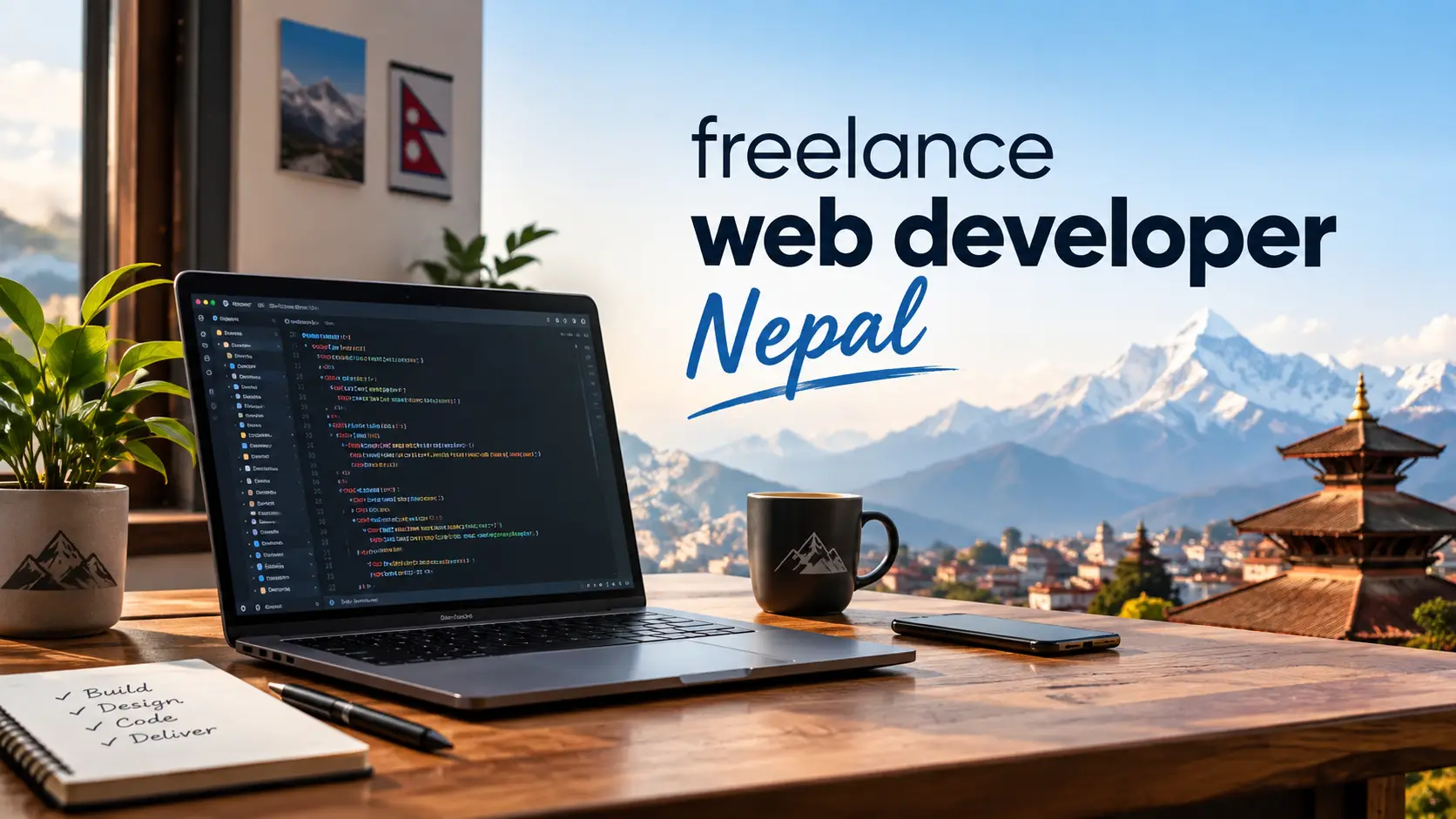
Freelance web developer in Nepal working on a laptop with code and a website design on screen

Key Takeaways

  • Realistic 2026 price bands in NPR, not vague “contact for a quote” answers.
  • Four verification tests you can run yourself in ten minutes, with no technical background.
  • The domain and hosting ownership trap that costs Nepali businesses their websites every year.
  • How to pay safely when local escrow does not exist, using a milestone structure.
  • The Nepal-specific work — eSewa, Khalti, Fonepay, Bikram Sambat dates, Preeti to Unicode — that generic guides ignore completely.

What a Freelance Web Developer in Nepal Actually Does in 2026

The job description has widened a lot. Five years ago, hiring a freelance developer in Nepal usually meant buying a WordPress theme with your logo dropped into it. In 2026, a competent independent developer is expected to handle the full lifecycle:

  • Discovery and scope — turning “I need a website” into a page-by-page specification with success criteria.
  • Design and build — WordPress, Next.js, Laravel or a headless stack, chosen for your maintenance budget rather than the developer’s habit.
  • Performance and Core Web Vitals — a site that loads in under three seconds on an NTC or Ncell mobile connection, not just on office fibre.
  • Technical SEO — schema markup, sitemaps, indexing, and a Search Console handover.
  • Local integrations — payment gateways, SMS APIs, Nepali date handling, bilingual content.
  • Deployment and maintenance — backups, SSL renewal, plugin and dependency updates, uptime monitoring.

The reason this matters for hiring: a developer who only does the middle step will hand you a beautiful site that nobody finds, nobody can update, and nobody can recover when it breaks. When you interview, ask which of the six items above are included in the quote. The honest answer is never “all of them, for NPR 20,000.”

Freelancer vs Agency vs In-House: Which One Fits Your Project?

Most comparison articles are written by freelancers, so they conclude that freelancers always win. That is not true. Here is the honest version, written by someone who has worked on all three sides of this table.

FactorFreelance DeveloperWeb AgencyIn-House Hire
Typical business site costNPR 25,000 – 1,50,000NPR 80,000 – 6,00,000+NPR 40,000 – 1,50,000 per month salary
Who you actually talk toThe person writing the codeAn account manager, usuallyYour own employee
Speed to startDaysTwo to six weeksOne to three months of hiring
Bus factor / continuity riskHigh — one personLow — team coverageMedium — resignation risk
Best forSMEs, startups, redesigns, one clear productBanks, INGOs, multi-team projects, tendersCompanies whose product is software
Biggest riskDisappears; no backup developerJunior does the work at senior priceIdle cost between projects

The honest rule: if your project has one decision-maker and a scope you can describe in two pages, a freelancer is faster and cheaper. If your project needs a signed tender, a compliance audit, or five people working in parallel, pay the agency premium. The mistake is hiring a freelancer for an agency-shaped project and then blaming the freelancer when one person cannot cover design, backend, QA and project management at once.

How Much Does a Freelance Web Developer Cost in Nepal?

Almost every competing page dodges this question with “it depends on your requirements.” It does depend — but you still deserve a starting range. These bands reflect what independent developers in Kathmandu Valley realistically quote to domestic clients in 2026.

Project TypeTypical Range (NPR)TimelineWhat Drives the Price Up
One-page / landing site12,000 – 30,0003 – 7 daysCustom illustration, copywriting
Business / corporate website (5 – 12 pages)25,000 – 60,0002 – 4 weeksBilingual content, custom design, CMS training
E-commerce store60,000 – 2,00,0004 – 10 weeksPayment gateways, delivery logic, stock sync
Custom web application / dashboard1,50,000 – 8,00,000+2 – 6 monthsUser roles, reporting, third-party APIs
Redesign of an existing site30,000 – 1,20,0002 – 6 weeksContent migration, URL redirect mapping
Monthly maintenance retainer3,000 – 25,000 / monthOngoingResponse-time guarantee, content updates
Hourly rate (domestic clients)1,500 – 5,000 / hour—Seniority, urgency, legacy code

Two costs sit outside the developer’s fee and are yours forever: a domain (roughly NPR 1,500 – 3,000 a year for .com, with .com.np free but requiring documentation) and hosting (roughly NPR 3,000 – 15,000 a year for shared hosting, more for a VPS). A quote that hides these inside a single number is a quote you cannot compare. For a full breakdown of what each line item should cost, see our detailed guide to website design cost in Nepal.

Why the cheapest quote is rarely the cheapest outcome: an NPR 15,000 site built on a nulled theme with no backup, no updates and no documentation usually needs a full rebuild within twelve to eighteen months. At that point you have paid NPR 15,000 plus the rebuild, plus the lost search rankings from the downtime. The real question is not “what does this cost?” but “what does doing this badly cost?”

Four Tests to Verify Any Developer in Ten Minutes (No Coding Needed)

You do not need to read code to assess a developer. Run these four checks on their own portfolio site before your first call. If their own website fails, your website will fail the same way.

1. The PageSpeed Test

Paste their portfolio URL into Google PageSpeed Insights and read the mobile score, not desktop. Above 85 is strong. Between 60 and 85, ask them what they would fix. Below 60 on their own site, and performance is not something they take seriously.

2. The Live URL Test

Ask for three live client sites you can open right now. Screenshots and Behance mockups prove nothing — they can be templates, concepts, or someone else’s work. “NDA” covering every single project is a red flag.

3. The Search Test

Google their name plus “web developer Nepal.” If a developer who sells SEO cannot rank their own site for their own name, that tells you exactly how much SEO your project will get.

4. The Response Test

Send one message: “I am considering a project — can you outline your process and rough timeline?” A professional replies within 24 hours and asks questions back. A quote with a fixed price and zero questions means they have not understood the job.

Questions That Separate a Real Developer From a Reseller

A large share of “freelance developers” in Nepal are resellers: they take your money, buy a theme, and pass the build to someone cheaper. These four questions expose that quickly.

Ask This✓ Good Answer✗ Warning Answer
“Why this platform for my project?”Explains trade-offs against your budget, team skill and update frequency.“I only build in X.”
“How do you back up and restore a site?”Names a schedule, an off-server location, and a tested restore process.“The hosting company handles backups.”
“What happens after launch?”Defines a warranty window, a maintenance option, and response times.“Just message me if something breaks.”
“Whose name goes on the domain and hosting?”“Yours. I will be added as a user, not the owner.”“I manage all of that under my account.”

Who Owns Your Domain and Hosting? The Question Nobody Else Asks

This is the single most expensive mistake I see in Nepal, and none of the competing guides on this topic mention it. A developer registers your domain and hosting under their own account “to make things easier.” Two years later the relationship ends, or the developer moves abroad, stops replying, or simply forgets the renewal. Your domain expires. Your email stops working. Your Google rankings, built over years, vanish. And legally, the asset was never in your name.

Insist on this before any money changes hands:

  • The domain is registered in your name or your company’s name, with the registrar login held by you.
  • The hosting account is in your name and billed to you; the developer gets a sub-user account.
  • Google Analytics, Search Console and Google Business Profile use your Google account as owner; the developer is added as a user with access that can be revoked.
  • The full source code is delivered to a repository you control, not just uploaded to the server.
  • Written confirmation that copyright in the custom work transfers to you on final payment.

A professional will agree to all five without hesitation, because none of it costs them anything. Resistance here tells you the business model relies on you being unable to leave.

Paying a Freelance Developer in Nepal Safely

International platforms like Upwork hold funds in escrow. For a domestic Nepali project, no equivalent exists — there is no neutral third party holding the money. That is not a reason to pay everything upfront, and not a reason to pay nothing until the end. Use milestones instead.

30% — On signing

Released when the written scope and sitemap are agreed. Covers discovery and the developer’s commitment of calendar time.

40% — On staging approval

Released when you can click through the working site on a staging URL, not when you see a design image.

30% — On handover

Released after live launch, credential transfer, source code delivery and a recorded training walkthrough.

Practical billing notes for Nepali businesses:

  • Ask whether the developer is a registered firm issuing a PAN or VAT invoice. If your business claims the expense, you need a valid bill — not a handwritten receipt.
  • Withholding tax treatment differs between a registered vendor with a VAT invoice and an unregistered individual. Confirm the current rate with your accountant before you release the first milestone, and agree in writing whether the quoted figure is inclusive or exclusive of tax.
  • For local transfers, bank transfer or connectIPS gives you a traceable record. Cash gives you nothing to point at in a dispute.
  • If you are paying a Nepali developer from abroad, Wise and Payoneer are the common routes; confirm which one they already have set up rather than forcing a new account mid-project.

Nepal-Specific Work Your Developer Must Actually Handle

A generic developer guide written for a global audience skips all of this. For a website serving Nepali customers, these details decide whether the site works in practice.

  • Payment gateways: eSewa, Khalti, Fonepay, IME Pay and connectIPS each have their own integration flow, settlement timeline and merchant onboarding paperwork. Ask which ones the developer has integrated before, and who handles the merchant application.
  • Bikram Sambat dates: If your site publishes notices, events or invoices, BS date display and AD-to-BS conversion are not optional. Retro-fitting them later is far more expensive than planning for them.
  • Preeti and legacy Nepali fonts: Older organisations often hold years of content typed in Preeti or Kantipur. Migrating it to Unicode is a real workstream with a real cost — and it must happen, because search engines cannot read Preeti-encoded text.
  • Bilingual structure: Nepali and English content needs proper hreflang and URL structure, not a Google Translate widget that produces unindexable pages.
  • Hosting location and latency: A server in the US adds real delay for Kathmandu visitors. Either host closer (Singapore or India regions) or put a CDN in front of the site. Ask which the developer plans to do, and why.
  • SMS and notification APIs: Order confirmations and OTPs through Nepali SMS gateways require separate accounts and per-message credit. Clarify who owns and tops up that account.

Red Flags: Walk Away If You See These

✗ Process Red Flags

  • A fixed price given without a single question about your business.
  • 100% payment demanded before any work starts.
  • No written scope — just Viber messages and a verbal agreement.
  • Says yes to every request without ever pushing back.

✗ Technical Red Flags

  • Cannot show a single live URL you can open and test.
  • Wants the domain and hosting under their own account.
  • Uses pirated or “nulled” premium themes and plugins.
  • No staging environment — edits made directly on the live site.

What I’ve Learned Building Websites in Kathmandu

I have been building and shipping websites from Kathmandu for years now, mostly with Next.js and Node.js, and I run a small development outfit here. A few lessons that no amount of theory would have taught me:

The projects that go wrong are almost never the technically hard ones. They go wrong because nobody wrote down what “done” means. My worst experience as a developer was a project where “a simple booking website” turned out to mean multi-property inventory, seasonal pricing, and an agent commission system — discovered in week six. Now I will not start a build without a written scope, however small the job. Clients who resist that step are exactly the clients who will redefine the project at week six.

The client who asks the most questions is usually the best client. I used to find detailed questions exhausting. I now read them as a signal that this person will test the site, give real feedback, and actually use what I build. The clients who say “you’re the expert, do whatever you think” are the ones who dislike everything at handover, because they never had a chance to disagree earlier.

Handover is the part everybody undervalues. Early on I delivered sites with a two-line email of credentials. Clients would come back weeks later asking how to add a blog post, and both of us would be frustrated. Now every project ends with a short screen recording walking through the exact tasks the client will do most often. It takes twenty minutes and removes months of small support requests.

Cheap quotes have a shape. When a competing quote is a third of mine, I no longer assume I am overpriced. I ask what is in it. Usually it excludes content migration, excludes SEO setup, excludes any maintenance, and assumes a stock theme. That is a legitimate product — it just is not the same product. Ask for the exclusion list in writing and the two quotes become comparable.

If you want to see how these stages play out on a real build — scope, staging, launch and handover — walk through this website case study from concept to launch.

What Existing Guides on This Topic Leave Out

Before writing this, I read through the pages currently ranking for this topic in Nepal. Most are portfolio homepages rather than guides, and the few real articles share the same blind spots. If you have already read them, here is what you did not get:

  • Actual NPR figures. Several guides quote USD hourly rates aimed at Upwork clients, which is useless if you are a business in Pokhara hiring locally.
  • The ownership question. Not one competing page tells you to put the domain and hosting in your own name — the single most damaging oversight in Nepali web projects.
  • Payment structure without escrow. Advice to “always use escrow” does not apply to a domestic Nepali project. A milestone schedule does.
  • Mixed intent. Some articles targeting this search are actually about becoming a freelancer — rates to charge, platforms to join — when the reader was trying to hire one. They answer the wrong question well.
  • Nepal-specific technical work. Payment gateway options, BS dates, Preeti-to-Unicode migration and hosting latency are absent almost everywhere.
  • Billing and tax reality. No competing page mentions PAN or VAT invoices, which matters to every registered business that needs to book the expense.

If You Want to Become a Freelance Web Developer in Nepal

A share of people searching this term are not hiring — they want to do the job. The short version, from the other side of the table:

  • Build one real thing, not ten tutorials. A single live project with actual users outperforms a portfolio of clones. Clients click the link; they do not review your code.
  • Rank your own site first. It is the only portfolio piece that proves you understand SEO, performance and content at once.
  • Domestic and international are two different businesses. Local clients pay in NPR on relationship and referral; international clients pay in USD on profile and reviews. Pick one to start, because the sales motion is completely different.
  • Write everything down. Scope, exclusions, revision limits, payment schedule. Most freelancer horror stories in Nepal trace back to a verbal agreement.
  • Specialise. “I build fast e-commerce sites for Nepali retailers” wins more work than “I am a full stack developer.”

Frequently Asked Questions

How much does a freelance web developer charge in Nepal?

A business website typically costs NPR 25,000 to 60,000, an e-commerce store NPR 60,000 to 2,00,000, and a custom web application NPR 1,50,000 and upwards. Hourly rates for domestic clients usually fall between NPR 1,500 and 5,000. Domain and hosting are separate annual costs that should be billed in your name.

Is it safe to hire a freelance developer instead of a company in Nepal?

Yes, provided you manage the two real risks: continuity and payment. Use a written scope, a three-stage milestone payment schedule, and insist that the domain, hosting, analytics and source code sit in your own accounts. With those in place, you can change developers at any time without losing the asset.

How long does it take to build a website in Nepal?

A landing page takes three to seven days, a standard business website two to four weeks, an e-commerce store four to ten weeks, and a custom application two to six months. The most common cause of delay is not development speed but slow delivery of content, images and approvals from the client side.

Who should own the domain and hosting, me or the developer?

You should. Register the domain in your own or your company’s name and keep the registrar and hosting logins yourself, adding the developer as a user. If a developer insists on holding ownership, treat it as a serious warning sign rather than a convenience.

What should be in a web development contract in Nepal?

At minimum: a page-by-page scope with explicit exclusions, a payment schedule tied to deliverables, the number of revision rounds included, a post-launch warranty period, the maintenance arrangement afterwards, ownership and credential transfer terms, and what happens if either side exits early.

Can a freelance web developer in Nepal handle large or enterprise projects?

Experienced freelancers regularly deliver custom CRMs, internal tools and complex integrations. The limiting factor is not skill but parallel capacity. If the project needs design, backend, QA and project management running simultaneously against a fixed deadline, either budget for a longer timeline or hire a small team rather than one person.

Planning a Website Project in Nepal?

I build fast, SEO-ready websites and web applications from Kathmandu using Next.js, Node.js and WordPress — with a written scope, milestone payments, and every credential handed over in your name. Tell me what you are trying to build and I will tell you honestly whether you need a freelancer, an agency, or neither.

Start a Conversation →

Successful SEO Campaigns: Lessons from Top Case Studies

Successful SEO Campaigns: Lessons from Top Case Studies

Understanding the intricacies of successful SEO campaigns is crucial for digital marketers aiming to enhance search visibility and drive organic traffic. By analyzing real-world case studies, we can uncover effective strategies and actionable insights that have propelled top businesses to SEO success. This blog post explores these lessons, providing a comprehensive analysis of key metrics, strategies, and tools that define effective SEO.

📌 Key Takeaways

  • Analyze real-world SEO strategies that drove success.
  • Understand key metrics for measuring SEO campaign effectiveness.
  • Learn from proven SEO tactics to enhance your digital marketing.
id=”understanding-successful-seo-campaigns” class=”autoblogger-h2″ style=”font-size: 1.75rem; font-weight: 800; color: #0f172a; margin: 2.5rem 0 1.25rem 0; border-bottom: 2px solid #e2e8f0; padding-bottom: 0.5rem;”>Understanding Successful SEO Campaigns

Defining Success in SEO

A successful SEO campaign is characterized by its ability to significantly improve search engine rankings, increase organic traffic, and achieve specific business objectives. However, defining success in SEO is not one-size-fits-all. It depends on the goals of the business, whether it’s boosting e-commerce sales, increasing brand awareness, or improving local search visibility.

Key Metrics to Track

To measure the success of an SEO campaign, you must track several key metrics. These include:

  • Organic Traffic: The number of visitors reaching your site through unpaid search results.
  • Keyword Rankings: Positions of your targeted keywords on search engine results pages (SERPs).
  • Conversion Rates: The percentage of visitors completing desired actions, such as purchases or sign-ups.
  • Bounce Rate: The percentage of visitors leaving your site after viewing only one page.

You can explore a comprehensive list of SEO success metrics [here](https://moz.com/beginners-guide-to-seo).

Case Study: E-commerce SEO Success

Background and Objectives

An e-commerce company sought to increase its online sales by enhancing its organic search visibility. The primary objective was to improve keyword rankings and boost traffic to product pages.

Strategies Implemented

The company employed several effective SEO strategies:

  1. Keyword Optimization: Conducted thorough keyword research to identify high-traffic, low-competition keywords.
  2. Content Creation: Developed high-quality, informative product descriptions and blog content to attract and engage users.
  3. Technical SEO: Improved site speed, mobile responsiveness, and fixed crawl errors.

These efforts led to a 40% increase in organic traffic and a 25% boost in conversion rates within six months.

Case Study: Local Business SEO Triumph - successful SEO campaigns
Case Study: Local Business SEO Triumph

Case Study: Local Business SEO Triumph

Initial Challenges

A local restaurant faced challenges in appearing prominently on local search results. Despite having excellent customer reviews, their online presence was limited.

Results Achieved

By implementing a local SEO strategy, the restaurant achieved remarkable improvements:

  1. Google My Business Optimization: Enhanced their GMB profile with accurate details, photos, and regular updates.
  2. Local Keywords: Integrated location-based keywords into their website content.
  3. Local Citations: Ensured consistent NAP (Name, Address, Phone) data across local directories.

As a result, the restaurant saw a 50% increase in local search visibility and a 30% rise in foot traffic.

Lessons Learned from Successful SEO Strategies - successful SEO campaigns
Lessons Learned from Successful SEO Strategies

Lessons Learned from Successful SEO Strategies

Common Themes

Several common themes emerge from analyzing successful SEO campaigns:

  • Focus on User Intent: Understanding what users are searching for and tailoring content to meet those needs is paramount.
  • High-Quality Content: Engaging, informative content consistently ranks higher on SERPs.
  • Technical Excellence: A technically sound website enhances user experience and search visibility.

Actionable Insights

  • Regularly Update Content: Keep your content fresh and relevant to maintain rankings.
  • Leverage Analytics: Use data to understand user behavior and refine your strategies.
  • Build Quality Backlinks: Earn links from reputable sites to boost authority and trust.

Measuring the Impact of SEO Campaigns

Tools for Tracking Success

To effectively measure the impact of your SEO efforts, leverage the following tools:

  • Google Analytics: Track traffic, conversions, and user behavior.
  • Google Search Console: Monitor keyword performance and identify site issues.
  • SEMrush/Ahrefs: Analyze competitors and discover backlink opportunities.

Interpreting Data

Interpreting SEO data requires understanding the story behind the numbers. For example, a spike in bounce rate might indicate irrelevant content or technical issues. Regularly reviewing these metrics allows you to make informed decisions and adjust strategies accordingly.

Conclusion

By studying successful SEO campaigns and analyzing [case study examples](https://searchengineland.com), digital marketers can gain valuable insights into what works and what doesn’t. Focus on key metrics, maintain high-quality content, and continually optimize your strategies to achieve long-term success in your SEO endeavors.

💡 Pro Tip: Stay updated with the latest SEO trends and algorithm changes to keep your strategies effective and competitive.

⚠️ Important Note: SEO is a long-term investment. Be patient and consistent with your efforts to see sustainable results.

By applying these lessons learned from top case studies, you can craft a tailored strategy that aligns with your business goals and drives measurable success.

Frequently Asked Questions

What makes an SEO campaign successful?

A successful SEO campaign effectively improves search rankings, increases organic traffic, and meets predefined business goals.

How can I measure the success of my SEO efforts?

Success can be measured using metrics such as organic traffic growth, conversion rates, and search engine rankings.

What are common strategies in successful SEO campaigns?

Common strategies include keyword optimization, high-quality content creation, and technical SEO improvements.

SEO Troubleshooting Guide: Fix Common Issues Fast

SEO Troubleshooting Guide: Fix Common Issues Fast

Navigating the complex world of search engine optimization (SEO) can be daunting, especially when issues arise that affect your website’s performance. An effective SEO troubleshooting guide can be your savior, helping you swiftly identify and resolve common problems. In this comprehensive guide, we’ll delve into the key SEO issues and provide actionable solutions to enhance your website’s performance, boost search rankings, and ultimately drive more traffic.

📌 Key Takeaways

  • Identify and resolve common SEO problems effectively.
  • Learn practical steps for optimizing website performance.
  • Improve search rankings with targeted troubleshooting.
id=”understanding-common-seo-issues” class=”autoblogger-h2″ style=”font-size: 1.75rem; font-weight: 800; color: #0f172a; margin: 2.5rem 0 1.25rem 0; border-bottom: 2px solid #e2e8f0; padding-bottom: 0.5rem;”>Understanding Common SEO Issues

The first step in troubleshooting common SEO issues is recognizing the problems that frequently occur. These can be broadly categorized into technical SEO errors and content-related problems.

Technical SEO Errors

Technical SEO errors can significantly hinder your website’s visibility. Common issues include broken links, improper redirects, and poor site architecture. These errors can confuse search engine crawlers, leading to lower rankings.

  1. Broken Links: Use tools like Screaming Frog or Ahrefs to identify and fix broken links. Make sure every link on your site points to a valid destination.
  1. Improper Redirects: Ensure that 301 redirects are used for permanent URL changes. Avoid using 302 redirects, which are temporary and may not transfer SEO value.
  1. Site Architecture: A well-organized site structure helps search engines index your pages efficiently. Use a logical hierarchy and ensure critical pages are easily accessible.

Content and Keyword Problems

Content is king, but only if optimized correctly. Issues here often involve poor keyword usage and low-quality content.

  1. Keyword Stuffing: Avoid overloading your content with keywords. Instead, focus on natural integration and semantic variations.
  1. Thin Content: Ensure all pages provide valuable information. Pages with little content should be expanded or consolidated with related content.
  1. Duplicate Content: Use canonical tags to indicate the preferred version of a page when duplicates exist.

Conducting a Comprehensive SEO Audit

An SEO audit is a systematic examination of your website’s performance. It helps identify weaknesses and opportunities for improvement.

Tools for SEO Auditing

Several tools can aid in conducting thorough SEO audits:

  • Google Analytics: Offers insights into user behavior and site performance.
  • SEMrush: Provides comprehensive data on keywords, backlinks, and competitor performance.
  • Moz: Useful for keyword optimization and backlink analysis. Check out the [Moz SEO Learning Center](https://moz.com/learn/seo) for more resources.

Analyzing SEO Data

Once you’ve gathered data, it’s crucial to interpret it effectively:

  1. Identify Trends: Look for patterns in traffic changes or keyword performance.
  2. Pinpoint Issues: Use the data to highlight specific areas needing attention, such as high bounce rates or low conversion pages.
  3. Set Priorities: Rank issues based on their potential impact on SEO performance and address high-priority items first.

Fixing Technical SEO Problems - SEO troubleshooting guide
Fixing Technical SEO Problems

Fixing Technical SEO Problems

Technical issues often require immediate attention due to their impact on user experience and search rankings.

Improving Site Speed

Site speed is critical for both user satisfaction and SEO.

  1. Optimize Images: Compress images without losing quality to reduce load times.
  2. Minimize JavaScript and CSS: Remove unnecessary code to enhance loading efficiency.
  3. Use a Content Delivery Network (CDN): Distribute content globally to improve access speed.

Mobile Optimization

With the majority of searches coming from mobile devices, ensuring your site is mobile-friendly is essential.

  1. Responsive Design: Implement a design that adjusts to various screen sizes seamlessly.
  2. Mobile Usability: Test your site using Google’s Mobile-Friendly Test and address any issues found.

Optimizing Content and Keywords - SEO troubleshooting guide
Optimizing Content and Keywords

Optimizing Content and Keywords

Enhancing content quality and keyword strategy are crucial for engaging users and improving search visibility.

Keyword Research Techniques

Effective keyword research can significantly boost your SEO efforts.

  1. Use Tools: Leverage tools like Google Keyword Planner and SEMrush to discover high-performing keywords.
  2. Analyze Competitors: Identify keywords competitors rank for and assess their relevance to your content.

Content Quality Improvement

High-quality content attracts and retains users.

  1. Engaging Headlines: Craft compelling titles that capture attention and include primary keywords.
  2. Value-Driven Content: Focus on creating content that answers users’ questions or solves their problems.

Backlinks remain a vital component of SEO, signaling trust and authority to search engines.

Developing a strategy for acquiring quality backlinks is crucial.

  1. Guest Blogging: Write for reputable sites in your niche to earn backlinks and increase exposure.
  2. Collaborations: Partner with industry influencers to create content that naturally attracts links.

Not all backlinks are created equal; quality matters more than quantity.

  1. Assess Authority: Use tools like Moz’s Domain Authority metric to evaluate the strength of linking sites.
  2. Relevance: Ensure links come from sites relevant to your industry or content theme.

Conclusion

Resolving SEO issues effectively requires a meticulous approach and a clear understanding of both technical and content-related challenges. By conducting regular audits, fixing technical problems, optimizing content and keywords, and building quality backlinks, you can significantly improve your website’s SEO performance. For further guidance, refer to [Google Search Central documentation](https://developers.google.com/search/docs) for technical SEO best practices. Start implementing these strategies today to see tangible improvements in your search rankings and website traffic.

💡 Pro Tip: Regularly update your content and SEO strategies to adapt to changing search engine algorithms and user preferences.

⚠️ Important Note: SEO is a long-term process. Patience and consistency are key to achieving and maintaining high search rankings.

Frequently Asked Questions

What are the most common SEO issues?

Common issues include technical errors, poor keyword usage, and inadequate backlinks.

How can I improve my website's SEO performance?

Conduct audits, fix technical issues, optimize content, and build quality backlinks.

What tools can help with SEO troubleshooting?

Tools like Google Analytics, Moz, and SEMrush are useful for identifying and resolving SEO issues.

Website Design Cost in Nepal 2026: Real Prices (NPR 8,000+)

Website Design Cost in Nepal (2026): Real Prices, Not Padded Quotes

Website design cost in Nepal 2026 — price breakdown chart in NPR for business, e-commerce and custom websites
Website design cost in Nepal 2026 — verified NPR price ranges for every website type.
Quick Answer

Website design cost in Nepal ranges from NPR 8,000 for a one-page site to NPR 2,50,000 for a full e-commerce platform in 2026. A normal 5–8 page business website costs NPR 18,000 to NPR 45,000. A professional website with a CMS, blog and multiple service pages costs NPR 45,000 to NPR 90,000. Add roughly NPR 2,000–6,000 per year for domain and hosting.

Most published "Nepal website price" guides quote 2–3× these figures because they are written by agencies pricing in their office rent, sales team and account managers. This guide prices the actual work.

Every week someone messages me with the same sentence: "One person quoted me NPR 15,000 and another quoted NPR 1,80,000 for the same website. Who is lying?"

Usually, neither. They are quoting two completely different pieces of work and calling both a "business website." The NPR 15,000 version is a free theme with your logo dropped in. The NPR 1,80,000 version includes original design, a proper CMS, content entry, testing and three months of support. The word "website" is doing a lot of hiding.

I build websites for Nepali businesses from Kathmandu — WordPress for content-driven sites, Next.js and Node.js when a business actually needs an application. I have quoted, delivered and occasionally rescued enough projects to know where the money really goes. This guide gives you the numbers, the traps, and the exact questions that separate a fair quote from a padded one. If you want to see the kind of work these prices buy, my portfolio and services are here.

Website Design Cost in Nepal 2026: Complete Price Table

These are realistic 2026 rates for a skilled independent developer in Nepal delivering finished, owned, handed-over work. Agencies typically sit 60–150% above these numbers for the same scope.

Website TypeCost (NPR)TimelineBest For
One-page / landing page8,000 – 18,0003–7 daysCampaigns, single services, events
Personal / portfolio site10,000 – 25,0005–10 daysFreelancers, doctors, lawyers, creatives
Small business website (5–8 pages)18,000 – 45,0002–3 weeksShops, clinics, consultancies, cafés
Professional CMS website45,000 – 90,0003–5 weeksGrowing companies, service brands
Corporate / multi-department90,000 – 2,00,0005–10 weeksBanks, groups, manufacturers, INGOs
School / college website30,000 – 90,0003–6 weeksSchools, colleges, training institutes
Travel / trekking with enquiry system40,000 – 1,50,0004–9 weeksTrekking agencies, tour operators
Hotel / resort with booking55,000 – 1,60,0004–10 weeksHotels, homestays, resorts
News portal40,000 – 1,20,0003–7 weeksOnline news, magazines, publishers
Basic e-commerce store45,000 – 95,0003–6 weeksUp to ~200 products, COD + 1 gateway
Advanced e-commerce95,000 – 2,50,0006–14 weeksLarge catalogue, multi-gateway, inventory
Multi-vendor marketplace2,50,000 – 7,00,0003–6 monthsDaraz-style platforms with sellers
Custom web application / SaaS1,00,000 – 6,00,000+2–8 monthsDashboards, portals, internal systems
Website redesign (existing site)15,000 – 80,0001–4 weeksSites that look dated but work
Landing page for ads (with tracking)12,000 – 25,0004–8 daysMeta / Google Ads campaigns

All figures exclude domain, hosting and third-party licence fees. See the total cost of ownership section for the all-in number.

Want your own scope priced instead of a range? Send me your page list.

Why These Prices Are Lower Than Most Quotes in Nepal

If you have already read two or three "website cost in Nepal" articles, my numbers will look low. That is deliberate, and here is exactly why they can be:

  • No office overhead. Agency quotes carry rent in Kathmandu, a sales team, account managers and idle bench time. On a NPR 1,00,000 project, a meaningful share of that never touches your website.
  • No layers between you and the developer. Your feedback goes straight to the person writing the code. No brief gets lost in translation, which kills the revision cycles that inflate quotes.
  • Reusable, owned component libraries. I do not rebuild a contact form, a booking enquiry flow or a product grid from zero every time. Years of reusable, tested components mean I charge for the parts that are genuinely new to your project — you can see the range of work at wilson.com.np.
  • Honest scoping instead of padding. Many quotes include a 30–40% buffer for "unknowns." I would rather define the scope properly upfront and charge for changes transparently.
Important

Lower price does not mean less work — it means less waste. Every price in this guide assumes original design work, mobile-responsive layouts, real testing, technical SEO setup, admin training and full handover of the domain, hosting and source code. If a quote is cheap because those are missing, it is not cheap. It is incomplete.

Website Design Cost in Nepal by Type (What Each Price Actually Includes)

One-Page / Landing Page: NPR 8,000 – 18,000

A single scrolling page covering your offer, benefits, proof and one clear call to action. This is the highest-return first website for a service business that mostly sells through Facebook or word of mouth.

  • Hero section with your main offer
  • Services or benefits block
  • Testimonials or client logos
  • Enquiry form + click-to-call + WhatsApp button
  • Mobile-first responsive layout
  • Google Analytics and Search Console setup

Price goes up when you need custom illustration, heavy animation, a booking calendar, multilingual content or a CRM connection.

Portfolio Website: NPR 10,000 – 25,000

For freelancers, photographers, architects, doctors, lawyers and consultants. Cost is driven almost entirely by how many projects you want showcased and whether you need a blog. A 6-project portfolio with a contact form sits at the bottom of the range; a 40-project filterable gallery with case study pages sits at the top.

Small Business Website: NPR 18,000 – 45,000

This is the most common request in Nepal and the one with the widest quote spread in the market. A fair NPR 18,000–45,000 build includes:

  • 5–8 pages (Home, About, Services, Service detail, Gallery, Blog, Contact)
  • Semi-custom design built on your brand colours, not a stock demo
  • WordPress CMS so you can edit text and images yourself
  • Contact form with email delivery that actually works in Nepal's mail environment
  • Google Maps, social links, WhatsApp button
  • Technical SEO: titles, meta descriptions, sitemap, schema, image compression
  • Speed optimisation and SSL
  • One training session so your staff can update content

Professional CMS Website: NPR 45,000 – 90,000

Where you move from "we exist online" to "our website generates enquiries." Expect a fully custom design direction, 10–20 pages, a structured blog, team and project managers in the admin panel, advanced forms, filtering and real performance work on Core Web Vitals.

E-commerce Website: NPR 45,000 – 2,50,000

The single biggest cost driver in Nepali e-commerce is product data entry, not the store itself. Building the store is a fixed job. Entering 800 products with variants, images, weights and descriptions is an open-ended one.

E-commerce TierCost (NPR)What's Included
Starter store45,000 – 95,000Up to ~200 products, cart, checkout, COD, one wallet gateway, order emails, basic stock tracking
Growth store95,000 – 1,80,000Custom design, filters, customer accounts, wishlist, reviews, 2–3 gateways, discount engine, delivery zones
Advanced store1,80,000 – 2,50,000+Large catalogue, multi-warehouse inventory, invoice generation, returns workflow, courier + accounting integrations, reports
Product data entry15 – 60 per productCharged separately, or you do it yourself and save the whole line item

Custom Web Application: NPR 1,00,000 – 6,00,000+

School portals, clinic management, inventory systems, booking platforms, internal dashboards. Here, screen count tells you almost nothing about price. One screen with role-based permissions, complex calculations and an external API can cost more than fifteen informational pages. These projects are priced from a written feature specification, never from a category name.

What Actually Makes a Website Cost More (or Less) in Nepal

FactorCost ImpactWhy
Unique page templatesHigh10 pages using 3 layouts is far cheaper than 6 pages with 6 different layouts
Design originalityHighCustom UI/UX means research, wireframes and revision rounds
Content readinessHighMissing text and photos is the #1 cause of delayed, more expensive projects in Nepal
User accounts & rolesHighPermissions, security and testing multiply with every role added
Payments or bookingsHighMoney flows need error handling, reconciliation and real testing
Third-party integrationsMedium–HighSMS, courier, accounting, CRM and map APIs each need work and testing
Bilingual (Nepali + English)MediumTranslation, font handling, URL structure, duplicated testing
Search & filteringMediumRequires structured data and backend logic, not just a search box
Number of revision roundsMediumUnlimited revisions are always priced in somewhere — usually invisibly
Deadline pressureMediumCompressed timelines mean overtime or parallel resources
Post-launch support periodLow–MediumA 3-month warranty costs more than a 2-week handover

Template vs Semi-Custom vs Fully Custom Design

Design LevelDesign Cost (NPR)Good WhenReal Downside
Template / theme3,000 – 12,000Budget is tight and your requirements are standardYour site looks like 200 others; heavy themes slow you down
Semi-custom12,000 – 35,000Most Nepali SMEs — best value in the marketSome structural limits remain from the base system
Fully custom UI/UX35,000 – 90,000Strong brand, unusual user journeys, competitive nicheLonger design phase, more approval rounds

My honest recommendation for 90% of Nepali businesses: semi-custom. You get a layout shaped around your actual services and brand without paying for wireframing workshops you will not use. Save the fully custom budget for when your website is directly responsible for revenue.

Technology Stack and Its Effect on Cost

TechnologyTypical Cost (NPR)Best ForWatch Out For
WordPress12,000 – 90,000Business sites, blogs, news, most SMEsPlugin bloat and security if unmaintained
WooCommerce45,000 – 1,80,000Small and medium online storesNeeds good hosting past ~500 products
Shopify25,000 – 70,000 + monthly feeSimple stores with no custom logicRecurring USD platform fee; limited NPR gateway options
Laravel / custom PHP80,000 – 5,00,000+Portals, custom CMS, business systemsYou need a developer available long-term
Next.js + Node.js90,000 – 6,00,000+Dashboards, SaaS, fast content sites at scaleOverkill for a 6-page brochure site
Static HTML / Astro8,000 – 30,000Landing pages, fast one-pagersContent edits need a developer unless a CMS is added
From experience

I have been asked to build Next.js sites for restaurants with nine pages and no traffic. It looks impressive on a quote and costs the client twice what they needed — and then they cannot edit their own menu. Match the stack to the job. A well-built WordPress site beats a badly built custom one every single time.

The Cost of a Nepali or Bilingual Website (Nobody Prices This)

Content Gap

I checked every major "website cost in Nepal" guide ranking today. Not one of them prices Nepali-language content — in a country where a large share of government bodies, schools, news portals and local businesses need it.

Adding Nepali to an English site is not a translation invoice. It touches design, fonts, URLs and testing.

Bilingual Work ItemAdded Cost (NPR)Note
Language switcher + URL structure setup5,000 – 15,000Needs correct hreflang or Google may treat pages as duplicates
Devanagari typography & layout adjustment3,000 – 10,000Nepali text runs taller; line-height and buttons must be re-tuned
Nepali content translation300 – 900 per pageMachine translation reads badly and hurts credibility
Preeti / Kantipur → Unicode conversion2,000 – 12,000Old legacy-font content is invisible to Google until converted
Bilingual testing pass3,000 – 8,000Forms, PDFs and emails all need re-testing in both languages
Costly mistake

If your existing website's Nepali content is typed in Preeti or Kantipur font, search engines read it as meaningless Latin characters. You can have 300 Nepali articles and rank for none of them. Converting to Unicode is the single cheapest SEO fix available to many Nepali news portals and institutional sites — and almost nobody tells clients about it.

Domain Registration Cost in Nepal 2026 (and the .com.np Trap)

Domain TypeCost per YearWho Can Register
.com / .net / .orgNPR 1,200 – 1,900Anyone. Renews annually, sometimes higher than year one.
.com.npFreeNepal-registered entities — requires OCR company registration certificate and PAN/VAT certificate
.np (personal)FreeNepali individuals with citizenship, passport or driving licence
.org.np / .edu.npFreeNGOs and recognised educational institutions with supporting documents
Domain in redemption (expired)NPR 5,000 – 15,000Recovery fee after expiry — avoid by enabling auto-renew

Three things most guides get wrong about Nepal's .np registry:

  1. "Just citizenship documents" is wrong for .com.np. A company domain requires a company registration certificate from the Office of Company Registrar plus a PAN/VAT certificate. An individual freelancer generally cannot get .com.np on citizenship alone — that route is the personal .np namespace.
  2. Free does not mean effortless. Applications are reviewed manually, typically within 1–3 working days, and expired or mismatched documents are the most common rejection reason.
  3. Free does not mean free of risk. If your developer registers it under their own email, you do not truly control your domain. Fix this at day one, not at handover.
SEO note

A .com.np signals local relevance to Nepali users and can help trust and local search. But if you serve international clients — trekking, outsourcing, handicrafts, remote services — buy the .com too and redirect one to the other. NPR 1,500 a year is cheap insurance against a competitor taking your brand name.

Website Hosting Cost in Nepal 2026 (Real, Verified Prices)

Content Gap

Competing guides quote shared hosting in Nepal at "NPR 2,000–8,000 per year." That figure is years out of date. Published prices from Nepal-based hosts in 2026 start dramatically lower — and if you are being charged NPR 8,000 for entry-level shared hosting, you are paying a margin, not a market rate.

Hosting TypeReal 2026 Annual Cost (NPR)Good ForWatch Out For
Entry shared hosting (Nepal host)500 – 2,500Portfolios, small business sites, blogsRenewal price often higher than the promo price
Business shared hosting2,500 – 6,000Busier business sites, small storesCheck actual CPU/RAM limits, not just "unlimited"
Managed WordPress hosting6,000 – 25,000Sites you do not want to maintain yourselfUsually worth it for stores and news portals
VPS (Nepal or regional)12,000 – 60,000Custom apps, high traffic, multiple sitesSomeone must actually manage the server
Cloud (AWS / DigitalOcean / Hetzner)15,000 – 2,00,000+SaaS, apps, scaling workloadsBills in USD and varies with usage
SSL certificateFree (Let's Encrypt)Every websiteDo not pay NPR 8,000/yr for basic SSL. Free is equally secure.
Business email (Google Workspace / Zoho)0 – 12,000Professional @yourbrand addressesZoho's free tier covers most small Nepali teams

Should you host in Nepal or abroad?

  • Host in Nepal if your visitors are almost all inside Nepal, you want NPR billing with eSewa/Khalti, and you value phone support in Nepali. Latency to local visitors is excellent.
  • Host abroad (Singapore, Mumbai, Frankfurt) if you serve international clients — trekking companies, exporters, outsourcing firms. Pair it with a free Cloudflare CDN and local visitors barely notice.
  • Either way, use Cloudflare's free plan. It gives you CDN, free SSL, DDoS protection and DNS at zero cost. This is the highest-value free item in the entire stack.

Payment Gateway Integration Cost: eSewa, Khalti and Fonepay

Content Gap

Competing articles say "payment gateway integration costs extra" and stop there. Here are the actual development costs, the merchant requirements, and the per-transaction rates that eat your margin every single month.

GatewayIntegration Cost (NPR)Typical Transaction FeeMerchant Requirement
Cash on DeliveryIncluded0%None — still the majority of Nepali orders
eSewa8,000 – 20,000~1.5% (negotiable at volume)PAN; VAT certificate above threshold
Khalti7,000 – 18,000~2% (negotiable at volume)PAN; business registration for full merchant
Fonepay QR8,000 – 20,000Often 0% on QRBank acquirer relationship + PAN
ConnectIPS10,000 – 25,000Varies by bankNCHL onboarding via your bank
Stripe / PayPal (international)12,000 – 30,000~3% + fixed feeRestricted for Nepal-registered entities — check eligibility first
eSewa + Khalti together15,000 – 35,000Per-gateway rates applyRecommended combination for Nepali stores
  • If you use WooCommerce, insist on the plugin route. Maintained eSewa and Khalti plugins exist. A day of work, not a week. If someone quotes NPR 50,000 to add eSewa to a WooCommerce store, ask why they are writing it from scratch.
  • Merchant approval is on you, not your developer. Gateway onboarding needs your PAN, bank details and sometimes VAT registration. Start the application on day one — approval is often the thing that delays launch, not the code.
  • Budget the percentage, not just the setup. At NPR 5,00,000 monthly sales, a 2% rate is NPR 10,000 every month — far more than the one-time integration fee. Negotiate your rate once volume justifies it.

The 13% VAT Question Nobody Answers

Content Gap

Zero competing guides mention VAT. Yet it is the single most common billing surprise in Nepali web projects — a NPR 1,00,000 quote arriving as a NPR 1,13,000 invoice.

Web development is a taxable service in Nepal. When you buy from a VAT-registered company, the invoice carries VAT on top of the quoted amount at the prevailing rate. What this means in practice:

  • Always ask: "Is this quote VAT-inclusive or exclusive?" Before comparing two quotes, normalise them. A VAT-inclusive NPR 1,10,000 quote is cheaper than a VAT-exclusive NPR 1,00,000 one.
  • If you are VAT-registered yourself, a VAT bill is usually good news. You get a claimable purchase invoice. Many businesses unknowingly choose the non-billing option and lose that benefit.
  • If you need a formal PAN/VAT bill for your books, say so upfront. Some individual freelancers cannot issue one, and discovering that at payment time creates an awkward and avoidable problem.
  • TDS applies to service payments. Companies commonly deduct tax at source on service invoices. Agree who absorbs it before the final instalment, not during it.
Tip

Put one line in your scope document: "Quoted price is [inclusive / exclusive] of VAT. A PAN/VAT invoice [will / will not] be issued." That one sentence prevents the most common payment dispute in this industry. Confirm current rates and your own obligations with your accountant or the Inland Revenue Department — I build websites, I am not a tax adviser.

Year 1 vs Year 2: What a Nepali Website Really Costs Over Time

Content Gap

Every competing article gives you a build price. None of them give you the number that actually matters to a business owner: what does this cost me over three years?

Scenario A: Small business website

ItemYear 1 (NPR)Year 2+ (NPR/yr)
Design & development28,0000
Domain (.com.np free + .com backup)1,5001,500
Shared hosting2,0002,500
SSL (Let's Encrypt)00
Business email (Zoho free tier)00
Basic maintenance (optional)0 – 18,00012,000 – 24,000
Total31,500 – 49,5004,000 – 28,000

Scenario B: E-commerce store

ItemYear 1 (NPR)Year 2+ (NPR/yr)
Design & development75,0000
Payment gateway integration (eSewa + Khalti)22,0000
Product data entry (300 items)9,000Ongoing / in-house
Domain1,5001,500
Business hosting5,0006,000
Premium plugin licences4,000 – 12,0004,000 – 12,000
Maintenance (recommended, not optional for stores)24,00036,000 – 60,000
Gateway transaction fees~1.5–2% of sales~1.5–2% of sales
Total (excl. transaction fees)1,40,500 – 1,48,50047,500 – 79,500

The lesson: a brochure website is genuinely cheap to keep alive — under NPR 5,000 a year if you maintain it yourself. An e-commerce store is a running business system with real annual costs. Budget for year two before you commit to year one.

Website Maintenance Cost in Nepal

PlanMonthly (NPR)IncludesRight For
Self-managed0You run updates and backups yourselfTechnical owners, simple sites
Basic1,000 – 2,500Core/plugin updates, backups, uptime monitoring, SSL renewalBrochure and portfolio sites
Standard2,500 – 7,000Basic + content updates, bug fixes, monthly health reportActive business sites, blogs
Premium7,000 – 20,000Standard + speed work, SEO monitoring, small feature additionsStores, news portals, lead-generating sites
Application support20,000 – 60,000Priority response, server management, ongoing development hoursCustom apps, SaaS, marketplaces
Real cost of skipping maintenance

The most expensive websites I work on are the cheap ones that were abandoned. An unmaintained WordPress site gets compromised through an outdated plugin, gets flagged by Google for malware, and the cleanup plus reputation recovery costs more than five years of basic maintenance would have. If you take one thing from this guide: budget NPR 1,000–2,500 a month, or commit to doing updates yourself every month.

Hidden Costs That Turn a NPR 40,000 Quote into NPR 75,000

Hidden CostTypical Amount (NPR)How to Avoid It
Premium theme / page builder licence3,000 – 15,000/yrAsk whose licence it is and whether it renews in your name
Content writing500 – 2,500/pageWrite it yourself; you know your business better anyway
Professional photography8,000 – 40,000Worth it. Stock photos of foreigners hurt trust in Nepal.
Stock images0 – 15,000Use Unsplash/Pexels free tiers where photography isn't critical
Product data entry15 – 60/productDo it in-house with a CSV template
SMS gateway (OTP, order alerts)Per-SMS + setupUse email + WhatsApp first; add SMS when volume justifies it
Google Maps APIUsage-basedAn embedded static map is free and enough for a contact page
Post-warranty change requests1,500 – 4,000/hrGet the warranty period in writing before signing
Staff CMS training3,000 – 10,000Insist on a recorded training video — reusable forever
Migration from a previous developer5,000 – 30,000Keep your own hosting and domain access from day one

What You Should NOT Pay For in Nepal

Content Gap

Every guide tells you what to pay for. This is the list of things that are commonly charged in Nepal and should cost you nothing.

  • Basic SSL certificate — NPR 5,000–15,000/yr. Let's Encrypt is free, automatic and equally secure for a normal website. Paid SSL only makes sense for specific enterprise validation needs.
  • "SEO submission to 500 search engines" — NPR 5,000–20,000. This service has not been meaningful for over a decade. Google finds your sitemap on its own.
  • .com.np registration fee — NPR 1,000–3,000. The domain is free from the registry. Paying a small handling fee for someone to prepare documents is reasonable; paying for the domain itself is not.
  • "Mobile version" as a separate line item — NPR 10,000–30,000. Responsive design is standard practice in 2026, not an upgrade. Over half of Nepali traffic is mobile.
  • Monthly fee just to keep the site online, with no work done. Hosting is hosting. Maintenance is maintenance. If you are billed monthly, you should receive a report of what was done.
  • A charge to give you your own admin password. This happens. It is not a service — it is leverage. Walk away.

Why NPR 5,000 Websites Exist — and What You Actually Get

They are real, and for some people they are the right choice. But you should know exactly what is being sold:

  • A nulled (pirated) premium theme. No updates, no support, and a meaningful chance of injected malware in the theme files.
  • Oversold reseller hosting. Hundreds of sites on one small account. Your site slows to a crawl whenever a neighbour has a traffic spike.
  • No admin access for you. Every text change becomes a paid request. This is the business model, not an oversight.
  • The developer's email on your domain. The single most common way Nepali businesses lose control of their own web presence.
  • Demo content left in place. Lorem ipsum, stock placeholders and the theme author's copyright in your footer.
  • No handover, no documentation, and no reply after three months.
When cheap is right

If you genuinely need a placeholder — you are testing an idea, or you just need a URL on a business card — a NPR 8,000–12,000 honest one-page site is a perfectly sensible decision. Just make sure it is honest cheap: your hosting account, your domain, your admin login, a legitimate free theme. Cheap and owned beats cheap and hostage every time.

Freelancer vs Agency vs DIY Builder in Nepal

FactorDIY BuilderFreelancerAgency
Typical business site costNPR 12,000 – 30,000/yrNPR 18,000 – 90,000NPR 80,000 – 3,00,000
Recurring costMonthly platform fee foreverHosting + optional maintenanceHosting + retainer
CommunicationN/A — you do itDirect with the builderVia account manager
SpeedFast if you have timeFastSlower — approval layers
Team depthNoneSolo + trusted networkDesigners, devs, QA, PM
Continuity riskLowDepends on one personLower
Design originalityTemplate-lockedHighHigh
Best forTesting an idea, zero budgetMost SMEs in NepalLarge orgs, multi-stakeholder projects

If you decide the freelance route fits, you can review my past projects and service scope before sending a brief.

Choose a freelancer when your project has one decision-maker and a clear goal — which describes most Nepali businesses. Choose an agency when the project needs multiple specialists working in parallel, formal SLAs, or your organisation requires vendor registration and contract governance. Choose DIY only if your time is genuinely worth less than the money saved, and you have accepted that you will be maintaining it forever.

Not sure which one your project needs? Ask me — I'll tell you honestly, even if the answer is "not me." Email me

Does Your City Change the Price? Kathmandu vs Pokhara vs Biratnagar

Content Gap

Several competing pages list city names for SEO purposes but never answer the obvious question: does a business in Butwal pay more or less than one in Kathmandu?

The honest answer: no, and you should be suspicious if it does. Web development is delivered remotely. The file I write for a Kathmandu client is identical to the one I write for a client in Dharan. What actually varies:

  • Local agency pricing outside the valley is sometimes higher, not lower — fewer providers means less competition in some cities.
  • In-person meetings cost money. If you require on-site visits in Pokhara or Biratnagar, travel and time are a legitimate line item. Video calls are free.
  • Photography is local. If your site needs real photos of your premises, that vendor is in your city and priced locally.

If someone quotes you a "Kathmandu rate" and a different "outside valley rate" for the same remote work, ask them to explain what physically differs. There usually isn't an answer.

How Long It Takes — and the Dashain Factor Nobody Warns You About

Project TypeRealistic TimelineWhat Usually Causes Delay
Landing page3–7 daysWaiting for your logo and copy
Portfolio site5–10 daysProject photos not ready
Business website2–3 weeksContent, content, content
Professional CMS site3–5 weeksDesign approval rounds
E-commerce store3–14 weeksGateway merchant approval + product data
Custom application2–8 monthsRequirements changing mid-build
Local timing advice

Do not start a critical website project in Ashwin–Kartik. Dashain and Tihar together take 2–3 weeks out of the Nepali working calendar. Client approvals stall, developers travel home, and your "three-week project" quietly becomes six. Plan launches for Mangsir–Falgun, or start in Shrawan–Bhadra so you launch before the festival season — which is also when retail and travel businesses most need a working site.

The other timing lever: many Nepali organisations release budgets at the start of the fiscal year in Shrawan. If you are getting a project approved internally, that is your window.

The Payment Schedule You Should Actually Agree To

Content Gap

Competing guides say "milestone-based payment recommended" and leave it there. Here is a concrete schedule that protects both sides — use it as-is.

Milestone% of TotalReleased When
1. Project start30%Signed scope document with page list and feature list
2. Design approval25%You approve the homepage and one inner page design
3. Development complete30%Full site working on a staging URL you can test
4. Launch & handover15%Live on your domain, all accounts transferred to you, training done

Two rules that prevent almost every dispute: never pay 100% upfront, and never expect a developer to hand over a finished site for 0% down. A 30/25/30/15 split means neither side is ever carrying all the risk. For projects above NPR 2,00,000, add a fifth milestone at 10% released after a 30-day post-launch stability period.

What Each Budget Actually Buys in Nepal

NPR 10,000 – 20,000

A clean one-page or 3-page site. Legitimate free or low-cost theme, your branding, working contact form and WhatsApp button, mobile responsive, basic SEO. Enough to look credible and capture enquiries. You own everything.

NPR 20,000 – 45,000

A proper 5–8 page business website with a CMS you can edit, semi-custom design, blog, gallery, Maps, schema markup and speed optimisation. This is the sweet spot for most Nepali SMEs and covers about 70% of what I am asked to build.

NPR 45,000 – 90,000

Custom design direction, 10–20 pages, structured content types, advanced forms and filtering, serious performance work, proper on-page SEO across every page, and a warranty period. Or a solid starter online store.

NPR 90,000 – 2,00,000

Corporate sites with multiple departments, bilingual content, careers and downloads sections. Or a growth-stage e-commerce store with multiple gateways, customer accounts, inventory and reporting.

NPR 2,00,000+

Custom applications, marketplaces, booking platforms, dashboards, systems with roles and permissions. At this level the website is the business operation, and it should be scoped from a written specification document — never from a price list.

How to Cut Your Website Cost Without Cutting Quality

  1. Write your own content before development starts. This is the biggest single saving available, and content delays cause most timeline overruns. Even rough drafts in a Google Doc help enormously.
  2. Launch with 5 pages, not 20. Add pages after launch once you see what visitors actually look for. Phase one should be as small as it can be while still being useful.
  3. Take your own photos. A decent phone camera with good natural light beats generic stock photography for local trust. Nepali customers can tell.
  4. Enter your own product data. Ask for a CSV template. On a 500-product store this alone can save NPR 15,000–30,000.
  5. Skip features you cannot name a user for. Live chat, memberships, loyalty points, an app — if you cannot describe the exact person who will use it next month, cut it from phase one.
  6. Buy hosting yourself. Prices are published. You avoid a markup and you own the account permanently.
  7. Consolidate the work. One person handling design, build, SEO setup and maintenance costs less than four vendors and removes the finger-pointing when something breaks.
  8. Choose the right platform. Do not pay for a custom-coded application when a well-built CMS does the job. Do not fight a CMS when you actually need an application.
  9. Keep one decision-maker. Every additional approver adds revision rounds, and revision rounds are where budgets quietly die.

The Handover Checklist: What You Must Receive

Content Gap

Competing guides say "make sure you own the source code." That is far too vague to act on. Here is the exact list — print it, and do not release the final payment until every line is ticked.

  • Domain registrar account in your name, with your email as the registrant contact
  • Hosting / cPanel login under your own account, not a sub-account of your developer's reseller
  • Website admin account with full administrator privileges — not "editor"
  • Source code (a ZIP or a Git repository you have access to)
  • Database backup file, plus instructions for taking future backups
  • Google Analytics and Search Console properties owned by your email, with the developer added as a user
  • Any paid theme or plugin licence keys, and confirmation of whether they transfer to you
  • Design source files (Figma, PSD or equivalent) if you paid for custom design
  • A recorded training video walking through common edits
  • A written list of what is NOT included and what future changes will cost
The number one mistake

Letting the developer register your domain under their email "to make it easier." It is easier — right up until you want to change developer, and suddenly your entire web presence and your business email are held by someone you no longer work with. Register the domain yourself. It takes fifteen minutes.

Content Gap

Google search results in 2026 increasingly answer questions directly, and a growing share of Nepali users now ask ChatGPT, Gemini or Perplexity for recommendations before they ever open a search results page. A website built to 2021 standards is invisible in that flow. No competing cost guide budgets for this.

The good news is that most of it is cheap or free if done during the build rather than bolted on later:

Work ItemCost If Done During BuildCost If Retrofitted Later
Structured data (Organization, LocalBusiness, FAQ, Product schema)IncludedNPR 5,000 – 15,000
Clear question-and-answer content structureIncludedNPR 500 – 2,000/page rewrite
Crawlable, server-rendered HTML (not JS-only content)IncludedCan require a rebuild
Google Business Profile + consistent NAP citationsNPR 0 – 5,000NPR 0 – 5,000
Author bios and verifiable credentials on the pageIncludedNPR 3,000 – 8,000

Practical takeaway: when you compare quotes, ask whether structured data and server-rendered content are included. A NPR 30,000 site with proper schema will outperform a NPR 60,000 site without it in both Google and AI-assisted search.

15 Questions to Ask Before You Hire Anyone in Nepal

  1. Can you show me three live sites you built that are still online and maintained?
  2. Is this quote VAT-inclusive or exclusive, and will I receive a PAN/VAT invoice?
  3. Exactly how many pages and which features does this price cover?
  4. Is the design template-based, semi-custom or fully custom?
  5. Who writes the content and who enters the product data?
  6. Will the domain be registered under my email address?
  7. Will I get full admin access and the source code at handover?
  8. How many revision rounds are included, and what happens after that?
  9. Is basic technical SEO included — titles, schema, sitemap, speed, Search Console?
  10. Are hosting, theme licences and plugin renewals my cost or yours?
  11. What is the warranty period for bugs after launch, and what does it cover?
  12. What will maintenance cost monthly, and can I cancel it?
  13. If I have an existing site, how will you preserve my current rankings and URLs?
  14. What is the payment schedule, tied to which deliverables?
  15. If you become unavailable, can another developer pick this up? (A "no" is a serious answer.)

Real Project Cost Examples (Itemised)

Anonymised examples of the kind of projects Nepali businesses actually commission, with the money broken down so you can see where it goes.

Example 1 — Dental clinic, Lalitpur

Line ItemCost (NPR)
6-page semi-custom WordPress site24,000
Appointment enquiry form + WhatsApp integration4,000
Technical SEO + Google Business Profile setup5,000
Domain (.com) + shared hosting, year 13,500
Total year 136,500

Example 2 — Trekking agency, Thamel (bilingual, international audience)

Line ItemCost (NPR)
Custom design, 18 pages + trip package system68,000
Itinerary builder with day-by-day structure14,000
Trip enquiry + booking form with email automation8,000
Content entry for 22 trekking packages11,000
International hosting + CDN, year 17,000
Total year 11,08,000

Example 3 — Retail store going online, Kathmandu

Line ItemCost (NPR)
WooCommerce store, custom theme, 280 products72,000
eSewa + Khalti integration20,000
Delivery zones + COD workflow6,000
Product data entry (client did 180, I did 100)4,000
Business hosting + domain, year 16,500
Total year 11,08,500

Figures are representative of projects in this scope band. Your exact quote depends on your page list, features and content readiness.

Get a Real Quote — Not a Price Range

Send me your page list, features and rough budget. I'll reply with an itemised quote showing exactly what's included, what isn't, and what it will cost you in year two. No sales call required.

Usually replies within a few hours · Kathmandu, Nepal (NPT)

About the author — Wilson Shrestha is a freelance web developer based in Kathmandu, Nepal, building websites and web applications for Nepali and international clients. He works primarily with WordPress, Next.js and Node.js, and has delivered business websites, e-commerce stores and custom platforms across retail, hospitality, education and professional services.

The prices in this guide come from quotes he has issued and projects he has delivered, cross-checked against published rates from Nepali hosting providers, domain registries and payment gateways in 2026. See his work at wilson.com.np.

Frequently Asked Questions

How much does website design cost in Nepal in 2026?

Website design in Nepal costs between NPR 8,000 and NPR 2,50,000 in 2026 depending on type. A one-page site costs NPR 8,000–18,000, a 5–8 page business website costs NPR 18,000–45,000, a professional CMS website costs NPR 45,000–90,000, and a full e-commerce store costs NPR 45,000–2,50,000. Domain and hosting add roughly NPR 2,000–6,000 per year.

What is the cheapest realistic website option in Nepal?

An honest one-page website at NPR 8,000–12,000 on a free .com.np domain and an entry shared hosting plan around NPR 500–2,500 per year. That gives you a real, owned web presence for under NPR 15,000 in year one. Anything advertised below this usually means a pirated theme, no admin access, or a domain registered in someone else's name.

How much does an e-commerce website cost in Nepal?

A starter online store costs NPR 45,000–95,000 for up to around 200 products with cash on delivery and one wallet gateway. A growth store with custom design, filters, customer accounts and multiple gateways costs NPR 95,000–1,80,000. Advanced stores with inventory management, courier and accounting integrations run NPR 1,80,000–2,50,000 and above. Payment gateway integration adds NPR 7,000–35,000 depending on how many gateways you need.

How much does hosting cost in Nepal per year?

Entry-level shared hosting from Nepal-based providers starts around NPR 500–2,500 per year in 2026, with business plans at NPR 2,500–6,000. Managed WordPress hosting runs NPR 6,000–25,000, VPS NPR 12,000–60,000, and cloud hosting NPR 15,000 upward depending on usage. SSL should be free via Let's Encrypt. If you are quoted NPR 8,000 for a basic shared plan, compare published prices before agreeing.

Is a .com.np domain really free, and can anyone get one?

Yes, .np domains are issued free by Nepal's registry, but eligibility matters. A .com.np requires a Nepal-registered entity with a company registration certificate from the Office of Company Registrar and a PAN or VAT certificate. Individuals without a registered company generally use the personal .np namespace instead, or buy an international .com for around NPR 1,200–1,900 per year. Applications are reviewed manually and typically approved within 1–3 working days.

Is VAT charged on website development in Nepal?

Web development is a taxable service, so a VAT-registered provider will add VAT to the quoted amount on the invoice. Always ask whether a quote is VAT-inclusive or exclusive before comparing it with another quote, and confirm whether you will receive a PAN/VAT bill for your accounts. Tax deducted at source may also apply on service payments. Confirm your specific obligations with your accountant or the Inland Revenue Department.

How much does website maintenance cost monthly in Nepal?

Basic maintenance covering updates, backups, uptime monitoring and SSL renewal costs NPR 1,000–2,500 per month. Standard plans with content updates and bug fixes run NPR 2,500–7,000. Premium plans with performance and SEO work run NPR 7,000–20,000, and full application support runs NPR 20,000–60,000. You can also self-manage at zero cost if you are comfortable running monthly updates and backups yourself.

Is it cheaper to hire a freelancer or an agency in Nepal?

A freelancer is typically 40–70% cheaper for the same scope because there is no office overhead, sales team or account management layer. A business website that costs NPR 18,000–90,000 with an experienced freelancer commonly costs NPR 80,000–3,00,000 at an agency. Agencies make more sense for large multi-stakeholder projects, formal vendor contracts, or when several specialists must work in parallel.

How long does it take to build a website in Nepal?

A landing page takes 3–7 days, a portfolio site 5–10 days, a business website 2–3 weeks, a professional CMS website 3–5 weeks, an e-commerce store 3–14 weeks, and a custom application 2–8 months. The most common cause of delay is content — text and photos not being ready. Also avoid starting critical projects during Dashain and Tihar, which remove 2–3 weeks from the working calendar.

How much does it cost to add eSewa or Khalti to my website?

Integrating eSewa typically costs NPR 8,000–20,000 and Khalti NPR 7,000–18,000, or NPR 15,000–35,000 for both with unified order handling. On WooCommerce, maintained plugins exist for both, so integration should take about a day. Beyond setup, expect roughly 1.5–2% per transaction, negotiable at higher volumes. Fonepay QR often carries no merchant fee. You will need a PAN, and business registration or VAT certificate for a full merchant account.

Does a website cost more in Kathmandu than in Pokhara or Biratnagar?

No. Web development is delivered remotely and the work is identical regardless of your city. The only legitimate location-based costs are travel for in-person meetings if you require them, and local photography. If a provider quotes different rates for different cities for the same remote work, ask them to explain what physically differs.

What should a website quote include so I can compare fairly?

A comparable quote should state the page list, number of unique page templates, whether design is template-based or custom, the technology used, who provides content and product data, number of revision rounds, testing scope, technical SEO inclusions, domain and hosting responsibility, third-party licence costs, timeline, payment milestones, source code ownership, training, warranty period and an explicit list of what is excluded.

What should I receive at handover?

Domain registrar account in your name, hosting account under your own login, full administrator access to the website, source code, a database backup, Google Analytics and Search Console properties owned by your email, any paid licence keys, design source files if you paid for custom design, a recorded training video, and a written list of exclusions with future change costs. Do not release the final payment until all of these are in your hands.

Can I build a website for free in Nepal?

Technically yes — a free .np domain, a free hosting tier or site builder, and a free theme can get you online at zero cost. But free plans generally carry platform branding, limited features, poor SEO control and no data portability. For a business that depends on credibility or enquiries, a NPR 10,000–20,000 owned website is a far better investment than a free one you cannot control.

Is SEO included in website development cost?

Basic technical SEO should be included: clean URLs, editable titles and meta descriptions, heading structure, XML sitemap, robots.txt, schema markup, image alt text, mobile responsiveness, and Search Console and Analytics setup. Ongoing SEO — keyword research, content production, link building and monthly reporting — is a separate service, typically NPR 10,000–40,000 per month depending on competitiveness.

How much does a Nepali-language or bilingual website cost extra?

Expect NPR 5,000–15,000 for the language switcher and URL structure, NPR 3,000–10,000 for Devanagari typography adjustments, NPR 300–900 per page for quality translation, and NPR 3,000–8,000 for a bilingual testing pass. If you have existing content typed in Preeti or Kantipur fonts, budget NPR 2,000–12,000 for Unicode conversion — until that is done, search engines cannot read your Nepali content at all.

How much does a website redesign cost in Nepal?

A visual refresh of an existing working site costs NPR 15,000–40,000. A full redesign with new structure, content migration and performance work costs NPR 40,000–80,000, rising above that for large or complex sites. Critically, insist that URL mapping and 301 redirects are included — a redesign that ignores your existing URLs can erase rankings and traffic you spent years building.

Why do website quotes in Nepal vary so much for the same request?

Because the word "website" hides completely different scopes. One quote may include custom design, content entry, testing, SEO setup, training and three months of support. Another may include only a theme installation with five pages, no content, no testing and no handover. Compare deliverables, ownership terms, exclusions and year-two costs rather than comparing the final number.

Sources and Pricing Notes

Third-party prices, domain rules, hosting plans, gateway rates and tax provisions change. Confirm current charges with the relevant provider before finalising a budget. Prices in this guide reflect the market in Ashwin 2083 BS (September 2026) and are reviewed quarterly.

Chat on WhatsApp