Rank Math vs Yoast SEO Showdown: Which WordPress Plugin Wins in 2026?
If you've started a WordPress blog or website, you've likely heard about two names dominating the SEO plugin space: Rank Math and Yoast SEO. But which one actually deserves a spot on your WordPress dashboard?
After reviewing thousands of WordPress installations, analyzing feature sets, running performance tests, and comparing real-world user experiences, we've compiled everything you need to make an informed decision. This guide cuts through the marketing noise and gives you the honest comparison both plugins deserve.
Quick Answer: For most WordPress site owners in 2026, Rank Math offers superior value with its feature-rich free tier. Yoast remains the safest choice for absolute beginners who want prescriptive guidance and a smaller learning curve.
Quick Comparison: Rank Math vs Yoast SEO at a Glance
Feature
Rank Math
Yoast SEO
Focus Keywords
5 per post (Free)
1 per post (Free)
Redirect Manager
✓ Free
Premium Only
Schema Types
18+ Free
Limited Free
WooCommerce SEO
✓ Free
$79/year addon
Local SEO Schema
✓ Free
Premium
Readability Analysis
Good
Excellent
Rank Tracking
Pro Only
Not Available
Premium Price
$39–$249/year
$118.80/year
The Rank Math Story: The Challenger Rewriting the SEO Plugin Playbook
Rank Math launched in 2018 with a single goal: disrupt the SEO plugin market by offering premium-level features for free. In less than six years, it has grown to over 3 million installations with a 4.9-star rating, proving that users reward innovation and generous free tiers.
What makes Rank Math revolutionary? It didn't just copy Yoast—it asked users what features they actually wanted but had to pay for, then made them free. The result? A modular, lightweight, AI-forward plugin that treats the free tier as a complete product, not a crippled preview.
Understanding Yoast SEO: The Industry Standard That Still Works
Yoast SEO has been around for over 15 years and powers on-page SEO for over 10 million websites. Its traffic light system—red, orange, green—became synonymous with SEO optimization. There's a reason: it works, it's simple, and it has an ecosystem of tutorials and community support unmatched by competitors.
Yoast's strength isn't in breadth—it's in depth. Its readability analysis is the gold standard. The plugin asks specific questions about content structure, keyword placement, and sentence variety, then gives actionable feedback.
Free Tier Showdown: Where Rank Math Pulls Ahead
The free tier is where the most meaningful difference emerges. Here's what you get without spending a dime:
Rank Math Free Includes:
5 focus keywords per post
Redirect manager & 404 monitoring
18+ schema markup types
WooCommerce SEO optimization
Local SEO schema (LocalBusiness, FAQ)
Image SEO (auto alt text generation)
Google Search Console integration
Site audit with 30+ SEO tests
Yoast Free Includes:
1 focus keyword per post
Basic schema (Article, Organization, WebPage)
Readability analysis
XML sitemaps
Basic on-page SEO checks
The Verdict: For a local business owner, Rank Math Free handles everything. Yoast would require Premium ($99/year) + Local SEO add-on ($79/year) + WooCommerce add-on ($79/year) = $257 for what Rank Math gives free.
Premium Pricing: Value Per Dollar Analyzed
Rank Math Pro Plans: $39–$249/year with unlimited site licenses on Business and Agency plans.
Yoast SEO Pricing: $118.80/year per site, with additional $79 add-ons for each feature module.
For an agency managing 10 WordPress sites: Rank Math Business costs $749/year (unlimited sites), while Yoast costs $3,585/year. Savings with Rank Math: $2,836/year.
Performance Impact: Does Your SEO Plugin Slow Down WordPress?
Rank Math is approximately 40% lighter than Yoast on code footprint and 75% lighter on memory consumption. On shared hosting with limited resources, this difference is tangible—roughly 50-100ms faster page load with Rank Math on equivalent setups.
User Interface: Simplicity vs. Power
Yoast SEO UI: Clean, minimal, prescriptive. The traffic light system guides you through an optimization workflow. For beginners, this is incredibly intuitive.
Rank Math UI: Modern, modular, feature-forward. The setup wizard asks more questions upfront, then adapts the dashboard to your needs. For advanced users, this transparency is empowering.
Schema Markup & Technical SEO: The Advanced Player Advantage
Rank Math's Technical Edge: 18+ pre-built schema types, schema builder without coding, automatic LocalBusiness schema, 404 monitor with redirects, Google Search Console integration, and breadcrumb configuration—all in the free version.
Yoast's Technical Approach: Limited to 3-4 schema types in free version, reliable XML sitemaps, but no native 404 monitoring or Search Console integration.
WooCommerce SEO: The Ecommerce Category Winner
Rank Math: Free version includes WooCommerce SEO. Pro tier adds advanced controls and product schema customization. One Rank Math Pro license covers unlimited product catalogs.
Yoast: Requires separate Yoast WooCommerce SEO add-on at $79/year per site.
Rank Math PRO includes Content AI—a machine-learning tool that analyzes your content and suggests auto-generated SEO titles, meta descriptions, and readability improvements. Yoast has no AI content generation feature but offers extremely detailed readability feedback.
Migration Between Plugins: How Painful Is the Switch?
Rank Math: Includes one-click importer for Yoast SEO, transferring titles, descriptions, keywords, and schema data in minutes.
Yoast SEO: Does not include an importer for other plugins. Switching from Rank Math to Yoast requires manual workarounds.
Learning Curve: Which Plugin Has the Gentler Onboarding?
Yoast: Shallow at first. The traffic light system lets you optimize your first post in minutes. Advanced features reveal themselves gradually.
Rank Math: Steeper initial ramp with the setup wizard asking questions upfront. Once you understand the system, you can do more without premium features.
Which Plugin Should You Actually Use? The Final Decision
Choose Rank Math If You:
Manage multiple WordPress sites
Run an ecommerce store with WooCommerce
Need local business schema without paying extra
Want redirect management in the free version
Prefer technical control and detailed SEO scoring
Are switching from Yoast (one-click migration)
Have limited server resources (lighter plugin)
Choose Yoast SEO If You:
Prioritize writing quality and readability feedback
Want the gentlest onboarding experience
Benefit from extensive tutorials and community guides
Manage only one or two WordPress sites
Prefer simplicity over breadth of features
Want a proven, 15-year-old plugin with maximum stability
Q: Will switching from Yoast to Rank Math hurt my SEO rankings?
A: No. Switching plugins doesn't change your content or backlinks. Rank Math includes a migration tool to transfer your SEO metadata seamlessly.
Q: Is Rank Math really free, or does it have hidden costs?
A: Rank Math's free tier is genuinely free. Premium features live in paid tiers, but the free version handles most WordPress sites' needs.
Q: Which plugin is lighter on WordPress performance?
A: Rank Math is approximately 40% lighter on code and 75% lighter on memory than Yoast.
Q: Can I use both Rank Math and Yoast SEO together?
A: No. Using both will cause duplicate metadata and conflicting instructions to search engines.
The Bottom Line: Our 2026 Verdict
For most WordPress site owners in 2026, Rank Math is the stronger recommendation. Its free tier covers 95% of what most sites need, premium pricing is built for growth, and migration from Yoast is seamless. Yoast remains the right choice if you're a writer who thrives on detailed readability feedback or you already run Yoast with heavy customizations.
Both plugins are excellent. The winner is the one that fits your workflow, budget, and skill level. Your SEO success ultimately depends on content quality, not the plugin you choose. Pick one, master it, and focus on creating better content than your competitors.
Web Hosting Nepal Price Guide 2026: Real NPR Costs, Hidden Fees & Best Value Plans
Updated: October 2026 · Written for Nepali business owners, bloggers, students and freelance developers.
Ask three Nepali hosting companies what a website costs to host for one year and you will get three very different answers: Rs 999, Rs 4,500 and Rs 18,000. All three can be correct, because they are quoting different products, different renewal structures and different amounts of actual server resource.
This guide breaks down every real cost line, in NPR, for 2026. It covers shared, VPS, cloud and reseller hosting, domain and SSL charges, and the five fee traps that make the advertised price and the amount debited from your eSewa wallet two different numbers.
Quick answer
Web hosting in Nepal costs roughly NPR 1,000 to 2,500 per year for an entry shared plan, NPR 3,000 to 8,000 per year for a business shared plan, NPR 12,000 to 60,000 per year for a VPS, and NPR 25,000 and upward for managed cloud hosting.
Add a domain (.com.np is free for eligible Nepali registrants, .com is Rs 1,200 to 2,500 per year) and 13% VAT, and a realistic first-year budget for a small business website is NPR 4,000 to 12,000.
Web Hosting Price in Nepal at a Glance (2026)
The table below is the market range observed across Nepali and international providers serving Nepal in October 2026. Prices move, and almost every host runs seasonal discounts around Dashain and Tihar, so treat these as planning figures and confirm on the provider page before you pay.
Hosting type
Annual price (NPR)
Typical resources
Right for
Entry shared
1,000 – 2,500
2–5 GB SSD, 1 site, 2–5 mailboxes
Portfolio, student project, new blog
Business shared
3,000 – 8,000
10–30 GB NVMe, 3–5 sites, unlimited mail
Company site, local news site, small WooCommerce
Premium / LiteSpeed shared
6,000 – 12,000
40 GB+ NVMe, caching, daily backups
Traffic-earning blogs, lead-generating business sites
Bar length is scaled to the upper end of each range. Cloud hosting is capped at the top of the scale.
What You Are Actually Paying For
Most Nepali hosting pages list disk space and bandwidth. Those are the two least useful numbers on the page. A 50 GB plan is useless if your WordPress site is 900 MB, and bandwidth is almost never the limit that stops a small site. The things that genuinely decide whether Rs 1,200 or Rs 7,000 is the right spend are:
Storage type. NVMe is meaningfully faster than SATA SSD for database-heavy sites. In 2026, NVMe should be the baseline, not a premium upsell.
Web server and caching. LiteSpeed with LSCache typically outperforms plain Apache for WordPress at the same price point.
Entry processes and CPU limits. This is the real cap on a shared plan. A site can sit at 2% disk usage and still throw 508 errors because it hit its concurrent-process ceiling.
Inode limit. The number of files allowed, often 100,000 to 500,000. A WooCommerce site with plugins and cached images can hit this long before it hits the disk quota.
Server location. A Kathmandu or Singapore data centre serves Nepali visitors faster than a US one, but a US server with a global CDN can beat a poorly configured local one.
Support response time. The difference between a 20-minute reply and a two-day reply is worth more than Rs 2,000 a year when your site is down during a campaign.
Shared Hosting Price in Nepal
Shared hosting is where roughly nine out of ten Nepali websites live, and it is where the price spread is widest. The entry tier starts around Rs 99 to 200 per month when billed annually, which works out to roughly Rs 1,000 to 2,500 a year.
The sub-Rs 1,500 plans are genuinely usable for a brochure site or a portfolio. What you give up is headroom: one website, a handful of mailboxes, a tight inode ceiling and shared CPU that is split across a dense server. They are a perfectly sensible starting point. They are a poor place to run an online store.
Entry vs business shared, line by line
Feature
Entry plan
Business plan
Annual price
Rs 1,000 – 2,500
Rs 3,000 – 8,000
Storage
2 – 5 GB SSD
10 – 30 GB NVMe
Websites allowed
1
3 – 5
Email accounts
2 – 5
Unlimited
Free SSL
Yes
Yes
Daily backups
Usually paid add-on
Often included
Realistic monthly visitors
Up to ~10,000
30,000 – 80,000
VPS and Cloud Hosting Price in Nepal
A VPS gives you guaranteed RAM and CPU plus root access. Nepali providers price entry VPS plans from roughly Rs 1,000 to 1,500 per month, with 4 GB RAM and 2 vCPU configurations landing around Rs 3,000 to 3,500 per month. Annualised, that is Rs 12,000 at the low end and Rs 40,000 or more for a configuration that comfortably runs a Laravel or Node application with a database.
Cloud hosting is the next step. Local cloud plans with NVMe and dedicated vCPUs commonly start near Rs 5,000 per month, and international managed cloud platforms sit around USD 11 to 14 per month, which is roughly Rs 1,600 to 2,000 at current rates.
The honest test for upgrading: do not move to a VPS because a sales page recommends it. Move when your shared plan is actually throttling you — repeated 508 or 503 errors, server response time above 600 ms under normal traffic, or an inode warning in cPanel. Until then, a Rs 6,000 premium shared plan beats a badly administered Rs 30,000 VPS.
Domain Cost in Nepal: Clearing Up the .com.np Confusion
This is the single most misreported figure in Nepali hosting content. You will find articles quoting .com.np at Rs 1,500 to 2,000 per year and others calling it free. Here is the actual position.
.com.np itself is free. Nepal’s .np namespace is administered by Mercantile Communications through register.com.np, and registration plus annual renewal carries no registry fee for eligible applicants.
Eligibility is document-based. A .com.np application generally requires a company registration certificate, PAN or VAT certificate and a request letter on letterhead. Personal .np registrations use citizenship documents instead.
The fee you see quoted is a registrar service charge. If you ask a hosting company to handle the paperwork, DNS setup and follow-up, they bill for that service — typically Rs 500 to 2,000. That is a convenience fee, not the price of the domain.
Rejections are usually document quality. Cropped or blurry scans are the most common cause of a failed application, and each resubmission adds days.
Domain
First year (NPR)
Renewal (NPR)
Notes
.com.np
Free
Free
Documents required; registrar may charge a handling fee
.com
1,200 – 2,500
1,800 – 3,000
Renewal is almost always higher than the promo first year
.org.np / .net.np
Free
Free
Entity type must match the extension
.com.np + .com together
1,200 – 2,500
1,800 – 3,000
Recommended: redirect one to the other to protect the brand
The 5 Hidden Costs Nobody Quotes You
This is where the advertised price and the real price separate. Every one of these has caught Nepali site owners out.
1. The renewal cliff
Promotional first-term pricing is standard on international hosts and increasingly common locally. A plan advertised at USD 2.50 a month on a four-year term can renew at two to three times that. Always ask for the renewal rate in writing before paying.
2. 13% VAT
Many Nepali hosting pages quote prices VAT-exclusive. A Rs 4,500 plan becomes Rs 5,085 at checkout. On a reseller plan the difference is over Rs 2,000 a year.
3. Backups as an add-on
Entry plans often include no automated backup, or keep only a weekly server-level snapshot you cannot restore yourself. Budget Rs 1,000 to 3,000 a year, or run a free backup plugin to external storage.
4. Professional email
cPanel mailboxes are free but deliverability to Gmail is often poor from shared IPs. Teams that need reliable mail end up on Google Workspace or Zoho, adding roughly Rs 3,000 to 12,000 a year.
5. Migration and lock-in
Free migration is a strong selling point when you join and an obstacle when you leave. Confirm you get full cPanel access and can export a complete backup yourself. If you cannot, the switching cost is real money later.
Local vs International Hosting for a Nepali Website
This is the decision most buyers get wrong, usually by assuming local automatically means faster. Independent testing of hosts serving Nepal shows a very wide spread in time to first byte, from roughly 0.36 seconds at the top of the local market to well over 2.5 seconds at the bottom. Several international providers outperform the majority of Nepali hosts on raw speed, while several Nepali hosts comfortably beat budget international plans.
Factor
Nepali host
International host
Payment
eSewa, Khalti, IME Pay, bank transfer
USD card or PayPal required
Support hours
Nepali time, phone and Viber common
24/7 ticket and chat, no local calls
Speed for Nepali visitors
Excellent to poor — test before buying
Strong with a CDN, weak without
Price stability
Fixed in NPR
Exposed to USD exchange rate
Billing paperwork
VAT bill for company accounts
Foreign invoice, harder to expense
Best for
Nepal-only audience, local payments, NPR invoicing
Global audience, advanced stacks, tight performance needs
Payment is the practical deciding factor for many buyers. International hosts bill in USD, which means you need an international payment card. If that is the route you want, read our guide to getting a dollar card in Nepal first, because a failed renewal payment is the most common way a site goes offline unexpectedly.
Total Cost of Ownership: Three Realistic Scenarios
Hosting is never the only line item. These are complete year-one budgets, hosting plus domain plus the extras that actually get bought.
Line item
Student / blog
Small business
WooCommerce store
Hosting
1,500
5,000
18,000
Domain
0 (.com.np)
1,800 (.com)
1,800 (.com)
SSL
0 (Let’s Encrypt)
0
0
Backups
0 (plugin)
1,500
3,000
Professional email
0 (cPanel)
0 (cPanel)
10,000
Premium theme / plugins
0
7,000
20,000
13% VAT (on local billing)
195
845
2,730
Year-one total
Rs 1,695
Rs 16,145
Rs 55,530
These totals exclude design and development. If you are budgeting a full build, see our breakdown of website design cost in Nepal, which covers the one-time build charges that sit on top of these recurring figures.
How to Choose Your Plan: A Simple Decision Path
Does your site take payments or logins?
↓
NO — brochure site or blog
Under 10,000 visits a month: entry shared, Rs 1,000–2,500/yr. Growing traffic: business shared, Rs 3,000–8,000/yr.
YES — store, portal or app
Light catalogue: premium LiteSpeed shared, Rs 6,000–12,000/yr. Real order volume or custom stack: VPS or managed cloud, Rs 18,000+/yr.
↓
Before you pay, confirm three things: NVMe storage, the renewal price, and that you get your own cPanel login.
What I Have Learned Running Sites on Nepali Hosting
A few things that no pricing page will tell you, learned the slow way:
The cheapest plan is rarely the most expensive mistake. Entry shared hosting is genuinely fine for a new site. The expensive mistake is buying a four-year term to lock in a promo rate and then discovering the host is slow or the support is absent.
Test the support before you commit. Open a pre-sales ticket at 9 pm on a Saturday and ask a technical question. The reply time and the quality of the answer predict your next two years better than any feature table.
Ask for a trial URL on their actual server. A good host will give you a temporary link. Run it through a speed test from a Kathmandu connection and from a global test location. Published uptime figures are marketing; your own test is data.
Keep the domain separate from the hosting. If domain and hosting sit with the same provider and the relationship goes bad, migration gets painful. Registering the domain in your own name, under your own account, costs nothing extra and saves a great deal later.
Plan for Dashain and Tihar. Festival campaigns are when Nepali e-commerce traffic spikes and when budget shared plans fall over. If your revenue is seasonal, buy for the peak month, not the average one.
Hosting Speed Is a Ranking Factor: Do Not Buy Blind
Server response time feeds directly into Core Web Vitals, which Google uses as a page experience signal. A host with a 2.5 second time to first byte makes good Core Web Vitals scores almost impossible, no matter how well the site is built. That is why hosting is a poor place to save Rs 3,000 a year on a site that earns revenue.
Before and after you buy, measure. Free tools will show you server response time, largest contentful paint and the real cost of a slow host. Our roundup of the best SEO tools covers which free and paid options give reliable performance data, and which ones are worth paying for once your site starts earning.
Pre-Purchase Checklist
Renewal price confirmed in writing, not just the promo price
VAT inclusive or exclusive clarified
NVMe storage, not SATA SSD
Inode and entry-process limits stated on the plan page
Backup frequency, retention period and self-restore access
Your own cPanel or control panel login, with full backup export
Free SSL included and auto-renewing
Refund window and what it actually covers
Domain registered in your name, not the agency name
A speed test you ran yourself, from Nepal
Frequently Asked Questions
How much does web hosting cost per year in Nepal?
Entry shared hosting costs roughly NPR 1,000 to 2,500 per year, business shared hosting NPR 3,000 to 8,000, VPS hosting NPR 12,000 to 60,000, and managed cloud hosting NPR 25,000 and above. Add 13% VAT on locally billed plans.
Is the .com.np domain really free?
Yes. Registration and annual renewal of .com.np through Mercantile Communications carries no registry fee for eligible Nepali businesses and organisations. Any price you see quoted is a registrar service charge for handling the paperwork and DNS setup, typically NPR 500 to 2,000.
Should I choose a Nepali host or an international one?
Choose a Nepali host if your audience is in Nepal, you want to pay with eSewa or Khalti, and you need a VAT bill for company accounts. Choose an international host if you need advanced stacks, global performance with a CDN, or 24/7 technical support, and you have a USD payment card. Performance varies enormously within both groups, so test rather than assume.
Is cheap hosting under NPR 1,500 a year safe to use?
For a portfolio, a student project or a new blog, yes. Entry plans give you NVMe storage, free SSL and a control panel, which is everything a small site needs. They are not suitable for online stores, membership sites or anything where downtime costs money, because CPU and inode limits are tight.
When should I upgrade from shared hosting to a VPS?
Upgrade when you see concrete symptoms: repeated 508 or 503 resource errors, server response time consistently above 600 milliseconds, inode warnings in cPanel, or a requirement for software your shared host does not support such as Node.js or Redis. Traffic volume alone is a poor trigger.
Does hosting affect my Google rankings in Nepal?
Indirectly but meaningfully. Server response time feeds into Core Web Vitals, a page experience signal, and slow servers also reduce conversions. A host with a sub-500 millisecond time to first byte gives you a fighting chance; one above two seconds makes good scores very hard. Measure it with the SEO tools we compare here before and after any migration.
What hidden costs should I budget for?
Renewal price increases after the first term, 13% VAT, backup add-ons at NPR 1,000 to 3,000 a year, professional email at NPR 3,000 to 12,000 a year if cPanel mail deliverability is not good enough, and premium plugin or theme licences.
The Bottom Line
For most Nepali websites, the right answer in 2026 is a business shared plan at NPR 3,000 to 8,000 a year, on NVMe storage, with a free .com.np domain or a .com at around NPR 1,800. That combination covers a professional company site comfortably and leaves room to grow.
Spend less than that only if the site is genuinely small and nothing depends on it. Spend more only when you can point to a specific limit you are hitting, not because a sales page suggested it.
And whatever you choose, get the renewal price in writing. That one question saves more money than any discount code.
Prices in this guide reflect the Nepali hosting market as of October 2026 and are compiled from publicly listed provider pricing. Hosting prices change frequently — always confirm the current rate and the renewal rate directly with the provider before purchasing.
Best SEO Tools in 2026: 25 Free, Paid, Local and AI Tools Compared
By Wilson Shrestha, Kathmandu-based web developer and freelancer who runs wilson.com.np, a WordPress blog with 200+ posts grown through SEO Last updated: 16 October 2026
The best SEO tools in 2026 are not one product. Google Search Console tells you what Google already sees, an all-in-one suite such as Semrush or Ahrefs shows what competitors do, a crawler finds technical errors, and local businesses need a separate set of tools for Google Maps. A new group of AI-native tools, led by open-source projects like OpenSEO and Claude SEO, now lets you run research and audits from inside an AI assistant.
This guide covers 25 tools in six groups, with prices checked in October 2026, rupee costs for readers in Nepal, and step-by-step notes on how and where to use each one. If you only need the three big suites side by side, read our full Ahrefs vs Semrush vs Ubersuggest comparison.
Short answer
Start free with Google Search Console, Bing Webmaster Tools and Ahrefs Free. When you need competitor data, pick Semrush (SEO plus ads, daily rank tracking) or Ahrefs (backlinks and content research). On a small budget, use Ubersuggest or OpenSEO. For a shop, clinic or restaurant, add Google Business Profile and a map-grid tracker such as Local Falcon.
Quick picks: best SEO tool by use case
Best all-in-one
Semrush
Daily rank tracking, PPC data and a local add-on. From $139/month.
Best for backlinks and content
Ahrefs
Freshest link index and Content Explorer. From $29/month (Starter).
Best budget suite
Ubersuggest
$29/month or a one-time $290 lifetime plan.
Best free tool
Google Search Console
Real Google clicks, queries and indexing data for your site.
Best for local SEO
Google Business Profile + Local Falcon
Free profile plus map-grid rank tracking from $24.99/month.
Best open-source and AI-native
OpenSEO and Claude SEO
Pay-as-you-go data from $10/month, and a free audit skill for Claude Code.
Every price in this guide comes from the vendor’s own pricing page or, where a vendor hides prices, from at least one independent pricing check dated 2026. Ahrefs, Screaming Frog and OpenSEO were re-checked on 16 October 2026; Semrush and Ubersuggest on 27 September 2026 for our three-way comparison. The screenshots show each tool’s real interface.
What we judged: data quality, free tier, entry price, ease of use, and whether the tool helps a small site in a small market like Nepal.
What we did not do: we took no payment from any vendor and this page has no affiliate links.
Rupee figures use US$1 = Rs 155 (Nepal Rastra Bank selling rate, 8 October 2026). Your bank adds card and forex fees.
All 25 SEO tools in one table
Scroll sideways on a phone. “Entry price” is the cheapest paid monthly plan in US dollars.
Tool
Type
Best for
Free option
Entry price
Semrush
All-in-one
SEO + ads, daily rank tracking
Free plan, 10 reports/day
$139 (Rs 21,545)
Ahrefs
All-in-one
Backlinks, content research
Ahrefs Free (own sites)
$29 Starter (Rs 4,495)
Ubersuggest
All-in-one
Beginners on a budget
3 searches/day
$29 or $290 lifetime
Moz Pro
All-in-one
Domain Authority, link metrics
30-day trial
$49 ($39 billed yearly)
SE Ranking
All-in-one
Agencies, affordable tracking
Free trial
$65 (about $52 yearly)
Google Search Console
Free
Real Google clicks and indexing
Free
$0
Bing Webmaster Tools
Free
Bing indexing, AI performance data
Free
$0
Google Analytics 4
Free
Traffic and conversions
Free
$0
Google Keyword Planner
Free
Search volume ranges, CPC
Free with Ads account
$0
PageSpeed Insights
Free
Core Web Vitals
Free
$0
Rich Results Test
Free
Checking schema markup
Free
$0
Google Trends
Free
Seasonality, comparing terms
Free
$0
Microsoft Clarity
Free
Heatmaps, session recordings
Free
$0
Google Business Profile
Local
Google Maps listing
Free
$0
Bing Places / Apple Business Connect
Local
Bing and Apple Maps listings
Free
$0
Local Falcon
Local
Map-grid rank tracking
Trial
$24.99
Semrush Local
Local
Listings, reviews, map heatmaps
—
$30 per location
Whitespark
Local
Citations, local rank tracking
Free mini tools
$1/location (GBP); $39 citations
BrightLocal
Local
Agencies with many locations
14-day trial
Check current price
OpenSEO
AI-native, open source
Cheap pay-as-you-go research
Self-host free + API costs
$10 (usage included)
Claude SEO
AI-native, open source
Deep audits inside Claude Code
Free (MIT)
Needs a paid Claude plan
Ahrefs Brand Radar
AI visibility
Brand mentions in ChatGPT, AI Overviews
—
$199
Screaming Frog
Technical
Deep site crawls
Free up to 500 URLs
$279/year
Surfer
Content
On-page content scoring
—
$99
Rank Math / Yoast
WordPress plugin
Titles, schema, sitemaps
Free versions
Pro from about $8
Cheapest way into each paid tool
Entry price per month (USD)
Lowest monthly-billed paid plan, October 2026. Screaming Frog shown as its yearly licence divided by 12.
OpenSEO
$10
Screaming Frog
$23
Local Falcon
$24.99
Ahrefs Starter
$29
Ubersuggest Individual
$29
Moz Pro Starter
$49
SE Ranking Essential
$65
Surfer Essential
$99
Semrush SEO
$139
Best all-in-one SEO suites
An all-in-one suite combines keyword research, competitor analysis, backlink data, site audits and rank tracking. You need one when free tools stop answering the question “what are my competitors doing?”
1. Semrush: best all-in-one for SEO plus ads
Semrush, now owned by Adobe, is the broadest suite here. It is the only one of the big three that updates keyword rankings daily on every paid plan, and it has the deepest data on competitors’ Google Ads.
Price: free plan (10 reports a day); SEO plan $139/month; SEO + AI Search plans from $199/month; 7-day trial.
Use it for: keyword research with intent labels, keyword gaps against five competitors, daily position tracking, and a site audit that explains each fix in plain language.
Watch out for: Local, Content and Advertising toolkits are paid add-ons, and extra users cost more.
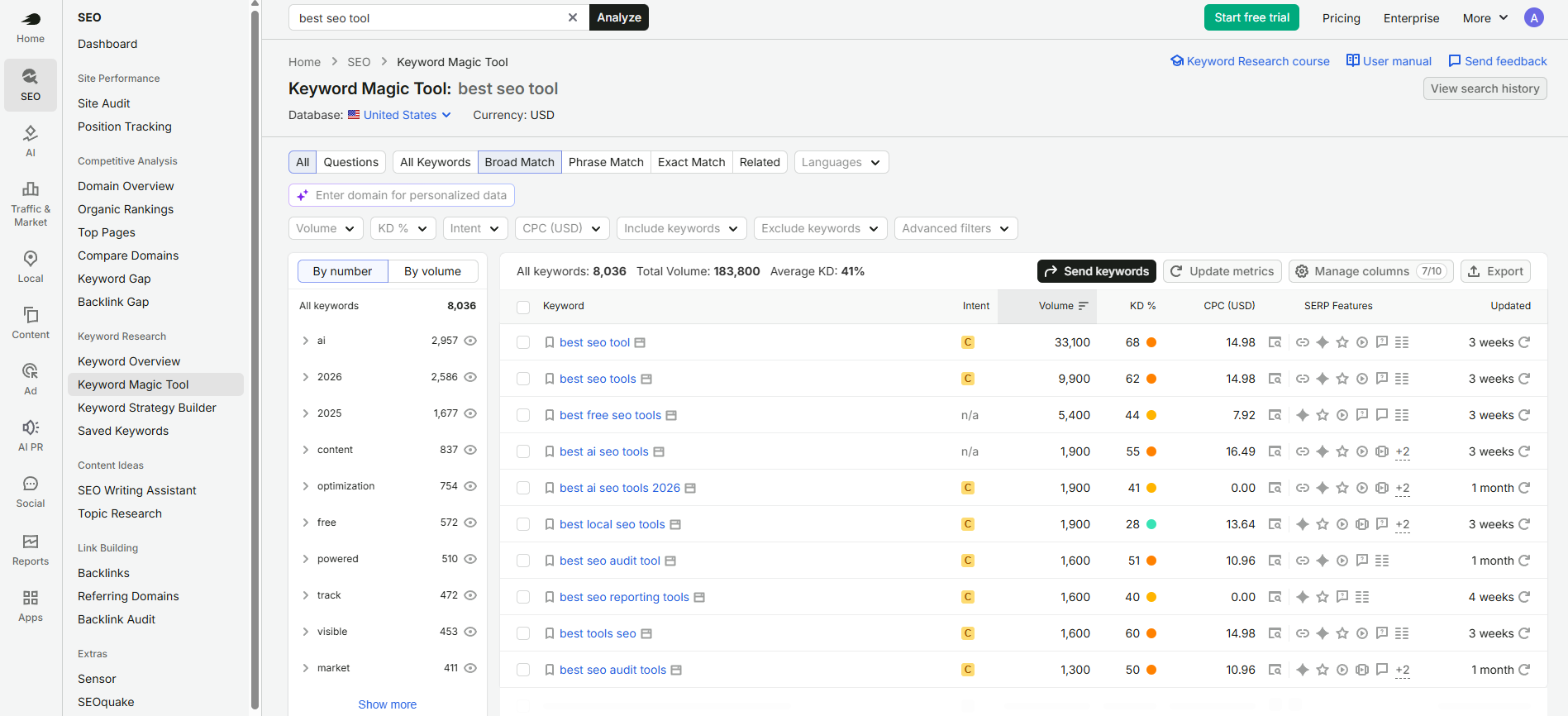
Semrush Keyword Magic Tool: group keyword ideas by topic, then filter by intent and difficulty.
How to use it: open Keyword Magic Tool, type a seed keyword, choose your country database, then filter by intent (informational or commercial) and keyword difficulty below 30 for a newer site. Send the shortlist to Position Tracking so you see daily movement after you publish.
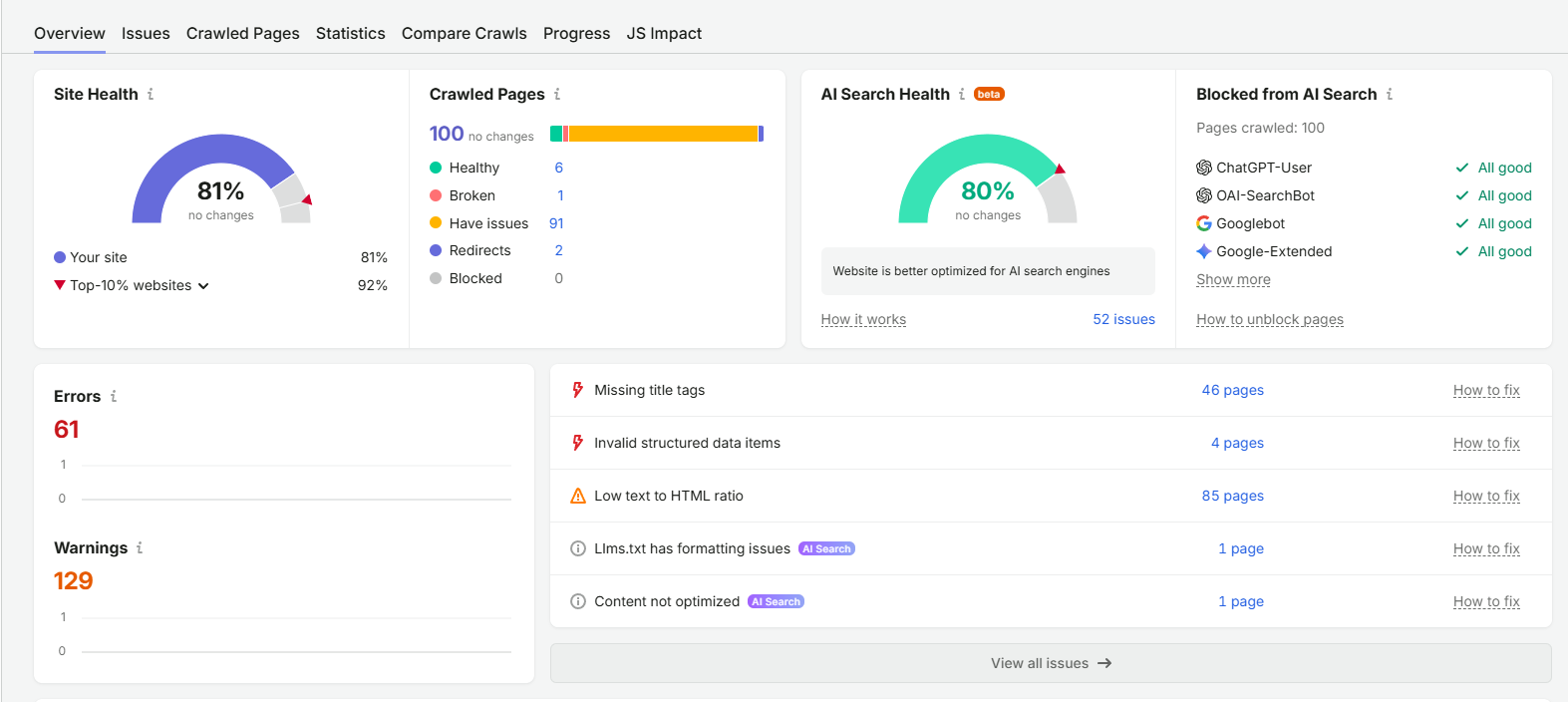
Semrush Site Audit: a health score with errors and warnings ranked by priority.
2. Ahrefs: best for backlinks and content research
Ahrefs has the freshest live backlink index of the three big suites and the best tool for deciding what to write next (Content Explorer, from the Standard plan).
Price (checked 16 Oct 2026): Ahrefs Free for your own verified sites; Starter $29; Lite $129 (750 tracked keywords, 5 tracked AI prompts); Standard $249; Advanced $449. No free trial and no discounts; yearly billing saves up to 17%.
Use it for: competitor backlink teardowns (Link Intersect), Content Gap, Traffic Potential when picking topics, and API or MCP access from Lite so AI assistants can query your data.
Watch out for: rank tracking updates weekly on every plan, and Lite caps you at 1,000 credits per user.
Ahrefs dashboard: every project’s health, traffic and link metrics on one screen.
How to use it: verify your site in Ahrefs Free first (it costs nothing and unlocks Site Explorer and Site Audit for your own domain). Pay only when you need competitor data. In Site Explorer, enter a competitor, open Top pages to see which articles earn their traffic, then Referring domains to see who links to them.
Ahrefs traffic source report: see which channels send visitors, including AI assistants.
3. Ubersuggest: best budget suite
Ubersuggest is the easiest of the suites to learn and the only one with a one-time lifetime price, which matters if you pay with a capped dollar card.
Price: 3 free searches a day; Individual $29/month or $290 lifetime; Business $49; Enterprise $99; 7-day trial on monthly plans. Prices shown can differ by country.
Use it for: keyword ideas, simple difficulty scores, weekly rank tracking (125 keywords per project on Individual) and a beginner-friendly site audit.
Watch out for: much smaller backlink and keyword data than Ahrefs or Semrush, and no API.
Ubersuggest rank tracking: positions and weekly changes for your tracked keywords.Ubersuggest site audit: an on-page score and a short list of issues to fix first.
How to use it: add your site as a project, connect Google Search Console when asked, and let the weekly audit run. Fix “critical errors” first, then work through warnings. Use Keyword Ideas for blog topics, but treat its volumes as a direction, not a forecast.
Choosing between these three? Our Ahrefs vs Semrush vs Ubersuggest guide compares every plan, 3-year cost in NPR, keyword data, backlinks, rank tracking and AI visibility.
4. Moz Pro: best for authority metrics
Moz Pro created Domain Authority, still the number many link sellers and clients quote. Starter costs $49/month ($39 billed yearly) and Standard $99 ($79 yearly), with a 30-day free trial. Starter is tight (about 50 tracked keywords), so most users need Standard. Use Moz when you trade links or report DA to clients; the free MozBar extension shows DA on any page.
5. SE Ranking: best value for agencies
SE Ranking starts at about $65/month (around $52 billed yearly) with daily rank tracking, audits, white-label reports and an AI Overviews tracker. It suits freelancers managing three or more client sites; for a single blog, Ahrefs Starter or Ubersuggest is cheaper.
Best free SEO tools (use these first)
Free tools give you first-party data, which no paid tool can match for your own site. A new blog can reach its first few thousand monthly visitors with nothing else.
Local SEO decides whether a business appears in Google Maps and the “map pack” when someone searches “dentist near me” or “momo restaurant in Thamel”. Rankings change street by street, so local tools measure positions across a grid of map points instead of one national number.
Tool
Geo-grid tracking
GBP management
Citations
Reviews
Price
Google Business Profile
No
Yes (the profile itself)
No
Reply to reviews
Free
Local Falcon
Yes, flexible grids
No
No
No
From $24.99/mo
Semrush Local
Yes (Map Rank Tracker)
Yes, AI posting and replies
Yes (Local Pro)
Yes (Local Pro)
$30 or $60 per location
Whitespark
Yes (Local Ranking Grids)
Yes, $1 per location
Yes, Citation Finder from $39
Reputation Builder
Sold per tool
BrightLocal
Yes
Yes
Yes
Yes
14-day trial; prices rose in July 2026
Ahrefs GBP Monitor
Location-based Rank Tracker
Beta, included from Lite
No
No
Included
Claude SEO /seo local
Via /seo maps
Audits GBP signals
NAP consistency check
Review analysis
Free skill
Google Business Profile, Bing Places and Apple Business Connect
These free listings are the foundation; no paid tool can rank a business that has not claimed its profile. Where to use: every business with a physical address or a service area. How: claim the profile at business.google.com, choose the most specific primary category, add opening hours, photos, products or services, and the same name, address and phone (NAP) used on your website and Facebook page. Then import the profile into Bing Places and claim the business on Apple Business Connect so iPhone Maps users find it too.
Local Falcon: map-grid rank tracking
Local Falcon pioneered geo-grid tracking in 2018. It drops a grid (from 3×3 up to 21×21 points) over your area and checks where your profile ranks at each point, producing a colour heatmap. Plans start at $24.99/month and use scan credits. Where to use: a restaurant, clinic or showroom that wants to know why it ranks first in Thamel but tenth in Lazimpat. How: connect the business, pick 2–3 money keywords, run a 7×7 grid with a 2 km radius, and rescan monthly after changes to categories, photos or reviews.
Semrush Local
Semrush’s Local toolkit costs $30 (Base) or $60 (Pro) per location per month. It adds a Map Rank Tracker with heatmaps, a GBP audit, an AI agent that drafts posts and review replies, and (on Pro) listing distribution to 70+ directories. Note for Nepal: the directory list varies by country and may not cover Nepal, so check before buying Local Pro. Local Base is usually enough for one location.
Whitespark and BrightLocal
Whitespark sells each tool separately: GBP management at $1 per location per month, Local Rank Tracker from $14/month, and Local Citation Finder from $39/month ($33 yearly), which finds where your top competitors are listed and you are not. BrightLocal bundles rank tracking, audits, citations and reviews for agencies running many locations; it has a 14-day trial, and prices rose by 5–10% in July 2026, so check the current figure.
A local SEO workflow for a business in Nepal
Claim and complete your Google Business Profile, then copy the exact NAP to Bing Places, Apple Business Connect, Facebook and your website footer.
Add LocalBusiness schema to your contact page and test it in the Rich Results Test.
Ask every happy customer for a review using the review link from your profile, and reply to every review within a few days.
Measure with a monthly Local Falcon or Semrush Local grid scan around your shop.
Audit twice a year with Claude SEO’s /seo local or BrightLocal to catch NAP mismatches and missing profile fields.
Build Nepal-specific listings by hand. Most citation tools focus on the US, UK and Australia, so local directories and business associations usually need manual submission.
New AI-native SEO tools: OpenSEO, Claude SEO and AI visibility
The biggest change in 2026 is SEO tools built for AI agents. Instead of reading a dashboard, you ask an assistant such as Claude, Codex or Cursor a question and it pulls live SEO data through an MCP server (Model Context Protocol, a standard way for AI apps to call tools). Two open-source projects lead this group.
OpenSEO: open-source, pay-as-you-go SEO research
OpenSEO is an MIT-licensed alternative to Semrush and Ahrefs, started in February 2026 by developer Ben Senescu and backed by Y Combinator. It covers keyword research, domain overview, backlinks, rank tracking, technical site audits and AI visibility tracking. It does not crawl the web itself: data comes from the DataForSEO API, and you pay only for what you query.
Option
Cost
Best for
Hosted (openseo.so)
$10/month including $10 of usage; free trial with $0.50 of credits
Bloggers and small businesses
Self-hosted
$0 for the app, plus your own DataForSEO API bill
Developers and agencies
Typical usage
About $0.05 per keyword search and $0.08 per domain overview (OpenSEO’s estimator)
Light, occasional research
How to set it up (self-hosted):
git clone https://github.com/every-app/open-seo.git
cd open-seo
docker compose up -d
# open http://localhost:3001 and paste your DataForSEO API key
Connect it to an AI assistant: add the OpenSEO MCP server to Claude, Cursor or ChatGPT, then ask questions like “find low-difficulty keywords about Nepali typing and group them into topics”.
Search Console data is free inside OpenSEO and does not use your credits.
Where it fits: a solo blogger who runs 100 keyword searches and 20 backlink checks a month pays about $10 instead of $129 for Ahrefs Lite.
Limits: a young project, its audit covers technical SEO only, and its data is only as good as DataForSEO’s, so it will not match Ahrefs on backlink freshness.
Claude SEO: a full SEO audit inside Claude Code
Claude SEO is a free, MIT-licensed plugin for Claude Code, Anthropic’s coding assistant. It is a community project by Agrici Daniel, not an Anthropic product. It runs 25 sub-skills and up to 15 parallel agents that check technical SEO, content quality (E-E-A-T), schema, AI-search readiness, local SEO and more, then write a prioritised report as Markdown and PDF. The repository had about 15,800 GitHub stars in October 2026.
What you need: Claude Code (included in paid Claude plans; see our Claude AI price in Nepal guide) and Python 3.10 or newer. Install from inside Claude Code:
Full-site audit with a 0–100 score and action plan
Taking on a new client or site
/seo page <url>
Deep single-page check
Before publishing an important post
/seo local <url>
GBP signals, NAP consistency, reviews, map pack
Auditing a local business
/seo maps
Geo-grid checks, GBP audit, competitor radius
Comparing local competitors
/seo schema <url>
Detect, validate and generate JSON-LD
Adding Article or LocalBusiness schema
/seo geo <url>
AI Overviews and AI-citation readiness
Pages you want cited by AI answers
/seo google setup
Connects PageSpeed, CrUX, Search Console and GA4
Once, to use real field data
Where it shines: sites built with Next.js, React or Vue, because it renders JavaScript pages with a headless browser; schema generation; and quick audits before a client call.
What it is not: a data index. Keyword volumes and backlinks need optional paid extensions (DataForSEO, Ahrefs MCP) or your own Google API keys.
Be careful: it installs scripts on your computer, so read the install file first, and check AI findings against Search Console before acting on them.
AI visibility trackers
These tools check whether ChatGPT, Gemini, Perplexity and Google’s AI Overviews mention or cite your brand. Ahrefs Brand Radar starts at $199/month standalone (Ahrefs plans include 5–20 tracked prompts). Semrush’s SEO + AI Search plans track 50–200 prompts daily. OpenSEO tracks prompts for about $0.002 per check. Bing Webmaster Tools now has a free AI performance report. For most small sites, the free option is enough: watch AI referrals in GA4 and test your key questions in ChatGPT and Gemini once a month.
Technical and content tools
Screaming Frog SEO Spider – a desktop crawler, free up to 500 URLs and $279 per user per year after that. Version 24 can crawl with OpenAI or Gemini, render JavaScript, and pull Search Console and PageSpeed data into the crawl. Use it for migrations, redirect maps and finding orphan pages.
Surfer – content scoring against the pages already ranking, from $99/month. Worth it if you publish several articles a week; otherwise a good outline and Search Console data do the same job.
Rank Math and Yoast – WordPress plugins for titles, meta descriptions, XML sitemaps, breadcrumbs and schema. Both have free versions; pick one and never run both.
Paying for SEO tools from Nepal: what fits a $500 dollar card
Most Nepali freelancers pay with a prepaid dollar card, which Nepal Rastra Bank caps at $500 a year for most individuals (registered IT businesses can apply for higher limits). That one rule decides which tools are realistic.
One year of each tool vs the $500 limit (USD)
Cheapest plan for 12 months, before bank fees and any VAT. Green fits inside $500; red does not.
OpenSEO ($10 x 12)
$120
Screaming Frog licence
$279
Ubersuggest lifetime (one-time)
$290
Local Falcon ($24.99 x 12)
$300
Ahrefs Starter ($29 x 12)
$348
Moz Pro Starter (yearly)
$468
Ahrefs Lite ($129 x 12)
$1,548
Semrush SEO ($139 x 12)
$1,668
Rent the big tools by the month. One month of Semrush ($139, about Rs 21,500) or Ahrefs Lite ($129, about Rs 20,000) fits easily. Do your competitor research in that month, export it, then cancel.
Prefer one-time or usage pricing. Ubersuggest lifetime, Screaming Frog and OpenSEO all leave room on the card for hosting and other software.
Avoid unofficial “group buy” accounts sold through local resellers. They break the vendors’ terms, can be shut off without warning, and expose your client data.
Recommended SEO tool stacks by budget
Rs 0 a month
New blogs and small businesses
Google Search Console + Bing Webmaster Tools
Ahrefs Free + Semrush free plan
GA4, Clarity, PageSpeed Insights
Rank Math or Yoast (free)
Google Business Profile (if local)
About Rs 1,500–4,500 a month
Serious bloggers and freelancers
Everything in the free stack
OpenSEO ($10) or Ahrefs Starter / Ubersuggest ($29)
Screaming Frog free, licence when you pass 500 URLs
Claude SEO if you already pay for Claude
Rs 20,000+ a month
Agencies and companies
Semrush or Ahrefs Lite/Standard
Screaming Frog licence
Local Falcon or Semrush Local per client location
An AI visibility tracker for brand clients
Where each tool fits in an SEO workflow
Stage
Free tool
Paid or AI tool
1. Find topics
Search Console queries, Keyword Planner, Google Trends
There is no single best tool. Semrush is the most complete all-in-one suite, Ahrefs is best for backlinks and content research, and Google Search Console is the best free tool. Most sites need Search Console plus one paid suite at most.
What is the best free SEO tool?
Google Search Console, because it shows the real queries, clicks and indexing status Google records for your site. Pair it with Bing Webmaster Tools and Ahrefs Free for audits.
Is Ahrefs or Semrush better?
Ahrefs is better for link building and topic research; Semrush is better if you also run Google Ads or need daily rank tracking. Our Ahrefs vs Semrush vs Ubersuggest guide compares them plan by plan.
What are the best local SEO tools?
Start with a fully completed Google Business Profile, then add a map-grid tracker such as Local Falcon (from $24.99/month) or Semrush Local ($30 per location). Whitespark and BrightLocal add citation building and review management for agencies.
What is OpenSEO?
OpenSEO is an open-source, MIT-licensed SEO tool for keyword research, backlinks, rank tracking, site audits and AI visibility. You can self-host it free with your own DataForSEO API key or use the hosted version from $10 a month, and connect it to AI assistants through MCP.
Is Claude SEO made by Anthropic?
No. Claude SEO is a free community plugin by Agrici Daniel that runs inside Anthropic’s Claude Code. It audits technical SEO, content, schema, local SEO and AI-search readiness, and needs a Claude plan that includes Claude Code.
Can I pay for SEO tools from Nepal?
Yes, with a dollar card or an international card. Most individuals have a $500 yearly limit, which covers tools like Ubersuggest lifetime, Ahrefs Starter, OpenSEO or Screaming Frog, but not a full year of Semrush or Ahrefs Lite.
Do I need a paid SEO tool for a new blog?
Not at first. Free tools cover indexing, keyword ideas and technical checks. Pay for a suite when you need competitor keywords or backlink data, and consider renting it for one month at a time.
Claude AI Price in Nepal (2026): Pro, Max & Team Cost in NPR
By Wilson Shrestha · Last updated: 13 October 2026 · Prices checked against Anthropic’s official pricing page and Nepal Rastra Bank’s exchange rate
Search “Claude AI price in Nepal” and the top result quotes a reseller price, a list of Claude models that are now retired, and a dollar conversion that is off by about Rs 400. If you are deciding whether to pay for Claude this month, you need three numbers: what Anthropic actually charges, what that is in rupees today, and what you will really pay once tax, your bank and the dollar card limit get involved.
This guide gives you all three for every Claude plan, explains how to pay from Nepal (card, app store or eSewa/Khalti reseller), and tells you which plan is worth the money for students, freelancers, developers and companies.
Quick answer: Claude AI price in Nepal (October 2026)
Free: Rs 0
Pro: $20/month = about Rs 3,103/month, or $200/year = about Rs 2,586/month billed yearly
Max 5x: $100/month = about Rs 15,515
Max 20x: $200/month = about Rs 31,030
Team: from $20 per seat/month (yearly) = about Rs 3,103 per user
Reseller (Khalti/eSewa): Pro reported at about Rs 3,800/month
Rupee figures use Rs 155.15 per US dollar, Nepal Rastra Bank’s selling rate on 8 October 2026 (Asoj 22, 2083). Prices are before tax and bank charges. Check the NRB forex page for today’s rate.
Good news first: Nepal is on Anthropic’s list of supported countries, so you can sign up at claude.ai, use the Free plan and subscribe to a paid plan from Nepal without any VPN or workaround. Anthropic does not price Claude in Nepali rupees, so your bank converts the US dollar price.
Free
Rs 0
Sonnet and Haiku, web search, files, memory, up to 5 projects.
Pro · best value
Rs 3,103
Opus, Claude Code, Research, unlimited projects. Rs 2,586/month if paid yearly.
Max
Rs 15,515+
5x or 20x Pro’s usage, priority access, monthly API credits.
Plan
Official price (USD)
Approx. price in Nepal (NPR)
Best for
Free
$0
Rs 0
Trying Claude, everyday questions
Pro (monthly)
$20/month
Rs 3,103/month
Writers, students, freelancers
Pro (yearly)
$200/year ($17/month)
Rs 31,030/year (Rs 2,586/month)
Anyone sure they’ll use it all year
Max 5x
$100/month
Rs 15,515/month
Developers using Claude Code daily
Max 20x
$200/month
Rs 31,030/month
All-day power users
Team Standard seat
$20/seat yearly, $25 monthly
Rs 3,103–3,879 per user
Agencies and offices (2–150 people)
Team Premium seat
$100/seat yearly, $125 monthly
Rs 15,515–19,394 per user
Team members who code all day
Enterprise
$20/seat/month (yearly) + usage at API rates
Rs 3,103 per seat + usage
Banks, telecoms, large companies
Monthly cost of each Claude plan in Nepal
Before tax and bank charges, at Rs 155.15 per US dollar
Pro (yearly, per month) ~Rs 2,586
Pro (monthly) ~Rs 3,103
Team Standard (monthly, per user) ~Rs 3,879
Max 5x ~Rs 15,515
Max 20x ~Rs 31,030
What Each Claude Plan Actually Gets You
Claude’s current models are Haiku 5.5 (fastest), Sonnet 5.5 (the everyday workhorse), Opus 5.5 (the strong all-rounder for complex work) and Fable 5.1 (the newest, most capable tier). Anthropic doesn’t publish a fixed number of messages for any plan: usage limits reset on a rolling five-hour window, paid plans also have weekly limits, and long chats or bigger models use your allowance faster.
Claude Free (Rs 0)
Free is more generous than most people expect. You get Sonnet and Haiku on web, desktop and mobile, web search, file creation with code execution, memory across chats, Artifacts, connectors, voice mode, and up to five projects. For homework help, translations, emails and short documents, it is enough. What it lacks is Opus, Claude Code, Research and the higher limits.
Claude Pro (about Rs 3,103, or Rs 2,586 yearly)
Pro is where Claude becomes a work tool. Anthropic says it gives at least five times Free’s usage per session, and adds Opus, Claude Code (the coding agent for your terminal and editor), Research reports, unlimited projects, scheduled tasks, Claude in Chrome and Microsoft 365, and Dashboards (beta). Fable is available on Pro only through pay-as-you-go usage credits. Pro is the only individual plan with a yearly option.
Claude Max (about Rs 15,515 or Rs 31,030)
Max keeps every Pro feature but raises the limits to 5x or 20x Pro per session, with higher output limits, priority access when traffic is high, early access to new features, Fable within your weekly limits, and $100 (5x) or $200 (20x) of monthly API credits for building on the Claude Platform. It is billed monthly only.
Claude Team and Enterprise
Team is for 2 to 150 people. You get central billing, single sign-on, admin controls, enterprise search across connected tools, shared projects, up to $500 a month in pooled API credits, and your content is not used for model training by default. You can mix Standard and Premium seats, so a Kathmandu agency could give Premium seats only to its developers. Enterprise adds audit logs, SCIM, role-based access and custom data retention, at $20 per seat plus usage billed at API rates.
Feature
Free
Pro
Max 5x / 20x
Team
Sonnet and Haiku
Yes
Yes
Yes
Yes
Opus
No
Yes
Yes
Yes
Fable
No
Usage credits only
50% of weekly limits
Premium seats
Claude Code
No
Yes
Yes
Yes
Research
No
Yes
Yes
Yes
Projects
Up to 5
Unlimited
Unlimited
Unlimited + sharing
Priority access at busy times
No
No
Yes
Yes
Monthly API credits
No
No
$100 / $200
Up to $500 pooled
Training on your chats
Opt-out
Opt-out
Opt-out
Off by default
Corrections to what other Nepali price pages say
$20 is about Rs 3,100 at October 2026 rates, not Rs 2,700.
Opus 4.8 and Sonnet 4.6 are now listed as legacy models. Pro today runs Sonnet 5.5 and Opus 5.5.
Pro does not include priority access at high-traffic times; Anthropic lists that for Max and Team.
Free does include projects (up to five) and memory.
The Real Cost: What You Pay on Top of the Dollar Price
Anthropic’s pricing page notes that its prices don’t include applicable tax. When you pay from Nepal, three things can push your bill above the sticker price.
1. Exchange rate and bank margin
Your card is charged in dollars and your bank converts at its own selling rate, which is usually a little above NRB’s reference rate. The dollar has also been climbing: it crossed Rs 155 in October 2026, up from about Rs 148 in March. A $20 plan that cost about Rs 2,960 in spring now costs about Rs 3,100, with no change at Anthropic’s end.
2. Tax on foreign digital services
Nepal applies 13% VAT to digital services sold to Nepali consumers, and foreign providers above a turnover threshold also owe a separate 2% Digital Service Tax (that one is paid by the company, not added to your bill). Anthropic says some regions see tax added at checkout, so always read the final total on the payment screen. If 13% VAT is added:
Plan
Before tax
With 13% VAT
Pro, monthly ($20)
Rs 3,103
Rs 3,506
Pro, yearly ($200)
Rs 31,030
Rs 35,064
Max 5x ($100)
Rs 15,515
Rs 17,532
Max 20x ($200)
Rs 31,030
Rs 35,064
3. The $500 yearly dollar card limit
Most people in Nepal pay foreign subscriptions with a prepaid dollar card, which NRB caps at $500 per person per year. That single rule decides which Claude plan you can realistically pay for yourself. It is the same wall many people hit when they try to run Facebook ads from Nepal: one ad campaign and one AI subscription can use up the whole allowance.
How much of your $500 yearly dollar card limit each plan uses
12 months of each plan compared with the $500 cap
Pro yearly ($200) 40%
Pro monthly x 12 ($240) 48%
Pro monthly + 13% VAT ($271) 54%
Max 5x x 12 ($1,200) 240% – card runs out after 5 months
Max 20x x 12 ($2,400) 480% – card runs out after 2 months
In plain terms: Pro fits comfortably on a personal dollar card; Max does not. If you need Max, the realistic routes are a company card under NRB’s April 2026 IT-sector facility ($3,000 or $5,000 a year), a foreign-currency account funded by your own freelance income, or a card held abroad. Our guide to the dollar card in Nepal explains the limits, bank fees and which banks let you reload from the app.
Money-saving tip: pay Pro yearly
The yearly plan is $200 instead of $240, a saving of about Rs 6,206 a year. It also means one card charge instead of twelve, so fewer reload fees, fewer per-transaction charges and fewer chances of a failed renewal when your card balance is short.
Official Subscription vs Nepali Resellers (eSewa, Khalti)
If you don’t have a card that works abroad, a few Nepali sellers offer Claude Pro for local payment. PriceNepal reported one such seller, GurkhaTools, charging Rs 3,800 a month in June 2026 with Khalti, ConnectIPS and eBanking. We have not bought from any reseller, so treat these as reported prices.
Option
Monthly price
vs official Pro
Privacy
Official Pro, yearly, your own card
Rs 2,586 + any tax
Cheapest
Fully private
Official Pro, monthly, your own card
Rs 3,103 + any tax
Baseline
Fully private
Reseller private Pro (reported)
About Rs 3,800
About 22% more (8% more than with VAT)
Private if it’s on your own email
Shared login sold as “Claude Pro”
Varies
Cheaper
None
What reseller pages don’t spell out
You pay for convenience, not a discount. A private reseller plan costs more than paying Anthropic directly. That can still be worth it if you have no usable card.
Shared Claude logins are a bad deal. Pro is a personal plan and the usage limit is shared, so one heavy user can lock everyone out for hours. Other users can also see your chats, files and projects.
A Max plan priced below $100 should make you ask how it’s paid for. One reseller listing showed Max at “Rs 13,500+”, below the official Rs 15,515. Accounts billed through regional tricks or reused cards can be cancelled without warning, and your chat history goes with them.
Ask for activation on your own email. Avoid any deal where the seller keeps the password.
Why You See Indian Rupee Prices for Claude Online
In July 2026 Anthropic introduced rupee billing in India, its second-largest market. Indian accounts now see Pro at ₹2,399 a month or ₹2,000 a month billed yearly, and Max from ₹11,999, with GST included. Those prices apply only to accounts billed in India. A Nepali account still sees US dollar prices.
Plan
India price (incl. GST)
In NPR (at Rs 160.15 per ₹100)
Nepal (USD, before tax)
Pro, monthly
₹2,399
Rs 3,842
Rs 3,103
Pro, yearly (per month)
₹2,000
Rs 3,203
Rs 2,586
Max (from)
₹11,999
Rs 19,216
Rs 15,515
Two takeaways for Nepali readers. First, the dollar price is not worse for you than India’s rupee price; the Indian figure includes 18% GST. Second, if you are a Nepali student or worker living in India, you will be billed the Indian rupee price on an Indian card, and you can pay without touching your Nepali dollar card limit.
How to Buy Claude Pro from Nepal
Method 1: Pay Anthropic directly (recommended if you have a card)
STEP 1
Get a card
A prepaid dollar card or international-enabled Visa/Mastercard, with e-commerce turned on.
STEP 2
Sign in
Open claude.ai in a browser and sign in with your email or Google account.
STEP 3
Upgrade
Choose Upgrade, pick Pro, and select monthly or yearly billing.
STEP 4
Check the total
Confirm the final amount with any tax, keep $1–2 spare on the card, approve the OTP.
Subscribing inside the iPhone or Android app bills through Apple or Google Play instead, and app store prices are often higher than the web price because of store commission. Compare the two before paying. You also cancel an app store subscription from Apple or Google, not from Claude’s settings.
If your card is declined
Check that international e-commerce is enabled in your bank app.
Make sure the balance covers the total plus a dollar or two for tax and conversion.
Use your real Nepal billing address, exactly as your bank has it.
Don’t retry the same card many times in a row; wait, fix the cause, then try once.
If your yearly $500 is used up, you must wait for it to reset.
Method 2: Through a Nepali reseller (Khalti, eSewa, ConnectIPS)
Choose a seller with a registered business, real reviews and a written refund policy.
Insist on activation on your own Claude account and email.
Pay and keep the receipt.
Once active, change your password and turn on any available security settings.
Note the renewal date: reseller plans usually don’t renew automatically.
Claude API Price in Nepal (for Developers)
The Claude API is billed separately from Pro and Max, as prepaid credits on the Claude Platform console. You pay per million tokens (one million tokens is roughly 750,000 English words). Here are the current models in rupees:
Model
Input per 1M tokens
Output per 1M tokens
Good for
Haiku 5.5 (prompts up to 100K)
$0.10 (Rs 16)
$0.50 (Rs 78)
Chatbots, tagging, high-volume tasks
Sonnet 5.5
$2 (Rs 310)
$10 (Rs 1,552)
Coding, agents, most apps
Opus 5.5
$4 (Rs 621)
$20 (Rs 3,103)
Complex coding and enterprise work
Fable 5.1
$10 (Rs 1,552)
$50 (Rs 7,758)
Long-running agents
Batch processing cuts these prices by 50%, and prompt caching makes repeated context much cheaper. A Nepali startup building a customer-support bot on Haiku 5.5 could handle thousands of conversations for a few hundred rupees; the same volume on Opus costs many times more. Because API credits also come out of your dollar allowance, most solo developers start small and top up as usage grows.
Claude vs ChatGPT Price in Nepal
At the main tier, both cost the same $20. The differences are at the bottom and in the yearly option. For a full rupee breakdown of OpenAI’s plans, see our ChatGPT price in Nepal guide.
Tier
Claude
ChatGPT
Free
Yes
Yes
Budget paid tier
None
Go (localized, roughly $5–8)
Main paid tier
Pro $20, or $17/month yearly
Plus $20
Heavy-use tiers
Max $100 / $200
Pro from $100
Team plan
Team from $20/seat (2+ users)
Business from $20/user (2+ users)
If budget is the main concern, ChatGPT Go is the cheaper paid option. If you mainly write long documents, work with big files or code, Claude Pro paid yearly is the better value of the two $20 plans. Many freelancers keep one paid plan and use the other’s Free tier.
Which Claude Plan Should You Choose?
You are…
Choose
Monthly cost
A student or Lok Sewa candidate
Free
Rs 0
A blogger, writer or researcher
Pro, yearly
~Rs 2,586
A freelancer or developer
Pro (Max 5x only if you hit limits daily)
~Rs 2,586–3,103
A full-time Claude Code user
Max 5x
~Rs 15,515
An agency or office team
Team, Standard seats (Premium for devs)
~Rs 3,103–3,879 per user
A developer building an app
API credits (Haiku or Sonnet)
Pay per use
My default advice: use Free for a week on your real work. If you keep hitting the limit or need Opus or Claude Code, take Pro on the yearly plan with your own card. Only move to Max when Pro limits are stopping paid work several times a week, and only if you have a way to pay beyond the $500 dollar card.
Whichever plan you pick, Claude can still get facts wrong. Check figures, legal points and anything you’ll publish, on every plan.
Frequently Asked Questions
What is the price of Claude AI in Nepal?
Claude Free costs nothing. Claude Pro is $20 a month, about Rs 3,103, or $200 a year, about Rs 2,586 a month. Max costs $100 or $200 a month, about Rs 15,515 or Rs 31,030. Rupee prices use NRB’s rate of Rs 155.15 per dollar and exclude tax.
Is Claude available in Nepal?
Yes. Nepal is on Anthropic’s list of supported countries, so you can use claude.ai, the mobile and desktop apps, Claude Code and the API from Nepal.
Is Claude free in Nepal?
Yes. The Free plan works in Nepal and includes Sonnet and Haiku, web search, file creation, memory and up to five projects, with usage limits that reset every few hours.
Can I pay for Claude with eSewa or Khalti?
Not directly. Anthropic takes card payments, and the mobile apps bill through Apple or Google Play. To pay with eSewa or Khalti you need a Nepali reseller, which costs more, or you can load a prepaid dollar card from your bank and use that.
Can I pay for Claude Pro with a dollar card?
A prepaid dollar card from a Nepali bank is a Visa or Mastercard and is the usual way to pay. It is capped at $500 a year, which covers a full year of Pro but only about five months of Max 5x.
Does Claude charge VAT in Nepal?
Anthropic’s listed prices exclude tax, and Nepal applies 13% VAT to foreign digital services. Check the total on the checkout screen. If VAT is added, Pro comes to about Rs 3,506 a month.
Is Claude cheaper than ChatGPT in Nepal?
Claude Pro and ChatGPT Plus both cost $20 a month. Claude Pro is cheaper if you pay yearly ($17 a month), while ChatGPT has a lower-priced Go plan that Claude does not match.
Is it safe to buy a shared Claude Pro account?
Not for anything private. Everyone on a shared login can see your chats and files, the usage limit is shared, and Pro is meant for one person, so the account can be suspended. Buy only plans activated on your own email.
Final word
The cheapest way to use Claude in Nepal is the Free plan. The best value for most working people is Pro on yearly billing, about Rs 2,586 a month, paid with your own dollar card so your data stays private and your limit stretches further. Max is powerful but needs more than a personal dollar card can cover.
Prices change. Before subscribing, check Anthropic’s official Claude pricing page and today’s NRB exchange rate.
Sources: Anthropic, Claude plans and pricing and supported countries (checked 13 Oct 2026); Nepal Rastra Bank exchange rate for Asoj 22, 2083 via Kantipur; NRB prepaid card rules; Indian rupee pricing as reported by Business Today and Technobezz (July 2026); reseller price as reported by PriceNepal (June 2026).
ChatGPT Price in Nepal (2026): Go, Plus & Pro Cost in NPR
By Wilson Shrestha · Last updated: 8 October 2026 · Prices checked against OpenAI’s official pricing page and Nepali reseller listings
Search “ChatGPT price in Nepal” and you get two kinds of pages: resellers selling an account, and news posts from 2025 still quoting launch-day prices. Neither tells you what you will actually pay, in rupees, this month.
This guide does. You’ll find every ChatGPT plan converted to Nepali rupees, the extra costs most articles skip (tax, bank conversion and the yearly dollar card cap), how official prices compare with eSewa and Khalti reseller deals, and a plain recommendation for students, freelancers and businesses.
Quick answer: ChatGPT price in Nepal (October 2026)
Free: Rs 0
Go: about Rs 770–1,230/month (OpenAI localizes Go, so check your upgrade screen)
Plus: $20 = about Rs 3,070/month
Pro: from $100 = about Rs 15,350/month
Resellers (eSewa/Khalti): about Rs 999 shared, Rs 3,300–4,200 private
Rupee figures use Rs 153.50 per US dollar, close to Nepal Rastra Bank’s recent selling rate. Check the NRB forex page for today’s rate.
All ChatGPT Plans and Their Price in Nepali Rupees
Free
Rs 0
Unlimited everyday text chats; small allowances for uploads, images and deep research.
Go
Rs 770–1,230
Higher limits than Free, longer memory. May show ads. Budget pick for students.
Plus
Rs 3,070
Advanced reasoning models, Projects, custom GPTs, Sites, Codex. Best value for work.
Pro
Rs 15,350+
Highest limits and the top Pro reasoning model in chat. For heavy daily users.
Plan
Official price (USD/month)
Approx. price in Nepal (NPR/month)
Best for
Free
$0
Rs 0
Casual questions, trying ChatGPT
Go
$8 in the US; localized lower in Nepal (about $5 at launch)
Before tax and bank charges, at Rs 153.50 per US dollar
Go (localized)~Rs 768
Go ($8)~Rs 1,228
Plus~Rs 3,070
Business (yearly, per user)~Rs 3,070
Pro (lower tier)~Rs 15,350
Pro (higher tier)~Rs 30,700
A note on Pro: OpenAI added a $100 tier in April 2026 alongside the original $200 plan, and its pricing page now describes Pro as a choice of three usage tiers. The $100 and $200 levels are the ones with confirmed prices; check the upgrade screen for the third.
What Each Plan Actually Gets You
OpenAI changes model names every few months, so instead of a list that will be outdated by Tihar, here is what separates the plans in practice.
ChatGPT Free (Rs 0)
Free now gives unlimited everyday text chats, plus small allowances for file uploads, image creation, voice, deep research and Codex. For asking questions, translating or drafting a short email, it is genuinely enough.
ChatGPT Go (about Rs 770–1,230)
Go is the budget paid plan: more messages with tools, more uploads, more image generation, more voice chats and longer memory than Free. Nepal was one of 16 Asian countries added to Go in October 2025, before OpenAI opened it worldwide in January 2026 at $8 in the US, with localized pricing in some markets.
The catch: Go may include ads, and it does not unlock the advanced reasoning models, custom GPTs, Sites or full deep research. Think of it as “Free with higher limits”, not “cheap Plus”.
ChatGPT Plus (about Rs 3,070)
Plus is where ChatGPT becomes a work tool. It removes ads and adds the advanced reasoning models (including GPT-6 Astra inside ChatGPT Work and Codex), expanded deep research, Projects, scheduled tasks, custom GPTs, ChatGPT Sites, interactive charts, and Office and Google Sheets extensions. Limits still apply, especially on the newest flagship model, but most people never hit them on everyday work.
ChatGPT Pro (from about Rs 15,350)
Pro raises every limit, puts the top Pro reasoning model directly in the chat window, and allows much longer Codex and Work sessions. Unless you code or research with ChatGPT for several hours a day and keep hitting Plus limits, you don’t need it.
ChatGPT Business (about Rs 3,070–3,840 per user)
Business adds a shared workspace, admin controls, company knowledge connectors, and your data is not used for training by default. It needs at least two seats, so a two-person agency billed yearly pays roughly Rs 6,140 a month.
Feature
Free
Go
Plus
Pro
Ads
Possible
Possible
No
No
Advanced reasoning models
No
No
Yes
Expanded
Deep research
Limited
Limited
Yes
Maximum
Custom GPTs and Sites
No
No
Yes
Yes
Codex (coding agent)
Limited
Limited
Yes
Expanded
Image generation
Limited
More
Yes, with Thinking
Unlimited
The Real Cost: What You Pay on Top of the Dollar Price
The sticker price is not the whole bill. Three things can push it up when you pay from Nepal.
1. Exchange rate and bank margin
Your card is charged in dollars, and your bank converts it at its own selling rate, which is usually slightly worse than the NRB reference rate. Some banks also add a small foreign transaction fee. Ask your bank for its exact charges before subscribing.
2. Tax on foreign digital services
Nepal applies 13% VAT to digital services sold to Nepali consumers, and foreign providers above a threshold also owe a separate 2% Digital Service Tax. Whether OpenAI adds VAT at checkout for your account can vary, so look at the final amount on the payment screen. If 13% is added:
Plan
Before tax
With 13% VAT
Go ($5 localized)
Rs 768
Rs 867
Go ($8)
Rs 1,228
Rs 1,388
Plus ($20)
Rs 3,070
Rs 3,469
Pro ($100)
Rs 15,350
Rs 17,346
3. The $500 yearly dollar card limit
Most people in Nepal pay foreign subscriptions with a prepaid dollar card, which NRB caps at $500 per year from the date of activation. That cap decides which ChatGPT plan you can realistically pay for yourself:
How much of your $500 yearly dollar card limit each plan uses
Annual cost compared with the $500 prepaid card cap
Go for 12 months ($60–96)up to 19%
Plus for 12 months ($240)48%
Plus + 13% VAT ($271)54%
Pro for 12 months ($1,200+)Not possible (240%+)
If you also pay for hosting, domains, Canva or SEO tools on the same card, plan your annual budget first. Our guide to the dollar card in Nepal explains which banks issue it, the documents you need, and how the limit works.
Official Subscription vs Nepali Resellers
Because many people don’t have an international card, a whole market of resellers sells ChatGPT access for eSewa, Khalti or QR payment. Here’s how typical October 2026 reseller prices compare with paying OpenAI directly (Plus at Rs 3,070):
Option
Typical price
vs official Plus
Privacy
Official Plus (your own card)
Rs 3,070 + any tax/bank fee
Baseline
Fully private
Reseller shared Plus login
Rs 900–999
About one-third the price
None: chats, memory and files visible to others
Reseller new private account
Around Rs 3,300
Slightly more expensive
Private, but the seller created the account
Reseller renewal on your own account
Around Rs 4,200
About 35–40% more expensive
Fully private
What most reseller pages won’t spell out
Only the shared plan is actually cheaper. Private reseller plans cost the same as or more than subscribing directly. You’re paying for local payment convenience, not a discount.
A private Plus account far below Rs 3,000 deserves questions. Ask how it is billed. Accounts paid through regional tricks, promo abuse or reused cards can be cancelled by OpenAI without warning, and you lose your chats.
Is a shared ChatGPT account safe?
It works, and for Rs 999 you get the Plus features. But everyone on the login can see your conversations, files and projects. ChatGPT’s memory also mixes everyone’s context, so answers can reference things you never said. The usage allowance is shared too, so heavy users on the same login can lock you out of the best models for hours.
Treat a shared account like a cyber café computer: fine for studying, general questions and practice. Never paste client work, passwords, bank details, citizenship numbers or anything private.
How to Buy ChatGPT Plus or Go from Nepal
Method 1: Pay OpenAI directly (recommended if you have a card)
STEP 1
Get a card
A prepaid dollar card or an international-enabled credit/debit card from your bank.
Click your profile, choose Upgrade plan, then pick Go, Plus or Pro.
STEP 4
Check total
Confirm the final amount, including any tax, before paying.
Tip: subscribing in the iPhone app bills through Apple, and Android may use Google Play billing; those prices can differ from the web. Compare before you pay, and turn on card alerts so you notice each monthly renewal.
Method 2: Through a Nepali reseller (eSewa, Khalti, QR)
Choose a reseller with a registered business, real reviews and a clear refund policy.
Prefer “renewal on your own account” if you already have chat history you care about.
Pay via eSewa, Khalti, mobile banking or QR, and keep the receipt.
Once active, change your password if you shared it, and turn on two-factor authentication.
Which ChatGPT Plan Should You Choose?
You are…
Choose
Monthly cost
A student doing homework help and revision
Free, then Go if you hit limits
Rs 0–1,230
A blogger or content writer
Plus
~Rs 3,070
A freelancer or developer using Codex
Plus (Pro only if you keep hitting limits)
~Rs 3,070
A small agency or company team
Business (2+ seats)
~Rs 3,070–3,840 per user
On a tight budget with nothing private to protect
Reseller shared Plus
~Rs 999
My honest default: start with Free for a week. If you keep running into limits on things that matter to your work, go straight to Plus. Go is good value for students, but most working professionals end up upgrading from it within a month.
For bloggers and SEO work
ChatGPT is great for outlines, drafts and brainstorming keyword angles, but it doesn’t give you real search volume or backlink data. If you’re budgeting for content tools, see our breakdown of Ahrefs vs Semrush vs Ubersuggest to decide where the rest of your dollar card limit should go.
For businesses thinking of using ChatGPT Sites
Plus includes ChatGPT Sites, which publishes a simple page from a chat. It’s handy for a quick landing page or portfolio, but it is not a replacement for a proper business website with your own domain, SEO setup and Nepali payment integration. For that, check our guide to website design cost in Nepal.
Is ChatGPT Plus Worth It in Nepal?
Rs 3,070 a month is a real expense here, roughly the cost of a good home internet plan. It pays for itself if ChatGPT saves you more than two or three hours of paid work a month, which is easy for freelancers, developers, marketers and writers. It’s harder to justify if you mainly chat casually, because Free has become generous for everyday text.
Whatever you choose, ChatGPT can still state wrong facts confidently. Check numbers, citations and anything legal or medical before relying on it. That applies on every plan, including Pro.
Frequently Asked Questions
What is the price of ChatGPT Plus in Nepal?
ChatGPT Plus costs $20 a month, about Rs 3,070 at Rs 153.50 per dollar. With 13% VAT, if applied, it is about Rs 3,470. Resellers charge around Rs 999 for a shared login and Rs 3,300 to 4,200 for a private one.
How much is ChatGPT Go in Nepal?
Go launched in Nepal in October 2025 at a localized price of about $5 a month. OpenAI’s US price is now $8 and Go is still localized in some markets, so expect roughly Rs 770 to 1,230. Your exact price appears on the upgrade screen.
Is ChatGPT free in Nepal?
Yes. The Free plan works in Nepal and includes unlimited everyday text chats, with limited uploads, images, voice and deep research.
Can I pay for ChatGPT with eSewa or Khalti?
Not directly. OpenAI accepts major international cards. To pay with eSewa or Khalti you need a Nepali reseller, or you can load a prepaid dollar card from your bank and use that.
Can I pay for ChatGPT with a dollar card in Nepal?
Yes. A prepaid dollar card from a Nepali bank works for ChatGPT, but it is capped at $500 per year, which covers a full year of Plus but not Pro.
Does ChatGPT charge VAT in Nepal?
Nepal applies 13% VAT to foreign digital services sold to consumers. Whether it shows on your ChatGPT invoice depends on OpenAI’s checkout for your account, so check the total before paying.
Is buying a shared ChatGPT account safe?
Shared logins go against OpenAI’s terms, which treat Plus as an individual plan, so the account can be suspended. It also offers no privacy. Use one only for non-sensitive tasks and accept the risk of losing access.
Is ChatGPT Pro worth it in Nepal?
For almost everyone, no. At about Rs 15,000 to 30,000 a month it only makes sense for developers or researchers who regularly exhaust Plus limits and earn enough from that work to cover the cost.
Final Word
The cheapest way to use ChatGPT in Nepal is the Free plan. The best value for most working people is Plus at about Rs 3,070 a month, paid with your own card so your data stays private. Shared reseller accounts are the only option that’s truly cheaper than official pricing, and they come with real privacy trade-offs.
Prices change often. Before you subscribe, check OpenAI’s official ChatGPT pricing page and today’s NRB exchange rate.
Entrepreneur in Nepal: Opportunities, Challenges and How to Start in 2026
Becoming an entrepreneur in Nepal is harder than the success stories suggest, and more promising than the headlines about migration admit. Reporting cited at a March 2026 industry roundtable put departures on work permits at more than 2,230 Nepalis a day in the first quarter of FY 2025/26. At the same time, Nepal was named the “world’s fastest-growing startup ecosystem” in StartupBlink’s 2026 index.
Both facts are true, and the gap between them is where an entrepreneur in Nepal actually works. This guide covers who counts as an entrepreneur here, which sectors have real demand, how to register, what funding exists, and why so many ventures close in year one. It ends with a 90-day plan you can start on this week.
Quick answer: key takeaways
The ecosystem is growing fast but from a small base. The ranking measures momentum, not scale.
The main government support is a collateral-free startup loan at 3% interest. It is heavily oversubscribed and often slow.
Entrepreneurs estimate that around 99% of loan-backed startups close within a year. Official data is missing, so treat the figure as an estimate.
Registration is a clear sequence: company registrar, then tax (PAN/VAT), then municipality. It is the easiest part of the journey.
An entrepreneur is someone who spots a need, organises money, people and materials around it, and carries the risk of failure. In Nepal that covers a momo stall owner in Pokhara, a dairy farmer building a cold chain, and a software founder serving clients abroad. Most guides treat these as one group. They are not, because their problems differ.
Type
Typical example
Biggest need
Small traders and makers
Shops, bakeries, small mills, restaurants
Working capital, location, licences
Tech and IT founders
Software services, SaaS, e-commerce
Talent, payments, equity funding, global clients
Agri and food entrepreneurs
Dairy, processing, agri-tech
Market linkage, cheap credit, storage
Tourism and hospitality
Homestays, trekking services, lodges
Trust, safety systems, off-season income
Women entrepreneurs
Any of the above
Collateral, family and social support
Returnees
Savings from abroad invested at home
Local market knowledge, a trusted team
A short history: entrepreneurship is not new to Nepal
Long before “startup” became a buzzword, Nepali communities ran trade networks. Early research on the Thakali of Marpha described a strong cultural drive toward trade and investment. Newar traders of the Kathmandu Valley built routes to Lhasa well before formal markets existed. After 1950 and 1990, many Newar families moved into teaching, tourism, cooperatives and work abroad.
One cultural hurdle has not gone away. Parents often still expect a secure government job (sarkari jagir) over a risky venture. That pressure is part of the real cost of starting up, and it is rarely mentioned in how-to guides.
Why 2026 is a turning point
Three developments make this year different from earlier ones.
#1
Nepal ranked the world’s fastest-growing startup ecosystem in StartupBlink’s 2026 index, measured from a small base.
24 Nov 2026
Scheduled date for Nepal’s graduation from Least Developed Country status, according to the UN.
Rs 1.88 bn
Subsidised startup loans paid to nearly 1,500 entrepreneurs over the past three fiscal years.
1. A faster-moving ecosystem
The StartupBlink ranking is encouraging, but read it as momentum, not size. Nepal’s total startup funding is still modest, and most of the visible money is debt and grants rather than equity.
2. LDC graduation changes the incentives
After graduation, Nepal loses some LDC-specific trade preferences and funding windows. Analysts argue this should push the economy toward domestic production and value addition. Since over 80% of Nepal’s exports go to India under a bilateral treaty, the direct trade effect may be limited. Producers who sell to Europe or other markets should check what changes for their product.
3. A promised paperwork reset
The government has announced a Startup Fast Track Working Plan 2026. It proposes annual instead of four-monthly tax filing, a one-door business registry, and faster subsidised loans. It is a plan, not yet a result. The Kathmandu Post’s editorial board welcomed it but warned that earlier promises often stalled in implementation.
Sectors with real opportunity
Pick a sector where you have a customer to talk to this week, not just a trend. These are the areas where demand and policy attention overlap:
Agriculture and agri-tech. Agriculture still contributes roughly a quarter of GDP and employs around 61% of people. Storage, processing and market linkage are weak points you can build a business around.
IT services and software. Nepal’s startup story is largely an IT-services story, with product companies forming on top of it.
Tourism and hospitality. Homestays, trekking logistics, booking tools and safety services all depend on repeat trust.
Clean energy. Energy storage and distribution are open to private ventures. See our guide to investment opportunities in Nepal for the bigger picture.
Local manufacturing. An industry roundtable flagged a procurement bias toward imports. Producers who can match quality at a fair price have room to grow.
Health, education, logistics and waste management. These are everyday problems that many people are willing to pay to solve.
How to register your business in Nepal
Private limited companies are registered under the Companies Act, 2063 (2006) through the Office of Company Registrar (OCR), part of the Ministry of Industry, Commerce and Supplies. Smaller sole-proprietor ventures may follow a different route, so confirm which one fits you.
1
Choose structure and name
Check that your name is not already in use or reserved.
2
Reserve at OCR
Use the registrar’s portal at ocr.gov.np.
3
File incorporation papers
Company details, objectives, capital, shareholders and proof of a registered office.
4
Register for PAN/VAT
Use your certificate and tax letter at the Inland Revenue Office.
5
Get a municipal licence
The local body checks your location and activity.
Fees depend on authorised capital, and VAT registration depends on turnover. Check the registrar and the Inland Revenue Department for current requirements, because the one-door registry plan may change the sequence.
Funding: what exists and what it really takes
Most guides stop at “the government offers loans.” Here is how the options compare in practice.
Subsidised, collateral-free loans of roughly Rs 2 to 2.5 million at 3% interest
Highly competitive, and founders have waited months or over a year for disbursement
Commercial bank loans
Standard business credit
Early-stage firms often cannot meet collateral requirements
Angel, venture and incubator capital
Equity and mentoring
Very few deals relative to the number of companies
Savings, family and cooperatives
Fast, flexible, no application
Personal risk is high, and it can strain family relationships
Chart 1: The startup loan funnel (this year’s round)
Source: The Kathmandu Post, June 2026. Bar length is proportional to applications.
Applications received: 10,244
Preliminary shortlist: 1,301 (about 13%)
Planned final selection: about 750 (about 7%)
The takeaway: your odds of winning a subsidised loan are roughly one in fourteen, so plan the business to survive without it.
Chart 2: Equity funding is rare
Source: Tracxn, September 2026. It counts companies it tracks, so treat it as an indicator, not a census.
Companies tracked: 17,119
Companies that have secured funding: 294 (about 1.7%)
Challenges and common mistakes
The honest list of obstacles, drawn from reporting and from entrepreneurs themselves:
Access to finance. Collateral rules and slow loan processing hit early-stage businesses hardest.
Bureaucracy and legal uncertainty. Entrepreneurs report difficulty finding reliable information on registration, finance and schemes. Nepal also lacks a clear legal definition of a “startup.”
Skills and mentoring. Finding trained staff is hard, and training them adds cost. Long-term incubation support is thin.
Social pressure. Family expectations and stigma about “small” businesses are real, and women entrepreneurs often face more of them.
High early failure. Entrepreneurs estimate that about 99% of loan-backed ventures close in the first year. An earlier 2023 estimate put startup success at 5 to 10%. The numbers differ because no one tracks outcomes properly, but both say the same thing: most ventures do not last.
Many of the businesses that received subsidised loans were ordinary restaurants and clothing shops. Nothing is wrong with those businesses, but copying what is already everywhere is the first mistake below.
Common mistake
Do this instead
Copying the most visible business on the street
Find one specific customer problem and a reason you can serve it better
Building the plan around a loan you may not get
Model the business on savings plus revenue, and treat a loan as upside
Skipping validation
Talk to 20 potential customers and try to get a few paid pre-orders
Ignoring compliance until it hurts
Register, get PAN and keep clean books from day one
Underestimating training costs
Budget for onboarding and write simple procedures early
Your 90-day action plan
Days 1 to 14: validate. Interview at least 20 target customers, and write down what they currently use and what they pay.
Days 15 to 30: decide structure and budget. Choose between a firm and a private limited company, and calculate your break-even point.
Days 31 to 50: register. Reserve the name, file incorporation papers, then complete PAN/VAT and your municipal licence.
Days 51 to 70: set up and apply. Open a business bank account, set up bookkeeping, and watch for the next startup loan call. Join a chamber or incubator network for mentoring.
Days 71 to 90: launch small. Sell a minimum version to real customers, track revenue and costs weekly, and improve one thing at a time.
Frequently asked questions
Is Nepal a good place to be an entrepreneur in 2026?
Yes, with realistic expectations. Momentum and policy attention are up, but funding, bureaucracy and mentoring gaps remain. It rewards founders who start lean and solve a clear local problem.
Does Nepal offer government startup loans?
Yes. The Startup Enterprise Loan Programme offers collateral-free loans at 3% interest through Rastriya Banijya Bank, with caps of roughly Rs 2 to 2.5 million depending on the round. Selection is competitive, so check the current call before planning around it.
How do I register a company in Nepal?
Reserve a name and file incorporation documents with the Office of Company Registrar. Then register for PAN/VAT at the Inland Revenue Office and obtain a municipal business licence.
What is the startup success rate in Nepal?
There is no reliable official figure. Published estimates range from a 5 to 10% success rate (2023) to roughly 99% closing within a year among loan recipients (2026). Both indicate a very high failure rate.
Which business should I start first?
Start where you already have access to customers, supply or expertise. Agriculture, IT services, tourism, clean energy and local manufacturing all have demand, but your edge matters more than the sector.
Conclusion
Being an entrepreneur in Nepal in 2026 means working inside a contradiction: a celebrated ecosystem and a very high failure rate. The founders who do well treat subsidised loans as a bonus, validate before they spend, and stay compliant. If you are exploring where capital is flowing, our guide to investment opportunities in Nepal is a good next read. For a long-term view of building a business, start with the Binod Chaudhary autobiography review.
Sources and notes
Last updated October 2026. Policies and loan terms change often, so confirm with the official office before you act.