Korea EPS-TOPIK Nepal Preparation 2026: Exam Dates, Syllabus, Study Plan and the Real Cut-Off

Korea EPS-TOPIK Nepal Preparation 2026: Exam Dates, Syllabus, Study Plan and the Real Cut-Off

By Wilson Shrestha · Updated 27 October 2026 · Checked against the EPS Korea Section (DoFE) notices for the 2026 first-phase EPS-TOPIK, including the UBT test schedule published on 13 October 2026

Korea EPS-TOPIK Nepal preparation banner: Korean language test guide for Nepali applicants in 2026

Quick answer

The 2026 Korea EPS test in Nepal (EPS-TOPIK, UBT) is a 40-question, 100-mark, 50-minute tablet-based Korean test: 20 reading and 20 listening questions, 25 minutes each. Tests run at the UBT centre in Bhaisepati, Lalitpur, from 17 November 2026 (Service I) through February 2027 (Manufacturing). Questions come from a closed question bank built on HRD Korea’s free Standard Textbook, so the textbook, its audio and timed tablet practice are the core of your preparation. Only about 7,200 candidates will be selected, so aim to rank, not just to pass.

Key takeaways

  • Applications for 2026 closed on 2 August 2026. If you applied, your sector decides your test date, and the date and venue cannot be changed.
  • Estimated final selections: Manufacturing 5,000, Agriculture & Livestock 2,000, Service I 100, Forestry 100.
  • In the last round, roughly 1 in 9 Manufacturing candidates and 1 in 14 Agriculture candidates passed the language stage.
  • Passing the language test leads to a second-stage Skill Test and job capacity assessment. Final selection uses the combined points.
  • Korea’s minimum wage is KRW 10,320 an hour in 2026 and rises to KRW 10,700 in 2027. Many older Nepali guides still quote last year’s figure.

What Is the Korea EPS Test in Nepal?

The EPS-TOPIK (Employment Permit System – Test of Proficiency in Korean) is the Korean language test you must clear to work in South Korea on an E-9 visa. It is run by the Human Resources Development Service of Korea (HRD Korea) and conducted in Nepal by the EPS Korea Section of the Department of Foreign Employment in Gwarko, Lalitpur, under the government-to-government agreement between Nepal and Korea.

It is not the same as the regular TOPIK that the Korean Embassy runs for students. Regular TOPIK has levels (TOPIK I and II) and is used for study and long-term visas. The EPS-TOPIK has no levels: it produces a single score that ranks you against other Nepali applicants in your sector.

Search intent check: most people searching “Korea EPS test Nepal” want three things: when the exam is, what is in it, and how to prepare well enough to be selected. Competing pages mostly copy the application notice. This guide focuses on preparation, because the application window for 2026 has already closed and the test is now weeks away.

2026 EPS-TOPIK Test Dates in Nepal (by Sector)

The application window ran from 11 to 17 Shrawan 2083 (27 July to 2 August 2026) on eoers.epsnepal.gov.np, with a fee of US$28 paid in rupees. On 13 October 2026 the EPS Korea Section published the UBT test schedule. Based on that schedule, sectors are tested in this order:

Service I
17 – 19 November 2026
Forestry
18 – 19 November 2026
Agriculture & Livestock
20 November – 10 December 2026
Manufacturing
From 11 December 2026, in blocks into late February 2027

Your exact day and shift are printed on your test application slip and in the sector-wise PDF list on epsnepal.gov.np. Check your own entry there: the dates above are the sector ranges, and Manufacturing is split into several blocks because it has the most candidates.

Daily shift timings at the UBT centre, Bhaisepati

ShiftOrientationWhole session (orientation + 50-min test)
1st9:00 – 9:309:00 – 10:20
2nd10:30 – 11:0010:30 – 11:50
3rd13:00 – 13:3013:00 – 14:20
4th14:30 – 15:0014:30 – 15:50
5th16:00 – 16:2016:00 – 17:10

Timings as published in the 2026 first-phase notice. The office says the schedule can change with the number of applicants, so treat your slip as final. Late arrivals are not allowed into the hall.

EPS-TOPIK Exam Format: Marks, Questions and Timing

Nepal’s general EPS-TOPIK is fully objective (multiple choice with four options) and taken on a tablet in the UBT (Ubiquitous-Based Test) format. There is no writing or speaking section.

SectionQuestionsMarksTimePer question
Reading205025 min75 sec
Listening205025 minAudio-paced
Total4010050 min2.5 marks each

Diagram: what each mark is worth

Reading 50
Listening 50

Every question is worth 2.5 marks. One extra correct answer can move you past hundreds of candidates in a ranked sector, so a guess is always better than a blank.

Seen “50 questions, 200 marks, 70 minutes” elsewhere? That is the Special EPS-TOPIK for returning workers and the format used in some other countries. Nepal’s 2026 general test is 40 questions for 100 marks.

Quota, Pass Rates and the Real EPS-TOPIK Cut-Off

This is the part most competing guides skip. EPS-TOPIK uses relative ranking: HRD Korea sets a minimum floor for each industry, but the number of candidates who actually pass the first stage depends on the quota and where the cut-off line lands for your sector. Under the 2026 point-based selection system, the estimated final selections are:

Chart: 2026 estimated selections by sector (7,200 total)

Manufacturing5,000
Agriculture & Livestock2,000
Service I100
Forestry100

Now compare that with how many people sat the previous round. Results published in March and April 2026 for the 2025 first-phase test showed:

Chart: 2025 round, candidates who sat vs. passed the language stage

Sat the test
Passed
Manufacturing6,071 of 56,282 (10.8%)
Agriculture & Livestock2,020 of 27,764 (7.3%)

Bar lengths are to scale: the Agriculture bar is about half as long because about half as many people sat that sector. Figures as reported from the published EPS Nepal result lists.

What this means for your preparation

  • The official floor (reported as 60 out of 100 for Manufacturing and 45 for other industries) is not your target. Candidates are ranked above it until the quota is filled.
  • With roughly 9 out of 10 candidates missing out, a realistic goal is to answer at least 34 to 36 of 40 questions correctly (85 to 90 marks). Treat that as a working target, not an official number.
  • Your score also follows you to the roster, where employers can see it. A higher score keeps helping after you pass.

What to Study: The Official EPS-TOPIK Syllabus

There is no separate “syllabus PDF”. HRD Korea states that EPS-TOPIK questions are taken from a closed question bank based on its Standard Textbook. That single fact should shape your whole plan: if a topic, word or grammar pattern is not in the Standard Textbook, it is a low priority.

Core (free, official)

  • HRD Korea Standard Textbook – the new edition comes in two volumes: daily life and workplace life
  • The matching listening audio files
  • Self-study supplementary e-books in several sending-country languages
  • All on epstopik.hrdkorea.or.kr

Supporting (use with care)

  • Timed mock tests on a phone or tablet (UBT-style)
  • Nepali-translated textbook apps for word meanings
  • Older published question banks for pattern practice
  • Check every source against the textbook; many paid “model sets” drift away from it

Topic areas that keep appearing

  • Hangul and pronunciation: reading syllables correctly, sound changes, numbers (both Korean and Sino-Korean systems), time, dates and money.
  • Daily life: shopping, transport, the bank, the hospital, the post office, weather, the dormitory and food.
  • Workplace life: greetings at work, instructions from a supervisor, tools and machines, overtime, days off, payslips.
  • Safety: warning signs, protective equipment, fire and emergency instructions. Picture-and-sign questions are common and fast to score.
  • Korean culture and labour basics: manners, public holidays, workers’ rights and how to get help.

Sample workplace vocabulary to master first

KoreanRomanisedMeaning
안전모anjeonmosafety helmet
위험wiheomdanger
금지geumjiprohibited
비상구bisangguemergency exit
소화기sohwagifire extinguisher
출근 / 퇴근chulgeun / toegeunarrive at work / leave work
잔업janeopovertime work
월급wolgeupmonthly salary
기숙사gisuksadormitory
조심하세요josimhaseyobe careful

EPS-TOPIK Study Plan Based on How Many Weeks You Have Left

Generic “3-month plans” do not help someone whose Service I test is three weeks away. Counting from 27 October 2026, here is roughly how much time each sector has:

SectorWeeks left (approx.)Main priority
Service I, ForestryAbout 3 weeksRevision and timed mock tests only
Agriculture & Livestock3 to 6 weeksClose textbook gaps, then daily mocks
Manufacturing6 to 17 weeksFull cycle: textbook, listening, then mocks

The 4-phase plan (stretch or shrink to fit your weeks)

1
Foundation (about 20% of your time)
Hangul, pronunciation rules, both number systems, time and money. Do not move on until you can read any syllable aloud without hesitating.
2
Textbook pass (about 40%)
Go chapter by chapter through the Standard Textbook. For each chapter: vocabulary, the dialogue with audio, grammar, then the practice questions at the end.
3
Listening and question patterns (about 20%)
Replay textbook audio without the script, then with it. Practise picture questions, sign questions and “what will the person do next” dialogues.
4
Timed mocks and error log (about 20%, final weeks)
One full 50-minute mock a day on a phone or tablet. Write every wrong answer in a notebook and revise that notebook, not the whole book.

A daily routine that fits around work

Morning · 30 min
New vocabulary (15–20 words) with audio
Commute · 20 min
Textbook dialogues through earphones
Evening · 60 min
One chapter or one timed mock
Before sleep · 10 min
Review today’s error log

Illustrative example, based on the patterns candidates commonly describe

Suman, 26, works at a hardware shop in Butwal and is in the Manufacturing list, with a January slot. In his first two full mocks he scores 31 and 33 out of 40, losing most marks on listening questions about numbers and times. Instead of buying another model-question book, he spends ten days only on the number, time and money chapters with audio, and starts writing down every number he hears in the dialogues. His mock scores move to 36 and 37.

The lesson: your error log tells you where the marks are. Fixing one weak pattern is usually worth more than reading one more book.

Reading and Listening Strategy for the UBT Test

Reading (25 min)

  • Budget about 75 seconds a question. Sign and picture questions take 20–30 seconds, so bank that time for longer passages.
  • Read the question before the passage, so you know what to look for.
  • If a question stalls you beyond two minutes, choose your best option, flag it and move on.
  • Never leave a blank: there is no reported negative marking.

Listening (25 min)

  • Look at the options before the audio starts, especially picture options.
  • Listen for numbers, places, times and negatives (“not”, “cannot”). These decide most answers.
  • Do not fight one missed question; the next audio will not wait for you.
  • Practise with earphones, because the test is taken on a tablet with a headset.

One practical gap: many Nepali candidates prepare only on paper. The test is tapped on a tablet, so do your final two weeks of mocks on a phone or tablet screen to get used to scrolling, tapping and the timer.

Exam Day at the UBT Centre: Rules That Can Disqualify You

  • Bring the same original passport you used in the application, plus your test application slip. Without both, you will not be allowed in.
  • Arrive before your orientation time. Late candidates are not admitted, and your date and shift cannot be swapped.
  • Mobile phones, smartwatches, Bluetooth earphones, MP3 players and electronic dictionaries are banned in the building. If one is found, your test is invalid.
  • Fingerprint (biometric) verification is part of the check-in process, so expect to be verified before you sit.
  • Impersonation or cheating brings a four-year ban from EPS-TOPIK, and offenders can be named publicly.

Night-before checklist

☑ Original passport and printed application slip in one envelope

☑ Route to Bhaisepati planned with spare time for traffic

☑ Phone left at home or with someone outside the building

☑ Light meal planned, especially for afternoon shifts

☑ No new material: revise only your error log

After the Test: From Result to Flying to Korea

Passing the language test starts a longer process. Here is the order it usually follows:

EPS-TOPIK language test (UBT)

↓ Result via HRD Korea and EPS Nepal

Skill Test + job capacity assessment (2nd stage)

↓ Combined points decide final selection

Medical check and police report, then job application form

↓

Name on the job-seeker roster (valid 2 years)

↓ A Korean employer selects you

Contract, E-9 visa, labour approval and pre-departure training

↓

Flight to Korea and arrival training
  • Scores: you can check your marks on eps.go.kr and epstopik.hrdkorea.or.kr once results are released.
  • Sector is fixed: each person applies for one sector and cannot change it after passing the first stage.
  • Medical and police: candidates who pass but fail the medical or get an adverse police report cannot complete the job application form. Our police clearance certificate guide shows how to apply online.
  • Colour vision: colour blindness or colour weakness makes you ineligible, so get your eyes checked early rather than after months of study.
  • Validity: a final successful result is valid for two years from publication. If no employer picks you in that time, you have to sit the test again.
  • Labour approval: before departure you need Shram Swikriti like any other foreign-employment worker. When you return on leave later, see our Shram Swikriti renewal guide.

Not sure whether your Bikram Sambat birth date falls inside the age window for a future round? The 2026 round accepted applicants born between 28 July 1986 and 27 July 2008. Convert your date with our Nepali to English date converter (BS to AD), and remember that the window moves with every new notice.

How Much Do EPS Workers Earn in Korea? (2026 and 2027)

Korea has one national minimum wage for every industry, and it applies equally to foreign workers. Employers can pay more, and most manufacturing jobs add overtime.

YearHourly minimumMonthly minimum (209 hours)
2025KRW 10,030KRW 2,096,270
2026 (current)KRW 10,320KRW 2,156,880
2027 (announced)KRW 10,700KRW 2,236,300

The 209-hour month includes 40 hours a week plus paid weekly rest. Most people who pass in this round will start work in 2027, so the 2027 rate is the one to plan around.

Once you are earning in won, the way you send money home matters. Compare providers in our guide to sending money to Nepal and the IME vs Western Union rate comparison, and set up a remit-friendly account before you fly using our guide to opening a bank account in Nepal from abroad.

Wrong EPS-TOPIK Information to Ignore

While researching this guide, we found the same mistakes repeated across Nepali and international sites. Here is what they say and what the 2026 notices actually say:

What you may readThe 2026 reality for Nepal
“50 questions, 200 marks, 80 to pass”40 questions, 100 marks, ranked within the sector quota
“Minimum wage is KRW 10,030”That was 2025. It is KRW 10,320 in 2026 and KRW 10,700 in 2027
“Agriculture quota is 1,800”The notice lists 2,000 (5,000 + 2,000 + 100 + 100 = 7,200)
“Passing the language test guarantees a job”No. A skill test, points ranking and employer selection still follow
“Pay an agent to secure your roster spot”The notice says no private person or institution is involved in the EPS process beyond the EPS Korea Section

Scam warning: a Korean language institute can legally teach you Korean, but nobody can sell you a guaranteed pass, a better shift, a leaked question set or a faster roster position. Report anyone who asks.

Frequently Asked Questions

When is the EPS-TOPIK 2026 exam in Nepal?

The UBT tests start on 17 November 2026 with Service I, followed by Forestry (18–19 November), Agriculture and Livestock (20 November to 10 December) and Manufacturing (from 11 December 2026 into February 2027). Your exact date and shift are on your application slip and the sector list on epsnepal.gov.np.

How many questions are in the Korea EPS test in Nepal?

40 multiple-choice questions: 20 reading and 20 listening, worth 50 marks each, for a total of 100 marks in 50 minutes.

What is the pass mark for EPS-TOPIK in Nepal?

There is no fixed pass mark that guarantees success. HRD Korea sets a minimum floor by industry, but candidates are ranked and selected up to the sector quota. In the last round only about 7 to 11 percent of candidates passed the language stage, so aim for 85 marks or more.

Which book is best for EPS-TOPIK preparation?

HRD Korea’s Standard Textbook, because the test questions come from a closed question bank based on it. It is free on epstopik.hrdkorea.or.kr with audio files and supporting self-study e-books in several languages.

How much is the EPS-TOPIK fee in Nepal?

US$28, paid online in Nepali rupees at the Nepal Rastra Bank exchange rate on the day you register.

Can I apply for EPS-TOPIK now?

Not for the 2026 first phase; the window closed on 2 August 2026. New rounds are announced on epsnepal.gov.np and applications are taken only on eoers.epsnepal.gov.np. Starting your study now means you will be ahead when the next notice is published.

What is the age limit for the EPS test?

18 to 39. For the 2026 round, applicants had to be born between 28 July 1986 and 27 July 2008. The exact dates are recalculated in every notice.

Is there negative marking in EPS-TOPIK?

No negative marking is mentioned in the official notice. Each question carries 2.5 marks, so always choose an answer rather than leaving one blank.

What happens after passing the EPS-TOPIK language test?

You take the second-stage Skill Test and job capacity assessment. Final selection is based on combined points. Selected candidates then complete a medical check and police report, submit the job application form and wait on the roster for a Korean employer to choose them.

How long is the EPS-TOPIK result valid?

Two years from the date the final result is published. If you are not selected by an employer within that time, you must take the test again.

Official Links

Disclaimer: wilson.com.np is an independent guide and is not affiliated with the EPS Korea Section, the Department of Foreign Employment, HRD Korea or the Government of Nepal. Dates, quotas and rules can change at short notice; the official notices on epsnepal.gov.np are the final authority.
E-Passport Nepal Online Form & Passport Renewal (2026): Steps, Documents, Fee and Time

E-Passport Nepal Online Form and Passport Renewal: Steps, Documents, Fee and Time (2026 Guide)

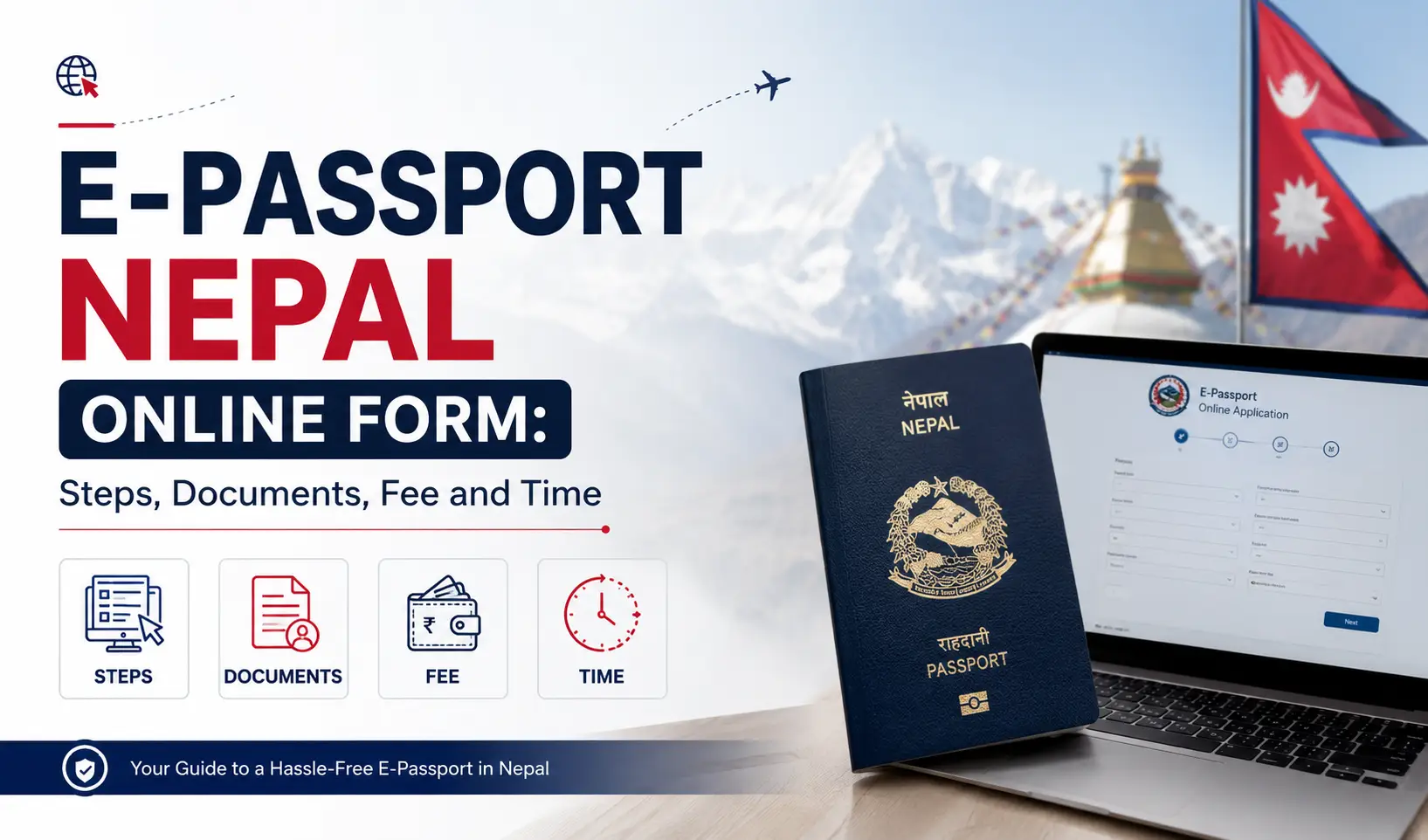
Nepal e-passport online form and passport renewal guide showing a Nepali e-passport beside a laptop and the Nepal flag

Last checked: 26 October 2026 (Kartik 2083). Renewal section expanded 22 November 2026. Every fee, document and time limit below was checked against the Department of Passports’ own pages (nepalpassport.gov.np). Where the Department’s pages disagree with each other, we show both figures instead of picking one.

The e-passport Nepal online form is the free pre-enrollment form on the Department of Passports’ portal. You use the same form for a new passport and for a passport renewal. You fill it at home, book a date and time at your passport office, and then visit that office once for document checks, fee payment, photo and fingerprints. Your passport is later printed and sent back to the same office for collection.

This Nepal e-passport online form guide covers everything in one place: which option to choose, how to write each field so your form is not rejected, the documents to carry, the real fee in your district versus the fast service in Kathmandu, how long each office takes, how to renew your passport (including switching from an old MRP passport), and how to track your passport without calling the office.

Quick Answers

QuestionAnswer
Official form linkonline.nepalpassport.gov.np (also via the Nepal ePassport mobile app)
Cost of the formFree. You only pay the passport fee.
Fee at your district (regular)Rs 5,000 (34 pages) / Rs 10,000 (66 pages)
Fee at the Department, Kathmandu (fast)Rs 12,000 (34 pages) / Rs 20,000 (66 pages)
Renewal feeSame as a new passport. Lost or damaged passports cost more.
When you can renewOnce less than 1 year of validity remains, or earlier in specific cases
TimeDepartment: within 2 working days. District: 10–45 days. Abroad: 15 days to 2 months.
PhotoTaken at the office. Do not bring one.
National ID numberCompulsory for applicants aged 16+ applying in Nepal
Upload sizeScanned originals, 1 MB or less per file

What Is the E-Passport Online Form?

Nepal moved from the machine-readable passport (MRP) to the electronic passport, which carries a chip with your biometric data. Every new or renewed ordinary passport now starts with an online pre-enrollment form. The form does three jobs:

  • Captures your personal details before you reach the office, so the counter work is shorter.
  • Books your appointment slot at a specific enrollment centre.
  • Generates a PDF with a barcode and QR code that staff scan when you arrive.

Filling the form does not complete your application. The application is only complete after verification, payment and biometric enrollment at the office.

Before You Start: 5-Minute Readiness Checklist

Most rejected or delayed forms fail because something was missing before the applicant even opened the portal. Have these ready first:

✓ Identity

  • Original citizenship certificate (or minor ID card)
  • National Identity Number (NIN) if you are 16 or older. Not sure? Check your NID status online
  • Your current or last passport, if any

✓ Digital prep

  • Scans of originals, each 1 MB or smaller
  • Your date of birth in both BS and AD. Use our BS to AD date converter
  • A working email and phone number

✓ Decisions

  • Application type (new, renewal, lost, damaged, correction)
  • 34 or 66 pages
  • District office (cheaper) or Department (faster)

If you do not yet have your national ID number, sort that first, because the form will not go through without it for adults applying in Nepal. If you already registered and only need the digital copy, see how to download your eNID in Nepal.

The Whole Process at a Glance

From your laptop to the passport in your hand, the journey has six stages. Only the first happens at home.

STAGE 1 · HOME

Fill form online and book a slot

STAGE 2 · OFFICE

Verification counter checks documents

STAGE 3 · OFFICE

Pay fee (bank, online or digital)

STAGE 4 · OFFICE

Photo and fingerprints, then sign

STAGE 5 · WAIT

Track status in Nepal ePassport app

STAGE 6 · OFFICE

Collect passport in person

How to Fill the E-Passport Nepal Online Form: Step by Step

Step 1: Open the official portal

Go to online.nepalpassport.gov.np (linked from nepalpassport.gov.np) and choose to apply for a passport. On a phone, the Department’s Nepal ePassport app on Google Play or the App Store works too. Avoid look-alike sites and agents who ask for your citizenship photo on social media.

Step 2: Choose the application type

You get five options. Picking the wrong one is one of the most common reasons for a trip back to the office.

OptionChoose it when
First Issuance (New)You never held an MRP or e-passport. Also choose this if you only ever had an old handwritten passport.
Passport RenewalYou have held an MRP or e-passport before. Details stay the same, validity is extended. See the full renewal section.
Replacement (Lost/Stolen)Your passport is lost or stolen. Higher fee applies.
Replacement (Damaged)Pages torn, overwritten or otherwise unusable. Higher fee applies.
Modification (Data Correction)A detail on your earlier passport must change, or the earlier mistake was yours.
Special cases the Department lists: if the office made the error, apply the same way as the original application. Army or Police personnel who got a gratis MRP for peace missions but no longer hold it should choose Renewal and enter that passport number. Holders of official or diplomatic passports should ignore those numbers when applying for an ordinary passport.

Step 3: Choose 34 or 66 pages

Pick the page count and press Next. Most people need only 34 pages (see the fee section for when 66 makes sense).

Step 4: Select your office and book date and time

Choose the enrollment centre: your District or Area Administration Office, or the Department of Passports in Tripureshwor for fast service. Then pick an open appointment slot. If you are abroad, choose Other and select the country.

Step 5: Fill your details and upload documents

Enter every section in order and upload the documents it asks for. Scan originals (not photocopies) and compress each file to 1 MB or less before you start, so the session does not time out while you resize files.

Step 6: Review everything, then click Apply

Compare each line with your citizenship certificate. The Department warns that an error that reaches the printed passport means a new application and a new fee, so this check is worth five extra minutes.

Step 7: Save the PDF

The PDF downloads automatically after submission, and you can download it again manually. Print it, or keep the original PDF file on your phone. A screenshot is not accepted.

Field-by-Field Rules (So Your Form Is Not Rejected)

These rules come from the Department’s official guide on filling the application.

FieldHow to fill it
Given nameFirst and middle names only. Letters only. No Dr., Mr., Ms. or other titles.
SurnameAs on citizenship. Write all surnames if you have more than one (for example Paudel Chhetri). Remove dots: G.C. becomes GC. No surname? Write your name as it appears.
Place of birthDistrict on your citizenship. If born abroad, the country.
NationalityNEPALI
Date of birthBS exactly as on citizenship, plus the AD conversion. If your citizenship shows only the year, use the date on your national ID or current passport, without changing the year.
SexM, F or X, as on citizenship.
AddressAs on citizenship or national ID: province, district, municipality, ward, tole. Moved? Attach the migration certificate. Married women updating address need the marriage registration.
Email and phonePhone with country code. Ready and rejected notices come here, so use numbers you actually check. A family member’s number is allowed.
Citizenship numberThe box fits 14 digits. If yours is longer, drop digits from the left. Example: 072-312-13792/432796 becomes 31213792432796.
Citizenship issue date and placeThe original issue date and district, even if you later took a copy (pratilipi) elsewhere.
National ID numberCompulsory at 16+ in Nepal. Not compulsory under 16 or at missions abroad.
Latest passportNumber, date and place of your most recent passport or travel document. A handwritten passport is not entered.
Father’s and mother’s namesFull names exactly as on your citizenship.

Common mistakes that cost applicants a second visit

  • Choosing First Issuance when you had an MRP before. If you ever held a machine-readable passport, it is a renewal.
  • Entering a copy-citizenship date. Use the first issue date and district.
  • Wrong AD date of birth. A one-day conversion error is a data error. Double-check with a converter.
  • Typing spaces or dashes in the citizenship number. Digits only, rightmost 14.
  • Letting someone else fill it and not checking. The Department explicitly asks you to fill it yourself or verify every line if someone helped.
  • Bringing a screenshot. Carry a printout or the original PDF.

Documents Required for E-Passport in Nepal

Standard documents (everyone applying in Nepal)

  1. Submitted form with barcode and QR code (printed, or original digital file, not a screenshot)
  2. Original citizenship certificate or minor identity card
  3. Current passport original, if you have one
  4. National identity card, or proof of NID application showing the number
  5. Bank voucher or cash receipt for the fee (if already paid)
  6. Any extra papers your case needs (below)

Extra documents for specific cases

Your situationBring this
Want date of birth as per academic certificateSLC/SEE certificate or a higher qualification
Want date of birth as per Indian, British or Singapore pension recordDistrict Administration Office letter referring to the discharge certificate
Married woman adding husband’s surnameMarriage registration certificate and husband’s citizenship
Divorced woman keeping only the surname on her citizenshipDivorce certificate
Address changed after migrationCopy of migration (basai sarai) certificate
Child applying at the Department for the first timeMinor ID verification from the District/Area Administration Office, parents’ citizenship and parents’ marriage registration

A child’s minor identity card usually starts with a registered birth. If that is still pending, see our guide to applying for a birth certificate online in Nepal.

E-Passport Fee in Nepal (2026)

The fee depends on three things: page count, the applicant’s age, and whether you use regular service in your district or fast service at the Department. Here is how the main options compare visually.

Passport fee comparison (Rs)

District, 34 pages
5,000
Dept, child under 10, 34 pages
9,500
District, 66 pages
10,000
Department (fast), 34 pages
12,000
Dept, lost/damaged, 34 pages
17,000
Department (fast), 66 pages
20,000
Dept, lost/damaged, 66 pages
25,000

Green = regular service in your district. Maroon = fast service at the Department. Orange = lost or damaged replacement at the Department.

Official fee table at the Department of Passports

Type34 pages66 pages
New or renewalRs 12,000Rs 20,000
New or renewal, child under 10Rs 9,500Rs 14,500
Lost or damagedRs 17,000Rs 25,000
Lost or damaged, child under 10Rs 14,500Rs 19,500
Office’s own errorFreeFree

Why the district fee is Rs 5,000 and Rs 10,000

The Department’s fee page only lists its own fast-service rates. On its “where to apply” page, it says fast service costs Rs 7,000 more than the district fee for 34 pages and Rs 10,000 more for 66 pages. That puts the regular district fee at Rs 5,000 and Rs 10,000, which matches the schedule published when e-passports launched in November 2021. Child and lost-passport rates in districts are not listed online, so confirm them at your District Administration Office before paying.

Money tip: if you are not in a hurry, applying at your own district saves Rs 7,000 on a 34-page passport. The printed passport is the same document either way.

How and when to pay

  • If you know the exact fee and your form is complete, you can pay before your verification visit.
  • Otherwise, pay at the office after verification, through the bank the office names, or via the online or digital payment options listed on nepalpassport.gov.np.
  • Keep the voucher or receipt. You need it again on collection day.
  • Missions abroad set their own fee and payment method in local currency.

34 pages or 66 pages?

The Department advises 66 pages only for frequent travellers who expect to fill their pages, and says plainly that a 66-page passport does not improve your chance of getting a visa. For a student visa, a single work contract or occasional tourism, 34 pages is enough.

Where to Apply: District vs Department vs Abroad

District / Area Admin Office

Service: Regular only

Who: Where your citizenship or minor ID was issued, or where you have officially migrated

Best for: Lowest fee, no rush

Department, Tripureshwor

Service: Fast only

Who: Anyone, from any district

Best for: Urgent travel, the only option for a passport within days

Nepali Embassy / Consulate

Service: Regular only

Who: Nepalis living abroad

Best for: Renewal without travelling home

Districts and missions do not offer fast service, and the Department does not offer regular service. If you live in a district other than the one on your citizenship and have not migrated officially, the Department in Kathmandu is the only place that accepts you.

How Long Does an E-Passport Take in Nepal?

Processing time depends on where you apply. The chart shows the range the Department publishes, on a 60-day scale.

Processing time range (days)

Department (fast)
Within 2 working days
District office
10 to 30 days on one Department page, 15 to 45 days on its FAQ page
Mission abroad
15 days to 2 months

District timing varies with distance from Kathmandu and transport, because passports are printed centrally and sent back. If your travel date is fixed, plan around the longer 45-day figure, or apply at the Department.

At the Office: Three Counters and Photo Rules

  1. Verification: staff compare your form with the original documents.
  2. Payment: pay the fee if you have not already.
  3. Enrollment: photo and fingerprints are captured, you review the details and sign.

Do not bring a photo. It is taken at the office. The only exception is a newborn or very young child who cannot sit for the camera. For the photo:

  • Jewellery: small everyday pieces (like a small nose stud) are fine if they do not shine or cover eyes, mouth or eyebrows. Remove party jewellery.
  • Makeup: keep it minimal and natural. Nothing that changes your facial appearance.
  • Tika: there is no strict rule, but the Department suggests not wearing one. Worth remembering if you apply right after Dashain or Tihar.
  • Tattoos and scars: permanent marks on the face or neck are fine. If a mark is from a temporary injury, the Department suggests waiting until it heals, because a mismatched face can cause trouble while travelling.

How to Track Your Passport Status

The office will not give status updates on request. Instead, download the Nepal ePassport app from Google Play or the App Store and check the status yourself. You also get an SMS and email when the passport is ready.

If your form is rejected, you are informed on the phone and email you entered. Contact your enrollment centre and resubmit the required documents. Because your photo is normally already on file, the resubmission can usually move forward even if you are not present in person.

How to Renew Your Passport in Nepal

Passport renewal uses the same online form and the same office visit as a new passport. The differences are the option you choose, the old passport you bring, and the timing rules below. Renewal also covers switching from an old machine-readable passport (MRP) to an e-passport.

When can you renew?

You can apply for renewal once less than one year of validity remains. If you do not need to travel, the Department says you do not have to renew an expired passport at all. You can renew earlier than one year in these cases:

  • Passport is unreadable, torn, worn out or has wrong details
  • Passport is lost, or pages are torn or overwritten
  • Pages are full
  • Your surname changed
  • A minor turned 16 and wants a new passport
  • Your face changed after an accident or treatment
  • Your emergency contact details need changing
  • A divorced woman wants to drop her former husband’s surname
  • Your validity is shorter than an approved foreign employment period
  • Your validity is shorter than your study period abroad

Renewal step by step

  1. Open the form at online.nepalpassport.gov.np or in the Nepal ePassport app.
  2. Choose “Passport Renewal”. Pick this if you have ever held an MRP or e-passport, even an expired one. Choose a Replacement option instead if your passport is lost, stolen or damaged.
  3. Choose 34 or 66 pages and your office: your district for the regular fee, or the Department in Kathmandu for fast service.
  4. Enter your latest passport details: passport number, issue date and place. Your other details should match your citizenship and national ID.
  5. Submit and save the PDF with the barcode and QR code. A screenshot is not accepted.
  6. Visit the office with your old passport, citizenship and national ID. Go through verification, payment and new photo and fingerprints.
  7. Collect the new passport and hand in your old one at collection.

Documents for passport renewal

  • Submitted form printout or the original PDF
  • Your current or last passport, original
  • Original citizenship certificate
  • National identity card or NID number (16+ applying in Nepal)
  • Fee voucher or receipt, if already paid
  • Supporting papers if a detail is changing, such as a marriage registration for a surname change or a migration certificate for a new address (see the extra documents table)

Passport renewal fee

Renewal costs the same as a new passport: Rs 5,000 (34 pages) or Rs 10,000 (66 pages) at your district, and Rs 12,000 or Rs 20,000 for fast service at the Department. Children under 10 pay less at the Department. If your passport is lost or damaged, it is not a simple renewal, and the higher replacement fee applies. See the full fee section.

Renewing an MRP passport to an e-passport

Still have a valid MRP passport? You do not need an e-passport yet. You can keep travelling on the MRP until it expires, and apply for an e-passport once less than a year remains or it becomes unusable. When you do, choose Passport Renewal, not First Issuance, and enter your MRP number as your latest passport.

Renewing from abroad

Nepalis living abroad renew through the Nepali embassy or consulate in their country. On the form, choose Other as the location and select the country. Missions offer regular service only, set their own fee and payment method in local currency, and take about 15 days to 2 months. National ID is not compulsory for applications at missions. Relatives in Nepal cannot renew your passport on your behalf, so apply early if your visa or work permit renewal depends on it.

Going abroad for work? Your passport validity matters for the labour permit too. See our Shram Swikriti renewal guide, and the police clearance certificate guide, which also asks for your passport details.

Fixing Mistakes and Changing Appointments

When you notice the errorWhat happens
After submitting, before your visitAsk staff to correct it at verification or when the photo is taken.
At the counter, before signingCheck the corrected details carefully, then sign.
After photo and final approvalNo longer correctable. The application must be cancelled and restarted.
After the passport is printedYour mistake: new application and new fee. Office mistake: free reissue.

Appointments cannot be changed online. If you cannot attend, contact the office and either bring the same form or fill a new one, as the office instructs. If no slots appear for your Area Administration Office or mission, the Department says it has asked those offices to open more slots, so contact the office directly.

Collecting Your Passport

Go to the office where you applied once you get the ready notice. Bring:

  • The application form
  • Your old original passport (not needed for first passport or lost passport)
  • Citizenship certificate
  • Fee receipt

You must collect it yourself, and a parent collects a child’s passport. If you truly cannot go, a relative can collect it with your written authorization plus their own citizenship or passport. Collection takes about 10 to 15 minutes.

Important: a passport you reported lost or stolen must never be used for travel, even if you find it later. Hand it to the office.

Practical Tips Before Your Visit

  • Office hours: the Department works Monday to Friday, 9 AM to 5 PM. Arrive a little before your slot.
  • Keep everything in one folder: form printout, originals and receipt. You need almost the same set again on collection day.
  • Save your PDF in two places: phone and email. Losing it before the visit means calling the office.
  • Link your documents digitally: keeping your citizenship and NID in the Nagarik App helps you read numbers and dates correctly while filling the form.
  • Need a passport only for a short trip? If you are abroad and urgently need to come home, the mission can issue a one-way travel document. Relatives in Nepal cannot make a passport on your behalf.
  • Help: Department hotline +977-1-5970330, info@nepalpassport.gov.np. District queries: district@nepalpassport.gov.np.

Doing other government paperwork online as well? Our guide to getting a driving licence in Nepal follows a similar pre-registration and biometrics process, and the Nepal government services hub lists every related guide.

Frequently Asked Questions

Is the e-passport online form free to fill?

Yes. The pre-enrollment form on online.nepalpassport.gov.np is free. You only pay the passport fee at the bank, online or at the office.

How much is the e-passport fee in Nepal in 2026?

Regular service at your district costs Rs 5,000 for 34 pages and Rs 10,000 for 66 pages. Fast service at the Department of Passports costs Rs 12,000 and Rs 20,000. Lost or damaged replacements at the Department cost Rs 17,000 and Rs 25,000.

How do I renew my passport in Nepal?

Fill the online form at online.nepalpassport.gov.np, choose “Passport Renewal”, enter your latest passport details and book a slot. Then visit the office with your old passport, citizenship and national ID for verification, payment, photo and fingerprints, and hand in the old passport when you collect the new one.

How much does passport renewal cost in Nepal?

The same as a new passport: Rs 5,000 (34 pages) or Rs 10,000 (66 pages) at your district, or Rs 12,000 and Rs 20,000 for fast service at the Department. Lost or damaged passports cost more.

How many days does it take to get an e-passport in Nepal?

Within 2 working days at the Department in Kathmandu. District offices take about 10 to 45 days depending on distance, and missions abroad take 15 days to 2 months.

Is the National ID card compulsory for a passport?

Yes for applicants aged 16 and above applying in Nepal. It is not compulsory for children under 16 or for applications at Nepali missions abroad.

Do I need to bring a passport-size photo?

No. Your photo is taken at the office during enrollment. Only newborns or very young children who cannot sit for the camera are an exception.

Can I change my appointment date after submitting the form?

Not online. Contact the office where you booked, and either bring the same form or fill a new one as the office instructs.

Can I apply from a district other than the one on my citizenship?

Only if you have officially migrated to that district. Otherwise, apply at your citizenship district or at the Department of Passports in Kathmandu, which accepts applicants from any district.

When can I renew my passport?

When less than one year of validity remains, or earlier if pages are full, it is damaged or lost, your surname changed, or its validity is shorter than your approved foreign employment or study period.

Do I need an e-passport if my MRP passport is still valid?

No. You can keep travelling on a valid MRP passport. Apply for the e-passport, using the Passport Renewal option, when less than a year remains or the MRP becomes unusable.

Can I renew my Nepali passport from abroad?

Yes, at the Nepali embassy or consulate in your country. Choose “Other” and your country on the form. Missions offer regular service only, charge in local currency and take about 15 days to 2 months.

How do I check whether my passport is ready?

Use the Nepal ePassport app from Google Play or the App Store. You will also receive an SMS and email when it is ready or if it is rejected.

Conclusion

The e-passport Nepal online form takes about 20 minutes if your documents are ready, whether you are applying for the first time or renewing. Choose the right application type, enter your name, dates and citizenship number exactly, pick your district if you can wait (and save Rs 7,000), and keep the PDF safe. At the office, read every detail once more before you sign, because that signature is the last point where a mistake is free to fix.

Grammarly Price in Nepal (2026): Pro Cost in NPR, Free vs Pro & Cheapest Legit Way to Pay

Grammarly price in Nepal 2026: Grammarly Pro cost in Nepali rupees on a writing workspace

Grammarly Price in Nepal (2026): Pro Cost in NPR, Free vs Pro & Cheapest Legit Way to Pay

By Wilson Shrestha · Last updated: 25 October 2026 · Prices checked against Grammarly’s official plans page and Nepal Rastra Bank’s exchange rate

Search “Grammarly price in Nepal” and almost every result is a shop selling “Grammarly Premium” for eSewa or Khalti, at anything from Rs 399 to Rs 7,700. None of them tell you what Grammarly itself charges, why their price is so much lower than the official one, or what you give up by buying a shared login.

This guide fills that gap. You get Grammarly’s official 2026 price converted to rupees at today’s rate, the cost with 13% VAT, how much of your $500 dollar card it uses, what the free plan already does, how reseller deals actually work, and the cheaper tools that might do the job instead.

Quick answer: Grammarly price in Nepal (October 2026)

  • Grammarly Free: Rs 0. Spelling, grammar, tone detection and 100 AI prompts a month.
  • Grammarly Pro, yearly: $144 a year = about Rs 21,918 a year (Rs 1,827 a month), or about Rs 24,768 with 13% VAT.
  • Grammarly Pro, monthly: $30 a month = about Rs 4,566 a month, or Rs 54,796 if you pay monthly for a full year.
  • Free trial: 7 days on Pro, but you need a working international card and it turns into a paid plan unless you cancel.
  • Reseller prices in Nepal: Rs 399 to Rs 7,700 depending on length and whether the account is shared or on your own email.

Rupee figures use Rs 152.21 per US dollar, Nepal Rastra Bank’s selling rate on 24 October 2026. Check the NRB forex page for today’s rate.

Grammarly Price List in Nepal (October 2026)

Grammarly bills Nepali customers in US dollars, so your bank converts the price on the day you pay. Here is every plan at Rs 152.21 per dollar:

Plan and billingOfficial priceIn NPRWith 13% VATEffective per month
Free$0Rs 0Rs 0Rs 0
Pro, yearly (best value)$144 a yearRs 21,918Rs 24,768Rs 1,827
Pro, quarterly (if offered to you)$60 every 3 monthsRs 9,133Rs 10,320Rs 3,044
Pro, monthly$30 a monthRs 4,566Rs 5,160Rs 4,566
Pro for a team of 5 (yearly)$720 a yearRs 109,591Rs 123,838Rs 1,827 per person
EnterpriseCustom quote–––

Grammarly’s own plans page shows only the monthly and yearly options. Some independent price trackers also report a quarterly plan at $60 every three months, so it is listed here in case it appears on your checkout screen.

What one year of Grammarly Pro costs, by billing option

Total for 12 months before tax, at Rs 152.21 per US dollar.

Monthly billing × 12 ($360) Rs 54,796

Quarterly billing × 4 ($240) Rs 36,530

Yearly billing ($144) Rs 21,918

Grammarly Free Rs 0

Grammarly Premium Is Now Grammarly Pro

If you are searching for “Grammarly Premium price in Nepal”, this is the first thing to know: Grammarly no longer sells a plan called Premium. It merged Premium and its old Business plan into one plan called Grammarly Pro. Pro keeps every Premium writing feature and adds team tools such as a shared style guide, brand tones and snippets.

  • Same headline price: $12 a month on yearly billing, as Premium was.
  • Billed per member: one person pays one seat; a team pays one seat per writer, up to 149 members.
  • Old Premium subscribers who switch to Pro get a prorated refund for the rest of their Premium period, according to Grammarly’s plans page.
  • New owner name on the site: Grammarly is now part of the Superhuman platform, so you may see Superhuman branding on receipts and help pages.

Nepali shops still sell “Grammarly Premium” because that is the name people search for. What you receive is a Pro account (or a seat on someone else’s Pro team), not an older product.

Grammarly Free vs Pro: What You Actually Get

Grammarly Free

Rs 0

  • Spelling, grammar and punctuation fixes
  • Tone detection (it shows your tone)
  • 100 AI prompts a month
  • Works in browser, Word, Google Docs and phone keyboard

Grammarly Pro

Rs 1,827–4,566 /month

  • Everything in Free
  • Full-sentence rewrites and tone adjustment
  • Plagiarism and AI-text detection
  • 2,000 AI prompts per member per month
  • Fluency help for non-native English writers
FeatureFreeProEnterprise
Fix spelling and grammarYesYesYes
See your toneYesYesYes
Adjust tone and rewrite full sentencesNoYesYes
Plagiarism checkNoYesYes
AI-generated text detectionNoYesYes
Citation consistencyNoYesYes
AI prompts per month1002,000 per memberUnlimited
Style guide and brand tonesNo1 eachUnlimited
Priority supportNoYesDedicated

Is Grammarly Free enough for most people in Nepal?

For emails, Facebook posts, job applications and most college assignments, yes. The free plan already catches the mistakes Nepali writers make most often in English: missing articles (a, an, the), wrong prepositions, subject-verb agreement and tense slips. What Free will not do is rewrite a whole clumsy sentence for you or check your work for plagiarism.

Pro is worth paying for if you:

  • write in English for clients abroad (freelance content writing, virtual assistance, customer support)
  • submit a thesis, research paper or journal article and want a plagiarism check before your supervisor runs one
  • apply for foreign universities or jobs and need SOPs, cover letters and emails to read naturally
  • run a blog or agency where several writers need one consistent style

Grammarly Monthly or Yearly? The 5-Month Rule

The $12 price you see everywhere is the yearly rate, paid as one $144 charge. Month-to-month costs $30, two and a half times more. The simple way to decide: $144 divided by $30 is 4.8. If you will need Pro for five months or longer, yearly is cheaper.

1 MONTH

Monthly wins

Rs 4,566 vs Rs 21,918

3 MONTHS

Monthly wins

Rs 13,699 vs Rs 21,918

5 MONTHS

Yearly wins

Rs 22,832 vs Rs 21,918

12 MONTHS

Yearly saves Rs 32,877

Rs 54,796 vs Rs 21,918

A practical pattern for students: if you only need Pro while writing a thesis or a semester project, pay monthly for those two or three months and drop back to Free afterwards. If you write in English for work every week, go yearly.

The Real Cost of Grammarly From Nepal

The sticker price is not exactly what leaves your bank account. Four things change the final amount:

COST 1

Exchange rate

The yearly plan cost Rs 22,331 at the 12 October rate and Rs 21,918 on 24 October. Same plan, Rs 413 apart.

COST 2

Bank margin

Your bank uses its own selling rate, usually a little above NRB’s, and some add a card fee.

COST 3

13% VAT

Foreign digital services sold to Nepali consumers are taxable at 13%. It may or may not appear at checkout.

COST 4

App store price

Subscribing inside the iPhone or Android app is billed by Apple or Google and can differ from the web price.

How much of your $500 dollar card does Grammarly use?

Most people in Nepal pay foreign subscriptions with a prepaid dollar card, capped at $500 per person per year. Grammarly is one of the bigger single charges you will make on it, because the yearly plan is billed all at once.

Share of the $500 yearly dollar card limit used by one year of Grammarly Pro

Before VAT unless marked.

Yearly plan ($144) 29%

Yearly plan with 13% VAT ($162.72) 33%

Quarterly × 4 ($240) 48%

Monthly × 12 ($360) 72%

The yearly plan leaves you about $340 for everything else. Add one $20 AI chatbot for a year and you are near the limit. Our AI tools price in Nepal guide shows how different tool “stacks” fit inside $500, and the dollar card in Nepal guide explains which banks issue one and how to reload it.

How to Buy Grammarly Pro From Nepal

Grammarly accepts Visa, Mastercard, American Express, Discover and PayPal. It does not accept eSewa, Khalti or ConnectIPS, and PayPal is not available for personal payments from Nepal, so in practice you need a card that works for international online payments.

Do you have a dollar card or an international Visa/Mastercard with e-commerce turned on?

↓

YES: buy from Grammarly directly

Your own account, your own documents, full Pro features, and you can cancel any time.

→ Follow the steps below. Keep $15–20 extra on the card for VAT and conversion.

NO: use Free, or a Nepali reseller

Pay with eSewa, Khalti or mobile banking.

→ Choose activation on your own email, never a shared login for private or client work. See the reseller section below.

Step by step: paying Grammarly with a dollar card

  1. Load the card first. Put at least $165 on it for the yearly plan ($144 plus possible VAT and conversion), or $35 for one month.
  2. Sign up for Grammarly Free on the website, not inside the mobile app, so you are billed at the web price.
  3. Open the upgrade page and choose yearly or monthly. If Grammarly offers you a regional plan (see below), compare it here.
  4. Enter your card details with your billing country set to Nepal and the name exactly as printed on the card.
  5. Check the final total on the payment screen before you confirm. This is where any tax shows up.
  6. Turn off auto-renew in your account settings if you only want one term, so the card is not charged again next year.

Careful with the 7-day free trial

Grammarly offers a 7-day free trial of Pro with $0 charged on the day you start, and it sends a reminder email two days before the trial ends. If you do not cancel, the plan you picked is charged in full. On a yearly plan that means a single $144 charge, about 29% of your dollar card limit, in one go. Set a phone reminder for day five.

Does Nepal get the cheaper Grammarly Plus plan?

Grammarly sells a region-specific plan called Grammarly Plus in some countries, at a lower local price than Pro. According to Grammarly’s help center, you only qualify if your payment method and billing country both match a region where Plus is offered. Grammarly does not publish the list of countries, and we could not confirm that Nepal is on it as of October 2026.

So before paying $144 for Pro, open Grammarly’s Plus upgrade page while logged in with your Nepali card details. If Plus appears with a lower price, it is the better deal. If it doesn’t, Pro at the global price is what Nepal currently gets. If you have ever had trouble getting a Nepali card accepted abroad, our guide on how to pay online from Nepal covers the common fixes.

Official Price vs Nepali Reseller Price

Grammarly is unusual. With ChatGPT or Claude, a private reseller account usually costs a bit more than paying directly. With Grammarly, Nepali shops advertise prices far below the official Rs 21,918 a year. Here is what online stores in Nepal were listing in 2026 (we have not bought from them, so treat these as advertised prices):

What is being soldAdvertised priceOfficial equivalentWhat it usually means
Shared login, 1 monthRs 399–500Rs 4,566Seller’s email and password, used by several people
Shared or “1 device” login, 1 yearRs 2,999–4,000Rs 21,918Same, with a replacement promise
On your own email, 1 monthAbout Rs 999–1,000Rs 4,566Usually a seat on the seller’s Pro team
On your own email, 12 monthsAbout Rs 5,999–7,700Rs 21,918Team seat or promotional pricing
6 or 12 months, very cheapRs 590–990Rs 10,959–21,918Ask how it is billed before paying

Why can resellers sell Grammarly so cheaply?

Grammarly Pro is billed per member and a single Pro team can have up to 149 members. A seller who pays for a team, or uses discount offers and regional plans bought elsewhere, can split that cost across many buyers. Shared logins go further: one paid account, many people. That is how a Rs 21,918 product ends up at Rs 990.

The trade-offs are real:

  • Shared logins are not private. Everyone on the account can open the documents saved in Grammarly’s editor. Never paste a thesis, client file or job application into a shared account.
  • Team seats can disappear. The seller is the team admin and can remove your seat at any time, or lose it if their own payment fails.
  • Sharing breaks Grammarly’s terms. Accounts caught being shared can be locked, and some sellers even warn that they will terminate your access if you share it further.
  • Refunds depend on the seller, not Grammarly, so read the warranty terms first.

If you do buy from a reseller, check these five things:

  1. Is Pro activated on your own email, or are you given someone else’s password?
  2. For how long is the replacement warranty, and does it cover the full term you paid for?
  3. Is the seller a registered business with a website and order history, not a chat-only seller?
  4. Does the price include the plagiarism checker and AI prompts, or only grammar suggestions?
  5. What happens to your saved documents when the term ends?

Grammarly for Students in Nepal

Grammarly does not sell an individual student discount. Its education pricing is for institutions: a college or university buys licences and gives Pro access to its students and staff. Before you pay anything, ask your college IT department or library whether your institution already has a Grammarly for Education licence. Some universities in the region offer it to students at a heavily subsidised price.

If your college has no licence, this combination covers most student needs for free:

  • Grammarly Free for grammar and spelling as you type.
  • A free AI chatbot for rewriting awkward paragraphs. Paste a paragraph and ask it to make it clearer without changing the meaning.
  • Your college’s plagiarism checker (often Turnitin) for the final submission, instead of paying for Grammarly’s.

Cheaper Grammarly Alternatives in Nepal

Grammarly Pro is not the only way to clean up your English. Depending on what you write, one of these may be enough:

ToolYearly priceIn NPR per yearBest for
Grammarly Pro$144Rs 21,918Real-time checks everywhere you type, plagiarism check
ProWritingAid PremiumAbout $120About Rs 18,265Long-form and fiction writers, detailed style reports
QuillBot PremiumAbout $99.95About Rs 15,213Paraphrasing, summarising, ESL writers
Free AI chatbots (ChatGPT, Claude, Gemini)$0Rs 0Rewriting and explaining mistakes, on request
Grammarly Free$0Rs 0Everyday spelling and grammar

Grammarly vs an AI chatbot: which is better value?

A $20 AI plan costs about Rs 3,044 a month, more than Grammarly Pro on yearly billing, but it does far more than check grammar. The difference is how they work. Grammarly sits inside every text box and fixes mistakes as you type. A chatbot only helps when you copy text into it and ask.

  • If you mostly write short messages, emails and forms, Grammarly Free or Pro fits better.
  • If you write long documents and also need research, summaries or coding help, one AI plan plus Grammarly Free is usually better value than Grammarly Pro alone. Compare the options in our ChatGPT price in Nepal, Claude AI price in Nepal and Gemini price in Nepal guides.
  • Claude in particular is strong at editing long English text while keeping your voice, and its yearly Pro plan works out to less per month than paying for ChatGPT Plus.

Which Grammarly Plan Should You Choose?

You are…Best choiceCost
A school or +2 studentGrammarly FreeRs 0
A bachelor’s or master’s student writing a thesisCollege licence if available; otherwise Pro monthly for 2–3 monthsRs 0 or about Rs 9,133–13,699
Applying abroad (SOP, cover letters)Pro monthly during application seasonRs 4,566 a month
A freelance writer or VA with foreign clientsPro yearlyRs 21,918 a year
A blogger or content agency with several writersPro yearly, one seat per writer, shared style guideRs 21,918 per writer a year
An office in Nepal writing mostly emailsFree for everyone, Pro for the 1–2 people writing to foreign partnersRs 0–43,836 a year

Our default advice: use Grammarly Free for two weeks on your real writing. If you keep hitting the “rewrite with Pro” suggestions or need a plagiarism check, start the 7-day trial, decide before day five, and pay yearly on your own card if you will use it for five months or more.

Frequently Asked Questions

What is the price of Grammarly in Nepal?

Grammarly Free costs nothing. Grammarly Pro costs $144 a year (about Rs 21,918, or Rs 1,827 a month) on yearly billing, or $30 a month (about Rs 4,566) on monthly billing, at Nepal Rastra Bank’s rate of Rs 152.21 per dollar on 24 October 2026.

How much is Grammarly Premium in Nepal?

Grammarly Premium has been replaced by Grammarly Pro at the same price: about Rs 1,827 a month on yearly billing or Rs 4,566 month-to-month. Nepali resellers still use the Premium name and sell access from about Rs 399 for a shared month.

Can I pay for Grammarly with eSewa or Khalti?

Not directly. Grammarly accepts international cards and PayPal. From Nepal you can pay with a prepaid dollar card or an international card with online payments enabled, or buy through a Nepali reseller who accepts eSewa and Khalti.

Is there a Grammarly free trial in Nepal?

Yes. Grammarly offers a 7-day free trial of Pro with no charge on the first day, but it needs a card and becomes a paid plan automatically unless you cancel before it ends.

Is VAT charged on Grammarly in Nepal?

Nepal applies 13% VAT to foreign digital services sold to consumers. Whether it appears on your Grammarly bill depends on Grammarly’s registration. With 13% VAT, the yearly plan costs about Rs 24,768 and the monthly plan about Rs 5,160.

Is it safe to buy cheap Grammarly from Nepali sellers?

Shared logins are cheap but not private, and can be locked for breaking Grammarly’s terms. Accounts on your own email are safer, but usually depend on a seat in the seller’s team that can be removed. For confidential work, pay Grammarly directly.

Is Grammarly Free good enough for students?

For most assignments, yes. Grammarly Free fixes spelling, grammar and punctuation and gives 100 AI prompts a month. Students mainly need Pro for full-sentence rewrites and a plagiarism check on a thesis or research paper.

Should I pay for Grammarly monthly or yearly?

Pay yearly if you will use Pro for five months or more, since $144 equals 4.8 months of the $30 monthly price. Over a full year, yearly billing saves $216, about Rs 32,877.

Final word

Grammarly in Nepal costs Rs 0 on the free plan, about Rs 21,918 a year for Pro on yearly billing, or Rs 4,566 a month if you pay monthly. Most people should start with Free, use the 7-day trial only with a reminder set, and pay Grammarly directly on their own card if they will use Pro for five months or longer. Cheap reseller deals exist for a reason: they are usually shared or borrowed seats, so keep them away from anything private.

Software prices and exchange rates change. Before subscribing, check Grammarly’s own checkout page and today’s NRB rate. We update this page when prices change.

Sources: Grammarly plans and pricing (Free, Pro and Enterprise features, AI prompt limits, 7-day trial, accepted payment methods, checked 25 October 2026); Grammarly help center: About Grammarly Plus; Nepal Rastra Bank foreign exchange rates (USD selling rate Rs 152.21 on 24 October 2026 and Rs 155.08 on 12 October 2026, as reported by Ratopati and ShareSansar); quarterly plan and alternative tool prices from independent price trackers (2026); Inland Revenue Department VAT procedures for non-resident digital service providers; reseller prices from Nepali online store listings in 2026.

Vehicle Insurance Prices in Nepal (2026 / FY 2083-84): Full Rate Table

Vehicle Insurance Prices in Nepal (2026 / FY 2083–84): Full Rate Table and What Changes Next

Short answer: compulsory third-party vehicle insurance in Nepal currently costs about Rs. 1,705 a year for a bike under 150cc and about Rs. 7,355 a year for a private car under 1000cc, rising to roughly Rs. 2,157 and Rs. 10,745 at the top bands. Those prices are set by a national tariff, so they are the same at every licensed insurer — shopping around saves you nothing on price. What almost no other page tells you: the FY 2083–84 budget doubled the third-party sum insured from Rs. 5 lakh to Rs. 10 lakh, and the regulator is currently rewriting the premium table because of it.

Vehicle insurance prices in Nepal 2026 showing third-party premium rates for bikes, cars and electric vehicles

Vehicle insurance prices in Nepal right now: the full table

These are the amounts you actually pay at the counter or in the app — premium plus VAT plus stamp duty, all in. Every licensed non-life insurer in Nepal charges the same figures, because they come from the Motor Insurance Rate Directive, 2073 issued by the Nepal Insurance Authority (Nepal Beema Pradhikaran).

Vehicle classBandAnnual third-party premium
Motorcycle / scooter (petrol)Below 150ccRs. 1,705
150–249ccRs. 1,931
250cc and aboveRs. 2,157
Private car / jeep / vanBelow 1000ccRs. 7,355
1000–1600ccRs. 8,485
Above 1600ccRs. 10,745
Electric two-wheelerBelow 800 WRs. 1,705
800–1200 WRs. 1,931
1200 W and aboveRs. 2,157
Electric four-wheelerUp to 20 kWRs. 7,355
Above 20 kWRs. 8,485

You will see these numbers quoted as Rs. 1,705, Rs. 1,706.30 or Rs. 1,715 depending on which wallet or insurer you use. The next section explains exactly why, because that confusion sends a lot of people searching.

Why the same bike gets quoted three slightly different prices

This is the single most common point of confusion, and no competing guide explains it. The figure on your policy is not one number. It is a tariff premium with tax and stamp duty stacked on top:

Tariff premium

Rs. 1,500

Third-party liability plus compulsory personal accident cover

Plus 13% VAT

Rs. 195

Charged on the premium, not on the stamp

Plus stamp duty

Rs. 10

Flat, same on every policy

You pay

Rs. 1,705

Bike below 150cc, one year

The Motor Insurance Rate Directive, 2073 sets the combined third-party and personal accident premium for a motorcycle below 150cc at Rs. 1,500. Add 13% VAT and Rs. 10 stamp duty and you land on Rs. 1,705 exactly. The same arithmetic produces every other figure in the table above.

So the small differences you see are not different prices. They are rounding and presentation: some platforms display paisa (Rs. 1,706.30), some add a few rupees of policy or service charge into the displayed total (Rs. 1,715), and some show the clean tariff total (Rs. 1,705). If a seller quotes you materially more than the table — hundreds of rupees more — you are being charged a service fee, and you are entitled to ask what it is for.

Third-party premiums side by side

Seeing the bands against each other makes the jump from two wheels to four obvious. A private car costs roughly four to six times what a bike costs for the identical type of cover.

Bike below 150cc — Rs. 1,705

Bike 150–249cc — Rs. 1,931

Bike 250cc and above — Rs. 2,157

Car below 1000cc — Rs. 7,355

Car 1000–1600cc — Rs. 8,485

Car above 1600cc — Rs. 10,745

Bars are scaled against the highest private-vehicle band (Rs. 10,745).

Every insurer charges the same. So what should you actually compare?

Motor premiums in Nepal are tariff-based, not competitively priced. Sagarmatha, Shikhar, Himalayan Everest, National, Prabhu, United Ajod and the rest all quote the identical third-party figure for the identical vehicle. Any page promising to help you “find the cheapest third-party insurance in Nepal” is selling you something that does not exist.

That does not mean the choice is meaningless. It means the comparison shifts from price to service:

  • Claim settlement record. Claim ratios across Nepali non-life insurers vary widely. That variation is the real difference between two policies that cost the same.
  • Branch and workshop network near you. For a comprehensive policy this matters enormously. A surveyor who can reach your vehicle the same day is worth more than any discount.
  • How fast they issue the policy document. You cannot renew your bluebook without it, so a slow issuer can cost you a late fine.
  • Whether they sell digitally. Buying through eSewa, Khalti or an insurer’s own portal saves a half-day trip. The premium is the same either way.
  • Add-on availability if you want comprehensive cover — zero depreciation, engine protection, roadside assistance. These are priced on top of the tariff and do differ.

The change that is coming: sum insured doubled, premium revision in progress

This is the part every other guide is missing. The FY 2083–84 budget doubled the compulsory third-party sum insured from Rs. 5 lakh to Rs. 10 lakh. Because the payout limit doubled, the premium table has to be rewritten.

The Nepal Insurance Authority has formed a study committee to recommend the new rates, and has been amending the motor insurance directive accordingly. Authority officials’ preliminary working estimate is that third-party premiums could rise by up to around 70%. The tariff had last been set back in 2065 BS, so this is the first substantial revision in well over a decade.

What this means for you today: as of the time of writing, the Motor Insurance Rate Directive, 2073 is still the operative directive listed by the Authority, and the rates in the table above are still what you pay. The new rates are not in force yet.

But if you are budgeting for the year, or deciding whether to renew now or wait, it is worth seeing the scale of what has been floated:

Bike below 150cc

Now: Rs. 1,705

If premiums rise around 70%: about Rs. 2,900

Car 1000–1600cc

Now: Rs. 8,485

If premiums rise around 70%: about Rs. 14,400

These projections are illustrative only. They apply the regulator’s own preliminary ceiling estimate to today’s tariff. The final rates will be set by the Authority’s rate-fixing process and may land lower, be phased in, or differ by vehicle class — public transport, trucks and taxis are expected to be affected differently from private vehicles. Do not treat these figures as announced rates.

Third-party vs comprehensive: what you get for the money

What happensThird-party (compulsory)Comprehensive (optional)
You injure or kill someone elseCoveredCovered
You damage someone else’s vehicle or propertyCoveredCovered
Driver and passenger accident coverCovered (built into the premium)Covered
Your own vehicle is damaged in a crashNot coveredCovered, minus depreciation
Your vehicle is stolen or burntNot coveredCovered
Flood, landslide, earthquake, riot damageNot coveredUsually an add-on peril, priced separately
Legally required to renew your bluebookYes — this is the minimumSatisfies the requirement too
Typical annual costRs. 1,705 – Rs. 10,745 by bandScales with vehicle value — see below

The practical test is simple. Third-party protects your wallet from other people’s losses. Comprehensive protects it from your own. If losing your vehicle tomorrow would be a financial disaster you could not absorb, third-party alone is not enough, whatever the law says.

What comprehensive insurance actually costs in Nepal

Comprehensive is not a flat price, which is why you rarely see it in a table. It is built from three parts:

  1. Own-damage premium — a percentage of the vehicle’s declared value (sum insured). For private four-wheelers this has run in the region of 0.63% to 0.87% per year depending on the value band and vehicle, which insurers often express as roughly Rs. 8.4 to Rs. 8.7 per Rs. 1,000 of sum insured. Two-wheelers sit higher as a percentage, commonly quoted around 2% to 2.5% of value.
  2. The third-party component — the compulsory liability and personal accident element, as in the table at the top.
  3. Tax and stamp — 13% VAT on the premium, plus Rs. 10 stamp duty.

Worked example: a car declared at Rs. 25 lakh

Own-damage at roughly 0.84% of Rs. 25,00,000 = about Rs. 21,000

Plus the third-party component for its CC band

Plus 13% VAT on the total premium, plus Rs. 10 stamp

Realistic all-in range: roughly Rs. 28,000 to Rs. 35,000 a year before any no-claim discount, and more if you add zero-depreciation or natural-peril cover. For a bike worth Rs. 2.5 lakh, comprehensive typically lands somewhere around Rs. 6,000 to Rs. 9,000 a year.

Two things that genuinely reduce the bill, and that sellers do not always volunteer:

  • No-claim discount. Go a year without claiming and the next renewal drops. The discount builds up over consecutive claim-free years, which is why making a small cosmetic claim can cost you more over three years than paying for the repair yourself.
  • Declared value discipline. Over-declaring your vehicle’s value inflates your premium every year and will not increase your payout, because settlement is capped at the depreciated value anyway. Under-declaring saves a little now and guts your claim later.

Depreciation: the number that decides what you actually get paid

Here is where most owners get a nasty surprise. A comprehensive claim is not settled at what your vehicle is worth. It is settled after a depreciation deduction fixed by the directive, based on the vehicle’s age:

Vehicle ageDepreciation deductedYou receive up to
6 months to 1 year5%95% of value
1 to 2 years10%90%
2 to 3 years15%85%
3 to 4 years25%75%
4 to 5 years35%65%
5 to 10 years40%60%

And once a vehicle passes 10 years from registration, an additional loading of around 10% is applied to the premium calculated that way. So an older vehicle pays more for cover and receives less when it claims. That combination is precisely when owners should sit down and ask whether comprehensive still makes financial sense, or whether third-party plus a repair fund is the better call.

Electric vehicle insurance prices

EVs are not a separate insurance regime in Nepal. They sit inside the same directive, banded by motor power instead of engine capacity:

  • Electric two-wheelers pay exactly what petrol bikes pay — Rs. 1,705 to Rs. 2,157 — banded by wattage rather than cc.
  • Electric four-wheelers pay Rs. 7,355 up to 20 kW and Rs. 8,485 above 20 kW.
  • For comprehensive EV cover, the own-damage rate is applied to the declared value in much the same way, with a lower percentage applied to the first Rs. 20 lakh of value and a higher one above it.

The real EV insurance question in Nepal is not the third-party price — it is the battery. Ask your insurer in writing how battery damage and battery replacement are treated under the policy, and whether the depreciation table is applied to the battery pack. The answer varies, it is the most expensive single component in the vehicle, and it is where EV claims most often go wrong.

How insurance ties into your bluebook, licence and fines

Vehicle insurance in Nepal is not a standalone purchase. It is a gate you have to pass through:

What I have learned paying these premiums here

A few things that only become clear once you have actually renewed a policy in Kathmandu a few times:

  • Buy or renew insurance before tax day, not on tax day. The most common reason people pay a late fine on their bluebook is that they went to pay tax and discovered the policy had expired. Insurance takes minutes if you plan it and ruins a day if you do not.
  • Check the policy document for the engine and chassis number, not just your name. A typo there is invisible until you claim, and then it is the first thing a surveyor catches. Read those two lines the moment you get the paper.
  • Photograph the policy and keep it in your phone and in the vehicle. Traffic checks do not wait for you to find an email.
  • If an agent quotes a “special discounted” third-party rate, be suspicious. The tariff is fixed. A lower price means either a shorter policy period than you think, or something you do not want to be holding.
  • For comprehensive, ask where the nearest empanelled workshop is before you sign. People choose on brand and then discover the approved garage is across the valley. That distance is the difference between a cashless repair and fronting the money yourself.
  • Report accidents promptly, even small ones. Policies carry notification deadlines. A delay is the easiest reason for an insurer to reduce or reject a claim, and it is entirely avoidable.

Common mistakes in the pages ranking for this keyword

Worth stating plainly, because repeating these errors can cost you money:

“Beema Samiti sets the rates”

The regulator was restructured and renamed Nepal Beema Pradhikaran (Nepal Insurance Authority) under the Insurance Act, 2079. Pages still naming the old body are years out of date, and usually their figures are too.

Invented “premium ranges”

Several recent pages quote bands like “Rs. 2,200–3,000 for two-wheelers”. Third-party premiums are fixed tariff amounts, not ranges. A range is a sign the figures were estimated rather than checked.

Stale 2022–2023 tables

Wallet blog posts with the right numbers but no date leave you unable to tell whether anything has changed. With a revision actively in progress, the date matters more than usual this year.

Confusing tax with insurance

Annual vehicle tax is set by your province. Insurance premium is set nationally by the Authority. They appear on the same bill and are governed by completely different rules.

Frequently asked questions

How much is vehicle insurance in Nepal for a bike?

Compulsory third-party insurance costs about Rs. 1,705 a year for a motorcycle or scooter below 150cc, Rs. 1,931 for 150–249cc, and Rs. 2,157 for 250cc and above. These totals include 13% VAT and Rs. 10 stamp duty, and they are identical at every licensed insurer.

How much is car insurance in Nepal?

Third-party cover for a private car costs about Rs. 7,355 a year below 1000cc, Rs. 8,485 for 1000–1600cc, and Rs. 10,745 above 1600cc. Comprehensive cover is priced on the vehicle’s declared value instead and commonly lands around Rs. 28,000 to Rs. 35,000 a year for a car declared at Rs. 25 lakh.

Is vehicle insurance cheaper at some companies in Nepal?

No. Motor premiums follow the Nepal Insurance Authority’s tariff directive, so every licensed insurer charges the same amount for the same cover. Compare claim settlement record, workshop network and service speed instead of price.

Are vehicle insurance prices going up in Nepal?

A revision is in progress. The FY 2083–84 budget doubled the third-party sum insured from Rs. 5 lakh to Rs. 10 lakh, and the Nepal Insurance Authority formed a study committee to set new premium rates, with officials’ preliminary estimate suggesting an increase of up to around 70%. The existing 2073 tariff still applies until the revised rates are formally issued.

Is third-party insurance compulsory in Nepal?

Yes. It has been mandatory for motor vehicles since FY 2066–67, and you cannot renew your bluebook without a valid policy.

What does third-party insurance actually pay out?

It pays third parties for injury, death and property damage your vehicle causes, and includes compulsory personal accident cover for the driver and passengers. It pays nothing towards damage to your own vehicle. The compulsory sum insured was doubled to Rs. 10 lakh through the FY 2083–84 budget.

How much is electric scooter insurance in Nepal?

The same as a petrol bike: Rs. 1,705 below 800 W, Rs. 1,931 for 800–1200 W, and Rs. 2,157 for 1200 W and above. Electric cars pay Rs. 7,355 up to 20 kW and Rs. 8,485 above that.

Why does my insurance quote show Rs. 1,706.30 instead of Rs. 1,705?

Rounding. The tariff premium of Rs. 1,500 plus 13% VAT plus Rs. 10 stamp duty gives Rs. 1,705; some platforms display paisa or fold a small policy charge into the figure. Differences of a few rupees are normal. Differences of hundreds are a service fee you should ask about.

Should I buy comprehensive insurance for an older vehicle?

Run the numbers first. Vehicles aged 5 to 10 years face a 40% depreciation deduction on claims, and vehicles past 10 years from registration attract roughly a 10% premium loading. At some point the premium stops being good value against the realistic payout, and third-party plus your own repair fund is the more rational choice.

Can I buy vehicle insurance online in Nepal?

Yes. Third-party policies can be bought and renewed through eSewa, Khalti and most insurers’ own portals, often bundled with bluebook renewal. The premium is the tariff amount either way, so buying online costs no more than buying at a branch.

The short version

  • Third-party insurance is compulsory and costs Rs. 1,705 to Rs. 2,157 for bikes and Rs. 7,355 to Rs. 10,745 for private cars, all taxes included.
  • The price is identical at every insurer. Compare claim service, not premium.
  • Your quote is tariff premium plus 13% VAT plus Rs. 10 stamp — that is where the odd numbers come from.
  • Comprehensive is priced on declared value, roughly 0.63% to 0.87% a year for cars, and claims are settled after a fixed depreciation deduction.
  • A premium revision is in progress because the sum insured doubled to Rs. 10 lakh. Budget for an increase, but pay today’s tariff until the new rates are issued.
  • Renew insurance before your bluebook deadline, not on it.

Rates, directives and provincial rules change each fiscal year, and this one is a year of active change. Treat the figures here as the current tariff and your planning baseline, and confirm the live amount with a licensed insurer or in the app before you pay.

Driving License Trial Rules in Nepal (2083): 70-Mark Sheet, Instant Fails & Retrial

Driving license trial rules in Nepal – 70-mark trial sheet for bike, scooter and car

Driving License Trial Rules in Nepal (2083): 70-Mark Sheet, Instant Fails & Retrial Rules

The driving license trial in Nepal is no longer a one-mistake-and-you’re-out test. Since the Department of Transport Management (DoTM) brought in its point-based directive, every candidate starts with 100 marks, loses marks for small errors, and passes with 70 or more. But a short list of mistakes still ends the trial on the spot, and several popular guides get those rules wrong. This page sets out the official marking sheet for bike, scooter and car, shows real score examples, and explains exactly what happens if you fail.

Quick answer: driving license trial rules in Nepal

  • Trial is marked out of 100 across 7 stations. Pass mark: 70.
  • Bike/scooter: figure 8, narrow plank, U-turn, traffic light, bumps, ramp, behaviour.
  • Car/jeep: figure 8, bumps, U-turn, traffic light, ramp, garage (reverse) parking, behaviour.
  • Some mistakes are an instant fail whatever your score: tyre outside a line, foot down on the plank, touching the U-turn line, rolling back over 6 inches on the ramp.
  • You get 3 trial attempts on one written pass. After a first fail, the two retrials must happen within 18 months. Fail all three and you start again with a new form and the written test.

Rules checked on 8 October 2026 (22 Ashwin 2083) against DoTM’s trial directive as reported by Onlinekhabar, and 2025–2026 Kantipur reporting. Your transport office’s notice is final for your case.

Driving License Trial Rules at a Glance

RuleWhat applies
Total marks100
Pass mark70 (so you can lose up to 30 marks)
Stations7 for both two-wheelers and four-wheelers (two stations differ)
Scooter vs motorcycleSame course and same sheet
Instant failYes, for specific errors, regardless of marks
Attempts3 trials per written pass
Retrial window2 retrials within 18 months of the first fail
After 3 failsNew application + written exam again
Revenue after passingPay within 18 months of passing; licence issued within 24 hours of payment (new system from April 2026)

Where the 100 marks sit (chart)

Each bar shows the marks a station carries out of 100. The biggest stations are where a mark cut hurts most, but remember the red-box rules below: some smaller stations are pass-or-fail.

Bike / scooter (100 marks)

Figure 820
Ramp20
Traffic light15
Bumps15
Narrow plank10
U-turn10
Behaviour10

Car / jeep (100 marks)

Figure 820
Garage parking20
Traffic light15
Ramp15
Bumps10
U-turn10
Behaviour10

Where the 70-Mark Trial Rules Come From

The marking system comes from DoTM’s Driving Licence Examination Operation Directive 2077 (सवारी चालक अनुमतिपत्र परीक्षा सञ्चालन कार्यविधि निर्देशिका २०७७). It was announced in Chaitra 2077 (April 2021). COVID closures delayed it, and the new marking took effect when tests resumed in September 2021. Before that, a single error of any size meant failure.

Transport offices now sit under the provincial governments, so the pace of roll-out and day-to-day practice (trial centres, booking, use of your own vehicle) can differ by province. The marks and fail conditions below are the directive’s national standard.

Bike and Scooter Trial Rules: Full Marking Sheet

Category A covers motorcycles, scooters and mopeds. There is no separate scooter course.

StationMarksMarks cutInstant fail
1. Figure 820−5 line touched once; −5 foot down onceLine touched more than once; tyre outside the line; foot down more than once; wrong direction; engine stalls
2. Narrow plank10No partial cutFoot touches ground; leaving the plank before the end
3. U-turn10−10 no indicatorTouching the line
4. Traffic light15−15 signal not followedNone
5. Bumps (speed breaker)15−5 foot down once; −5 engine stalls onceFoot down or stall more than once
6. Ramp (uphill/downhill)20None – one stall costs nothingStopping past the line or not stopping (up or down); rolling back over 6 inches; stalling more than once
7. Behaviour10−3 no mirror/tyre/brake check; −4 helmet not locked; −3 uncontrolled ridingNone
Total100Pass: 70 or more, with no instant-fail error

Bike trial details that people miss

  • A stall in the figure 8 is a fail on a bike, even though one stall at the bumps only costs 5 marks.
  • One stall on the ramp costs nothing. A second stall fails you.
  • The plank is all-or-nothing: it is the only bike station where a single foot-down ends the test.
  • Locking the helmet strap is worth 4 marks before you even start the engine.

Car and Jeep Trial Rules: Full Marking Sheet

Category B (car, jeep, van) drops the plank and adds garage parking, where you reverse into an L-shaped bay.

StationMarksMarks cutInstant fail
1. Figure 820−5 per line touch, up to 2 touchesMore than 2 touches; tyre outside the line; wrong direction; reversing when you should go forward
2. Bumps (speed breaker)10−5 engine stalls onceStalling more than once
3. U-turn10−10 no indicatorTouching the line
4. Traffic light15−15 signal not followedNone
5. Ramp15None – one stall costs nothingStopping past the line or not stopping; rolling back over 6 inches; stalling more than once
6. Garage parking20−10 one forward move while reversingMore than one forward move; touching the line
7. Behaviour10−3 no mirror/tyre/brake check; −4 no seatbelt; −3 uncontrolled drivingNone
Total100Pass: 70 or more, with no instant-fail error

Bike vs car: what’s different

PointBike / scooterCar / jeep
Figure 8 line touches allowed1 (−5)2 (−5 each)
Special stationNarrow plank (10)Garage parking (20)
Bumps15 marks10 marks
Ramp20 marks15 marks
4-mark safety itemHelmet lockedSeatbelt on
Other ruleStall in figure 8 = failRear-view camera must be covered

Instant-Fail Mistakes in the Driving Trial

These end your trial even if you had 100 marks up to that point.

Bike / scooter

  • Figure 8: 2nd line touch, 2nd foot-down, tyre outside, wrong direction, engine stall
  • Foot on the ground or leaving the plank early
  • Touching the U-turn line
  • 2nd foot-down or 2nd stall at the bumps
  • Ramp: stopping past the line, not stopping, rolling back over 6 inches, 2nd stall

Car / jeep

  • Figure 8: 3rd line touch, tyre outside, wrong direction, reversing
  • 2nd stall at the bumps
  • Touching the U-turn line
  • Ramp: stopping past the line, not stopping, rolling back over 6 inches, 2nd stall
  • Garage parking: touching the line, or a 2nd forward correction

Score Examples: Would You Pass?

The 30-mark margin goes faster than most people expect. Two “attention” mistakes, missing the light (−15) and the indicator (−10), already cost 25.

CandidateMistakesScoreResult
Bike AFigure 8 line touch (−5), no U-turn indicator (−10), helmet unlocked (−4)81Pass
Bike BRan the light (−15), no indicator (−10), foot down at bumps (−5)70Pass (just)
Bike CSame as B + skipped mirror/tyre/brake check (−3)67Fail
Bike DPerfect run, but foot touched ground on the plank—Instant fail
Car ATwo figure 8 touches (−10), one parking correction (−10), no seatbelt (−4), rough driving (−3)73Pass
Car BOne stall on the ramp, otherwise clean100Pass

The lesson: the cheapest marks to protect are the ones that need no skill. Do the mirror/tyre/brake check, lock the helmet or wear the seatbelt, use the indicator before the U-turn, and read the light. That’s 32 marks, more than your whole margin.

Vehicle and Trial-Day Rules

Using your own vehicle

The 2077 directive lets a candidate who passed the written test take the trial on their own vehicle if it meets these standards. Whether your office or trial centre allows it in practice varies by province, so ask before trial day.

RequirementMotorcycle / scooterCar / jeep
EngineAt least 95 ccAt least 750 cc
WheelbaseAt least 1,200 mmAt least 2,300 mm
Size—3,300 × 1,450 × 1,450 mm (L × W × H)
TransmissionManual for motorcycles—
Hill hold / hill assistMust be of the same standard type as trial vehicles
PapersRegistration and third-party insurance up to date
ConditionFuel, brakes, transmission, doors, windows and locks working. Car rear-view camera must be covered.

What to carry on trial day

  • Original citizenship certificate or national ID
  • Your application number / printout from the online driving license (eDLVRS) application
  • Your existing licence, if you are adding a category
  • Your own helmet for a two-wheeler trial, and a fastened seatbelt in a car
  • Payment receipt if your office requires one for a retrial

Driving License Retrial Rules: What Happens If You Fail

A failed trial does not cancel your application, and you do not repeat the written test for your retrials.

SituationRule
Trial attempts3 in total on one written pass
Time limitAfter the first fail, the 2 retrials must be taken within 18 months
How to bookApply for a re-trial (पुनः प्रयोगात्मक परीक्षा) through your transport office, online where your office enables it
Retrial feeCharged per attempt (commonly quoted as Rs 500); pay the amount shown at payment
Fail all 3Start again: new form and the written test again
Fail the written testWait 3 months before reapplying (Vehicle and Transport Management Act 2049, Section 49)
Bike licence holder adding carNo written test; go straight to the car trial

Watch for office closures. Trial centres do shut temporarily. In Bhadra 2083, for example, the Bharatpur transport office (Chitwan) suspended trials and re-trial applications for about six weeks. Check your office’s notice before you count on a date inside your 18-month window.

Before your retrial

  1. Name the station that failed you and practise only that element first.
  2. Rebuild the station with cones or bricks at home size and drill it in short daily sessions.
  3. Practise on the same type of vehicle you will test on, especially for the ramp and plank.
  4. Rehearse the “free” marks: pre-ride check, helmet/seatbelt, indicator, light.

After You Pass the Trial

  • Pay the licence revenue at your transport office. DoTM says revenue can be paid up to 18 months after passing; after that, the process starts again.
  • Licence within 24 hours: under a system DoTM started on 15 April 2026, data for everyone who paid revenue is sent to the printing centre the same evening and the card is printed overnight.
  • Track your card with our driving license print status check.
  • Diary the renewal date. A late renewal costs money; see the driving license renewal fine in Nepal.
  • Driving abroad? Once you hold a smart licence you can apply for an International Driving Permit through NASA.

Common Wrong Claims About the Trial, Corrected

You may readWhat the rules say
“The 70-mark system started in 2023.”The directive is from 2077 BS and took effect when tests resumed in September 2021. Provinces rolled it out at their own pace.
“Retrials must be done within 90 days.”Reported practice is two retrials within 18 months of the first fail.
“Car ramp is 20 marks, parking is 15.”Swapped: car ramp is 15, garage parking is 20.
“Touching the line in garage parking just costs marks.”Touching the line is an instant fail. Only one forward correction is a mark cut (−10).
“Any stall on the ramp fails you.”One stall on the ramp costs nothing. The second fails you.
“Missing the traffic light is a fail.”It costs all 15 marks but is not an instant fail.

Could the Trial Rules Change Soon?

Possibly. A draft Vehicle and Transport Management Act prepared by the Ministry of Physical Infrastructure and Transport proposes a tougher trial, possibly including dirt and slippery road sections, and higher minimum ages. It is a draft, not law. Until it passes and DoTM issues new directives, the 70-mark sheet above applies. We will update this page if that changes.

FAQ: Driving License Trial Rules in Nepal

How many marks do I need to pass the driving trial in Nepal?

You need at least 70 out of 100, and you must avoid every instant-fail error. A score of 85 with a foot down on the plank is still a fail.

What are the instant-fail mistakes in the trial?

The main ones are a tyre going outside a marked line, touching the U-turn line, rolling back more than 6 inches on the ramp, putting a foot down on the plank (bike), and touching the line or making a second forward correction in garage parking (car).

How many times can I retake the driving trial?

You get three trial attempts on one written pass. After the first fail, the two retrials must be completed within 18 months. If all three fail, you apply again and retake the written exam.

Do I have to retake the written exam if I fail the trial?

No, not for your retrials. You only sit the written test again after failing all three trial attempts.

Is the scooter trial different from the motorcycle trial?

No. Scooters and motorcycles use the same course and the same 100-mark sheet, including the narrow plank.

Does the car trial have a narrow plank?

No. Cars and jeeps take garage (reverse) parking instead, worth 20 marks.

Does stalling the engine fail the trial?

It depends where. On a bike, any stall in the figure 8 fails you. At the bumps, one stall costs 5 marks and a second fails you. On the ramp, one stall costs nothing and a second fails you.

How soon do I get my licence after passing the trial?

Since April 2026, DoTM says the licence is printed within 24 hours of paying the revenue. You can pay the revenue up to 18 months after passing the trial.

Sources: DoTM Driving Licence Examination Operation Directive 2077 as reported by Onlinekhabar (Chaitra 2077) and Onlinekhabar English (July 2021); Kantipur reporting on retrial and written-test rules (Mangshir 2082), the 24-hour licence system (Baisakh 2083) and the Chitwan trial-centre closure (Bhadra 2083). This is an independent guide, not a government website.

Likhit Exam Questions for Bike 2083: 71 Real DoTM Questions with Answers

Likhit Exam Questions for Bike 2083: 71 Real DoTM Questions with Answers

Likhit exam questions for bike in Nepal – DoTM Category A and K written test

If you are getting a licence for a motorcycle or scooter, your likhit (लिखित परीक्षा) questions come from one place: the Department of Transport Management’s Category A and K question bank. DoTM published the revised 2082/83 version on 1 Asoj 2083 (17 Sep 2026). It has exactly 500 questions, and every exam paper is built from it.

Below are 71 of those questions with answers and a one-line reason, grouped in the same six sections as the real paper. You will also find the exact exam format from DoTM’s own instructions, which sections give the most marks per hour of study, and what to do if you fail.

Quick answer: bike likhit exam format (2083)
• 25 questions from a bank of 500 • 4 marks each • 30 minutes
• Pass mark 60 / 100 = at least 15 correct (you can miss 10)
• Fixed mix: 6 operation, 5 Act, 3 mechanical, 2 environment, 3 accident, 6 signs
• Fail? You can sit it again after 3 months
• Practise free: drivinglicensenepal.wilson.com.np

Checked against DoTM’s Category A & K booklet (Revision FY 2082/83) on 8 Oct 2026.

Bike likhit exam format: questions, marks and time

The last page of DoTM’s booklet is an instruction to transport offices. It fixes the exam: offices may only use questions from the booklet, the exam lasts 30 minutes, you need 60 marks to pass, and each section contributes a set number of questions.

SectionQuestions in bankAsked in examMarks
1. Vehicle operation130624
2. Vehicle Act & rules90520
3. Technical & mechanical80312
4. Environmental pollution3028
5. Accident awareness60312
6. Traffic signs & signals110624
Total50025100
Why some websites say 20 questions or 80 marks: when the system started in 2021 (Directive 2077), news reports described 20 questions and different pass marks. The current booklet says 25 questions and 60 marks. Mock tests with 30 questions or a 24/30 pass mark don’t match DoTM’s format.

Which sections to study first

Every question is worth 4 marks, but the pools are different sizes. Divide the marks by the questions you need to learn and a clear study order appears:

Environment · 8 marks from 30 Qs2.7 marks per 10 Qs
Vehicle Act · 20 marks from 90 Qs2.2 marks per 10 Qs
Traffic signs · 24 marks from 110 Qs2.2 marks per 10 Qs
Accident · 12 marks from 60 Qs2.0 marks per 10 Qs
Vehicle operation · 24 marks from 130 Qs1.8 marks per 10 Qs
Mechanical · 12 marks from 80 Qs1.5 marks per 10 Qs

Marks available per 10 questions studied. Calculated from DoTM’s section table.

So: learn the 30 environment questions first, then the Act and the sign shapes. Leave the mechanical pool for last — 80 questions buy you only 3 on the paper. You need 15 right, not 25, so a solid hour on the high-value sections matters more than finishing all 500.

Category A or K: which bank is yours?

The bike bank is one shared booklet for both. DoTM’s own answers settle what each category covers:

CategoryVehicles (DoTM Q137, Q139)Minimum age
AMotorcycle, scooter, moped and e-scooter16
KScooter and moped only (no geared motorcycle)16

If there’s any chance you will ride a geared bike, apply for A — it covers everything K does. Car applicants (Category B) use a separate 500-question booklet, though rules and signs overlap.

Vehicle operation (6 questions in your exam)

The biggest pool (130). Most questions are common sense, but the bike-control ones — which hand or foot does what — catch people who ride a scooter.

1. Which gear should you use while riding a motorcycle up a steep hill? (Q4)
(A) First gear · (B) Second gear · (C) Third gear · (D) Fourth gear
✓ A) First gear. First gear gives the most pulling power, so the bike climbs without stalling.

2. From which side should you overtake? (Q5)
(A) Left side · (B) Right side · (C) Both sides · (D) All of the above
✓ B) Right side. Nepal drives on the left, so you always pass on the right.

3. A moving motorcycle has to stop suddenly. What should you do? (Q7)
(A) Pull the clutch and press both brakes · (B) Press the rear brake hard · (C) Turn off the engine · (D) Shift down, pull the clutch and press both brakes together
✓ D) Shift down, pull the clutch and press both brakes together. The full answer wins: shift down, clutch in, both brakes together. Rear brake alone takes too long to stop.

4. When is using the headlight mandatory? (Q9)
(A) Daytime only · (B) At night and in low visibility · (C) Only on empty roads · (D) In a traffic jam
✓ B) At night and in low visibility. Headlights are for darkness, fog, rain and dust.

5. How should you signal to the vehicle ahead before overtaking? (Q18)
(A) Honk the horn · (B) Use the side indicator · (C) Both A and B · (D) None of the above
✓ B) Use the side indicator. The indicator tells everyone around you, not just the vehicle ahead.

6. A vehicle behind you is trying to overtake. What do you do? (Q23)
(A) Speed up · (B) Honk · (C) Don’t give way · (D) Turn on the left indicator and slow down to give way
✓ D) Turn on the left indicator and slow down to give way. Let it pass safely; racing it is how accidents start.

7. What does a continuous line in the middle of the road mean? (Q41)
(A) No stopping · (B) No parking · (C) No overtaking · (D) None of the above
✓ C) No overtaking. A solid centre line must not be crossed, so you cannot overtake.

8. Your phone keeps ringing while you ride. What should you do? (Q43)
(A) Pull over safely and talk after stopping · (B) Hold the phone in your helmet and keep riding · (C) Stop in the middle of the road · (D) Any of the above
✓ A) Pull over safely and talk after stopping. Never ride and talk. Stop somewhere safe first.

9. What must you press every time you change gear on a motorcycle? (Q47)
(A) Clutch · (B) Headlight · (C) Foot brake · (D) All of the above
✓ A) Clutch. The clutch disconnects the engine so the gear can change.

10. Between an uphill and a downhill vehicle, which gets priority? (Q48)
(A) The downhill vehicle · (B) The uphill vehicle · (C) Either · (D) All of the above
✓ B) The uphill vehicle. The vehicle climbing has the harder restart, so the one coming down gives way.

11. How do you ride a motorcycle downhill more safely? (Q78)
(A) Turn on the headlight · (B) Hold the clutch in · (C) Use first gear and brake gently · (D) None of the above
✓ C) Use first gear and brake gently. Low gear gives engine braking; holding the clutch in lets the bike free-wheel.

12. What happens when tyre pressure is low? (Q88)
(A) Mileage increases · (B) Control improves · (C) Fuel consumption increases · (D) Speed increases
✓ C) Fuel consumption increases. Soft tyres drag on the road, so you burn more fuel (and lose grip).

13. In what order do traffic lights change? (Q91)
(A) Green, Red, Yellow · (B) Red, Green, Yellow · (C) Green, Yellow, Red · (D) Yellow, Green, Red
✓ C) Green, Yellow, Red. Green to yellow (get ready to stop) to red.

14. What is the best thing for a two-wheeler rider to wear at night? (Q96)
(A) Fluorescent / reflective jacket or bright clothing · (B) Life jacket · (C) Raincoat · (D) None of the above
✓ A) Fluorescent / reflective jacket or bright clothing. Being seen is the whole point at night.

15. On a geared petrol motorcycle, what does the left foot control? (Q97)
(A) Clutch · (B) Brake · (C) Accelerator · (D) Gear
✓ D) Gear. Left foot = gear lever. Right foot = rear brake.

16. On a geared petrol motorcycle, what does the left hand control? (Q100)
(A) Clutch · (B) Brake · (C) Accelerator · (D) Both A and B
✓ A) Clutch. Left lever = clutch on a geared bike.

17. What does the right hand control on a two-wheeler? (Q101)
(A) Clutch · (B) Front brake · (C) Accelerator · (D) Both B and C
✓ D) Both B and C. Right grip is the throttle and the right lever is the front brake.

18. On a petrol motorcycle, which wheel does the foot brake work on? (Q102)
(A) Both wheels · (B) Front wheel · (C) Rear wheel · (D) None of the above
✓ C) Rear wheel. Foot pedal = rear brake.

19. When should you switch from high beam to low beam? (Q115)
(A) When no vehicles are visible · (B) When a vehicle comes from the opposite direction · (C) When the road ahead is unclear · (D) None of the above
✓ B) When a vehicle comes from the opposite direction. High beam blinds oncoming drivers.

Practise these as a timed test: try the free Nepal driving licence practice quiz — Nepali and English, works offline on your phone.

Vehicle Act and rules (5 questions)

Numbers and categories. These are pure memory, so read them twice.

20. Which vehicles can you ride with a Category A licence? (Q137)
(A) Car · (B) Tractor · (C) Motorcycle, scooter, moped and e-scooter · (D) Auto-rickshaw
✓ C) Motorcycle, scooter, moped and e-scooter. A covers every two-wheeler, geared or not, petrol or electric.

21. Which vehicles can you ride with a Category K licence? (Q139)
(A) Motorcycle and scooter · (B) Scooter and moped · (C) Motorcycle, scooter and moped · (D) Motorcycle and moped
✓ B) Scooter and moped. K is scooter and moped only, so no geared motorcycle.

22. What is the minimum age for a motorcycle licence? (Q144)
(A) 16 years · (B) 17 years · (C) 18 years · (D) 20 years
✓ A) 16 years. 16 for two-wheelers; 18 for a car.

23. After passing the written test, how many times can you take the practical (trial) test? (Q158)
(A) 1 · (B) 2 · (C) 3 · (D) 4
✓ C) 3. Three chances in total; fail all three and you start again.

24. Which exams must you pass to get a driving licence? (Q163)
(A) Written · (B) Practical · (C) Both A and B · (D) Neither
✓ C) Both A and B. Likhit first, then the trial.

25. Which documents must a rider carry at all times? (Q168)
(A) Bluebook · (B) Driving licence · (C) Both A and B · (D) Neither
✓ C) Both A and B. Licence and bluebook, every ride.

26. Who does third-party insurance cover? (Q176)
(A) Passengers · (B) Pedestrians (people outside your vehicle) · (C) The driver · (D) The co-driver
✓ B) Pedestrians (people outside your vehicle). The “third party” is someone other than you and the insurer, e.g. a pedestrian you hit.

27. Under which Act are driving licence provisions made? (Q194)
(A) Motor Vehicle and Transport Management Act, 2049 · (B) Driver’s Licence Act · (C) Transport Management Act · (D) Traffic Act
✓ A) Motor Vehicle and Transport Management Act, 2049. The 2049 (1992) Act; the exam guidelines come from its Section 49.

28. Where is a licence issued by a Transport Management Office valid? (Q199)
(A) Only in that province · (B) Only in that local level · (C) Throughout Nepal · (D) In any country
✓ C) Throughout Nepal. It is valid nationwide. Abroad you need an International Driving Permit.

29. According to the exam guidelines, how many questions are asked in the written exam? (Q200)
(A) 15 · (B) 20 · (C) 25 · (D) 30
✓ C) 25. DoTM’s 2082/83 booklet says 25 questions are asked. Older news reports said 20 — that was the 2021 rule.

30. On which side of the road do you drive in Nepal? (Q202)
(A) Right · (B) Left · (C) Either · (D) All of the above
✓ B) Left. Keep left, overtake right.

31. What should you do if you lose your licence? (Q204)
(A) Tell the Transport Management Office and apply for a duplicate · (B) Contact DoTM · (C) Get a duplicate from traffic police · (D) Get one from the District Administration Office
✓ A) Tell the Transport Management Office and apply for a duplicate. Duplicates come from the Transport Management Office.

32. How many marks do you need to pass the written exam for motorcycles and scooters? (Q215)
(A) 50 · (B) 80 · (C) 70 · (D) 60
✓ D) 60. 60 out of 100, i.e. 15 correct answers out of 25.

33. How many marks do you need to pass the practical exam? (Q216)
(A) 50 · (B) 30 · (C) 80 · (D) 70
✓ D) 70. 70 out of 100 in the trial.

Technical and mechanical knowledge (3 questions)

Only 3 questions come from 80, so don’t over-study — but know the basics below.

34. In which gear should a motorcycle be started? (Q231)
(A) First · (B) Second · (C) Neutral · (D) Any gear
✓ C) Neutral. Start in neutral so the bike doesn’t lurch forward.

35. What is the usual voltage of a motorcycle battery? (Q237)
(A) 18 V · (B) 12 V · (C) 15 V · (D) All of the above
✓ B) 12 V. 12 volts.

36. What is not found in a tubeless tyre? (Q238)
(A) Air · (B) Tube · (C) Rubber · (D) Air valve
✓ B) Tube. The name gives it away.

37. In which gear does a vehicle have the most pulling power? (Q245)
(A) First · (B) Second · (C) Third · (D) Fourth
✓ A) First. Lowest gear, most torque at the wheel.

38. What water is used in batteries? (Q246)
(A) Mineral water · (B) Drinking water · (C) Distilled water · (D) All of the above
✓ C) Distilled water. Only distilled water; tap water damages the plates.

39. What does a spark plug do? (Q247)
(A) Heats the engine · (B) Produces a spark · (C) Strengthens the engine · (D) Reduces fuel use
✓ B) Produces a spark. The spark ignites the fuel–air mix in a petrol engine.

40. What is the clutch used for? (Q249)
(A) To brake · (B) To change gear · (C) To stop the vehicle · (D) To add fuel
✓ B) To change gear. It disconnects engine from wheel so you can shift.

41. What does a dipstick do? (Q251)
(A) Checks engine oil level · (B) Checks water level · (C) Adjusts oil level · (D) None of the above
✓ A) Checks engine oil level. Pull it out, wipe, dip again, read the oil level.

42. What does the engine kill switch do? (Q260)
(A) Turns on the light · (B) Shuts the engine off immediately · (C) Turns the tyre · (D) Heats the engine
✓ B) Shuts the engine off immediately. The red switch on the right handlebar — use it if the throttle sticks or you fall.

43. Your petrol bike emits black smoke when started. What do you do? (Q262)
(A) Block the silencer · (B) Remove the silencer · (C) Take it to a workshop · (D) Add fuel
✓ C) Take it to a workshop. Black smoke means incomplete combustion — it needs repair.

44. Why doesn’t a scooter have gears? (Q268)
(A) Because it is small · (B) Because it has automatic transmission · (C) Because it has manual transmission · (D) All of the above
✓ B) Because it has automatic transmission. Scooters use an automatic (CVT) transmission.

45. Your motorcycle’s accelerator gets stuck. What should you do? (Q288)
(A) Pull the clutch and brake gradually while shifting down · (B) Grab the front brake at once · (C) Grab the rear brake at once · (D) Slam both brakes
✓ A) Pull the clutch and brake gradually while shifting down. Clutch in cuts drive to the wheel; then slow down gradually.

46. How is a two-wheeler’s front brake operated? (Q289)
(A) Right hand · (B) Left hand · (C) Right foot · (D) Left foot
✓ A) Right hand. Right lever.

47. What is regenerative braking? (Q297)
(A) Brakes that produce heat · (B) Sending energy back to the battery while braking · (C) Not braking · (D) Stopping the tyre
✓ B) Sending energy back to the battery while braking. Electric scooters recharge a little each time you slow down.

Environmental pollution (2 questions)

The smallest pool: 30 questions for 8 marks. Best return on your study time.

48. Which pollutes more, a two-stroke or a four-stroke engine? (Q303)
(A) Two-stroke · (B) Four-stroke · (C) Both · (D) Neither
✓ A) Two-stroke. Two-strokes burn oil mixed with the fuel.

49. Which engine pollutes the least? (Q305)
(A) Diesel · (B) Petrol · (C) Electric · (D) Both B and C
✓ C) Electric. No tailpipe at all.

50. What colour smoke comes from a poorly maintained motorcycle? (Q308)
(A) Blue · (B) Black · (C) White · (D) Green
✓ B) Black. Black = too much fuel, poor combustion.

51. What does a catalytic converter do? (Q309)
(A) Filters oil · (B) Treats exhaust smoke · (C) Increases engine capacity · (D) All of the above
✓ B) Treats exhaust smoke. It converts harmful exhaust gases into less harmful ones.

52. Smoke from which vehicle has the most carbon particles? (Q314)
(A) Diesel · (B) Petrol · (C) LPG · (D) CNG
✓ A) Diesel. Diesel produces the most soot.

53. How does your vehicle cause noise pollution? (Q320)
(A) Too much lighting · (B) Overusing the horn · (C) High speed · (D) Crowded areas
✓ B) Overusing the horn. The horn is the main culprit in Kathmandu.

54. What unit is noise measured in? (Q329)
(A) PSI · (B) Decibel · (C) Bar · (D) Pascal
✓ B) Decibel. Decibel (dB).

Accident awareness (3 questions)

When in doubt, pick the answer that helps the injured person and slows you down.

55. Why is a helmet necessary? (Q340)
(A) To avoid traffic police · (B) To protect your head in an accident · (C) Nothing happens · (D) All of the above
✓ B) To protect your head in an accident. Head injuries are the main cause of death in two-wheeler crashes.

56. Which is the most unsafe vehicle in terms of accidents? (Q342)
(A) Jeep · (B) Truck · (C) Bus · (D) Motorcycle / scooter
✓ D) Motorcycle / scooter. Riders have no protective shell.

57. What should you do first for someone injured in an accident? (Q343)
(A) Record a video · (B) Give first aid · (C) Run away · (D) Nothing
✓ B) Give first aid. Help first, and call 100 (police) or 102 (ambulance).

58. If an injured person vomits, how should they be positioned? (Q353)
(A) Flat on their back · (B) Face down · (C) Any position · (D) Turned on their side (recovery position)
✓ D) Turned on their side (recovery position). Lying on the side keeps the airway clear.

59. What happens if you overtake from the left? (Q363)
(A) You arrive faster · (B) Risk of accident increases · (C) Nothing much · (D) All of the above
✓ B) Risk of accident increases. Drivers don’t expect to be passed on the left.

60. The battery short-circuits and catches fire. What do you do first? (Q370)
(A) Speed up · (B) Switch off the engine · (C) Run away · (D) Pour water on it
✓ B) Switch off the engine. Cut the electrics first. Water on an electrical fire is a bad idea.

61. What makes motorcycles fall most often? (Q381)
(A) Using the front brake hard at high speed · (B) Turning right · (C) Using both brakes · (D) All of the above
✓ A) Using the front brake hard at high speed. A grabbed front brake at speed locks the wheel.

62. Should you give food or drink to an accident victim straight away? (Q383)
(A) Yes, food · (B) Let them drink water · (C) No food or drink · (D) All of the above
✓ C) No food or drink. They may need surgery or may choke.

63. What happens if you ride in a zigzag on the road? (Q389)
(A) Risk of accident increases · (B) Skill improves · (C) You arrive faster · (D) All of the above
✓ A) Risk of accident increases. Weaving is one of the most common causes of bike crashes.

Traffic signs and signals (6 questions)

These are the text questions. About 85 of the 110 sign questions are pictures — practise those with images (see the practice link below).

64. What does a stop line mean? (Q393)
(A) Stop the vehicle completely · (B) Slow down · (C) Turn · (D) Speed up
✓ A) Stop the vehicle completely. Stop behind it, not on it.

65. What should you do when the light is red? (Q394)
(A) Go immediately · (B) Stop the vehicle · (C) Get ready to move · (D) All of the above
✓ B) Stop the vehicle. Red means stop.

66. What does a triangular traffic sign mean? (Q396)
(A) Information · (B) Warning (cautionary) · (C) Restriction · (D) All of the above
✓ B) Warning (cautionary). Triangle = warning of something ahead.

67. What does a rectangular or square sign mean? (Q397)
(A) Information · (B) Warning · (C) Restriction · (D) Both B and C
✓ A) Information. Rectangles give information — parking, hospital, petrol pump.

68. What does a circular sign mean? (Q398)
(A) Information · (B) Warning · (C) Restriction (an order) · (D) All of the above
✓ C) Restriction (an order). Circles tell you what you must or must not do.

69. Which colour is not used for road markings? (Q400)
(A) White · (B) Yellow · (C) Red · (D) Black
✓ C) Red. Road markings use white, yellow and black.

70. What does a continuous white line in the centre of the road mean? (Q402)
(A) Cannot be crossed · (B) Can be crossed · (C) Both · (D) None
✓ A) Cannot be crossed. Same rule as Q41 above: no crossing, no overtaking.

71. How many colours does a traffic signal have? (Q403)
(A) 2 · (B) 3 · (C) 4 · (D) 5
✓ B) 3. Red, yellow and green.

Nepali words you’ll see on the paper

Most offices run the exam in Nepali. If you studied in English, learn these words so the question doesn’t trip you up:

EnglishNepali
Overtakeओभरटेक / उछिनु
Clutchक्लच
Acceleratorएक्सिलेटर
Brakeब्रेक
Gearगियर
Indicatorइन्डिकेटर
Zebra crossingजेब्रा क्रसिङ
Pedestrianपैदल यात्रु
Uphill / downhillउकालो / ओरालो
Driving licenceसवारी चालक अनुमतिपत्र
Pollutionप्रदूषण
Accidentदुर्घटना
Traffic signयातायात संकेत चिन्ह
All of the aboveमाथिका सबै

A 7-day study plan

DayWhat to do (about 1 hour)
1Environment section (30 Qs) + the 4 sign shapes. Easiest marks first.
2Vehicle Act & rules (90 Qs). Write the numbers on one page: ages, marks, attempts.
3Sign pictures (Q416–500 in the DoTM PDF). Cover the options and name each sign.
4Vehicle operation (130 Qs). Focus on hands, feet, gears and brakes.
5Accident awareness (60 Qs) + mechanical (80 Qs), skim speed.
6Two timed 25-question mocks. Note every wrong answer.
7Re-read only your wrong list, then one last mock. Aim for 20+ to be safe.

On exam day bring your citizenship certificate and the exam slip or receipt your office gave you, arrive early, and read every option — “All of the above” is correct surprisingly often in this bank.

If you fail the likhit exam

Under Section 49 of the Motor Vehicle and Transport Management Act, 2049, a candidate who fails the written test can sit it again after 3 months. Use that time to work through the whole bank rather than another “important questions” list.

Once you pass, you get three chances at the trial, and you need 70 out of 100 there. Your licence is then printed as a smart card — you can check your licence print status online instead of visiting the office.

Frequently asked questions

How many questions come in the bike likhit exam?

25 questions, chosen from DoTM’s 500-question Category A and K bank: 6 vehicle operation, 5 Act and rules, 3 mechanical, 2 environment, 3 accident awareness and 6 traffic signs.

What is the pass mark for the bike likhit exam?

60 out of 100. Each question carries 4 marks, so you need at least 15 correct answers out of 25.

How much time do I get?

30 minutes for all 25 questions.

Is the bike likhit exam the same as the car exam?

No. DoTM publishes a separate 500-question bank for Category A and K (bike and scooter) and another for Category B (car and jeep). Traffic rules and signs overlap, but the vehicle and mechanical questions differ.

Can I take the likhit exam in English?

DoTM publishes the bike question bank in both Nepali and English, but most offices run the paper in Nepali. Ask your Transport Management Office whether an English paper is available, and learn the key Nepali terms either way.

What happens if I fail the likhit exam?

You can retake the written exam after 3 months, as provided in Section 49 of the Motor Vehicle and Transport Management Act, 2049.

Where can I get the official bike likhit questions PDF?

On DoTM’s website under “AK” class written test questions 2082-83 (published 1 Asoj 2083), with an English version linked from the same page.

Sources: Department of Transport Management, “Collection of objective questions and answers for the written examination for driving licenses of category A and K”, Revision FY 2082/83 (dotm.gov.np, 1 Asoj 2083); Onlinekhabar, 11 Asar 2078 (Directive 2077); Ekantipur, 29 Mangsir 2082 (retake rules). Questions are quoted from DoTM with lightly edited wording; the reasons are ours. Checked 8 Oct 2026.