Driving License Print Status Check Online Nepal (2026): Free DOTM Tool

Driving License Print Status Check Online Nepal (2026): Free DOTM Tool
Driving license print status check online Nepal – DOTM smart card checker

If you passed your trial weeks ago and you are still waiting, you want one answer: has my smart card actually been printed yet? The tool below searches the printed–licence lists the Department of Transport Management (DOTM) publishes, tells you which office your card was sent to, and — the part most checkers skip — tells you what to do when your number does not appear.

The 20–second answer

Enter your licence number as XX-XX-XXXXXXXX in the checker below. If it appears, your card has been printed centrally and sent to the office named in the result — ring that office before you travel, because dispatch takes a few more days. If it does not appear, it is almost always a batch that has not been published yet, not a lost application. Cross-check with DOTM’s own page and the SMS line before you assume something has gone wrong.

Still driving on your trial receipt in the meantime? That is normal, and it is what the transport office expects you to carry.

Driving Licence Print Status Check — Free Online Tool

Type your number in any form you like. Hyphens, spaces, no separators at all, or Nepali digits (०१-०२-०१२३४५६७) all work — the field tidies itself as you type. You can check up to five numbers at once, switch the whole tool into Nepali, and save your number so one tap re-checks it next week.

Unofficial tool · data from DOTM public lists

Driving Licence Print Status Check

Enter your DOTM licence number to see whether your smart card has been printed and which office it was sent to.

Format XX-XX-XXXXXXXX. Hyphens, spaces and Nepali digits are all fine — the box tidies them for you.

Useful when you and a family member tested on the same day. Up to five at a time.

744,210 Records held
12 Transport offices
— Latest list date
Free No login needed
No result here? Try DOTM’s own SMS line

Send LC followed by your number to 33001, 34949 or 31003. Works on NTC, Ncell and Smart Cell. Standard SMS charges apply.

Open SMS app
Transport offices that publish printed lists

Bagmati Province

  • Chabahil, Kathmandu
  • Ekantakuna, Lalitpur
  • Thulo Bharyang, Kathmandu
  • Sano Bharyang, Kathmandu
  • Radhe Radhe, Bhaktapur
  • Bharatpur, Chitwan
  • Hetauda, Makwanpur

Koshi Province

  • Biratnagar, Morang
  • Itahari, Sunsari
  • Damak, Jhapa
  • Lahan, Siraha

Madhesh Province

  • Janakpur, Dhanusha
  • Birgunj, Parsa
  • Kalaiya, Bara
  • Bardibas, Mahottari

Gandaki Province

  • Pokhara, Kaski
  • Baglung

Lumbini Province

  • Butwal (Belbas), Rupandehi
  • Bhairahawa, Rupandehi
  • Nepalgunj, Banke
  • Tulsipur, Dang

Karnali Province

  • Birendranagar, Surkhet

Sudurpaschim Province

  • Dhangadhi, Kailali
  • Mahendranagar, Kanchanpur

This tool searches the printed-licence lists the Department of Transport Management publishes at dotm.gov.np. It is not a government service and cannot change your place in the queue. For anything official, use applydlnew.dotm.gov.np or your own transport office.

This is an independent tool, not a government service. It reads the same public lists DOTM publishes and cannot move you up the queue. For anything legally binding, use DOTM’s own licence check or your transport office.

What a “print check” actually tells you

Nepal’s smart-card licence is not printed at your transport office. After you pass the written (likhit) and trial exams and your biometrics are cleared, your record goes to a central printing facility in Kathmandu. Cards are made in batches, quality checked, then shipped back out to the office where you applied.

A print check searches the lists DOTM publishes after each batch. So a positive result means one specific thing:

  • Your card exists. It has been physically manufactured with your photo, chip and QR code.
  • It has been assigned to an office. The list says which one.
  • It has not necessarily arrived there. This is the single biggest misunderstanding, and I cover it in detail below.

If you have not reached this stage yet — you are still applying, or renewing — start with our guides to applying for an online driving licence in Nepal via eDLVRS and filling the driving licence online form. A print check only works once your card has entered the printing queue.

The two DOTM lists almost no checker tells you about

Every other print-check site I looked at treats DOTM data as one big pile. It is not. The department publishes printed licences in two separate streams, in two different sections of dotm.gov.np, and knowing which one you are in changes what you should expect.

1. Regular printing — नियमित तर्फ

The ordinary queue. DOTM publishes these office by office: one notice for Bharatpur, another for Radhe Radhe, another for Lahan, and so on.

Because they are per office, a gap of several weeks between notices for your office is completely normal even while other offices get updated.

2. Urgent printing — अत्यावश्यक

Cards fast-tracked for people who cannot wait — professional drivers, medical need, travel. These are published by date, not by office, often several notices in a single month.

If you applied through the urgent route, searching only the regular lists will show nothing, and you will wrongly conclude you have been forgotten.

The checker above searches both streams and labels which one your record came from, so you are not left guessing. That single label is the most useful thing on the result card, and no competing tool shows it.

Printed, dispatched, collectable: three different things

People travel to an office, queue, and are told “not arrived” while their phone shows “printed”. Nobody is lying. These are three separate stages and print lists only confirm the first one.

StageWhat has happenedCan you collect?
PrintedCard manufactured centrally and added to a published listNot yet
DispatchedBatch handed to government logistics for your officeNot yet — allow a few days
Received and enteredOffice has the box and has logged the cards at the counterYes — this is the moment to go

Practical rule: treat a “printed” result as permission to phone your office, not as permission to travel to it. One phone call saves a wasted morning, and for anyone coming in from outside the valley it saves a whole day and a bus fare.

Five ways to check, and when each one is the right one

No single source is authoritative at every moment, because they update on different clocks. Use them in this order.

MethodSpeedInternet?Best for
The checker on this pageInstantYesName, category, office and list type in one card; checking several people at once
DOTM licence checkInstant when upYesThe reference answer — if anything disagrees, this wins
SMS shortcode1–2 minutesNoWeak signal areas, load-shedding, no data pack
Province / office portalInstantYesOften the freshest source for that one office
The counter itselfSame dayNoAnything unusual: rejections, name errors, long silences

Checking by SMS

Send LC, a space, then your licence number to 33001. 34949 and 31003 are also in circulation. Example message body: LC 01-02-12345678

Different sources quote different shortcodes, so if one returns nothing, try the next before concluding anything. Standard SMS charges apply, and the reply reflects the gateway’s data, which can lag the web lists by days in either direction.

Province and office portals: the source nobody mentions

Licensing moved to the provinces, and several provinces and individual offices now run their own status pages. These are frequently more current for that office than the central notices, because the office updates them itself. Not one of the popular print-check sites points people to them.

  • Lumbini — Rupandehi (Butwal): the Rupandehi licence office runs a print-status search at tmolicense.p5gov.com, and its notice page states cards are handed out from room number 11, 9:00 am to 5:00 pm. That is the level of detail the central site never carries.
  • Lumbini eDLVRS: edlvrs.lumbini.gov.np for applications and renewals in that province.
  • Bagmati — Chitwan: Bharatpur operates through chitwanyatayat.bagamati.gov.np alongside the central notices.
  • Your own office’s Facebook page. Not glamorous, but several offices post the arrival of a card batch there before anything else updates. Search the office name in Nepali.

If your province runs its own portal, check it as well as the tool above. Two sources that agree is a much stronger signal than one.

Why your friend’s licence shows and yours does not

You sat the same trial, on the same day, at the same office. Theirs appears; yours does not. This is the single most common message people send about print status, and it almost never means your application failed.

  • Batches are not built in trial order. Records are pulled for printing as verification clears, not as a queue by exam date.
  • One of you may be in the urgent stream. Different list, different publishing rhythm.
  • A biometric or photo re-check delays a single record without touching anyone else in the batch.
  • Category matters. Records for categories that need extra verification can be held back while simpler ones move.
  • Your name may be spelled differently in the source list than on the receipt you are holding — which does not stop a number search, but does explain confusion at the counter.

What I learned building this checker

I build web tools from Kathmandu, and this one started because I was tired of refreshing a government page that half the time would not load. Once I started importing DOTM’s published lists into a database, a few things became obvious that are not obvious from the outside.

  • There is no live feed. Several competing sites advertise “LIVE” data. There is no API to be live against. DOTM posts documents, irregularly, per office or per date. Any tool claiming a real-time link to the department is describing something that does not exist.
  • Publishing is lumpy, not daily. Some weeks bring several office notices back to back; other weeks bring none. Checking every single day changes nothing. Twice a week is plenty.
  • Formatting is inconsistent between offices. Some lists arrive with clean columns, others as text where the number and name run together. That is why the checker accepts any spelling of your number and why the importer is deliberately forgiving — a rigid parser would silently drop whole offices.
  • Most “not found” results are typing, not tragedy. A dropped leading zero and a transposed pair of digits account for a surprising share of failed searches. The tool now pads an obviously missing leading zero and re-checks before it tells you there is nothing.

That last point is why the not-found card on this page gives you a plan instead of a shrug. Being told “no record” with no next step is what sends people on an unnecessary bus ride to a transport office.

Nothing showing up? A timeline you can actually follow

Weeks 1–4 — do nothing

This is inside normal. Carry your trial-pass receipt, check twice a week, and keep the SIM you registered with active so any official SMS reaches you.

Weeks 4–8 — widen the search

Check all three sources: this tool, DOTM’s page, and SMS. Add your province portal. Confirm the number on your receipt digit by digit against what you are typing.

Months 2–3 — go in person

Take your trial-pass receipt, payment receipt and citizenship to the office where you tested. Ask them to confirm your record reached the printing queue at all — that is the question that gets a useful answer.

Beyond 3 months — put it in writing

Ask at the counter for the office’s citizen charter (नागरिक बडापत्र) and submit a written query referencing it. A dated written record moves things in a way a verbal question does not.

Urgent need? Ask about the fast-track route

If you have a job offer, a foreign trip or a medical reason, ask your office about the urgent (अत्यावश्यक) printing route and bring documentation of the need. That is the stream whose lists DOTM publishes by date rather than by office.

Collecting your smart card

Once your office confirms the card is physically there:

  • Citizenship certificate — original plus one photocopy.
  • Revenue / payment receipts — DOTM’s own collection notices specifically ask you to bring every original receipt.
  • Trial-pass slip or token from exam day.
  • Your old paper licence if this is a renewal — you surrender it at the counter.
  • Check the card before you leave. Name spelling, date of birth, categories, and that the QR scans. A correction started at the counter is far easier than one started next month.

Can somebody else collect it? Some offices allow it with an authorisation letter signed by you, your original citizenship, and the collector’s own citizenship. Others insist you come yourself because of the fingerprint check. Phone first — policy genuinely varies by office.

Renewing rather than collecting a first licence? Our guide to renewing a driving licence online covers the renewal window, documents and what still has to be done in person.

Where the popular checkers disagree with each other

While building this, I read the competing tools closely. Some of what they publish does not hold up, and you should know which numbers to distrust before you make decisions based on them.

  • Record counts contradict themselves on the same page. One popular site advertises a headline figure in its search box, a noticeably larger figure in the body text, and a third figure in the footer. Treat any precise total as marketing, not data.
  • Office counts do not add up. The same site promises a complete directory of a stated number of offices, lists a different number, and quotes a third number in its FAQ and image captions. The real list changes as offices open and split.
  • “Updated within 24–48 hours” assumes a publishing schedule DOTM does not keep. Notices appear when a batch is done, and for some offices that means weeks between updates.
  • “Live” badges. There is no public real-time DOTM endpoint. A badge saying otherwise is decoration.
  • Fabricated activity tickers. At least one site shows a rolling popup of named strangers “just checking” their licence. It is a conversion device, not evidence of a live database.

The tool on this page shows you what it actually holds — the record count, the number of offices in the data, and the date of the newest list imported — and those figures come straight out of the database rather than being typed into the design.

Reading your licence number

A DOTM smart-card number is twelve digits, written in three parts:

01 – 02 – 12345678

province / zone code · office code · your serial

  • The separator does not matter for searching here — but on DOTM’s own form, get the hyphens right.
  • A dropped leading zero is the most common typing error. 1-02-12345678 should be 01-02-12345678.
  • Older paper licences used shorter formats. If yours is short, search it anyway, but expect to confirm at the office.

Frequently asked questions

How do I check my Nepal driving licence print status online?

Enter your licence number as XX-XX-XXXXXXXX in the checker at the top of this page. If your number appears in the printed lists, you will see the name on record, category, the office to collect from, the list date and whether it came from the regular or urgent stream. You can also use DOTM’s own check, the SMS line, the Nagarik App or your province portal.

What does it mean when my licence shows as printed?

It means the card has been manufactured at the central printing facility and assigned to your transport office. It does not mean the card is sitting at that counter yet. Dispatch and logging in at the office take a few more days, so phone the office before travelling.

My licence number is not found. What should I do?

In most cases your batch simply has not been published yet. Re-read your number digit by digit, especially the leading zero, then cross-check with DOTM’s own page and the SMS line. If nothing appears anywhere four weeks after your trial, visit the office where you tested with your trial-pass receipt.

How do I check my driving licence by SMS in Nepal?

Send LC followed by a space and your licence number to 33001. The shortcodes 34949 and 31003 are also in use. It works on NTC, Ncell and Smart Cell, standard charges apply, and the reply can differ from the website because the two update on different schedules.

Can I drive while I wait for the smart card?

Yes. Carry the trial-pass receipt or interim document your transport office issued, along with your old licence if you were renewing. Keep a photo of your print-status result on your phone as supporting proof — useful in a traffic check, though not a legal substitute for the document itself.

How often should I check my print status?

Twice a week. DOTM publishes in irregular batches rather than daily, so checking every day tells you nothing new and only adds worry. Save your number in the tool above and one tap re-checks it.

Where does the data in this checker come from?

From the printed-licence notices the Department of Transport Management publishes at dotm.gov.np, covering both the regular (नियमित) and urgent (अत्यावश्यक) streams. It is imported from those documents, not read from a live government feed — no such public feed exists.

Is this an official government website?

No. It is an independent tool built to make public information easier to search, and it has no affiliation with DOTM, the traffic police or any government office. For anything official — collection, disputes, corrections — your transport office is the authority.

The name or details on my printed card are wrong. What now?

Raise it at the counter before you leave, if you can. Otherwise return to the issuing office with your citizenship certificate and file a correction application. Do not use a card with incorrect details as identification until it has been replaced.

Can I check several licence numbers at once?

Yes — open the “Check several” tab in the tool and paste up to five numbers, one per line. It is built for families who sat their trials together and for anyone helping relatives who are not online.

The short version

Check twice a week, not twice a day. Read “printed” as phone the office, not go to the office. Know whether you are in the regular or urgent stream, because they publish on different rhythms. Check your province’s own portal as well as the central one. And if four weeks pass with nothing anywhere, stop refreshing and go and ask, receipt in hand.

Save this page with your number in the link — add ?lc=01-02-12345678 to the address and it checks itself every time you open the bookmark.

Sources

  • Department of Transport Management — printed licence notices, regular stream: dotm.gov.np
  • Department of Transport Management — urgent printed licence notices: dotm.gov.np
  • Online Driving License System — official licence check and applicant instructions: applydlnew.dotm.gov.np
  • Transport Management Office Rupandehi — print status and collection details: tmolicense.p5gov.com

Last reviewed September 2026. Procedures, shortcodes and office lists change — confirm anything time-sensitive with your transport office.
How to Check Vehicle Tax and Bluebook Renewal Online in Nepal (2083/84)

How to Check Vehicle Tax and Bluebook Renewal Online in Nepal (2083/84)

Short answer: you can check your vehicle tax dues and pay them online in minutes through the Nagarik App, the TMIS portal, or a wallet like eSewa or Khalti. What has changed in FY 2083/84 is the part after payment — in Bagmati Province, owners whose payment is reflected in the Vehicle Registration System are no longer required to queue at a transport office just to get the bluebook stamped. Almost every guide still online tells you to go and stand in that line.

How to check vehicle tax and bluebook renewal online in Nepal using Nagarik App and TMIS portal

What “checking vehicle tax” and “bluebook renewal” actually mean

People search these as one phrase, but they are two separate things, and confusing them is why so many owners end up paying twice or turning up at the wrong counter.

  • Vehicle tax is the annual road tax your province charges, based on engine capacity (CC) or motor power (kW). It is set every year by your provincial Finance Act, not by the federal government.
  • Renewal fee is a small separate charge the Transport Management Office adds on top — typically Rs. 300 for two-wheelers and Rs. 500 for four-wheelers.
  • Third-party insurance is mandatory and must be valid before renewal can be completed. No valid policy, no renewal.
  • Bluebook renewal is the record update itself — the entry confirming the above three are cleared for that fiscal year.

So “checking vehicle tax online” means looking up what you owe. “Bluebook renewal online” means clearing it and getting the record updated. The online systems handle the first two completely. Whether the third step still needs a physical visit is exactly what changed this year.

The FY 2083/84 change almost no guide has updated

What changed: Through the Economic Bill 2083 (FY 2026/27), the Bagmati Provincial Government introduced online vehicle tax payment and removed the mandatory physical Blue Book renewal visit for digitally verified vehicles.

Owners who pay through the online system, and whose payment record is reflected in the Vehicle Registration System (VRS), are no longer required to visit a transport office to renew the registration book. The stated aim is shorter queues and wider digital service coverage.

This matters because every one of the popular pages ranking for this keyword today — the wallet blogs, the doorstep-service landing pages, the tax calculators — still ends with some version of “now visit the TMO to get your bluebook stamped.” For a large share of Bagmati owners in FY 2083/84, that step is no longer compulsory.

The honest caveat: the exemption is conditional on your record actually appearing in VRS. If your vehicle was recently transferred between provinces, has arrears, was bought at auction, or simply was never linked correctly in the system, the record may not resolve and a counter visit is still the fix. Check your status online first — that is the whole point of this guide — rather than assuming either way.

Other FY 2083/84 changes worth knowing before you pay

  • Annual tax rates were kept unchanged for almost every category, with one exception: private EVs up to 50 kW went up by Rs. 1,500 and commercial EVs up to 50 kW by Rs. 1,000.
  • Fees for applying for a driving licence, renewing one, and adding a category were doubled.
  • Vehicles older than 14 years from date of manufacture now attract an additional 5% tax for each subsequent year. If you run an older vehicle, budget for this.
  • Public buses, minibuses and microbuses offering fare concessions to students, senior citizens and persons with disabilities get a 60% reduction in annual vehicle tax.
  • Full exemptions apply to fire engines, ambulances, hearses, three-wheeled scooters up to 150cc used by persons with disabilities, and vehicles over 20 years old preserved in public museums.
  • Vehicles severely damaged in accidents or held by courts as evidence are exempt for the period they are out of service, on the basis of police, local government or court recommendation.
  • Buyers of auctioned vehicles pay tax only for the year the purchase completes; prior years are waived.
  • Stolen vehicles are exempt from tax, renewal fees and penalties for the missing period, on police recommendation.

Before you check: what to have in front of you

Gather these before opening any app. Every failed lookup I have seen came down to one of them being wrong.

  • Your full vehicle number exactly as printed in the bluebook — province or zone code, lot number, vehicle-class letters (BA, CHA, PA and so on) and the numeric part. All four fields matter.
  • The registering office, not just the province. Ekantakuna, Chabahil, Bhaktapur and Thulo Bharyang hold different sets of records.
  • A mobile number registered in your own name for the OTP.
  • Your previous tax receipt or the last stamped page of the bluebook, so you know which fiscal year you are actually paying from.
  • A valid third-party insurance policy, or be ready to buy one in the same session.

Method 1: Check and pay through the Nagarik App

This is the official government route and the one I recommend to most people, because the record it writes is the record the transport office reads.

  1. Open the Nagarik App and log in. Your citizenship must already be verified in the app — if it is not, do that first, because verification is not instant.
  2. Find the Vehicle Tax service (the section with the vehicle icon).
  3. Select your province and then the exact transport office where the vehicle is registered.
  4. Choose the vehicle type, then enter the lot number, the class letters and the vehicle number. Tap search.
  5. If the record is found, the app returns your vehicle details and a live tax calculation including any accumulated fines. This screen alone answers “how much do I owe?” — you do not have to pay to see it.
  6. Review the breakdown line by line: tax, renewal fee, insurance, penalty. They are separate amounts and should not be lumped together.
  7. Pay using a linked bank account, wallet or ConnectIPS.
  8. Download the receipt immediately. Do not rely on being able to fetch it later.

The receipt carries a QR code. Traffic police can scan it to verify tax clearance, which is why keeping a printed or offline copy in the vehicle is genuinely useful — mobile data at a checkpoint is not something to depend on.

Method 2: Check on the TMIS portal (tmis.bagamati.gov.np)

The Transport Management Information System is the Bagmati Province web portal behind the Nagarik App integration. Use it when you want a bigger screen, when you are managing several vehicles, or when the app lookup is failing and you want to see whether the problem is the app or the record.

  1. Go to tmis.bagamati.gov.np and register with your mobile number. You will receive an OTP.
  2. Log in and add (link) your vehicle to your account using the registration details from the bluebook.
  3. Once linked, the dashboard shows the vehicle record, tax history and outstanding dues.
  4. Pay via mobile banking, internet banking, debit or credit card, or a wallet, and download the receipt.

Realistic expectation: OTP delivery on this portal has been unreliable for years — it is the single most common complaint in the comment sections of every guide about it. If the OTP does not arrive, try a different network, retry at an off-peak hour, and if it still fails, use the Nagarik App instead rather than registering repeatedly.

Method 3: Check and pay through eSewa, Khalti or MyPay

Wallets are convenient, and their calculators are the fastest way to get a ballpark figure. But be clear about what you are buying.

  1. Open the wallet and search for “Bluebook Renewal” or find Government Services, then Vehicle Tax.
  2. Select your province’s transport office.
  3. Fill in the vehicle details from your bluebook. The app calculates tax, renewal fee and insurance.
  4. Review and authorise payment, then save the receipt.

Two things the wallet blogs state plainly and that you should take seriously:

  • The calculated amount can differ slightly from the final government figure. Overpayment is refunded; underpayment must be settled before the office payment goes through.
  • The rates used are Bagmati Province rates. If your vehicle is registered elsewhere, the number shown may simply be wrong for you.

Method 4: Doorstep pickup services — and the caveat nobody mentions

Several providers collect your bluebook from home, do the office work, and return it. Khalti’s service charge has been Rs. 350 for two-wheelers and Rs. 500 for four-wheelers, with turnaround usually quoted at three to four working days; it has also run a cheaper missed-call and SMS booking route. eSewa has offered bluebook renewal within Kathmandu Valley with no additional service fee when bundled with third-party insurance, on a similar three to four day timeline. Third Wheel and similar operators run comparable services inside the Valley.

The gap in the competitor pages: these services are not as permanent as their landing pages imply. Khalti’s bluebook renewal service was suspended in March 2026 following the government crackdown on middlemen operating at transport offices, and was only resumed later in the year.

If you are planning around a doorstep service, confirm it is actually running this week before your deadline passes — and note that eSewa’s own terms say it cannot be held responsible for fines incurred within three working days of payment. Hand your bluebook over with time to spare, not on the last day.

Which method should you use?

MethodBest forExtra costWatch out for
Nagarik AppMost owners; the official recordNoneCitizenship verification must be done first
TMIS portalDesktop use, multiple vehiclesNoneOTP delivery is frequently unreliable
eSewa / Khalti / MyPayQuick estimate, familiar interfaceNone to smallFigures are Bagmati-based and approximate
Doorstep serviceNo time, Valley addressAround Rs. 350–500Availability has been interrupted before
Office counterArrears, disputes, transfers, auctionsNoneGo early; carry originals

What it actually costs: reading your bill correctly

Your total is never one number. It is four lines, and understanding them is how you spot an error before you pay.

1. Annual vehicle tax

Set by your province, based on CC or kW. This is the only line a late penalty is calculated on.

2. Renewal fee

Around Rs. 300 for two-wheelers, Rs. 500 for four-wheelers. Flat, and never multiplied by the penalty rate.

3. Third-party insurance

Mandatory. Roughly Rs. 1,700–2,200 for bikes and Rs. 7,000–10,000+ for private cars, by CC band.

4. Late penalty, if any

A percentage of line 1 only. If a calculator applies it to your whole bill, the calculator is wrong.

As a worked example, a typical 150cc private motorcycle in Bagmati lands somewhere around Rs. 7,000 all-in when paid on time — roughly Rs. 5,000 tax, Rs. 300 renewal fee, and about Rs. 1,700 third-party insurance. An older vehicle adds the 14-year surcharge on top. These are planning figures, not a quotation; the portal’s own calculation is the one that counts.

Third-party insurance bandIndicative premium
Bike / scooter below 150 CCAround Rs. 1,705
Bike / scooter 150–249 CCAround Rs. 1,931
Bike / scooter 250 CC and aboveAround Rs. 2,157
Private car below 1000 CCAround Rs. 7,355
Private car 1000–1600 CCAround Rs. 8,485
Private car 1600 CC and aboveAround Rs. 10,745
Electric two-wheeler (by wattage band)Around Rs. 1,705–2,157
Electric four-wheeler (by kW band)Around Rs. 7,355–8,485

Premium bands are revised separately from tax slabs. Treat the figures above as a budgeting guide and confirm the live amount in the app before paying.

Late renewal: how the fine is calculated

For Bagmati, the penalty is charged on the tax amount and escalates in bands: 5% for the first 30 days past the deadline, 10% for the following 45 days, 20% thereafter until the fiscal year ends, and then 32% for each subsequent fiscal year, capped at five years.

What that means practically: a delay of a few weeks is cheap, a delay past the fiscal year is expensive, and a delay of several years compounds badly. If you have missed more than one year, do not just pay through an app — ask the office whether a relief provision applies to your exact case first, because paying blindly can forfeit a waiver you were entitled to.

For FY 2083/84 there is a specific route for obsolete two-wheelers: owners who submit recommendations from both the local government and Nepal Police and clear all outstanding taxes and renewal fees up to the current fiscal year by the end of Poush 2083 (mid-January 2027) get all penalties accumulated up to FY 2082/83 waived, and the vehicle is removed from the registration database. If you have a dead bike sitting in a yard accruing fines, this is the window.

What I learned doing this myself

A few things that only become obvious after you have actually run through the process here in Kathmandu:

  • The lookup failing usually is not the app’s fault. Nine times out of ten the vehicle number is entered with the wrong class letters or the wrong registering office. Take a photo of the bluebook’s first page and copy character by character from the photo instead of from memory.
  • Do the tax lookup a month before expiry, not on expiry day. Checking is free and instant. If the record does not resolve, you then have four weeks to fix it instead of four hours.
  • Sort insurance first. Renewal cannot complete without a valid policy, and discovering it lapsed mid-payment means starting over.
  • Screenshot every confirmation screen. If a payment shows as deducted but unconfirmed, do not immediately pay again — pending is not the same as failed. Save the transaction ID and timestamp, wait for reconciliation, and escalate with that evidence if needed.
  • Print the QR receipt and keep it in the vehicle. It is the thing traffic police can actually scan, and it does not depend on your phone having signal.
  • Never share OTPs with anyone offering to help. Legitimate services collect documents, not one-time passwords.

If your vehicle is registered outside Bagmati

This is the single biggest blind spot in the pages currently ranking for this keyword: most of them are written entirely around Bagmati and never say so clearly.

  • Tax slabs are set province by province through each provincial Finance Act, so a calculator built on Bagmati figures can be materially wrong for a vehicle registered in Koshi, Madhesh, Lumbini, Karnali or Sudurpashchim.
  • Online payment coverage is uneven. Bagmati and Gandaki have been the furthest along; other provinces vary by office and by vehicle record.
  • The FY 2083/84 removal of the mandatory physical renewal visit is a Bagmati provincial reform. Do not assume it applies to a vehicle registered elsewhere.
  • If your vehicle moved between provinces, expect the online record to be incomplete and plan on a counter visit.

Common errors and what to do about them

ProblemLikely cause and fix
Vehicle not foundWrong office or class letters selected. Re-enter from a photo of the bluebook. If it still fails, the record may not be digitised — visit the office.
OTP never arrivesKnown portal issue. Use a number registered in your own name, retry off-peak, or switch to the Nagarik App.
Amount looks wrongCheck whether the penalty was applied to the whole bill instead of the tax line, and whether the calculator used Bagmati rates for a non-Bagmati vehicle.
Paid but record not updatedAllow time for VRS reconciliation. Keep the receipt; if it does not resolve, take the receipt to the registering office.
Several years unpaidDo not pay online first. Ask the office about applicable relief or waiver provisions for your case.

Related guides on this site

Frequently asked questions

Can I check my vehicle tax online without paying anything?

Yes. Both the Nagarik App and the TMIS portal show your vehicle details and outstanding amount, including accrued fines, before any payment step. Checking costs nothing.

Do I still have to visit the transport office after paying online?

In Bagmati Province for FY 2083/84, owners who pay online and whose payment is reflected in the Vehicle Registration System are no longer required to visit an office to renew the bluebook. If your record does not resolve online, or your vehicle is registered in another province, plan on a visit.

How much does bluebook renewal cost for a 150cc bike?

In Bagmati, roughly Rs. 7,000 paid on time — about Rs. 5,000 annual tax, Rs. 300 renewal fee and around Rs. 1,700 third-party insurance. Older vehicles and late payments add to this. Confirm the exact figure in the app.

What is the fine for renewing late?

In Bagmati the penalty is applied to the tax amount only: 5% for the first 30 days after the deadline, 10% for the next 45 days, 20% until the fiscal year ends, then 32% for each following fiscal year up to five years. The renewal fee and insurance premium are never multiplied by that rate.

Do I need third-party insurance to renew the bluebook?

Yes, it is mandatory and checked before renewal is completed. You can buy or renew it within the same flow on most wallets, or separately with any licensed insurer.

Is online vehicle tax payment available outside Bagmati Province?

Coverage varies. Bagmati and Gandaki have been furthest along; elsewhere availability depends on the office and on whether your vehicle record is digitised. Use only the official portal or app shown for your own province.

Did vehicle tax rates go up in FY 2083/84?

Rates were kept unchanged for almost all categories. The exceptions are private electric vehicles up to 50 kW, up by Rs. 1,500, and commercial electric vehicles up to 50 kW, up by Rs. 1,000. Separately, vehicles more than 14 years old attract an additional 5% per subsequent year, and driving licence fees were doubled.

I have not paid for several years. What should I do?

Check with your registering office before paying, because relief provisions can apply to long-overdue cases, stolen vehicles, auctioned vehicles and obsolete two-wheelers being deregistered. Paying blind through an app can cost you a waiver you qualified for.

Are doorstep bluebook renewal services safe to use?

Established wallet-backed services are generally legitimate, but availability has been interrupted before — one major provider suspended its service in March 2026 during a crackdown on middlemen at transport offices and resumed only later. Confirm the service is running, allow several working days, and never hand over OTPs.

A checklist before you start

  • Bluebook photo taken, all four parts of the vehicle number readable
  • Registering office identified, not just the province
  • Third-party insurance valid, or ready to buy
  • Mobile number registered in your own name for the OTP
  • Tax status checked at least a few weeks before expiry
  • Payment breakdown reviewed line by line before authorising
  • Receipt downloaded, printed, and the QR copy kept in the vehicle

Checking your vehicle tax online takes about two minutes and costs nothing, and it is the step that makes everything after it predictable. Rates, portal coverage and provincial rules do change each fiscal year, so verify the live figure in the official app or at your registering office before you pay.

NRN Card Nepal 2026: Fees, Documents, Online Apply & Full Process

NRN Card Nepal 2026: Fees, Documents, Online Apply & Full Process

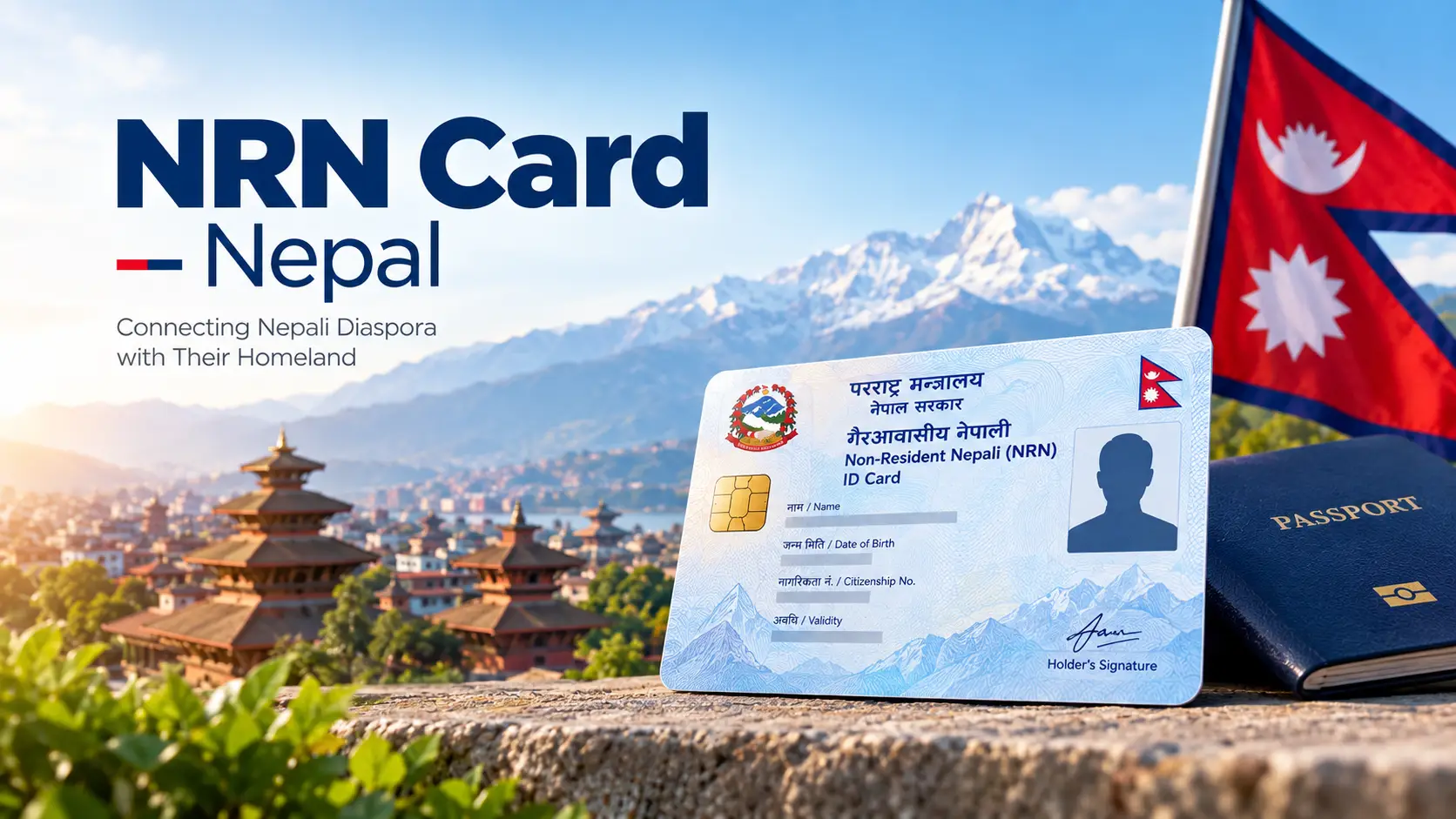
NRN Card Nepal — Non-Resident Nepali identity card application guide showing fees, documents and online apply process

Last updated: 19 September 2026 · Verified against the Ministry of Foreign Affairs, the official NRN portal (nrn.mofa.gov.np), and Nepali embassy fee schedules in Washington DC, London and Hong Kong.

If you are a Nepali living abroad — or a foreign citizen whose parents or grandparents were Nepali — the NRN Card is the single document that reconnects you legally to Nepal. It unlocks a free visa, the right to buy property, the right to open a foreign-currency bank account, and the right to invest and take your money back out.

The problem is that the information is scattered. The Ministry of Foreign Affairs publishes its fee schedule only in Nepali. Each embassy lists a different price in a different currency. And almost nobody tells you the two details that get most applications rejected: your renunciation certificate must already be issued, and your photo must be exactly 45 mm × 35 mm.

This guide puts all of it in one place, in English, with the 2026 numbers.

Key takeaways

  • Two categories: Foreign Citizen of Nepali Origin (card valid 10 years) and Nepali Citizen Residing Abroad (card valid 2 years).
  • Apply online first at nrn.mofa.gov.np — there is no paper-only route any more.
  • Fee in Nepal: NPR 1,500 registration + USD 500 or USD 250 (origin card, by country tier) or USD 50 (Nepali citizen abroad), paid in rupees at that day's NRB rate.
  • SAARC countries are excluded from both categories — India, Pakistan, Bangladesh, Sri Lanka, Bhutan, Maldives and Afghanistan.
  • Renouncing Nepali citizenship is mandatory for foreign citizens of Nepali origin, and the certificate must be in hand before you apply.
  • An NRN Card is not NRN Citizenship. They are two separate documents from two separate ministries.

What is the NRN Card?

The Non-Resident Nepali (NRN) Identity Card is an official identity document issued by the Ministry of Foreign Affairs (MOFA) in Kathmandu, or by any Nepali embassy or consulate general abroad. It formally recognises you as a Non-Resident Nepali under the Non-Resident Nepali Act, 2064 (2008) and the Non-Resident Nepali Rules, 2066 (2009).

Think of it as a diaspora status card rather than a travel document. It does not replace your passport and it does not let you vote. What it does is switch on a defined package of economic, social and cultural rights inside Nepal that ordinary foreign nationals do not get — chiefly a free visa, the ability to own land within set ceilings, and the ability to move investment capital in and profits out.

Important distinction: the NRN Card does not, by itself, give you the right to enter Nepal. Foreign citizens of Nepali origin still need a visa — the card simply makes that visa free (gratis) and long-term. Nepali citizens residing abroad never needed a visa in the first place; for them the card is about property, banking and investment rights.

Who is eligible — and who is not

The NRN Act splits applicants into exactly two categories. Which one you fall into decides your documents, your fee and your card's validity, so get this right before you start.

Category 1: Foreign Citizen of Nepali Origin (FCNO)

You qualify if you, or your father, mother, grandfather or grandmother was a citizen of Nepal at any time, and you have since acquired the citizenship of a foreign country that is not a SAARC member state.

  • Card validity: up to 10 years
  • Covers first, second and third generation applicants (you, your parent, or your grandparent was Nepali)
  • Renunciation of Nepali citizenship is compulsory

Category 2: Nepali Citizen Residing Abroad (NCRA)

You qualify if you still hold Nepali citizenship and have been living in a foreign country for at least two years, engaged in a profession, occupation, business or employment.

  • Card validity: up to 2 years
  • You keep your Nepali citizenship and passport
  • Much cheaper and much simpler than the FCNO card

Who is excluded

This is where competitor guides tend to go quiet. The law explicitly rules out several groups:

  • Residents of SAARC countries — India, Pakistan, Bangladesh, Sri Lanka, Bhutan, the Maldives and Afghanistan. This applies to both categories.
  • Nepali diplomats and consular staff posted abroad on a Government of Nepal assignment.
  • Students studying at an academic institution abroad — time on a student visa does not count toward the two-year requirement.
  • Children of a Nepali-origin mother and a non-Nepali father. The Embassy of Nepal in Washington DC states directly that such a child is not eligible for an NRN ID card. This is a live grievance in the diaspora and it is worth knowing before you pay any fee.

How to get an NRN Card?

Regardless of where in the world you are, the process follows the same three legal steps set out in the NRN Rules:

  1. Register as an NRN. Submit an application with the prescribed registration fee to the competent authority — the head of the Nepali embassy or consulate if you are overseas, or the Secretary of the Ministry of Foreign Affairs if you are in Nepal.
  2. Pay the card fee. Once your registration is approved, pay the separate identity card fee, which varies by category and by the country of your passport.
  3. Collect your card. The authority prints and issues the NRN Identity Card, either over the counter or by post.

In practice, step one now begins online for everyone. The rest of this guide walks through each stage.

Where should you apply — Nepal or abroad?

If you apply…AuthorityTypical processing timeBest for
In NepalMOFA, Singha Durbar (Room 314)Often same dayAnyone visiting Nepal with complete documents
Hong KongConsulate General of Nepal3 working days + 1 day to printHK and Macao residents
LondonEmbassy of Nepal, UKSame day in person; up to 7 working days by postUK residents
Washington DCEmbassy of Nepal, USA10–15 business daysUS residents (check your consulate's jurisdiction)

Jurisdiction matters. In the United States you must apply to the embassy or consulate that covers your state of residence — you cannot simply walk into Washington DC because you happen to be visiting. If you do want to apply outside your jurisdiction, email the mission in advance and get written confirmation first.

How to apply for an NRN card online?

Every NRN application now starts at the government's dedicated portal: nrn.mofa.gov.np. There is no alternative paper-first route, and missions will turn you away if you have not submitted online.

  1. Open the portal and sign up. Go to nrn.mofa.gov.np and create an account. You will see two separate forms — Foreign Citizen of Nepali Origin and Nepali Citizen Residing Abroad. Choose carefully; picking the wrong one means restarting.
  2. Select the correct issuing office. The form asks which office will process your application. Choose the embassy or consulate covering your residence, or select the MOFA Labour Migration and Nepali Diaspora Coordination Division if you intend to apply in Kathmandu.
  3. Fill in your personal details. Enter names exactly as they appear on your passport. A mismatch between your foreign passport and your old Nepali citizenship certificate is the single most common cause of delay — if the spelling differs, be ready to explain it.
  4. Upload your documents. Every supporting document must be uploaded in the required format and dimensions. Oversized or wrongly sized files are rejected by the system itself, not by a human, so you will not always get a clear error message.
  5. Upload your photo and signature. The photo must be a recent passport-size image at 45 mm × 35 mm (400 × 300 pixels). The signature should be signed on plain white paper and scanned.
  6. Submit and print. Submit the form, then print the completed application and sign it by hand. This signed printout is part of your physical file.
  7. Notify your mission. Online submission alone does not start the clock. Email your embassy or consulate to tell them the application is in — Hong Kong, for example, asks applicants to email the consulate directly after submitting.
  8. Submit the physical file and pay. Mail, drop off or hand-deliver the printed application with your self-attested document copies and the fee. Then collect the card, or receive it in your prepaid return envelope.

There is no online payment. This catches almost everyone. The portal handles your application, not your fee. Missions require a cashier's cheque, money order, or in-person card payment; in Nepal, you pay through a bank voucher at Rastriya Banijya Bank. Budget time for this step.

Self-attesting your copies

Most missions require every photocopy to be self-attested: write "True Copy" on the back of each page, sign it, and date it. An unsigned or un-attested file is returned without being processed.

How to make an NRN card in Nepal (the MOFA route)

If you are already in Kathmandu, applying directly at the Ministry of Foreign Affairs is usually the fastest option in the world — MOFA aims to issue the card the same day when the file is complete. But the building is inside Singha Durbar, a restricted government compound, so you cannot simply walk in.

  1. Complete the online form first at nrn.mofa.gov.np and prepare your original documents.
  2. Call ahead on 01-4211121 to book a convenient time with the NRN Desk. This is not optional — it is how you get into the compound.
  3. Give your entry details. Provide your full name, the district that issued your citizenship, your address, and your vehicle number if you are driving. MOFA forwards this to Counter No. 1 at the Singha Durbar south gate.
  4. Collect your entry pass at Counter No. 1, south gate, on the appointed day. You will need to leave an ID (citizenship or driving licence) at the gate and collect it on your way out.
  5. Register at reception inside MOFA, then go to the NRN Desk, Room 314, third floor (east side), under the Policy, Planning, Development Diplomacy and Nepali Diaspora Division.
  6. Document check and approval. If your file is complete, it goes to the Secretary's office on the second floor for approval.
  7. Get your payment voucher. Take the approval to the Financial Administration Section, Room 226, second floor, and collect a revenue voucher.
  8. Pay at the bank. Deposit the amount at the Rastriya Banijya Bank branch inside the Singha Durbar compound, near the television tower (opposite the Ministry of Information and Communication).
  9. Return with the original voucher to the division. Your card is printed and issued — usually the same day, unless the ministry needs to verify something further.

Bring originals, not just copies. For foreign citizens of Nepali origin, the original citizenship renunciation document must be produced. The ministry keeps the photocopy and hands the original back to you after inspection.

Non-Resident Nepali (NRN) Identity Card: NRN Identity Card vs NRN Citizenship

This is the most confused topic in the entire NRN space, and it is the biggest gap in every competing article we reviewed. The NRN Identity Card and NRN Citizenship are two different documents, issued by two different ministries, under two different laws. Having one does not automatically give you the other.

FeatureNRN Identity CardNRN Citizenship
Governing lawNon-Resident Nepali Act, 2064 & Rules, 2066Constitution of Nepal, Article 14; Nepal Citizenship Act, 2063 (Section 7A) and its amendment Regulations
Issued byMinistry of Foreign Affairs, or Nepali embassies/consulates abroadDistrict Administration Office (DAO/CDO), under the Ministry of Home Affairs
What it isAn identity and benefits card for diaspora NepalisA limited, non-political citizenship status
Who can applyForeign citizens of Nepali origin, and Nepali citizens abroad 2+ yearsOnly foreign citizens of Nepali origin (non-SAARC)
Validity10 years (FCNO) or 2 years (NCRA), renewableA citizenship certificate — no fixed expiry
Voting rightsNoNo
Public office / civil service / army / judiciaryNoNo — explicitly excluded
Nepali passportNoNo
Visa needed to enter NepalYes, but free (gratis) while the card is validHolders are entitled to a free multi-entry residential visa
Where to applyOnline at nrn.mofa.gov.np, then the mission or MOFAIn person at the DAO of your (or your ancestor's) home district
Typical timelineSame day (Nepal) to 15 business days (US)Roughly 10–15 working days at the DAO

How the two documents relate

In practice the NRN Identity Card functions as the gateway document. Most DAOs expect to see an NRN ID card (or at least evidence you qualify for one) when you apply for NRN citizenship, and your copy of the card is listed among the supporting documents.

The NRN citizenship route typically requires you to:

  • Formally renounce your Nepali citizenship at the DAO and obtain the renunciation certificate
  • Get a recommendation letter from your local Ward Office confirming your Nepali origin
  • Have the DAO forward your file to the police for a background check
  • Bring a close relative who holds valid Nepali citizenship to appear in person at the DAO and verify your identity
  • Submit your foreign passport, foreign citizenship certificate, your (or your parents'/grandparents') Nepali citizenship copies, photographs and the application form

Embassies cannot issue NRN citizenship. The Embassy of Nepal in Washington DC confirms that missions are not currently authorised to issue it, and directs applicants to their District Administration Office in Nepal instead. There is a legal provision to apply via a mission, but in practice almost every applicant is told to come to Nepal. Plan a trip.

And a point no guide should skip: Nepal does not permit full dual citizenship. A Nepali who voluntarily acquires foreign citizenship loses their Nepali citizenship automatically. NRN citizenship is the narrow, non-political exception that lets you hold a foreign passport alongside a Nepali identity — it is a bridge, not dual nationality.

NRN Card benefits

Here is what the card actually buys you, grouped by what people use it for.

1. Free, long-term visa

  • Foreign citizens of Nepali origin receive a gratis tourist visa on arrival at the airport, for a number of days set by the Department of Immigration.
  • That visa is then converted to an NRN visa by applying to the Non-Tourist Visa Section of the Department of Immigration, extendable for a maximum of one year at a time.
  • Both the arrival visa and the extension are free of charge for as long as the NRN card is valid — effectively ten years of free visas for FCNO holders.
  • Nepali citizens residing abroad need no visa at all; their card is about the economic rights below.

The card is not a visa. An NRN card holder still cannot legally remain in Nepal without obtaining the NRN visa. The card waives the fee; it does not waive the requirement. Overstaying on the strength of the card alone will land you in trouble at departure.

2. The right to buy property in Nepal

Foreign citizens of Nepali origin may purchase land or immovable property for residential use by themselves or their family, within a strict ceiling that depends on location:

#LocationMaximum areaApprox. in square metres
1Inside Kathmandu Valley2 Ropani~1,017 m²
2Municipalities in the Terai8 Kattha~2,709 m²
3Municipalities in other districts (outside the Valley and Terai)4 Ropani~2,035 m²
4Rural municipalities in the Terai1 Bigha~6,773 m²
5All other areas10 Ropani~5,087 m²
  • The ceiling applies to one location only — you choose which category applies, you do not get all five.
  • Exception: the ceiling does not apply to land you already acquired while you were still a Nepali citizen.
  • Inheritance is separate. A foreign citizen of Nepali origin can inherit ancestral property from Nepali citizens without government approval — but you must hold an NRN ID card to do so.
  • You must apply to MOFA for a land-purchase recommendation. There is no fee for this recommendation, and MOFA generally issues it within one week.

A limitation nobody advertises: the Embassy of Nepal in Washington DC states that while an NRN ID card allows you to purchase property in Nepal, it may not permit you to transfer or sell that land. If your plan is to buy and later flip, get specific legal advice before you commit capital.

3. Banking and money

  • Open and operate an account in convertible foreign currency at any Nepali commercial bank or financial institution, for income earned abroad.
  • Repatriate your investment and the profits earned on it back out of Nepal.

4. Investment rights

  • NRNs are treated as foreign investors under the Foreign Investment and Technology Transfer Act, 2019 (FITTA) and may invest in convertible currency.
  • Permitted forms include equity shares, reinvestment of profits, lease finance, venture capital funds, listed stocks via the secondary market, acquisition of shares or assets in a Nepali company, technology transfer, and establishing or expanding an industry.
  • The conditions: a minimum of NPR 50 million in equity shares, a sector that is not on FITTA's Negative List, and a business that qualifies as an "Industry" under the Industrial Enterprises Act, 2020.

5. Social and civil rights

  • Marry in Nepal under the National Civil Code.
  • Apply to reacquire Nepali citizenship by relinquishing your foreign citizenship.
  • Formal recognition of your Nepali origin for schools, institutions and cultural participation.

What the NRN Card does NOT give you

  • No voting rights and no right to stand for election.
  • No appointment to the civil service, security forces, judiciary or constitutional bodies.
  • No Nepali passport.
  • No automatic right of entry — you still take the (free) visa.
  • No dual citizenship.

Planning to manage property, taxes or a business remotely? Your NRN card pairs with Nepal's other digital identity services. If you hold Nepali citizenship, it is worth also sorting out your National ID (NID) card status and downloading your eNID while you are in Nepal — both are now required for a growing list of government and banking services.

What are the documents required?

The list differs sharply between the two categories. Prepare the correct one.

For a Foreign Citizen of Nepali Origin

  1. Completed online application form, printed and signed by hand.
  2. Proof of your current foreign citizenship — naturalisation certificate, citizenship certificate, or a birth certificate if you were born in that country.
  3. Copy of your valid foreign passport.
  4. Original certificate of renunciation of Nepali citizenship, plus a photocopy. This is mandatory and non-negotiable.
  5. Proof of Nepali origin, one of:
    • Your own former Nepali citizenship certificate, minor certificate or birth certificate (first generation)
    • Your father's or mother's Nepali citizenship certificate (second generation)
    • Your grandfather's or grandmother's Nepali citizenship certificate, plus a document proving the relationship (third generation)
  6. Proof of profession, business or employment abroad — business registration documents, or an employment letter and income details.
  7. Recent passport-size photographs. MOFA in Nepal asks for three; missions abroad typically ask for two, uploaded at 45 mm × 35 mm (400 × 300 px).
  8. Your signature, email address and local phone number on plain white paper (for mission applications).
  9. Payment instrument — cashier's cheque or money order for postal submissions, or a debit/credit card in person.
  10. Self-addressed prepaid return envelope with tracking, if you want the card mailed back.

For a Nepali Citizen Residing Abroad

  1. Completed online application form, printed and signed.
  2. Copy of your Nepali citizenship certificate.
  3. Copy of your Nepali passport (the biographic data page of a valid passport).
  4. Copy of your residence permit — Green Card, PR card or equivalent, if applicable.
  5. Proof of address — any official document showing your current overseas address.
  6. Proof of business or employment in your country of residence.
  7. Appointment letter and current employment confirmation, if you work for an international organisation or agency.
  8. Passport-size photographs — three for MOFA in Nepal, typically two abroad.
  9. Your signature, email and phone number on plain white paper.
  10. Self-addressed prepaid return envelope, if applying by post.

Document tip: gather your parents' or grandparents' citizenship certificate numbers and issuing districts, not just the photocopies. MOFA's own guidance specifically asks for the certificate number and district, which means someone in Nepal may need to pull the record. Ask a family member to retrieve this before you travel.

NRN Card fee in Nepal

The fee structure is genuinely confusing because it comes in two parts, and because the card fee depends on which passport you hold, not where you currently live. Here is the official MOFA schedule.

Part 1: Registration fee

A flat NPR 1,500 is charged when you submit the application to register your name as an NRN. Everyone pays this.

Part 2: Identity card fee (also charged on renewal)

CategoryCountry of your passportOfficial feeApprox. NPR*
Foreign Citizen of Nepali OriginEurope, North America, South America, Australia and the countries of that continent, New Zealand, Japan and South KoreaUSD 500~NPR 75,800
All other countriesUSD 250~NPR 37,900
Nepali Citizen Residing AbroadAny countryUSD 50~NPR 7,600

*Indicative only. The fee is payable in Nepali rupees at the Nepal Rastra Bank exchange rate fixed for the day you pay. NRB's published rate in early September 2026 was around NPR 151.66 per USD. Always check nrb.org.np/forex on the day.

Where to deposit the fee in Nepal

  • Bank: Rastriya Banijya Bank, Singha Durbar branch (near the television tower, opposite the Ministry of Information and Communication)
  • Nepal Rastra Bank account no.: 1000200010000
  • Office code no.: 326003501
  • Revenue heading no.: 14529

NRN card fee at Nepali missions abroad

Missions convert the same USD schedule into local currency and add the registration component, so the numbers look different but the underlying logic is identical.

MissionForeign Citizen of Nepali OriginNepali Citizen Residing AbroadNotes
Embassy of Nepal, Washington DCUSD 520USD 70Debit card adds 2% + 25¢; credit card adds 3%. No online payment.
Consulate General, Hong KongHKD 4,050 (British passport)HKD 2,110 (HKSAR passport)Reflects the USD 500 vs USD 250 country tiers.
Embassy of Nepal, LondonGBP 365—Same fee applies to renewal.

The insight most guides miss: notice that Hong Kong charges British passport holders roughly double what it charges HKSAR passport holders. That is not a Hong Kong policy — it is the MOFA country-tier rule showing through. Your fee is set by the passport you carry. A Nepali-origin Canadian living in Dubai pays the USD 500 tier; a Nepali-origin Malaysian pays USD 250.

Renewal, lost cards and replacements

Renewing your NRN card

  • Renewal requires the full set of documents needed for a new card, plus your original, unexpired NRN identity card.
  • Foreign citizens of Nepali origin must again attach the citizenship renunciation document.
  • The renewal fee is identical to the new-card fee. There is no discount for renewing.
  • Start at least three months before expiry. An expired card generally means starting a fresh application with full documentation.

If your card is lost or damaged

  • You may reapply, but you must submit everything required for a new card, plus a police report about the loss.
  • The fee is doubled. In Washington DC that means USD 1,040 for an origin card and USD 140 for a Nepali-citizen card.
  • Missions also ask for a copy of the lost or damaged card and a self-declaration letter stating it was lost.

Photograph both sides of your NRN card the day you receive it and store the image in your cloud drive. A copy of the lost card is a required document for replacement — and doubling a USD 500 fee because you had no copy is an expensive lesson.

Mistakes that get NRN applications rejected

Having walked several family members and clients through this — including one file that came back twice from Washington DC before it cleared — these are the failures we see over and over. None of them appear on the official pages.

  • Applying before your renunciation certificate is issued. This is the number one rejection. Submitting your renunciation application and handing over your original citizenship certificate is not enough. The Embassy of Nepal in Washington DC states plainly that the issued certificate is mandatory before you can apply for the NRN ID. Expect this to add weeks to your timeline, and sequence it first.
  • Photo dimensions. 45 mm × 35 mm at 400 × 300 pixels is not the same as a US or UK passport photo. A standard 2×2 inch American photo will be rejected by the portal's uploader, often with no useful error. Get it resized before you start.
  • Name mismatches. Nepali names get transliterated differently on foreign passports than on old citizenship certificates — "Shrestha" versus "Shresth", middle names dropped, surnames swapped. If yours differ, prepare a short covering note and any supporting document that bridges the two spellings.
  • Forgetting to email the mission. Several consulates only begin verification after you notify them that the online form is submitted. Applicants routinely wait weeks assuming the portal notified someone. It often does not.
  • Missing the "True Copy" attestation. Files are returned unprocessed if copies are not self-attested and signed. It takes five minutes and saves a round trip in the post.
  • Assuming you can pay online. There is no online payment anywhere in this process. Arrange a cashier's cheque or money order in advance, or plan an in-person visit.
  • Arriving at Singha Durbar without calling first. You will not get past the gate. Call 01-4211121 and book, and have your citizenship district and vehicle number ready.
  • Counting student years toward the two-year rule. Time spent studying abroad does not qualify you as a Nepali Citizen Residing Abroad. You need profession, occupation, business or employment.

Practical sequencing that works: renounce citizenship first → wait for the certificate → gather ancestral citizenship numbers from family in Nepal → resize the photo → submit online → email the mission → arrange payment → submit the physical file. Treat it as a two-to-three month project, not a two-week one.

Related identity and compliance services in Nepal

An NRN card rarely sits alone. Most people who get one are also managing property, tax or travel paperwork in Nepal at the same time:

Frequently asked questions about the NRN Card

How long is an NRN card valid?

Up to 10 years for a foreign citizen of Nepali origin, and up to 2 years for a Nepali citizen residing abroad. Both are renewable, and renewal costs the same as a new card.

Do I have to give up my Nepali citizenship to get an NRN card?

Only if you are applying as a foreign citizen of Nepali origin — Nepali law requires you to have renounced Nepali citizenship, and the issued renunciation certificate must be submitted. If you are applying as a Nepali citizen residing abroad, you keep your citizenship and passport.

Can I get an NRN card if I live in India or another SAARC country?

No. Both NRN categories explicitly exclude SAARC member states — India, Pakistan, Bangladesh, Sri Lanka, Bhutan, the Maldives and Afghanistan.

Can NRN card holders vote in Nepali elections?

No. Neither the NRN identity card nor NRN citizenship grants political rights. There is no voting, no standing for office, and no appointment to the civil service, security forces, judiciary or constitutional bodies.

How much land can an NRN buy in Nepal?

Within one of these ceilings, for residential use: 2 Ropani inside Kathmandu Valley, 8 Kattha in Terai municipalities, 4 Ropani in municipalities of other districts, 1 Bigha in Terai rural municipalities, or 10 Ropani elsewhere. The ceiling does not apply to land acquired while you were still a Nepali citizen.

Is there any fee for the MOFA land purchase recommendation?

No. MOFA charges no fee for the land-purchase recommendation, and the recommendation is generally issued within one week.

How long does it take to get an NRN card?

It depends entirely on where you apply. MOFA in Kathmandu aims for same-day issuance when the file is complete. Hong Kong takes about 3 working days for approval plus 1 day to print. London is same-day in person, up to 7 working days by post. Washington DC takes 10–15 business days.

Can I apply for an NRN card from inside Nepal?

Yes. Apply online at nrn.mofa.gov.np and select the Ministry of Foreign Affairs (Labour Migration and Nepali Diaspora Coordination Division) as your office, then visit the NRN Desk in Room 314 at Singha Durbar after calling 01-4211121 to book.

My mother is Nepali and my father is a foreign national. Can my child get an NRN card?

Under current practice, no. The Embassy of Nepal in Washington DC states that a child of a Nepali-origin woman married to a non-Nepali foreign national is not eligible for an NRN ID card. This remains a contested point in the diaspora, so check with your mission before spending on fees.

Can I sell land in Nepal using my NRN card?

The NRN card allows you to purchase property, but the Embassy of Nepal in Washington DC notes it may not permit you to transfer or sell that land. Take specific legal advice before buying with an exit in mind.

What happens if I lose my NRN card?

You reapply with the full set of documents for a new card, plus a police report about the loss, a copy of the lost card and a self-declaration letter — and you pay double the standard fee.

Is the NRN card the same as NRN citizenship?

No. The NRN card is issued by the Ministry of Foreign Affairs under the NRN Act, 2064. NRN citizenship is issued by a District Administration Office under the Ministry of Home Affairs, based on Article 14 of the Constitution and the Nepal Citizenship Act, 2063. The card is generally treated as the gateway document for the citizenship application.

Can I pay the NRN card fee online?

No. There is no online payment service anywhere in the process. In Nepal you pay via a bank voucher at Rastriya Banijya Bank inside Singha Durbar; abroad, missions accept cashier's cheques, money orders or in-person card payments.

Final word

The NRN Card is one of the better-value documents the Government of Nepal issues. For a Nepali citizen living abroad, USD 50 buys two years of property, banking and investment rights. For a foreign citizen of Nepali origin, USD 500 buys a decade of free visas and the legal standing to own land in the country your family came from.

The friction is administrative, not legal. Get the renunciation certificate first, size your photo correctly, collect your ancestors' citizenship numbers, and email your mission after you submit. Do those four things and the rest of the process is largely paperwork.

Sources

Disclaimer: This article is for general information only and is not legal advice. Government fees, forms and procedures change. Always confirm current requirements with the Ministry of Foreign Affairs or the Nepali embassy or consulate with jurisdiction over your place of residence before submitting an application or paying any fee.

Social Security Fund (SSF) Nepal: Complete Guide 2026

Complete Guide to Social Security Fund (SSF) Nepal: Registration, Contribution Rates and Benefits (2026 / 2082-83)

Last updated: 17 September 2026  |  Reviewed against: Contribution Based Social Security Act 2074, Social Security Regulations 2075, and the 5th amendment to the Social Security Scheme Operation Procedure (effective Baisakh 1, 2082).

Complete guide to Social Security Fund (SSF) Nepal showing contribution rates, registration process and benefits
SSF Nepal at a glance — 31% of basic salary, four protection schemes, one social security number for life.

If you receive a salary in Nepal, there is an 11% line on your payslip that most people never question. If you run a company here, there is a 20% cost sitting on top of every basic salary you pay. Both go to the same place: the Social Security Fund (SSF), or Samajik Suraksha Kosh — Nepal's national contribution-based social security scheme.

The Fund is no longer a pilot programme. By the end of Ashad 2082/83, SSF had crossed 3,043,200 registered contributors and 23,490 registered employers, with total collections of NPR 116.71 billion and claims paid out of NPR 21.27 billion. It is now the single most consequential statutory obligation a Nepali employer carries after salary itself.

This guide covers what SSF actually is, exactly who must register, what the 31% buys you, how to register step by step, and — the part most articles skip — the deadlines, penalties and 2082/83 rule changes that decide whether your contributions are compliant or quietly accruing interest.

SSF Nepal — Key Facts at a Glance

  • Total contribution: 31% of basic salary — 11% employee + 20% employer
  • Legal basis: Contribution Based Social Security Act, 2074 (2017); operational since 22 May 2019
  • Who must register: Every employer in Nepal — no minimum employee threshold
  • Schemes: Medical & maternity · Accident & disability · Dependent family · Old-age pension
  • Portal: ssf.gov.np (employer system: sosys.ssf.gov.np)
  • Pension eligibility: Age 60 + at least 180 months (15 years) of contribution
  • Registration cost: Free — there is no government fee

What is the Social Security Fund (SSF) Nepal?

The Social Security Fund is a government-managed, contribution-based insurance and pension system established under the Contribution Based Social Security Act, 2074 (2017) and operated by the Social Security Fund Management Board under the Ministry of Labour, Employment and Social Security. Mandatory contributions for the formal private sector began on 22 May 2019.

The simplest way to understand it: SSF replaced a fragmented mess. Before it existed, a Nepali employee's protection was scattered across a provident fund account at Karmachari Sanchaya Kosh, a gratuity accrual sitting on the employer's books, a group medical policy if the company felt generous, and an accident policy if it felt very generous. Each had a different administrator and a different claim process, and the gratuity often evaporated when a company shut down.

SSF folds all of that into one fund, one monthly deposit and one social security number (SSN) that follows you for life — through every job change, and now even across borders.

The four protection schemes

  • Medical Treatment, Health and Maternity Protection — hospitalisation, OPD, sick pay, maternity
  • Accident and Disability Protection — workplace and non-workplace accidents, disability pension
  • Dependent Family Protection — spouse pension, children's education allowance, funeral grant
  • Old-Age Protection — monthly pension after 60, plus a lump-sum retirement fund

The Act also contemplates an unemployment protection scheme, which has not yet been brought into operation. Any article telling you that you can claim unemployment benefit from SSF today is ahead of the law.

Who Must Register for SSF in Nepal?

This is where most confusion — and most non-compliance — starts. The rule is far broader than people assume.

Section 7 of the Act requires every employer operating in Nepal to register with the SSF. Registration is not conditional on headcount, sector, profit status or contract type. An employer with a single employee on a three-month contract carries exactly the same obligation as a company with 400 permanent staff.

Correcting a widespread myth: you will find blogs and even payroll vendors claiming SSF is mandatory only for businesses with 10 or more employees. There is no such threshold anywhere in the Act. If you have one employee, you must register. The "10 employees" figure appears to be borrowed from an unrelated Labour Act provision and has been copied from site to site ever since.

Under Section 8, the employer — not the employee — must enrol each worker within three months of their appointment date. That is a hard deadline, not a guideline. Employees cannot opt out, and an employee who says "please just pay me the cash instead" cannot waive the obligation on the employer's behalf.

Mandatory vs voluntary participation

CategorySSF RequirementNotes
Private-sector employersMandatoryAll registered companies, regardless of size or headcount
Formal-sector employeesMandatoryFull-time, part-time, contract, and temporary workers
Public enterprisesMandatoryGovernment-owned corporations and entities
NGOs and INGOsMandatoryAll organisations with at least one employee
Self-employed and freelancersVoluntaryCan join and make their own contributions
Informal-sector workersVoluntaryDomestic workers, daily-wage labourers
Migrant workers (NRNs)VoluntaryNepali citizens abroad can continue contributing
Gig workersVoluntaryEligible from FY 2082/83 updates

What about government employees?

Here is a detail that most SSF articles on the first page of Google still have wrong. The old line — "government staff use a separate pension system, SSF is only for the private sector" — is out of date. From FY 2082/83, newly appointed civil servants are being brought under the contribution-based system rather than the traditional non-contributory pension and gratuity arrangement. Employees already in pensionable service continue under the old scheme.

If you joined government service recently and assumed SSF does not concern you, check your appointment terms — the answer now depends on your appointment date, not on your sector.

Foreign nationals working in Nepal

Foreign employees working for a Nepal-registered employer are also enrolled. The practical difference is on the way out: a foreign national may withdraw the retirement-fund portion once their employment in Nepal ends, without waiting until age 60.

Why You Should Register for SSF?

Most people read the 11% deduction as money taken away. That framing is what makes SSF feel like a tax. Look at it from the other side: for your 11%, your employer is legally required to add 20% on top. Nowhere else in your financial life does someone add NPR 2,000 every time you set aside NPR 1,100.

For employees

  • Roughly triple value on your own money. On a basic salary of NPR 30,000, you contribute NPR 3,300 and NPR 9,300 lands in the fund.
  • Medical cover from month three. Up to NPR 100,000 per year of hospitalised treatment, with a separate critical-illness cover reported at up to NPR 10 lakh over a lifetime.
  • Accident cover from day one. Employment accidents are covered in full with no monetary ceiling; non-employment accidents up to NPR 7,00,000.
  • Your family is insured. If you die while contributing, your spouse receives a lifetime pension of 60% of your last basic salary — an outcome no provident fund balance can replicate.
  • Portability. Your SSN stays with you across every employer. There is no "settling" a balance and starting fresh.
  • Two separate tax advantages that almost nobody claims deliberately (see below).

Content gap — the tax angle competitors skip entirely. SSF gives you two distinct tax benefits, not one. First, a contributor is exempt from the 1% Social Security Tax charged on the first income band, because the 11% deduction already contains a 1% social security tax component routed to the Fund. Second, SSF contributions qualify as deductible retirement contributions up to the lowest of: the actual contribution, NPR 500,000 a year, or one-third of assessable income — a materially higher ceiling than the NPR 300,000 limit that applies to an ordinary approved retirement fund. For a mid-to-senior salary in Kathmandu, that difference alone is worth tens of thousands of rupees a year. Our finance section covers how this interacts with Nepal's income tax slabs.

For employers

  • It replaces, not adds to, your old obligations. The employer's 20% already contains the 10% that used to go to PF plus the 8.33% gratuity accrual. Enrolled employers do not run both.
  • The 20% is a deductible business expense, and the gratuity liability comes off your balance sheet as a future obligation and becomes a predictable monthly cost.
  • Company renewal and tendering. In practice, proof of SSF compliance is increasingly requested during business renewals, tenders and due diligence. Non-compliance is no longer just a labour issue — it blocks transactions.
  • Accident liability transfers to the Fund — but only if your deposits are current. See the Section 9(6) warning below.
  • Retention. For skilled staff in Kathmandu's competitive market, "we are SSF-registered" has become a baseline expectation rather than a perk.

SSF Contribution Rates in Nepal (2082/83)

Both employers and employees contribute monthly to the SSF based on the employee's basic salary. The total contribution rate is 31%, split between employer and employee.

ContributorRateOn Basic Salary of NPR 30,000
Employee contribution11%NPR 3,300
Employer contribution20%NPR 6,000
Total monthly contribution31%NPR 9,300

The single most common payroll error in Nepal: calculating SSF on gross salary. SSF is charged on basic only. If basic is NPR 30,000 and allowances add another NPR 10,000, the contribution is 31% of 30,000 — not of 40,000. Get this wrong and the error compounds every month until somebody reconciles the statement, usually years later when an employee claims.

Where the 31% actually comes from

Paid byHeadingRate of basic salary
EmployeeProvident fund10%
EmployeeSocial security tax1%
EmployerProvident fund10%
EmployerGratuity8.33%
EmployerAdditional contribution1.67%
Total monthly contribution to SSF31%

How the 31% is allocated across the four schemes

Content gap — the allocation changed in 2082 and most guides never updated. Nearly every SSF article still publishes the original split (1% / 1.4% / 0.27%). The 5th amendment to the Social Security Scheme Operation Procedure, applied from Baisakh 1, 2082, revised the protection-scheme allocations. Here is the before-and-after:

SchemeOriginal allocationRevised (from Baisakh 1, 2082)
Medical treatment, health & maternity1.00%1.20%
Accident & disability protection1.40%0.80%
Dependent family protection0.27%0.67%
Old-age protection28.33%28.33%
Total31%31%

Note what this tells you about the system's design: over 91% of your contribution is your own retirement money. The old-age share of 28.33% is itself made of two parts — a Pension Fund (20%) that pays a monthly pension from age 60, and a Retirement Fund (8.33%, the old gratuity) that can be taken as a lump sum when employment ends. Less than 3% of your salary buys the medical, accident and family insurance layered on top. That is why describing SSF as "just a deduction" misses what it is: a retirement fund with four insurance policies attached.

Salary ceiling

Contributions are not unlimited. For FY 2082/83 the contributable salary ceiling was raised to NPR 350,000 per month (up from NPR 300,000). If basic salary exceeds that, the 31% applies only up to the ceiling. For the vast majority of Nepali employees this cap never comes into play, but senior executives and their payroll teams should confirm the current figure on the portal before finalising structures.

SSF Benefits and Schemes Explained

1. Medical Treatment, Health and Maternity Protection Scheme

After contributing for a minimum of 3 consecutive months, employees can access medical benefits. For maternity benefits, a minimum of 12 months of contributions is required.

Benefit TypeAnnual LimitCo-payment
Hospitalised treatment (IPD)Up to NPR 100,00020% borne by employee
Non-hospitalised treatment (OPD)Up to NPR 25,00020% borne by employee
Combined maximum per yearNPR 100,000—
Maternity leave salary60% of basic payFor extended leave period
Maternity care coverageAs per scheme limitsFor contributor or spouse

Three details worth knowing, because they are where claims go wrong:

  • Sick pay is separate from the NPR 100,000 cap. If your illness exceeds the paid sick leave your employer owes under the Labour Act, SSF pays 60% of basic salary for the unpaid portion, subject to scheme limits.
  • Maternity is two different claims. The treatment element (delivery-related medical care) and the cash element (60% of basic for leave beyond the employer-paid 60 days, up to 98 days total) are claimed separately with different documents. Mixing them up is one of the most common causes of partial settlement.
  • There is a newborn grant. A contributor — or the wife of a male contributor — is entitled to a cash benefit equal to one month's minimum remuneration per newborn. Where both spouses contribute, only one may claim.
  • Cover survives your job by three months. Medical protection remains effective for a period after contributions stop, which matters if you change jobs.

2. Accident and Disability Protection Scheme

This is the only scheme with no waiting period — cover begins from the date of enrolment.

  • Employment accidents: treatment costs covered in full, with no upper ceiling.
  • Non-employment accidents: covered up to NPR 7,00,000.
  • Permanent total disability: a monthly pension, which the rules require not to fall below 60% of the government's prescribed minimum basic salary, with adjustments based on assessed disability level.
  • Reporting window: accidents must be reported to the Fund promptly — do not let paperwork drift while someone recovers.

3. Dependent Family Protection Scheme

If a contributor dies, the family receives:

  • Spouse: lifetime monthly pension of 60% of the contributor's last basic remuneration (conditional on not remarrying)
  • Children: education allowance of 40% of basic remuneration, for up to two children, until 18 (extended while studying under scheme conditions)
  • Funeral expenses: a lump-sum grant

Nominee ≠ legal heir. The person you nominate on the SSF portal and the person the law recognises as your heir can be two different people, and families discover this at the worst possible moment. Review your nomination whenever you marry, have a child, or lose a parent.

4. Old-Age Protection Scheme

The largest share — 28.33% — and the one with the strictest rules:

  • Pension Fund (20%): monthly pension from age 60, provided you have at least 180 months (15 years) of contribution. Where a lump sum is not chosen, the monthly pension is calculated by dividing the accumulated pension amount by 160.
  • Retirement Fund (8.33%): payable as a lump sum when employment ends — this is the portion you can access before 60.
  • Pension amounts are subject to periodic review based on actuarial assessment.

The retirement-age trap nobody mentions. The Labour Act sets the retirement age at 58. SSF pension is payable only from 60. That is a two-year gap between the day you must stop working and the day your pension can start. If you are planning your exit, plan for those 24 months — the retirement-fund lump sum is usually what bridges them.

How can you do it step by step?

The full process has two halves: the employer registers the company, then enrols each employee. Employees do not register themselves for the formal-sector scheme — if you are an employee waiting to "sign up", you are waiting for something that will never happen. Push your employer instead.

Step 1: Employer Registration

The employer must first register on the official SSF portal at ssf.gov.np. The process is entirely online with no requirement for physical document submission and no government registration fee.

Documents required for employer registration

DocumentDetails
Company registration certificateIssued by Office of Company Registrar
PAN/VAT certificateFrom Inland Revenue Department
Shareholder/proprietor detailsCitizenship copies of directors
Authorised person detailsLetter of authorisation + citizenship
Company bank account detailsAccount number and bank name

Step 2: Employee Enrolment

Once the employer registration is approved and an Employer Registration Number (ERN) is issued, each employee is added through the portal. Every employee receives an 11-digit Social Security Number (SSN), which stays with them permanently — across jobs, across employers, across career breaks.

Documents required for employee registration

DocumentDetails
Citizenship certificateNepali citizenship (nagarikta)
Passport-size photographRecent photograph
Employment contract/appointment letterSigned by employer
Bank account detailsFor benefit disbursement
Basic salary informationAs per employment contract

The full sequence, start to finish


  1. Create the employer account

    Register the company at ssf.gov.np with PAN/VAT, company registration details and an authorised contact person. Verification typically takes a few working days depending on document completeness.


  2. Receive your ERN and log in

    Once approved, you receive employer credentials for the online system (sosys.ssf.gov.np) where all ongoing work happens.


  3. Add each employee and collect SSNs

    Enter employee details, citizenship information, appointment date and basic salary. Do this within three months of each appointment. New joiner already has an SSN from a previous employer? Use the existing number — never create a second one.


  4. Generate the monthly contribution statement

    Run payroll, calculate 31% of each employee's basic, and generate the contribution statement in the portal for that Nepali month.


  5. Pay the total 31%

    Deposit both shares together via ConnectIPS, eSewa, Khalti, Fonepay, partner-bank online banking, or over the counter at a listed bank.


  6. Upload the payment voucher — this step is not optional

    Your contribution is not recorded until the payment confirmation is uploaded and matched against the statement. Paying the bank and skipping this step is the classic way to end up "non-compliant" while genuinely having paid.


  7. Verify, every single month

    Employees: check your own record on the contributor portal or app, or send SSF by SMS to 41042. A deduction on your payslip is not proof of a deposit into the Fund.

What the process actually feels like — notes from registering a small Kathmandu team

Three things caught us out when we put our own team through this, and none of them appear in the official documentation.

First, the salary structure matters more than the registration. We had staff on a single consolidated figure with no basic/allowance split. Because SSF is calculated on basic, we had to restructure contracts before enrolling — and once you declare a basic, revising it downward later is a conversation with both your employee and the Fund that you do not want to have. Decide the structure first, register second.

Second, the voucher upload is where compliance quietly breaks. Our second month's payment went out from the bank on time, but the confirmation sat unuploaded in someone's downloads folder for three weeks. The money had left the company account, the employees had been deducted, and the portal still showed nothing. Now the payment and the upload are one task in our checklist, never two.

Third, employees do not check their own statements. When we asked our team six months in, exactly one person had ever logged into the contributor portal. We now include the SMS shortcode in the onboarding email and mention it once a quarter. It takes ten seconds and it is the only way an employee ever catches a gap early enough to fix it painlessly.

Deadlines, Penalties and the Compliance Risk Nobody Prices In

The monthly deadline

The Act's original requirement is that contributions be deposited within 15 days of the end of the month they relate to — the contribution for Baisakh is due by 15 Jestha, and so on. A 2025 amendment is widely reported to have extended this to 25 days, and some payroll providers now work to a month-end deadline.

Practical advice: the reporting on this is genuinely inconsistent across legal firms and payroll vendors, which tells you something about how recently it changed. Keep working to the 15th. It is the most conservative reading, it costs you nothing, and it is the deadline you can defend if the interpretation goes the other way. Confirm the current figure against the Fund's own notices before changing your internal calendar.

What non-compliance costs

FailureConsequence
Late deposit of contributions10% per annum interest on the overdue amount, recoverable by the Fund
Non-registration / non-complianceFine up to NPR 1,00,000 and/or imprisonment up to one year
Deducting from salary but not depositingFine equivalent to the misappropriated amount (or NPR 1,00,000 if the amount cannot be determined), and/or imprisonment
Late employer registrationBack contributions due from each employee's actual start date, plus accrued interest

Content gap — the provision that should frighten every employer. Under the amended Section 9(6), if an employer fails to deposit contributions on time and an employee suffers an accident or dies during that gap, the employer must pay benefits equivalent to what the Fund would have covered. Read that alongside the accident scheme's unlimited cover for employment accidents and the dependent-family scheme's lifetime spouse pension, and the exposure becomes obvious: a single late month can convert a NPR 9,300 obligation into a liability measured in lakhs. Neither competing article on this topic mentions this at all. It is the strongest argument for compliance that exists, and it is sitting unused in the statute.

There is a second, slower consequence: interest accrues on every unpaid back contribution from the date it was due. For an employer with years of silent non-compliance, the interest can exceed the principal. Voluntary disclosure before enforcement action generally produces a better outcome than being found.

Withdrawal, Pension and the Loan Facility

What you can take out, and when

ComponentShareWhen accessible
Retirement Fund (gratuity portion)8.33%On leaving employment, or at 60 — lump sum
Pension Fund20%From age 60 only, with 180 months of contribution
Protection schemes~2.67%Not withdrawable — these are insurance premiums, not savings

The most damaging myth about SSF: "you can withdraw everything after you quit." You cannot. The retirement-fund portion may be withdrawn when employment ends. The pension portion is designed to be received as a monthly pension after 60. Anyone who tells you the whole balance is available on resignation is describing the old provident fund, not SSF.

The enrolment-date rule that changes everything

There is a hard cut-off at 31 Ashadh 2078 (15 July 2021):

  • Enrolled on or before that date: you may allocate the full 28.33% to the Retirement Benefit Scheme, withdrawable on termination or at 60 — or opt into the Pension Scheme by request, and at 60 choose either a lump sum or a monthly pension (accumulated amount ÷ 160).
  • Enrolled after that date: the split between Retirement Fund and Pension Fund is automatic, with no election. The pension portion is locked until 60.

If you are unsure which side of the line you fall on, your enrolment date is on your contributor profile. It is worth five minutes to check, because it determines whether you have a choice at all.

Loans against your contributions

A benefit almost nobody uses, and neither competitor mentions: after contributing for at least 36 months, contributors may be eligible for loans — home, education, social function and special-purpose facilities — with limits tied to salary and contribution history. Contributors may also borrow up to 80% of their Retirement Fund balance after three years of contributions. Applications go through the SSF portal or app; some facilities require collateral. Given typical personal-loan rates in Nepal, this is worth investigating before you approach a bank.

SSF vs EPF vs CIT: Which Applies to You?

FeatureSSFEPF (Sanchaya Kosh)CIT
NatureMandatory for formal-sector employersStatutory, for civil servants and legacy arrangementsVoluntary savings and investment
Contribution31% of basic (11% + 20%)20% of basic (10% + 10%)Flexible, employee-led
Medical coverYesNoNo
Accident & disability coverYesNoNo
Family/survivor pensionYes — lifetime spouse pensionBalance onlyBalance only
Retirement outcomeMonthly pension + lump sumLump sumLump sum or annuity
Access before retirementRetirement Fund portion onlyLoans and partial withdrawalMore flexible

The honest comparison: SSF wins decisively on protection and loses on liquidity. EPF and CIT give you access to your money; SSF gives you insurance you cannot buy privately at that price and a pension you cannot spend early. For most salaried employees the question is academic — enrolment is not a choice — but if you are self-employed and deciding voluntarily, that liquidity trade-off is the real decision, not the headline rate.

Do not run both. An employee enrolled in SSF should not also have a separate provident fund deduction. The employer's 20% already contains the 10% that would have gone to PF plus the 8.33% gratuity accrual, and the employee's 11% contains the 10% PF deduction. A company deducting both is taking money the employee does not owe. Check your payslip today.

Freelancers, Self-Employed and Migrant Workers

Self-employed and gig workers

The self-contributor scheme lets self-employed people, freelancers, informal workers and gig workers enrol voluntarily through the portal and contribute their own share — there is no employer to add 20%, so the contributor carries the full amount. From FY 2082/83, gig workers were explicitly brought into scope and an agricultural-worker pilot was introduced.

For Nepal's large freelance and IT-contracting population, this is genuinely worth modelling: you are buying medical, accident and family cover plus a pension in one instrument, at a cost you control. Run the numbers against private insurance before dismissing it.

Migrant workers and NRNs

Nepali workers going abroad are now enrolled in SSF when taking their labour permit, and those already abroad can apply online. The contribution basis differs from the formal-sector rule — it is calculated on the industrial minimum basic remuneration rather than an employer-declared salary. The material benefit: your family in Nepal retains medical coverage while you work abroad, and the fund reports that migrant enrolment is a major driver of its recent contribution growth.

Mistakes Nobody Warns You About

  1. Calculating on gross instead of basic. The most expensive arithmetic error in Nepali payroll.
  2. Paying the bank but not uploading the voucher. Money gone, record blank.
  3. Creating a second SSN for a new joiner. Splits a contribution history that should be continuous, and the 180-month pension clock is counted on that history.
  4. Assuming the payslip proves the deposit. It proves a deduction. Only the portal proves a deposit.
  5. Deducting SSF and PF simultaneously. Double-charging an employee who cannot see it.
  6. Enrolling late and thinking the past is forgiven. Back contributions run from the actual start date, with interest.
  7. Never updating the nominee. The one mistake whose cost is paid entirely by someone else.
  8. Treating the 58/60 gap as someone else's problem. Two unfunded years arrive faster than they sound.

Digital Services and Contact Info

ServiceContact Details
Medical Claims01-5356315 | claim@ssf.gov.np
Retirement Claims01-5360851 | retirement@ssf.gov.np
KYC Update & Self-Employment Listing9851345815 | kyc@ssf.gov.np
Migrant WorkersWhatsApp/Viber: 9851351754 | migrantworker@ssf.gov.np
Loan Applications01-5360837

Regional Contact Offices

SSF is expanding its reach beyond the capital. Visit your nearest office in:

  • Biratnagar – 021-466685
  • Simara – 053-590299
  • Butwal – 071-534816
  • Nepalgunj – 081-550890
  • Pokhara – 061-591291
  • Janakpur – 041-591024

Quick self-service options: check contribution status by sending SSF to 41042 by SMS, or log in to the contributor portal / mobile app for statements, KYC updates and claim submission.

Do the maths before your next payroll run

SSF sits alongside income tax slabs, TDS and the retirement-contribution deduction limit — and the four interact. If you want the tax side worked through properly, our finance guides cover Nepal's tax and personal finance rules in the same detail as this article.

Frequently Asked Questions

Is SSF mandatory for a company with only 2 employees in Nepal?

Yes. There is no minimum employee threshold in the Contribution Based Social Security Act 2074. An employer with a single employee has the same registration obligation as one with hundreds. Claims that SSF starts at 10 employees are incorrect.

Is SSF calculated on basic salary or gross salary?

Basic salary only. Allowances, overtime, festival bonus and other components are excluded. If basic is NPR 30,000 and gross is NPR 40,000, the 31% applies to 30,000 — a total of NPR 9,300 per month.

Can I withdraw my full SSF amount after resigning?

No. Only the Retirement Fund portion (the 8.33% gratuity component) is withdrawable when employment ends. The Pension Fund portion is payable from age 60, and a monthly pension requires at least 180 months of contribution. Contributors enrolled on or before 31 Ashadh 2078 have more flexibility than those enrolled after.

How is the SSF monthly pension calculated?

For contributors receiving a monthly pension, the accumulated pension amount is divided by 160 to arrive at the monthly figure. Eligibility requires reaching age 60 with at least 180 months (15 years) of contribution, and amounts are subject to periodic actuarial review.

What is the SSF deposit deadline each month?

The Act's original rule is within 15 days of the end of the month the contribution relates to. A 2025 amendment is reported to have extended this to 25 days. Because reporting on this remains inconsistent, working to the 15th is the safest practice. Late deposits attract 10% per annum interest.

Do I still need a Provident Fund if my employer pays SSF?

No. The employer's 20% SSF contribution already absorbs the 10% PF contribution plus the 8.33% gratuity accrual, and the employee's 11% absorbs the 10% PF deduction. If both SSF and PF appear on your payslip, raise it with your HR team.

Does SSF reduce my income tax in Nepal?

In two ways. SSF contributors are exempt from the 1% social security tax on the first income band, and SSF contributions are deductible as retirement contributions up to the lowest of the actual contribution, NPR 500,000 per year, or one-third of assessable income.

Can freelancers and self-employed people join SSF in Nepal?

Yes, voluntarily, through the self-contributor scheme on the SSF portal. Because there is no employer, the contributor pays the full amount. Gig workers were explicitly brought into scope from FY 2082/83.

How do I check whether my employer is actually depositing my SSF?

Send SSF to 41042 by SMS, or log in to the contributor portal or mobile app with your social security number. A deduction on your payslip is not evidence that the money reached the Fund — check the record itself, ideally every month.

What happens if my employer never registered me with SSF?

The employer remains liable for back contributions from your actual start date, plus 10% per annum interest, and faces fines of up to NPR 1,00,000 and possible imprisonment. Under Section 9(6), if you suffer an accident or die during an unpaid period, the employer must pay benefits equivalent to what the Fund would have covered.

Can I take a loan against my SSF contributions?

After at least 36 months of contribution, contributors may be eligible for home, education, social-function and special-purpose loans, and may borrow up to 80% of their Retirement Fund balance after three years. Applications go through the SSF portal or app; some facilities require collateral.

Does SSF cover government employees?

Increasingly, yes. From FY 2082/83, newly appointed civil servants are being brought under the contribution-based system rather than the traditional pension and gratuity arrangement. Employees already in pensionable service continue under the earlier scheme, so the answer depends on your appointment date.

Final Word

SSF is not a deduction — it is the largest single financial asset most salaried Nepalis will accumulate, wrapped in four insurance policies they would struggle to buy privately at the price. But it only works if the deposits actually happen, month after month, under one unbroken social security number.

So do two things this week. If you are an employee, send an SMS to 41042 and look at your own record — not your payslip, your record. If you are an employer, open the portal and confirm that your last three months' vouchers are uploaded and matched, not just paid. Those two checks take less than ten minutes and they are where almost every SSF problem in Nepal could have been caught early.

This guide is general information based on the Contribution Based Social Security Act 2074, the Social Security Regulations 2075 and the scheme operation procedure as published. Scheme rates, ceilings and deadlines are revised periodically — verify current figures at ssf.gov.np or with the Fund directly before making payroll or financial decisions.

How to Get a Driving Licence in Nepal (2026): eDLVRS Online Form, Likhit, Trial & Fees

/* ============ Article Styles — Online Driving License in Nepal ============ */ .dl-article{--dl-ink:#12203a;--dl-body:#33415c;--dl-muted:#64748b;--dl-line:#e3e8f0;--dl-blue:#0b5ed7;--dl-blue-soft:#eef4ff;--dl-red:#b42318;--dl-red-soft:#fef3f2;--dl-green:#067647;--dl-green-soft:#ecfdf3;--dl-amber:#b54708;--dl-amber-soft:#fffaeb;font-family:-apple-system,BlinkMacSystemFont,"Segoe UI","Noto Sans",Roboto,Arial,sans-serif;color:var(--dl-body);font-size:17px;line-height:1.75;max-width:820px;margin:0 auto;-webkit-font-smoothing:antialiased} .dl-article h1,.dl-article h2,.dl-article h3,.dl-article h4{color:var(--dl-ink);line-height:1.28;font-weight:700;margin:1.9em 0 .55em} .dl-article h1{font-size:2.05rem;margin-top:0;letter-spacing:-.02em} .dl-article h2{font-size:1.5rem;padding-top:.7em;border-top:1px solid var(--dl-line)} .dl-article h3{font-size:1.18rem} .dl-article h4{font-size:1.02rem;margin-bottom:.35em} .dl-article p{margin:0 0 1.1em} .dl-article a{color:var(--dl-blue);text-decoration:underline;text-underline-offset:2px} .dl-article a:hover{text-decoration:none} .dl-article ul,.dl-article ol{margin:0 0 1.2em;padding-left:1.35em} .dl-article li{margin-bottom:.5em} .dl-article strong{color:var(--dl-ink)} .dl-figure{margin:0 0 1.6em} .dl-figure img{width:100%;height:auto;border-radius:10px;display:block} .dl-figure figcaption{font-size:.87rem;color:var(--dl-muted);margin-top:.5em;text-align:center} .dl-meta{font-size:.9rem;color:var(--dl-muted);border-left:3px solid var(--dl-line);padding-left:.9em;margin-bottom:1.6em} /* Callouts */ .dl-box{border-radius:10px;padding:1.05em 1.25em;margin:0 0 1.6em;border:1px solid} .dl-box p:last-child,.dl-box ul:last-child,.dl-box ol:last-child{margin-bottom:0} .dl-box .dl-box-title{font-weight:700;color:var(--dl-ink);display:block;margin-bottom:.4em;font-size:1.02rem} .dl-alert{background:var(--dl-red-soft);border-color:#fecdca} .dl-alert .dl-box-title{color:var(--dl-red)} .dl-tip{background:var(--dl-green-soft);border-color:#abefc6} .dl-tip .dl-box-title{color:var(--dl-green)} .dl-note{background:var(--dl-blue-soft);border-color:#cddffc} .dl-warn{background:var(--dl-amber-soft);border-color:#fedf89} .dl-warn .dl-box-title{color:var(--dl-amber)} /* Key takeaway / answer box */ .dl-answer{background:#f8fafc;border:1px solid var(--dl-line);border-left:4px solid var(--dl-blue);border-radius:8px;padding:1.15em 1.35em;margin:0 0 1.8em} .dl-answer ul{margin-bottom:0} /* Tables */ .dl-table-wrap{overflow-x:auto;margin:0 0 1.6em;-webkit-overflow-scrolling:touch} .dl-article table{border-collapse:collapse;width:100%;font-size:.94rem;min-width:520px} .dl-article th,.dl-article td{border:1px solid var(--dl-line);padding:.62em .8em;text-align:left;vertical-align:top} .dl-article th{background:#f1f5f9;color:var(--dl-ink);font-weight:700} .dl-article tbody tr:nth-child(even){background:#fafbfd} /* Steps */ .dl-steps{list-style:none;counter-reset:dlstep;padding-left:0;margin:0 0 1.7em} .dl-steps>li{counter-increment:dlstep;position:relative;padding:0 0 1.15em 2.9em;margin:0} .dl-steps>li::before{content:counter(dlstep);position:absolute;left:0;top:.05em;width:1.85em;height:1.85em;border-radius:50%;background:var(--dl-blue);color:#fff;font-weight:700;font-size:.85rem;display:flex;align-items:center;justify-content:center} .dl-steps>li h4{margin:0 0 .25em} /* Pros/cons split */ .dl-split{display:flex;flex-wrap:wrap;gap:1rem;margin:0 0 1.6em} .dl-split>div{flex:1 1 260px;border:1px solid var(--dl-line);border-radius:10px;padding:1em 1.15em;background:#fff} .dl-split h4{margin-top:0} /* CTA */ .dl-cta{background:var(--dl-ink);color:#fff;border-radius:10px;padding:1.25em 1.4em;margin:0 0 1.7em} .dl-cta p{margin:0 0 .7em;color:#dbe4f3} .dl-cta a.dl-btn{display:inline-block;background:#fff;color:var(--dl-ink);font-weight:700;padding:.6em 1.15em;border-radius:6px;text-decoration:none;font-size:.95rem} .dl-cta a.dl-btn:hover{background:#e8eefb} /* FAQ */ .dl-faq details{border:1px solid var(--dl-line);border-radius:8px;padding:.85em 1.1em;margin-bottom:.7em;background:#fff} .dl-faq summary{font-weight:700;color:var(--dl-ink);cursor:pointer;list-style:none} .dl-faq summary::-webkit-details-marker{display:none} .dl-faq summary::after{content:"+";float:right;color:var(--dl-blue);font-weight:700} .dl-faq details[open] summary::after{content:"–"} .dl-faq details[open] summary{margin-bottom:.6em} .dl-faq p:last-child{margin-bottom:0} /* Author / sources */ .dl-author{border:1px solid var(--dl-line);border-radius:10px;padding:1.1em 1.3em;background:#f8fafc;font-size:.94rem;margin:2em 0 1.4em} .dl-sources{font-size:.88rem;color:var(--dl-muted)} .dl-sources li{margin-bottom:.3em} @media(max-width:600px){.dl-article{font-size:16px}.dl-article h1{font-size:1.65rem}.dl-article h2{font-size:1.3rem}}

How to Get a Driving Licence in Nepal (2026): The Complete eDLVRS Guide to the Online Form, Likhit Exam, Trial, Fees and Your Card

Last updated: 22 November 2026 (Mangsir 2083) · Covers all 7 provincial eDLVRS portals, the revised FY 2083/84 fee schedule, the online licence correction service, and the current smart-card printing and postal delivery arrangements.

How to get a driving licence in Nepal 2026 — applying through the eDLVRS portal on a laptop and mobile
Nepal's driving licence process moved to the province-based eDLVRS system on 1 Shrawan 2083 (17 July 2026).
Smart-card printing: where things stand now

Printing stopped nationwide on 14 August 2026, after printing responsibility moved to the provinces and most of them had no agreement with the Security Printing Centre. It has since restarted under a new arrangement. Madhesh and Lumbini have signed their own agreements and started printing. Madhesh dispatched its first batch of about 3,000 cards in September. For the other five provinces, DoTM announced on 20 September 2026 that it and the Security Printing Centre will handle printing until each province signs its own agreement.

Printed cards now travel by post. Under an agreement signed on 6 Asoj 2083 between DoTM, the Security Printing Centre and the Department of Postal Services, cards go to your transport office, and the eDLVRS form lets you choose normal or express home delivery to your address. What this means for you: apply normally, keep your temporary slip until the card arrives, and check your status online before travelling to an office. We could not confirm that the old 24-hour emergency card service is back, so if you have a fixed travel date, read the realistic timeline section first.

The short answer
  • Where to apply: your province's own eDLVRS portal — not one national website. Start at edlvrs.dotm.gov.np and pick your province.
  • The process: online form and fee → office visit for biometrics and documents → written (likhit) exam → trial → temporary slip → smart card by post.
  • What's online: form filling, category selection, office and appointment booking, government fee payment, PDF licence download, print-status tracking and correcting errors on your licence.
  • What still needs an office visit: biometrics, document verification, the written (likhit) exam and the trial.
  • Cost: fees changed in FY 2083/84 and now differ by province. Category A/K is Rs 3,000; Category B is Rs 4,000 (Rs 5,000 in Madhesh). Application fee ranges Rs 500–1,000. Full table below.
  • Login: scan the QR on your National ID card or use the Nagarik App to auto-fill your details.

What eDLVRS is, and why the old portal stopped working

The Department of Transport Management (DoTM) switched Nepal's driving licence services to eDLVRS — the Electronic Driving Licence and Vehicle Registration System — on 1 Shrawan 2083 (17 July 2026). If you last applied a year or two ago and are wondering why your bookmarked link is dead, that's why: the old central portal at applydlnew.dotm.gov.np has been retired, and the central data-centre issues in August 2026 finished it off. DoTM's electronic-services directive, in force from 31 Bhadra 2083, now gives eDLVRS its legal basis.

The structural change matters more than the new interface. Under Schedule 6 of Nepal's Constitution, vehicle taxes, registration and driving licences are provincial subjects. eDLVRS finally reflects that: instead of one national system, each of the seven provinces now runs its own portal on its own gov.np domain, with its own fee schedule, its own budget and its own printing arrangements.

That's the reason for almost every quirk in this guide — why fees differ between Bagmati and Madhesh, why you choose a portal by exam location rather than home district, and why printing stalled the moment responsibility moved down a level.

Step 1: pick the correct provincial portal

Use the portal for the province where you will sit your written exam and trial — not necessarily the province on your citizenship certificate. If you live and work in Kathmandu but hold a Dhanusha citizenship, you want Bagmati.

Official eDLVRS portals, as listed on DoTM's central hub.
ProvinceOfficial eDLVRS portalApplication fee (FY 2083/84)
Koshiedlvrs.koshi.gov.npRs 1,000
Madheshedlvrs.madhesh.gov.npRs 500
Bagmatiedlvrs.bagamati.gov.npRs 1,000
Gandakiedlvrs.gandaki.gov.npRs 1,000
Lumbiniedlvrs.lumbini.gov.npRs 500
Karnaliedlvrs.karnali.gov.npRs 1,000
Sudurpashchimedlvrs.sudurpashchim.gov.npRs 750
Note the spelling

Bagmati's domain is bagamati.gov.np (with the extra "a") and Sudurpashchim's is sudurpashchim.gov.np. Typo-squatting sites already exist for both. If you are ever unsure, go through the government hub at edlvrs.dotm.gov.np and click through — never pay a fee on a portal you reached from a Facebook post or a YouTube description.

What you can and cannot do online (the honest boundary)

Most guides describe eDLVRS as "fully online." That's the press-release framing. Here is the working reality:

✅ Genuinely online now

  • New licence application form
  • Renewal request
  • Adding a vehicle category (श्रेणी थप)
  • Duplicate licence and retrial requests
  • Government revenue / fee payment
  • Transport office and appointment selection
  • Health check submitted by any NMC-registered doctor via the doctor portal
  • PDF copy download and print-status tracking
  • Choosing normal or express postal delivery of the card
  • Correcting personal details (new, Sept 2026)

❌ Still requires you in person

  • Biometric capture (photo, fingerprints, signature)
  • Original document verification
  • Written (likhit) exam
  • Practical trial
  • Card collection, unless you chose home delivery

So the honest saving is roughly this: the old process cost you a full day queuing for a form and a payment counter before you ever sat an exam. eDLVRS removes that day. It does not remove the exam day or the trial day.

Eligibility and documents: what stops applications before they start

Minimum age by category

CategoryVehicles coveredMinimum age
A / KMotorcycle, scooter16 years
BCar, jeep, van, pickup18 years
C / DTempo, auto-rickshaw / power tiller18 years
E / FTractor / minibus, mini truck18 years
G / H / I / JTruck, bus, road roller, dozer, crane, fire engine, excavator, backhoe loader21 years (heavy and commercial)

There is no shortcut from A to B. Holding a Category A licence since 16 does not let you sit the Category B trial before 18. There is also no upper age limit — a question that comes up constantly and that almost no competing guide answers directly.

Documents checklist

  • National ID card with a readable QR code, or the Nagarik App installed and logged in. NID has effectively become mandatory for licence services under eDLVRS.
  • Original citizenship certificate plus a photocopy (both sides). A photocopy alone will get you turned away.
  • Blood group report. It is asked for and printed on the card. "I think I'm O positive" is not an answer that works at the counter.
  • Passport-size photograph, recent.
  • Existing licence number if you are renewing or adding a category. Lost it? Our lost driving licence guide shows how to find your number and get a duplicate.
  • Working mobile number and email — every OTP, booking confirmation and payment receipt goes there.
  • A funded online payment method (eSewa, Khalti, ConnectIPS or bank) ready before you start.
The single most common reason applications get stuck

Your name spelling on the form must match your citizenship certificate character for character. Not "close enough." A Shrestha spelled "Shreshtha" on one document and "Shrestha" on the other is the most frequent cause of a rejected or frozen application, and it is painful to unwind after payment. Since the NID auto-fill pulls from a different database than your citizenship, check the auto-filled fields rather than trusting them.

How to apply for a new driving licence online in Nepal


  1. Prepare everything first — the session times out

    A genuinely large share of the frustration people report with eDLVRS is starting the form and then hunting for a blood group report or a payment top-up while the session expires. Ten minutes of preparation saves a full restart. Lay out the documents above on the desk before you open the browser.


  2. Open your province's portal and authenticate

    Go to your provincial eDLVRS site, choose New Licence Application, then scan the QR code on your National ID card or log in through the Nagarik App. Your name, date of birth, parents' names and permanent address should auto-fill.


  3. Fill the form and select your category

    Pick the category carefully — fees and minimum ages differ, and changing it later is a correction request, not an edit. Choose your card delivery option (collect at the office, or normal or express post to your address) on the same form. Not sure what the trial for your category involves? Read our driving licence trial rules guide before you choose.


  4. Choose your transport office and health-check location

    Since Asar 2083, DoTM has instructed all seven provinces to accept a medical certificate from any doctor registered with the Nepal Medical Council, submitted through a dedicated doctor portal that verifies the NMC licence number in real time. You are no longer tied to a short list of clinics beside the transport office — which was the main choke point where middlemen operated.


  5. Pay the government fee online

    Pay through the eDLVRS gateway using eSewa, Khalti, ConnectIPS or a bank. Save the digital receipt — screenshot it and download the PDF. You will need it at the office, and portal outages at exactly the wrong moment are not rare.


  6. Book your appointment

    Select an available date for biometric enrolment and document verification. Slots go quickly in Bagmati and Lumbini; in Karnali and Sudurpashchim they are usually easy to get.


  7. Attend in person with originals

    Arrive with your original citizenship, National ID, application printout and payment receipt. Biometrics and verification happen here, and you'll be given your written exam date.


  8. Pass the written (likhit) exam

    Multiple-choice, drawn from DoTM's published question bank of roughly 500 questions, available in Nepali and English. The bank is public, which makes this one of the few exams in Nepal you can genuinely cover end to end. Read our Nepal driving licence mock test guide for the real exam format and a pass plan, then practise the DoTM questions free on our online likhit tool — aim for three full mock tests before exam day.


  9. Pass the trial

    Category A is the figure-of-eight track: control and balance, feet up throughout. Category B is a track section plus a road section, judged on control, observation and traffic-rule compliance. The trial, not the written exam, is where most people fail. Our trial rules guide covers the 70-mark sheet, the mistakes that fail you instantly, and how retrials work.


  10. Collect your temporary slip — then track the card

    After passing, you get a temporary driving slip that is legally valid until the smart card is issued. Keep it safe and carry it while you drive. Do not travel to the office to "check" — use our driving licence print status checker first.

On exam format numbers you'll see online

You will find guides confidently stating 20 questions, 25 questions and 50 questions, with pass marks of 50%, 52% and 80%. They cannot all be right. The format varies by category and by office, and some pages are simply recycling pre-2026 figures. The reliable facts are: the questions come from the official DoTM bank, the paper is MCQ, and you can take it in Nepali or English. Confirm the exact count and pass mark on your booking confirmation or at your transport office — and prepare from the full bank, which makes the question count irrelevant anyway.

How to renew your driving licence online

Renewal is the process that benefits most from eDLVRS, because it used to be almost entirely queuing.

  1. Log in and choose Licence Renewal

    Authenticate via NID QR or Nagarik App, then enter your existing licence number to link the record. The system pulls up your categories so you can confirm you're renewing the right ones.

  2. Confirm and update your details

    If your address or citizenship details have changed since your original application, update them here with supporting documents.

  3. Select health-check location and transport office

    Same NMC-doctor arrangement as a new application.

  4. Pay — including any penalty

    If you are past the grace period, the system calculates the late penalty and adds it automatically. The total you see already includes the fine.

  5. Attend your appointment

    Medical check, biometric capture and document verification with originals.

We've written a dedicated walkthrough with screenshots of each renewal screen in our online driving licence renewal guide.

Validity, grace period and penalties

  • Validity is now 10 years for new and renewed licences under the FY 2083/84 provincial Economic Acts — up from the long-standing 5 years. If your existing card was issued before this change, it still shows 5 years. Trust the expiry date printed on your card, not a general rule you read somewhere.
  • Renew early if you can. The new validity period runs from your existing expiry date, not your renewal date, so renewing a month early costs you nothing.
  • There is a grace period after expiry before penalties start, but reported figures vary (35 days and 90 days are both circulating) and penalty schedules now sit with each province. Our driving licence renewal fine guide has the penalty table; check your own province's current schedule before paying.
  • Driving on an expired licence is illegal even inside the grace period. The grace period waives the renewal penalty; it does not authorise you to drive.

New in September 2026: fix errors on your licence online

This is the most useful eDLVRS addition since launch, and as of this writing almost no other guide in Nepal has covered it. DoTM has added a Licence Correction Application module, so minor personal-detail errors no longer require a trip to the transport office.

What you can correct: first name, surname, date of birth, parents' names, permanent address, mobile number and email address.

How it works:

  • Open your province's eDLVRS homepage and click "License Correction Application" at the bottom left.
  • Enter your name, National ID number, a photo of your National ID card, your licence number, mobile number and email.
  • Click Continue — an OTP arrives on your registered mobile. Enter it.
  • From the dashboard, select the fields you want corrected and enter the correct values.
  • Confirm the details are accurate and click Submit Update Request. The system shows a final review screen; cancel if anything is wrong, or click Yes, Submit.
  • The request routes to your transport office for verification and approval. Once approved, the corrected details appear in the online system.
The one hard constraint

Your corrected details must match your National Identity Card. The correction service is a reconciliation tool against NID data, not a free-text edit. If your NID itself carries the error, fix the NID first — otherwise the request will be rejected and you will have spent the effort twice.

Driving licence fees in Nepal 2083/84 — and why they differ by province

This is where most articles you'll find online are now actively wrong. Many still quote Rs 1,500 for a bike and Rs 2,000 for a car, and several state that "fees have not changed, they've only moved online." Fees roughly doubled from 17 July 2026 when each province enacted its own Economic Act 2083.

New licence and renewal fees

CategoryVehiclesSix provincesMadheshPrevious (FY 2082/83)
A / KMotorcycle, scooterRs 3,000Rs 3,000Rs 1,500
B / E / FCar, jeep, van / tractor / minibus, mini truckRs 4,000Rs 5,000Rs 2,000
C / DTempo, auto-rickshaw / power tillerRs 4,000Rs 4,000Rs 2,000
G / H / I / JTruck, bus, lorry, road roller, dozer, crane, fire engine, loader, excavator, backhoeRs 6,000Rs 7,000Rs 3,000

Application and category-addition fees

ProvinceApplication feeAdd category A–FAdd category G–J
Madhesh, LumbiniRs 500 (unchanged)Rs 1,000Rs 2,000
SudurpashchimRs 750 (+50%)Rs 750Rs 750
Koshi, Bagmati, Gandaki, KarnaliRs 1,000 (doubled)Rs 1,000Rs 2,000

Why the same service costs different amounts in different provinces

Because the federal government cannot set these rates. Under Schedule 6 of the Constitution, provinces hold exclusive authority over vehicle taxes, registration fees, service charges and penalties. DoTM officials have said plainly that they have no power to alter provincial fees or to interfere with those decisions. Provinces could coordinate on a uniform national schedule if they chose to — so far they have not.

Practical consequence: a Category B licence costs Rs 4,000 in Bagmati and Rs 5,000 in Madhesh, and the application fee is double in Bagmati what it is in Lumbini. Before you assume this creates an arbitrage opportunity: you should apply in the province where you will actually test and collect, and travelling for a trial you then have to repeat is a false economy. But if you genuinely split time between two provinces, it is worth a minute's arithmetic.

How long does it actually take? (A realistic timeline)

StageTypical waitNotes
Online form + payment20–40 minutesSame day, if documents are ready
Biometric / verification appointmentDays to a few weeksSlot availability varies sharply by province
Written examScheduled at verificationResult usually same day or next
TrialBooked after written passRetake possible if you fail; fee applies
Temporary slipImmediately after passing trialLegally valid for driving
Smart card printing and deliveryVaries by provincePrinting restarted from September 2026; cards go by post to your office or home. Expect delays while the new system settles.

The government's promise when eDLVRS launched was a card within 24 hours of data submission. That promise collapsed when printing responsibility transferred to provinces that had not budgeted for it, and printing stopped from 14 August 2026.

The current arrangement has three parts. Madhesh and Lumbini have their own agreements with the Security Printing Centre and print cards for their applicants. Koshi, Bagmati, Gandaki, Karnali and Sudurpashchim are covered by a federal arrangement announced on 20 September 2026, under which DoTM and the Security Printing Centre print cards until each province signs its own deal. Printed cards are sent by post to your transport office, or to your home if you chose postal delivery on the form.

If you have a hard deadline — a flight, a job start date, a visa file

We could not confirm that the 24-hour emergency card service has come back under the new system, so do not build a travel plan around receiving a physical card within days. Complete your process early so you hold a valid temporary slip and your record exists in the system, download the PDF copy from your provincial portal, choose express postal delivery if it is offered, and if you have documented urgency, take it to your transport office in person and ask what they can issue in writing.

If you're a Nepali living abroad

eDLVRS quietly solved a real problem for the diaspora. Previously, a licence expiring while you were in Qatar, Japan, Australia or the US meant burning vacation days in a Kathmandu queue. Now the renewal request and fee payment can be handled from anywhere with a browser, so the paperwork is done before you land and your in-person step is a single short visit rather than a week of them.

Three caveats that matter more than the convenience:

  • You still need the in-person biometric and verification step in Nepal. Plan one office day into your trip.
  • The card may not be printed before you fly back out. Choose postal delivery to a family member's address in Nepal, or ask your office about collection by an authorised family member and confirm what they'll accept in writing.
  • A Nepali licence alone does not let you drive in most foreign countries. You need an International Driving Permit issued against a valid, unexpired Nepali licence — so if yours is expiring, renew first, then follow our International Driving Permit guide.

What I'd tell a friend applying this month

Having walked family members through this system in Bagmati since the switch, a few things I'd only know from doing it rather than reading about it:

  • Do the form on a laptop, not a phone. The portals are mobile-responsive in theory. In practice the NID QR scan plus a payment gateway redirect plus a session timer is a combination that fails more often on mobile data than on a desktop with stable wi-fi.
  • Screenshot every screen after you hit submit. Payment receipt, application number, appointment confirmation. When a portal has an off day — and they do — the screenshot is what gets you taken seriously at the counter.
  • The NID auto-fill is a starting point, not gospel. Read every auto-filled field before you continue. I've seen a correct NID auto-fill a middle name that the citizenship certificate does not carry, which then has to be unwound through the correction module.
  • Book the earliest appointment slot of the day. Biometric queues compound through the morning and a 10 AM slot can become a 1 PM reality.
  • For Category B, practise the road section, not just the track. Everyone drills the figure-of-eight. The road portion — mirror checks, indicating properly, holding lane discipline at a junction — is where examiners actually fail people who can clearly drive.
  • Do the full question bank once. It sounds like a lot for a 20-something-question paper. It takes about three focused evenings and it removes the entire category of "I got unlucky with the questions."

Ready to sit the likhit? Run through the real DoTM question bank free — in Nepali or English, with mock-exam timing and instant scoring. No login, works on mobile data.

Start free practice exam →

Common mistakes that cost people time and money

  • Name mismatch with citizenship. The number-one cause of frozen applications.
  • Applying for Category B before turning 18. There is no early route, no exception, and the fee is not refunded cleanly.
  • Bringing only a photocopy of citizenship. Originals, every time.
  • Not knowing your blood group. It goes on the card and it will be asked.
  • Using the wrong province's portal. Choose by where you will test, not where you were born.
  • Quoting last year's fee to yourself and not funding your wallet. Category B is Rs 4,000 now, not Rs 2,000, plus the application fee.
  • Paying on a lookalike domain. Only gov.np addresses reached via the official hub.
  • Assuming the PDF copy is a licence. It's a convenience copy — currently not accepted as valid identification during traffic checks. Carry the physical card or your temporary slip.

Frequently asked questions

How do I get a driving licence in Nepal?

Fill the new licence form on your province's eDLVRS portal and pay the fee online, attend your appointment for biometrics and document checks, pass the written (likhit) exam, then pass the trial. You get a temporary slip straight away, and the smart card is printed and sent by post to your transport office or home.

Can I get a driving licence in Nepal completely online without visiting an office?

No. The form, fee payment, appointment booking, health-check submission and licence correction are online. Biometric capture, document verification, the written exam and the trial still require you to attend in person. For a new licence, expect at least two office visits — verification/written exam, then trial.

Which eDLVRS portal should I use?

The portal for the province where you will take your written exam and trial. That's usually where you live and work, not necessarily where your citizenship was issued. Start at edlvrs.dotm.gov.np and click through to the correct province.

Why did applydlnew.dotm.gov.np stop working?

The old central portal was retired when eDLVRS launched on 17 July 2026, and it was fully suspended in August 2026 after technical problems at DoTM's central data centre. The provincial eDLVRS portals run on separate infrastructure and are the correct route now.

How much does a driving licence cost in Nepal in 2026?

Category A/K (motorcycle, scooter) is Rs 3,000. Category B, E and F is Rs 4,000 in six provinces and Rs 5,000 in Madhesh. Heavy categories G to J are Rs 6,000 (Rs 7,000 in Madhesh). On top of that, the application fee is Rs 500 in Madhesh and Lumbini, Rs 750 in Sudurpashchim, and Rs 1,000 in Koshi, Bagmati, Gandaki and Karnali. These rates took effect on 17 July 2026 under each province's Economic Act 2083.

Why are driving licence fees different in different provinces?

Schedule 6 of Nepal's Constitution gives provinces exclusive authority over vehicle taxes and transport service fees. Each province set its own rates in its FY 2083/84 Economic Act. DoTM has stated it has no power to change or override provincial fee decisions.

Is my driving licence valid for 5 years or 10 years?

New and renewed licences under the FY 2083/84 provincial Economic Acts carry 10-year validity, up from the previous 5 years. Cards issued before this change still show 5 years. The expiry date printed on your card and shown in your eDLVRS profile is authoritative — go by that.

Are driving licence cards being printed now?

Yes. Printing stopped from 14 August 2026 and restarted from September under a new arrangement. Madhesh and Lumbini print through their own agreements with the Security Printing Centre, and DoTM handles printing for the other five provinces until they sign their own. Cards are sent by post to your transport office or your home. Your temporary slip stays legally valid for driving until the card arrives.

Can I fix a spelling mistake on my licence without going to the office?

Yes, as of September 2026. Use the "License Correction Application" link on your province's eDLVRS homepage to correct your first name, surname, date of birth, parents' names, permanent address, mobile number or email. The corrected details must match your National Identity Card, and the request is verified and approved by your transport office.

Do I need a National ID card to apply?

Effectively yes — NID has been made compulsory for driving licence services under eDLVRS, and the correction module explicitly validates against NID data. You can authenticate either by scanning the QR on the physical card or through the Nagarik App.

Can any doctor do my medical check now?

Any doctor registered with the Nepal Medical Council can submit your health verification through the eDLVRS doctor portal, which verifies the NMC licence number in real time. DoTM circulated a directive to all seven provinces to recognise these certificates, specifically to break the clinic bottleneck near transport offices.

Is the downloadable PDF licence legally valid?

Not as identification during traffic checks. It's a convenience copy. Keep carrying your physical smart card, or your temporary slip if the card hasn't arrived yet.

Can I renew from abroad?

You can complete the renewal request and fee payment from abroad. The biometric and verification step still requires one in-person visit in Nepal, so the practical benefit is having everything else done before you land. Because the card may not be ready within a short trip, choose postal delivery to an address in Nepal where someone can receive it.

About this guide. Written and maintained by Wilson Shrestha, a Kathmandu-based web developer who has walked family members and clients through the eDLVRS process since it went live in Shrawan 2083. This is an independent explainer, not a government publication, and it does not act as an agent for any licence service.

Verify before you pay. Nepal's licence rules are moving quickly right now — fees changed in July, the medical arrangement changed in Asar, the correction module appeared in September, and printing and delivery arrangements changed again in September and Asoj. Always cross-check current fees and requirements on your provincial eDLVRS portal or DoTM's official notice board before making a payment.

Sources

  • Department of Transport Management — official eDLVRS portal hub: edlvrs.dotm.gov.np
  • DoTM notice on eDLVRS online operation, 32 Asar 2083; NMC doctor-portal directive, Asar 2083
  • DoTM electronic-services directive, in force from 31 Bhadra 2083
  • Provincial Economic Acts 2083 (FY 2083/84) fee schedules, as reported 23 July 2026
  • DoTM statements on the printing suspension and pending licence volume, 16 September 2026
  • DoTM announcement of the eDLVRS licence correction module, 15 September 2026
  • DoTM and Security Printing Centre printing arrangement for provinces without agreements, 20 September 2026; Madhesh and Lumbini provincial printing agreements
  • DoTM, Security Printing Centre and Department of Postal Services card-distribution agreement, 6 Asoj 2083
{ "@context": "https://schema.org", "@graph": [ { "@type": "Article", "headline": "How to Get a Driving Licence in Nepal (2026): The Complete eDLVRS Guide to the Online Form, Likhit Exam, Trial, Fees and Your Card", "description": "How to get a driving licence in Nepal through eDLVRS: all 7 provincial portals, the online form, likhit exam, trial, revised 2083/84 fees by province, the online correction service, and current card printing and postal delivery.", "image": "https://wilson.com.np/wp-content/uploads/2026/09/Online-Driving-License-in-Nepal.webp", "author": { "@type": "Person", "name": "Wilson Shrestha", "url": "https://wilson.com.np/" }, "publisher": { "@type": "Organization", "name": "wilson.com.np", "url": "https://wilson.com.np/" }, "datePublished": "2026-09-17", "dateModified": "2026-11-22", "inLanguage": "en", "about": { "@type": "Thing", "name": "Driving licence in Nepal" }, "mainEntityOfPage": { "@type": "WebPage", "@id": "https://wilson.com.np/online-driving-license-in-nepal/" } }, { "@type": "HowTo", "name": "How to get a driving licence in Nepal via eDLVRS", "description": "Step-by-step process for a new driving licence application through Nepal's province-based eDLVRS system.", "totalTime": "PT45M", "estimatedCost": { "@type": "MonetaryAmount", "currency": "NPR", "value": "4000" }, "supply": [ { "@type": "HowToSupply", "name": "National ID card or Nagarik App" }, { "@type": "HowToSupply", "name": "Original citizenship certificate" }, { "@type": "HowToSupply", "name": "Blood group report" }, { "@type": "HowToSupply", "name": "Passport-size photograph" } ], "step": [ { "@type": "HowToStep", "name": "Prepare documents", "text": "Gather your National ID, citizenship certificate, blood group report, photo and a funded online payment method before opening the portal, as the session times out." }, { "@type": "HowToStep", "name": "Open your provincial eDLVRS portal", "text": "Choose your province from edlvrs.dotm.gov.np and authenticate by scanning your National ID QR code or through the Nagarik App." }, { "@type": "HowToStep", "name": "Fill the form and select category", "text": "Complete the application form, select your licence category and card delivery option, and check every auto-filled field against your citizenship certificate." }, { "@type": "HowToStep", "name": "Choose office and health-check location", "text": "Select your transport office and a Nepal Medical Council registered doctor for your health verification." }, { "@type": "HowToStep", "name": "Pay the government fee online", "text": "Pay through the eDLVRS gateway using eSewa, Khalti, ConnectIPS or a bank, and save the digital receipt." }, { "@type": "HowToStep", "name": "Book your appointment", "text": "Select an available date for biometric enrolment and document verification." }, { "@type": "HowToStep", "name": "Attend in person", "text": "Bring original documents for biometric capture and verification, and receive your written exam date." }, { "@type": "HowToStep", "name": "Pass the written exam", "text": "Sit the multiple-choice likhit exam drawn from DoTM's published question bank, available in Nepali or English." }, { "@type": "HowToStep", "name": "Pass the trial", "text": "Complete the practical trial for your category — the figure-of-eight track for Category A, track plus road section for Category B." }, { "@type": "HowToStep", "name": "Collect your temporary slip and track the card", "text": "Receive a legally valid temporary driving slip and track your smart card print status online until it arrives by post." } ] }, { "@type": "FAQPage", "mainEntity": [ { "@type": "Question", "name": "How do I get a driving licence in Nepal?", "acceptedAnswer": { "@type": "Answer", "text": "Fill the new licence form on your province's eDLVRS portal and pay online, attend your appointment for biometrics and document checks, pass the written (likhit) exam, then pass the trial. You get a temporary slip straight away, and the smart card is printed and sent by post to your transport office or home." } }, { "@type": "Question", "name": "Can I get a driving licence in Nepal completely online without visiting an office?", "acceptedAnswer": { "@type": "Answer", "text": "No. The form, fee payment, appointment booking, health-check submission and licence correction are online. Biometric capture, document verification, the written exam and the trial still require an in-person visit. For a new licence, expect at least two office visits." } }, { "@type": "Question", "name": "Which eDLVRS portal should I use?", "acceptedAnswer": { "@type": "Answer", "text": "The portal for the province where you will take your written exam and trial — usually where you live and work, not necessarily where your citizenship was issued. Start at edlvrs.dotm.gov.np and click through to your province." } }, { "@type": "Question", "name": "How much does a driving licence cost in Nepal in 2026?", "acceptedAnswer": { "@type": "Answer", "text": "Category A/K is Rs 3,000. Category B, E and F is Rs 4,000 in six provinces and Rs 5,000 in Madhesh. Categories G to J are Rs 6,000, or Rs 7,000 in Madhesh. The application fee is Rs 500 in Madhesh and Lumbini, Rs 750 in Sudurpashchim, and Rs 1,000 in Koshi, Bagmati, Gandaki and Karnali." } }, { "@type": "Question", "name": "Why are driving licence fees different in different provinces?", "acceptedAnswer": { "@type": "Answer", "text": "Schedule 6 of Nepal's Constitution gives provinces exclusive authority over vehicle taxes and transport service fees. Each province set its own rates in its FY 2083/84 Economic Act, and DoTM has no power to override those decisions." } }, { "@type": "Question", "name": "Is my driving licence valid for 5 years or 10 years?", "acceptedAnswer": { "@type": "Answer", "text": "New and renewed licences under the FY 2083/84 provincial Economic Acts carry 10-year validity, up from 5 years. Cards issued before the change still show 5 years. Go by the expiry date printed on your card." } }, { "@type": "Question", "name": "Are driving licence cards being printed now?", "acceptedAnswer": { "@type": "Answer", "text": "Yes. Printing stopped from 14 August 2026 and restarted from September under a new arrangement. Madhesh and Lumbini print through their own agreements with the Security Printing Centre, and DoTM handles printing for the other five provinces. Cards are sent by post to your transport office or home, and your temporary slip stays valid for driving until the card arrives." } }, { "@type": "Question", "name": "Can I fix a spelling mistake on my licence without going to the office?", "acceptedAnswer": { "@type": "Answer", "text": "Yes, as of September 2026. Use the License Correction Application link on your province's eDLVRS homepage to correct your name, date of birth, parents' names, permanent address, mobile number or email. The corrected details must match your National Identity Card." } }, { "@type": "Question", "name": "Do I need a National ID card to apply?", "acceptedAnswer": { "@type": "Answer", "text": "Effectively yes. National ID has been made compulsory for driving licence services under eDLVRS. You can authenticate by scanning the QR on the physical card or through the Nagarik App." } }, { "@type": "Question", "name": "Can any doctor do my medical check now?", "acceptedAnswer": { "@type": "Answer", "text": "Any doctor registered with the Nepal Medical Council can submit your health verification through the eDLVRS doctor portal, which verifies the NMC licence number in real time. DoTM directed all seven provinces to recognise these certificates." } }, { "@type": "Question", "name": "Is the downloadable PDF licence legally valid?", "acceptedAnswer": { "@type": "Answer", "text": "Not as identification during traffic checks. It is a convenience copy only. Carry your physical smart card, or your temporary slip if the card has not arrived yet." } } ] } ] }
.wh-rel{max-width:880px;margin:30px auto 10px;padding:22px 24px;border:1px solid #e6e9f0;border-radius:16px;background:#f6f8fc;font-family:Inter,system-ui,sans-serif}.wh-rel h3{margin:0 0 10px;font-size:19px;color:#14213d;padding:0}.wh-rel ul{margin:0 0 12px;padding-left:20px}.wh-rel li{margin-bottom:6px}.wh-rel a{color:#1f6feb;text-decoration:none}.wh-rel .hub{font-weight:700}

Nepali to English Date Converter (BS to AD)

Nepali Date Converter

Instantly convert between Bikram Sambat (BS) and Gregorian (AD) dates — plus date difference and age.

Date
Bikram Sambat
—
—
Gregorian (AD)
—
—
From
to
To
—
Pick two dates to see the difference
Date of birth
Age as of
—
Pick a date of birth to calculate age

Supports BS 2000–2086 (AD 1943–2030), verified with an automated round-trip test. Runs entirely in your browser — nothing you enter is sent or stored anywhere.

Nepali to English Date Converter (BS to AD): Convert Any Bikram Sambat Date Accurately

Nepali to English date converter (BS to AD) alt="Nepali to English Date Converter showing Bikram Sambat date Ashwin 1, 2083 converted to September 17, 2026 AD" width="1200" height="675" loading="eager" decoding="async">
Convert Bikram Sambat (BS) dates to Gregorian (AD) dates instantly — with the correct weekday.

Quick answer: A Nepali to English date converter turns a Bikram Sambat (BS) date into its exact Gregorian (AD) equivalent. Bikram Sambat runs roughly 56 years and 8½ months ahead of the English calendar, so Ashwin 1, 2083 BS = 17 September 2026 AD (Thursday). Because Nepali months vary between 29 and 32 days each year, there is no fixed formula — the conversion has to be read from the published calendar data for that specific year.

If you have ever filled in a passport form, a DV Lottery entry, a foreign university application or a bank KYC form, you already know the problem: your citizenship certificate says 2045 Bhadra 12, and the form wants a day, a month and a year in English. Guessing costs you a rejected application.

I built the converter on this page after watching too many people do the maths by hand and get it wrong by a day or two. This guide explains exactly how BS to AD conversion works, where people slip up, and what most converters on the internet quietly get wrong — including the timezone bug that shows the wrong Nepali date to every Nepali living outside Nepal.

What a Nepali to English Date Converter Actually Does

Nepal runs on two calendars at once. Government offices, courts, land records, school certificates, tax filings and festivals all use Bikram Sambat (BS). Airlines, embassies, foreign universities, banks and virtually every international system use the Gregorian calendar (AD). A date converter — miti pariwartan in Nepali — is the bridge between the two.

A good converter does four things:

  • BS → AD: turns a Nepali date such as Ashwin 1, 2083 into 17 September 2026.
  • AD → BS: turns an English date back into the Nepali miti, for citizenship records or festival planning.
  • Returns the weekday — critical when a deadline falls on a Saturday or a public holiday.
  • Outputs in both scripts, so you can paste Devanagari (२०८३ असोज १) into Nepali forms and Roman text into English ones.

The converter above adds two things most tools skip: a Difference tab that counts the days between two dates in either calendar, and an Age tab that calculates exact age from a BS date of birth.

Why Bikram Sambat and Gregorian Dates Never Line Up

Most people assume there is a simple sum: add 57 years, subtract some months, done. There isn't, and understanding why will save you from a lot of bad guesses.

1. The year gap changes twice a year

The Bikram Sambat era begins in 57 BCE, which puts it about 56 years and 8½ months ahead of the Gregorian calendar. But the Nepali year starts in mid-April, not in January. The practical result:

  • From mid-April to 31 December, BS year = AD year + 57. (September 2026 → 2083 BS)
  • From 1 January to mid-April, BS year = AD year + 56. (February 2027 → still 2083 BS)

This is why a single BS year always straddles two AD years — and why "2083 BS" can't be translated into one English year.

2. Nepali months have no fixed length

In the Gregorian calendar, April always has 30 days. In Bikram Sambat, month lengths are fixed each year by astronomical calculation of the sun's position, so a month can run 29, 30, 31 or 32 days, and the same month can differ from one year to the next. Ashadh might be 31 days one year and 32 the next. A whole BS year is therefore 365 or 366 days, but distributed unpredictably across the twelve months.

That is the real reason a converter needs a lookup table of published month lengths rather than a formula. Anyone claiming a clean arithmetic shortcut is approximating.

3. Every Nepali month spans two English months

Baishakh is not April. Baishakh runs from roughly mid-April to mid-May. Shrawan is not July — it runs mid-July to mid-August. Every single Nepali month cuts across the boundary between two Gregorian months, which is exactly where mental arithmetic falls apart.

2083 BS Month Lengths and Their English Dates

Here is the full mapping for the current Nepali year, 2083 BS. I have cross-checked these against the published patro data and round-tripped every boundary date through the converter.

Nepali months of 2083 BS with day counts and corresponding English date ranges
Nepali monthDevanagariDays in 2083English (AD) date range
Baishakhवैशाख3114 Apr 2026 – 14 May 2026
Jesthaजेठ3115 May 2026 – 14 Jun 2026
Ashadhअसार3215 Jun 2026 – 16 Jul 2026
Shrawanसाउन3117 Jul 2026 – 16 Aug 2026
Bhadraभदौ3117 Aug 2026 – 16 Sep 2026
Ashwin (Asoj)असोज3117 Sep 2026 – 17 Oct 2026
Kartikकात्तिक3018 Oct 2026 – 16 Nov 2026
Mangsirमंसिर2917 Nov 2026 – 15 Dec 2026
Poushपुस2916 Dec 2026 – 13 Jan 2027
Maghमाघ3014 Jan 2027 – 12 Feb 2027
Falgunफागुन3013 Feb 2027 – 14 Mar 2027
Chaitraचैत3015 Mar 2027 – 13 Apr 2027

Total: 365 days. Note how Ashadh reaches 32 days while Mangsir and Poush drop to 29 — a 3-day swing between months inside the same year. Do not reuse this table for 2084 BS. The lengths are recalculated every year.

Useful anchor dates to memorise: Baishakh 1, 2083 = 14 April 2026 (Tuesday, Nepali New Year) · Baishakh 1, 2084 = 14 April 2027 · Magh 1, 2083 = 14 January 2027 (Maghe Sankranti).

How to Convert a Nepali Date to English, Step by Step

Converting BS to AD (Nepali date of birth to English)

  1. Copy the date exactly as printed on your document. Take it from your citizenship certificate, birth registration or SLC/SEE certificate — not from memory, and not from a relative's recollection.
  2. Set the toggle to BS. This tells the converter you are entering a Bikram Sambat date.
  3. Select the year first, then the month, then the day. The day dropdown reloads once the month is chosen, because some months offer 32 days and others only 29.
  4. Read the AD result together with the weekday. The weekday is your free error check — more on that below.
  5. Copy the result in the format the form asks for. Most Nepali government forms want DD/MM/YYYY; US forms (including the DV Lottery) usually want MM/DD/YYYY. The same date, written the wrong way round, reads as a completely different day.

Converting AD to BS (English date to Nepali miti)

The process is identical in reverse: switch the toggle to AD, pick the Gregorian year, month and day, and read the Bikram Sambat result. This is what you need when a foreign-issued certificate must be entered into a Nepali system, or when you want to know which Nepali miti your English birthday falls on this year.

The round-trip check I always run

This takes ten seconds and catches almost every input error. After converting BS → AD, convert the answer straight back AD → BS. If you don't land on the exact date you started with, something went wrong — usually a mis-picked month, or a BS year typed as an AD year.

The second check is the weekday. If you know your birth certificate or an older family member says you were born on a Friday and the converter returns a Monday, stop and re-check the input before that date goes anywhere official.

The Manual Method (For When You Have No Internet)

You cannot convert exactly by hand, but you can get within a day or two — enough to sanity-check a result:

  • Subtract 56 years and 8 months and about 15 days from the BS date.
  • Or, faster: identify which half of the Nepali year the date falls in. If the Nepali month is Baishakh through Poush, subtract 57 from the BS year. If it is Magh, Falgun or Chaitra, subtract 56.
  • Then shift the day: the 1st of a Nepali month lands somewhere between the 12th and the 18th of the corresponding English month.

Never use the manual method for anything official. It will be off by one to three days. It is a plausibility check, not a conversion. For documents, always use the converter.

Where You Will Actually Need BS to AD Conversion

  • Nepali passport applications. The form asks for date of birth in both BS and AD, and the two must agree with your citizenship certificate.
  • DV Lottery and visa applications. The US Diversity Visa entry, Schengen applications and most embassy forms accept AD only, and a mismatch against your passport is a hard rejection.
  • Lok Sewa Aayog and government exams. Vacancy notices, deadlines and age-eligibility limits are all announced in BS. If you are abroad, you need the AD dates to plan travel and file on time.
  • SEE, NEB and university admissions. Registration portals often require AD birth dates even though your school records are all in BS. If you are also working out your grade point average, the SEE GPA calculator handles the other half of that paperwork.
  • Foreign employment (EPS Korea, Gulf, Japan). Contracts, medical reports and insurance documents run on AD dates while your source documents are in BS.
  • Banking, KYC and remittance. Nepali banks record account opening in BS; international correspondent banks want AD.
  • Property and legal documents. Lalpurja, sale deeds and court filings are dated in BS. NRNs handling family property from abroad convert these constantly.
  • Business invoicing and VAT. IRD-compliant bills in Nepal carry BS dates, while accounting software and foreign clients expect AD. If you run a shop or a service business, the invoice generator and billing software is built for exactly this dual-date reality.
  • Document translation. Certified translators convert every date on a transcript or certificate — and a single wrong digit invalidates the attestation.

7 Conversion Mistakes I See Constantly

These come from real support messages and from watching people use the tool.

1. Treating the BS year as an AD year

Someone born in 2050 BS types "1950" or "2050 AD" into an English form. A BS year in the 2000s corresponds to an AD year in the 1940s–1990s. Always label which calendar you are writing in.

2. Assuming Baishakh = April

The single most common error. A date in late Baishakh falls in May, not April. The same trap applies to every month.

3. The day-32 problem

Nepali months can have 32 days. Plenty of web forms — and plenty of databases — silently reject or truncate day 32 because the Gregorian calendar never goes past 31. If a date in Ashadh or Jestha won't save, this is almost always why.

4. Converting the wrong date of birth

Many Nepalis have two birth dates: the real one, and the one recorded on the birth registration or citizenship certificate (sometimes registered years later, sometimes rounded to Baishakh 1). For any official form, convert the date printed on the document — consistency with your paperwork matters more than biographical accuracy.

5. Mixing up DD/MM and MM/DD

3 May reads as 5 March in the American format. Check which convention the form uses before you type.

6. Trusting a converter for very old dates

Conversions before roughly 1970 BS are reconstructed from historical records rather than from published official patro, and different tools genuinely disagree by a day. For pre-1970 BS dates, check two independent converters and, where a legal document is involved, verify with the issuing office.

7. Copying the date but forgetting the year boundary

Chaitra 30, 2083 is 13 April 2027 — a different AD year from Baishakh 1, 2083 (14 April 2026), even though both sit inside the same Nepali year. When a deadline is announced as "Chaitra 2083", check which English year that lands in.

What Most Nepali Date Converters Don't Tell You

Having built one, here are the things I wish more tools were honest about.

The timezone trap for Nepalis abroad

Nepal Standard Time is UTC+5:45 — a 45-minute offset shared with almost nowhere else on earth. Many converters derive "today's Nepali date" from the visitor's browser clock. If you are in New York, Sydney or Riyadh, that can show you yesterday's or tomorrow's Nepali date. A correctly built converter anchors "today" to Nepal Standard Time regardless of where the visitor sits. It is a small detail that matters enormously when you are checking whether a Lok Sewa deadline has passed.

Adhik Maas does not apply to the Nepali calendar

You will see converters advertising support for Adhik Maas (the extra month). That belongs to the lunar Vikram Samvat used in parts of India. Nepal's Bikram Sambat is a solar calendar — it has no leap month. It absorbs the extra fraction of a day by varying the length of ordinary months, which is exactly why Ashadh sometimes stretches to 32 days. If a tool inserts a thirteenth month into a Nepali year, it is applying the wrong calendar system.

Supported ranges vary wildly — and matter

Different converters cover different spans: some handle roughly 1898–2101 BS, others stretch from 1658 BS onward. Wider isn't automatically better. Anything outside the well-documented modern range (about 1970–2100 BS) is extrapolated. If your date falls outside that window, treat the answer as indicative.

Age in BS is not the same as age in AD

Because the Nepali year starts in mid-April, your "Nepali age" can tick over months before your English birthday. For anything with an age cut-off — Lok Sewa eligibility, driving licence, retirement — calculate it properly rather than subtracting years. The Nepali age calculator works directly from a BS date of birth and gives you exact years, months and days.

The weekday is the feature nobody advertises

Most converters return only a date. The weekday tells you whether a deadline falls on a Saturday (Nepal's weekly holiday), whether an office will be open, and — as described above — gives you a free cross-check against the original document.

BS to AD Year Reference (2080–2084)

BS yearStarts (Baishakh 1)Ends (Chaitra last day)Spans AD years
208014 Apr 202312 Apr 20242023–2024
208113 Apr 202413 Apr 20252024–2025
208214 Apr 202513 Apr 20262025–2026
2083 (current)14 Apr 202613 Apr 20272026–2027
208414 Apr 2027mid-Apr 20282027–2028

Nepali New Year always lands between 12 and 15 April. If you ever see a converter placing Baishakh 1 in March or May, close it.

A Short Note on Why I Built This

I am a web developer based in Kathmandu, and the trigger was mundane: helping a relative fill in a visa application where the existing tools returned three slightly different answers for a 1960s BS birth date. One had the day right and the weekday wrong. One was off by a day. One rejected the 32nd of Ashadh outright.

So the converter on this page was built around three rules: pin "today" to Nepal Standard Time rather than the visitor's clock; allow every valid day including the 32nd; and always show the weekday so users can verify the result themselves. It runs entirely in your browser — nothing you type is sent anywhere or stored.

Frequently Asked Questions

What is today's Nepali date in English?

Today is Ashwin 1, 2083 BS, which is 17 September 2026 AD (Thursday). Use the converter above for any other date — it anchors "today" to Nepal Standard Time, so the result is correct whether you are in Kathmandu or overseas.

How many years ahead is the Nepali calendar?

About 56 years and 8½ months. In practice, add 57 to the English year between mid-April and December, and 56 between January and mid-April.

How do I convert my Nepali date of birth to English?

Set the toggle to BS, select the year, month and day exactly as printed on your citizenship certificate, and read the AD result. Then convert it back the other way to confirm you land on the same Nepali date.

Is there a formula to convert BS to AD?

No exact one. Nepali month lengths vary from 29 to 32 days and change every year, so conversion relies on published calendar data rather than arithmetic. Subtracting roughly 56 years, 8 months and 15 days gets you close but is usually off by a day or more.

Which year is 2083 BS in AD?

2083 BS runs from 14 April 2026 to 13 April 2027, so it covers parts of both 2026 and 2027. No single English year matches it.

Can a Nepali month really have 32 days?

Yes. Month lengths are set by the sun's position, and months such as Jestha and Ashadh often run to 32 days. In 2083 BS, Ashadh has 32 days while Mangsir and Poush have only 29.

Is this converter accurate enough for a passport or visa application?

Yes, for dates within the modern published range of roughly 1970–2100 BS. For older dates, cross-check against a second converter and, if a legal document depends on it, confirm with the issuing office.

Why do different date converters give different answers?

Almost always for pre-1970 BS dates, where month lengths are reconstructed from historical sources rather than official records. For dates in the modern range, well-built converters agree.

When does the Nepali New Year fall?

Baishakh 1, always between 12 and 15 April. Baishakh 1, 2083 fell on 14 April 2026, and Baishakh 1, 2084 falls on 14 April 2027.

Does the converter work offline or store my data?

The conversion runs in your browser. Nothing you enter is transmitted or saved, which matters when you are converting a date of birth from an identity document.

About the author — Wilson Shrestha is a web developer based in Kathmandu, Nepal, building free Nepali utility tools at wilson.com.np. He develops and maintains this BS ⇄ AD converter, the Nepali age calculator and the SEE GPA calculator, and works with Nepali businesses on billing systems that handle dual-calendar records. Last updated: 17 September 2026 (Ashwin 1, 2083).