
Ek Chihan Book Summary: Plot, Characters, Themes & Honest Review
By Wilson Shrestha · Updated 30 September 2026 · Novel by Hridaya Chandra Singh Pradhan (हृदयचन्द्रसिंह प्रधान) · 12-minute read
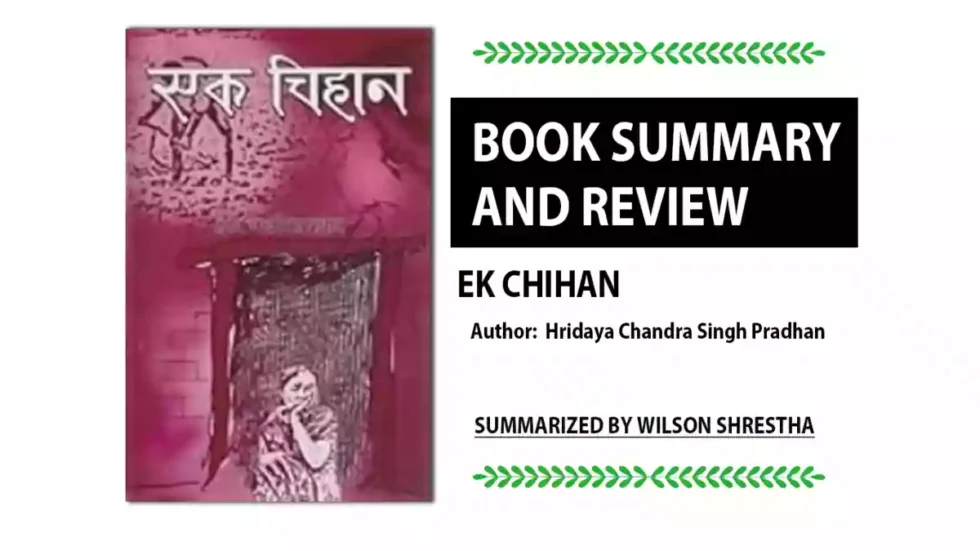
Ek Chihan in 60 seconds
Ek Chihan (एक चिहान, “One Grave”) is a social-realist Nepali novel by Hridaya Chandra Singh Pradhan, first published in 2017 BS (around 1960 AD), a year after the author died. It follows Astanaran, a poor Newar Jyapu farmer in Kathmandu, and his family as illness, debt, a greedy doctor and a scheming landlord push them to the edge. Just when the family finally finds some peace, three days of non-stop rain in 2011 BS flood the Bishnumati fields and collapse their old house, and the whole family ends up in “one grave.” The story is based on a real flood tragedy in Kathmandu.
Ek Chihan at a Glance
| Detail | Information |
|---|---|
| Title | Ek Chihan (एक चिहान) – “One Grave” |
| Author | Hridaya Chandra Singh Pradhan (1972–2016 BS / 1916–1960 AD) |
| First published | 2017 BS (about 1960 AD), after the author’s death |
| Genre | Social realism with a progressive (pragatibadi) outlook |
| Setting | Kathmandu, a Newar Jyapu (farming) community, around 2011 BS (1954 AD) |
| Based on | A real 2011 BS flood in which a Kathmandu farming family died together |
| Protagonists | Astanaran (the father) and Shivnaran (his eldest son) |
| Main antagonists | Dr. Godattaprasad and Subba Surman |
| Publishers (current) | Sajha Prakashan; a new Sambad Prakashan edition appeared in 2083 BS (2026) |
| Where students meet it | An abridged version is taught in NEB Class 12 Nepali |
In this summary
The True Story Behind Ek Chihan
Most summaries skip this, but it is the key to understanding the book: Ek Chihan is not pure imagination. Nepali literary critics note that Pradhan built the novel around a real incident from 2011 BS, when floods and landslides after heavy monsoon rain wiped out a Newar farming family in Kathmandu. Pradhan took that single news-like tragedy and asked a bigger question: what had already been done to this family before the flood ever came?
Pradhan himself knew hardship. He grew up at his maternal home in Naradevi because his own family was poor, received no formal schooling as a child, took part in the 2007 BS movement against the Rana regime, and died young in 2016 BS. He never saw Ek Chihan in print.
Timeline: the author, the flood and the book
Hridaya Chandra Singh Pradhan is born in Kathmandu.
He joins the movement that ends Rana rule. The new era shapes his progressive writing.
Monsoon floods in Kathmandu kill a farming family together – the real event behind the novel. The same year he publishes his first novel, Swasnimanchhe.
Pradhan dies at about 43.
Ek Chihan is published after his death – his second and final novel.
An abridged edition is prepared, the version later used in Class 12 Nepali.
The novel is still in print, with a fresh Sambad Prakashan edition this year.
Ek Chihan Full Plot Summary
The story moves in four clear stages. Here is the arc at a glance before we go through each part.
STAGE 1
Illness
Astanaran falls sick; funeral savings go to the doctor.
STAGE 2
Death & debt
No money even for the funeral; the family borrows.
STAGE 3
Exploitation
The doctor and Subba Surman target Nanithaku.
STAGE 4
Hope, then the flood
Simple weddings, new plans – then one grave.
Stage 1: Astanaran’s illness and the Rs 25
The novel opens with Astanaran, an old, honest Jyapu farmer, who has been seriously ill for about two months. His wife Latmaya, sons Shivnaran, Punnaran and Harshanaran, and daughter Nanithaku try everything they can afford: a local gubhaju, another healer from Asan, and a kaviraj. Nothing works.
There is a proper doctor in town, but the family cannot pay him. In the end the sons dig into the twenty-five rupees Astanaran had secretly saved for his own death rites. Even then, Dr. Godattaprasad agrees to visit only after a fee is promised in advance – and he is more interested in the beautiful young Nanithaku than in the patient.
Before he dies, Astanaran gives his sons a farmer’s last lesson: farmers feed the world, every grain comes from their sweat, the Asar planting must never be missed even if a father dies, the mother and sister must be cared for, and no one should borrow money for a showy funeral.
Stage 2: Death, grief and debt
Astanaran dies, and the whole tole mourns a kind, social man. But grief is quickly replaced by a harsher problem: the family does not even have money to buy the shroud (katro). The children are forced to go to Dr. Godattaprasad for help, which gives him a new excuse to keep visiting the house. Despite the father’s advice, custom and social pressure push the family into loans for the rituals – exactly the trap Astanaran had warned them about.
Stage 3: Nanithaku between two predators
With the father gone, two powerful men circle the family:
- Subba Surman, a rich landowner, sends his clerk Rambahadur with a marriage proposal for Nanithaku and even dangles a one-year waiver of the land rent (kut). Latmaya is tempted, but Shivnaran sees through the plan and refuses. When Rambahadur insults him, Shivnaran grabs him by the throat, and Surman later takes the dispute to the authorities.
- Dr. Godattaprasad, a married man with children, keeps visiting and draws Nanithaku into a relationship. Rumours spread through the neighbourhood. Shivnaran scolds his sister and starts taking her to the fields with him, but the affair has already pushed her into a crisis and she disappears for weeks.
The turning point comes from an unexpected person: the doctor’s own wife, Ranjanadevi. Educated and kind, she suspects her husband, tracks Nanithaku down, and speaks to her about a woman’s dignity and worth. With Shivnaran and Ranjanadevi’s support, Nanithaku agrees to come home and ends the relationship.
Stage 4: Simple weddings, new hope, and the flood
Shivnaran now acts on his father’s progressive values. Nanithaku marries Ramkhelawan Raut, a young man from the Tarai, and Harshanaran marries Putali Tamang. Both weddings are simple – no dowry, no expensive feasts, and across caste and regional lines.
For the first time the family breathes. Shivnaran, now free of responsibilities, tells his wife Hakumaya about his small dreams: build a house, host a feast, take the children to the cinema, and finally live a little.
Then it rains for three days and three nights in 2011 BS. The Bishnumati overflows into the riverside fields. Shivnaran, Hakumaya and their two children are swept away from their field hut. At the same time, the weak old family house collapses and buries Latmaya and the others inside. The family that survived disease, debt and exploitation is wiped out by nature – and ends up in one grave.
Why the ending hits so hard: Pradhan places the flood right after the family’s happiest moment. The reader has just seen Shivnaran plan a better life. The message is clear – for the poor, even hope is fragile, because they live in the weakest houses on the most dangerous land.
Meaning of the Title “Ek Chihan”
Ek Chihan means “one grave.” On the surface it describes the ending, where an entire family dies together in the flood. On a deeper level it works on three layers:
- Literal: the whole family is buried together.
- Social: poverty, debt and blind custom had been digging that grave for years before the rain came.
- Class: the family stands for a whole class of hard-working poor people who share one fate while the rich stay safe.
Ek Chihan Characters
The cast is small but carefully chosen: one family on one side, the people who profit from them on the other.
Character map
↓ their children ↓
+ Hakumaya, two children
younger son
+ Putali Tamang
+ Ramkhelawan Raut
Dr. Godattaprasad (doctor)
Subba Surman (landlord)
Rambahadur (Surman’s clerk)
Ranjanadevi, the doctor’s wife, who helps Nanithaku recover her dignity
| Character | Who they are | What they represent |
|---|---|---|
| Astanaran | Old, honest Jyapu farmer and father | Dignity of labour; rejects costly rituals |
| Shivnaran | Eldest son, main male character | The hard-working, self-respecting farmer who resists injustice |
| Latmaya | Astanaran’s wife | A traditional mother, tempted by the landlord’s offer |
| Nanithaku | The young daughter | How poor women become targets of powerful men |
| Dr. Godattaprasad | Government hospital doctor | Educated but immoral; the main villain |
| Subba Surman | Rich landowner | Feudal exploitation through land and money |
| Ranjanadevi | The doctor’s wife | The educated, conscious woman |
| Ramkhelawan Raut & Putali Tamang | Spouses of Nanithaku and Harshanaran | Inter-caste, inter-regional unity |
Themes and Message of Ek Chihan
The main message (mool bhav) is simple: society must honour labour, end exploitation, and drop the blind customs that keep poor families in debt. Here are the six themes you will see again and again.
1. Dignity of labour
Farmers are shown as the food-givers of society, yet they are the ones who suffer most.
2. Class exploitation
The doctor, the landlord and moneylenders all profit from the family’s weakness.
3. Costly customs
Expensive death rites, feasts and dowry push the poor into lifelong debt.
4. Exploitation of women
Nanithaku’s story shows how poverty makes young women vulnerable.
5. National unity
Inter-caste and hill–Tarai marriages are presented as a path to a united Nepal.
6. Fate of the poor
Even nature strikes hardest at people living in weak houses on risky land.
The two-class society in Ek Chihan
Ek Chihan Book Review: Is It Worth Reading?
Yes – especially if you want to understand ordinary life in Kathmandu after 2007 BS rather than palace history. It is a short, emotional and very readable novel, and the ending stays with you for days.
Our rating (out of 5)
Overall: 4.4 / 5
What works
- A rare, detailed picture of Newar Jyapu life in old Kathmandu
- Villains who feel real, not cartoonish
- Progressive ideas (no dowry, inter-caste marriage) that were bold for 2017 BS
- One of the most memorable endings in Nepali fiction
What may not work for you
- The message is sometimes stated directly, almost like a speech
- Characters are clearly “good” or “bad”
- Older vocabulary and Newar terms can slow new readers
- The flood ending can feel sudden on a first read
Reader’s note from Wilson
Living in Kathmandu, I read Ek Chihan differently the second time. The Bishnumati corridor where Shivnaran’s field hut stood is now lined with houses and roads, but every monsoon we still see news of riverside settlements flooding and weak walls collapsing after long rain. The names change; the pattern Pradhan described in 2011 BS has not fully gone away.
What struck me most is Astanaran’s advice not to borrow for a big funeral. Many families around us still spend beyond their means on rituals and weddings. That is why this 60-plus-year-old novel still feels like it was written about people we know.
Common Mistakes About Ek Chihan Online
While researching this update, we found several errors repeated across book sites and summaries. Here is what is actually correct.
| What you may read | What is correct |
|---|---|
| “Ek Chihan is by Parijat.” | It is by Hridaya Chandra Singh Pradhan. Parijat wrote Shirishko Phool, a very different, existentialist novel. |
| “Published in 1971.” | Nepali sources, including the textbook tradition, give the first publication as 2017 BS (about 1960 AD). Later reprints are sometimes mistaken for the first edition. |
| “It is a 107-page book.” | Page counts depend on the edition: roughly 200 to 280 pages for the full novel. The school version is abridged. |
| “It is purely fictional.” | The ending is based on a real 2011 BS flood that killed a Kathmandu farming family. |
Ek Chihan for Class 12 Nepali (NEB) Students
An abridged version of Ek Chihan is included in the NEB Class 12 Nepali textbook (listed as lesson 5 in widely used editions). If you are here for exams, these are the points examiners look for.
Mool bhav in three lines
- A poor Newar farming family in Kathmandu suffers illness, debt and exploitation and finally dies together in the 2011 BS flood.
- The novel attacks exploitation by the rich, blind religious customs and wasteful spending on rituals and dowry.
- It calls for respect for labour, simple living, and inter-caste, inter-regional unity.
How to write a character sketch
Who is the character?
Main or supporting; good or bad
3–4 qualities with one event each
Which class or idea they represent
Example (Shivnaran): eldest son and main male character; hard-working, honest and obedient to his father’s values; stands up to Rambahadur and refuses Subba Surman’s proposal; arranges simple inter-caste marriages; represents the self-respecting labouring class.
Likely exam questions
- Write the main theme (mool bhav) of Ek Chihan.
- Justify the title “Ek Chihan.”
- Write a character sketch of Shivnaran, Nanithaku or Dr. Godattaprasad.
- Explain the social problems shown in the novel.
- Did you like the ending? How would you have ended it?
Similar Nepali Books You Should Read Next
If Ek Chihan moved you, these summaries from our Nepali books review collection make a good reading list.
| Book | Author | Read it if you want |
|---|---|---|
| Seto Bagh | Diamond Shumsher Rana | The Rana-era palace world that Ek Chihan’s farmers lived beneath |
| Shirishko Phool | Parijat | An inner, existential story instead of a social one |
| Pagal Basti | Saru Bhakta | A philosophical look at society and the human mind |
| Jiwan Kada Ki Phool | Jhamak Ghimire | A true story of struggle and resilience |
For another family-centred read, see our Aama Ko Sapana book summary, or pick your next novel from our list of the top 10 Nepali novels to read.
Frequently Asked Questions
Who wrote Ek Chihan?
Ek Chihan was written by Hridaya Chandra Singh Pradhan (1972–2016 BS), a progressive Nepali novelist, playwright, essayist and critic. It is not by Parijat.
When was Ek Chihan published?
It was first published in 2017 BS (about 1960 AD), shortly after the author’s death. An abridged edition from 2067 BS is used in Class 12, and new editions are still being printed.
What does “Ek Chihan” mean?
It means “one grave.” At the end of the novel, the whole family dies in the 2011 BS flood and is buried together, symbolising the shared fate of the poor.
Is Ek Chihan based on a true story?
Yes. Critics note that it is based on a real 2011 BS flood in Kathmandu in which a Newar farming family died together.
Who is the main character of Ek Chihan?
Astanaran drives the first part of the story, but Shivnaran, his eldest son, is the main male character and hero of the novel.
What is the main theme of Ek Chihan?
Social realism with a progressive view: respect for labour, opposition to exploitation and costly customs, and support for inter-caste and inter-regional unity.
Final Thoughts
Ek Chihan is short, but it carries the weight of a whole class of people. Pradhan shows that the flood was only the last blow – illness without care, debt for rituals, and powerful men who treat the poor as prey had already dug the grave. More than six decades later, the book remains one of the clearest windows into working-class Kathmandu and a must-read for anyone exploring Nepali literature.
Looking for more? Browse all our Nepali book reviews and summaries.