
Soccer Manager Transfer Market Tips: 15 Ways to Buy Cheap and Sell High (SM27)
Transfers are where most Soccer Manager careers are won or lost. Spend badly in your first window and you are stuck with a bloated wage bill and players who do not fit your tactics. Spend smartly and you can turn a mid-table side into a title challenger without ever topping up with real money.
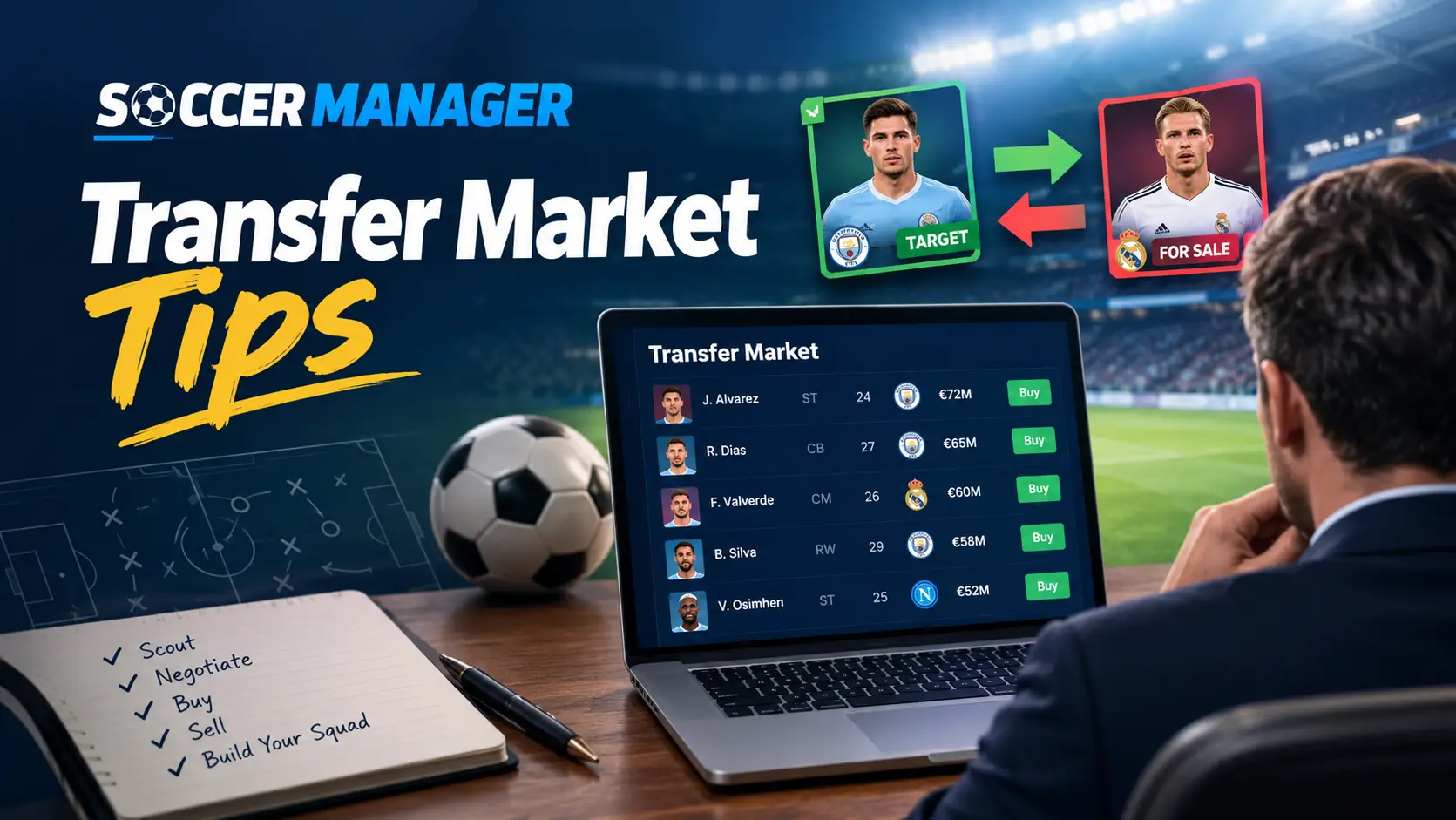
Quick answer
- Plan first: use the Squad Planner to decide which positions you need before you open the market.
- Scout every target before bidding. Price and star rating alone hide poor fits.
- Mine free agents and loans for cheap quality, especially in your first season.
- Buy young, sell at the peak. High-potential youngsters are your future starters and your biggest profit source.
- Never let contracts run down. Renew or sell early, or you lose players for nothing.
Our Soccer Manager best guide covers transfers briefly alongside training and roles. This post goes much deeper: a complete, step-by-step transfer playbook updated for Soccer Manager 2027 (SM27), which launched on 10 September 2026. Most tips also work in SM26 and older versions.
What's New for Transfers in Soccer Manager 2027
Before the tips, it helps to know what changed this season, because a few of these changes directly affect how you should use the transfer market.
- Squad Planner: a new tool that lets you map out your squad's future and prepare for the transfer window. This is now the best place to start every window.
- Club Archetypes: each club gets a unique identity and board objectives based on its real-life philosophy. If your club values youth or financial sustainability, your transfer strategy should match it.
- No 25-player squad cap: a post-launch update removed the 25-player limit. More room for prospects, but a bigger squad still means a bigger wage bill.
- Bench increased from 7 to 9: squad depth matters more on matchdays, so a couple of reliable backups are worth more than one extra star.
- Carry-over saves: you can continue your SM26 save in SM27, but once you move it you cannot go back.
- Real-world data: player and transfer data comes from Soccerwiki, a community-edited database. Missing late summer transfers were patched in two updates during September 2026.
Before the Window Opens: Plan Your Squad
1. Start every window in the Squad Planner
The single biggest transfer mistake is opening the market "to see who's available." You end up buying a player because he looks good, not because you need him. Open the Squad Planner first and go position by position: who starts, who backs up, who is too old, and who is out of contract soon. Your shopping list should come out of that review, not out of the transfer search.
A simple rule: aim for two solid options in every position of your main formation. If you play the setups from our Soccer Manager best tactics guide, list the exact roles you need (for example, a ball-winning midfielder and a wing-back) rather than just "a midfielder."
2. Know your real budget, not just your transfer balance
Your transfer balance is only half the picture. Every signing also adds wages, and wages keep costing you every week. Check the finance screen before you bid and look at the season projection. If it already shows a loss, a big signing will make it worse and can upset the board.
If you are starting a new career, your starting balance option matters. A Standard Start (around $34M in SM26) forces disciplined spending and is the best way to learn the market. Enhanced and Legendary starts give you far more money, but make it easy to overspend on players you don't need.
3. Match signings to your Club Archetype and board objectives
In SM27, your board's objectives are tied to your club's archetype. A club built around developing young talent will judge you differently from one expected to win now. Read your objectives before the window and let them guide the type of player you buy. Hitting objectives keeps the board happy and protects your job when results dip.
Finding the Right Players
4. Scout before you bid, every time
Scouting a player reveals far more than his headline rating: his potential, his strengths and weaknesses, and how well he fits your squad. It takes time, so start scouting your main targets early in the window rather than on deadline day. Rival clubs can sign a player while you are still waiting for a report, so scout your most important targets first.
When the report arrives, check three things: does he fit the role you need, does his potential justify the price, and are his wage demands affordable?
5. Use the shortlist as your transfer to-do list
Add every interesting player to your shortlist, even if you cannot afford him yet, and review it regularly. Prices change as form, age and contracts change, and a player who was too expensive in summer can become affordable in winter. A well-kept shortlist also means you can move fast when a target suddenly becomes available.
6. Check the free-agent list every window
Free agents cost no transfer fee, only wages. Good-quality players regularly appear on the list after their contracts expire, and young free agents can have real potential. Check the list at the start of each window and again near the end, when clubs release players they could not sell.
The catch: free agents often ask for higher wages because there is no fee. Compare the total cost (wages over the contract) against buying a similar player outright.
7. Use loans to fill gaps without spending your budget
A loan adds a quality player for a season without a transfer fee. Loans are ideal for short-term cover (an injury crisis, a cup run) or when a better permanent target is not available yet. Only take loan players who fit your squad and will actually play; a loanee sitting on your bench is wasted wages.
8. Look beyond the biggest leagues
Players from the top five European leagues carry a price premium. With over 90 leagues in the game, similar-quality players in smaller leagues are often far cheaper. Point your scouts at leagues other managers ignore and you will find undervalued players who can step straight into your team.
Negotiating and Closing Deals
9. Don't open with the asking price
If a club rejects your offer, raise it in small steps rather than jumping straight to the asking price. You will often land the player for less than the listed value. Don't drag it out too long on a player you really want, though, since another club can step in.
10. Watch the wage, not just the fee
A cheap fee with high wages can cost you more over a three-year contract than a bigger fee with modest wages. Before you confirm any deal, add up the fee plus the total wages over the contract. Keep your wage structure sensible too: one player on a huge salary can make others demand more.
11. Never sell a key player without a replacement lined up
Other clubs will bid for your best players, especially mid-season. Do not accept just because the number looks big. Identify and ideally secure the replacement first, then sell. Selling a starter and failing to replace him can wreck your season.
Selling Players for Profit
12. Buy young, develop, sell at the peak
This is the most reliable money-maker in Soccer Manager. Buy young players with high potential at low prices, give them training and minutes, and their value rises as their rating climbs. Focus training on players with strong growth arrows, since they improve fastest.
Sell the ones who won't break into your first team once their value has risen, usually after one or two seasons, and keep the ones who become starters. The profit funds your next window, and you avoid paying top prices for established stars.
13. Sell older players a season early
Players' values fall as they age. Sell players in their late twenties to early thirties while they still have resale value, rather than waiting until they are worth almost nothing. If a veteran is still important to you, keep him, but plan his replacement in the Squad Planner now.
14. Renew or sell before contracts run down
A player whose contract is about to expire can leave for free, and his value drops as the end date approaches. Check expiry dates at the start of every season. Offer key players a renewal early. Sell players you no longer need while they still have a year or more left, so you still receive a fee.
15. Clear deadwood to free up wages
Players who never play still take wages. Even with the SM27 squad cap removed, a squad full of unused players drains your finances. Sell or loan them out each window and put the saved wages toward a better signing.
Transfer Options Compared
| Option | Upfront cost | Best for | Main risk |
|---|---|---|---|
| Permanent transfer | Transfer fee + wages | Long-term starters and young prospects | Overpaying or a poor tactical fit |
| Free agent | Wages only | Squad depth and bargains on a tight budget | High wage demands |
| Loan in | Wages (often partial) | Short-term cover and testing a role | No long-term value |
| Youth signing | Low fee + low wages | Future starters and resale profit | May never develop |
| Selling / loaning out | None (you receive money or save wages) | Raising funds and cutting the wage bill | Weakening the squad without a replacement |
Common Transfer Mistakes to Avoid
- Panic buying on deadline day. Prices are higher and you have no time to scout.
- Buying by star rating alone. A high-rated player in the wrong role performs worse than a lower-rated player who fits your tactics.
- Ignoring wages. Weekly wages add up faster than most managers expect.
- Hoarding young players with no plan. Without training and minutes, their value won't grow.
- Letting contracts expire. You lose both the player and his transfer value.
- Selling your best player without a replacement. The money rarely makes up for the drop in results.
Your Transfer Window Checklist
- Review your squad and needs in the Squad Planner.
- Check finances, wage bill and board objectives.
- Check contract expiry dates: renew, sell or release.
- Scout your shortlist targets early.
- Check free agents and loan options first.
- Bid below the asking price and raise in small steps.
- Sell surplus players, and replace before selling starters.
- Recheck free agents near the end of the window.
Once your squad is set, the next step is getting the best out of it on the pitch. Use our Soccer Manager counter formations guide to set up against every opponent.
FAQ: Soccer Manager Transfer Market
How do I find cheap good players in Soccer Manager?
Check the free-agent list, scout leagues outside the top five European competitions, and target young players with high potential. Add them to your shortlist and buy when their price is low.
How do I make money from transfers in Soccer Manager?
Buy young, high-potential players cheaply, train them and give them minutes so their value rises, then sell the ones who won't make your first team after one or two seasons. Also sell older players before their value drops.
Is it better to sign free agents or buy players?
Free agents save the transfer fee but usually ask for higher wages, so compare the total cost over the contract. For squad depth, free agents are usually better value; for long-term starters, buying a younger player is often the smarter investment.
Should I scout players before buying them?
Yes. Scouting reveals a player's potential, strengths, weaknesses and fit for your squad. Buying without scouting is the most common way to waste transfer money.
What happens when a player's contract expires?
He can leave your club for free and you receive no fee. Renew important players early and sell the rest while they still have time left on their contracts.
Does my SM26 save carry over to SM27?
Yes. SM27 is a continuous app, so you can continue your SM26 save, but once you move it to SM27 you cannot return it to SM26.
Is there still a squad limit in Soccer Manager 2027?
The 25-player squad cap was removed in a post-launch SM27 update. You can carry a bigger squad, but every extra player still adds to your wage bill.
Final Thoughts
The managers who win in Soccer Manager are not the ones with the biggest budgets. They plan every window, scout before they spend, and treat players as assets that rise and fall in value. Start your next window in the Squad Planner, follow the checklist above, and your squad and bank balance will both grow season after season. For training, roles and more, see our complete Soccer Manager tips and tricks guide.
Sources: Invincibles Studio – SM27 features; Invincibles Studio – SM27 transfer updates.