
Soccer Manager Player Roles and Playstyle Guide
In Soccer Manager, your formation only decides where your players stand. The player role decides what they actually do once the whistle blows — whether a centre-back sticks tight to the striker or steps out to pass, whether a midfielder sits deep or runs box-to-box, whether a striker drops in to link play or holds the line to beat the offside trap. Get the roles right and an average squad punches above its rating. Get them wrong and a team full of stars looks disjointed.
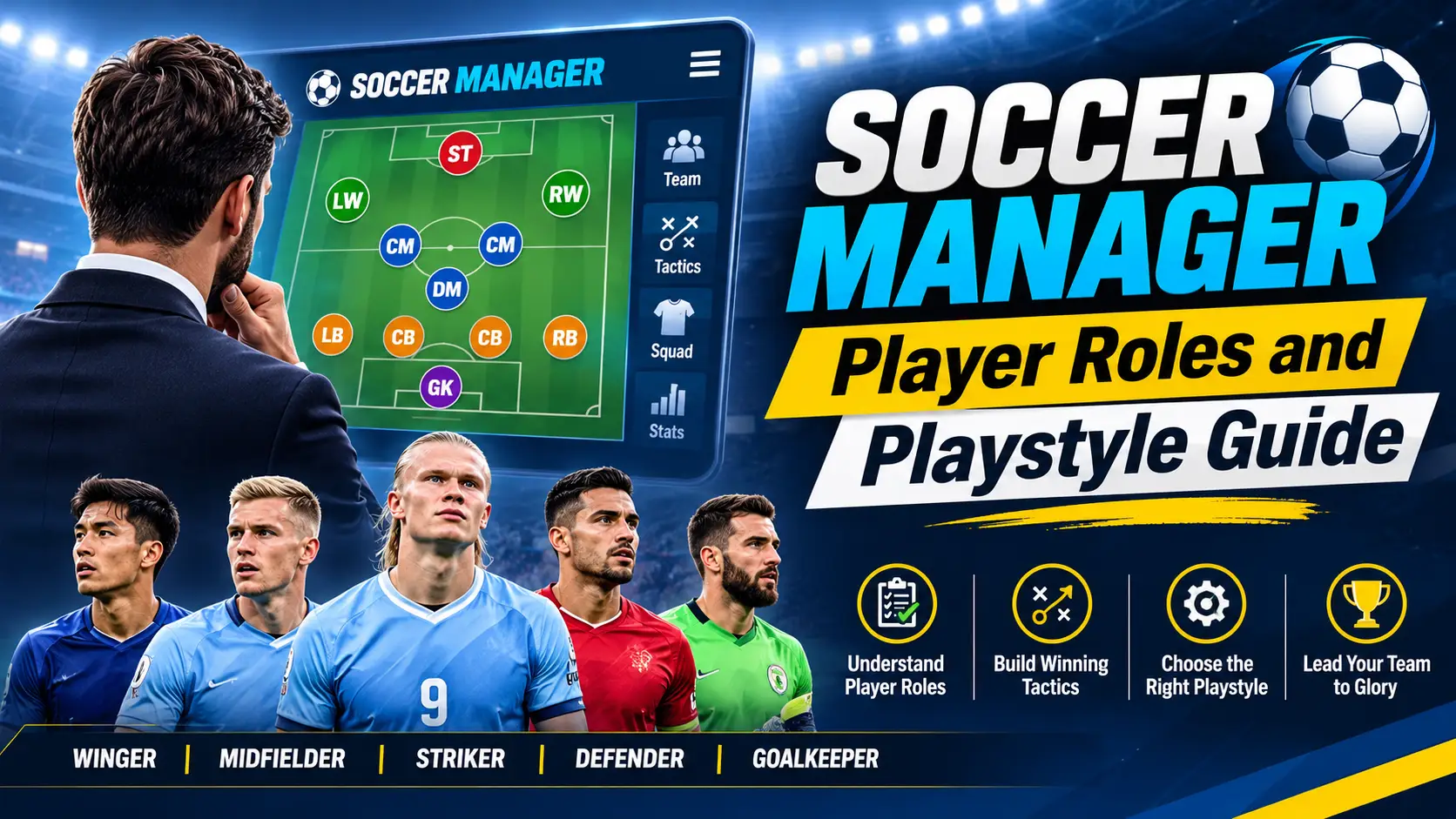
This guide breaks down every Soccer Manager player role by position, the key attributes each role needs, and — the part most guides skip — which roles fit which playstyle. Use the menu below to jump straight to what you need.
What Are Player Roles in Soccer Manager?
A player role is a preset set of instructions attached to each position in your starting eleven. It tells that player how aggressively to defend, how far to push forward, and whether to prioritise safety or creativity on the ball. Two players in the same formation slot can behave completely differently depending on the role you give them.
Three things decide a good role
- Position — each role is only available to certain positions.
- Attributes — the role only works if the player has the stats it depends on.
- Playstyle fit — the role has to serve your overall plan for the match.
Quick Reference: Best Role for Each Position
Want the short answer? Here is the safest all-round role for every position, plus the stronger pick when you want to be more aggressive.
| Position | Safest all-round role | Best for aggressive setups |
|---|---|---|
| Goalkeeper | Keeper | Modern Keeper |
| Centre-back | General Defender | Ball-Playing Defender |
| Full-back | Full Back | Wing Back |
| Holding midfield | Ball-Winning Midfielder | Deep-Lying Playmaker |
| Central midfield | Box-to-Box Midfielder | Advanced Playmaker |
| Wide midfield | Wide Midfielder | Winger |
| Striker | General Forward | Finisher / Target Man |
Now let’s go position by position so you understand why. Each card lists the role, what it does, and the key attributes it depends on.
● Goalkeeper Roles
Keeper
The standard goalkeeper. He stays on his line, protects the goal, and makes the safe decision rather than gambling. The default choice for almost every team, and it rarely needs changing.
Modern Keeper
Effectively a sweeper-keeper. He is quick off his line, comes out to clear through balls, and acts as a spare man behind your defence — letting you push your back line higher. It is risky, so only use it with a keeper who has real pace and composure. Best paired with a high line or a high press.
● Defender Roles
General Defender
The balanced centre-back — solid in the tackle, decent in the air, no glaring weakness. If you’re unsure, this is the role for your centre-backs.
Stopper
The aggressor of the two centre-backs. He steps out to win the ball early and makes the first challenge. Pair a Stopper with a calmer partner so you aren’t exposed when he jumps out.
Ball-Playing Defender
The opposite of a Stopper. Instead of just clearing the ball, he starts attacks with sharp passing out of defence — the cornerstone of any build-from-the-back setup. Give it to a defender with weak passing and you’ll gift away chances.
Full Back
A defence-first wide defender. He holds his position and stays back while your team attacks, giving you a compact, stable shape. Ideal when defending deep or protecting a lead.
Wing Back
The attacking full-back. He pushes high up the flank to add width and support the attack, then has to recover. Devastating going forward but leaves space behind — best with a holding midfielder covering, or a back three.
● Midfield Roles
Most matches are won and lost in midfield, and it has the most roles. Think in three layers: destroyers (win the ball), creators (make the play), and runners (cover ground).
Ball-Winning Midfielder
Your defensive shield. He sits in front of the back line and breaks up attacks with tackles and interceptions. Every attacking formation needs at least one.
Deep-Lying Playmaker
A creator who starts the play from deep, spraying passes forward from in front of the defence. He is the engine of a possession side and the key to launching quick counters — one of the highest-impact roles in the game.
Box-to-Box Midfielder
The all-rounder who covers every blade of grass, helping in both boxes. He needs serious stamina but rewards you with energy at both ends — the safest central pick for most teams.
General Midfielder
The balanced, no-frills midfielder — the midfield version of a General Defender. Reliable and flexible when you want a steady middle without specialising.
Playmaker
The man who runs the game. He controls the midfield with his presence and feeds the players around him. Build your attack through him and get him on the ball as often as possible.
Advanced Playmaker
A more forward-focused creator. Rather than supplying the whole team, he concentrates on creating chances for your attackers higher up the pitch — the classic number 10.
Wide Midfielder
A midfielder who positions out wide and contributes in both attack and defence. He gives you width without abandoning his defensive duties — safer and more balanced than an all-out Winger.
Winger
Plays wide and lives to attack — beating his man, getting to the byline, and supplying the strikers. He offers little defensively, so make sure your full-back or a midfielder covers behind him.
● Attack Roles
General Forward
The balanced striker: can score, hold the ball, and link play. No standout trait, no real weakness. The dependable choice when you aren’t building around a specific plan.
Target Man
Stays high up front as the focal point, holding the ball up and attacking crosses in the box. He only works if you feed him — crosses from wingers or direct long balls. Give him height and strength and he torments small defences.
Finisher
A poacher who pushes against the last defender and uses pace to beat the offside trap. His whole job is to be in the right place and put the ball away. Deadly on the counter and against high lines.
Support Striker
Plays just behind or alongside the main striker, keeping a close partnership and feeding him chances. The ideal second striker in a two-up-top or a 4-4-2.
Deep-Lying Forward
Drops back from the front line to link play and create for the wingers and other forwards — a false-nine style role. Use it when you want your striker involved in build-up, not just finishing.
Wide Forward
Plays like a winger but focuses on scoring rather than assisting. Play him on the opposite flank to his strong foot (an “inverted” winger) so he can cut inside and shoot.
Best Roles for Each Playstyle
This is where roles stop being a list and become a system. Pick your playstyle first, then assign the roles that serve it.
| Playstyle | Defence | Midfield | Attack |
|---|---|---|---|
| Possession | Ball-Playing Defender, Wing Back | Deep-Lying Playmaker, Playmaker, Advanced Playmaker | Deep-Lying Forward, Support Striker |
| Counter-attack | General Defender, Full Back | Ball-Winning Midfielder, Deep-Lying Playmaker | Finisher, Winger |
| High press | Ball-Playing Defender, Modern Keeper | Ball-Winning Midfielder, Box-to-Box Midfielder | Finisher, Wide Forward |
| Defensive / park the bus | General Defender, Full Back, Keeper | Ball-Winning Midfielder, General Midfielder | Target Man, General Forward |
| Wing play / crossing | Wing Back | Wide Midfielder, Winger | Target Man |
| Direct / long ball | Stopper, Full Back | Ball-Winning Midfielder, Box-to-Box Midfielder | Target Man + Finisher |
Possession
You want players comfortable on the ball at every line. Ball-Playing Defenders start the build-up, playmakers knit it together, and a Deep-Lying Forward drops in to create overloads. Patience over pace.
Counter-attack
Sit a little deeper, win the ball through a Ball-Winning Midfielder, then release it fast through a Deep-Lying Playmaker to a Finisher and a quick Winger. Speed in the final third is everything.
High press
Squeeze the pitch and win the ball high. This needs a Modern Keeper behind a high line and energetic, high-work-rate midfielders to hunt the ball. Stamina across the team is non-negotiable.
Defensive / park the bus
Protect the lead. Full Backs instead of Wing Backs, a Ball-Winning Midfielder screening the defence, and a Target Man or General Forward up top to hold the ball and relieve pressure on the counter.
Wing play and long ball
If your strength is on the flanks, use Wing Backs and Wingers to get crosses in for a Target Man. If you prefer going direct, a Stopper and a strong midfield feed long balls to a Target Man with a Finisher gambling off him.
Once you’ve chosen your roles, match them to the right shape. Our Soccer Manager best tactics and formation tips walks through the formations that suit each style, and the counter-formations guide shows how to adjust your roles to beat any opponent.
Common Mistakes With Player Roles
- Assigning a role the player can’t perform. A Ball-Playing Defender with poor passing, or a Target Man with no height, just hands the ball back. Match the role to the attributes.
- Too many attackers, no balance. A Winger plus a Wing Back on the same flank with no cover leaves a motorway behind you. Balance forward roles with a holding role.
- Ignoring stamina. Box-to-Box Midfielders, Wing Backs, and high-press setups burn energy fast. Rotate and keep morale high.
- Set and forget. Roles aren’t permanent. Switch a Wing Back to a Full Back to protect a lead, or a General Forward to a Finisher when you need a late goal.
Frequently Asked Questions
What is the best player role in Soccer Manager?
There’s no single best role — it depends on the player and your plan. The Box-to-Box Midfielder and General Defender are the most reliable all-round picks, and a Deep-Lying Playmaker is the highest-impact creative role for most teams.
What is a Modern Keeper in Soccer Manager?
A Modern Keeper is a sweeper-keeper: a goalkeeper who comes off his line to clear through balls and acts as an extra defender behind a high line. Only use it with a quick, composed keeper.
What’s the difference between a Stopper and a Ball-Playing Defender?
A Stopper is aggressive and steps out to win the ball early; a Ball-Playing Defender stays composed and starts attacks with his passing. They complement each other well as a centre-back pairing.
Which role is best for a striker who scores a lot?
If he has pace, use a Finisher to beat the offside trap. If he’s big and strong, use a Target Man. If he’s well-rounded, the General Forward is the safe pick.
Do player roles matter more than formation?
They work together. The formation sets the positions; the roles decide the behaviour. A great formation with mismatched roles underperforms, so always tune both.
Final Thoughts
Player roles are the difference between a squad that just lines up and a team that plays your way. Start from your playstyle, give each position the role that serves it, and make sure every player has the attributes the role demands. Tweak during matches, watch your stamina, and switch roles when the game state changes.
Ready to put it into practice? Build your shape with our best tactics and formation guide, counter your rivals with the counter-formations guide, and explore more titles on our gaming guides hub.