Check PAN Number Online in Nepal: Fast and Easy Steps

Person checking PAN number online in Nepal on a computer screen.
Checked against the official IRD website on 11 September 20268 min read

PAN Search Nepal: How to Check a PAN Number Online, and Find Yours If You Forgot

The official PAN search takes under a minute and costs nothing. This guide shows exactly how it works, what the result means, and what to do when you don't know your PAN at all.

0 of 9 digits entered.

We copy your PAN and open the official IRD search page in a new tab. Nothing is stored or sent to this website.

Quick answer

To check a PAN number online in Nepal, open the Inland Revenue Department's page ird.gov.np/pan-search, type the 9-digit PAN, answer the short captcha and click खोज्नुहोस् (Search). It is free and needs no login.

The official tool searches by PAN number only. You cannot look up a PAN by name or citizenship number online. If you've forgotten your PAN, jump to 7 ways to find it.

On this page

PAN search Nepal at a glance

PAN stands for
Permanent Account Number (स्थायी लेखा नम्बर)
Issued by
Inland Revenue Department (IRD), Lazimpat, Kathmandu
Format
9 digits, numbers only
Official search page
ird.gov.np/pan-search
Cost and login
Free, no login needed
Search by PAN number
Yes
Search by name
No
Search by citizenship number
No not through any public online tool
Forgot your PAN
Check your documents and apps, ask your employer or bank, or contact IRD with your citizenship

What is a PAN number in Nepal?

A PAN (Permanent Account Number), called स्थायी लेखा नम्बर in Nepali, is the unique tax identification number the Inland Revenue Department issues to individuals, businesses and organisations. Income tax returns, VAT bills, payroll salary payments and many bank and government transactions are all tied to it.

Two facts clear up most of the confusion online:

  • Nepal's PAN has 9 digits and contains only numbers. Many websites copy information about India's PAN, which is a 10-character mix of letters and numbers. That format does not apply in Nepal. A "PAN" with letters in it is not a Nepali PAN.
  • Your PAN never changes or expires. A PAN issued twenty years ago is still valid today. Individuals usually hold a Personal PAN (PPAN), and companies, firms and organisations hold a business PAN. One person should only ever have one PAN.

How to check a PAN number online in Nepal

The only official place to check a PAN is the IRD website. It takes under a minute.


  1. Open the official PAN search page

    Go directly to ird.gov.np/pan-search. Or open ird.gov.np, go to the ई–सर्भिस (e-Service) menu and choose PAN नम्बर खोजी. The page opens in Nepali; click ENG at the top for English.


  2. Enter the 9-digit PAN

    Type the number into the स्थाई लेखा नम्बर box. Digits only, with no spaces, dashes or letters.

    Simplified illustration of the official form. The captcha question changes each time.


  3. Answer the captcha

    The page asks a short human-verification question, usually a small sum. Type the answer.


  4. Click खोज्नुहोस् (Search)

    Use रिसेट गर्नुहोस् (Reset) to clear the form and check another number.


  5. Read the result

    The taxpayer's registered details appear below the form. The next section explains each part.

Bookmark the official page

Save ird.gov.np/pan-search instead of searching Google every time. Several look-alike websites rank for "PAN search", and some of them collect the numbers you type.

What the PAN search result shows

The layout changes from time to time, but a result on the IRD site typically includes:

FieldWhat it tells you
Taxpayer nameThe person or business registered to that PAN, in Nepali and English
Registered addressWard, municipality and district on record
Inland Revenue OfficeThe IRD office that manages the taxpayer's file
Registration detailsWhen the PAN or tax account was registered
Account type and statusWhether the taxpayer is registered for income tax, VAT (and in some cases excise), and whether each account is active
Filing informationFor many taxpayers, the fiscal years for which returns have been filed

What it does not show: citizenship number, date of birth, income, tax amounts, bank details or phone numbers. The public search only confirms identity and registration, which is why anyone can use it.

How to tell if a PAN is genuine

The name must match the bill, invoice or company you're dealing with, and the account should be active. If a seller charges 13% VAT, their PAN should show VAT registration. If it doesn't, ask questions before you pay.

For your own detailed history (returns filed, taxes paid, TDS), log in to the IRD Taxpayer Portal with your own credentials. That information never appears in the public search.

How to check a PAN on your phone

Mobile browser. The ird.gov.np/pan-search page works in any phone browser. Turn your phone sideways if the result table is cut off.

IRD Nepal app. The Inland Revenue Department links to its official Android and iOS app in the footer of ird.gov.np. Install it from that link so you get the genuine app.

Nagarik App. The government's Nagarik App lets you link your PAN to your verified citizen profile, so your PAN details are always on your phone once you know the number.

Can you search a PAN number by citizenship number in Nepal?

No. There is no public online tool, official or otherwise, that can legitimately find a PAN from a citizenship number. The IRD search page has one input field: the PAN itself. You enter a PAN and it returns a name. It does not work in reverse.

Works online

PAN number

Returns the registered name, address and status.

Not online

Citizenship number

Only through an IRD office, or the Nagarik App if already linked.

Not online

Name

No public name search exists.

This is deliberate. A citizenship number is sensitive personal data. If anyone could type one in and get back a PAN, name, address and tax status, it would be a gift to fraudsters.

Be careful with "find PAN by citizenship" websites

They have no special access to IRD's database. At best they send you to the same official page; at worst they collect your citizenship number. Never type your citizenship number, or upload a photo of your certificate, on an unofficial site.

What works instead

Your citizenship certificate is still the key to recovering your PAN, just not through a search box:

  • Visit an Inland Revenue Office with your original citizenship certificate. Staff can find your record from your citizenship details and tell you your PAN. This is the most reliable route. Go to the office where you registered if you remember it; otherwise your nearest office can guide you.
  • Contact IRD first. Call 01-5970081 or email serviceird@ird.gov.np to ask which office holds your record and what to bring. It can save you a wasted trip.
  • Use the Nagarik App. You register on the app with your citizenship details. If your PAN is already linked, you'll see it there. If the app asks you to enter your PAN, recover the number first using the methods below.

Searching by citizenship number online: the short answer

As of September 2026 it isn't possible. The closest online option is the Nagarik App, if your PAN is already linked. Otherwise the citizenship route means contacting or visiting an IRD office. This guide will be updated if IRD launches such a service.

Can you search a PAN by name?

No. The official IRD search has no name search, and no legitimate public tool offers one. Many people share names, and a name search would expose other people's tax details. It only works one way: from PAN to name, never from name to PAN.

I forgot my PAN number: 7 ways to find it

Forgetting your PAN is common, especially if you registered years ago for a job or bank account. Try these in order. Most people find their number in the first three.

  1. Search your phone and email

    IRD usually confirms a new PAN by SMS or email. Search your inbox and messages for "PAN", "IRD", "Inland Revenue" or स्थायी लेखा. Check your gallery for a photo of your PAN card and your downloads for a PAN certificate PDF.

  2. Log in to the IRD Taxpayer Portal

    If you still have your Taxpayer Portal login details, your profile and downloadable PAN certificate show your PAN.

  3. Open the Nagarik App

    If you linked your PAN to the app in the past, it appears in your profile.

  4. Ask your employer or HR

    Employers need your PAN to process salary and deduct tax, so it's on file with HR or accounts.

    Also check your salary slip or TDS certificate.

  5. Ask your bank

    If you gave your PAN when opening or updating your account (KYC), your branch can confirm it.

    Also check your bank KYC form and statements.

  6. Check old paperwork

    Anywhere you may have written your PAN: previous income tax returns, tax clearance letters, business registration files, DEMAT or Meroshare KYC forms, loan files, and vehicle or land transaction documents.

  7. Contact or visit IRD

    Call 01-5970081, email serviceird@ird.gov.np, or visit an Inland Revenue Office with your original citizenship certificate. They can retrieve your PAN. If you also want a new physical card, ask about replacement; a small administrative fee may apply.

Don't apply for a new PAN

One person should have only one PAN. A duplicate application creates problems that take longer to fix than recovering your original number.

Once you've found it, check it at ird.gov.np/pan-search, keep a photo of your PAN card and a copy of the certificate in a private cloud folder, and link it to the Nagarik App so you don't lose it again.

Old PAN search: checking an old PAN number

"Old PAN search" usually means one of four things.

You have an old PAN and want to check it

Use the same page, ird.gov.np/pan-search. There's no separate tool for old PANs. A PAN is permanent, so a number issued decades ago is searched exactly like a new one.

You're looking for the old IRD website

IRD still links to its previous site, old.ird.gov.np, under पुरानो वेबसाइट. PAN search is on the current website, and older tools may not be maintained, so use the current page.

Your old PAN shows no result or odd details

Check the digits first. On old handwritten cards, 1 and 7 or 0 and 6 are easy to confuse. If the number is right but still not found, or the details are outdated, visit the Inland Revenue Office printed on your old card (or your nearest office) with your citizenship certificate to have the record checked and updated.

You've lost your old PAN card

Your number still works. Download the PAN certificate from the Taxpayer Portal if you have access, or request a replacement card from an Inland Revenue Office.

New applicants: checking PAN application status

If you've just applied and haven't received a number yet, the public PAN search won't find you. Instead:

  • Look for the SMS or email confirming your PAN.
  • On the IRD Taxpayer Portal, check your application status with the submission number you received when you applied.
  • Be ready to complete photo and fingerprint verification at the Inland Revenue Office you selected. Many online applicants still need this step before the PAN is fully usable.

Once your PAN is issued, give it a little time to appear in the public search.

Why you should verify a PAN before you pay

The public PAN search is one of the easiest fraud checks in Nepal, and it works on anyone's PAN, not just yours:

  • Online shopping. A shop that sends a "PAN certificate" as proof may be using a random or borrowed number. If the name doesn't match the shop or bill, walk away.
  • VAT bills. Confirm that a seller charging VAT is actually VAT-registered.
  • Contractors and freelancers. Confirm the business you're paying exists and is active.
  • Rent agreements. Confirm the PAN on the agreement belongs to the person you're dealing with.
  • Payroll. Confirm a new employee's PAN matches their name before processing salary.

Common PAN search problems and fixes

"No record found"

Re-check all 9 digits. If the PAN was issued in the last few days, wait and try again. If it still fails, contact IRD on 01-5970081.

The captcha keeps failing

Reload the page and answer the new question. Captchas expire if the page sits open too long.

The page is stuck on "Loading…"

This usually means heavy traffic or a temporary server issue. Try again later, or switch to another browser or device.

The name appears only in Nepali

That's normal, because records are stored in Nepali. Switch the site to ENG or compare with the Nepali spelling on the citizenship certificate.

My own name or address is wrong

Your record hasn't been updated. Visit your Inland Revenue Office with your citizenship certificate to correct it.

A seller charges VAT but their PAN isn't VAT-registered

Don't pay VAT on that bill. Ask for a proper invoice, or buy elsewhere.

PAN search vs tax clearance search

The IRD website has two public lookups that people often mix up:

  • PAN नम्बर खोजी (PAN search) confirms who a PAN belongs to and their registration status.
  • कर चुक्ता खोजी (tax clearance search) at ird.gov.np/tax-clearance checks tax clearance information, which is often required for tenders, renewals and some official processes.

Use PAN search to verify identity, and tax clearance search when you need proof that taxes are up to date.

Stay safe when checking a PAN

  • Only trust pages on ird.gov.np and other official .gov.np domains.
  • Don't post photos of your PAN card or citizenship certificate on social media.
  • Never share your Taxpayer Portal password or an OTP with anyone, including people who claim to be from IRD.

नेपालीमा छोटो जानकारी

PAN नम्बर अनलाइन कसरी हेर्ने?

ird.gov.np/pan-search मा जानुहोस्, ९ अङ्कको स्थायी लेखा नम्बर (PAN) राख्नुहोस्, क्याप्चाको उत्तर दिनुहोस् र "खोज्नुहोस्" थिच्नुहोस्। यो सेवा निःशुल्क छ र लगइन आवश्यक पर्दैन।

नाम वा नागरिकता नम्बरबाट PAN खोज्न मिल्छ?

मिल्दैन। आन्तरिक राजस्व विभागको सार्वजनिक खोजीमा PAN नम्बर मात्र राख्न मिल्छ।

PAN नम्बर बिर्सनुभयो?

PAN कार्ड वा प्रमाणपत्रको फोटो, पुराना इमेल/SMS, नागरिक एप, कार्यालय वा बैंकका कागजात हेर्नुहोस्। नभेटिएमा सक्कली नागरिकता लिएर नजिकको आन्तरिक राजस्व कार्यालयमा जानुहोस्। PAN बिर्सेको कारणले नयाँ PAN का लागि फेरि आवेदन नदिनुहोस्।

सम्पर्क: ०१-५९७००८१, serviceird@ird.gov.np

Frequently asked questions

How can I check my PAN number online in Nepal?

Go to ird.gov.np/pan-search, enter your 9-digit PAN, answer the captcha and click Search. The result shows the registered name, address, Inland Revenue Office and registration status. It's free and doesn't need a login.

How do I search a PAN number by citizenship number in Nepal?

You can't search by citizenship number online, because the official IRD tool only accepts a PAN. To find your PAN using your citizenship, visit an Inland Revenue Office with your original certificate, or contact IRD on 01-5970081 or serviceird@ird.gov.np first.

Can I search a PAN by citizenship number online?

No. No public online service offers this, and websites that claim to cannot access IRD's database. The closest online option is the Nagarik App, if your PAN is already linked to your profile.

I forgot my PAN number. How can I get it?

Search your email and SMS for your PAN confirmation, look for a photo or PDF of your PAN card, log in to the Taxpayer Portal or Nagarik App, or ask your employer or bank. If none of that works, visit an IRD office with your citizenship certificate. Don't apply for a second PAN.

Is PAN search in Nepal free?

Yes. The IRD PAN search is a free public service with no login or registration.

Can I find someone's PAN by their name?

No. Nepal's official PAN search only works from PAN to name, not the other way around.

How do I do an old PAN search?

Use the same page, ird.gov.np/pan-search. PANs are permanent, so old numbers are searched the same way as new ones. If an old PAN isn't found, re-check the digits, then contact the IRD office shown on your old card.

How many digits is a PAN number in Nepal?

Nine digits, numbers only. The 10-character alphanumeric format belongs to India's PAN, not Nepal's.

Can I check my PAN on the Nagarik App?

Yes. Once your PAN is linked to your verified Nagarik App profile, your PAN details are available inside the app.

Does a PAN number expire in Nepal?

No. A PAN is permanent and stays the same for life, even if you lose the card.

Is it legal to check someone else's PAN?

Yes. PAN search is a public service meant for verifying taxpayers, and it only shows basic registration details, not private financial information.


Sources: Inland Revenue Department, PAN search and office contacts. Last checked 11 September 2026.

wilson.com.np is not affiliated with the Inland Revenue Department. This guide is general information; confirm details with IRD for official matters.

Wilson Shrestha

Written by Wilson Shrestha

Kathmandu-based web developer who writes practical guides on Nepali online services, NEPSE and digital tools. Contact Wilson

Renew Driving Licence Online in Nepal: Verified Step-by-Step Guide (2026)

Renew driving licence online in Nepal - step-by-step guide

Renew Your Driving Licence Online in Nepal: Step-by-Step Guide

Last verified: October 2026 · Fees, validity periods, and portal addresses are set by Nepal's Department of Transport Management (DOTM) and your provincial government, and they are revised periodically — always confirm current figures on the official portal before you pay.

Nepal's driving licence renewal has moved online, but "online" doesn't mean every applicant can finish the process without ever stepping into an office. This guide covers what you can actually do from home, which portal applies to you, what documents and fees to expect, and what happens if your licence has already expired — so you know exactly what you're walking into before you start.

Is Driving Licence Renewal Fully Online in Nepal?

Partly. You can start your application, enter your details, and in many cases pay your renewal fee entirely online. What you usually cannot skip is an in-person step at some point in the process — most commonly a biometric update (photo and fingerprints) or a medical/vision check, and sometimes document verification. Whether you need to visit an office at all depends on how early you're renewing:

  • Renewing before your licence expires: usually the lightest process — online application, with a biometric update that may still require a short office visit depending on your province.
  • Renewing within about a year after expiry: typically requires an online application plus a medical test and a visit to your provincial transport office.
  • Renewing more than a year or more after expiry: in many provinces this is treated as a fresh application — written test and practical trial included.

Bottom line: online renewal does cut down on form-filling and queueing for paperwork, but set aside the possibility of one office visit rather than expecting a fully remote process.

Which Portal Should You Use?

This is the part most guides get wrong: Nepal does not run driving licence services through one single national website. Since the federal transition, licence renewal is handled by the Department of Transport Management (DOTM) alongside province-specific e-licence portals. Start at the national site, then use your province's portal if you're redirected there:

ProvincePortal
National application portalapplydl.dotm.gov.np
Koshi Provinceedlvrs.koshi.gov.np
Madhesh Provinceedlvrs.madhesh.gov.np
Bagmati Provinceedlvrs.bagamati.gov.np
Gandaki Provinceedlvrs.gandaki.gov.np
Lumbini Provinceedlvrs.lumbini.gov.np
Karnali Provinceedlvrs.karnali.gov.np
Sudurpashchim Provinceedlvrs.sudurpashchim.gov.np

⚠️ Important Note: DOTM's online system has gone through server upgrades and outages in 2026, and portal addresses can change during these transitions. If a link above doesn't load, go to dotm.gov.np first — it will always point to whichever system is currently active.

Documents You Need Before You Start

Have these ready and scanned (or photographed clearly) before you open the portal:

  • Your current or expired driving licence — the physical card, plus a clear scan or photo of both sides.
  • Citizenship certificate or national ID — the same identity document you used for your original citizenship registration, or your National ID card if you have one (it can auto-fill parts of the form).
  • A recent passport-sized photo — digital, meeting the portal's size and background specifications.
  • A medical/vision certificate — not always required for early renewal, but routinely asked for if you're renewing after expiry or for certain licence categories.
  • Your registered mobile number — recent system updates require a mobile number linked to the application for OTP verification and status updates.

💡 Pro Tip: Scan documents at 300 DPI or higher and keep each file under the portal's upload size limit (usually 1–2 MB) in JPEG or PDF format. Blurry or oversized files are the most common reason applications get rejected or delayed.

Step-by-Step: How to Renew Your Driving Licence Online

Step 1: Go to the Right Portal

Use the table above to find your province's e-licence portal, or start at dotm.gov.np if you're unsure which one applies to you.

Step 2: Register or Log In

First-time users register with a mobile number and email; returning users log in directly. Some provincial portals let you auto-fill your details using your National ID or the Nagarik App QR code.

Step 3: Fill Out the Renewal Form

  1. Personal details: name, address, and contact information, exactly as they appear on your citizenship document.
  2. Licence details: current licence number, category (A, B, K, etc.), and expiry date.
  3. Upload documents: attach the scans from the checklist above.

⚠️ Important Note: A mismatch between your form entries and your citizenship or licence document — even a spelling difference — is one of the most common reasons renewal applications get rejected. Triple-check names, dates, and licence numbers before submitting.

Step 4: Pay the Renewal Fee

The portal calculates your fee based on licence category, province, and how long past expiry you are (see the fee section below), and accepts payment via online banking, mobile wallets (eSewa, Khalti), or card.

Step 5: Complete Any Required Office Visit

If your renewal requires a biometric update, medical test, or document verification, the portal will give you a date and location. Bring the original documents you uploaded — not just copies.

Step 6: Track and Collect Your Licence

You'll get a confirmation message with a reference number you can use to track status on the portal. Once approved, you'll be notified when your renewed smart card is ready for collection or dispatch.

Renewal Fees: What to Expect

Fees are set per province and have changed in several provinces in 2026 (Bagmati, for example, raised its licence fees), so treat the figures below as a general range rather than a fixed price — the portal will always show your exact fee before payment:

  • Renewing before expiry: roughly NPR 500–1,000 for most categories.
  • Renewing within about a year after expiry: roughly NPR 1,500–2,500, plus the medical test fee.
  • Renewing well beyond that window: priced as a new licence application, which costs significantly more and includes exam fees.

💡 Pro Tip: Save or screenshot your payment receipt and reference number immediately — you'll need the reference number to track your application, and the receipt if there's any dispute over payment.

What If Your Licence Has Already Expired?

Don't panic, but don't wait either — Nepal's motor vehicle regulations apply increasing penalties the longer a licence stays unrenewed:

  • Within about 90 days of expiry: you can typically renew without a late fine.
  • After that, up to around 5 years past expiry: you can still renew, but a late fine applies — commonly reported as an extra 100% to 500% on top of the standard renewal fee, depending on how long it's been.
  • Beyond roughly 5 years past expiry: the licence is generally treated as cancelled, meaning you'll need to re-register as a new applicant and retake the written and practical exams.

⚠️ Important Note: These windows and fine percentages come from current motor vehicle regulations as reported in 2026, but enforcement and exact amounts can vary by province and change with policy updates — confirm your specific fine, if any, on your provincial portal or at your local transport office before assuming the best case.

Common Mistakes to Avoid

Using the Wrong Portal

Starting an application on the wrong provincial portal, or on an outdated URL, is the single most common source of frustration. Always confirm your province's current portal via dotm.gov.np first.

Incomplete Applications

Missing a document or leaving a field blank is the fastest way to stall your application. Fill out every section and upload every required file before submitting.

Mismatched Information

Names, dates, or licence numbers that don't exactly match your citizenship document or existing licence frequently trigger rejections. Double-check everything against your physical documents before you submit.

Assuming No Office Visit Is Needed

Applicants who assume the entire process is remote are sometimes caught off guard by a required biometric or medical appointment. Check your application status for any scheduled visit as soon as you submit.

After Submission: Tracking and Receiving Your Licence

After you submit, you'll receive a confirmation message with a reference number — use it to check your status on the portal at any time. If anything in your application needs clarification, the transport office will contact you through the mobile number or email you registered, so check both regularly during processing.

⚠️ Important Note: Processing times have varied significantly in 2026 due to system upgrades at DOTM, from under two weeks to well over a month in some provinces. The portal's tracking page, not a fixed timeline, is the most reliable way to know where your application stands.

For the latest official guidance, fee schedules, and any service disruption notices, always cross-check with the Department of Transport Management directly before you apply or pay.

Frequently Asked Questions

Is renewing a driving licence in Nepal fully online?

Mostly, but not entirely. You can usually complete the application and payment online, but a biometric update, medical test, or document check may still require a short visit to your provincial transport office, especially if you're renewing after expiry.

Which website do I use to renew my driving licence?

There's no single national renewal website — each province runs its own e-licence portal. Start at dotm.gov.np to confirm your province's current portal, since addresses can change during system upgrades.

What documents are needed to renew my driving licence online in Nepal?

Your current or expired driving licence, citizenship certificate or National ID, a recent passport-sized photo, and — in many cases — a medical or vision certificate, plus a registered mobile number for OTP verification.

How much does it cost to renew a driving licence in Nepal?

It depends on your province, licence category, and how long after expiry you're renewing — roughly NPR 500–1,000 if you renew before expiry, and more if you renew late. The exact fee is always shown on the portal before you pay.

What happens if my driving licence has already expired?

You can usually still renew within about 90 days with no fine, and within about 5 years with a late fine. Beyond that, the licence is typically treated as cancelled and you'll need to reapply as a new applicant, including retaking the exams.

How long does it take to receive the renewed driving licence?

It varies by province and current system load — sometimes under two weeks, sometimes longer during system upgrades. Track your exact status using the reference number from your application rather than relying on a fixed estimate.

GPA to Percentage Calculator in Nepal: Convert NEB, SEE & TU GPA (2083)

GPA to Percentage Calculator (Nepal)

NEB (+2) and SEE GPA on the 4.0 scale

GPA to Percentage Calculator in Nepal showing NEB and SEE GPA converted into an estimated percentage range
GPA to percentage calculator for NEB (+2), SEE and university GPAs in Nepal.

GPA to Percentage Calculator in Nepal: Convert NEB, SEE & TU GPA Correctly (2083)

Need to turn your GPA into a percentage for a college form, a scholarship, a Lok Sewa or bank application, or a university abroad? This GPA to percentage calculator in Nepal gives you the number in seconds — and, unlike most converters, it also tells you how far that number can be trusted. Find your GPA in the table below, or use the two-line formula, and read the section on why GPA × 25 overstates your marks before you submit anything official.

Quick answer

For an NEB or SEE GPA on the 4.0 scale, the commonly used conversion is:

Percentage (common method) = GPA × 25
Realistic estimate of your actual marks = (GPA × 25) − 5

Example: GPA 3.20 → 80% by the common method, but your real average marks most likely sit between 70% and 80%, with 75% as the best single estimate. Use × 25 when a form asks for it; use the range when you need to know where you actually stand.

GPA to Percentage Calculator (Nepal Conversion Table)

Find your GPA in the first column. The table gives you three numbers for every GPA from 4.0 down to 1.6, so you are never stuck with only the optimistic one:

  • GPA × 25 – the figure most Nepali forms, colleges and converters expect.
  • Realistic estimate – the best single guess of your actual average marks.
  • Likely range – the band your real credit-weighted percentage must fall inside, based on NEB’s grade bands.
Your GPAGPA × 25Realistic estimateLikely range of actual marksNEB final grade
4.00100%95%90% – 100%A+
3.9097.5%92.5%87.5% – 97.5%A+
3.8095%90%85% – 95%A+
3.7092.5%87.5%82.5% – 92.5%A+
3.6090%85%80% – 90%A+
3.5087.5%82.5%77.5% – 87.5%A
3.4085%80%75% – 85%A
3.3082.5%77.5%72.5% – 82.5%A
3.2080%75%70% – 80%A
3.1077.5%72.5%67.5% – 77.5%B+
3.0075%70%65% – 75%B+
2.9072.5%67.5%62.5% – 72.5%B+
2.8070%65%60% – 70%B+
2.7067.5%62.5%57.5% – 67.5%B
2.6065%60%55% – 65%B
2.5062.5%57.5%52.5% – 62.5%B
2.4060%55%50% – 60%B
2.3057.5%52.5%47.5% – 57.5%C+
2.2055%50%45% – 55%C+
2.1052.5%47.5%42.5% – 52.5%C+
2.0050%45%40% – 50%C+
1.9047.5%42.5%37.5% – 47.5%C
1.8045%40%35% – 45%C
1.7042.5%37.5%32.5% – 42.5%C
1.6040%35%30% – 40%C
Need a GPA that is not in the table (e.g. 3.47)? Use the formula directly: 3.47 × 25 = 86.75%. Subtract 5 for the realistic estimate (81.75%) and 10 for the lower end of the range (76.75%). The range applies to NEB and SEE GPAs, where every grade band is 10 marks wide and 0.4 grade points apart.

Do not know your GPA yet? Calculate it first with the NEB GPA calculator for Class 11 and 12 or the SEE GPA calculator for Class 10, then come back to this table.

How to Convert GPA to Percentage in Nepal (Step by Step)

  1. Take the GPA printed on your grade sheet or transcript. Use it to two decimal places exactly as printed – do not round 3.18 up to 3.2.
  2. Check which system issued it. NEB and SEE use the 8-band scale (A+ = 4.0 down to D = 1.6). Tribhuvan, Kathmandu and Pokhara University programs use their own tables – see the section below before converting a university CGPA.
  3. Multiply by 25 to get the conventional percentage. This is what most forms mean by “percentage equivalent”.
  4. Subtract 5 for a realistic estimate of your actual marks, and subtract 10 for the lowest possible value.
  5. Write down which method you used. If a form has a remarks box, add “converted as GPA × 25” and attach the grade sheet.

Worked example: NEB Class 12 GPA 3.23

Common method: 3.23 × 25 = 80.75%
Realistic estimate: 80.75 − 5 = 75.75%
Likely range: 70.75% to 80.75%

Same GPA, two honest answers. If a scholarship form asks for a percentage and does not specify a method, 80.75% is the conventional figure. If you are deciding whether you realistically meet a “minimum 75% marks” requirement, the answer is “probably, but only just” — and that is a very different decision.

Two more quick examples

ResultGPAGPA × 25Realistic estimateLikely range
SEE (Class 10)3.6591.25%86.25%81.25% – 91.25%
NEB Class 122.4561.25%56.25%51.25% – 61.25%

Why GPA × 25 Overstates Your Percentage

Here is the part almost no GPA to percentage page in Nepal explains. A GPA is not a compressed percentage – it is built from grade bands, and every band throws away information.

How your marks become a GPA – and what gets lost

Your marks
e.g. 71% and 79% in two papers
→
Grade band
both become B+ (70 to under 80)
→
Grade point
both become 3.2
→
GPA × 25
3.2 × 25 = 80% for both

Diagram: the 71% student and the 79% student end up with the same GPA, and × 25 hands both of them 80%.

Look at where × 25 lands inside each NEB band. A grade point of 3.2 means you scored somewhere from 70 to just under 80. Multiplying by 25 gives 80 – the top edge of that band, not the middle. The same happens at every level:

NEB gradeGrade pointActual marks bandGPA × 25 givesWhere it lands
A+4.090 – 100100%Top edge
A3.680 – under 9090%Top edge (really the start of A+)
B+3.270 – under 8080%Top edge
B2.860 – under 7070%Top edge
C+2.450 – under 6060%Top edge
C2.040 – under 5050%Top edge
D1.635 – under 4040%Top edge

Because every subject’s real percentage sits between (grade point × 25) − 10 and grade point × 25, your credit-weighted average must sit in that same window for your final GPA. That is where the “likely range” column in the calculator table comes from – it is arithmetic, not guesswork.

Where a 3.23 GPA really sits (scale: 50% to 100%)

50%60%70%80%90%100%

Blue window: 70.75% to 80.75%

The blue window is every percentage a 3.23 GPA can come from. GPA × 25 (80.75%) sits on its right edge; the realistic estimate (75.75%) sits in the middle.

I tested it on 20,000 simulated NEB marksheets

To check the size of the gap, I simulated 20,000 NEB Science-stream marksheets in Python: six subjects with the real credit hours (English 4, Nepali 3, four 5-credit subjects), the 75:25 theory–practical split, Computer Science at 50:50, and theory and practical marks varying independently the way real results do. Each simulated student’s GPA was calculated with the official NEB bands and compared with their true average marks.

GPA × 25 vs actual average marks, by GPA band

GPA × 25Actual average marks
GPA 2.0 – 2.39
GPA × 25
55.8%
Actual
50.9%
GPA 2.4 – 2.79
GPA × 25
65.1%
Actual
60.0%
GPA 2.8 – 3.19
GPA × 25
74.9%
Actual
69.8%
GPA 3.2 – 3.59
GPA × 25
85.0%
Actual
80.1%
GPA 3.6 – 4.0
GPA × 25
95.0%
Actual
91.1%

Chart: averages from 20,000 simulated NEB marksheets. Bars are scaled 0–100%.

MethodAverage difference from actual marksTypical errorWorst case seen
GPA × 25+4.7 points (too high)4.7 points8.6 points
(GPA × 25) − 5−0.3 points1.0 point5.0 points

Two things stood out. First, × 25 was too high in every GPA band, by about five percentage points – enough to move someone across a 60%, 70% or 75% cut-off on paper. Second, the true credit-weighted percentage never fell outside the (GPA × 25) − 10 to GPA × 25 window in any of the 20,000 runs. This is a simulation, not real student data, but it is built on the same bands and credit hours NEB uses, so the direction of the error is not in doubt.

So is GPA × 25 wrong? Not for forms. It is the conventional conversion in Nepal, and colleges, banks and consultancies know exactly what it means. It is simply the ceiling of your real percentage, not your real percentage. Use it where it is requested; do not use it to judge whether you truly meet a marks requirement.
GPA to percentage Nepal conversion guide illustrating the GPA x 25 formula and NEB grade bands
NEB and SEE GPAs share one 8-band scale, which is why a single conversion table works for both.

The GPA to Percentage Formula Is Different for TU, KU and PU

The × 25 shortcut was built around the NEB/SEE scale, where 4.0 sits at 90–100%. University scales in Nepal do not line up that way, so applying × 25 to a university CGPA can be badly wrong.

Tribhuvan University (semester system)

Under the semester grading introduced for the 2074/75 intake onward, TU’s published table for programs such as BBS, BBA and MBS maps grades to marks like this:

TU gradeGrade pointCGPA rangeMarks (%)RemarkGPA × 25 would say
A4.04.0090 and aboveDistinction100%
A−3.73.70 – 3.9980 – 89.9Very good92.5% (wrong band)
B+3.33.30 – 3.6970 – 79.9First division82.5% (wrong band)
B3.03.00 – 3.2960 – 69.9Second division75% (wrong band)
B−2.72.70 – 2.9950 – 59.9Pass in individual paper67.5% (wrong band)
F–below 2.70below 50Fail–

A TU CGPA of 3.0 is a 60–69.9% result, but × 25 turns it into 75%. For a TU transcript, read your percentage band straight from the grading table printed on it, or interpolate inside the band – do not multiply by 25. Some TU faculties (for example, parts of Science and Technology) use a longer scale with more bands, so always check the legend on your own transcript.

Kathmandu University, Pokhara University and Purbanchal University

These universities also use 4.0 scales, but the marks attached to each grade vary by school and program – some KU schools start an A at 80%, others at 90%. There is no single correct multiplier, which is why you will see sites recommend × 25, × 20 or ÷ 4 × 100 for the same university. The only reliable source is the grade-to-marks legend on your own transcript.

Online converters disagree with each other

While researching this guide I compared the popular GPA to percentage converters ranking in Nepal. For the same 3.0 GPA they returned different answers:

Method you will find online3.0 GPA becomesCorrect when…
GPA × 2575%Conventional figure for NEB/SEE forms
GPA ÷ 4 × 10075%Identical to × 25; same caveats
GPA × 2060%Only if a specific university instructs it
Read the band on the transcript60 – 69.9% (TU)Always – this is the source of truth

GPA, Percentage and Division in Nepal

Older forms still ask for a “division”. Nepal’s school system dropped divisions when letter grading replaced percentages, so there is no official NEB GPA-to-division rule. The table below uses the old percentage-era division cut-offs applied to the realistic estimate – treat it as a guide for filling forms, not an official classification.

Old divisionPercentageNEB/SEE GPA (× 25 method)NEB/SEE GPA (realistic estimate)
Distinction80% and above3.20 and above3.40 and above
First division60% – 79.9%2.40 – 3.192.60 – 3.39
Second division45% – 59.9%1.80 – 2.392.00 – 2.59
Third divisionbelow 45% (pass)below 1.80below 2.00

For TU semester programs, use TU’s own remark column instead (B+ = first division, B = second division), shown in the TU table above.

When You Need a Percentage – and What to Submit

  • Bachelor admission in Nepal: most colleges state eligibility in GPA or grade already. Where a percentage is asked, × 25 is the accepted figure.
  • Scholarships and quota seats: check whether the notice says “GPA” or “percentage”. If it says percentage and you are near the cut-off, the realistic estimate tells you how safe you are.
  • Lok Sewa, bank and corporate jobs: application forms often have a percentage field. Enter GPA × 25 and keep the grade sheet ready for verification.
  • Study abroad: universities and credential evaluators usually assess your original grade sheet with its grading scale, not a percentage you calculated. Submit the grade sheet; add a converted figure only where the application asks for one, and label the method.
  • Result check first: if your NEB result is not out yet, any conversion is an estimate. Check your NEB Class 12 result here and convert the official GPA once it is published.

What Other GPA to Percentage Converters Miss

I reviewed the GPA to percentage converters currently ranking for this keyword in Nepal. The multiplication is easy; everything around it is where they fall short:

Gap in other convertersOn this page
Give one number with no warning that it is the top of the bandShows GPA × 25, a realistic estimate and the full range
Call 3.6 GPA “90% = A grade”, although NEB’s A band is 80–89Explains why × 25 lands on the band’s top edge
Apply × 25 to TU, KU and PU CGPAsShows the TU scale and why × 25 fails there
Contradict each other (× 25 vs × 20)Compares the methods and names the source of truth
No worked examples or evidenceWorked examples plus a 20,000-marksheet test
No link from conversion back to calculating the GPALinks to the NEB and SEE GPA calculators

Common Mistakes When Converting GPA to Percentage

  1. Treating GPA × 25 as your actual marks. It is the ceiling of a band. For NEB and SEE results it is typically about five points above your real average.
  2. Using × 25 on a university CGPA. TU’s 3.7 is an 80–89.9% grade, not 92.5%.
  3. Rounding the GPA before converting. 3.18 × 25 = 79.5%, not 80%. Some cut-offs are that close.
  4. Converting subject grades one by one and averaging them. NEB weights subjects by credit hours; a simple average of subject percentages will not match your GPA.
  5. Submitting only the converted figure. Always attach the original grade sheet or transcript and state the method you used.

Calculate your GPA first

Get an exact GPA from your marks, then convert it with the table above.

More free student tools: all Wilson tools

Frequently Asked Questions

How do I convert GPA to percentage in Nepal?

For NEB and SEE results, multiply your GPA by 25. A 3.2 GPA becomes 80%. That is the conventional figure; your actual average marks are usually about five points lower, so 75% is a more realistic estimate for 3.2.

Is GPA × 25 the official NEB formula?

No. NEB publishes grade bands (A+ = 90–100 and so on), not an official GPA-to-percentage formula. GPA × 25 is the widely accepted convention for forms, and it gives the top of the range your marks could fall in.

What is 3.6 GPA in percentage in Nepal?

3.6 × 25 = 90%. The realistic estimate is about 85%, and the actual marks fall between 80% and 90%. A 3.6 final GPA is graded A+ on the NEB/SEE scale.

What is 3.0 GPA in percentage?

For NEB or SEE, 3.0 × 25 = 75%, with a realistic estimate of 70% (range 65–75%). For a TU semester CGPA, 3.0 falls in the 60–69.9% band – do not use × 25 for TU.

What is 2.8 GPA in percentage?

2.8 × 25 = 70%. The realistic estimate is 65%, within a range of 60–70%.

Can I use this GPA to percentage calculator for SEE results?

Yes. SEE uses the same 8-band 4.0 scale as NEB, so the table and formulas apply directly. If you only have marks, use the SEE GPA calculator first.

Does this work for TU, KU or PU CGPA?

Not reliably. University scales map grade points to different marks bands, and they vary by faculty. Read the grading legend on your transcript and use the band it gives.

Which figure should I write on a form – × 25 or the realistic estimate?

Write GPA × 25 unless the form tells you otherwise, because that is the convention reviewers expect. Use the realistic estimate for your own planning, such as judging whether you really meet a marks cut-off.

How do I convert percentage back to GPA?

Find the grade band your percentage falls in (for example, 72% is B+ = 3.2 on the NEB scale). Dividing by 25 gives a rough figure, but the band is what NEB actually uses.

Final Word

GPA × 25 is the number Nepal’s forms expect, and this calculator gives it to you instantly. Just remember what it is: the top of the band your marks came from. Put the conventional figure on the form, keep the realistic estimate in your head, attach your grade sheet, and you will never be caught out by a percentage you did not actually score.

Written by Wilson Shrestha, Kathmandu. NEB grade bands are taken from the NEB letter grading scale; the TU table follows TU’s semester grading for the 2074/75 intake onward. The error figures come from a Python simulation of 20,000 NEB Science-stream marksheets using official bands and credit hours. Institutions can change their conversion rules – always follow the instructions of the college, employer or university you are applying to. Last updated: September 2026.

Check NEB Class 12 Result: Fast and Easy Steps

Check NEB Class 12 Result: Fast and Easy Steps

Checking your NEB Class 12 result can be a straightforward process when you know the right steps to follow. For many students in Nepal, the release of the NEB Class 12 results is a pivotal moment, as these results can significantly impact their future educational and career opportunities. In this comprehensive guide, we’ll walk you through how to efficiently check your NEB Class 12 result, understand common issues you might encounter, and how to download your marksheet.

Understanding the NEB Class 12 Result Process

Before diving into the process of checking your results, it’s crucial to understand the role of the Nepal Education Board (NEB) and why Class 12 results hold such importance.

Overview of NEB

The Nepal Education Board, formerly known as the Higher Secondary Education Board (HSEB), is the governing body responsible for managing and conducting the higher secondary education system in Nepal. It oversees the curriculum, examination, and certification of students in grades 11 and 12. The NEB plays a vital role in maintaining the educational standards and ensuring that students are evaluated fairly and accurately.

Importance of Class 12 Results

Class 12 results are a significant milestone in a student’s academic journey. They are often the deciding factor for college admissions and scholarships. Additionally, these results can influence career paths, as many professional courses require a certain level of academic performance at this stage. Therefore, understanding how to check NEB Class 12 results accurately and efficiently is essential for students and their guardians.

Step-by-Step Guide to Check NEB Class 12 Result

To check your NEB Class 12 result, you need to follow a series of straightforward steps. Here’s a detailed guide to help you navigate the process.

Accessing the Official NEB Website

  1. Open your web browser: Start by opening a web browser on your computer or mobile device.
  2. Visit the NEB result portal: Go to the [NEB result portal](https://neb.ntc.net.np). This is the official page for accessing results.
  3. Enter your details: You will need your exam symbol number and date of birth to log in. Make sure you have these details ready.
  4. Submit your information: After entering the required details, click on the ‘Submit’ button to view your results.

Retrieving Your Marksheet

Once you’ve checked your result, you may want to download your marksheet for future reference.

  1. Download your marksheet: After viewing your results, look for the option to download your marksheet. This is usually a simple PDF download link.
  2. Verify the information: Ensure that all the details on your marksheet, such as your name, symbol number, and scores, are accurate.
  3. Save a copy: It’s a good idea to save both a digital copy and a printed version of your marksheet for safekeeping.

Common Issues and Solutions in Checking Results

While checking your NEB Class 12 result is generally straightforward, you might encounter some common issues. Here’s how to tackle them.

Site Downtime and Error Messages

Occasionally, the NEB website may experience high traffic, leading to downtime or error messages.

  • Be patient: If the site is down, wait a few minutes and try again.
  • Check your internet connection: Ensure you have a stable internet connection.
  • Use off-peak hours: Try checking your result during off-peak hours when traffic is lower.

Incorrect Information on Marksheet

If you notice any discrepancies in your marksheet, it’s crucial to address them immediately.

  • Contact NEB officials: Reach out to NEB through their official contact channels. You can find these on the [official Nepal Education Board website](https://neb.gov.np).
  • Provide documentation: Be ready to provide any necessary documentation to support your claim for correction.

Alternative Ways to Access NEB Class 12 Results

If you’re unable to access the results online, there are alternative methods available.

SMS Services

NEB provides an SMS service for those who prefer to receive their results on their mobile phones.

  1. Compose a new SMS: Type your exam symbol number in the message body.
  2. Send the SMS: Send the message to the designated NEB number provided on their website or through your school.

Mobile Apps

There are several mobile apps available that can help you check your NEB Class 12 result.

  • Download a reliable app: Choose a trusted app from your device’s app store, such as “Nepal Education Board Results.”
  • Follow the app instructions: Enter your details as prompted by the app to access your results.

Ensuring the Accuracy of Your Marksheet

After obtaining your marksheet, it’s important to verify its accuracy to avoid future complications.

Verifying Details

  • Cross-check with your records: Compare your marksheet details with your exam records to ensure consistency.
  • Look for errors: Pay attention to your personal details and scores for any mistakes.

Steps to Take if Errors are Found

If you find errors in your marksheet, take immediate action.

  • Report the error: Notify your school or NEB officials about the error.
  • Submit a correction request: Provide a written request for correction along with any supporting documents.

By following these steps, you can ensure that your NEB Class 12 result is accurate and that you have all the documentation needed for your next steps in education or career planning.

💡 Pro Tips:

  • Always double-check the NEB website URL to avoid phishing sites.
  • Keep multiple copies of your marksheet in different formats (digital and physical).

⚠️ Important Notes:

  • Checking results via unofficial sources can lead to misinformation. Use only trusted NEB channels.

By understanding the process and being prepared for potential issues, you can smoothly navigate the process of checking your NEB Class 12 result. Remember, the accuracy of your results is crucial, so take the time to verify all information and address any discrepancies promptly.

Frequently Asked Questions

How can I check my NEB Class 12 result online?

Visit the official NEB website and follow the result checking process.

What should I do if my marksheet has errors?

Contact NEB officials immediately to rectify any discrepancies.

Can I access my NEB results via SMS?

Yes, NEB provides an SMS service for result checking.

{ “@context”: “https://schema.org”, “@type”: “FAQPage”, “mainEntity”: [ { “@type”: “Question”, “name”: “How can I check my NEB Class 12 result online?”, “acceptedAnswer”: { “@type”: “Answer”, “text”: “Visit the official NEB website and follow the result checking process.” } }, { “@type”: “Question”, “name”: “What should I do if my marksheet has errors?”, “acceptedAnswer”: { “@type”: “Answer”, “text”: “Contact NEB officials immediately to rectify any discrepancies.” } }, { “@type”: “Question”, “name”: “Can I access my NEB results via SMS?”, “acceptedAnswer”: { “@type”: “Answer”, “text”: “Yes, NEB provides an SMS service for result checking.” } } ] }
.wh-rel{max-width:880px;margin:30px auto 10px;padding:22px 24px;border:1px solid #e6e9f0;border-radius:16px;background:#f6f8fc;font-family:Inter,system-ui,sans-serif}.wh-rel h3{margin:0 0 10px;font-size:19px;color:#14213d;padding:0}.wh-rel ul{margin:0 0 12px;padding-left:20px}.wh-rel li{margin-bottom:6px}.wh-rel a{color:#1f6feb;text-decoration:none}.wh-rel .hub{font-weight:700}

Economics Class 12 NEB Notes

class 12 economics notes
[dsm_animated_gradient_text animated_gradient_text=”Economics” _builder_version=”4.18.0″ _module_preset=”default” header_text_align=”center” global_colors_info=”{}”][/dsm_animated_gradient_text]

Basic concepts of economics and allocations of resources

Scarcity

Human wants are unlimited but resources are limited and those resources are supplied in less amount than the demand. It is known as Scarcity.

Choice

Choice refers to the ability of a consumer or producer to decide which good, service, or resource to purchase or provide from a range of possible options.

Q NO.1 Scarcity is the central problem of the economy. Justify this statement.

Human wants are unlimited, but the resources are limited and those resources are supplied in less amount than the demand. It is known as Scarcity.

Scarcity is the central problem of the economy because while resources are limited, we are living in a society with unlimited wants. Therefore we have to choose. We have to make trade-offs. We have to effectively allocate resources. We have to do these things because resources are limited and cannot meet our own unlimited demands. People are creating unlimited demands, but there is less supply than demand so, that’s why scarcity is the central problem of the economy. People have a choice to choose the resources which are available.

In conclusion, Scarcity is the main problem of the economy because we have to choose the limited resources over the unlimited wants.

Production Possibility Curve

Introduction

Human wants are unlimited but resources are available to fulfill those wants are limited, they have alternative uses. The production possibility curve is also known as the production frontier curve or the production boundary curve to the production transformation curve.

Statement

Production possibility curve refers to locus focus of various alternative combinations of two commodities that can be produced utilizing the available means and resources and given technology by an economy in a certain time period

Assumptions

  • The economy is producing only two goods.
  • There is full employment of resources.
  • Production technology is given and constant.
  • The factor of production is given and constant.
  • The time period is given.

Table

CombinationsConsumer goodsCapital goodsOpportunity Cost
A010–
B19-1:1
C27-2:1
D34-3:1
E40-4:1

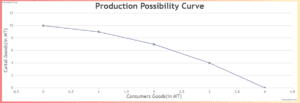
This table shows combinations, consumer goods, capital goods, opportunity cost. Here, combination A(0, 10) shows 0 MT consumer goods and 10 MT capital goods. Combination B (1,9) shows 1 MT consumer goods and 9 MT capital goods. Combination C (2, 7) shows 2 MT consumer goods and 7 MT capital goods. Combination D(3, 4) shows 3 MT consumer goods and 4 MT capital goods. Combination E(4, 0) shows 4 MT consumer goods and 0 MT capital goods.

Diagram

Production-Possibility-Curve

This figure shows that the x-axis measures consumer goods and the y-axis measures capital goods. In order to increase the production of one unit, more and more units of other goods have to be sacrificed since the resources are limited and are not equally efficient in the production of both the goods.

Conclusion

Hence, the resources are limited in order to increase the production of one good to the producer should have to sacrifice the production of other goods. The more unit of one commodity the more sacrifice of another commodity.

The shift in the PPC curve

The movement of the entire PPC form from its initial position to an inward or outward position, due to various reasons is called a shift in the PPC curve.

A rightward shift in the PPC curve

If the PPC curve moves upward due to technological progress, the discovery of natural resources, increase in the productivity of human resources, increase in the capital investment and increase in the capital formation, increase in the size of the population, etc is known as a rightward shift in the PPC curve.

Reasons for a rightward shift in PPC curve

  • Due to technological change.
  • Due to discoveries of natural resources in larger quantities.
  • Due to the increase in the productivity of labor.
  • Due to the increase in investment in capital and the increase in capital formation.
  • Due to the increase in the size of the population.

A leftward shift in the PPC curve

If the PPC curve moves backward or inward due to the backwardness in technology, shortage of natural resources, lack of capital investment, lack of machinery, lack of skilled human resources, decrease in size of the population, migration, etc is known as a leftward shift in PPC curve.

Reasons for a leftward shift in the PPC curve

  • Due to the backwardness in technology.
  • Due to the shortage of natural resources
  • Due to the lack of training for the labor.
  • Due to the decrease in capital investment.
  • Due to the decrease in the size of the population.

Division of labor

Dividing a whole task into different tasks and sub-tasks and done by separate labor according to skills, efficiency, and talent, etc is called division of labor.

Types of labor

1. Simple division of labor

If a task or work is entirely completed by a group of person then it will be known as a simple division of labor.

2. Occupational division of labor

If the people are categorized into various occupational groups like farmers, teachers, carpenters, etc then it is known as occupational division of labor.

3. Complex division of labor

Dividing a whole task into different tasks and sub-tasks and done by separate labor according to skills, efficiency, and talent, etc is called complex division of labor.

4. Territorial or Geographical division of labor

If some part of the country is specializing in the production of some goods it is known as territorial or geographical division of labor.

The advantages of the division of labor

  • The right person is in right place.
  • Increase in production.
  • Optimum use of machinery.
  • Saving of time.
  • Development of skills.
  • Production of quality goods and services.
  • Possibility of increase in innovation.

The disadvantages of the division of labor

  • The monotony of work.
  • Loss of resposibility.
  • Limited skills.
  • Workers become dependent.
  • Possibility of unemployment.
  • Possibility of over-production.
  • Possibility of decrease in productivity.

Specialization of labor.

The process of concentrating on and becoming an expert in a particular field, subject, or skills is a specialization of labor.

Advantage specialization of labor.

  • Specialization in a particular task, the small job allows workers to focus on the part of the production process so they will be better at some jobs than at others.
  • Workers who specialize in certain tasks often learn to produce quickly and with higher quality.
  • Specialization allows businesses to take the advantage of economies of scale, which means that increases the level of output and decreases the average cost of individual units.
  • Specialization of labor allows for big problems to be tackled with the efforts of many laborers.

Economic system

Economy is the system or the set of all activities related to production, consumption, and trade of goods and services in an area.

Types of economy

There are three types of economy. They are:-

  • Market economy.
  • Socialist economy.
  • Mixed economy.

1. Market economy

The market economy is also known as a capitalist economy or free enterprise economy. In a market economy, all economic activities like production, consumption, distribution, exchange, etc are organized and carried out by private sectors and guided by profit motive through the market forces – demand and supply.

Market forces determine what to produce, how to produce, and whom to produce. Demand or supply of resources determines their respective share in total income. Similarly, demand for and supply of goods and services determine the equilibrium price and quantity in the market. There is no extra tax or subsidy on goods and services. Consumers are free to decide their consumption or saving. There is no control over consumption level from the side of the government. Individuals can conduct international trade themselves. There is no control over export and import. The private sector is the backbone of economic development.

Hence, Government is the monitor and supervisor of the economy, US, UK, Japan, Germany are the example of a market economy.

Features of market economy

  • Economic activities are carried out by private sectors.
  • Existence of market mechanisms.
  • Consumer’s right.
  • Limited role of government.
  • Right of private property.
  • Self-interest.
  • No private monopoly.
  • Class conflict.

The advantages of the market economy.

  • Freedom of consumer.
  • Mobility of factor of production.
  • Efficient allocation of resources.
  • Perfect competition.
  • Technological innovation.

The disadvantages of the market economy.

  • Creates economic inequality.
  • Private sector domination.
  • Profit motive.
  • Possibility of illegal trade.
  • Possibility of production and consumption of harmful goods.
  • Neglects the production of public welfare goods.

2. Socialist economy

An economy in which all the economic activities are carried out by the central government for public welfare is called a command economy. A socialist economy is also known as a controlled economy or planned economy. In a socialist economy, resources are controlled by the state or government through the central planner.

In a socialist economy, all the wages, rent, interests, and profit are fixed by the government. The government decides what to produce, how to produce, and whom to produce. There is no existence of private property. In this economy, people are not guided by self-interest. They are guided by the interest of the nation. All the prices are set by the government since there is no private sector.

Hence, consumers are not free to choose goods and services for consumption. The government manages all economic activities. Some of the examples of socialist economies are North Korea, China, and the Former Soviet Union.

Features of a socialist economy

  • Public ownership of factor of production.
  • Social welfare.
  • No existence of market mechanisms.
  • Government has the absolute right to decision-making.
  • No existence of private sector.
  • No choice of the consumer.
  • Economic equality.
  • Class conflict.

Advantage of a socialist economy

  • Equal distribution of income.
  • Optimum use of all the resources.
  • Social welfare.
  • Long-term growth of the economy.
  • Better national security.

Disadvantage of a socialist economy

  • Barriers to the private sector.
  • Lack of competitiveness in the economy.
  • No consumers right.
  • Possibility of misuse of resources.
  • Lack of freedom.

3. Mixed economy

An economy in which economic activities are partly conducted by the government and private sector is called a mixed economy.

A mixed economy consists of both features of a socialist economy as well as a capitalist economy. Both government and private sector work together in this mixed economy. Major roles of the government are: providing security, supplying money, maintaining law and order, developing infrastructure, and so on. The private sectors are free to do their activities under the rules and regulations of the government.

Hence, production and distribution are managed and controlled by private sectors for the purpose of self-interest and profit earnings. The government sector prepares and implements policy instruments to control and regulate private enterprises directly and indirectly. Some of the examples of mixed economies are Nepal, India, Pakistan, Bangladesh, etc.

Feature of a mixed economy

  • Public-private ownership.
  • The majority of the economic activities are organized and carried out by the private sector.
  • Government plays the role of facilitator.
  • Consumers freedom.
  • Better allocation of resources by a public-private partnership.
  • Limited government intervention.
  • Price mechanisms and controlled price.
  • Profit motive and social welfare.

Advantage of mixed economy

  • The private sector is guided by the profit motive and self-interest.
  • Freedom and human rights.
  • Relatively equal distribution of income and optimum use of resources.
  • Check and balance by the government.
  • The government provides basic necessities like water, electricity, telephone, etc.

Disadvantage of a mixed economy

  • Possibility of high corruption.
  • The economy may be dominated by the big private sector.
  • Unwanted competition between private and public businesses.
  • Delay in decision-making by the government


Market and Revenue Curves

Market

A market is a place or process where buying and selling of goods and services take place.

Classification of Market

1) Perfect Competition Market

A market system in which a large number of sellers sell a homogeneous product to a large number of consumers
is known as perfect competition.

Features

  • There are a plenty of buyers and sellers.
  • All the firms in this market sale the homogenous product.
  • There is free entry and exit of firms.
  • There is free mobility of the factor of production.
  • The objective of the firm is profit maximization.
  • The market is completely understood by both buyers and sellers.

2) Monopoly Market

Monopoly is a market system in which there is only one product supplier and a high number of customers.

Features

  • There are a lot of buyers and just one seller.
  • There are no close substitutes or items available on the market.
  • There is a strong barrier to enter the new firms into the industry.
  • Monopoly firms are called price maker.
  • The profit motive is the firm’s goal.
  • Monopolists use a pricing discrimination policy.

3) Imperfect Competition Market

I) Duopoly

Duopoly refers to market arrangements in which there are only two sellers of a product.

II) Oligopoly

Oligopoly is a market in which there are few sellers and numerous customers.

III) Monopolistic Competition

The market structure in which a big number of sellers sell differentiated heterogeneous items to a large
number of consumers is referred to as monopolistic competition.

Revenue

Revenue is the monetary value obtained by a company or industry through the selling of goods and services.

Total Revenue

Total revenue is the total amount of sales receipts or money value collected by a business or industry from
the sale of varied amounts of goods within a certain time period.

Average Revenue

The average revenue of a product is the revenue per unit of a product. The ratio of total revenue to quantity
is known as average revenue.

Marginal Revenue

Marginal revenue is the additional income received by a company or industry by selling one more unit of
production. Marginal revenue is defined as the ratio of change in total revenue to change in quantity.

Nature under perfect competition market

  • TR rises at a constant rate in a perfect competitive market since the product’s price remains constant.
  • In a market with perfect competition, MR remains constant.
  • In a market with perfect competition, AR remains constant.

Nature under monopoly market

  • In a monopolistic market, TR first grows at a decreasing rate, then reaches a maximum and begins to fall as
    the price of the commodity falls as the selling amount increases.
  • MR stays constant in a monopolistic market.
  • In a monopolistic market, AR falls as the price of products and services rises. AR can never be 0 or
    negative.

TR, MR and AR curve under perfect competition market

Table

UnitsPriceTRARMR
15555
251055
351555
452055
552555
653055
753555

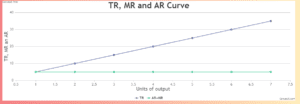
The units of several commodities are shown in the table above. The table also displays the price, TR, MR, and
AR. In a perfect competitive market, the commodity price remains constant. TR is the product of the price and
the number of units. TR and units are averaged to form AR. The MR is the ratio of the change in TR to the
change in quantity.

Diagram

tr ar and mr curve

The y-axis in the above table represents TR, MR, and AR, while the x-axis represents the units of output. In
this case, TR increases at a constant rate while MR and AR stay constant.

Relationship between TR, AR, and MR under perfect competition market

  • TR rises at the same rate as AR or MR at all levels of sales. It specifies that TR, AR, and MR are all equal
    for the first unit of sale.
  • For all levels of sales, AR and MR are equal and consistent.
  • AR and MR are equivalent to the price.

TR, MR and AR curve under monopoly market

Table

UnitsPriceTRMRAR
110101010
291889
382468
472847
563026
653005
7428-24

The above table shows the units of many commodities. The pricing, Total Revenue (TR), Marginal Revenue (MR),
and Average Revenue (AR) are also included in this table (AR). In a monopolistic market, the price of a
commodity declines. Total Revenue (TR) is calculated as the total of price and unit sales. Average Revenue is
calculated by dividing Total Revenue (TR) by the number of units sold (AR). The ratio of the change in Total
Revenue(TR) to the change in quantity is known as the margin of revenue (MR).

Diagram

The y-axis in the following table indicates Total Revenue (TR), Marginal Revenue (MR), and Average
Revenue(AR), while the x-axis represents the units of output. Total Revenue (TR) rises at a decreasing rate
until it reaches its maximum and begins to drop, whereas Average Revenue (AR) decreases but never becomes 0
and Marginal Revenue (MR) not only decreases but also becomes 0 and negative.

Relationship between TR and MR under monopoly market

  • When TR increases at decreasing rate MR is positive.
  • When MR becomes zero, TR reaches at its maximum.
  • When MR becomes negative, TR starts to decrease.
  • The decreasing and increasing rate of TR is equal to MR.

Relationship between AR and MR under monopoly market

  • AR and MR have positive relationship. A decrease in MR cause to decline in AR.
  • The decrease in MR is greater than the decrease in AR.
  • MR might be negative; however, AR always remains positive.
  • MR curve lies below the AR curve and halfway on the perpendiculars drawn from AR to the y-axis.

Numerical Problems.
1. a) Considered the following table.

UnitsPriceTRMRAR
110101010
281668
361826
4416-24
5210-62

b) What types of market is this?

This is a monopoly market.

Diagram

2. a) Considered the following table.

UnitsPriceTRMRAR
120202020
220402020
320602020
420802020
5201002020

b) What types of market is this? Why?

This is a Perfect Competition Market because price remains constant in perfect competiotion
market.

c) Diagram

3. a) You are given following table:

UnitsPriceTRMRAR
110101010
210201010
310301010
410401010
510501010
610601010
710701010

b) Plot TR, MR and AR in Graph

c) What type of market is this?

This is a perfect competition market.

d) What is the nature of TR curve?

TR curve increases at constant rate.

4. a) Consider the following table:

UnitsPriceTRMRAR
110101010
291889
382468
472847
563026
653005
7428-24

b) Plot TR, MR and AR in Graph

c) What type of market is this?

This is a monopoly market.

Cost and Cost Curves

Basic concept of Cost
Cost

The sum of the price paid to the inputs like rent, interest, wages, and other by producer to produce goods and services is known as cost

1. Money cost

The value of payment made in terms of money to the inputs used in the production in the form of rent, wages, salaries, allowences, profit, interest and price of raw materials is known as money cost.

2. Real cost

Real cost is a sacrifice made by the producer while producing goods and services. For example, Discomfort, pain are some examples of real cost.

3. Accounting cost

Cost which are necessary for accounting purposes is known as accounting cost.

4. Explict cost

The monetary payment of cash expenditure which a firm makes to those inputs which are not owned by the firm itself are called explict cost.

5. Implict cost

Implict cost ia the contribution made by the producer and his/her family members but not paid to them in monetary terms.

6. Economic cost

Economic cost is the aggregate of explict cost and implict cost.
Economic cost = Explict cost + Implict cost

Short-Run cost

Short-run is a time interval, which is too short to change all factor of production. It means all factor of production are not variable in short-run. Some factors are fixed and some are variable. Cost incurred on both fixed and variable factor of production in the short-run is known as short run cost.

Fixed cost

The cost incurred on the fixed factor used in the process of production is known as fixed cost. In other words, fixed cost are those cost which in total do not change with any changes in output.

Variable cost

Variable cost is the cost incurred on the purchase of variable factors used in the production. In other words, variable cost are those cost which vary directly with production.

Total cost

The overall amount of cost incurred by the producer while producing various units of goods and services in given time period is called total cost.
i.e. TC = TVC + TVC

Marginal cost

Marginal cost is the additional cost on total added by the production of one more unit of output.
Marginal cost is defined as the change in total cost resulting from one unit change in the level of output produced.
Mathematically,
MCn = TCn – TCn-1

Average cost

Average cost is per unit cost of production. Average cost, at each level of output is calculated by dividing total cost by the corresponding level of output/production. Mathematically,
AC = 

TCQ


Short-Run Total cost
1. Total Fixed cost (TFC)

The total amount of cost incurred on the fixed factor in short-run in the production process is known as total fixed cost. The total fixed cost remains constant whatever be the level of output, i.e. zero or more.

2. Total Variable cost (TVC)

The total amount of cost incurred on the variable factors in short-run is known as total variable cost. TVC remains at zero at zero level of output and it increases with increase in output.

3. Total cost (TC)

Total cost is self-defining. It is the sum of total fixed cost and total variable cost at each level of output or production.
Therefore,
TC = TFC + TVC

Table

QuantityTFCTVCTC
010010
1101020
2101828
3102434
4102838
5103444
6104252
7105262

Diagram

Nature

  • TFC remains the same whatever the output level, so TFC curve will parallel to x-axis.
  • TC and TVC always have inverse s-shape due to the apply of law of variable proportion.
  • TVC and TC curves are parallel to each other because the gap between TVC and TC is TFC which remains constant.

1. Average Fixed cost

  • Average fixed cost is the outcome of total fixed cost divided by the unit of a commodity.
  • Average fixed cost is the per unit fixed cost of the output.
  • Average fixed cost goes on decreasing with the increase in output level but it is always positive.
  • Average fixed cost takes the shape of L.

Mathematically,
AFC = 

TFCQ


2. Average Variable cost

  • Average variable cost is the outcome of total variable cost divided by the level of output.
    i.e. AVC = 
    TVCQ


  • At first, AVC decreases then reaches at maximum point and starts to increase.
  • It takes the shape of U.

3. Average cost

  • Average cost is the outcome of total cost divided by the level of output.
    i.e. AC = 
    TCQ


     or AC = AFC + AVC

  • AC is the summation of Average Fixed Cost and Average variable cost.
  • Average cost is the per unit cost of the output.
  • At first, AC decreases, then reaches at maximum point and starts to increase.
  • It takes the shape of U.

Table

QuantityTFCTVCAVCAFCAC
11525252045
21540201030
31545156.6721.67
4155614519
5157515419
615120203.3323.33
715175252.8527.85

In this above table it shows units, average variable cost, average fixed cost, average cost, total cost and total variable cost where TFC is constant while TVC is increasing at decreasing rate and then it is increasing in increaing rate and AVC is determined by the TVC and units and AFC is determined by the TFC and units and AC is the sum of AVC and AFC.

Diagram

In this table, x-axis represents units y-axis represents AVC, AFC and AC and AVC takes the shape of U while AFC is taking the shape of english letter L.

Reason behind U-shaped AC curve/SAC curve

In the short run production process law of variable proportion operates. According to this law, At first, TP increases at increasing rate while TP of a firm increases at increasing rate. Total cost of firm increases at decreasing rate in this situation per unit production (AC) declines. So, At first SAC curve slopes downward after the certain output level TP increases at the decreasing rate in this situation total cost of the firm increases at the increasing rate and per unit cost also increases by this reason SAC slopes upward and takes the shape of English letter U.

Marginal Cost (MC)

  • Change in total cost due to one unit change in output level is known as marginal cost.
  • Marginal cost is the additional cost on total cost added by the production of one more unit of output.
    i.e. MC = TCn – TCn-1

Table

UnitsTCMC
15050
27020
38010
4855
59510
611520
714530

The given above table shows the units, total cost (TC) and marginal cost (MC). Here, TC first increasing at increasing rate then it is increasing at decreasing rate and MC is the change in TC.

Diagram

In this table, x-axis measures the units and y-axis measures the marginal cost. Marginal cost always takes the shape of U.

Relation between AC and MC curve

  • When AC is decreasing MC lies below the AC.
  • When AC is increasing MC lies above the AC.
  • MC cuts AC from minimum point of AC.
  • The decreasing and increasing rate of MC is faster than AC

Theory of price and output determination

Equilibrium

Equilibrium is a state of rest, where two opposing forces are in balance.

Equilibrium condition of the firm under TC-TR approach in perfect competition.