
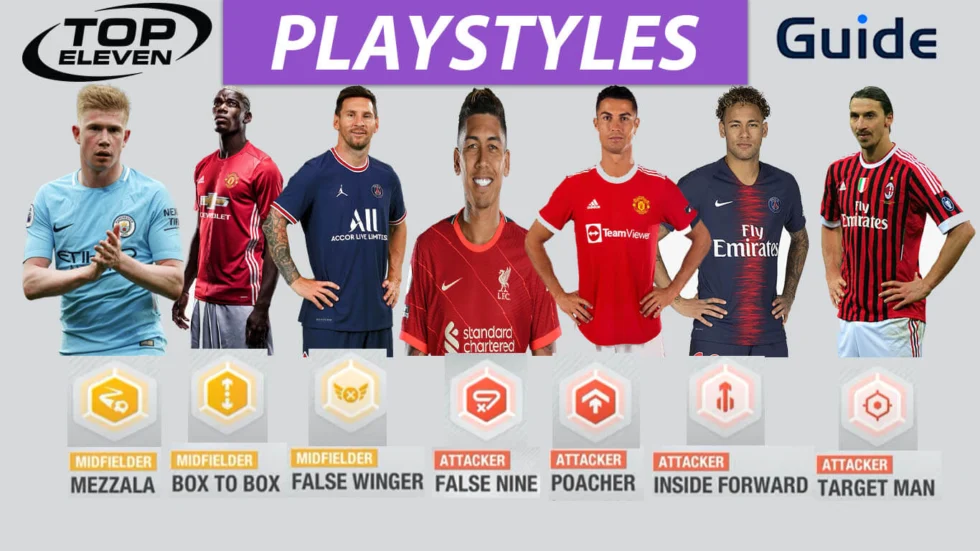
Top Eleven Playstyles
In Top Eleven Football Manager, a player's playstyle defines their individual playing behavior. There are different playing styles in the game such as Box-to-Box, Mezzala, Regista, False Wingers, Target Man, Full Back, Wing Back, Stopper, Sweeper Keeper, Poacher, and more.
MIDFIELD ROLE VISUALIZER
PITCH POSITIONING & HEATMAP
POSITION: MCSIMPLE DIFFERENCE AT A GLANCE
BOX-TO-BOX
Position: MC
Real Box-to-Box Players: Paul Pogba / Steven Gerrard / Frank Lampard / Bastian Schweinsteiger / Yaya Touré
Present in a large area of the field, the box-to-box MC appears wherever needed, supporting other midfielders. He can take part in both attacking and defending plays. Moves between defensive and attacking areas, supports teammates, makes forward runs, helps recover possession, and arrives in the opponent's box when opportunities arise.
Formations that fit Box-to-Box:
Advantages:
Disadvantages:
A Box-to-Box MC is an all-around midfielder who constantly moves between defense and attack, helping wherever the team needs him.
Attacking Role Visualizer
Understand how different attacking roles move, create space, contribute to build-up play, and threaten the opposition.
Poacher
A Poacher is a striker who specializes in finding and exploiting scoring opportunities inside and around the penalty area. Rather than dropping deep or becoming heavily involved in build-up play, he stays close to the opposition's defensive line, anticipates rebounds, loose balls, crosses, and defensive mistakes, and makes sharp movements into dangerous scoring positions.
Formations that fit Poacher
Advantages
- Excellent positioning inside the penalty area.
- Highly effective at finishing chances.
- Makes intelligent runs behind defenders.
- Excellent at reacting to rebounds and loose balls.
- Can exploit defensive mistakes.
- Constantly threatens the opponent's defensive line.
- Doesn't require many touches to score.
Disadvantages
- Limited involvement in build-up play.
- Usually contributes less defensively.
- Can become isolated if the team cannot create chances.
- Less effective when forced to play far from the penalty area.
- Relies heavily on service from teammates.
False Nine
A False Nine starts as the team's central striker but frequently drops into deeper midfield areas instead of staying on the opposition's defensive line. This movement can pull center-backs out of position, create space behind them for wingers or attacking midfielders, and allow the False Nine to participate in playmaking and combination attacks.
Formations that fit False Nine
Advantages
- Creates numerical superiority in midfield.
- Pulls opposing center-backs out of position.
- Creates space for wingers and inside forwards.
- Excellent for combination play.
- Can create chances through passing and movement.
- Makes the team's attack difficult to predict.
- Can score by arriving late into the penalty area.
Disadvantages
- Can leave the penalty area without a traditional striker.
- Requires attacking players to make runs beyond him.
- Can reduce the team's presence in the box.
- Less effective if teammates don't exploit the space created.
- Requires excellent passing, vision, movement, and decision-making.
Target Man
A Target Man is a physically strong striker who acts as a focal point for the team's attack. He uses his strength, height, aerial ability, and ball control to receive long passes and crosses, hold up the ball under pressure, and bring teammates into play. He can also attack crosses and score directly inside the penalty area.
Formations that fit Target Man
Advantages
- Strong aerial presence.
- Excellent at holding up the ball.
- Provides a reliable outlet under pressure.
- Can win aerial duels against defenders.
- Brings midfielders and wingers into the attack.
- Effective against teams defending deep.
- Dangerous from crosses and set pieces.
- Can protect the ball while teammates move forward.
Disadvantages
- May lack the pace of a mobile striker.
- Can struggle against fast and aggressive defenders.
- Requires good service from teammates.
- Can become isolated if the team sits too deep.
- Less effective when the team relies heavily on quick transitions.
- Can make the attack predictable if the team relies too heavily on long balls.
False Winger
Deployed in a wide midfield position, the False Winger moves inside toward the central areas of the pitch rather than staying close to the touchline. By moving centrally, he creates an extra midfielder, helps overload the opposition in the middle, and can pull defenders out of position. This movement also creates space for the team's full-back to overlap on the outside.
Formations that fit False Winger
Advantages
- Creates a numerical advantage in central midfield.
- Helps the team control possession in the middle.
- Pulls opposition players out of their defensive positions.
- Creates space for overlapping full-backs.
- Provides an additional passing option between the lines.
- Can create chances through central combinations.
- Makes the team's attacking structure less predictable.
Disadvantages
- Can leave the wide area exposed.
- Creates space for opponents to attack on the flank.
- Requires the full-back to provide width.
- Can overcrowd the centre if other midfielders also move inside.
- Less effective if the team lacks a wide player or full-back to maintain width.
- Requires good tactical awareness and positioning.
Defensive Role Visualizer
Understand how different defensive roles position themselves, defend space, support build-up play, and transition between defense and attack.
Sweeper Keeper
A Sweeper Keeper is a goalkeeper who actively operates outside his penalty area when necessary, particularly when his team plays with a high defensive line. He acts as an additional defensive player behind the back line, coming off his line to intercept through balls, clear danger, and support build-up play with his passing.
Formations that fit Sweeper Keeper
Advantages
- Covers space behind a high defensive line.
- Can intercept through balls before attackers reach them.
- Helps defend against balls played over the defense.
- Provides an additional passing option during build-up.
- Can start attacks with accurate distribution.
- Allows defenders to maintain a higher position.
- Helps the team maintain possession.
Disadvantages
- Risky if he misjudges his position.
- Can be vulnerable to long-range shots when outside the box.
- Requires excellent decision-making.
- Mistakes outside the penalty area can lead directly to goals.
- Needs strong ball control and passing ability.
Stopper
A Stopper is a center-back who actively steps out from the defensive line to confront attackers, challenge for the ball, and prevent opponents from receiving or turning in dangerous areas. Instead of simply holding the defensive line, the Stopper aggressively closes down forwards and midfielders while his defensive partner provides cover behind him.
Formations that fit Stopper
Advantages
- Aggressively closes down dangerous attackers.
- Strong in tackles and physical duels.
- Can disrupt attacks before they develop.
- Effective against physical forwards.
- Wins aerial and ground challenges.
- Can step into midfield to intercept passes.
- Provides aggressive defensive pressure.
Disadvantages
- Can leave space behind the defensive line.
- Risky if he steps out at the wrong time.
- Can be exposed by quick attackers running into the space behind him.
- Requires a defender who can provide cover.
- Can leave the defensive shape unbalanced.
Full-Back
A Full-Back is a wide defender who primarily protects the team's defensive line and covers the flanks. He supports the attack when appropriate through overlapping runs, passing, and crosses, but his first responsibility is maintaining defensive stability. Full-Backs are especially important when the team needs to balance attacking width with defensive protection.
Formations that fit Full-Back
Advantages
- Provides reliable defensive coverage on the flank.
- Tracks and marks opposing wingers.
- Maintains the defensive shape.
- Can overlap to support attacks.
- Provides width when needed.
- Can deliver crosses into the box.
- Helps transition quickly between defense and attack.
- Can support the center-backs when defending.
Disadvantages
- Can be exposed when pushing too far forward.
- Requires good positioning and defensive awareness.
- Can struggle against very fast wingers.
- May become isolated in wide defensive areas.
- Excessive overlapping can create space for counter-attacks.
Wing-Back
A Wing-Back operates higher and wider than a traditional Full-Back, taking on a major attacking and defensive role along the entire flank. With fewer traditional wide attackers ahead of him, the Wing-Back provides width, makes forward runs, delivers crosses, and supports attacks while still being responsible for recovering into the defensive line.
Formations that fit Wing-Back
Advantages
- Provides constant width on the flank.
- Can push high into attacking areas.
- Creates numerical advantages on the wings.
- Makes overlapping and underlapping runs.
- Provides crosses and cut-backs.
- Can effectively support attacking transitions.
- Gives the team an additional attacking player.
- Can stretch the opposition's defensive shape.
Disadvantages
- Large physical demands due to covering the entire flank.
- Can leave space behind when attacking.
- Vulnerable to counter-attacks if possession is lost.
- Requires high stamina and work rate.
- Needs defensive awareness when recovering.
- Can leave the team exposed if the opposite Wing-Back also pushes forward.
- Works best with a back three or adequate defensive cover.
Great.. Good Job
Along with everything that appears to be developing inside this specific area, all your points of view are actually somewhat exciting. However, I am sorry, but I do not subscribe to your whole suggestion, all be it exhilarating none the less. It seems to everyone that your remarks are not totally rationalized and in reality you are your self not really totally confident of your point. In any event I did enjoy reading it.
Great description. I look forward to the next positions if they come.
Updated. Please check