

Rabindra Bhattarai (रविन्द्र भट्टराई)
Author, Share Market Analyst
Education: Master’s in Finance & Investment, Tribhuvan University; post-graduate in Financial Planning, George Brown College (Canada); Canadian Securities Course.
Teaching: Taught finance and investment at Shanker Dev Campus (TU) for 13 years.
Work: One of the first people in Nepal to run share-market awareness training, which he has taken to many parts of the country. He has written 10+ books on shares, including Nepal ko Share Bazar, Share Mantra and Bittiya Swatantrata.
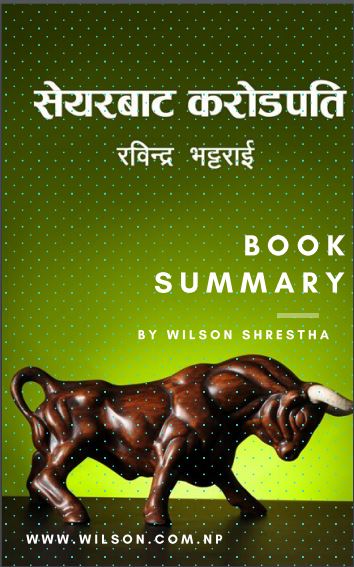
Share Bata Karodpati (सेयरबाट करोडपति, “Crorepati from Shares”) is a Nepali personal-finance book by share analyst Rabindra Bhattarai. Its message is simple: you do not need a large starting capital to build wealth. With patience, regular saving and about two hours of study a day, a small investor can grow thousands into lakhs, and lakhs into crores, through the share market. This Share Bata Karodpati book summary covers the book’s core money lessons and then updates its “how to enter the stock market” section with the rules that apply in Nepal in 2026.
Key takeaways in 30 seconds
- Don’t be a slave to money; make money work for you. That is the book’s central conclusion.
- Start early. Time does more of the work than the size of your investment.
- Learn before you invest, and don’t buy shares of whatever company comes along.
- Beginners should start with IPOs (primary market), then move to NEPSE (secondary market).
- Today everything is online: Demat, MeroShare, C-ASBA for IPOs, and TMS for trading.
Share Bata Karodpati: Book at a Glance
| Detail | Information |
|---|---|
| Title | सेयरबाट करोडपति (Share Bata Karodpati) |
| Author | Rabindra Bhattarai |
| Publisher | FinePrint |
| Language / genre | Nepali / self-help, personal finance |
| Launched | 12 Jestha 2073 (May 2016) in Kathmandu, by novelist Amar Neupane, SEJON chair Gokarna Awasthi and the author |
| Editions | Several reprints; Thuprai lists a 6th edition paperback (ISBN 9789937790147) |
| Formats | Paperback and e-book (Thuprai, Sept 2026: Rs 450 paperback, Rs 300 e-book) |
| Best for | First-time and small investors who want to understand shares in plain Nepali |
Part 1: How to Earn Money Without Working for It
The first half of the book is about mindset. Bhattarai argues that most people stay stuck because they only ever work for money. The way out is to climb, step by step, until money, knowledge and systems are doing the work for you.
1. Let money work for you
If you never put your money to work, you will spend your life working for someone else to earn it. The share market is one place where your money can earn for you through dividends, bonus shares and price growth.
2. First, work for money
At the start, most of us have nothing to invest. So the first step is ordinary: earn through a job or business, cover your expenses, and set aside savings that can later be invested.
3. Invest early, retire early
The book compares investors to sportspeople, who start earning young and retire early. The earlier you start, the longer compounding has to work, as the chart below shows.
In this example, the person who starts at 25 invests only Rs 6 lakh, less than half of the late starter, yet ends up with nearly twice as much. That is the “karodpati” effect the title points to. Note: the 10% return is an assumption used only to show how compounding works. It is not a forecast of NEPSE returns, which rise and fall from year to year.
4. Prefer business to a job
A job gives a fixed income for a limited period. A business has no fixed income, but it can keep earning for a very long time, even across generations. Owning shares makes you a part-owner of a business.
5. Let knowledge work
Investment in knowledge pays the best interest. At the book’s launch, Bhattarai advised investors not to put money into just any company that is on offer. Study a company before you buy it.
6. Let systems work
Build a business or income source that runs without you having to be there every day. That is what financial freedom looks like.
7. Let technology work
If technology can replace manual work, use it. In 2026 this applies directly to investing: IPO applications, share transfers and trading are all done online.
Part 2: How to Enter the Stock Market in Nepal (Updated 2026)
The book explains the two doors into the share market. The ideas still hold, but the paperwork has changed a lot since 2016. Here is the updated version.
Primary market (IPO)
When a company sells new shares to the public for the first time, it is called an initial public offering (IPO). The book recommends that beginners start here because it is simple and the risk is lower than trading. IPO shares are usually issued at Rs 100 each, and the minimum application is normally 10 units (Rs 1,000). When an issue is oversubscribed, shares are allotted by lottery.
Secondary market (NEPSE)
Once shares are listed, investors buy and sell them among themselves through brokers on the Nepal Stock Exchange (NEPSE), the country’s only stock exchange. NEPSE opened its trading floor on 13 January 1994 and had 263 listed companies as of March 2026. Note: investors do not have to “enlist” anything with NEPSE. Companies get listed; you only need a Demat account and a trading account with a broker.
The Accounts You Need, Step by Step
The original book listed paper forms. Today the process is digital and follows this order:
| Account | What it does | Where / cost (approx.) |
|---|---|---|
| Demat account | Holds your shares electronically. You receive a 16-digit BOID. | Any Depository Participant (DP) under CDS and Clearing Ltd. (CDSC). Opening fee is about Rs 50 and renewal Rs 100 a year; charges vary slightly by DP. |
| MeroShare | CDSC’s online portal to apply for IPOs, see holdings and approve sales (EDIS). | meroshare.cdsc.com.np. Rs 50 registration and Rs 50 yearly renewal. |
| C-ASBA / CRN | Lets your bank block (not deduct) the IPO amount from your account. The CRN links your bank to MeroShare. | Your bank. Some banks charge a small fee per application. |
| Trading (TMS) account | Needed to buy and sell listed shares on NEPSE. | A SEBON-licensed broker. NEPSE had 90 member brokers as of October 2024. |
Documents usually needed: citizenship certificate copy, a recent photo, a bank account in your own name and a filled KYC form. Many banks and brokers now let you complete KYC online. Your bank account name must match your Demat name exactly, or IPO applications will be rejected.
One broker, one account: As the book says, a trading account belongs to one broker. To trade through a second broker, you open another account with that broker.
For a detailed walkthrough, read our step-by-step guide to opening a Demat account in Nepal.
How to apply for an IPO on MeroShare
- Log in to MeroShare with your DP, username and password.
- Open My ASBA and choose the open issue.
- Enter the number of units, your bank and your CRN.
- Confirm with your transaction PIN. The bank blocks the amount.
- After the lottery, allotted shares go to your Demat. If you are not allotted, the blocked amount is released.
NEPSE Trading Hours and Settlement (T+2)
Since April 2026, NEPSE trades Monday to Friday, following the government’s move to a Saturday-Sunday weekend. The regular session runs from 11:00 AM to 3:00 PM, after a short pre-open session. Trades settle on a T+2 cycle:
When you sell, remember to authorise the transfer through EDIS in MeroShare, or the settlement can fail.
What Buying and Selling Shares Costs
Every trade carries three charges: broker commission, a SEBON fee of 0.015% and a DP charge of Rs 25 per company. Commission falls as the trade size grows:
Worked example: buying shares worth Rs 1 lakh
Broker commission 0.33% = Rs 330
SEBON fee 0.015% = Rs 15
DP charge = Rs 25
Total cost = Rs 370 (about 0.37% of the trade). Selling adds the same charges, plus capital gains tax if you made a profit.
Capital gains tax (CGT) changed twice in 2026
CGT is charged only on profit when you sell, and it is deducted during settlement. For individual investors, the rate depends on how long you held the shares:
The FY 2083/84 budget raised both rates by 2.5 points from Shrawan 2083 and made CGT on listed shares the final tax. In September 2026 the government cut them to 5% for shares held 365 days or less and 3.75% for shares held longer, as published in the Nepal Gazette. Some news outlets reported the long-term rate as 3.5%, so check the current rate with your broker or CDSC before you sell. Either way, the book’s advice to hold for the long term is also the tax-efficient choice.
Is Share Bata Karodpati Still Worth Reading in 2026?
Yes, for the mindset. The lessons on saving first, starting early, learning before investing and letting money work are timeless, and they are explained in simple Nepali. The procedures in the book, such as paper forms and older fee rates, have changed, so pair it with the updated steps above.
| Topic | In the book (2016) | In 2026 |
|---|---|---|
| IPO application | Physical forms with photo and citizenship | Online via MeroShare with C-ASBA and CRN |
| Trading | Mainly through the broker’s office | Online through the broker’s TMS |
| Trading days | Sunday to Thursday | Monday to Friday (since April 2026) |
| Selling shares | Broker handles transfer | You approve via EDIS on MeroShare; settles T+2 |
| CGT (individuals) | Lower flat rates | 5% up to 365 days, 3.75% beyond (Sept 2026) |
Before you invest
Share prices can fall as well as rise, and past returns do not guarantee future ones. This summary is for education only and is not financial advice. Invest money you will not need for several years, and spread it across companies and sectors.
Frequently Asked Questions
Who wrote Share Bata Karodpati?
Rabindra Bhattarai, a Nepali share market analyst who taught finance and investment at Shanker Dev Campus for 13 years and has written more than 10 books on the share market.
What is the main lesson of Share Bata Karodpati?
Don’t become a slave to money; make money work for you. The book shows how a small investor can build wealth over time through the share market with patience and study.
Where can I buy the book?
It is published by FinePrint and sold in bookshops across Nepal. It is also available online on Thuprai as a paperback and an e-book.
How much money do I need to start investing in Nepal?
An IPO application usually starts at 10 units, which is Rs 1,000 at the common Rs 100 issue price. You also need a bank account, a Demat account and MeroShare, which have small yearly fees.
Is the book suitable for complete beginners?
Yes. At the launch, SEJON chair Gokarna Awasthi said the book presents the share market in simple language and is useful for small investors and people just starting out.
Sources
- Thuprai: Share Bata Karodpati and author profile
- Bizshala: book launch report (May 2016)
- Nepal Stock Exchange (Wikipedia) and nepalstock.com
- Arthikpati: NEPSE to open on Fridays (April 2026)
- Onlinekhabar: broker commission and tax rates
- Ratopati/RSS: CGT raised in FY 2083/84 budget
- Bajarko Chirfar: CGT cut published in Gazette (Sept 2026)
- The Rising Nepal: number of brokers reaches 90
- CDS and Clearing Ltd. and MeroShare
Last updated: 27 September 2026. Rates and rules change often; always confirm with SEBON, NEPSE, CDSC or your broker.
good
Next