
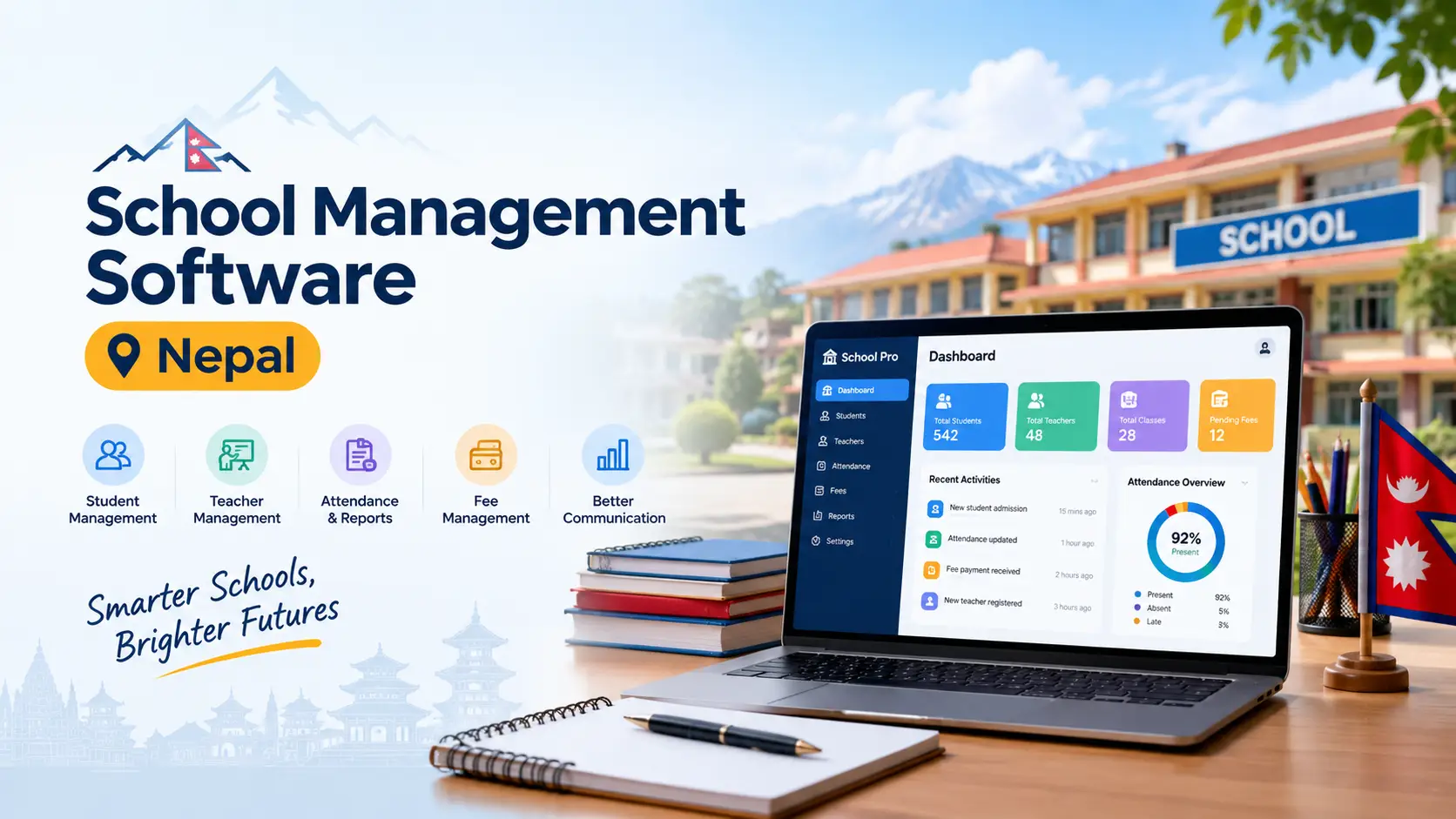
School Management Software in Nepal (2026): 8 Options Compared, Real NPR Costs and the Fee Rules Your Billing Must Follow
Updated 1 November 2026 (Kartik 2083) • Covers academic session 2083 and FY 2083/84 • Based on Ministry of Education notices, the Fee Determination Directive 2072, IRD notices and vendors’ own published material
Most “best school management software in Nepal” pages are written by a software company that ranks itself first. That is not much help when you are a principal or school accountant trying to decide where five years of student records, fee ledgers and exam results will live.
The decision also got more serious this year. In Chaitra 2082 and Baishakh 2083 the Ministry of Education warned private schools against advance admissions and unapproved fees, ordered refunds, and reminded them that fees may only be charged under the headings in the Fee Determination Directive 2072. Then the FY 2083/84 budget added a 3% “education equity fee” on student fees, which the government suspended in July after a public backlash. Your fee module is no longer just a convenience. It is the place where those rules either hold or break.
This guide compares the main school management software in Nepal, works out what each pricing model really costs in rupees over three years, explains the fee and reporting rules a school ERP and school billing software must handle in 2083, and gives you a checklist and demo script you can take straight into a vendor meeting.
Quick answer
- Established all-rounders: Veda (Ingrails), Digital Nepal ERP and e-School (e-Zone International) are the best-known Nepal-built systems. Each claims hundreds of schools; get quotes from at least two.
- Tight budget: Vidyapith publishes a flat Rs 1,299 a month for any school size; Pathami is reported to offer a free core; Paathshala is reported to give the software free and earn through RFID student ID cards.
- Weak internet: ask for proper offline sync, not just an app that caches the timetable. InPro School markets full offline working.
- Real cost: per-student pricing (commonly Rs 10–80 per student per month) costs a 600-student school Rs 2.2 lakh to Rs 17 lakh over three years. A flat licence can be far cheaper once you pass roughly 700 students.
- Non-negotiable: fee headings and caps that match your local level’s approval, receipts that cannot be edited or deleted, eSewa/Khalti collection, IEMIS-ready data, and a full data export when you leave.
In this guide
- What school management software does
- The 2083 rules your software must handle
- 8 school software options compared
- How much it really costs (3-year maths)
- Online fee collection: eSewa, Khalti and banks
- Which type fits your school
- Buyer’s checklist and demo script
- How to switch without wrecking the fee year
- Common mistakes
- FAQs
What school management software does in a Nepali school
School management software (also sold as a school ERP, school MIS or student information system) puts the jobs your office does on paper and in Excel into one database that staff, parents and students reach through a web dashboard and mobile apps. In Nepal the term covers anything from a fee-and-receipt tool for a 150-student Montessori to a multi-campus platform with hostel, transport and payroll.
The six module groups most Nepali vendors sell. The fee module is the one that carries legal risk.
If you only need a few of these, you may not need a full ERP. A 200-student school with no buses and no hostel is usually best served by a cheap system with strong fees, attendance and report cards, rather than paying for 24 modules nobody opens.
The 2083 rules your school software must handle
Vendor brochures talk about dashboards and AI. The questions that actually protect your school are about rules. Here are the five that matter in 2083.
1. The Fee Determination Directive 2072 and the 2083 crackdown
Private schools must charge fees only as set by the Institutional School Fee Determination Standards Directive 2072, with fees approved by the local level. Ahead of the 2083 session, the Ministry said it had evidence of schools admitting students and collecting large fees before the session started, in breach of the Education Rules 2059 and a Supreme Court order of 20 Chaitra 2082. It told schools to refund advance and excess fees and to stop charging under any heading the directive does not allow.
For your software, that turns into a short list of controls the billing module should enforce or at least warn about:
| Rule in the directive (as reported) | What the fee module should do |
|---|---|
| Fees only under 14 listed headings (admission, annual, monthly tuition, exam, educational tours, meals, transport and others) | Lock the fee-head list to approved headings; log who adds a new one |
| Admission fee no more than one month’s monthly fee, charged once per student | Cap the amount; block a second admission fee for a returning student |
| Annual fee no more than two months’ approved monthly fee | Cap at 2× the class’s monthly fee |
| Exam fee no more than 50% of the approved monthly tuition fee | Cap per class; confirm how your local level reads the rule |
| Transport fee approved by two-thirds of the parents’ meeting of bus users; hostel by agreement with residential parents | Charge only students assigned to a route or hostel; store the approval date |
| No admission or fee collection before the new session begins | Block bills dated before the session start date you set |
| Excess or advance fees must be refunded | Issue a refund or credit note linked to the original receipt; never delete the receipt |
| Fine up to Rs 25,000, licence cancellation on a repeat offence | Keep an audit trail you can show a local-level inspector |
Summary of the directive’s provisions as reported by Ekantipur and Nepal News in April 2026. Your local level’s fee approval letter is the document that counts for your school.
Worked example: what the caps mean for one class
| Approved monthly tuition fee (Grade 6) | Rs 3,000 |
| Maximum admission fee (new students only, once) | Rs 3,000 |
| Maximum annual fee | Rs 6,000 |
| Maximum exam fee | Rs 1,500 |
| A Rs 8,000 “annual development charge” entered by the accountant | Should be blocked |
Illustration only. Ask every vendor to set up this exact case in the demo and show you what happens.
2. The 3% education equity fee: announced, then suspended
This is the change most school software pages have not caught up with. The timeline:
What this means for your software
If a vendor pushed an update in June that adds a 3% line to every bill, make sure it is switched off. Any amount collected after the suspension should be refunded or credited. Because “for the time being” is not the same as “repealed”, the useful feature is a configurable statutory levy line that can be turned on, set to a rate, and reported by four-month period if a future budget brings it back.
3. VAT, IRD approval and CBMS: what actually applies to schools
Many school software vendors advertise “IRD-approved billing”. It helps to know what that does and does not cover:
- Education services are VAT-exempt in Nepal. Tuition and other school fees are not VAT tax invoices, so the VAT e-billing and CBMS turnover lines (currently Rs 20 crore under IRD’s April 2026 notice, with a Rs 10 crore line announced in the budget) are aimed at VAT-registered sellers. Our Nepal VAT e-billing guide explains those lines.
- Some school income can be taxable. If your school sells VAT-able goods or services and is VAT-registered, those bills must follow VAT rules. Ask your auditor which of your income lines fall here before you decide whether IRD listing matters to you.
- Clean receipts matter either way. Your PAN, sequential receipt numbers, Bikram Sambat dates, no editing or deleting, and a cancellation trail are what auditors and inspectors check. Treat these as must-haves even if VAT does not apply.
- If you do need IRD listing, check the exact product and version against our IRD-approved billing software list and see how IRD approval works.
4. IEMIS reporting
Every school from ECED to Grade 12 must keep its data up to date in the Integrated Educational Management Information System run by CEHRD (emis.cehrd.gov.np), and local levels verify it. Municipal fee notices for 2083 have repeated the same duty. Some vendors, such as Digital Nepal, say their systems support EMIS reporting. There is no public API we could find that lets software push data straight into IEMIS, so in practice “IEMIS-ready” means the software produces enrolment, staff and other figures in the shape IEMIS asks for, saving someone a week of counting. Ask the vendor to show the actual export, not a slide.
5. Student data and the Privacy Act 2075
Your school ERP holds children’s names, birth dates, photos, family details, health notes and, increasingly, biometric data and location from bus GPS. The Individual Privacy Act 2075 treats this kind of information as personal and expects it to be collected for a stated purpose and protected. Before you sign, get in writing where the servers are, who at the vendor can see your data, how backups work, and how quickly you get a full export if you leave.
8 school management software options in Nepal compared
We have no commercial relationship with any vendor below and have not run them in a live school. School counts, features and prices come from each company’s own material, software directories and other published analyses, so treat them as claims to test in a demo. The order is not a ranking.
| Software | Who it suits | Pricing (published or reported) | Stand-out claim |
|---|---|---|---|
| Veda (Ingrails) | Mid-size to large private schools and colleges | Quote only; a directory lists a US$500 minimum | 1,300+ schools and colleges; 97.8% renewal |
| Digital Nepal ERP | Schools wanting many modules and government reporting | Quote; reported one-time licence option | 800+ institutions; 24+ modules; EMIS and CAS support |
| e-School (e-Zone International) | Schools that want to start small and add tiers | Per student: listings show Rs 10–40 per student per month by tier; free single-admin starter | eSewa/Khalti payments, biometric sync, GoN-rule payroll in higher tiers |
| Paathshala EMIS | Schools that cannot pay a licence | Reported free software, paid through smart RFID student ID cards | RFID attendance, library, canteen payments, GPS bus tracking |
| Vidyapith (VishwaPratibha IT) | Small and budget schools | Flat Rs 1,299 a month, any school size (published) | Nepali/English interface, SMS, local payments |
| InPro School | Schools with unreliable internet | Quote | Full offline sync; fast setup and support promises |
| Pathami ERP | Community and very small schools | Reported free core modules | Admission, fee billing, exams, staff roles at no licence fee |
| Vedmarg (Indian) | Schools comfortable with an Indian product | About ₹12,999 a year (roughly Rs 20,800) reported | 80+ modules at a low flat price |
Checked 1 November 2026. Prices change and many vendors quote per school; always ask for a written quote with VAT, setup and SMS shown separately.
1. Veda (Ingrails)
Veda started in 2015 and is the name most private-school principals in the Kathmandu Valley already know. Ingrails says more than 1,300 schools and colleges use it and that it keeps a 97.8% client renewal rate. It is sold as separate parts for academics, billing, finance, inventory and attendance, with apps for parents, students, teachers and school owners, plus online-class tools that it built up during the pandemic.
- Strengths: large installed base, so staff you hire may already know it; mature parent app; flexible fee groups for monthly, one-time and yearly charges.
- Check: price is not published; a published competitor analysis describes its offline mode as limited to some features. Ask which modules are in your quote.
2. Digital Nepal ERP
Digital Nepal sells a combined school management, ERP and learning platform and says it is used by more than 800 schools and colleges, with over 24 modules. It leans on government alignment: EMIS reporting, CAS grading and lesson plans, plus apps for founders, teachers, parents, students and bus drivers. Hostel, reception and bank-transaction modules are part of the range.
- Strengths: very wide module list; strong focus on reporting to authorities.
- Check: a wide list can mean you pay for modules you do not use. Ask for a module-by-module quote.
3. e-School (e-Zone International)
e-School comes from e-Zone International in Lalitpur, one of the older Nepali vendors. It is one of the few with tiered, per-student pricing in public listings: a free starter with a single admin, then paid tiers that add SMS, fee collection with eSewa and Khalti, biometric sync, transport, an LMS, custom report cards, library barcodes and, at the top, payroll set up for Government of Nepal rules.
- Strengths: you can start cheap and upgrade; clear feature tiers.
- Check: one published analysis reports a professional implementation fee of one-third of the contract amount. Per-student pricing grows with enrolment.
4. Paathshala EMIS
Paathshala is reported to give schools the software, apps, website, GPS tracking and even biometric devices at no licence cost, and to earn its money through compulsory smart RFID student ID cards that work for attendance, library and canteen payments.
- Strengths: no upfront licence; strong on attendance hardware.
- Check: the cost moves to parents through the ID card fee, which must still fit the fee directive’s headings. Leaving later means replacing every card and device. Get the per-card price and contract length in writing.
5. Vidyapith (VishwaPratibha IT)
Based in Morang, Vidyapith publishes a flat price of Rs 1,299 a month regardless of school size, covering student and staff records, attendance, fees and receipts, report cards, routine, parent and teacher portals, SMS and local payments, in Nepali and English. That is the lowest published price we found from a Nepali vendor. It is a newer product, so ask for references from schools of your size and test how support works in your busiest week.
6. InPro School
Based in Damauli, Tanahun, InPro School is reported to sell itself on full offline sync: its desktop app keeps working through internet and power cuts and syncs later. It also advertises quick deployment and short support response times. If your school is outside the big cities and the internet drops daily, this is the feature to test hardest, with any vendor.
7. Pathami ERP
Pathami is reported to offer its core modules (admission, student billing, exams and staff roles) with no licence fee. That makes it worth a look for community schools and small private schools that are still on registers. As with any free tool, ask how backups, support and data export work, and what happens to your data if the free plan changes.
8. Vedmarg (and other Indian school ERPs)
Indian school ERPs such as Vedmarg market to Kathmandu schools with dense module lists at low flat prices, about ₹12,999 a year for a full plan according to one analysis. At Nepal Rastra Bank’s fixed rate of Rs 1.60 per rupee, that is roughly Rs 20,800. The catches are local: Bikram Sambat dates throughout, NEB and SEE grade formats, Nepali-language parent communication, eSewa and Khalti instead of UPI, and support during Nepali office hours. Payment may also have to go abroad, which our guide on paying online from Nepal covers.
Others you may hear about: Smart School (Code Logic Technologies), Sajilo School Manager (Eton Technologies), GuruChela (ByteRays Technology), Easy Gurukul (Itahari), Nimble EdTech, Marpha e-School and Zefed. The same checklist applies to every one of them.
How much school management software costs in Nepal
The sticker price tells you little, because Nepali vendors use four different pricing models. The model decides your cost far more than the brand does.
Per student per month
The most common model. Quotes of Rs 20–80 per student are typical according to one Nepal buyer’s guide, and public listings for one vendor start at Rs 10. Cheap for small schools, expensive as you grow.
Flat monthly or yearly fee
One price whatever your size, from Rs 1,299 a month to Rs 1.65 lakh a year in published examples. Predictable; watch for caps on users or modules.
One-time licence plus maintenance
Pay once, then a yearly maintenance fee (15–20% is common in the market). Appeals to owners who like to own assets; check how updates for rule changes are handled.
Free software, paid hardware
Software at no charge, paid for through RFID ID cards or devices. Low upfront cost, high switching cost.
Three-year licence cost for a 600-student school
Here is what the published and quoted price points mean for a typical 600-student private school over three academic years, licence only:
Calculated by wilson.com.np: 600 students × price × 36 months, or the flat fee × 3 years. Bar length to scale. Excludes VAT, setup, SMS and hardware. These are price points seen in the market, not quotes for a named product.
The break-even point
Size changes everything. The same two prices look very different per student as enrolment grows:
| Pricing | 200 students | 600 students | 1,200 students |
|---|---|---|---|
| Rs 20 per student per month (cost per year) | Rs 48,000 | Rs 1,44,000 | Rs 2,88,000 |
| Flat Rs 1.65 lakh a year (cost per student per month) | Rs 68.75 | Rs 22.92 | Rs 11.46 |
| Flat Rs 1,299 a month (cost per student per month) | Rs 6.50 | Rs 2.17 | Rs 1.08 |
Rule of thumb: a Rs 1.65 lakh flat licence becomes cheaper than Rs 20 per student once you pass about 690 students (Rs 1,65,000 ÷ Rs 240 a year). Below roughly 500 students, per-student pricing or a low flat fee usually wins. Above 1,000, always ask for a flat or capped price.
Hidden costs to budget for
| Cost | What to expect |
|---|---|
| Setup and data migration | Ranges from free to a large share of the contract; one vendor is reported to charge a third of the agreed amount |
| SMS to parents | NTC’s 2,000-SMS group pack costs Rs 1,243 with tax (about Rs 0.62 each); aggregators charge up to about Rs 1.40. A 600-student school sending six SMS a month for ten months uses about 36,000 SMS: roughly Rs 22,000–50,000 a year |
| Biometric or RFID devices | One-time device cost plus cards; check the brands the software supports before buying |
| Payment gateway charges | Ask eSewa, Khalti or your bank for the merchant rate in writing; Khalti says there is no charge to sign up its school fee service |
| Custom report cards and certificates | Often billed as extra work if your format differs from the vendor’s template |
| Website and hosting | Some bundles include a school website; if not, see our website design cost guide |
| VAT on the software | Ask whether the quote includes 13% VAT; education is exempt, the software you buy usually is not |
SMS volume is our estimate for illustration; your usage will differ.
Put it in perspective: at Rs 20 per student a month, software for a school charging Rs 2,500 monthly tuition costs 0.8% of tuition income. The bigger risks are a fee module that lets a bad charge through, or data you cannot get out.
Online fee collection: eSewa, Khalti and banks
Parents increasingly expect to pay fees from their phones, and parents working abroad need it. Both big wallets already serve schools:
- Khalti runs a school fee service that lists institutions in its app and website and pays collections into the school’s bank account in real time. It says signing up costs nothing, offers an open API for school software, and reports working with more than 1,000 schools, colleges and universities.
- eSewa has an Education Fee section covering Montessori, school and college fees and new admissions, and sends the school a notice for each successful payment.
- Banks and ConnectIPS suit larger annual payments and schools that want money straight into the bank.
The software question is not “does it accept eSewa?” but “does a wallet payment mark the right bill as paid, against the right student, without someone typing it in?” Ask the vendor to show a live payment clearing a due, and how a failed or double payment is handled. Integrating two wallets, not one, means parents can still pay when one is down.
Which type of software fits your school
Montessori or school under 250 students
A low flat fee or free core is enough. Prioritise fee receipts, attendance alerts and report cards. Skip transport, hostel and LMS modules.
250–800 students, buses
A full system with fees, transport routes, a parent app and wallet payments. Compare per-student and flat quotes using the break-even table.
800+ students, hostel or +2
An established ERP with hostel, payroll and accounts links, maker-checker approvals and a flat or capped price. Demand an SLA.
Several campuses or a trust
Central reporting with separate data per campus, one contract and a full export clause. A custom build can be worth pricing at this size.
Do you need separate accounts and payroll software? Many school ERPs include basic accounts and payroll, but if your auditor works in a dedicated accounting package, a clean journal export is better than a weak built-in ledger. See our guides to accounting software in Nepal and payroll and HR software (SSF and the new tax slabs apply to teachers too). For a busy admissions office handling inquiries all year, a CRM can track leads better than an ERP’s inquiry screen, and stores selling uniforms and books may want inventory software.
Buyer’s checklist: 14 things to check before you sign
| # | Requirement | Priority |
|---|---|---|
| 1 | Fee heads and caps set to your local level’s approval; warnings on over-limit charges | ✓ Must |
| 2 | Receipts that cannot be edited or deleted; cancellations and refunds with reasons | ✓ Must |
| 3 | Bikram Sambat dates and fiscal year everywhere, not just on printouts | ✓ Must |
| 4 | Scholarships and sibling discounts tracked separately from fee cuts | ✓ Must |
| 5 | eSewa and Khalti (ideally both) clearing the right bill automatically | ✓ Must |
| 6 | NEB/SEE letter grades and GPA, plus CAS for Grades 1–3 | ✓ Must |
| 7 | IEMIS-ready reports for enrolment and staff | ✓ Must |
| 8 | Full data export (students, ledgers, marks) in Excel/CSV on request, written into the contract | ✓ Must |
| 9 | Role-based access and a full audit log (who changed a fee, when) | ✓ Must |
| 10 | Parent app in Nepali and English, with SMS fallback for parents without smartphones | Strongly recommended |
| 11 | Offline working for fee counters and attendance | Outside cities: must |
| 12 | Configurable statutory levy line (for the equity fee or any future charge) | Recommended |
| 13 | Written data-protection terms: server location, backups, staff access | ✓ Must |
| 14 | Nepali-speaking support during admission and exam weeks, with a named contact | ✓ Must |
Demo script: make the vendor do these live
- “Set up Grade 6 with our approved fees, then try to add an annual fee above two months’ tuition. What happens?”
- “A parent paid twice through Khalti. Show the refund and how both receipts look afterwards.”
- “Cancel a receipt from last month. Who can do it, and what stays in the log?”
- “Enter marks for one Class 10 student and print the grade sheet with GPA.”
- “Turn the internet off. Take attendance and collect a cash fee. Turn it back on.”
- “Show the IEMIS enrolment report by class, gender and caste/ethnicity categories.”
- “Export every student, every ledger and every mark sheet for this year, now.”
A demo on the vendor’s sample data proves little. Ask for a one-week trial with 30 of your real students and your real fee structure.
How to switch without wrecking the fee year
The cleanest time to switch is before the new session, which for 2083 began on Baishakh 15 (28 April 2026). Work back from your next session start:
Poush–Magh
Shortlist three vendors, run demos with the script above, check references.
Falgun
Sign, clean student and guardian data, load staff, set fee heads to the approved structure.
Chaitra
Bring in opening dues per student; run final exams and results in both systems; train office staff.
Baishakh
Go live with the new session; launch the parent app at the first parents’ meeting.
Switching mid-year? Then carrying over each student’s dues and receipts to date is not optional. Run the old and new systems side by side for one billing month and match every student’s balance before you retire the old one.
Common mistakes schools make
Buying on the module count
Forty modules you do not use cost more and slow staff down. Buy for the five jobs you do every day.
Ignoring the pricing model
A cheap per-student price can triple your bill as enrolment grows. Price every quote over three years.
No export clause
Without one, leaving means re-typing years of ledgers. Test an export every few months.
Free fee heads for everyone
If any staff member can create a new charge, the software cannot protect you from the directive. Lock it to one approver.
Deleting instead of refunding
Deleting a wrong receipt breaks the audit trail. Refund or credit against it, with a reason.
App-only parent contact
Some parents never install the app. Keep SMS for absences and fee dues, and budget for it.
School management software FAQs
What is the best school management software in Nepal?
There is no single best for every school. Veda, Digital Nepal ERP and e-School are the most established Nepal-built systems; Vidyapith and free-core options suit small budgets; InPro School targets weak internet. Shortlist three, demo them with your own fee structure and students, and compare three-year cost.
How much does school management software cost in Nepal?
Published and quoted prices range from free core modules and Rs 1,299 a month flat, to Rs 10–80 per student per month, to flat licences around Rs 1.65 lakh a year. For a 600-student school that is roughly Rs 47,000 to Rs 17 lakh over three years, before VAT, setup, SMS and hardware.
Is there free school management software in Nepal?
Yes, in two forms. Pathami is reported to offer free core modules, and Paathshala is reported to give its software free while charging through RFID student ID cards. Free plans still need backups, support and a data export, so check those before relying on one.
Does school billing software need IRD approval?
Usually not for tuition fees, because education services are VAT-exempt and IRD’s e-billing approval and CBMS rules are VAT rules. If your school is VAT-registered for some taxable income, those bills must follow VAT rules, so confirm with your auditor. Either way, use software whose receipts cannot be edited or deleted.
What fees can private schools charge in Nepal?
Only fees under the 14 headings in the Fee Determination Directive 2072, approved by the local level. As reported, the admission fee cannot exceed one month’s fee and is charged once, the annual fee cannot exceed two months’ fee, and the exam fee cannot exceed 50% of the monthly fee. Breaches can lead to a fine of up to Rs 25,000.
Do private schools collect the 3% education equity fee now?
No. The 3% fee announced in the FY 2083/84 budget was suspended on 21 July 2026, and private schools should not collect it from parents. Keep the line switched off in your software but configurable, in case a future budget revives it.
Can parents pay school fees through eSewa or Khalti?
Yes. Both run school fee services, and Khalti says signing up is free and offers an API for school software. Make sure your software marks wallet payments against the right student’s bill automatically.
Can school software submit IEMIS data automatically?
Not directly as far as we could find; there is no public API for pushing data into IEMIS. Good software produces the enrolment and staff figures IEMIS asks for, so updating the portal at emis.cehrd.gov.np takes hours rather than days.
Bottom line
Choose school management software in Nepal the way an auditor would, not the way a brochure invites you to. Start with the fee rules: approved headings, caps, no advance collection, receipts nobody can quietly change. Then work out the three-year cost under the vendor’s pricing model, because that decides more than the brand. Only then compare apps and dashboards.
Shortlist three Nepal-built systems, run the seven-step demo script with your own data, get the export clause and data terms in writing, and plan the switch for the start of the next session. More guides are on our web, SEO and business software hub, and teachers checking results can use our SEE GPA calculator, NEB GPA calculator and GPA to percentage converter.
Sources
- Ekantipur – Under what headings can private schools charge fees (April 2026)
- Nepal News – Fee directive headings, caps and penalties
- Ratopati – Ministry warns against early admissions and fee hikes (April 2026)
- Edusanjal – 3% education equity fee collection rules
- Kathmandu Post – Equity fee withdrawal announced (21 July 2026)
- ICT Frame – IRD e-billing threshold lowered to Rs 20 crore
- CollegeNP – CEHRD IEMIS update and verification notice
- Nepal Law Commission – The Privacy Act 2075
- Khalti – School fee payment service and eSewa – Pay education fees
- ICT Frame – NTC group SMS prices (March 2026)
- Arjan KC – Nepal school software price and features (March 2026)
- pdpspectra – School ERP Nepal pricing models (May 2026)
- Vidyapith – Published flat pricing and SaaSworthy – e-School pricing tiers
- Digital Nepal – Company claims and Veda (Ingrails) company profile
This guide is general information checked on 1 November 2026. Vendor features, school counts and prices are the vendors’ own claims or third-party reports, not our test results. Fee rules are applied by your local level, and tax treatment depends on your school’s registration; confirm with your local education office and a registered auditor. wilson.com.np has no affiliate relationship with any vendor listed.