
Everest Base Camp Trek Cost Guide (2026): Real Prices in USD & NPR, Budgets and Hidden Costs
Updated October 2026 · Written in Kathmandu · Rupee figures at about NPR 152 per US$1 (Nepal Rastra Bank rate, 2026) · Lukla fares, park fees and visa fees checked for the 2026–27 seasons
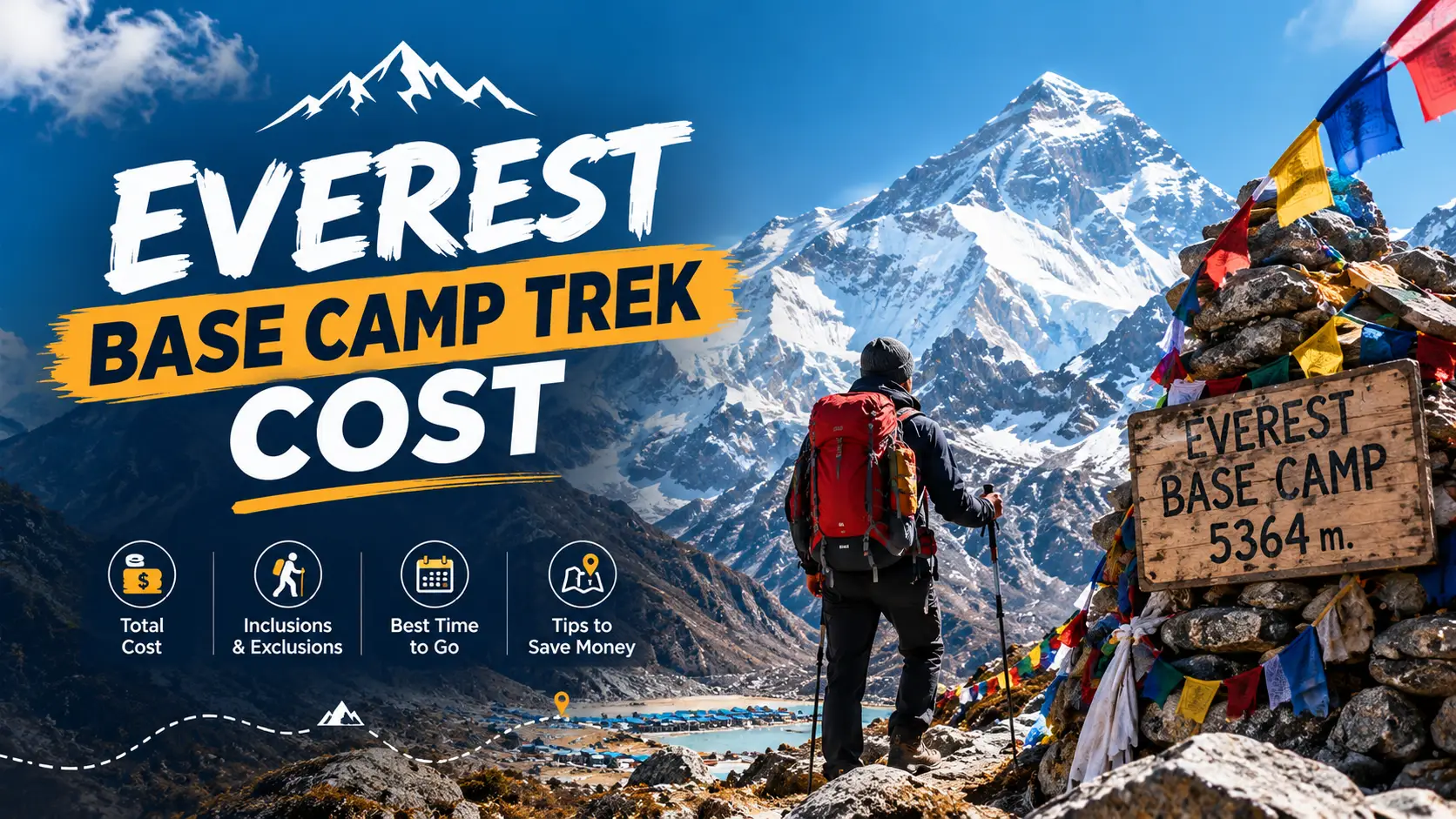
Search for the cost of the Everest Base Camp trek and you get numbers anywhere from $950 to $8,000. Almost every page that ranks is written by a trekking company selling a package, so the price you see is the price of their trip – not what the trek actually costs you from the day you land in Kathmandu to the day you fly home.
This guide does the maths instead. You get every line item in both US dollars and Nepali rupees, four real budget scenarios, a day-by-day spending ledger for the trail, the costs most packages quietly leave out, and separate figures for Nepali, Indian and SAARC trekkers, which almost no other guide covers. If you are still sorting out visas, SIM cards and arrival, read our complete guide to traveling to Nepal first.
Quick answer: how much does the Everest Base Camp trek cost?
For a standard 12-day trek from Lukla and back, most foreign trekkers spend $1,100–$1,400 going independently without a guide, $1,600–$1,900 per person when two people share a guide and porter, and $1,300–$2,000 for a local agency package (plus about $300–$500 of extras). Helicopter-return and premium trips run $2,000–$5,000+. The Lukla flight is the single biggest fixed cost at about $236–$240 each way. International flights, your Nepal visa and Kathmandu hotels come on top.
In this guide
- Where your money goes (chart)
- Everest Base Camp trek cost by travel style
- Full cost breakdown in USD and NPR
- Getting to Lukla: flight, Ramechhap, jeep or helicopter
- Permit costs in 2026
- Teahouse, food and how prices rise with altitude
- Guide and porter costs, plus tips
- Day-by-day spending ledger
- Package vs independent: which is cheaper?
- Cost for Nepali, Indian and SAARC trekkers
- Hidden costs most guides skip
- How much cash to carry
- How to cut the cost without cutting safety
- FAQs
Where Your Money Goes on the Everest Base Camp Trek
Here is how a realistic budget splits for one person in a pair of trekkers sharing a licensed guide and a porter on the classic 12-day itinerary. Total: about $1,690 (≈ NPR 2.57 lakh), excluding international flights, visa and Kathmandu hotels.
Worked example by wilson.com.np using 2026 fares and typical trail prices. Your split changes most with two choices: whether you hire staff, and whether you fly from Kathmandu or Ramechhap.
The takeaway: permits are almost irrelevant to your budget. Flights, people and food make up over 80% of the cost, so that is where any saving – or overspending – actually happens.
Everest Base Camp Trek Cost by Travel Style (2026)
All four figures below cover the trek from Kathmandu back to Kathmandu, including the Lukla flights. They are per person and assume the standard 12-day Lukla-to-Lukla itinerary.
| Travel style | Cost (USD) | Cost (NPR) | Best for |
|---|---|---|---|
| Independent, no guide | $1,100–1,400 | 1.67–2.13 lakh | Experienced hikers comfortable at altitude, carrying their own pack |
| Two people sharing guide + porter | $1,600–1,900 | 2.43–2.89 lakh | Couples and friends who want support but control over the plan |
| Solo with private guide + porter | $2,000–2,400 | 3.04–3.65 lakh | Solo first-timers who want everything arranged around them |
| Local agency package | $1,300–2,000 + $300–500 extras | 2.4–3.8 lakh all-in | Most first-timers; one booking covers flights, permits, staff and lodges |
| Helicopter return package | $2,000–3,300 | 3.04–5.02 lakh | Short on time; walk up, fly out from Gorak Shep |
| International operator / luxury lodges | $3,000–5,000+ | 4.56–7.6+ lakh | Small groups, Western trip leaders, lodges with attached bathrooms |
Full Everest Base Camp Trek Cost Breakdown in USD and NPR
This is the master table. Use it to build your own budget: add the rows that apply to you and skip the rest. Rupee figures use NPR 152 per dollar, so recheck the rate before you change money.
| Cost item | USD | NPR | Notes |
|---|---|---|---|
| Getting there and permits | |||
| Kathmandu ↔ Lukla flights (return) | $472–480 | 71,700–73,000 | Foreigner fare, revised from 1 March 2026 |
| Ramechhap ↔ Lukla flights + shared jeep | $380–450 | 57,800–68,400 | Used in peak months; 4–5 h drive each way |
| Sagarmatha National Park permit | ≈$22 | 3,390 | NPR 3,000 + 13% VAT |
| Khumbu Pasang Lhamu municipality permit | ≈$20 | 3,000 | Paid in Lukla; replaces the TIMS card here |
| On the trail (12 days) | |||
| Teahouse rooms (11 nights) | $60–165 | 9,100–25,100 | $5–10 low, $10–15 high per night |
| Meals, three a day | $300–450 | 45,600–68,400 | $25–40 a day; rises with altitude |
| Water, hot drinks, showers, charging, Wi-Fi | $60–120 | 9,100–18,200 | The “small” costs that add up |
| People (optional for independent trekkers) | |||
| Licensed guide (12 days) | $300–480 | 45,600–73,000 | $25–40 a day |
| Porter (12 days) | $216–360 | 32,800–54,700 | $18–30 a day; often shared by two trekkers |
| Guide’s own Lukla flights | ≈$140–150 | 21,000–23,000 | Nepali fare; usually passed on to you |
| Tips for guide and porter | $150–250 | 22,800–38,000 | Per group, paid on the last evening |
| Before you start | |||
| Insurance to 6,000 m with helicopter rescue | $80–200 | 12,200–30,400 | 2–3 week policy, healthy adult |
| Gear rental or purchase in Thamel | $30–150 | 4,600–22,800 | Down jacket, sleeping bag, poles |
| Nepal tourist visa (30 days) | $50 | – | 15 days is $30 – usually too short |
| Kathmandu hotel (3–4 nights) | $90–400 | 13,700–60,800 | Before, after and one weather buffer night |
Sources: Nepal Department of National Parks and Wildlife Conservation fee schedule, Nepal Department of Immigration visa fees, 2026 airline fares published by Kathmandu operators, and 2026 trail prices reported by trekking agencies. Trail prices vary by lodge and season.
Getting to Lukla: The Biggest Single Cost
Airlines revised Lukla fares from 1 March 2026, and the foreigner fare from Kathmandu now sits at roughly $236–$240 one way. In the spring and autumn peak seasons, though, most Lukla flights leave from Manthali Airport in Ramechhap, a 4–5 hour drive east of Kathmandu. That changes both the price and your sleep. For the route itself, see our Everest trek map with elevations and distances.
≈$236–240 one way. 30–35 minutes. Mostly used outside peak months. No night drive, but schedules are tight and weather delays are common.
≈$160–186 one way plus $30–40 each way for a shared jeep. Cheaper on paper, but a 1–2 a.m. departure or an extra hotel night in Manthali.
A fraction of the airfare, but adds 2–4 days of walking and lodging. Popular with Nepali trekkers and anyone avoiding flights.
Shared seats are sold when flights are grounded; a private charter Kathmandu–Lukla is around $3,000 per helicopter. Splitting it among 4–5 people is how most groups use it.
Baggage limit
Lukla airlines allow about 10 kg checked plus 5 kg hand luggage, and excess weight is charged per kilo. Leave city clothes at your Kathmandu hotel (most store bags free) instead of paying to fly them up the mountain.
Everest Base Camp Permit Costs in 2026
The Everest region needs two permits and no TIMS card. Together they cost a foreign trekker about NPR 6,390 (roughly $42).
| Permit | Foreigner | SAARC national | Nepali citizen | Where to pay |
|---|---|---|---|---|
| Sagarmatha National Park | NPR 3,000 + VAT (3,390) | NPR 1,500 | NPR 100 | Monjo gate or Kathmandu |
| Khumbu Pasang Lhamu Rural Municipality | NPR 3,000 (raised from 2,000) | Confirm at counter | Confirm at counter | Lukla, after landing |
Children under 10 enter the national park free. Some 2026 guides still quote the municipality fee at NPR 2,000; budget NPR 3,000 so you are never short. Both permits are cash only, so carry rupees, not dollars. Park fees are set by the Department of National Parks and Wildlife Conservation.
Teahouse and Food Costs: How Prices Climb With Altitude
Everything above Lukla is carried up by porters, yaks or helicopters, so prices rise with every day you walk. Rooms are cheap – often $5–10 in Phakding and Namche and $10–15 in Dingboche, Lobuche and Gorak Shep – because lodges make their money on food. Many will even waive the room charge if you eat all your meals there.
Typical price of a plate of dal bhat by village (NPR)
Namche
Tengboche
Dingboche
Lobuche
Gorak Shep
Approximate 2026 asking prices, consistent with reported meal costs of about $5–7 at lower villages and $8–12 higher up. Individual lodges vary.
| Everyday item | Lower villages | Above 4,000 m (13,100 ft) |
|---|---|---|
| Room for the night | $5–10 | $10–15 |
| Main meal (dal bhat, noodles, fried rice) | $5–7 | $8–12 |
| Food for a full day | $20–28 | $30–40 |
| Bottled water (1 litre) | NPR 100–200 | up to NPR 400–500 at Gorak Shep |
| Hot shower | $3–4 | $4–5, often unavailable |
Guide and Porter Costs for Everest Base Camp
The Khumbu Pasang Lhamu Rural Municipality did not adopt Nepal’s 2023 rule requiring guides for foreign trekkers, so independent trekking to Everest Base Camp is still allowed with both permits. A few agency websites claim otherwise; the local authority has publicly confirmed solo trekkers may enter, as reported by The Himalayan Times. Rules can change at short notice, so check again at the Lukla counter.
Licensed guide
$25–40 a day, usually including the guide’s own meals and bed. Handles lodge bookings, pace, altitude checks and emergency calls.
Porter
$18–30 a day. Carries up to about 20 kg, typically for two trekkers. Ask whether your agency insures its porters.
Porter-guide
Somewhere between the two. One person carries a lighter load and guides. A good budget compromise for solo trekkers.
How much to tip on the Everest trek
Tips are not optional in practice – they are a real part of staff income. A common guideline is about $10–15 a day for the guide and $5–8 a day for each porter, per group rather than per trekker. For a 12-day trek that is roughly $150–250 in total. Hand it over in rupees, in person, on the last evening in Lukla.
Day-by-Day Spending Ledger: What You Actually Pay on the Trail
Package prices hide where money goes. This worked example follows one independent trekker on the classic itinerary, eating three teahouse meals a day and buying a few hot drinks, water refills and charging sessions. Flights, permits, staff and insurance are not included here.
| Day | Sleep at | Room | Food | Extras | Running total |
|---|---|---|---|---|---|
| 1 | Phakding | $6 | $24 | $4 | $34 |
| 2 | Namche Bazaar | $8 | $26 | $6 | $74 |
| 3 | Namche (rest day) | $8 | $26 | $8 | $116 |
| 4 | Tengboche | $10 | $30 | $6 | $162 |
| 5 | Dingboche | $10 | $32 | $8 | $212 |
| 6 | Dingboche (rest day) | $10 | $32 | $8 | $262 |
| 7 | Lobuche | $12 | $36 | $10 | $320 |
| 8 | Gorak Shep + EBC | $15 | $40 | $12 | $387 |
| 9 | Pheriche | $10 | $34 | $8 | $439 |
| 10 | Namche Bazaar | $8 | $28 | $6 | $481 |
| 11 | Lukla | $8 | $26 | $6 | $521 |
| 12 | Fly out | – | $8 | – | $529 |
Total on-trail spend ≈ $529 (≈ NPR 80,400): rooms $105, food $342, extras $82. Day 8 at Gorak Shep is the most expensive day of the trek.
Package vs Independent: Which Is Actually Cheaper?
Here is the part most cost guides skip. Going independent is the cheapest option only if you trek without staff. The moment you hire a guide and porter yourself, a good local package is often the same price or cheaper, because agencies buy flights in bulk, lodges give rooms to guided groups, and the guide’s own flights are already built in.
Totals include Lukla flights, permits, trail costs, insurance and gear; staff scenarios also include the guide’s flights and tips. Excludes visa, international flights and Kathmandu hotels.
What a package usually includes – and what it doesn’t
✓ Usually included
- Lukla flights (or Ramechhap flights plus jeep)
- Both permits
- Licensed guide, and often a porter
- Teahouse rooms on twin-share
- Three meals a day (check this line)
- Airport transfers in Kathmandu
✗ Usually excluded
- Tips for guide and porter
- Hot showers, charging, Wi-Fi, bottled water
- Drinks beyond tea or coffee, snacks
- Travel insurance and visa
- Extra nights from flight delays
- Single-room supplement
Everest Base Camp Trek Cost for Nepali, Indian and SAARC Trekkers
Most cost guides are written only for Western tourists. If you hold a Nepali or SAARC passport, the trek is much cheaper, mainly because of lower park fees and, for Nepali citizens, a rupee airfare.
| Cost item | Nepali citizen | Indian / other SAARC |
|---|---|---|
| Visa | – | Indians need no visa; other SAARC citizens get a free 30-day visa on their first visit each year |
| Sagarmatha National Park | NPR 100 | NPR 1,500 |
| Kathmandu ↔ Lukla flight (return) | ≈NPR 21,000–23,000 | Confirm your fare category when booking |
| Rooms, food and extras (12 days) | ≈NPR 50,000–85,000 | ≈NPR 50,000–85,000 |
| Estimated total, flying in | ≈NPR 70,000–1,10,000 | Depends on airfare category |
Many Nepali trekkers skip the flight altogether and take a jeep through Salleri to the road-head, then walk up to the Lukla trail. That swaps most of the airfare for 2–4 extra days of lodging and food – usually still cheaper, and a better acclimatization profile too. Weighing other trips at a similar budget? Our Nepal adventure travel guide ranks 12 adventures by thrill, cost and season.
Hidden Costs Most Everest Cost Guides Skip
Cloud can ground Lukla flights for days. Each extra night in Lukla or Kathmandu costs another $30–60 in room and food, plus guide wages if you have one.
If you hire a guide in Kathmandu, you normally pay their return Lukla ticket too – around NPR 21,000–23,000.
Many policies now carry a $500–1,500 excess on helicopter evacuations in Nepal. Without insurance a rescue can cost $3,000–10,000.
Delays can push you past a 15-day visa. Extensions start at $45 for 15 days, so buying the 30-day visa up front is usually the cheaper bet.
Jeep transfers both ways, and sometimes a night in Manthali, eat most of the fare saving over flying from Kathmandu.
Foreign cards pay a fixed fee per withdrawal and withdrawal limits are low, so several withdrawals stack up. Above Namche there are no ATMs at all.
How Much Cash to Carry on the Everest Trek
The trail runs on rupees. Lodges rarely take cards and often can’t break large notes, and the last reliable ATMs are in Namche Bazaar. Withdraw in Kathmandu, top up in Namche, and carry small notes.
| How you trek | Cash per day | For 12 days + 20% reserve |
|---|---|---|
| Independent, paying rooms and food | NPR 6,500–8,000 | NPR 95,000–1,15,000 |
| Package with meals included | NPR 2,500–3,500 | NPR 36,000–50,000 + tips |
How to Cut the Everest Base Camp Trek Cost Without Cutting Safety
- Treat your own water. Bottled water gets four to five times dearer by Gorak Shep. Purification tablets or a filter pay for themselves within days and cut plastic waste.
- Eat dal bhat. It is the best-value meal on the trail and usually comes with a free refill; imported menu items cost much more.
- Eat where you sleep. Lodges often discount or waive the room when you take your meals there.
- Share a guide and porter. Splitting staff between two trekkers saves around $500 each compared with going solo with private staff.
- Rent heavy gear in Thamel. Down jackets and sleeping bags rent for a few dollars a day instead of costing hundreds to buy.
- Carry a power bank. Charging costs more the higher you go; a full power bank covers several days of photos.
- Trek in shoulder months. Early March and early December are quieter, with easier lodge bookings and more room to negotiate.
- Never save money on insurance or acclimatization days. One helicopter flight costs more than every other saving on this list combined.
Local Tips from Kathmandu
- Ask any agency for a line-by-line quote. If a package is far below $1,300, check whether meals, the porter or the Lukla flights have been dropped.
- Ask how staff are paid and insured. The cheapest trip often saves money on the porter, not on you.
- Budget two spare days, not one. They cost far less than rebooking an international flight.
- Keep NPR 10,000 untouched as an emergency reserve until you are back in Lukla.
- Compare Everest with other Himalayan trips before you commit; our Himalayan travel guide sets Nepal against Bhutan, Tibet and the Indian Himalaya.
What Most Everest Base Camp Cost Guides Leave Out
- Rupee figures. You pay on the trail in NPR, but most guides quote only dollars.
- The real cost of Ramechhap. The cheaper fare comes with jeep fares, a night drive and sometimes an extra hotel night.
- The guide’s flight. It can add $140–150 to an independent budget.
- The package paradox. Self-hiring staff can cost more than a local package.
- Day-level spending. Gorak Shep is your most expensive day, not Namche.
- Nepali and SAARC prices. Domestic trekkers pay a fraction of the foreign cost.
Everest Base Camp Trek Cost: Frequently Asked Questions
How much does the Everest Base Camp trek cost in 2026?
Most foreign trekkers spend $1,100–1,400 independently, $1,600–1,900 each when two share a guide and porter, or $1,300–2,000 for a local package plus $300–500 in extras. Helicopter-return and premium trips cost $2,000–5,000 or more.
How much is the Everest Base Camp trek in Nepali rupees?
For a foreigner, roughly NPR 1.7–2.1 lakh independently and NPR 2.4–3.8 lakh with a package and extras. A Nepali citizen flying to Lukla typically spends about NPR 70,000–1,10,000.
Can you do Everest Base Camp for under $1,000?
Only if you cut the flight. Trekking independently from a jeep road-head, treating your own water and eating dal bhat can bring the trail cost under $1,000, but it adds several days of walking.
How much are Everest Base Camp permits in 2026?
About NPR 6,390 for foreigners: NPR 3,390 for Sagarmatha National Park (including VAT) and NPR 3,000 for the Khumbu Pasang Lhamu municipality permit. No TIMS card is needed in the Everest region.
How much is the Lukla flight?
For foreigners, about $236–240 one way from Kathmandu after the March 2026 fare revision. Ramechhap–Lukla is cheaper at about $160–186 but requires a 4–5 hour jeep ride each way.
How much does a guide and porter cost for Everest Base Camp?
A licensed guide costs about $25–40 a day and a porter $18–30 a day. For 12 days that is roughly $520–840 for both, before tips and the guide’s own flights.
How much cash should I carry for the Everest trek?
Independent trekkers should carry about NPR 6,500–8,000 a day; package trekkers about NPR 2,500–3,500 a day plus tips. Withdraw in Kathmandu and Namche – there are no ATMs higher up.
Is a package cheaper than trekking independently?
Not if you trek without staff. But if you plan to hire a guide and porter anyway, a local package is often the same price or cheaper, because flights, lodging and the guide’s travel are bought at agency rates.
How much should I tip my guide and porter?
About $10–15 a day for the guide and $5–8 a day per porter, per group. On a 12-day trek that is around $150–250 in total.
How much does an Everest Base Camp trek with a helicopter return cost?
Packages where you walk up and fly out from Gorak Shep typically cost $2,000–3,300 per person, depending on whether the helicopter is shared and whether it flies to Lukla or all the way to Kathmandu.
The bottom line
Budget about $1,100–1,400 to trek Everest Base Camp independently, $1,600–2,000 with a guide or a good local package, and keep $300–500 aside for tips, extras and delays. Flights, staff and food are 80% of the cost; permits barely register. Spend your savings anywhere except insurance and rest days.
Next steps: plan the route on our Everest trek map, sort visas and SIM cards with our guide to traveling to Nepal, and browse other ideas in Nepal adventure travel.