
Best Time to Visit Kathmandu (2026–27): Month-by-Month Weather, Festivals, Air Quality & Crowds
Updated October 2026 · Written from Kathmandu · Climate figures from 1991–2020 Kathmandu Airport normals · Heights in feet
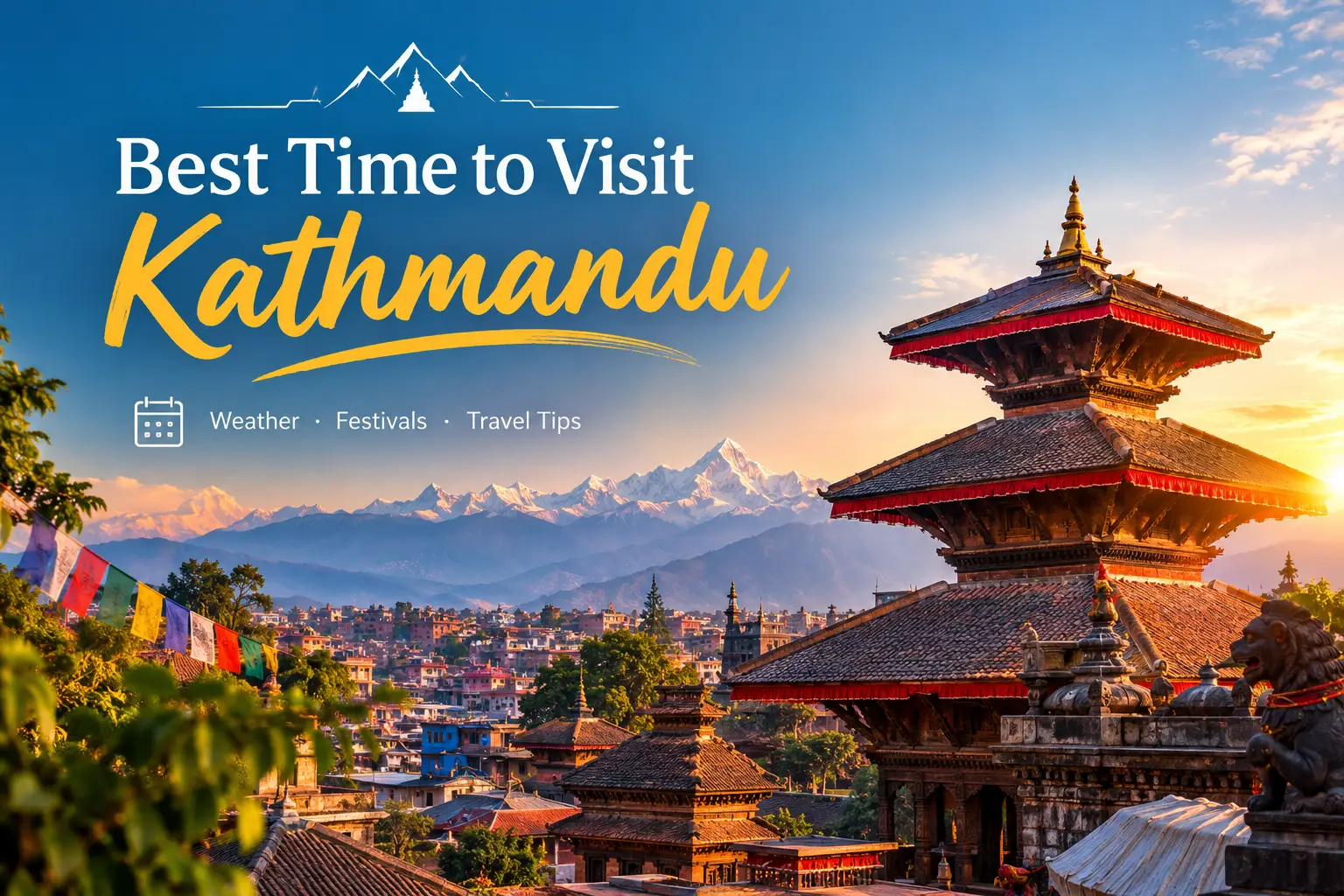
Most guides answer “when should I go to Kathmandu?” with one word: autumn. That is a good start, but it leaves out the things that actually shape a trip here – the week the whole city shuts for Dashain, the winter haze that hides the mountains you flew in to see, the hailstorms of late April, and the monsoon months when hotel rates fall and the valley turns emerald green.
This guide is written by people who live in Kathmandu. It combines long-term climate data, Nepal Tourism Board arrival numbers, official 2026 holiday dates and air-quality research with what we see on our own streets every month, so you can pick the best time to visit Kathmandu for your kind of trip – not just the average tourist’s.
Quick answer
The best time to visit Kathmandu is mid-October to late November: dry, sunny days of about 75–81°F, cool nights, the clearest mountain views and the Dashain and Tihar festivals. The second-best window is March to April, when it is warm and the hills bloom, though haze is heavier. The wettest months are July and August, and air pollution is worst from December to April.
In this guide
Best Time to Visit Kathmandu at a Glance
Kathmandu sits in a bowl-shaped valley at about 4,600 ft, so it escapes both the heat of Nepal’s lowlands and the cold of the mountains. You can visit in any month. What changes is rain, visibility, air quality, crowds and what’s happening on the streets. We scored each month on all five.
Our overall rating for visiting Kathmandu, by month (out of 10)
Our editorial score combining rainfall, sky clarity, air quality, crowds and festivals. Dark green = best; red = toughest. Your own score will shift with your priorities – see best time by type of trip.
Kathmandu Weather by Month: The Real Numbers
Competing guides disagree wildly on Kathmandu’s rainfall because many use coarse global models. The figures below are 1991–2020 climate normals from observations at Kathmandu’s Tribhuvan International Airport (4,386 ft), published by Climate-Zone. Remember that monsoon totals swing a lot from year to year.
Daily temperature range by month
36–66°F
41–72°F
46–79°F
54–82°F
61–84°F
66–84°F
68–82°F
68–84°F
64–82°F
55–81°F
46–75°F
37–68°F
Each bar runs from the average night-time low to the average daytime high, on a 0–32°C (32–90°F) scale. Note the big day-night swing in winter: a 66°F afternoon can be followed by a near-freezing night.
Average monthly rainfall in Kathmandu
15 mm (0.6 in)
20 mm (0.8 in)
51 mm (2.0 in)
75 mm (3.0 in)
83 mm (3.3 in)
203 mm (8.0 in)
366 mm (14.4 in)
274 mm (10.8 in)
218 mm (8.6 in)
76 mm (3.0 in)
8 mm (0.3 in)
≈0 mm
Source: 1991–2020 normals, Kathmandu Airport station. About 70% of the year’s rain falls between June and September. Most of October’s total usually lands in the first half of the month.
Kathmandu climate table
| Month | Avg high | Avg low | Rain | Feels like |
|---|---|---|---|---|
| January | 19°C / 66°F | 2°C / 36°F | 15 mm | Sunny afternoons, cold foggy mornings |
| February | 22°C / 72°F | 5°C / 41°F | 20 mm | Warming up, dry, hazy |
| March | 26°C / 79°F | 8°C / 46°F | 51 mm | Pleasant, the odd shower |
| April | 28°C / 82°F | 12°C / 54°F | 75 mm | Warm, afternoon storms, hail possible |
| May | 29°C / 84°F | 16°C / 61°F | 83 mm | Hot and muggy before the monsoon |
| June | 29°C / 84°F | 19°C / 66°F | 203 mm | Monsoon arrives mid-month |
| July | 28°C / 82°F | 20°C / 68°F | 366 mm | Wettest month, humid |
| August | 29°C / 84°F | 20°C / 68°F | 274 mm | Heavy rain, very green |
| September | 28°C / 82°F | 18°C / 64°F | 218 mm | Rain easing off late in month |
| October | 27°C / 81°F | 13°C / 55°F | 76 mm | Fresh, clear, festive |
| November | 24°C / 75°F | 8°C / 46°F | 8 mm | Dry, crisp, best visibility |
| December | 20°C / 68°F | 3°C / 37°F | ≈0 mm | Bright days, cold rooms at night |
Does it snow in Kathmandu?
Almost never in the city itself. Winter nights drop to around freezing, and you may see frost on fields at the valley edges, but snow on the surrounding hills such as Chandragiri or Shivapuri is an occasional winter event rather than a reliable sight. Most Kathmandu homes and budget hotels have no central heating, which is why winter feels colder indoors than the numbers suggest.
Kathmandu Season by Season
Locals describe six seasons (ritu), but for planning a trip, four work best. Here is what each one is really like on the ground.
Autumn (late September to November): the best season
Once the monsoon withdraws, rain washes the dust out of the air and the sky turns a deep blue. From mid-October the snow peaks of the Langtang and Ganesh Himal ranges can often be seen from rooftops and from hill viewpoints such as Nagarkot (about 7,100 ft). This is also festival season: the 15-day Dashain festival and the five-day Tihar “festival of lights” both fall in October and November.
✓ Why go
- Driest, clearest skies of the year (November: about 8 mm of rain)
- Comfortable 75–81°F days
- Dashain and Tihar celebrations
- Ideal for treks that start from Kathmandu
✗ Watch out for
- Peak prices and full hotels in Thamel
- Shops and offices closing on main festival days
- Packed long-distance buses during Dashain
- Late-monsoon showers lingering into early October
Winter (December to February): sunny, cold and quiet
Winter in Kathmandu is surprisingly pleasant during the day – dry, sunny and often in the high 60s°F. The catch is the mornings and nights, which hover just above freezing, and the haze that builds as the season goes on. December still offers clear mountain views on many mornings; by January and February, smog and temperature inversions often hide them. Crowds thin out and hotel deals appear, and in February or March Tibetan New Year (Gyalpo Losar) fills Boudhanath with families in traditional dress.
Spring (March to May): warm, blooming and hazy
Spring is the second-best season. March and April are warm, rhododendrons bloom on the hills around the valley, and Bisket Jatra in Bhaktapur marks Nepali New Year in mid-April with huge chariot processions. The downsides are rising haze, which often blurs mountain views by April, and afternoon thunderstorms, sometimes with hail, that become common from late April. May is hot and sticky by Kathmandu standards and works best as a short city stop before or after a high-altitude trek.
Monsoon (June to mid-September): green, cheap and unpredictable
The monsoon is not non-stop rain. In Kathmandu it usually falls in heavy bursts, often in the afternoon or overnight, with drier windows in between. Temples and Durbar Squares are uncrowded, the paddy fields at the valley edges are an intense green, and the rain clears the air better than any other season. But mountain views largely disappear, roads out of the valley can be blocked by landslides, and domestic flights face delays. Gai Jatra and Krishna Janmashtami bring colour to the city in August and early September.
Month-by-Month Planner for Kathmandu
| Month | Mountain views | Crowds | What’s on | Verdict |
|---|---|---|---|---|
| Jan | Fair (haze) | Low | Maghe Sankranti | Good for budget culture trips |
| Feb | Fair | Medium | Losar, often Shivaratri | Good, warming up |
| Mar | Fair to good | High | Holi, Ghode Jatra | Very good |
| Apr | Fair (haze) | High | Bisket Jatra, Nepali New Year | Very good |
| May | Poor | Medium | Buddha Jayanti | OK, getting hot |
| Jun | Poor | Low | Rato Machhindranath (Patan, timing varies) | Fair |
| Jul | Very poor | Lowest | Paddy planting season | Toughest month |
| Aug | Very poor | Low | Gai Jatra, Janai Purnima | For culture lovers on a budget |
| Sep | Improving | Rising | Teej, Indra Jatra | Good in the second half |
| Oct | Good to excellent | Peak | Dashain (some years Tihar) | Excellent |
| Nov | Excellent | High | Tihar, Chhath | Best month |
| Dec | Good mornings | Medium | Yomari Punhi, Tamu Lhosar | Good, pack warm |
Kathmandu Festival Calendar 2026–27
Nepali festivals follow the lunar Bikram Sambat calendar, so their Western dates move every year – a detail most “best time” guides skip. The 2026 dates below come from the Ministry of Home Affairs public holiday list for 2083 BS (summarised by Pradhan & Associates). For 2027, we give the expected month; always confirm exact days once the official calendar is out.
| Festival | Date | Where to see it |
|---|---|---|
| Dashain 2026 | Started 11 Oct; public holiday 17–23 Oct 2026 | Temples like Taleju and Naxal Bhagwati; kites and bamboo swings everywhere |
| Tihar 2026 | Holiday 8–12 Nov 2026 (Laxmi Puja 8 Nov, Bhai Tika 11 Nov) | The whole city lit with oil lamps; Newar Mha Puja and New Year processions |
| Chhath | 15 Nov 2026 | Riverbanks and ponds such as Kamal Pokhari and Gahana Pokhari |
| Yomari Punhi | 24 Dec 2026 | Newar homes and bakeries – try a yomari dumpling |
| Tamu Lhosar | 30 Dec 2026 | Gurung community gatherings, Tundikhel |
| Maha Shivaratri | Feb–Mar 2027 | Pashupatinath – sadhus and huge crowds |
| Gyalpo Losar | Feb–Mar 2027 | Boudhanath Stupa |
| Holi (Fagu Purnima) | March 2027 | Basantapur and Thamel – wear clothes you can lose |
| Bisket Jatra & Nepali New Year | Mid-April 2027 | Bhaktapur |
| Buddha Jayanti | May 2027 | Swayambhunath and Boudhanath |
| Gai Jatra | August 2027 | Kathmandu, Patan and Bhaktapur old towns |
| Indra Jatra | September 2027 | Kathmandu Durbar Square – the Living Goddess Kumari’s chariot |
| Dashain 2027 | Expected to start about 30 Sep, with Vijaya Dashami around 9 Oct 2027 | Earlier than in 2026 – plan autumn 2027 trips around it |
2027 Dashain dates are based on the Drik Panchang calendar; Nepal’s official calendar committee may differ by a day.
Want to understand what you’re seeing? Read our explainer on how Dashain is celebrated, look at the rangoli designs families make for Tihar, or learn what people say to each other on the last day of Tihar in our collection of Bhai Tika wishes.
Local tip: what Dashain really means for visitors
During Dashain, Kathmandu does something surprising – it empties. Hundreds of thousands of residents travel to their home villages, so the city’s roads are suddenly calm and the air feels cleaner. The flip side: around the main tika days many local restaurants, shops, government offices and banks close, and bus tickets out of the valley sell out days in advance. Thamel’s tourist businesses mostly stay open. If you need a visa extension or a trekking permit, sort it out before the holiday week begins.
Air Quality: The Factor Most Kathmandu Guides Skip
Almost every competing guide calls winter and spring “good” months without mentioning that they are also Kathmandu’s smoggiest. The valley’s bowl shape traps dust, traffic exhaust and smoke under cold winter air. Research published in Nepal’s JNMA journal found pollution highest from roughly January to April and lowest in June to August, when monsoon rain washes the air.
Average PM2.5 in the Kathmandu Valley by season (µg/m³)
Seasonal values from a 2025 Mahidol University study of Kathmandu Valley PM2.5; year-round average from a 2026 study using seven government monitoring stations. Even the cleanest season is well above the WHO guideline.
What this means for your trip:
- Clearest air with dry weather: from late September through November, just after the monsoon.
- Haziest months: December to April. Mountain views from the city get rarer as winter goes on.
- If you have asthma or heart or lung conditions, autumn is the safest dry-season choice. Check a live AQI app each morning and carry a well-fitting N95-type mask for busy roads like the Ring Road.
- Mornings are clearer than afternoons for views, but smog is often thickest in the early morning in winter, before the sun breaks the inversion.
Crowds and Prices: When Kathmandu Is Busiest
Nepal welcomed 1,158,459 international tourists in 2025, and October was the busiest month with 128,443 arrivals, according to Nepal Tourism Board figures reported by Himal Press. Since almost every visitor passes through Kathmandu, these numbers are a good guide to how busy the city’s hotels and heritage sites will be.
Busiest arrival periods in Nepal, fiscal year 2025/26
Source: Nepal Tourism Board data reported by Onlinekhabar, measured in Nepali calendar months. Arrivals dip sharply in the monsoon.
- Book early for October–November and March–April. Good mid-range rooms in Thamel, Lazimpat and near Boudha fill first, and flights from the Gulf and India are priciest around Dashain.
- Best deals: June to August, and January. Many hotels discount heavily in the monsoon.
- Shoulder sweet spots: late November to mid-December (clear, dry, fewer people) and late February.
Check the news before you book
Weather is not the only thing that shapes a trip. In September 2025, arrivals fell 18.3% year on year after large youth-led protests in Kathmandu, as reported by The Himalayan Times, before recovering strongly in October. Check your government’s travel advisory a few weeks before you fly, and keep plans flexible around strikes or road closures.
The Best Time to Visit Kathmandu by Type of Trip
There is no single perfect month for everyone. Start from what matters most to you:
If you want…
Himalayan views from the valley
→ Late October to mid-December. Go up to Nagarkot, Chandragiri (about 8,370 ft by cable car) or Shivapuri at sunrise.
If you want…
Festivals and street life
→ September to November for Indra Jatra, Dashain and Tihar; mid-April for Bisket Jatra.
If you want…
To trek after Kathmandu
→ October–November or March–April. Spend 2–3 days in the city first to sort permits and gear.
If you want…
Low prices and empty temples
→ June to August or January. Expect rain or cold mornings in return.
If you want…
An Everest mountain flight
→ October to February, on the earliest morning departure. Monsoon flights are often cancelled for cloud.
If you want…
Photography of green landscapes
→ Late August to September, when rice terraces are lush and the air is clean between showers.
What to Pack for Kathmandu, Season by Season
- Light layers and a fleece
- Sunglasses and sunscreen
- Modest clothes for festival temples
- Down jacket for mornings and nights
- Thermal base layer to sleep in
- Face mask for smog
- Breathable T-shirts
- Compact umbrella for afternoon storms
- Mask on hazy days
- Waterproof jacket
- Quick-dry clothes and sandals
- Dry bags for phone and passport
Local Tips: What Living in Kathmandu Teaches You About Timing
- Plan sightseeing around the clock, not just the calendar. In autumn and winter, the best mountain views come before about 10 a.m.; by afternoon, dust and cloud usually soften them.
- Monsoon rain has a rhythm. On many monsoon days the mornings are dry enough to explore Patan or Bhaktapur, with the heavy rain arriving in the afternoon or at night. Keep museums and cafes for later in the day.
- Winter fog can delay early flights. In December and January, thick morning fog sometimes holds up early departures at Tribhuvan Airport. Avoid tight same-day connections.
- Late April storms arrive fast. A sunny spring afternoon can turn into a short, violent thunderstorm with hail. Carry an umbrella even when the morning is clear.
- Eat by season. Winter is the time for warming Newar dishes; festivals bring special foods like sel roti at Tihar and yomari in December. Our guide to Newari cuisine and where to eat it and the Taste of Nepal hub are good places to start.
- Rooms are cold in winter. Ask whether your hotel has heaters or electric blankets before booking a December–February stay.
When Is the Worst Time to Visit Kathmandu?
July and August are the hardest months for most travelers: they bring the heaviest rain (July averages 366 mm), hidden mountains, muddy lanes and the most transport disruption. Still, they are not “bad” for everyone – if you are on a tight budget, mainly want temples and culture, or are heading to a rain-shadow region like Upper Mustang, the monsoon can work well.
If air quality matters to you, add January to April to your list of months to think twice about, and if you hate crowds, avoid the peak of October.
Planning the rest of your Nepal trip?
Kathmandu is usually just the first stop. Our complete guide to traveling to Nepal covers the visa on arrival fee, the best tourist SIM, trekking rules, travel insurance and sample itineraries – everything you need once you’ve picked your dates.
Frequently Asked Questions About the Best Time to Visit Kathmandu
What is the best month to visit Kathmandu?
November. It is the driest month (about 8 mm of rain), daytime highs are around 75°F, skies are clear for mountain views, air quality is better than in winter or spring, and in many years Tihar falls in early November.
Is October a good time to visit Kathmandu?
Yes – it is one of the two best months. The first week or so can still bring late-monsoon showers, but the second half is usually dry and clear. October is also Kathmandu’s busiest month and often coincides with Dashain, so book early and expect some closures on the main festival days.
Is it worth visiting Kathmandu during the monsoon?
It can be, if you mainly want culture, lower prices and fewer crowds. Rain usually comes in bursts rather than all day, and the air is cleanest of the year. You will rarely see the mountains, though, and road and flight delays are more common.
Does it snow in Kathmandu?
Snow in the city is extremely rare. Winter nights fall to around 36–37°F in December and January, and the surrounding hills occasionally get a dusting, but you should not plan a trip around seeing snow in Kathmandu.
When is air pollution worst in Kathmandu?
Roughly December to April, when dry weather and cold-air inversions trap pollution in the valley. It is lowest in the June–August monsoon and relatively better in October and November.
What is the cheapest time to visit Kathmandu?
June to August is cheapest, followed by January. Tourist numbers fall in these months and many hotels offer discounts. Prices are highest in October–November and March–April.
When can you see the Himalayas from Kathmandu?
Most reliably from late October to mid-December, on clear mornings. Ranges such as Langtang and Ganesh Himal are visible from high rooftops and from viewpoints like Nagarkot and Chandragiri. Views fade with spring haze and largely vanish in the monsoon.
How many days do you need in Kathmandu?
Three to four days covers the highlights: Kathmandu Durbar Square, Swayambhunath, Boudhanath, Pashupatinath, Patan and Bhaktapur. Add a day if you are visiting during a festival or want a sunrise trip to Nagarkot.
The bottom line
For most travelers, the best time to visit Kathmandu is mid-October to November: dry, clear, comfortable and full of festivals. Choose March–April if you want spring warmth and blossoms and don’t mind haze, December for quiet, sunny days with cold nights, and the monsoon only if low prices and empty temples matter more than mountain views. Whatever month you choose, check the festival dates and the morning air quality – they shape a Kathmandu trip as much as the weather does.
Sources: Climate-Zone (Kathmandu Airport 1991–2020 normals); Ministry of Home Affairs public holiday list 2083 BS via Pradhan & Associates; Nepal Tourism Board arrival data via Himal Press, Onlinekhabar and The Himalayan Times; Sah Telee, JNMA (Kathmandu air quality); Mahidol University PM2.5 studies (2025, 2026); Drik Panchang (Dashain 2027).