
Top Eleven Training Guide (2027): Drills, Teamplay Form & Condition Explained
Updated 16 October 2026 · Top Eleven 2027 – Be a Football Manager (Android, iOS, web) · ~13 min read
Quick answer
Training in Top Eleven does two jobs. Regular drills (Attack, Defence, Possession, Physical & Mental) raise player attributes and add some Teamplay Form. Teamplay drills are consumable and only raise Teamplay Form (Attack, Defence, Possession, Condition), which is capped at 10 and can be pushed to 20 per season with Advancement points. Always train with at least 4 players so you also gain Teamplay Form and Sharpness, mix drill intensities and roles for a higher Session Score, and plan around condition: players recover only 6% every three hours without rests.
Most managers lose matches in Top Eleven long before kick-off. They pick a good formation, then send out a squad with low condition, no Teamplay Form and no Sharpness. This Top Eleven – Be a Football Manager training guide explains how the current training system works, what each number on the training screen means, which drills suit each position, and how to manage condition so your best eleven is fresh on matchday.
Everything here applies to Top Eleven 2027, which launched on 9–10 August 2026. If you are new to the game, start with our Top Eleven guide, and browse every post in the Top Eleven hub.
Contents
1. What training does in Top Eleven
2. Regular drills vs Teamplay drills
3. Teamplay Form, caps and Advancement points
4. How to build a high Session Score
5. A daily training routine that works
6. Best drills for each position
7. Condition, rests and recovery times
8. Which players to train hardest
9. Power training
10. Personal Trainer, Player Academy and new roles
11. What Top Eleven 2027 changed
12. Common training mistakes
13. FAQ
What training does in Top Eleven
The training screen feeds five separate systems. Older guides talk about “skill points” and three training types (stretching, cardio, practice match); that system was replaced in 2016, and the current version took shape with Nordeus’s November 2023 training update. Here is what you are actually improving today:
| System | What it does | How you raise it |
|---|---|---|
| Player attributes | Long-term quality of each player | Regular drills, Player Academy, Personal Trainer |
| Teamplay Form | Squad cohesion bonus in four areas: Attack, Defence, Possession, Condition | Any group session with 4+ players; Teamplay drills give much more |
| Sharpness | How well each player uses your Teamplay Form in a match | Daily group training; it goes inactive if a player stops training |
| Condition | Fitness on matchday; every drill spends some | Time (6% per 3 hours) or Rests |
| Training level | Your manager-wide progress, up to level 111 | Training points from every session; unlocks and upgrades drills |
The key idea: attributes are the slow, permanent part; Teamplay Form and Sharpness are the fast, matchday part. A strong manager trains for both every day.
Regular drills vs Teamplay drills
| Regular Training Drills | Teamplay Drills | |
|---|---|---|
| Types | Attack, Defence, Possession, Physical & Mental | Starter, Expert, Ultimate tiers |
| Raise attributes? | Yes – their main job | No |
| Raise Teamplay Form? | A little | A lot; Ultimate drills can have unique effects |
| Used up? | No, reusable every day | Yes, consumable |
| How you get them | Unlocked and upgraded as your training level rises (to 111) | Drill Lab on your Campus, season events, the Shop |
In short, regular drills build the player and Teamplay drills prepare the team. Use regular drills every day; save Teamplay drills for the days before important fixtures.
Teamplay Form, caps and Advancement points
Teamplay Form (previously called Team Bonuses) is shown as four circles in the Training section: Attack, Defence, Possession and Condition. Each starts the season with a cap of 10. Once a type reaches 10, extra gains are not wasted – they fill the Excel bar. Every full Excel bar gives one Advancement point, and each point raises one type’s cap by 2. You can do this five times per type, so each cap can climb from 10 to 20.
Teamplay Form cap by Advancement points spent on one type
Five points per type × four types = up to 20 Advancement points can be useful in one season.
Three rules that change how you train:
Keep training after you hit 10. Extra form becomes Excel bar progress, so “I’m at 10, I can stop” wastes the most valuable part of the system.
Keep form high every day. You also earn Excel bar points each season day based on the Teamplay Form you reached the day before, so letting it drop costs you twice.
Spend Advancement points before the season ends. Caps and unspent points reset with the new season. Raise the type your formation leans on first – usually Attack for attacking setups, Defence for counter-attacking ones (see our Top Eleven best formations guide).
Nordeus also describes a random bonus called Training Uplift: whenever a session raises Teamplay Form, one motivated player can spark extra Teamplay Form for his zone of the pitch. It does not raise attributes. Well-designed sessions improve the chance of getting it, and the training report shows when it happened.
How to build a high Session Score
When you create a session, the info bar at the bottom shows projected gains, condition loss and the Session Score – Nordeus’s rating of how well the session is designed. Two bonuses drive it: the Player Variety Bonus (include players whose roles match the drills) and the Intensity Variety Bonus (mix drills of different intensities). Build every session in this order:
| Step | Do this | Why |
|---|---|---|
| 1 | Add at least 4 players | Fewer than 4 = no Teamplay Form and no Sharpness at all |
| 2 | Group players by area (e.g. defenders + DMC, or midfield + forwards) | Lets you pick drills that match their roles for the Player Variety Bonus |
| 3 | Mix drill intensities instead of stacking one type | Intensity Variety Bonus |
| 4 | Read the condition loss before you confirm | A high score is useless if your starters arrive tired |
| 5 | Add a Teamplay drill only when you need form fast | They are consumable; spend them before big matches |
Session Score is a guide, not the goal. A slightly lower score that keeps your first eleven fit is better than a perfect score that leaves them at 70% condition for a cup final.
A daily training routine that works
This is the routine we use; it is our approach, not an official recommendation. Adjust it to your match times.
1. Right after a match: claim Rests from the Training Centre and Treatments from the Treatment Wing on your Campus, then heal any injuries.
2. Morning session – reserves and young players: run attribute-focused regular drills with harder intensity. They are not playing soon, so condition matters less.
3. Midday session – first eleven, light: a short group session of 4+ starters with varied intensities to keep Teamplay Form and Sharpness up without draining condition.
4. Before a big match: use Teamplay drills to top up the Form type your tactics depend on, then let starters recover. Check that every starter is near full condition at kick-off.
5. End of the day: spend any full Excel bars as Advancement points instead of letting them sit.
Best drills for each position
Each drill trains a set of attributes, and a drill only gives full value to players who use those attributes. The table below shows the drill types and drills most commonly recommended for each role. Drill names come from community guides (GamingonPhone’s list, first published 2021 and updated in 2024); your list may differ depending on which drills you have unlocked or upgraded.
| Role | Focus drill types | Commonly recommended drills |
|---|---|---|
| GK | Defence, Physical | Goalkeeper Training, Hold The Line, Gym |
| DC | Defence, Physical | Press The Play, Hold The Line, Warm Up, Gym |
| DL / DR | Defence, Physical | Press The Play, Carioca With Ladders, Long Run, Hurdle Jumps |
| DMC | Defence, Possession, Physical | Press The Play, Use Your Head, Video Analysis, Piggy In The Middle, Gym |
| MC | All four types | Pass Go & Shoot, Slalom Dribble, Press The Play, First Touch Play, Sprint |
| ML / MR | Attack, Possession, Physical | Slalom Dribble, Sprint, Long Run |
| AMC | Attack, Possession | Pass Go & Shoot, Slalom Dribble, Ball Control |
| AML / AMR | Attack, Physical | Pass Go & Shoot, Fast Counter-Attack, Slalom Dribble |
| ST | Attack, Possession | Pass Go & Shoot, Shooting Technique, Use Your Head, Ball Control |
Players with two roles: use drills that appear in both roles’ lists. Three roles: train for the role the player actually plays most.
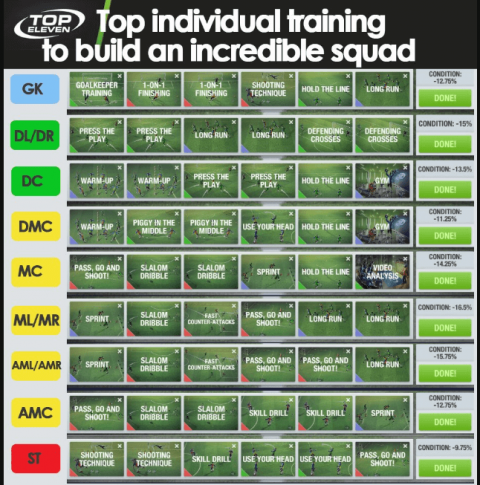
Which attributes matter for which role is covered in more depth in our Top Eleven playstyles guide; pair it with the chart below when choosing what to train.

Condition, rests and recovery times
Nordeus’s help centre confirms that players recover 6% condition every three hours. The Physio Center (Training → Physio Center) shows the time to the next 6% in its bottom-left corner. That gives these waiting times without using a Rest:
Hours to reach 100% condition without Rests
Our calculation from the official 6%-per-3-hours rate. Real times can be a little shorter, because the first 6% arrives whenever the current 3-hour cycle ends.
What this means in practice: a starter who finishes a match tired and then trains hard can easily miss full condition for the next day’s game. Check the clock before you train your first eleven.
| Recovery source | What you get | Tip |
|---|---|---|
| Time | 6% every 3 hours | Train reserves hard; give starters the time |
| Training Centre (Campus) | Generates Rests over time | Claim them daily and upgrade the facility |
| Videos on mobile | Free Rests when offered | The cheapest boost in the game |
| Shop | Rest packs for purchase | Only worth it for power training or finals |
| Treatment Wing (Campus) | Treatments for injuries | Injured players can’t train – heal first |
Which players to train hardest
Nordeus does not publish a training-speed formula, but players have reported the same pattern for years: younger players gain much faster from training, and gains slow sharply around 30. The bands below come from long-standing community observation, not official numbers.
| Age | Training speed (community view) | How to use them |
|---|---|---|
| 18–21 | Fastest | Train hard every day; best targets for power training |
| 22–26 | Good | Core of your squad; balance attributes and form |
| 27–29 | Slowing | Train mainly for Teamplay Form and Sharpness |
| 30+ | Slow; not eligible for the Personal Trainer (official) | Use them for matchday experience; don’t spend tokens on them |
Power training

Power training is a player-made strategy, not a menu option: you pick a few fast-learning players and train them session after session, using Rests to refill their condition between sessions. It turns Rests into attribute gains much faster than normal daily training.
When it is worth it: on young, high-potential players you plan to keep for several seasons, and when you have spare Rests from the Training Centre or events.
When it is not: on players aged 29 or more, on players you might sell soon, or on the day before an important match. Repeated hard sessions also raise injury risk, so keep Treatments on hand.
Personal Trainer, Player Academy and new roles
| Feature | How it works | Watch out for |
|---|---|---|
| Personal Trainer | Spend tokens for an instant boost to one player | Players over 30 are not eligible |
| Player Academy | Unlocks at training level 3. New coaches appear every two days for drill sessions, skill seminars and training camps | The player can’t play matches until he returns, training can’t be cancelled, one coach per player, no Playstyle points while there, no coaches on the season’s last day |
| New role | Squad → choose player → tap + next to Roles → pick a role → Start | You can only choose roles from the offered list |
Player Academy tip: send players during a quiet stretch of fixtures, never the day before a derby, because you can’t pull them back early.
What Top Eleven 2027 changed (and didn’t)
Top Eleven 2027 arrived on 9–10 August 2026 with Legendary Mentors (Cesc Fàbregas, Alan Shearer, Claude Makélélé and Nemanja Vidić), redesigned tactics, a more detailed live match and upgraded match reports. Each Mentor has a Tactic Boost, an Attribute Boost and a Signature Move, and you can swap Mentors at half-time.
Nordeus’s 2027 announcements do not describe changes to the training screen itself, so the drills, Teamplay Form and condition rules in this guide still apply. Two things to keep in mind:
Mentor boosts are matchday boosts, not training. They don’t replace Teamplay Form or Sharpness; they stack on top of a well-trained squad.
The new match report is a training tool. If it shows your side losing possession or conceding from crosses, shift that week’s drills toward Possession or Defence.
The Campus facilities from Top Eleven 2026 still matter for training: the Training Centre produces Rests, the Treatment Wing produces Treatments, and the Drill Lab (from Campus level 2) produces Teamplay Drills.
Common Top Eleven training mistakes
| Mistake | Fix |
|---|---|
| Training only 2–3 players at a time | Use 4 or more, or you gain no Teamplay Form or Sharpness |
| Stopping once Teamplay Form hits 10 | Keep going; the extra fills the Excel bar for Advancement points |
| Saving Advancement points “for later” | They reset at season end; spend them |
| Stacking the same drill intensity | Mix intensities for the Intensity Variety Bonus |
| Training defenders on attacking drills | Match drills to roles (see the position table) |
| Hard sessions for starters just before a match | Train reserves hard; keep starters’ sessions light |
| Spending tokens on a 30+ player | The Personal Trainer won’t accept him; invest in youth |
| Forgetting Campus claims | Collect Rests, Treatments and Teamplay Drills every day |
Training only wins matches when the tactics fit the squad. Once your players are fit and sharp, choose the right shape with our best formations guide and adjust to your opponent with the Top Eleven counter formations table.
Keep reading
→ Top Eleven guide
→ Top Eleven best formations with tactics
→ Top Eleven counter formations
→ Top Eleven playstyles guide
→ All Top Eleven guides
FAQ
How does training work in Top Eleven?
Regular drills (Attack, Defence, Possession, Physical & Mental) raise player attributes and add some Teamplay Form. Consumable Teamplay drills raise Teamplay Form faster but don’t improve attributes. Every drill costs condition, and sessions also earn training points that unlock and upgrade drills up to training level 111.
How many players do I need in a training session?
At least 4. With fewer than 4 players, the session can still improve attributes but gives no Teamplay Form and no Sharpness.
What is the maximum Teamplay Form?
Each of the four types starts with a cap of 10. Extra form fills the Excel bar, each full bar gives an Advancement point, and each point raises one cap by 2, up to 20. Caps reset to 10 every season.
How fast do players recover condition?
6% every three hours, so a player at 70% needs about 15 hours to reach 100% without Rests. Rests from the Training Centre, videos or the Shop restore condition instantly.
How do I get more Teamplay drills?
Build the Drill Lab on your Campus (available from Campus level 2) and claim its drills regularly. They also come from season events and the Shop.
Can I train players over 30?
They can join normal training sessions, but they are not eligible for the Personal Trainer, and players generally report much slower gains at that age. Use them mainly for Teamplay Form and matchday experience.
Did Top Eleven 2027 change training?
Top Eleven 2027 added Legendary Mentors, redesigned tactics and better match reports. Nordeus has not announced changes to the training system itself, so drills, Teamplay Form and condition work as described in this guide.
Sources: Top Eleven official news – “New Era of Top Eleven Training” (5 Nov 2023) and “Top Eleven 2026 – Campus” (10 Aug 2025); Nordeus Help Center articles on Teamplay Form, Sharpness, Training Uplift, regular and Teamplay drills, Player Academy, new roles, Personal Trainer eligibility, rest times and Campus facilities; Nordeus Help Center and Zynga announcement for Top Eleven 2027 (Aug 2026); GamingonPhone position drill list (2021, updated Sep 2024) for drill names. Age bands and the daily routine are community experience and our own approach. Checked 16 October 2026.