
Natural Resources of Nepal: Types, Uses, Latest Data & Challenges (2026)
By Wilson Shrestha · Kathmandu · Updated October 2026 · Figures from the Economic Survey 2025/26, NEA, Department of Mines and Geology and ICIMOD
Quick answer
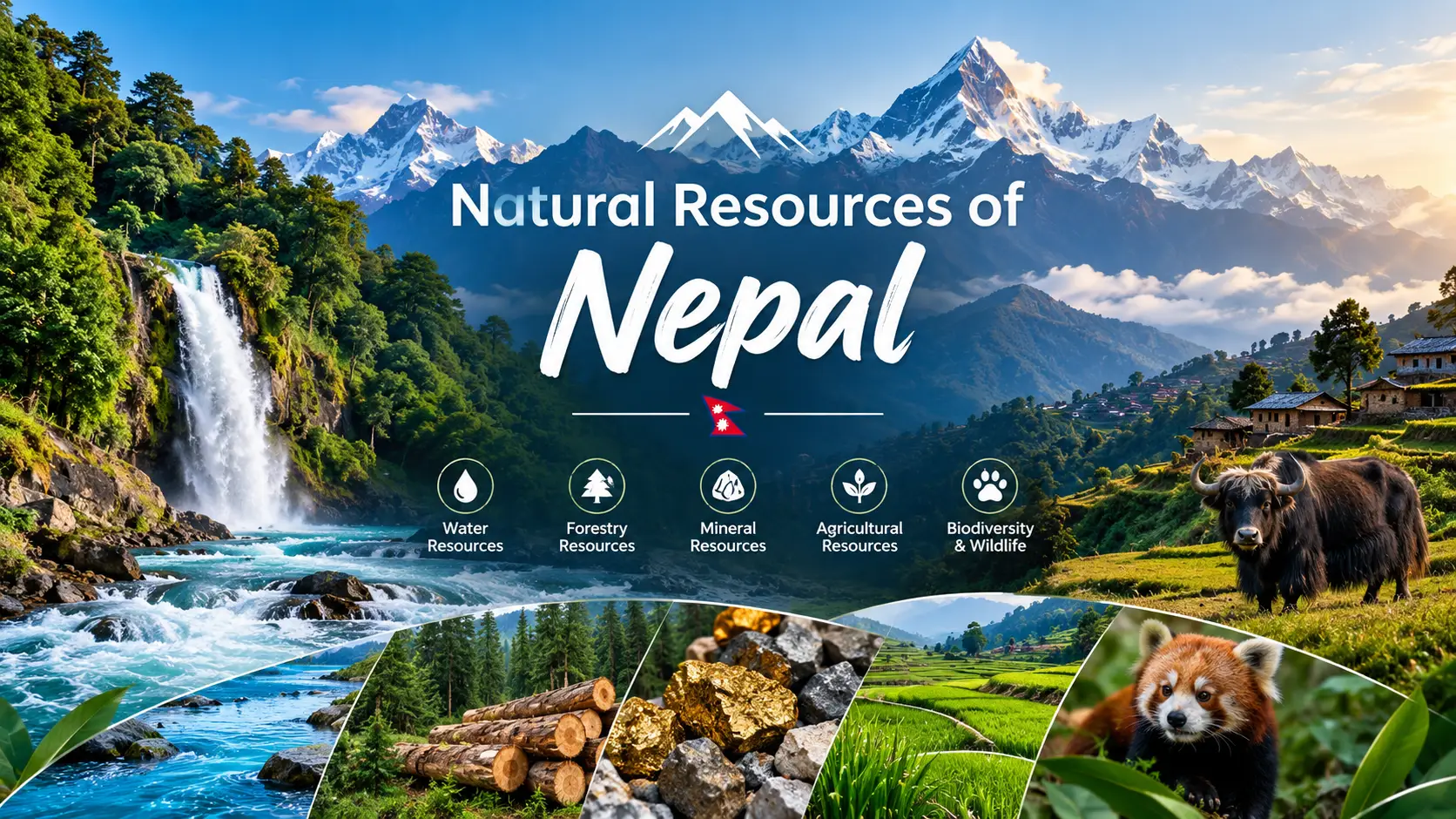
The major natural resources of Nepal are water (around 6,000 rivers, glaciers and lakes), forests (46.08% of the country in 2024), land and soil (about 28% arable), minerals (limestone, magnesite, iron ore, and a newly confirmed methane gas reserve in Dailekh), and biodiversity and wildlife. Nepal’s mountains, scenery and sunshine are resources too, powering tourism and solar energy.
Most articles about Nepal’s natural resources were written years ago. They still say Nepal produces 600 MW of electricity, that forests are shrinking, or that Nepal is the world’s second richest country in water. None of that is true in 2026. This guide covers every resource type with the latest official numbers, explains which popular claims are myths, and ends with quick revision notes for NEB, SEE and Lok Sewa students.
In this guide
- Nepal’s natural resources at a glance (2026)
- Types of natural resources: renewable vs non-renewable
- 1. Water resources and hydropower
- 2. Forest resources
- 3. Land and soil
- 4. Mineral and energy resources
- 5. Biodiversity and wildlife
- 6. Other resources: mountains, sunlight and herbs
- All resources compared in one table
- Myths vs facts
- Problems and challenges
- Conservation and management
- My take as a Kathmandu resident
- Quick revision notes for exams
- FAQs
Nepal’s Natural Resources at a Glance (2026)
Nepal covers only about 147,181 km², roughly 0.1% of the world’s land, yet it rises from under 100 m in the Terai to the top of Everest. That height difference is the reason one small country holds so many different resources. Here are the numbers that matter today:
46.08%
Forest cover in 2024 (43.38% forest + 2.7% shrub), 2nd highest in South Asia
4,120 MW
Installed electricity capacity at the end of FY 2025/26 (NEA)
~225 bn m³
Surface water flowing out of Nepal every year
27.89%
Share of land that is arable (Department of Survey)
23.4%
Area under protected status: 34,420 km²
Rs 29.32 bn
Electricity exported to India and Bangladesh in FY 2025/26
80.7 bn m³
Methane gas confirmed at Jaljale, Dailekh (final study)
0.43%
Mining and quarrying’s share of GDP, the smallest sector
Types of Natural Resources in Nepal: Renewable vs Non-Renewable
Economists and textbooks group natural resources by whether nature can replace them within a human lifetime. This split also explains Nepal’s strategy: build the economy on resources that renew (water, forests, sunlight) and use the finite ones carefully.
Renewable resources
- Water: rivers, lakes, glaciers, groundwater
- Hydropower and solar energy
- Forests, timber, herbs and pasture
- Wildlife and biodiversity
- Fertile soil, if it is protected from erosion
Non-renewable resources
- Metallic minerals: iron, copper, lead, zinc
- Industrial minerals: limestone, magnesite, mica, talc
- Building stone: marble, slate, sand and gravel
- Fossil fuels: methane gas (Dailekh), small coal seams
- Land area itself (it cannot be expanded)
1. Water Resources and Hydropower
Water is Nepal’s most valuable natural resource. Snowmelt, glaciers and the summer monsoon feed roughly 6,000 rivers and rivulets, and about 225 billion cubic metres of surface water leaves the country every year. The water flows south into the Ganges basin, which is why Nepal is often called the water tower of South Asia.
River systems of Nepal
Geography books classify Nepal’s rivers into three groups according to where they start and whether they dry up:
| Class | Where they start | Examples | Main use |
|---|---|---|---|
| First-class (snow-fed) | Himalaya and Tibet; flow all year | Koshi (Saptakoshi), Gandaki (Narayani), Karnali, Mahakali | Large hydropower and irrigation |
| Second-class | Mahabharat range; never dry but shrink in winter | Mechi, Kankai, Kamala, Bagmati, West Rapti, Babai | Medium irrigation, drinking water |
| Third-class (seasonal) | Chure (Siwalik) hills; may dry in winter | Tilawe, Sirsiya, Hardinath, Duduwa | Monsoon farming; flash-flood risk |
Hydropower: huge potential, fast but uneven growth
The famous figure of 83,000 MW is a theoretical estimate first made in 1966. Only part of it can be built at a sensible cost: the economically feasible potential is usually put at about 42,000–43,000 MW. A 2019 study by the Water and Energy Commission Secretariat gives a more conservative 72.5 GW gross and 32.7 GW economically feasible. Either way, Nepal has developed only a small slice:
Hydropower: potential vs what Nepal has built (MW)
Sources: NEA Annual Report 2025/26; widely cited potential estimates. Installed capacity is about 10% of the economic potential.
The good news is the direction. NEA added 529 MW in fiscal year 2025/26 alone and holds power purchase agreements for 545 projects worth about 12,135 MW. Load-shedding schedules are gone, and Nepal now sells its monsoon surplus abroad:
- FY 2025/26 exports: 3.877 billion units of electricity, earning a record Rs 29.32 billion (up about 68% in one year).
- Net trade: imports fell to Rs 10.56 billion, leaving a surplus of Rs 18.76 billion.
- Buyers: mainly India’s power exchanges; Bangladesh has bought 40 MW through Indian lines since June 2025.
| Year | Milestone |
|---|---|
| 1911 | Pharping, Nepal’s first hydropower plant (500 kW), starts in Kathmandu |
| 2021 | 456 MW Upper Tamakoshi, the largest plant, comes online; India first allows Nepal to sell 39 MW |
| 2024 | First power shipment to Bangladesh (15 November) |
| FY 2025/26 | Installed capacity reaches 4,120 MW; record Rs 29.32 billion export income |
| 26 Aug 2026 | Bhotekoshi–Trishuli flood damages about 12 projects and removes ~431 MW from the grid |
Lakes, glaciers and groundwater
Nepal’s glaciers are its frozen water bank. An ICIMOD inventory counted 3,252 glaciers and 2,323 glacial lakes. The lakes are also major tourist attractions:
| Lake | District | Known for |
|---|---|---|
| Rara | Mugu | Largest lake in Nepal |
| Phoksundo (Rigmo) | Dolpa | Deepest lake in Nepal |
| Tilicho | Manang | One of the highest lakes in the world (about 4,919 m) |
| Phewa | Kaski (Pokhara) | Second largest lake; tourism and boating |
| Begnas and Rupa | Kaski (Pokhara) | Fish farming and tourism |
| Gosaikunda | Rasuwa | Hindu pilgrimage site at about 4,380 m |
| Imja Tsho | Solukhumbu | Fast-growing glacial lake, partly drained in 2016 |
Groundwater is the hidden half of the story. It supplies most drinking water in Kathmandu Valley and most irrigation in the Terai, yet only about 15 billion m³ of Nepal’s water is actually used each year, a tiny share of the total flow.
2. Forest Resources
Here the old textbooks are most out of date. Nepal’s forests are growing, not shrinking. According to the Economic Survey 2025/26, forest and shrub cover reached 46.08% of the country in 2024, made up of 43.38% forest and 2.7% shrub and bush land.
Nepal’s forest cover over time (% of land area)
Source: Economic Survey 2025/26. The Department of Survey’s separate land-use map puts forest at 41.71%, because it uses a different method and excludes shrubland.
Forest cover in South Asia (% of land)
World average: about 32%. Source: Economic Survey 2025/26.
The biggest reason for the recovery is community forestry. About 23,162 community forest user groups now manage around 2.5 million hectares, roughly a third of all forest land. Villagers protect the forest because they share its timber, firewood and fodder.
Forest types by altitude
| Forest type | Altitude | Where | Typical trees and plants |
|---|---|---|---|
| Tropical / sub-tropical evergreen | Up to ~1,200 m | Terai, Bhabar, Chure, inner Madhesh | Sal, sissoo, khair (cutch), simal |
| Temperate deciduous (mixed) | 1,200–2,100 m | Mahabharat range, mid-hills | Chestnut, walnut, alder, chilaune, rhododendron |
| Coniferous | 2,100–3,350 m | Upper hills, lower Himalaya | Pine, fir, spruce, deodar (Himalayan cedar), birch |
| Alpine shrub and meadow | 3,350–5,000 m | High Himalaya | Dwarf rhododendron, juniper, medicinal herbs, pasture |
| Tundra | Above 5,000 m | Near the snowline | Mosses and lichens only |
Forests provide firewood, timber, fodder, medicinal plants and, increasingly, carbon income. They also hold the steep hill soil in place, which is why losing them causes landslides and floods downstream.
3. Land and Soil Resources
Land is the resource most Nepalis depend on directly. Agriculture, forestry and fishing still form the largest sector of the economy at about 24% of GDP (2025/26), and the Department of Survey’s land-use data shows 41,275 km² (27.89%) of the country is arable. Most of the best farmland is in the Terai, often called the granary of Nepal.
Main soil types
| Soil | Found in | Fertility | Best crops |
|---|---|---|---|
| Alluvial | Terai and river basins | High | Rice, wheat, sugarcane, jute, lentils |
| Sandy-pebbly (Bhabar) | Bhabar belt, Chure foothills | Low; drains fast | Mostly forest (sal, sissoo) |
| Red / grey (residual) | Mahabharat slopes | Medium | Maize, millet, potato, tea, fruit |
| Lacustrine (Talaiya / kalo mato) | Kathmandu and Pokhara valleys | Very high | Rice, wheat, vegetables |
| Glacial / mountain | High Himalaya | Low; thin layer | Barley, potato, buckwheat |
Historical land tenure systems (Raikar, Birta, Guthi and Kipat) still appear in Lok Sewa exams. In short: Raikar is state land taxed by the government; Birta was tax-free land gifted by rulers and abolished in 2016 BS; Guthi is trust land that funds temples and festivals; Kipat was communal land of eastern hill communities. If you deal with land in Nepal, our Ropani to square feet converter helps with local units like ropani, aana and bigha.
4. Mineral and Energy Resources
Nepal has dozens of known mineral deposits, but mining contributes only about 0.43% of GDP, the smallest of all 18 sectors. Rugged terrain, poor roads, little exploration money and slow licensing are the main reasons. Here are the minerals that matter most:
| Mineral | Main locations | Status in 2026 |
|---|---|---|
| Limestone | Udayapur, Makwanpur (Hetauda), Surkhet, Dang, Palpa | Actively mined; feeds Nepal’s cement industry |
| Iron ore | Dhaubadi (Nawalparasi East), Phulchoki, Thoshe (Ramechhap) | Dhaubadi: ~99 million t, 96 million t extractable; production expected from about 2084 BS |
| Magnesite | Kharidhunga (Dolakha), Kampughat (Udayapur) | Large deposits; little production |
| Copper | Bhut Khola (Tanahun), Wapsa (Solukhumbu), Okhaldhunga | Small historic mines; not commercial |
| Gold (placer) | Sand of Kaligandaki, Budhigandaki, Sunkoshi, Mahakali | Small-scale panning only |
| Marble, slate, quartzite | Godawari, Bandipur, Baglung, Makwanpur | Quarried for construction |
| Mica, talc, lead, zinc | Bhojpur, Ganesh Himal, Phulchoki | Known deposits; mostly unworked |
| Methane gas | Jaljale, Bhairabi RM-1, Dailekh | 80.7 billion m³ confirmed; extraction not yet started |
The Dailekh gas discovery explained
In June 2025 the Department of Mines and Geology announced that drilling to 4,013 metres at Jaljale, Dailekh, with the China Geological Survey had found methane gas. Early news reports mixed up two figures, "1.12 billion" and "112 billion" cubic metres. The final study, submitted on 7 November 2025, settled it: the reserve holds about 80.7 billion m³, about 32 billion less than the preliminary estimate. Officials describe it as a medium-sized reserve by global standards. Only one of four target sites has been drilled, and as of October 2026 commercial production has not begun.
Why it matters
Petroleum products are Nepal’s largest import. If Dailekh’s gas proves commercial, it could supply cooking gas or a chemical fertiliser factory and cut that import bill. Until production starts, treat any "50 years of gas" headline as a hope, not a fact.
5. Biodiversity and Wildlife
Nepal holds about 3.2% of the world’s known flora and 1.1% of its fauna on 0.1% of its land. The national biodiversity strategy records 208 mammals, 867 birds, 123 reptiles, about 55 amphibians, 230 freshwater fish and 651 butterflies, plus 284 flowering plants found nowhere else on Earth.
355
Wild tigers (latest count)
752
Greater one-horned rhinos
498
Wild water buffalo (arna)
23.4%
Land in national parks, reserves and conservation areas
These animals are a direct economic resource. Wildlife tourism in Chitwan and Bardiya and trekking in Sagarmatha and Annapurna bring in foreign currency and support thousands of local jobs. Tiger numbers nearly tripled over the last decade and a half, one of the world’s clearest conservation success stories.
6. Other Resources: Mountains, Sunlight and Herbs
- Mountains and landscape: Nepal has eight of the world’s fourteen peaks above 8,000 m, including Everest. Mountaineering royalties, trekking and adventure sport are a renewable resource built on scenery.
- Solar energy: Nepal receives an average of roughly 3.6–6.2 kWh of solar radiation per square metre per day. Solar still makes up a tiny share of grid power but is a good partner to hydropower in the dry season, when rivers run low.
- Medicinal and aromatic plants: high-altitude herbs such as yarsagumba, chiraito, jatamansi and timur are collected and exported, giving mountain households cash income.
- Pasture land (kharka): alpine meadows support yak, sheep and goat herding in the Himalaya.
All Natural Resources of Nepal Compared
| Resource | Renewable? | Key 2026 figure | Main use | Biggest challenge |
|---|---|---|---|---|
| Water | Yes | ~225 bn m³/year; 4,120 MW installed | Hydropower, irrigation, drinking | Floods, GLOFs, slow project delivery |
| Forest | Yes | 46.08% of land | Timber, fuel, fodder, carbon, tourism | Encroachment, fire, invasive weeds |
| Land and soil | Partly | 27.89% arable | Farming (24% of GDP) | Fragmentation, erosion, urban sprawl |
| Minerals | No | Mining 0.43% of GDP | Cement, construction, future iron | Low investment, terrain, licensing |
| Natural gas | No | 80.7 bn m³ in Dailekh | Possible fuel and fertiliser | Not yet commercial |
| Biodiversity | Yes | 355 tigers, 752 rhinos | Tourism, medicine, ecology | Human-wildlife conflict, poaching |
| Sun and scenery | Yes | 8 of 14 peaks over 8,000 m | Tourism, solar power | Climate change, crowding |
Myths vs Facts About Nepal’s Natural Resources
MYTH: "Nepal is the second richest country in water resources after Brazil."
FACT: False by total volume. Nepal has about 210 km³ of renewable water and ranks around 43rd in the world. Brazil, Russia, the USA, Canada and China lead. Nepal is rich in water for its size and in steep river drops, which is what makes it good for hydropower.
MYTH: "Nepal can produce 83,000 MW of electricity."
FACT: Only in theory. The economically feasible figure is about 42,000 MW, and a 2019 government study suggests it may be lower still.
MYTH: "Nepal’s forests are disappearing."
FACT: Not since the 1990s. Cover rose from 39.6% to 46.08% in 2024, thanks largely to community forestry.
MYTH: "Nepal found 112 billion m³ of gas, enough for 50 years."
FACT: That was the June 2025 preliminary estimate. The final study confirms 80.7 billion m³, and nothing has been produced yet.
MYTH: "Nepal produces only 600 MW."
FACT: That figure is about a decade old. Installed capacity passed 4,000 MW in 2025/26.
Problems and Challenges in Using Nepal’s Natural Resources
Nepal’s problem has never been a lack of resources. It is turning them into income safely. These are the main obstacles in 2026:
- Climate change and glacial lake outburst floods (GLOFs): Himalayan glaciers are losing ice faster than before 2000. An ICIMOD–UNDP study lists 47 potentially dangerous glacial lakes in basins that drain into Nepal, 21 of them inside Nepal and 25 in Tibet. On 26 August 2026 a debris flood on the Bhotekoshi–Trishuli corridor killed many people, left hundreds missing and damaged about 12 hydropower projects, cutting roughly 431 MW (about a tenth of national capacity). It showed how exposed river-based infrastructure is.
- Slow project delivery: licences, land acquisition, transmission lines and financing delay projects for years, so potential stays on paper.
- Unequal development: most hydropower is built in the Koshi and Gandaki basins, while Karnali and Sudurpashchim remain underdeveloped despite huge potential.
- Sand and gravel mining: unregulated river-bed extraction and Chure hill quarrying lower water tables and worsen floods in the Terai.
- Pollution: rivers such as the Bagmati in Kathmandu receive untreated sewage and solid waste.
- Land fragmentation and migration: farms are split into tiny plots and many hill fields are left fallow as young people migrate, which pulled agriculture growth down to about 1.6% in 2025/26.
- Low investment in minerals: exploration is expensive, and deposits like Dhaubadi have taken more than a decade to move toward production.
Conservation and Sustainable Management
- Community forestry: 23,162 user groups manage about 2.5 million hectares, the main reason forest cover is rising.
- Protected areas: 23.4% of the country lies in national parks, wildlife reserves and conservation areas, with buffer-zone communities sharing park income.
- Glacial lake risk reduction: Imja Tsho’s water level was lowered in 2016, and a project of about USD 50 million now targets Thulagi, Lower Barun, Lumding Tsho and Hongu 2, alongside early-warning systems.
- Regional power trade: exporting monsoon surplus to India and Bangladesh turns spilled water into income and pays for new plants.
- Public companies in hydropower: projects like Upper Tamakoshi were partly funded by ordinary Nepali shareholders, linking local savings to national resources.
My Take as a Kathmandu Resident and Investor
I live in Kathmandu and follow hydropower closely because a large part of the Nepal Stock Exchange (NEPSE) is hydropower companies. When I wrote my UPPER fundamental analysis (Upper Tamakoshi) and BHL fundamental analysis, the lesson was the same: having water is not the same as earning from it. A plant can sit on a great river and still post losses because of debt, delays or a bad monsoon. The August 2026 flood made that risk painfully real.
What gives me hope is how much has changed in a few years. I remember daily load-shedding timetables taped to walls; today Nepal sells electricity abroad. If you are thinking about business or investment in this space, read our guides on investment opportunities in Nepal and starting as an entrepreneur in Nepal. Nothing here is financial advice; check current data before you invest.
Quick Revision Notes for NEB, SEE and Lok Sewa
- Main natural resources: water, forest, land/soil, minerals, biodiversity.
- Rivers: about 6,000; three snow-fed systems are Koshi, Gandaki and Karnali (plus Mahakali on the western border).
- Hydropower potential: 83,000 MW theoretical, about 42,000 MW economically feasible.
- Installed capacity: 4,120 MW (end of FY 2025/26, NEA).
- First hydropower plant: Pharping, 1911, 500 kW. Largest plant: Upper Tamakoshi, 456 MW.
- Forest cover: 46.08% in 2024 (Economic Survey 2025/26); second in South Asia after Bhutan (69.71%).
- Protected area: 34,420 km² or 23.4% of Nepal.
- Arable land: 27.89% (Department of Survey).
- Largest lake: Rara. Deepest: Phoksundo. High-altitude lake: Tilicho.
- Dhaubadi (Nawalparasi) = iron ore. Dailekh = methane gas, 80.7 billion m³ confirmed.
- Nepal is NOT the world’s second richest country in water; it ranks around 43rd by volume.
Preparing for public service exams? See our step-by-step guide to the Lok Sewa online application form. The Economic Survey quoted throughout this article is presented to Parliament by the finance minister; read about the current one in our Swarnim Wagle biography.
Frequently Asked Questions
What are the main natural resources of Nepal?
The main natural resources of Nepal are water (rivers, glaciers, lakes and groundwater), forests, land and soil, minerals such as limestone, magnesite and iron ore, natural gas in Dailekh, and rich biodiversity and wildlife. Mountains and sunlight are also important resources for tourism and solar power.
Which is the most important natural resource of Nepal?
Water is the most important. It feeds agriculture and drinking supply and generates almost all of Nepal’s electricity. Hydropower capacity reached 4,120 MW by the end of FY 2025/26, and power exports earned Rs 29.32 billion that year.
Is Nepal the second richest country in water resources?
No. This is a common myth. By total renewable water, Nepal ranks around 43rd in the world with about 210 cubic kilometres. It is water-rich for its small size, and its steep rivers are excellent for hydropower.
What percentage of Nepal is covered by forest?
According to the Economic Survey 2025/26, forest and shrub cover was 46.08% in 2024, made up of 43.38% forest and 2.7% shrub. That is the second highest share in South Asia after Bhutan.
What is the hydropower potential of Nepal?
Nepal’s theoretical hydropower potential is about 83,000 MW, of which around 42,000 MW is considered economically feasible. A 2019 government study gives a lower estimate of 72.5 GW gross and 32.7 GW feasible.
Which minerals are found in Nepal?
Nepal has limestone, magnesite, iron ore, copper, lead, zinc, mica, talc, marble, slate, placer gold and small coal deposits. Limestone for cement is the most actively mined. The Dhaubadi iron ore deposit in Nawalparasi holds about 99 million tonnes.
How much natural gas was found in Dailekh?
The final study by the China Geological Survey, submitted in November 2025, confirmed about 80.7 billion cubic metres of methane at Jaljale, Dailekh, lower than the preliminary estimate of 112 billion. Commercial production had not started as of October 2026.
What are the problems in using Nepal’s natural resources?
The main problems are climate change and glacial lake outburst floods, slow hydropower and mining project delivery, weak transmission, unregulated sand and gravel mining, river pollution, land fragmentation and low investment.
Conclusion
Nepal is not resource-poor; it is resource-underused. Its water, forests and biodiversity are renewable and, in the case of forests and wildlife, actually improving. Electricity has gone from shortage to export in a few years. The hard part is the next step: building safely in a warming, flood-prone Himalaya, spreading development to the far west, and turning finds like Dhaubadi iron and Dailekh gas into real production. Use the figures above, check the sources below for updates, and be wary of any article still quoting 600 MW or a shrinking forest.
Sources and further reading
- NEA Annual Report 2025/26 summary (Nepal News)
- Electricity trade surplus FY 2025/26 (Kathmandu Post)
- Forest cover, Economic Survey 2025/26 (Himalayan Times)
- National accounts 2025/26 (Nepal News)
- Dailekh methane final study (Nepal News)
- Dhaubadi iron ore plan (OnlineKhabar)
- Department of Survey land-use data (Republica)
- ICIMOD inventory of glaciers and glacial lakes in Nepal
- Glacial lake risk-reduction project (Kathmandu Post)
- Bhotekoshi flood and hydropower damage (Spotlight)
- Is Nepal the second richest in water? (OnlineKhabar)