
NRN Card Nepal 2026: Fees, Documents, Online Apply & Full Process
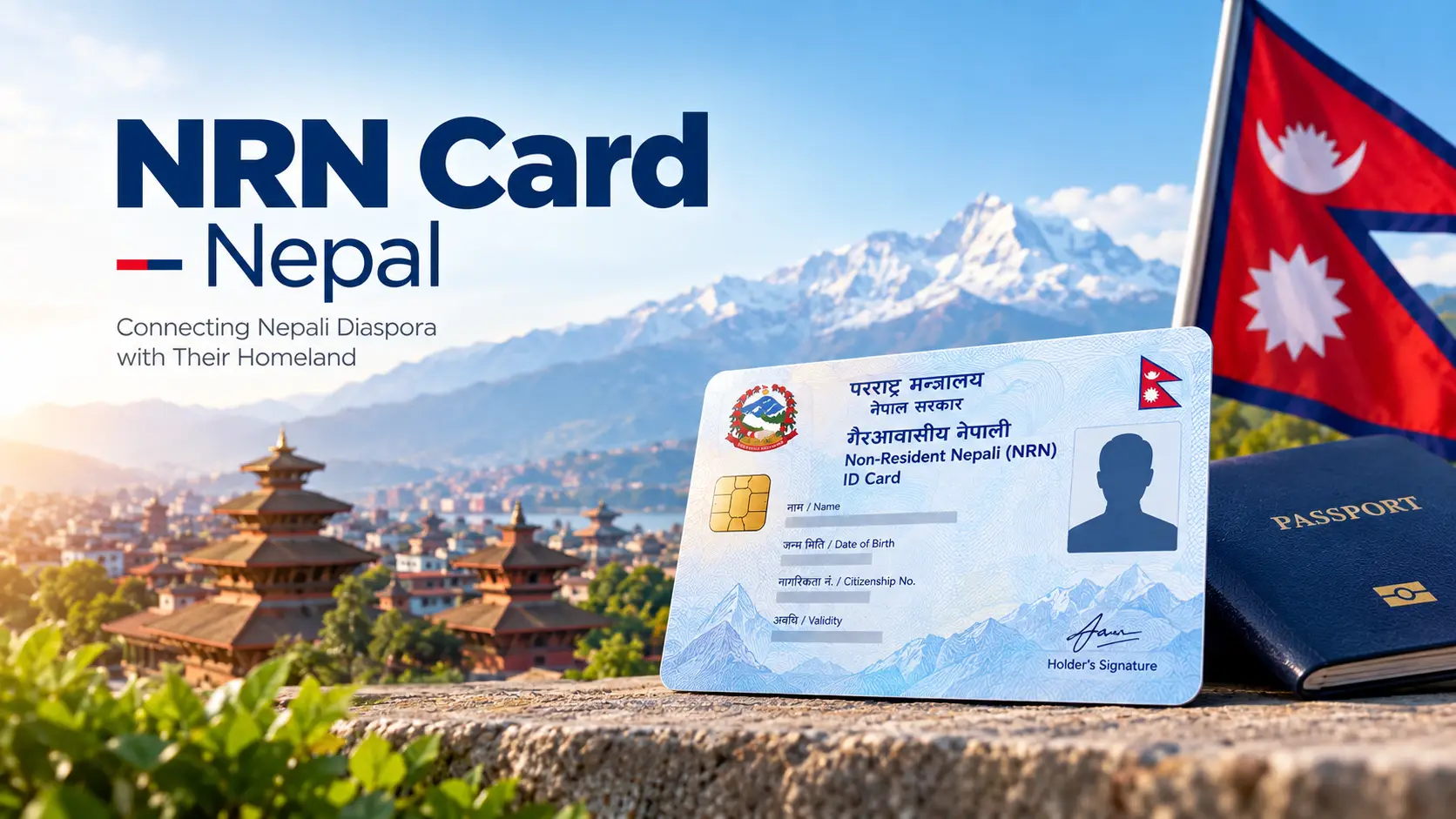
If you are a Nepali living abroad — or a foreign citizen whose parents or grandparents were Nepali — the NRN Card is the single document that reconnects you legally to Nepal. It unlocks a free visa, the right to buy property, the right to open a foreign-currency bank account, and the right to invest and take your money back out.
The problem is that the information is scattered. The Ministry of Foreign Affairs publishes its fee schedule only in Nepali. Each embassy lists a different price in a different currency. And almost nobody tells you the two details that get most applications rejected: your renunciation certificate must already be issued, and your photo must be exactly 45 mm × 35 mm.
This guide puts all of it in one place, in English, with the 2026 numbers.
Key takeaways
- Two categories: Foreign Citizen of Nepali Origin (card valid 10 years) and Nepali Citizen Residing Abroad (card valid 2 years).
- Apply online first at nrn.mofa.gov.np — there is no paper-only route any more.
- Fee in Nepal: NPR 1,500 registration + USD 500 or USD 250 (origin card, by country tier) or USD 50 (Nepali citizen abroad), paid in rupees at that day's NRB rate.
- SAARC countries are excluded from both categories — India, Pakistan, Bangladesh, Sri Lanka, Bhutan, Maldives and Afghanistan.
- Renouncing Nepali citizenship is mandatory for foreign citizens of Nepali origin, and the certificate must be in hand before you apply.
- An NRN Card is not NRN Citizenship. They are two separate documents from two separate ministries.
What is the NRN Card?
The Non-Resident Nepali (NRN) Identity Card is an official identity document issued by the Ministry of Foreign Affairs (MOFA) in Kathmandu, or by any Nepali embassy or consulate general abroad. It formally recognises you as a Non-Resident Nepali under the Non-Resident Nepali Act, 2064 (2008) and the Non-Resident Nepali Rules, 2066 (2009).
Think of it as a diaspora status card rather than a travel document. It does not replace your passport and it does not let you vote. What it does is switch on a defined package of economic, social and cultural rights inside Nepal that ordinary foreign nationals do not get — chiefly a free visa, the ability to own land within set ceilings, and the ability to move investment capital in and profits out.
Important distinction: the NRN Card does not, by itself, give you the right to enter Nepal. Foreign citizens of Nepali origin still need a visa — the card simply makes that visa free (gratis) and long-term. Nepali citizens residing abroad never needed a visa in the first place; for them the card is about property, banking and investment rights.
Who is eligible — and who is not
The NRN Act splits applicants into exactly two categories. Which one you fall into decides your documents, your fee and your card's validity, so get this right before you start.
Category 1: Foreign Citizen of Nepali Origin (FCNO)
You qualify if you, or your father, mother, grandfather or grandmother was a citizen of Nepal at any time, and you have since acquired the citizenship of a foreign country that is not a SAARC member state.
- Card validity: up to 10 years
- Covers first, second and third generation applicants (you, your parent, or your grandparent was Nepali)
- Renunciation of Nepali citizenship is compulsory
Category 2: Nepali Citizen Residing Abroad (NCRA)
You qualify if you still hold Nepali citizenship and have been living in a foreign country for at least two years, engaged in a profession, occupation, business or employment.
- Card validity: up to 2 years
- You keep your Nepali citizenship and passport
- Much cheaper and much simpler than the FCNO card
Who is excluded
This is where competitor guides tend to go quiet. The law explicitly rules out several groups:
- Residents of SAARC countries — India, Pakistan, Bangladesh, Sri Lanka, Bhutan, the Maldives and Afghanistan. This applies to both categories.
- Nepali diplomats and consular staff posted abroad on a Government of Nepal assignment.
- Students studying at an academic institution abroad — time on a student visa does not count toward the two-year requirement.
- Children of a Nepali-origin mother and a non-Nepali father. The Embassy of Nepal in Washington DC states directly that such a child is not eligible for an NRN ID card. This is a live grievance in the diaspora and it is worth knowing before you pay any fee.
How to get an NRN Card?
Regardless of where in the world you are, the process follows the same three legal steps set out in the NRN Rules:
- Register as an NRN. Submit an application with the prescribed registration fee to the competent authority — the head of the Nepali embassy or consulate if you are overseas, or the Secretary of the Ministry of Foreign Affairs if you are in Nepal.
- Pay the card fee. Once your registration is approved, pay the separate identity card fee, which varies by category and by the country of your passport.
- Collect your card. The authority prints and issues the NRN Identity Card, either over the counter or by post.
In practice, step one now begins online for everyone. The rest of this guide walks through each stage.
Where should you apply — Nepal or abroad?
| If you apply… | Authority | Typical processing time | Best for |
|---|---|---|---|
| In Nepal | MOFA, Singha Durbar (Room 314) | Often same day | Anyone visiting Nepal with complete documents |
| Hong Kong | Consulate General of Nepal | 3 working days + 1 day to print | HK and Macao residents |
| London | Embassy of Nepal, UK | Same day in person; up to 7 working days by post | UK residents |
| Washington DC | Embassy of Nepal, USA | 10–15 business days | US residents (check your consulate's jurisdiction) |
Jurisdiction matters. In the United States you must apply to the embassy or consulate that covers your state of residence — you cannot simply walk into Washington DC because you happen to be visiting. If you do want to apply outside your jurisdiction, email the mission in advance and get written confirmation first.
How to apply for an NRN card online?
Every NRN application now starts at the government's dedicated portal: nrn.mofa.gov.np. There is no alternative paper-first route, and missions will turn you away if you have not submitted online.
- Open the portal and sign up. Go to nrn.mofa.gov.np and create an account. You will see two separate forms — Foreign Citizen of Nepali Origin and Nepali Citizen Residing Abroad. Choose carefully; picking the wrong one means restarting.
- Select the correct issuing office. The form asks which office will process your application. Choose the embassy or consulate covering your residence, or select the MOFA Labour Migration and Nepali Diaspora Coordination Division if you intend to apply in Kathmandu.
- Fill in your personal details. Enter names exactly as they appear on your passport. A mismatch between your foreign passport and your old Nepali citizenship certificate is the single most common cause of delay — if the spelling differs, be ready to explain it.
- Upload your documents. Every supporting document must be uploaded in the required format and dimensions. Oversized or wrongly sized files are rejected by the system itself, not by a human, so you will not always get a clear error message.
- Upload your photo and signature. The photo must be a recent passport-size image at 45 mm × 35 mm (400 × 300 pixels). The signature should be signed on plain white paper and scanned.
- Submit and print. Submit the form, then print the completed application and sign it by hand. This signed printout is part of your physical file.
- Notify your mission. Online submission alone does not start the clock. Email your embassy or consulate to tell them the application is in — Hong Kong, for example, asks applicants to email the consulate directly after submitting.
- Submit the physical file and pay. Mail, drop off or hand-deliver the printed application with your self-attested document copies and the fee. Then collect the card, or receive it in your prepaid return envelope.
There is no online payment. This catches almost everyone. The portal handles your application, not your fee. Missions require a cashier's cheque, money order, or in-person card payment; in Nepal, you pay through a bank voucher at Rastriya Banijya Bank. Budget time for this step.
Self-attesting your copies
Most missions require every photocopy to be self-attested: write "True Copy" on the back of each page, sign it, and date it. An unsigned or un-attested file is returned without being processed.
How to make an NRN card in Nepal (the MOFA route)
If you are already in Kathmandu, applying directly at the Ministry of Foreign Affairs is usually the fastest option in the world — MOFA aims to issue the card the same day when the file is complete. But the building is inside Singha Durbar, a restricted government compound, so you cannot simply walk in.
- Complete the online form first at nrn.mofa.gov.np and prepare your original documents.
- Call ahead on 01-4211121 to book a convenient time with the NRN Desk. This is not optional — it is how you get into the compound.
- Give your entry details. Provide your full name, the district that issued your citizenship, your address, and your vehicle number if you are driving. MOFA forwards this to Counter No. 1 at the Singha Durbar south gate.
- Collect your entry pass at Counter No. 1, south gate, on the appointed day. You will need to leave an ID (citizenship or driving licence) at the gate and collect it on your way out.
- Register at reception inside MOFA, then go to the NRN Desk, Room 314, third floor (east side), under the Policy, Planning, Development Diplomacy and Nepali Diaspora Division.
- Document check and approval. If your file is complete, it goes to the Secretary's office on the second floor for approval.
- Get your payment voucher. Take the approval to the Financial Administration Section, Room 226, second floor, and collect a revenue voucher.
- Pay at the bank. Deposit the amount at the Rastriya Banijya Bank branch inside the Singha Durbar compound, near the television tower (opposite the Ministry of Information and Communication).
- Return with the original voucher to the division. Your card is printed and issued — usually the same day, unless the ministry needs to verify something further.
Bring originals, not just copies. For foreign citizens of Nepali origin, the original citizenship renunciation document must be produced. The ministry keeps the photocopy and hands the original back to you after inspection.
Non-Resident Nepali (NRN) Identity Card: NRN Identity Card vs NRN Citizenship
This is the most confused topic in the entire NRN space, and it is the biggest gap in every competing article we reviewed. The NRN Identity Card and NRN Citizenship are two different documents, issued by two different ministries, under two different laws. Having one does not automatically give you the other.
| Feature | NRN Identity Card | NRN Citizenship |
|---|---|---|
| Governing law | Non-Resident Nepali Act, 2064 & Rules, 2066 | Constitution of Nepal, Article 14; Nepal Citizenship Act, 2063 (Section 7A) and its amendment Regulations |
| Issued by | Ministry of Foreign Affairs, or Nepali embassies/consulates abroad | District Administration Office (DAO/CDO), under the Ministry of Home Affairs |
| What it is | An identity and benefits card for diaspora Nepalis | A limited, non-political citizenship status |
| Who can apply | Foreign citizens of Nepali origin, and Nepali citizens abroad 2+ years | Only foreign citizens of Nepali origin (non-SAARC) |
| Validity | 10 years (FCNO) or 2 years (NCRA), renewable | A citizenship certificate — no fixed expiry |
| Voting rights | No | No |
| Public office / civil service / army / judiciary | No | No — explicitly excluded |
| Nepali passport | No | No |
| Visa needed to enter Nepal | Yes, but free (gratis) while the card is valid | Holders are entitled to a free multi-entry residential visa |
| Where to apply | Online at nrn.mofa.gov.np, then the mission or MOFA | In person at the DAO of your (or your ancestor's) home district |
| Typical timeline | Same day (Nepal) to 15 business days (US) | Roughly 10–15 working days at the DAO |
How the two documents relate
In practice the NRN Identity Card functions as the gateway document. Most DAOs expect to see an NRN ID card (or at least evidence you qualify for one) when you apply for NRN citizenship, and your copy of the card is listed among the supporting documents.
The NRN citizenship route typically requires you to:
- Formally renounce your Nepali citizenship at the DAO and obtain the renunciation certificate
- Get a recommendation letter from your local Ward Office confirming your Nepali origin
- Have the DAO forward your file to the police for a background check
- Bring a close relative who holds valid Nepali citizenship to appear in person at the DAO and verify your identity
- Submit your foreign passport, foreign citizenship certificate, your (or your parents'/grandparents') Nepali citizenship copies, photographs and the application form
Embassies cannot issue NRN citizenship. The Embassy of Nepal in Washington DC confirms that missions are not currently authorised to issue it, and directs applicants to their District Administration Office in Nepal instead. There is a legal provision to apply via a mission, but in practice almost every applicant is told to come to Nepal. Plan a trip.
And a point no guide should skip: Nepal does not permit full dual citizenship. A Nepali who voluntarily acquires foreign citizenship loses their Nepali citizenship automatically. NRN citizenship is the narrow, non-political exception that lets you hold a foreign passport alongside a Nepali identity — it is a bridge, not dual nationality.
NRN Card benefits
Here is what the card actually buys you, grouped by what people use it for.
1. Free, long-term visa
- Foreign citizens of Nepali origin receive a gratis tourist visa on arrival at the airport, for a number of days set by the Department of Immigration.
- That visa is then converted to an NRN visa by applying to the Non-Tourist Visa Section of the Department of Immigration, extendable for a maximum of one year at a time.
- Both the arrival visa and the extension are free of charge for as long as the NRN card is valid — effectively ten years of free visas for FCNO holders.
- Nepali citizens residing abroad need no visa at all; their card is about the economic rights below.
The card is not a visa. An NRN card holder still cannot legally remain in Nepal without obtaining the NRN visa. The card waives the fee; it does not waive the requirement. Overstaying on the strength of the card alone will land you in trouble at departure.
2. The right to buy property in Nepal
Foreign citizens of Nepali origin may purchase land or immovable property for residential use by themselves or their family, within a strict ceiling that depends on location:
| # | Location | Maximum area | Approx. in square metres |
|---|---|---|---|
| 1 | Inside Kathmandu Valley | 2 Ropani | ~1,017 m² |
| 2 | Municipalities in the Terai | 8 Kattha | ~2,709 m² |
| 3 | Municipalities in other districts (outside the Valley and Terai) | 4 Ropani | ~2,035 m² |
| 4 | Rural municipalities in the Terai | 1 Bigha | ~6,773 m² |
| 5 | All other areas | 10 Ropani | ~5,087 m² |
- The ceiling applies to one location only — you choose which category applies, you do not get all five.
- Exception: the ceiling does not apply to land you already acquired while you were still a Nepali citizen.
- Inheritance is separate. A foreign citizen of Nepali origin can inherit ancestral property from Nepali citizens without government approval — but you must hold an NRN ID card to do so.
- You must apply to MOFA for a land-purchase recommendation. There is no fee for this recommendation, and MOFA generally issues it within one week.
A limitation nobody advertises: the Embassy of Nepal in Washington DC states that while an NRN ID card allows you to purchase property in Nepal, it may not permit you to transfer or sell that land. If your plan is to buy and later flip, get specific legal advice before you commit capital.
3. Banking and money
- Open and operate an account in convertible foreign currency at any Nepali commercial bank or financial institution, for income earned abroad.
- Repatriate your investment and the profits earned on it back out of Nepal.
4. Investment rights
- NRNs are treated as foreign investors under the Foreign Investment and Technology Transfer Act, 2019 (FITTA) and may invest in convertible currency.
- Permitted forms include equity shares, reinvestment of profits, lease finance, venture capital funds, listed stocks via the secondary market, acquisition of shares or assets in a Nepali company, technology transfer, and establishing or expanding an industry.
- The conditions: a minimum of NPR 50 million in equity shares, a sector that is not on FITTA's Negative List, and a business that qualifies as an "Industry" under the Industrial Enterprises Act, 2020.
5. Social and civil rights
- Marry in Nepal under the National Civil Code.
- Apply to reacquire Nepali citizenship by relinquishing your foreign citizenship.
- Formal recognition of your Nepali origin for schools, institutions and cultural participation.
What the NRN Card does NOT give you
- No voting rights and no right to stand for election.
- No appointment to the civil service, security forces, judiciary or constitutional bodies.
- No Nepali passport.
- No automatic right of entry — you still take the (free) visa.
- No dual citizenship.
Planning to manage property, taxes or a business remotely? Your NRN card pairs with Nepal's other digital identity services. If you hold Nepali citizenship, it is worth also sorting out your National ID (NID) card status and downloading your eNID while you are in Nepal — both are now required for a growing list of government and banking services.
What are the documents required?
The list differs sharply between the two categories. Prepare the correct one.
For a Foreign Citizen of Nepali Origin
- Completed online application form, printed and signed by hand.
- Proof of your current foreign citizenship — naturalisation certificate, citizenship certificate, or a birth certificate if you were born in that country.
- Copy of your valid foreign passport.
- Original certificate of renunciation of Nepali citizenship, plus a photocopy. This is mandatory and non-negotiable.
- Proof of Nepali origin, one of:
- Your own former Nepali citizenship certificate, minor certificate or birth certificate (first generation)
- Your father's or mother's Nepali citizenship certificate (second generation)
- Your grandfather's or grandmother's Nepali citizenship certificate, plus a document proving the relationship (third generation)
- Proof of profession, business or employment abroad — business registration documents, or an employment letter and income details.
- Recent passport-size photographs. MOFA in Nepal asks for three; missions abroad typically ask for two, uploaded at 45 mm × 35 mm (400 × 300 px).
- Your signature, email address and local phone number on plain white paper (for mission applications).
- Payment instrument — cashier's cheque or money order for postal submissions, or a debit/credit card in person.
- Self-addressed prepaid return envelope with tracking, if you want the card mailed back.
For a Nepali Citizen Residing Abroad
- Completed online application form, printed and signed.
- Copy of your Nepali citizenship certificate.
- Copy of your Nepali passport (the biographic data page of a valid passport).
- Copy of your residence permit — Green Card, PR card or equivalent, if applicable.
- Proof of address — any official document showing your current overseas address.
- Proof of business or employment in your country of residence.
- Appointment letter and current employment confirmation, if you work for an international organisation or agency.
- Passport-size photographs — three for MOFA in Nepal, typically two abroad.
- Your signature, email and phone number on plain white paper.
- Self-addressed prepaid return envelope, if applying by post.
Document tip: gather your parents' or grandparents' citizenship certificate numbers and issuing districts, not just the photocopies. MOFA's own guidance specifically asks for the certificate number and district, which means someone in Nepal may need to pull the record. Ask a family member to retrieve this before you travel.
NRN Card fee in Nepal
The fee structure is genuinely confusing because it comes in two parts, and because the card fee depends on which passport you hold, not where you currently live. Here is the official MOFA schedule.
Part 1: Registration fee
A flat NPR 1,500 is charged when you submit the application to register your name as an NRN. Everyone pays this.
Part 2: Identity card fee (also charged on renewal)
| Category | Country of your passport | Official fee | Approx. NPR* |
|---|---|---|---|
| Foreign Citizen of Nepali Origin | Europe, North America, South America, Australia and the countries of that continent, New Zealand, Japan and South Korea | USD 500 | ~NPR 75,800 |
| All other countries | USD 250 | ~NPR 37,900 | |
| Nepali Citizen Residing Abroad | Any country | USD 50 | ~NPR 7,600 |
*Indicative only. The fee is payable in Nepali rupees at the Nepal Rastra Bank exchange rate fixed for the day you pay. NRB's published rate in early September 2026 was around NPR 151.66 per USD. Always check nrb.org.np/forex on the day.
Where to deposit the fee in Nepal
- Bank: Rastriya Banijya Bank, Singha Durbar branch (near the television tower, opposite the Ministry of Information and Communication)
- Nepal Rastra Bank account no.: 1000200010000
- Office code no.: 326003501
- Revenue heading no.: 14529
NRN card fee at Nepali missions abroad
Missions convert the same USD schedule into local currency and add the registration component, so the numbers look different but the underlying logic is identical.
| Mission | Foreign Citizen of Nepali Origin | Nepali Citizen Residing Abroad | Notes |
|---|---|---|---|
| Embassy of Nepal, Washington DC | USD 520 | USD 70 | Debit card adds 2% + 25¢; credit card adds 3%. No online payment. |
| Consulate General, Hong Kong | HKD 4,050 (British passport) | HKD 2,110 (HKSAR passport) | Reflects the USD 500 vs USD 250 country tiers. |
| Embassy of Nepal, London | GBP 365 | — | Same fee applies to renewal. |
The insight most guides miss: notice that Hong Kong charges British passport holders roughly double what it charges HKSAR passport holders. That is not a Hong Kong policy — it is the MOFA country-tier rule showing through. Your fee is set by the passport you carry. A Nepali-origin Canadian living in Dubai pays the USD 500 tier; a Nepali-origin Malaysian pays USD 250.
Renewal, lost cards and replacements
Renewing your NRN card
- Renewal requires the full set of documents needed for a new card, plus your original, unexpired NRN identity card.
- Foreign citizens of Nepali origin must again attach the citizenship renunciation document.
- The renewal fee is identical to the new-card fee. There is no discount for renewing.
- Start at least three months before expiry. An expired card generally means starting a fresh application with full documentation.
If your card is lost or damaged
- You may reapply, but you must submit everything required for a new card, plus a police report about the loss.
- The fee is doubled. In Washington DC that means USD 1,040 for an origin card and USD 140 for a Nepali-citizen card.
- Missions also ask for a copy of the lost or damaged card and a self-declaration letter stating it was lost.
Photograph both sides of your NRN card the day you receive it and store the image in your cloud drive. A copy of the lost card is a required document for replacement — and doubling a USD 500 fee because you had no copy is an expensive lesson.
Mistakes that get NRN applications rejected
Having walked several family members and clients through this — including one file that came back twice from Washington DC before it cleared — these are the failures we see over and over. None of them appear on the official pages.
- Applying before your renunciation certificate is issued. This is the number one rejection. Submitting your renunciation application and handing over your original citizenship certificate is not enough. The Embassy of Nepal in Washington DC states plainly that the issued certificate is mandatory before you can apply for the NRN ID. Expect this to add weeks to your timeline, and sequence it first.
- Photo dimensions. 45 mm × 35 mm at 400 × 300 pixels is not the same as a US or UK passport photo. A standard 2×2 inch American photo will be rejected by the portal's uploader, often with no useful error. Get it resized before you start.
- Name mismatches. Nepali names get transliterated differently on foreign passports than on old citizenship certificates — "Shrestha" versus "Shresth", middle names dropped, surnames swapped. If yours differ, prepare a short covering note and any supporting document that bridges the two spellings.
- Forgetting to email the mission. Several consulates only begin verification after you notify them that the online form is submitted. Applicants routinely wait weeks assuming the portal notified someone. It often does not.
- Missing the "True Copy" attestation. Files are returned unprocessed if copies are not self-attested and signed. It takes five minutes and saves a round trip in the post.
- Assuming you can pay online. There is no online payment anywhere in this process. Arrange a cashier's cheque or money order in advance, or plan an in-person visit.
- Arriving at Singha Durbar without calling first. You will not get past the gate. Call 01-4211121 and book, and have your citizenship district and vehicle number ready.
- Counting student years toward the two-year rule. Time spent studying abroad does not qualify you as a Nepali Citizen Residing Abroad. You need profession, occupation, business or employment.
Practical sequencing that works: renounce citizenship first → wait for the certificate → gather ancestral citizenship numbers from family in Nepal → resize the photo → submit online → email the mission → arrange payment → submit the physical file. Treat it as a two-to-three month project, not a two-week one.
Related identity and compliance services in Nepal
An NRN card rarely sits alone. Most people who get one are also managing property, tax or travel paperwork in Nepal at the same time:
- If you are buying property or starting a business, you will need a PAN — here is how to check your PAN number online.
- If you will be driving during long stays in Nepal, see the process to apply for a driving licence online in Nepal.
- Nepali citizens residing abroad should confirm their National ID card registration status before their next trip home.
- And once registered, you can download your eNID digitally rather than queuing for the physical card.
Frequently asked questions about the NRN Card
How long is an NRN card valid?
Up to 10 years for a foreign citizen of Nepali origin, and up to 2 years for a Nepali citizen residing abroad. Both are renewable, and renewal costs the same as a new card.
Do I have to give up my Nepali citizenship to get an NRN card?
Only if you are applying as a foreign citizen of Nepali origin — Nepali law requires you to have renounced Nepali citizenship, and the issued renunciation certificate must be submitted. If you are applying as a Nepali citizen residing abroad, you keep your citizenship and passport.
Can I get an NRN card if I live in India or another SAARC country?
No. Both NRN categories explicitly exclude SAARC member states — India, Pakistan, Bangladesh, Sri Lanka, Bhutan, the Maldives and Afghanistan.
Can NRN card holders vote in Nepali elections?
No. Neither the NRN identity card nor NRN citizenship grants political rights. There is no voting, no standing for office, and no appointment to the civil service, security forces, judiciary or constitutional bodies.
How much land can an NRN buy in Nepal?
Within one of these ceilings, for residential use: 2 Ropani inside Kathmandu Valley, 8 Kattha in Terai municipalities, 4 Ropani in municipalities of other districts, 1 Bigha in Terai rural municipalities, or 10 Ropani elsewhere. The ceiling does not apply to land acquired while you were still a Nepali citizen.
Is there any fee for the MOFA land purchase recommendation?
No. MOFA charges no fee for the land-purchase recommendation, and the recommendation is generally issued within one week.
How long does it take to get an NRN card?
It depends entirely on where you apply. MOFA in Kathmandu aims for same-day issuance when the file is complete. Hong Kong takes about 3 working days for approval plus 1 day to print. London is same-day in person, up to 7 working days by post. Washington DC takes 10–15 business days.
Can I apply for an NRN card from inside Nepal?
Yes. Apply online at nrn.mofa.gov.np and select the Ministry of Foreign Affairs (Labour Migration and Nepali Diaspora Coordination Division) as your office, then visit the NRN Desk in Room 314 at Singha Durbar after calling 01-4211121 to book.
My mother is Nepali and my father is a foreign national. Can my child get an NRN card?
Under current practice, no. The Embassy of Nepal in Washington DC states that a child of a Nepali-origin woman married to a non-Nepali foreign national is not eligible for an NRN ID card. This remains a contested point in the diaspora, so check with your mission before spending on fees.
Can I sell land in Nepal using my NRN card?
The NRN card allows you to purchase property, but the Embassy of Nepal in Washington DC notes it may not permit you to transfer or sell that land. Take specific legal advice before buying with an exit in mind.
What happens if I lose my NRN card?
You reapply with the full set of documents for a new card, plus a police report about the loss, a copy of the lost card and a self-declaration letter — and you pay double the standard fee.
Is the NRN card the same as NRN citizenship?
No. The NRN card is issued by the Ministry of Foreign Affairs under the NRN Act, 2064. NRN citizenship is issued by a District Administration Office under the Ministry of Home Affairs, based on Article 14 of the Constitution and the Nepal Citizenship Act, 2063. The card is generally treated as the gateway document for the citizenship application.
Can I pay the NRN card fee online?
No. There is no online payment service anywhere in the process. In Nepal you pay via a bank voucher at Rastriya Banijya Bank inside Singha Durbar; abroad, missions accept cashier's cheques, money orders or in-person card payments.
Final word
The NRN Card is one of the better-value documents the Government of Nepal issues. For a Nepali citizen living abroad, USD 50 buys two years of property, banking and investment rights. For a foreign citizen of Nepali origin, USD 500 buys a decade of free visas and the legal standing to own land in the country your family came from.
The friction is administrative, not legal. Get the renunciation certificate first, size your photo correctly, collect your ancestors' citizenship numbers, and email your mission after you submit. Do those four things and the rest of the process is largely paperwork.
Sources
- Ministry of Foreign Affairs, Government of Nepal — NRN page (fees, documents, Singha Durbar process, land ceilings, bank details)
- Official NRN online application portal
- Embassy of Nepal, Washington DC — NRN ID card, fees and FAQs
- Consulate General of Nepal, Hong Kong — NRN ID card
- Embassy of Nepal, London — NRN ID
- Department of Immigration, Nepal — Non-Residential Nepali visa
- Non-Resident Nepali Association (NRNA) — FAQ
- Nepal Rastra Bank — daily foreign exchange rates
- Non-Resident Nepali Act, 2064 (2008); Non-Resident Nepali Rules, 2066 (2009); Constitution of Nepal, Article 14; Nepal Citizenship Act, 2063, Section 7A
Disclaimer: This article is for general information only and is not legal advice. Government fees, forms and procedures change. Always confirm current requirements with the Ministry of Foreign Affairs or the Nepali embassy or consulate with jurisdiction over your place of residence before submitting an application or paying any fee.