
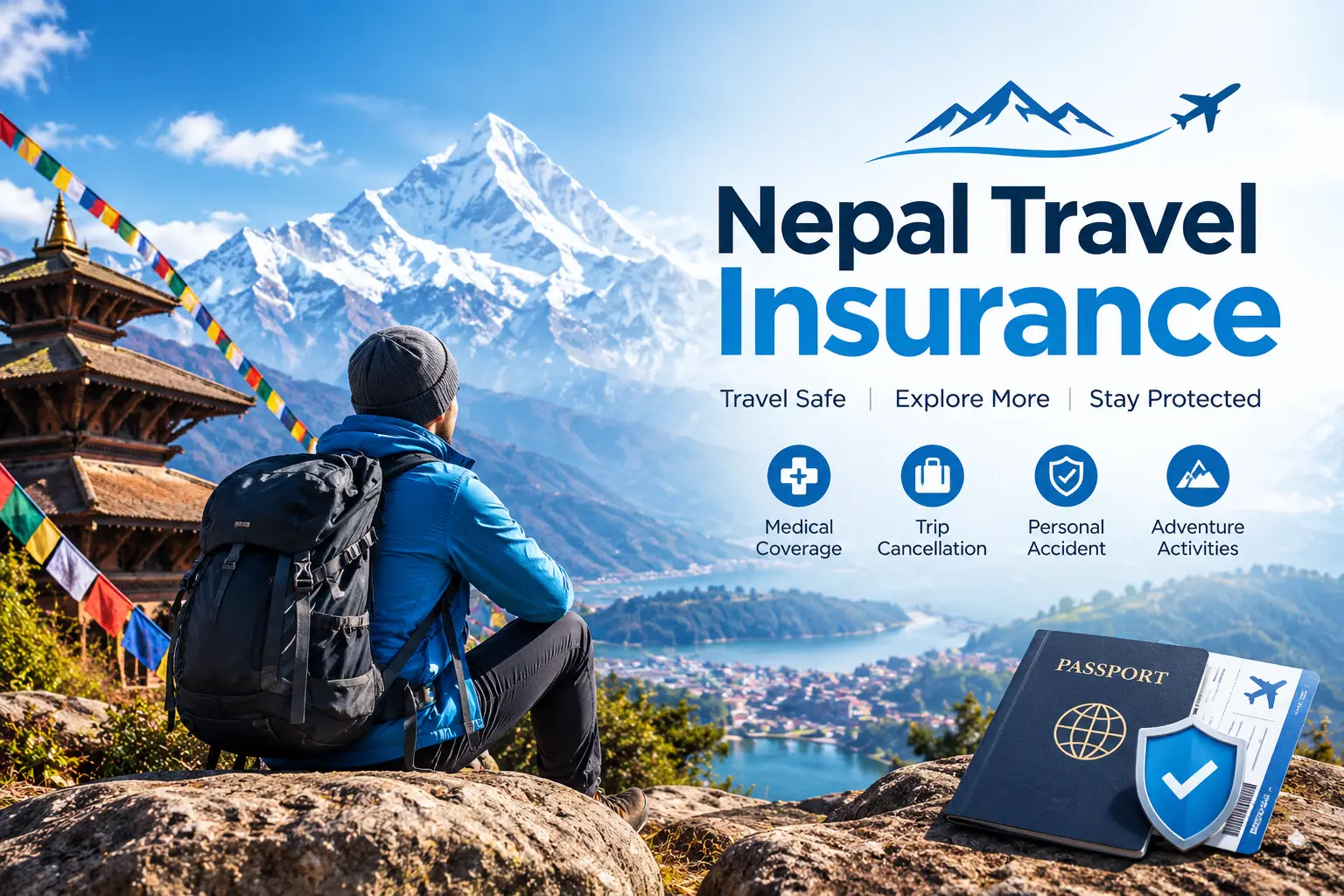
Nepal Travel Insurance (2026): What Your Policy Must Cover for Treks, Helicopter Rescue and Permit Checks
Updated October 2026 · Written from Kathmandu · Altitudes shown in feet first, with metres in brackets because insurers write their limits in metres
Most Nepal travel insurance guides online are written by insurance companies selling a policy. That is fine, but it means the awkward questions get skipped: does a 4,000-metre limit cover Everest Base Camp (it does not), who pays the helicopter before the claim is approved, and what changed after Nepal Police charged 32 people in the fake-rescue scam in March 2026?
This guide answers those questions for trekkers, climbers and ordinary sightseers. If you are still planning the whole trip, start with our complete guide to traveling to Nepal for visas, SIM cards and budgets, then come back here to choose the right cover.
Quick answer
- You do not need travel insurance to get a Nepal tourist visa on arrival, but you need it in practice for any trek, because licensed agencies and permit checks ask for proof.
- Your policy must name helicopter evacuation and cover trekking above the highest point of your route. Everest Base Camp and the Annapurna Circuit both go above 17,000 ft (about 5,200 m).
- The safe default for most teahouse treks is cover to 19,685 ft (6,000 m). Trekking peaks such as Island Peak and Mera Peak need specialist cover beyond that.
- Always call your insurer's 24/7 assistance line before a helicopter flies. Many insurers will not pay for an evacuation they did not approve.
- A one-week standard policy often costs far less than a single helicopter flight. Rescue charter prices in the Everest region run into the thousands of US dollars.
In this guide
- Is travel insurance mandatory for Nepal?
- What a Nepal policy must cover
- Altitude limits for every major trek (in feet)
- Policy cost vs real rescue costs
- The fake-rescue scandal and your claim
- What to do in an emergency on the trail
- Choosing the right type of policy
- Common exclusions
- Seasonal risks to insure against
- Pre-departure checklist and FAQs
Is Travel Insurance Mandatory for Nepal in 2026?
This is the most searched question about Nepal travel insurance, and the internet gives contradictory answers. Some trekking agency blogs say insurance became compulsory in 2024, others say April 2025, others say January 2026. Here is what we can say with confidence.
For entering Nepal: not required
The tourist visa on arrival at Tribhuvan International Airport does not ask for an insurance certificate. Indian citizens do not need a visa at all, and Indian insurers such as Bajaj Allianz confirm that Nepal's immigration rules do not require Indians to hold insurance to enter. Nepal dropped its pandemic-era insurance requirement for arrivals years ago.
For trekking: required in practice
Since 1 April 2023, the Nepal Tourism Board has required foreign trekkers in national parks and conservation areas to hire a licensed guide and get their TIMS card through a government-registered trekking agency. Restricted areas such as Upper Mustang, Manaslu and Dolpo have always required an agency and guide.
That agency link is what makes insurance unavoidable. Reputable agencies will not confirm a trek without seeing a valid policy that covers helicopter evacuation, and several report that insurance details are now part of the permit paperwork they submit.
Our honest take
We could not find a single public government circular that sets one nationwide "no insurance, no permit" rule with a clear start date, which is why agency websites disagree. It does not matter for your planning: treat insurance with helicopter evacuation as compulsory for any trek, because your agency, your permit checks and your own safety all depend on it.
| Trip type | Insurance required? | What we recommend |
|---|---|---|
| Kathmandu, Pokhara, Chitwan sightseeing | No | Standard travel policy with strong medical cover |
| Teahouse trek (EBC, Annapurna, Langtang) | Yes, in practice | Trekking cover to 19,685 ft (6,000 m) with helicopter evacuation |
| Restricted area (Manaslu, Upper Mustang, Dolpo) | Yes | Same as above; keep the policy wording printed for the agency |
| Trekking peak (Island, Mera, Lobuche) | Yes | Specialist mountaineering cover above 6,000 m, often plus a rescue membership |
| Rafting, paragliding, bungee | Usually asked by operator | Check each activity is listed in your policy |
What Nepal Travel Insurance Must Cover
A cheap policy bought at an airline checkout is built for beach holidays and city breaks. Nepal's risks are different: remote trails with no road access, rapid altitude gain, weather-dependent flights and hospitals that expect payment upfront. Use this as your minimum.
✓ Emergency medical
Hospital treatment in Kathmandu, including altitude illness (AMS, HAPE, HACE), injuries and stomach infections. Look for at least US$100,000.
✓ Helicopter evacuation
Must be named in the policy wording, not implied. Check whether search and rescue is included or only evacuation once you are found.
✓ Altitude cover
The limit must sit above your highest planned point. This single clause causes more rejected Nepal claims than anything else.
✓ Repatriation
Flying you home if treatment in Nepal is not enough. Healthcare is good in Kathmandu but drops sharply in remote districts.
✓ Cancellation and delay
Lukla flights cancel in fog, and landslides close roads. Cover for missed connections and extra nights can save hundreds of dollars.
✓ 24/7 assistance with direct payment
The insurer should be able to send a Guarantee of Payment to the helicopter operator or hospital, so you are not paying thousands on a credit card at 16,000 ft.
Altitude Limits: The Clause That Decides Most Nepal Claims
Insurers set a maximum height for trekking cover, commonly 3,000 m, 4,000 m or 6,000 m. Some exclude Nepal from trekking cover altogether. If you are injured or evacuated above your limit, the claim can be refused even if everything else was done correctly.
The chart compares the highest point of popular routes with the two most common policy limits: 13,123 ft (4,000 m) and 19,685 ft (6,000 m).
Highest point of popular Nepal routes (feet)
Needs a 6,000 m (19,685 ft) policy
Above 6,000 m: specialist cover
Bar scale: full width = 22,000 ft. Published elevations vary slightly between maps; always use the highest figure you can find for your route.
| Route | Highest point | Minimum policy limit |
|---|---|---|
| Poon Hill (Ghorepani) | 10,531 ft (3,210 m) | 4,000 m works |
| Annapurna Base Camp | 13,550 ft (4,130 m) | Above 4,000 m: buy 6,000 m |
| Langtang Valley with Tserko Ri | 16,352 ft (4,984 m) | 6,000 m |
| Manaslu Circuit | 16,752 ft (5,106 m) | 6,000 m |
| Annapurna Circuit | 17,769 ft (5,416 m) | 6,000 m |
| Everest Base Camp with Kala Patthar | about 18,200 ft (about 5,545 m) | 6,000 m |
| Island Peak / Mera Peak | 20,305 to 21,247 ft (6,189 to 6,476 m) | Mountaineering cover, no 6,000 m cap |
⚠ The 4,000 m trap
Many comparison sites list trekking cover "up to 4,000 m". That is 13,123 ft, which you pass on day four or five of the Everest Base Camp trek. If you fall ill at Lobuche or Gorak Shep, a 4,000 m policy may not pay for the helicopter.
How Much Does Nepal Travel Insurance Cost, and What Does a Rescue Cost Without It?
Price depends on your age, nationality, trip length, altitude and activities. As a guide, insurance comparison site HelloSafe found that a one-week standard policy for Nepal typically costs between US$30 and US$60 for US travellers. Trekking and adventure policies cost more, and mountaineering cover above 6,000 m costs considerably more.
Now compare that with helicopter prices in the Everest region. The bars below use published charter rates from expedition operators plus the range for emergency rescues reported by Everest analyst Alan Arnette. Real emergency bills also include hospital treatment.
Insurance vs helicopter costs (US dollars)
Charter prices are for planned, non-emergency flights quoted by operators and change with fuel, season and passenger numbers. Emergency rescue range per Alan Arnette: US$4,000 to $20,000 depending on start point and destination.
The other cost people forget is cash flow. Helicopter operators in Kathmandu generally will not fly for an uninsured foreigner without payment upfront or a Guarantee of Payment from an insurer. A reimbursement-only policy can still leave you paying first and claiming later.
How to pay less without losing cover
- Insure only the days you are in Nepal plus travel days; do not buy an annual policy for one trek unless you travel often.
- Raise the excess on baggage, not on medical or evacuation.
- Skip gadget cover if your phone is already insured at home.
- Never save money by dropping the altitude limit below your route's highest point.
The Fake-Rescue Scandal: What It Means for Your Nepal Policy
Almost no insurer page mentions this, but it is the biggest reason Nepal claims now get more scrutiny. In March 2026, a case was filed at Kathmandu District Court against 32 people accused of staging or inflating helicopter rescues of foreign trekkers to claim insurance payouts, according to The Kathmandu Post.
- Police alleged collusion between helicopter companies, hospitals, more than a dozen trekking companies, insurance agents and guides.
- Investigators said patients carried on a single flight were billed as separate rescues, and hospital records were fabricated or inflated.
- Claims linked to the racket were reported at more than US$19.6 million. The problem was first flagged in 2018.
- Earlier government investigators recorded complaints that some operators deliberately made tourists ill so they could be evacuated.
The result for honest travellers: insurers now insist on approving evacuations themselves, ask for more evidence and, in some cases, charge a higher excess for Nepal helicopter claims. World Nomads, for example, states that it applies a higher excess for helicopter evacuation in Nepal and that its assistance team must be contacted before any evacuation is arranged.
How to protect yourself
- Book through a trekking agency registered with the Department of Tourism and TAAN, and read recent independent reviews.
- Before the trek, save your insurer's emergency number in your phone and give it to your guide on paper.
- If a guide pushes a helicopter for mild symptoms, ask for a phone consultation with your insurer's doctor first.
- Never sign blank claim forms or hand over your passport and policy documents to be "handled" for you.
- Keep copies of every invoice, flight manifest and medical report. If something feels wrong, report it to your insurer and the Tourist Police.
What to Do in a Medical Emergency on the Trail
Altitude sickness can turn serious within hours. The first treatment is always to descend if you safely can. When a helicopter is needed, this order of steps protects both your health and your claim.
Step 1
Stop climbing. Descend if possible and assess symptoms with your guide.
Step 2
Call your insurer's 24/7 assistance line with your policy number and location.
Step 3
Insurer's doctor confirms whether evacuation is medically necessary.
Step 4
Insurer issues a Guarantee of Payment to the helicopter operator.
Step 5
Flight, hospital treatment, then keep every document for the claim.
If there is no phone signal, your guide or teahouse owner can often reach the insurer by satellite phone or radio. In a genuine life-threatening emergency, get help first and call the insurer as soon as you can; tell them exactly why you could not call earlier.
Choosing the Right Type of Policy
| Policy type | Best for | Watch out for |
|---|---|---|
| Standard travel insurance | City and cultural trips, Chitwan safari | Trekking often excluded or capped at 2,000 to 4,000 m |
| Adventure or trekking policy | Teahouse treks up to 19,685 ft (6,000 m) | Higher Nepal heli excess; may exclude mountaineering, ice climbing and search and rescue |
| Mountaineering insurance | Island Peak, Mera Peak, expeditions | Expensive; check whether it includes medical or only rescue |
| Rescue membership (e.g. Global Rescue) | Climbers above 6,000 m | Usually not a full travel policy; pair it with medical and cancellation cover |
| Policy bought in Nepal | Travellers who arrived uninsured | Confirm the insurer is licensed by the Nepal Insurance Authority and read the evacuation wording in English |
For Indian travellers
Indians can enter Nepal without a visa, so insurance is easy to forget. Your Indian health policy almost never pays for treatment abroad, and Nepali hospitals bill in cash. If you plan to trek, the same agency and evacuation rules apply to you as to every foreign trekker, so buy an Asia or Nepal travel plan that names trekking and helicopter evacuation.
Already in Nepal without insurance?
Some home-country insurers refuse policies once you have left home. Others allow it with a waiting period. Check the wording first; if they will not cover you, Kathmandu agencies can arrange trekking cover from local insurers. Buy before you start walking, not at the trailhead.
Common Exclusions in Nepal Travel Insurance
- Trekking above your altitude limit, or any mountaineering, rope work and ice climbing on a standard policy.
- Trekking without the required permits or guide. Breaking local rules can void cover.
- Evacuations not approved by the insurer when contact was possible.
- Alcohol- or drug-related incidents, including an injury after a night out in Thamel or Lakeside.
- Riding a motorbike or scooter without a valid licence for that class of vehicle, or without a helmet.
- Undeclared pre-existing medical conditions, including heart and lung conditions that matter more at altitude.
- Travelling against your government's travel advice for a specific area.
Seasonal Risks Your Policy Should Handle
| Season | Main risks | Cover that matters most |
|---|---|---|
| Autumn (Oct to Nov) | Peak crowds, busy flights, late monsoon floods | Travel delay, missed connections |
| Winter (Dec to Feb) | Snow on high passes, cold injuries | Trip interruption, medical |
| Spring (Mar to May) | Expedition season, altitude illness, avalanches | Evacuation, high altitude limit |
| Monsoon (Jun to Sep) | Landslides, road closures, Lukla cancellations, leeches | Cancellation, interruption, extra accommodation |
On-the-ground notes from Kathmandu
Living here, the pattern we see every season is that trips rarely go wrong in a dramatic way. They go wrong in small, expensive ways: a Lukla flight that does not leave for three days, a road to the trailhead blocked by a landslide, a stomach bug that turns into two nights in a Kathmandu clinic.
Autumn 2026 is a good example. In mid-October, local media reported floods on the Budhi Gandaki that washed away bridges in Gorkha district, the gateway to the Manaslu Circuit. Trekkers on or heading to that route needed the interruption and delay sections of their policies, not just the helicopter clause.
Our advice to friends visiting: buy insurance the day you book flights so cancellation cover starts early, keep a buffer of two or three days after any Lukla flight, and photograph your policy page that lists helicopter evacuation and the altitude limit.
Nepal Travel Insurance Checklist Before You Fly
Frequently Asked Questions
Is travel insurance mandatory for Nepal?
Not for entering the country or getting a tourist visa on arrival. For trekking it is required in practice: since April 2023 foreign trekkers must go through a licensed agency with a guide, and agencies and permit checks ask for proof of insurance that covers helicopter evacuation.
What altitude should my Nepal travel insurance cover?
At least the highest point of your route. For Everest Base Camp, the Annapurna Circuit, Manaslu and Gokyo, that means a 6,000 m (19,685 ft) limit. A 4,000 m (13,123 ft) policy only suits short treks such as Poon Hill.
How much is helicopter rescue in Nepal without insurance?
Planned charter flights in the Everest region cost roughly US$1,500 to US$6,500 depending on the route, and emergency rescues have been reported at US$4,000 to US$20,000, before hospital bills. Operators usually want payment or an insurer's guarantee before they fly.
Does travel insurance cover Island Peak or Mera Peak?
Standard and most trekking policies do not, because both summits are above 6,000 m and involve mountaineering. You need specialist mountaineering insurance, often combined with a rescue membership.
Can I buy travel insurance after arriving in Nepal?
Sometimes. Some insurers sell to travellers already abroad, often with a waiting period, and Kathmandu trekking agencies can arrange local cover. Buy it before your trek starts and check that evacuation is clearly included.
Do Indians need travel insurance for Nepal?
Indians do not need a visa or insurance to enter Nepal. It is still strongly recommended, because Indian health policies rarely pay abroad, and trekkers need evacuation cover for their agency.
Why was my Nepal helicopter claim rejected?
The usual reasons are trekking above the policy's altitude limit, not calling the insurer before the flight, no medical evidence that evacuation was necessary, or activities not covered by the policy. Since the 2026 fake-rescue prosecutions, insurers check Nepal claims more closely.
Final Word
The right Nepal travel insurance is not the cheapest one; it is the one whose altitude limit sits above your route, which names helicopter evacuation, and whose assistance team you can call from the trail. Get those three right and the rest is detail.
Planning the rest of your trip? Our Traveling to Nepal guide covers visa fees, the best tourist SIM, trekking rules and budgets in one place.
Sources
- The Kathmandu Post: Nepal charges 32 in fake rescue scam (March 2026)
- World Nomads: Trekking in Nepal and helicopter evacuation
- HelloSafe: Travel insurance for Nepal
- Alan Arnette: Everest helicopter rescue costs
- Viristar: Nepal requires licensed guides for treks in protected areas
This guide is general information, not insurance or legal advice. Policy terms differ; always read the wording of the policy you buy.