
Best Time to Visit Mount Everest (2026): Month-by-Month Guide for Trekkers, Climbers & Sightseers
Updated October 2026 · Written from Kathmandu · Heights in feet, temperatures in °F (with °C)
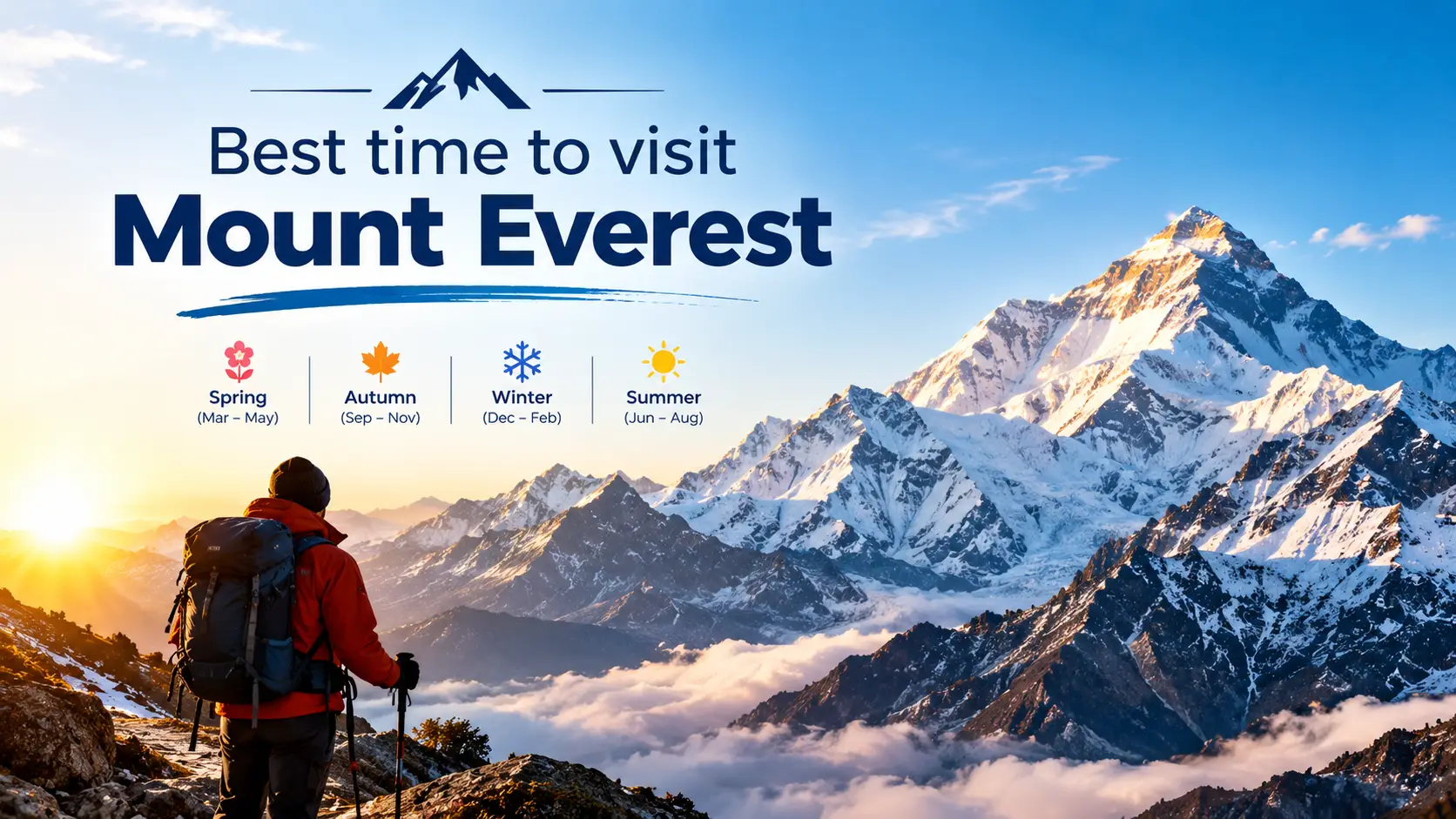
The best time to visit Mount Everest is mid-October to mid-November, when the monsoon has washed the air clean and the sky above the Khumbu is at its clearest. The second-best window is April to mid-May: warmer, greener, busier, and the only time you will see a full expedition city at Everest Base Camp. Avoid June to August unless you enjoy clouds, leeches and cancelled flights.
That short answer hides a lot. “Visiting Everest” can mean a two-week trek to base camp, a one-hour mountain flight from Kathmandu, a helicopter breakfast near Kala Patthar, a road trip on the Tibet side, or a two-month summit expedition – and each has a different best month. This guide breaks down every month with real temperatures, explains the timing details most guides skip (like why sunset beats sunrise on Kala Patthar), and helps you pick the right window for your kind of trip.
Quick answer: when to go
In this guide
Everest’s Four Seasons at a Glance
Weather on Everest is driven by two giant forces: the summer monsoon, which pushes moist air up from the Bay of Bengal from roughly June to mid-September, and the winter jet stream, which sits over the summit and blasts it with hurricane-force winds for most of the year. Good trekking happens between the monsoon and deep winter. Good climbing happens in the brief gap when the jet stream lifts off the summit in spring.
| Season | Months | Views | Crowds | Verdict |
|---|---|---|---|---|
| Autumn | Late Sep–Nov | Best of the year | Highest in October | Best overall |
| Winter | Dec–Feb | Very clear, short days | Very low | Good if you handle cold |
| Spring | Mar–May | Good, hazier by May | High in April–May | Excellent; climbing season |
| Monsoon | Jun–mid Sep | Mostly hidden | Very low | Avoid for views |
Every Month Rated for an Everest Visit
Most guides tell you “spring and autumn” and stop there. The chart below scores every month out of 10 for a typical Everest Base Camp trip, weighing mountain visibility, weather stability, Lukla flight reliability, temperature and crowding together.
Everest visit score by month (out of 10)
Feb
Mar
Apr
May
Jun
Jul
Aug
Sep
Oct
Nov
Dec
Wilson.com.np rating for a standard Everest Base Camp trek. Green = autumn, orange = spring, blue = winter, grey = monsoon. Your own score shifts if you prefer solitude over warmth, or are climbing rather than trekking.
Everest Base Camp Temperature by Month
These are typical daytime highs and night-time lows at Everest Base Camp itself (17,598 ft), based on average figures published by Kandoo Adventures. Lower villages such as Namche Bazaar are much milder, and Gorak Shep, where most trekkers sleep before base camp, is usually the coldest night of the trip.
Daily temperature range at Everest Base Camp (°F)
−4 to 14°F
−2 to 18°F
1 to 23°F
10 to 30°F
18 to 36°F
25 to 41°F
30 to 45°F
32 to 45°F
23 to 39°F
16 to 32°F
10 to 27°F
5 to 23°F
Scale runs from −10°F (left) to 50°F (right). Rounded from average Celsius figures. Wind chill can make it feel 20°F or more colder.
| Month | Day high | Night low |
|---|---|---|
| January | 14°F (−10°C) | −4°F (−20°C) |
| February | 18°F (−8°C) | −2°F (−19°C) |
| March | 23°F (−5°C) | 1°F (−17°C) |
| April | 30°F (−1°C) | 10°F (−12°C) |
| May | 36°F (2°C) | 18°F (−8°C) |
| June | 41°F (5°C) | 25°F (−4°C) |
| July | 45°F (7°C) | 30°F (−1°C) |
| August | 45°F (7°C) | 32°F (0°C) |
| September | 39°F (4°C) | 23°F (−5°C) |
| October | 32°F (0°C) | 16°F (−9°C) |
| November | 27°F (−3°C) | 10°F (−12°C) |
| December | 23°F (−5°C) | 5°F (−15°C) |
Why the warmest months are the worst months
Notice that July and August are the warmest at base camp – and they score lowest in our chart. Warm air in the Himalaya means monsoon moisture, which means cloud. The coldest, driest air of autumn and winter is exactly what gives you those razor-sharp views of Everest’s summit pyramid.
Mount Everest Month by Month
October: the best month to visit Everest
October is the closest thing the Himalaya has to a guarantee. The monsoon has cleared, the air is dry and dust-free, and mornings above Namche are usually cloudless. Days are comfortable for walking, though nights at Gorak Shep already drop well below freezing.
- Best for: first-time trekkers, photographers, anyone who wants the safest bet on views.
- Downside: the busiest month of the year. Lodges in Lobuche and Gorak Shep fill up and Lukla flights are packed.
- Watch out: Nepal’s biggest festivals, Dashain and Tihar, usually fall in October–November. Domestic travel spikes and some offices close for days.
November: clear skies with fewer people
The first half of November is as clear as October with noticeably thinner crowds after the first week or two. The trade-off is cold: expect single-digit Fahrenheit nights at the highest lodges and shorter afternoons. Late November is one of our favourite quiet windows for photography, because the low winter sun lights the peaks in warm colours for longer.
December: crisp, cold and quiet
December brings stable, clear weather and empty trails. Snowfall is usually light early in the month, but nights at base camp can approach 5°F or lower, and some higher lodges start to close later in the season. If you have a good down sleeping bag and want Everest almost to yourself, early December is an underrated choice.
January and February: deep winter
The coldest months. Skies are often clear, but snowstorms can block high trails for days, passes on the Three Passes route may be impassable, and more lodges close above Dingboche. Winter treks to base camp are possible for well-equipped, experienced walkers, but we would not recommend them for a first Himalayan trip. Late February starts to warm slightly and brings Lhosar (Sherpa New Year) celebrations in many villages.
March: the quiet start of spring
March is a sweet spot many guides overlook. Visibility is good, crowds are moderate until the last week, and the weather steadily warms. Early March can still feel wintry above 14,000 ft, so pack as you would for December. Expedition teams begin arriving in Lukla toward the end of the month.
April: rhododendrons and expedition season
April is spring at its best. Rhododendron forests bloom on the lower trail between Phakding and Tengboche, temperatures are milder, and from mid-April the yellow tents of climbing expeditions spread across the Khumbu Glacier at base camp – something you never see in autumn. Mornings are usually clear; afternoon cloud builds more often than in October.
May: warmest trekking and summit fever
May is the warmest month for trekking and the month most Everest summits happen, usually in the second half when the jet stream lifts off the peak. Base camp is at its busiest and most exciting. The catch is haze and afternoon cloud, which build as the monsoon approaches; by the last week of May, pre-monsoon showers become more likely at lower elevations. On 29 May, the anniversary of the first ascent in 1953, the region marks Everest Day and the Tenzing-Hillary Everest Marathon starts from base camp.
June, July and August: monsoon
The monsoon usually arrives in early to mid-June. Rain falls mainly below about 11,500 ft, turning the lower trail muddy and slippery, while the high valleys get cloud and occasional snow. Everest itself is hidden for days at a time, and Lukla flights are frequently delayed or cancelled. The upsides: green valleys, wildflowers, almost no other trekkers and lower lodge prices. Only consider this window if you are flexible and not focused on views.
September: the season reopens
Early September often still feels like monsoon, with cloud and rain on the lower trail. Conditions improve fast from mid-month, and the last week of September can be excellent with light crowds. If your dates are fixed, aim for after 20 September rather than the start of the month.
October vs April: Which Is Better?
This is the decision most people face. Both are excellent; they are good in different ways.
Choose October–November if…
- Clear views of Everest are your top priority
- You want the most stable, predictable weather
- You prefer cold, dry air to haze
- You want to see Nepal’s autumn festivals in Kathmandu
Choose April–mid May if…
- You feel the cold badly – nights are milder
- You want to see expeditions camped at base camp
- You love flowering rhododendron forests
- You are combining the trek with a trekking peak
Best Time to Visit Everest by Type of Trip
Here is the content gap almost every top-ranking article misses: the best month depends on how you are visiting Everest. Use this as your shortcut.
| How you visit | Best time | Why |
|---|---|---|
| Everest Base Camp trek (12–14 days) | Mid-Oct–mid-Nov; Apr–mid-May | Stable weather, reliable flights, open lodges |
| Gokyo Lakes & Three Passes | Oct–Nov; late Apr–May | High passes are snowbound in winter |
| Everest mountain flight from Kathmandu | Oct–Dec; Feb–Apr; early morning | Clear air; flights are cancelled in cloud |
| Helicopter tour to Kala Patthar area | Oct–Dec; Mar–May; departs at dawn | Morning visibility; afternoon winds and cloud ground flights |
| Tibet (north) side by road | May; late Sep–Oct | Clear north face; permits can pause around sensitive dates |
| Summit climb | Spring; summit window usually mid-to-late May | Jet stream lifts off the summit before the monsoon |
| Budget or solitude | Early Mar; late Nov–Dec | Clear skies, quieter lodges, easier bargaining |
Climbing Everest: the spring window
Nearly all summits from Nepal happen in spring. Teams arrive in late March or April, spend weeks acclimatizing on rotations through the Khumbu Icefall, and wait for a short run of low-wind days, typically in mid-to-late May. Autumn attempts exist but are rare because the jet stream returns and days get shorter and colder. From the 2026 season, the Nepal-side spring climbing permit costs US$15,000 per climber, up from US$11,000 under the old schedule, according to Global Summit Guide’s fee breakdown.
Visiting from Tibet
The Tibet side lets you drive almost to the foot of Everest’s north face, near Rongbuk Monastery, without a two-week trek. Foreign travelers need a Tibet Travel Permit arranged through a licensed agency and must travel on an organised tour. May and October are the clearest months; summer brings cloud, and winter is bitterly cold with fewer services. Permit availability can change at short notice, so confirm before you book flights.
The Best Time of Day to See Everest
Picking the right month is only half the job. In every season, the Himalaya follows a daily rhythm: clear mornings, cloud building from late morning, and often clearing again toward evening. Plan your big viewpoints accordingly.
Local tip: sunset beats sunrise on Kala Patthar
Most itineraries march you up Kala Patthar (18,192 ft) in the dark for sunrise. But Everest lies to the east, so at sunrise the sun rises behind it and the summit appears as a dark silhouette against a bright sky. In the late afternoon, the sun is behind you and lights Everest’s face in gold. If the afternoon is clear and you are feeling strong, a sunset climb usually gives the better photo – just carry a headlamp and warm layers for the descent. Note also that you cannot see Everest’s summit from base camp itself; Kala Patthar is the viewpoint.
Festivals and Events in the Everest Region
Timing a trip around a Sherpa festival adds a cultural layer most visitors miss.
Masked dances and blessings at Tengboche Monastery. Dates follow the Tibetan lunar calendar and change each year, so check before planning around it.
Sherpa New Year, celebrated with family gatherings, prayers and new prayer flags across the Khumbu.
Marks the 1953 first ascent by Tenzing Norgay and Edmund Hillary, with the Tenzing-Hillary Everest Marathon starting at base camp.
Nepal’s biggest national festivals. Wonderful in Kathmandu, but book transport early and expect office closures. Learn more on our Nepali culture hub.
Lukla Flights, Permits and When to Book
The Lukla flight factor
Your season also decides where your flight leaves from. During the peak spring and autumn seasons – roughly late March to the end of May and late September to the end of November – scheduled Lukla flights operate from Manthali Airport in Ramechhap, about 82 miles by road east of Kathmandu, to ease congestion at Tribhuvan International Airport. That usually means leaving your Kathmandu hotel around 1–2 a.m. or sleeping in Manthali the night before. In winter and the monsoon, flights often run directly from Kathmandu.
Lukla flights fly by sight only, so cloud on the approach cancels them in any season – even in October it is common to lose a day or two. Whatever month you choose, keep at least one or two buffer days before your international flight home.
Permits you need for the Everest region
- Sagarmatha National Park entry permit – about NPR 3,000 for foreigners, available in Kathmandu or at the Monjo park gate.
- Khumbu Pasang Lhamu Rural Municipality permit – bought in Lukla; it replaces the TIMS card in the Everest region. Published figures range from about NPR 2,000 to 3,000, so carry enough cash.
- Guide rules – Nepal’s mandatory-guide rule for most national parks has not been applied in the Khumbu in the same way, but reports conflict and rules change quickly. Confirm the current position with a registered agency before you go.
For visas, SIM cards, insurance altitude limits and a full Everest trek map with elevations, see our complete guide to traveling to Nepal.
When to book
| Travelling in | Book flights & agency | Why |
|---|---|---|
| October–November | 3–6 months ahead | Peak demand plus festival travel |
| April–May | 3–6 months ahead | Trekkers and expeditions compete for seats |
| March, September, December | 1–2 months ahead | Moderate demand |
| Jan–Feb, Jun–Aug | A few weeks ahead | Low season; flexibility matters more than early booking |
What Most “Best Time” Guides Don’t Tell You
- The weeks matter more than the months. Early September and late May behave like monsoon; late September and early March can be superb.
- You can’t see Everest’s summit from base camp. Plan a clear morning or evening on Kala Patthar, or a stop near Everest View Hotel above Namche (around 12,700 ft).
- Expedition tents only exist in spring. Visit base camp in October and you will see rock and ice, not the colourful tent city in photos.
- Peak season changes your airport. Spring and autumn Lukla flights start from Ramechhap, not Kathmandu.
- Cold is the price of clarity. The clearest months are also the coldest – budget for a proper sleeping bag rather than gambling on a warmer month with worse views.
- Always add buffer days. No month is immune to Lukla delays.
Curious about the rivers and glaciers that shape the Khumbu? Our explainer on the natural resources of Nepal covers the Himalayan water systems that the Dudh Koshi feeds into.
Frequently Asked Questions
What is the best month to visit Mount Everest?
October is the best single month, with the clearest skies and most stable weather of the year. Early to mid-November is nearly as good with fewer crowds, and April to mid-May is the best spring option.
Is it better to visit Everest in spring or autumn?
Autumn gives clearer, more reliable views; spring is warmer, greener and the only season when climbing expeditions are camped at base camp. Pick autumn for views and spring for warmth and expedition atmosphere.
Can you visit Everest Base Camp in winter?
Yes. December to February often has clear skies and empty trails, but nights at base camp drop to around −4°F, some high lodges close, and snow can block trails. It suits experienced trekkers with proper cold-weather gear.
Should I trek to Everest during the monsoon?
Only if you are flexible and not focused on views. From June to August, cloud hides Everest for days, the lower trail is muddy, and Lukla flights are often cancelled. The reward is green valleys and very few people.
When do climbers summit Mount Everest?
Most summits happen in spring, usually in mid-to-late May, when the jet stream briefly lifts off the summit before the monsoon arrives. Autumn ascents are possible but rare.
What time of day is best to see Everest clearly?
Early morning, usually before 9 a.m., is the clearest. Cloud often builds by midday and may clear again in late afternoon, when the setting sun lights Everest’s face as seen from Kala Patthar.
When is the best time for an Everest helicopter tour or mountain flight?
October to December and March to April, on an early-morning departure. Both depend on clear air and are often delayed or cancelled when cloud builds.
What is the best time to visit Everest from the Tibet side?
May and late September to October offer the clearest views of the north face. Foreign visitors need a Tibet Travel Permit through a licensed agency, and permit availability can change at short notice.
The bottom line
If you can choose freely, go to Everest between mid-October and mid-November for the clearest skies of the year. Choose April to mid-May if you want warmer nights and the buzz of expedition season. Whatever month you pick, start your viewpoint days early, add buffer days for Lukla flights, and pack for colder nights than you expect. Get those three things right and the mountain will usually show itself.