
Best Time to Visit ABC (2026–27): Month-by-Month Annapurna Base Camp Weather, Crowds & Safety
Updated October 2026 · Crowd figures from the Annapurna Conservation Area Project (ACAP) · All heights in feet, temperatures in °F with °C
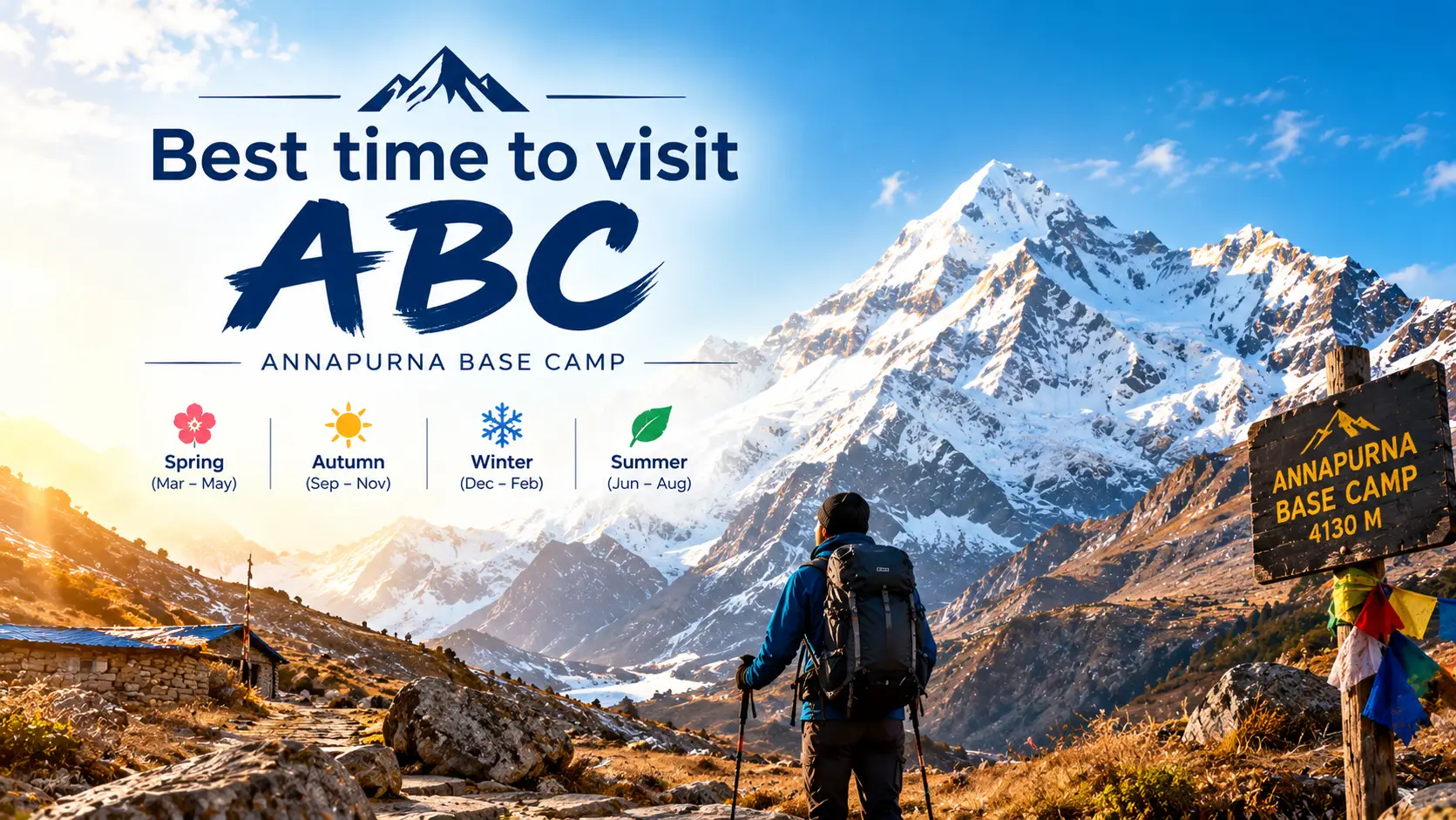
Quick answer: when is the best time to visit ABC?
The best time to visit ABC (Annapurna Base Camp) is October to November and March to April. October gives the clearest, most stable skies of the year; April adds rhododendron forests in full bloom. For fewer people, aim for the shoulder weeks: late September, early May and early December. Avoid June to August (monsoon rain, leeches, landslides and hidden peaks), and treat January to March with care because snow loads the avalanche-prone stretch between Deurali and Machhapuchhre Base Camp.
Annapurna Base Camp, also called the Annapurna Sanctuary, sits at about 13,550 ft in a ring of peaks that includes Annapurna I, Annapurna South, Hiunchuli and the fishtail summit of Machhapuchhre. The trek takes most people 7–10 days from Pokhara, and it is one of the few Himalayan trails you can walk in every month of the year. But “possible” and “worth it” are different things. The month you pick decides whether you see those peaks at sunrise or spend four days inside a cloud.
Most guides on this topic stop at “spring and autumn are best.” This one goes further: real visitor numbers from ACAP, a temperature chart for base camp in Fahrenheit, rainfall data for the Pokhara gateway, the 2026 festival dates that fill the trail with domestic trekkers, and the specific weeks when avalanche risk is highest. If you are still planning the wider trip – visa, SIM card and insurance – start with our complete guide to traveling to Nepal, then come back here to lock in your dates.
In this guide
- ABC trekking calendar: every month rated
- Annapurna Base Camp weather by month
- Season by season: autumn, spring, winter, monsoon
- Month-by-month breakdown
- Crowds, festivals and booking
- Avalanche and safety by season
- Best time for your trekking style
- Local timing tips most guides miss
- What to pack by season
- FAQs
ABC Trekking Calendar: Every Month Rated
This calendar is our own rating for a typical first-time trekker, weighing mountain visibility, trail safety, comfort and crowds. It is a judgement, not a measurement – the data behind it follows in the sections below.
Green = best season, yellow = transition, blue = winter, grey = monsoon. Rating is wilson.com.np’s editorial assessment for first-time trekkers.
Annapurna Base Camp Weather by Month
There is no official weather station at base camp, so every published ABC temperature is an estimate. The ranges below combine long-term Pokhara climate normals, the standard drop in temperature with altitude, and conditions reported by trekking operators. Treat them as a planning guide, not a forecast: a sunny noon at 13,550 ft can feel like a spring day, while the same spot after sunset can be well below freezing.
Typical temperature range at Annapurna Base Camp (night low to sunny day high, °F)
Approximate ranges for 13,550 ft, compiled from Pokhara climate normals, altitude lapse rates and trekking-operator reports. Wind chill can make winter nights feel far colder.
| Month | Daytime at ABC | Night at ABC | Snow at base camp? |
|---|---|---|---|
| January | 30–40°F (-1 to 4°C) | 0–10°F (-18 to -12°C) | Yes, often deep |
| February | 32–42°F (0 to 6°C) | 3–14°F (-16 to -10°C) | Yes, heaviest loading |
| March | 40–50°F (4 to 10°C) | 12–22°F (-11 to -6°C) | Common, melting |
| April | 46–57°F (8 to 14°C) | 20–30°F (-7 to -1°C) | Patches, fresh after storms |
| May | 50–60°F (10 to 16°C) | 26–34°F (-3 to 1°C) | Occasional |
| June–August | 52–60°F (11 to 16°C) | 34–42°F (1 to 6°C) | Rare; rain instead |
| September | 48–58°F (9 to 14°C) | 30–38°F (-1 to 3°C) | Rare |
| October | 44–55°F (7 to 13°C) | 20–30°F (-7 to -1°C) | Light, mostly on peaks |
| November | 38–48°F (3 to 9°C) | 12–22°F (-11 to -6°C) | Possible late in month |
| December | 32–42°F (0 to 6°C) | 5–14°F (-15 to -10°C) | Likely from mid-month |
Rainfall: why the monsoon matters more here than on most treks
The ABC trail starts on the southern slopes of the Annapurna range, which catch the full force of the monsoon. Pokhara, the gateway city, is one of the wettest places in Nepal – one long-term climate summary puts its annual total at about 152 inches a year, several times what London or Bangkok receives. The chart shows how sharply that rain is concentrated in June to September.
Average monthly rainfall in Pokhara, the ABC gateway (inches)
Source: long-term averages (CRU, UK Met Office data) published by weather2travel. Other datasets give higher annual totals, but every one shows the same June–September spike. November is the driest month of the trekking year.
Season by Season: Which One Fits Your Trip?
| Factor | Autumn Sep–Nov | Winter Dec–Feb | Spring Mar–May | Monsoon Jun–Aug |
|---|---|---|---|---|
| Mountain views | Best of the year | Very clear | Good, hazier by May | Mostly hidden |
| Trail condition | Dry and firm | Snow and ice above Deurali | Dry low, snow patches high | Mud, slippery steps |
| Main hazard | Crowded lodges | Avalanche, cold | Early-season avalanche, afternoon storms | Landslides, leeches |
| Crowds | Very high | Low | Highest in April | Low |
| Best for | First-timers, photographers | Experienced, solitude seekers | Flowers, warmer nights | Botany lovers, flexible schedules |
Autumn (September–November): the classic choice
After the monsoon washes the dust out of the air, the Himalaya enter their clearest weeks of the year. Mornings at base camp are usually cloudless, the trail is dry, and daytime walking temperatures in the forests are pleasant. This is also why autumn is the busiest season in the whole Annapurna region.
- Late September: the monsoon tails off, but expect some afternoon showers and lingering leeches in the lower forests. Quieter and greener than October.
- October: the most reliable month for views. Lodges at Chhomrong, Machhapuchhre Base Camp (MBC) and ABC fill early in the day.
- November: the driest month, with sharp, crisp light. Nights at base camp drop well below freezing, and crowds thin in the second half.
Spring (March–May): flowers and warmer nights
Spring is the second peak season. Nepal’s national flower, the rhododendron, turns the forests between Ghorepani, Chhomrong and Bamboo red, pink and white. Nights are milder than in autumn, which makes spring a good option if you sleep cold.
- March: blooms start at lower elevations; snow still lies above Deurali and early-season avalanche risk is real.
- April: peak flowers, stable weather and the busiest month of the year across the Annapurna Conservation Area.
- May: warm and pleasant, but haze builds and afternoon thunderstorms become regular as the monsoon approaches.
Winter (December–February): clear, cold and quiet
Winter skies are often as clear as autumn’s, and you may have the sunrise at base camp almost to yourself. The trade-off is cold and snow. Days in the sun can be comfortable, but temperature falls fast after sunset, and lodges above Chhomrong have no heating beyond the dining-room stove.
- December: the best winter month. Usually stable, with snow building from mid-month.
- January and February: the coldest months and the riskiest for avalanches between Deurali and MBC. Some lodges at higher stops may close; deep snow can add days to the trek.
Monsoon (June–August): only for flexible trekkers
The trail does stay open, and the valleys are spectacularly green with waterfalls everywhere. But mountain views are rare, the stone steps around Chhomrong and Jhinu get slippery, leeches are common in the lower forests, and landslides can cut the jeep roads to the trailheads. If you must trek now, add spare days, carry salt or leech socks, and accept that the peaks may stay hidden. Late August often brings the first dry breaks.
Month-by-Month Breakdown
| Month | What to expect | Verdict |
|---|---|---|
| January | Clear but bitterly cold; the quietest month in the region. Snow above Deurali. | Experienced only |
| February | Heaviest snow loading; highest avalanche concern on the Deurali–MBC stretch. | Avoid unless guided and flexible |
| March | Warming days, early rhododendrons, fewer people than April. Check snow conditions. | Good (late March better) |
| April | Peak blooms, stable weather, warm forests, the year’s biggest crowds. | Excellent |
| May | Warmest dry month; haze and afternoon storms grow. Early May is a good shoulder window. | Good |
| June | Monsoon arrives; clouds, rain and rising leech numbers. | Poor |
| July | Wettest month; landslides on access roads are common. | Poor |
| August | Still wet, with occasional clear mornings toward month-end. | Poor to fair |
| September | Transition; first half wet, second half increasingly clear and lush. | Fair to good |
| October | The most dependable views and weather of the year. Book lodges and transport early. | Best overall |
| November | Driest month, crisp light, colder nights; quieter after mid-month. | Excellent |
| December | Clear and peaceful; freezing nights and snow from mid-month. | Good (early December) |
Crowds, Festivals and Booking: What the Data Says
The trail to base camp is popular: more than 40,000 trekkers reach ABC every year, according to a Kathmandu Post report. ACAP’s visitor counts for the wider conservation area show just how uneven that traffic is across the year. In 2025, April was the busiest month and January the quietest, as reported by The Himalayan Times.
Foreign visitors to the Annapurna Conservation Area, selected months of 2025
Source: ACAP figures reported by The Himalayan Times, RSS and Diplomat Nepal. Counts cover all foreign visitors to the conservation area (ABC, Annapurna Circuit, Poon Hill, Mustang and more), not ABC alone, and mix Gregorian and Nepali calendar months. Domestic trekkers are counted separately and are not included.
Festival dates that change the trail (2026)
One gap in almost every “best time” guide: Nepal’s biggest festivals land in the middle of peak trekking season, and ACAP’s chief has noted that domestic tourists pour into the Annapurna region during festival holidays. That means fuller buses from Kathmandu to Pokhara, busier jeeps to the trailhead and more competition for beds at Chhomrong and MBC.
October 11–25, with Vijaya Dashami (Tika day) on October 21. Offices and many shops close around the main days; travel is busiest just before and just after.
Early November, with Laxmi Puja on November 8. Expect another wave of family travel and lit-up villages along the way.
If you can, start your trek a few days before the main festival rush or once the holiday travel has settled. For background on what the festival means to Nepali families, read our essay on Dashain.
Local tip: how to get October views without October crowds
Most groups follow the same schedule, so the lodges at MBC and ABC are fullest on the same nights. Ask your guide to shift your base-camp night by one day from the standard itinerary, start each walking day early, and plan to reach your lodge by early afternoon. In the last week of November and the first week of December, you keep most of autumn’s clarity with a fraction of the traffic.
Avalanche and Safety by Season
ABC is a moderate trek with a maximum altitude well below Everest Base Camp, but it has one well-known hazard zone. The narrow Modi Khola gorge between Himalaya, Hinku Cave, Deurali and Machhapuchhre Base Camp sits under steep slopes that release snow after heavy falls. On January 17, 2020, an avalanche near Hinku Cave and Deurali swept away four South Korean trekkers and three Nepali guides, and the route was closed for weeks, as the Kathmandu Post reported. The same report noted that a deep-snow winter trek can take at least 10 days instead of the usual week.
ABC elevation profile and avalanche-prone stretch (feet)
Jhinu
Chhomrong
Bamboo
Himalaya
Deurali
MBC
ABC
Avalanche-prone after heavy snow
Elevations are approximate and rounded. Profile is schematic, not to scale horizontally.
Risk calendar at a glance
| Hazard | When it peaks | What to do |
|---|---|---|
| Avalanche (Deurali–MBC) | January to March, and after any big snowfall | Ask lodge owners about the slope ahead; cross early in the day; wait out fresh snow |
| Landslides and road closures | June to September | Keep 1–2 buffer days; avoid walking during heavy rain |
| Leeches | June to mid-September, lower forests | Long socks, gaiters, salt or repellent |
| Ice on stone steps | December to February | Microspikes, trekking poles |
| Altitude sickness | Every month, above roughly 9,800 ft | Don’t rush from Deurali to ABC in one push if you feel unwell; descend if symptoms worsen |
Whatever the month: a licensed guide is required
Since April 1, 2023, foreign trekkers in the Annapurna Conservation Area must walk with a licensed guide booked through a registered agency; the rule was announced by the Nepal Tourism Board. You also need the ACAP permit (NPR 3,000 for most foreign nationals in 2026, lower for SAARC citizens). In the risky winter and early-spring weeks, a local guide who knows which slopes are loaded is a genuine safety asset, not just paperwork. Rules change, so confirm with your agency before you go.
Best Time to Visit ABC for Your Trekking Style
Mid-October to mid-November, or April. Dry trails, predictable weather and plenty of open lodges.
Late October to November for sharp, dust-free air and sunrise alpenglow on Annapurna South and Machhapuchhre.
Late March to mid-April for rhododendrons; late September for green valleys and waterfalls.
Early December, early March or the last days of September. Good odds of views with far fewer people.
April or October, when nights are least harsh and rescue and lodge services are fully staffed.
Dashain and Tihar breaks fit the calendar perfectly, but book transport early and expect full lodges near the festival days.
Local Timing Tips Most Guides Miss
1. Use the Pokhara forecast to estimate base camp
Air temperature typically drops about 3.5°F for every 1,000 ft you climb. Base camp sits roughly 10,850 ft above Pokhara, so a simple rule of thumb works:
Strong sunshine can make midday feel much warmer, and wind or cloud can make it feel colder, so pack for the low end. It is an estimate, not a substitute for a mountain forecast.
2. Mornings are the real “best time”
In almost every month, the clearest views come between sunrise and mid-morning. In spring and late autumn, cloud often builds up the valleys after about 10 or 11 a.m. Plan to sleep at ABC (not just visit from MBC) so you are there for first light, and walk early each day.
3. Budget for one weather day
Fresh snow above Deurali, a landslide on the Jhinu or Siwai road, or a festival transport crunch can each cost you a day. One spare day protects your sunrise at base camp and your international flight home.
4. Shoulder weeks beat shoulder months
“September” or “May” is too broad. The useful windows are narrower: the last 10 days of September, the first 10 days of May, and late November to mid-December. These capture most of the peak-season weather with noticeably fewer trekkers.
What to Pack by Season
| Season | Add these to your core kit |
|---|---|
| Autumn | Down jacket, sleeping bag rated to about 14°F (-10°C), sunglasses, sunscreen, light rain shell for September |
| Winter | Heavy down jacket, bag rated to about 0°F (-18°C), microspikes, gaiters, insulated gloves, hand warmers |
| Spring | Light rain jacket for afternoon storms, mid-weight down, bag rated to about 20°F (-7°C), sun hat |
| Monsoon | Waterproof jacket and pack cover, dry bags, leech socks, quick-dry clothes, spare dry layer |
What Most “Best Time to Visit ABC” Guides Leave Out
- April, not October, is the busiest month in the Annapurna Conservation Area, based on ACAP’s 2025 data – even though October has the better weather reputation.
- Festivals add domestic crowds that foreign-visitor statistics don’t show. Dashain (October 11–25, 2026) and Tihar (around November 8, 2026) are worth planning around.
- The avalanche risk is specific, not general: it concentrates on the Hinku Cave–Deurali–MBC stretch from January to March and after heavy snowfall.
- Winter adds days. Deep snow can stretch a one-week trek to 10 days or more.
- The guide rule applies all year. Since 2023 you cannot trek ABC independently as a foreigner, whatever the season.
- Rainfall at the gateway is extreme. Pokhara’s July average alone exceeds what many cities get in several months.
Frequently Asked Questions About the Best Time to Visit ABC
What is the best time to visit ABC?
October to November and March to April. October has the clearest and most stable weather; April has rhododendrons in bloom. Late September, early May and early December are quieter alternatives.
Which is the best month for the Annapurna Base Camp trek?
October is the best single month for views and weather. If you prefer warmer nights and flowers, choose April. If you prefer fewer people, choose the second half of November.
Can I trek to Annapurna Base Camp in winter?
Yes, with experience, good cold-weather gear and a licensed guide. December is the most manageable winter month. January and February bring deep snow, nights near 0°F (-18°C) and the highest avalanche risk between Deurali and MBC.
Is the ABC trek possible during the monsoon?
It is possible but not recommended for most trekkers. June to August brings heavy rain, slippery steps, leeches, landslides on access roads and few mountain views. Add buffer days if you go.
How cold is Annapurna Base Camp at night?
In October, nights are typically around 20–30°F (-7 to -1°C). In winter they can fall to about 0–10°F (-18 to -12°C). Summer nights stay a little above freezing.
When is Annapurna Base Camp least crowded?
January is the quietest month in the Annapurna region according to ACAP, followed by the monsoon months. For a good balance of weather and quiet, try early December or early March.
When do rhododendrons bloom on the ABC trail?
From around mid-March to late April, depending on altitude. Lower forests bloom first, and the higher forests around Bamboo and Dovan peak later.
Do I need a guide for the ABC trek?
Yes. Since April 2023, foreign trekkers in the Annapurna Conservation Area must trek with a licensed guide arranged through a registered agency, and need an ACAP permit.
The bottom line
If you can choose freely, go in mid-October to mid-November for the clearest views, or in April for flowers and milder nights. Shift by a week or two into the shoulder windows to trade a little certainty for a lot more quiet, plan around Dashain and Tihar, and respect the Deurali–MBC stretch whenever there is fresh snow.
Planning the rest of your trip? Our guide to traveling to Nepal covers visas, SIM cards, travel insurance and trekking permits in one place.