
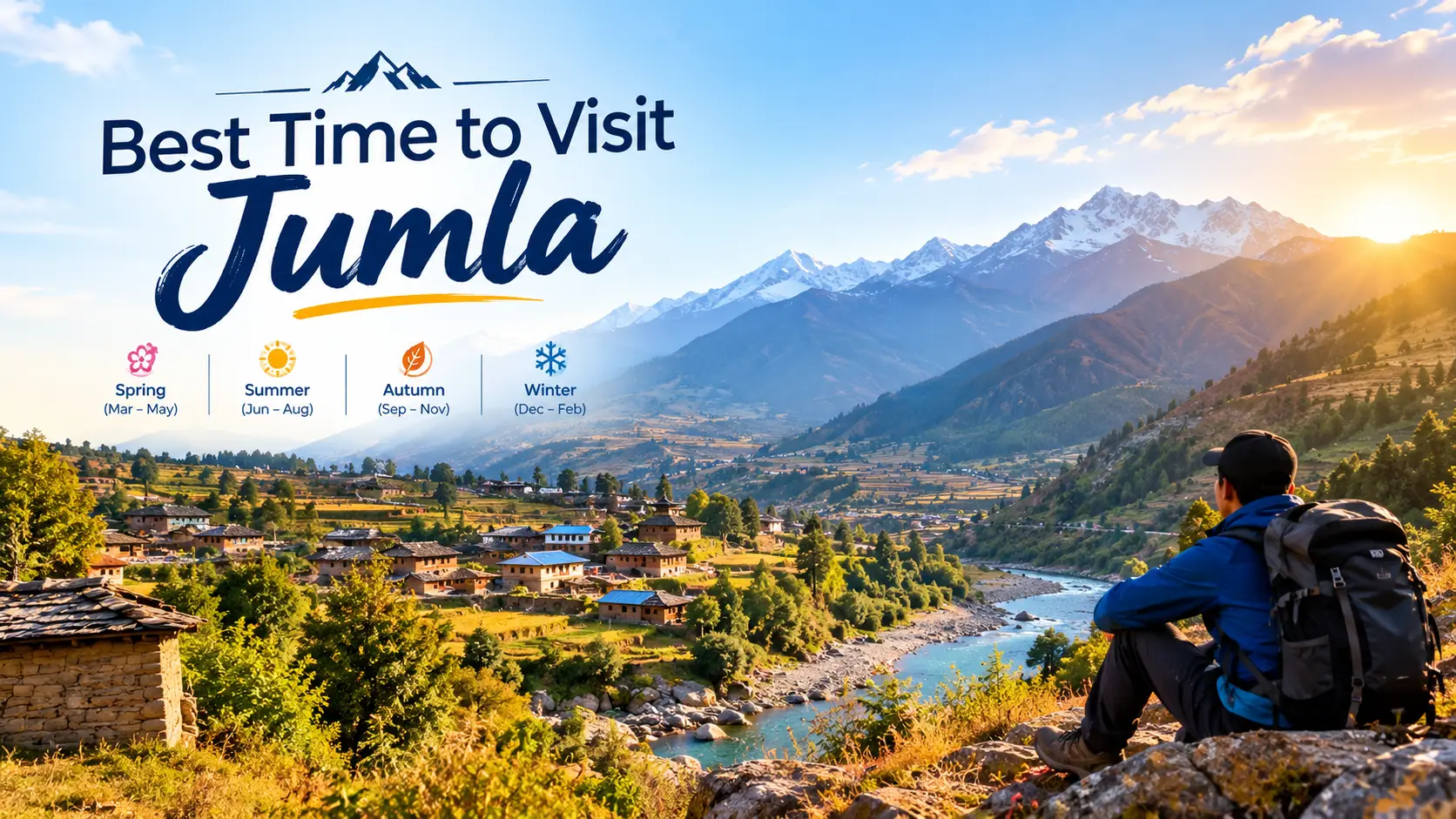
Best Time to Visit Jumla (2026): Month-by-Month Weather, Apple Season, Festivals & Rara Trek Guide
Updated October 2026 · Climate figures from Nepal’s Department of Hydrology and Meteorology (1991–2020 normals) · All heights in feet
Search “best time to visit Jumla” and most pages give you one line: spring or autumn. That is true, but it is not enough to plan a trip to one of the most remote district headquarters in Nepal. Jumla sits at about 7,750 ft in Karnali Province. You reach it on a small plane from Nepalgunj or along the single-lane Karnali Highway, and both of those depend heavily on the season. Get the month wrong and you can spend more days waiting for a flight than you spend in Jumla itself.
This guide goes further. It uses official climate data to show what each month actually feels like, when the famous Jumla apples are on the trees, which months suit the Jumla to Rara Lake trek, when festivals fill the bazaar, and how flights and roads behave through the year. If you are coming from abroad, start with our complete guide to traveling to Nepal for visas, SIM cards and insurance, then come back here to pick your dates.
Quick Answer: When Should You Go to Jumla?
The best time to visit Jumla is October to mid-November, when skies are clearest, rain almost stops and flights run most reliably. Late March to May is the second-best window. Go in September to mid-October for apple season, and January to February only if you want snow and can spare extra days. Avoid July and August unless you are coming for the festival.
In this guide
Jumla Weather in Numbers: What the Data Actually Says
Jumla has a highland climate with sharp day–night swings. Afternoons are pleasant for most of the year, but nights drop below freezing from November to February. Rain is heavily concentrated in July and August, while October to December is very dry. The table below uses the 1991–2020 averages recorded at Jumla’s weather station (about 7,753 ft) by Nepal’s Department of Hydrology and Meteorology.
| Month | Day high | Night low | Rain | Rainy days | Verdict |
|---|---|---|---|---|---|
| Jan | 57°F (13.8°C) | 23°F (−4.8°C) | 1.45 in | 3.8 | Snow season |
| Feb | 60°F (15.3°C) | 27°F (−2.7°C) | 1.78 in | 3.9 | Snow season |
| Mar | 66°F (18.8°C) | 33°F (0.6°C) | 1.94 in | 5.3 | Good (late March) |
| Apr | 72°F (22.0°C) | 40°F (4.2°C) | 1.67 in | 7.3 | Very good |
| May | 76°F (24.5°C) | 46°F (8.0°C) | 2.02 in | 9.2 | Very good |
| Jun | 79°F (26.2°C) | 56°F (13.3°C) | 3.12 in | 11.4 | Fair |
| Jul | 77°F (25.1°C) | 61°F (15.9°C) | 6.99 in | 20.9 | Avoid |
| Aug | 77°F (24.8°C) | 60°F (15.5°C) | 7.17 in | 21.2 | Avoid (unless festival) |
| Sep | 77°F (24.8°C) | 55°F (12.8°C) | 3.75 in | 13.0 | Good (late Sept) |
| Oct | 72°F (22.4°C) | 40°F (4.6°C) | 1.01 in | 2.9 | Best |
| Nov | 67°F (19.3°C) | 30°F (−1.3°C) | 0.35 in | 0.8 | Best (bring warm layers) |
| Dec | 62°F (16.5°C) | 24°F (−4.6°C) | 0.36 in | 0.9 | Fair (dry but freezing nights) |
Averages for Jumla station, 1991–2020. Rainy days = days with at least 0.1 mm of rain. Remember these are averages: a single winter storm can bring heavy snow, and a single monsoon week can close the road.
Average monthly rainfall in Jumla (inches)
Feb
Mar
Apr
May
Jun
Jul
Aug
Sep
Oct
Nov
Dec
July and August deliver more than 40% of Jumla’s yearly rain. October and November (green) combine dry skies with mild afternoons – the sweet spot.
Daily temperature range in Jumla (night low to day high)
Scale runs from 14°F to 86°F. Long bars mean a big gap between a frosty dawn and a warm afternoon – pack layers, not one heavy coat.
Jumla Season by Season
Autumn (late September to November): the best time to visit Jumla
Once the monsoon pulls back, Jumla is at its best. October averages fewer than three rainy days and November less than one. Days are warm enough for a T-shirt in the sun, the Tila valley turns gold, and visibility toward the snow peaks north of the district is at its sharpest. Apple picking runs into mid-October, and the Dashain and Tihar festivals bring the bazaar to life.
- Best for: the Rara Lake trek, photography, apples, culture, first-time visitors.
- Watch out for: nights below freezing from early November, and full flights and hotels during the Dashain–Tihar holidays, when Nepali travellers pour into Karnali.
Spring (late March to May): green valleys and long days
Spring is a close second. Frosty nights fade by April, the forests on the trail to Rara wake up, and May is the warmest dry month of the year with afternoons around 76°F. Showers become more frequent through May, and haze can soften long-distance mountain views, but trails are generally in good shape.
- Best for: trekking, flowers in the forests, fewer domestic crowds than Dashain.
- Watch out for: lingering snow on high passes in early spring, and afternoon storms building in May.
Monsoon (June to mid-September): lush, but hard to reach
From late June, rain arrives most days. July and August each average around 21 rainy days. Jumla town itself is not a washout – rain often comes in bursts – but getting there is the problem. The Karnali Highway is prone to landslides in the rainy season, and cloud grounds the small planes that serve the airport.
- Best for: the Jumla Jatra festival in August, green rice terraces, researchers and very flexible travellers.
- Watch out for: road blockages, cancelled flights, leeches and slippery trails.
Winter (December to February): snow, silence and frozen taps
Winter days are often bright and blue, but nights average around 23–27°F, and the record low at Jumla is 5°F. Snowfall usually arrives between January and February. It turns the hills white and is welcomed by farmers because it helps winter crops and the apple orchards, but it can shut the airport for days and freeze water pipes. In January 2026, snow disrupted flights at Jumla until the runway was cleared.
- Best for: snow photography, a quiet bazaar, experienced winter travellers.
- Watch out for: closed high passes on the Rara route, power and mobile interruptions during storms, limited heating in guesthouses.
Jumla Travel Calendar: Month by Month at a Glance
Most guides rate only the weather. This calendar rates the six things that actually decide a Jumla trip.
| Factor | Jan | Feb | Mar | Apr | May | Jun | Jul | Aug | Sep | Oct | Nov | Dec |
|---|---|---|---|---|---|---|---|---|---|---|---|---|
| Clear weather | Fair | Fair | Good | Best | Good | Fair | Poor | Poor | Good | Best | Best | Good |
| Rara trek | Poor | Poor | Good | Best | Best | Fair | Poor | Poor | Good | Best | Best | Fair |
| Flights & road | Poor | Fair | Good | Best | Good | Fair | Poor | Poor | Fair | Best | Best | Good |
| Apples | – | – | – | – | – | – | – | Late | Peak | Early | – | – |
| Festivals | – | Shivaratri* | Shivaratri* | – | – | Ropain | Ropain | Jatra | Dashain* | Dashain | Tihar* | – |
| Snow | Likely | Likely | Possible | – | – | – | – | – | – | – | – | Possible |
*Festival dates follow the lunar Nepali calendar and move each year. Green = best, light green = good, yellow = fair, red = poor. Use our Nepali to English date converter to turn Bikram Sambat festival dates into your calendar.
Best Time to Visit Jumla by Travel Goal
October to mid-November, or April to May. Dry trails, open passes and the most reliable flights in and out.
Mid-September to early October. Orchards are full and the worst of the monsoon has passed.
January to February. Add at least two buffer days for flight delays and pack proper winter gear.
August for the week-long Jumla Jatra; Ghatasthapana (first day of Dashain) for the Chandannath linga ceremony.
Late October to November for crisp light and golden fields; January for snow-covered temples and hills.
Late November and December, or early April before the main spring rush. Avoid the Dashain–Tihar holiday weeks.
Jumla Apple Season: When the Orchards Are Ready
Jumla is Nepal’s apple heartland. The district was declared organic in 2009, and in 2026 the Kathmandu Post reported that about 16,000 of the district’s 18,000 households grow apples. Fuji is the most popular variety, and Jaljala in Guthichaur hosts the country’s largest Fuji orchard.
The harvest usually runs from late August to mid-October. Local agriculture officials advise farmers not to pick before the first week of Bhadra (roughly the last week of August), because early fruit lacks sweetness. In 2026, technicians even visited orchards with refractometers to check sugar levels before allowing apples to leave the district.
What most guides miss
Apple season overlaps with the tail of the monsoon. Farmers rush to send fruit out before landslides block the Karnali Highway, so road traffic is heavy with apple trucks in September. If you are driving, start early in the day and expect delays. Harvests also vary by year: Jumla’s apple yield fell in 2025 after a dry winter and heavy rain during blossoming, so ask locally before planning a trip only around orchards.
Apples are only one part of Jumla’s farm story. The district also grows Jumli Marshi, a cold-tolerant red rice cultivated along the Tila River for centuries, with paddies reaching around 10,000 ft at Chhumchaur – among the highest rice fields in the world. For more on how land and water shape Nepal’s regions, see our guide to the natural resources of Nepal.
Festivals and Events in Jumla Worth Planning Around
| Festival | When | What happens |
|---|---|---|
| Jumla Jatra | August (around Gathemangal, about a week) | Karnali’s longest jatra, held in Khalanga since 1896: Lakhe dances, Deuda, a chariot procession and the symbolic slaying of the Lakhe. Crowds come from Mugu, Dolpa, Kalikot and beyond. |
| Chandannath linga ceremony | Ghatasthapana (first day of Dashain, Sept/Oct) | A tall wooden linga is carried from the forest and raised at the Chandannath–Bhairavnath temple. Karnali Province now gives Jumla a public holiday for it. |
| Dashain & Tihar | October–November | Family gatherings, swings, lights and deusi-bhailo. Peak domestic travel season for Jumla and Rara. Read our guide to Dashain for the background. |
| Maha Shivaratri | February or March | Devotees fill the Chandannath temple, Jumla’s main Shiva shrine. |
| Ropain (rice planting) | June–July | Songs, mud and traditional dress as Marshi paddies are planted – a great cultural window if you accept monsoon travel risk. |
Getting to Jumla: How the Season Changes Your Journey
The single biggest reason timing matters in Jumla is access. There is no direct flight from Kathmandu that most travellers can count on; the usual route goes through Nepalgunj.
The two main routes into Jumla
By air (fastest)
Kathmandu
↓ about 1 hour by plane
Nepalgunj · overnight usually needed
↓ 30–45 minutes, morning flight
Jumla · about 7,750 ft
By road (adventurous)
Kathmandu or Nepalgunj
↓ long drive west
Surkhet (Birendranagar)
↓ Karnali Highway, about 144 miles, single lane
Jumla via Dailekh and Kalikot
Schematic, not to scale. Flight days and fares change often; confirm directly with the airline.
Flights: what to expect in each season
- Seats are limited all year. In May 2026, Kantipur reported that Nepal Airlines had scheduled Nepalgunj–Jumla flights on just three days a week, at about NPR 8,900 one way, while private airlines shifted planes to busier eastern routes during tourist season.
- Monsoon and snow cancel flights. Cloud stops visual flights in July and August, and snow on the runway has closed the airport for several days at a time in past winters.
- Fly early. Morning departures are less likely to be cancelled than afternoon ones, when wind and cloud build up in the mountains.
- Book ahead for Dashain–Tihar. Students, workers and families fly home to Karnali, so seats vanish weeks in advance.
Karnali Highway: road conditions by season
The road from Surkhet first reached Jumla in 2007 and changed life in the district, but it remains a single-lane mountain highway where one stopped vehicle can cause hours of jams. Locals describe the old blacktop as badly worn and the road as very dusty in winter. In the monsoon it is prone to landslides, which is why apple farmers race to dispatch their harvest before heavy rain.
- October–May: the most dependable months to drive. Start at dawn and travel in daylight only.
- June–September: expect landslide blockages and add at least two spare days, or fly instead.
- Winter storms: heavy snow can stop long-distance vehicles until roads are cleared.
Best Time for the Jumla to Rara Lake Trek
Jumla is the classic starting point for walking to Rara Lake, Nepal’s largest lake, at roughly 9,800 ft inside Rara National Park. The trail crosses high ground such as the Jaljala area and passes through pine and juniper forest and small villages. Most itineraries take about 5–7 days from Jumla, often finishing with a flight out of Talcha airport near the lake.
The Rara National Park office considers March, April and October–November the best months to visit. The park recorded 24,931 visitors in fiscal year 2025/26, up from about 20,000 the year before, and the large majority were Nepali travellers arriving by road.
| Rara National Park fee | Amount (per entry) |
|---|---|
| Foreign nationals | NPR 3,000 (+ VAT) |
| SAARC nationals | NPR 1,500 |
| Nepali citizens | Nominal fee – confirm at the gate |
| Boating on Rara Lake | NPR 500 per person |
Fees per the Department of National Parks and Wildlife Conservation brochure and Rara National Park office reports. Check current rates before you go.
Foreign trekkers: plan for a licensed guide
Under Nepal’s 2023 trekking rule, foreign visitors in most national parks and conservation areas must trek with a licensed guide booked through a registered agency. Treat the Jumla–Rara route the same way and confirm with your agency. Our Nepal travel guide explains the rule and what your travel insurance must cover.
Pick Your Month in 30 Seconds
Start at the top and stop at the first “yes”.
↓ No
↓ No
↓ No
↓ No
What to Pack for Jumla by Season
- Down or fleece jacket for nights
- Sun hat and sunscreen
- Warm sleeping bag from November
- Light rain jacket
- Layers for cold mornings
- Trekking poles
- Waterproof jacket and pack cover
- Quick-dry clothes
- Leech socks, spare cash for delays
- Heavy down jacket, thermals
- Insulated boots, gloves, hat
- Power bank (outages happen)
What Most “Best Time to Visit Jumla” Guides Don’t Tell You
- Weather is only half the answer. Access by air and road decides whether you actually reach Jumla on schedule.
- “Spring” is not all equal. Early March nights still dip near freezing and high passes may hold snow; late March to May is the real spring window.
- November is drier than October – less than one rainy day on average – but noticeably colder at night.
- Dashain and Tihar are peak season for Nepali travellers. Rara and Jumla get busiest exactly when foreign guides call it “quiet”.
- Apple season is short and varies by year. A dry winter or wet blossoming season can cut the harvest.
- Some hotel booking sites mix up facts about Jumla’s attractions and rainfall. Rely on official weather data and local offices instead.
Practical tips from Nepal
- Plan at least one buffer day each way on the Nepalgunj–Jumla leg, and two in winter or monsoon.
- Carry enough cash in rupees; ATMs and card machines in Karnali can go down during storms.
- NTC usually has wider coverage than Ncell in remote Karnali; download offline maps before leaving Nepalgunj.
- Spend a night in Jumla bazaar before trekking to adjust to the altitude, and visit the Chandannath temple and Sinja Valley, where the Nepali language is said to have developed.
- Try Jumli Marshi rice, local apples and apple products while you are there – they are the district’s pride.
Frequently Asked Questions About Visiting Jumla
What is the best time to visit Jumla?
October to mid-November is the best time to visit Jumla, with dry, clear weather and the most reliable flights. Late March to May is the next-best window.
Which month is best for Jumla apples?
The apple harvest runs from late August to mid-October, and September is the peak month to see orchards full of ripe fruit.
Does it snow in Jumla?
Yes. Snow usually falls between January and February, sometimes into March. It can close Jumla airport and the highway for several days.
How cold is Jumla in winter?
Average winter nights are about 23–27°F (−5 to −3°C), while sunny afternoons reach about 57–62°F. The record low is 5°F.
Is Jumla worth visiting in the monsoon?
Only if you are flexible. July and August bring about 21 rainy days each, road landslides and flight cancellations, though August offers the colourful Jumla Jatra.
How do I get to Jumla from Kathmandu?
Fly from Kathmandu to Nepalgunj, then take a short morning flight to Jumla. The road option goes via Surkhet on the Karnali Highway and takes much longer.
When is the best time to trek from Jumla to Rara Lake?
October to mid-November and April to May are best, with March also suitable. The trek usually takes 5–7 days from Jumla.
How many days do I need in Jumla?
Allow two to three days for Jumla bazaar, Chandannath temple and Sinja Valley, plus at least one buffer day for flights. Add 5–7 days if you trek to Rara.
The bottom line
If you can choose freely, go to Jumla between October and mid-November: dry skies, mild afternoons, open trails to Rara and the most reliable flights. Choose April–May as a backup, September for apples and January–February for snow. Whatever month you pick, keep spare days in your plan – in Karnali, the weather decides your schedule.
Sources
- Department of Hydrology and Meteorology climate normals for Jumla, 1991–2020, as compiled on Wikipedia
- The Kathmandu Post: Jumla apple quality checks (2026)
- The Kathmandu Post: apple harvest and Karnali Highway (2023)
- Kantipur: limited flights in Karnali (2026)
- Kantipur: winter snowfall in Jumla (2026)
- The Rising Nepal: Rara visitor figures and best months (2026)
- The Rising Nepal: Jumla Jatra
- DNPWC: Rara National Park brochure