
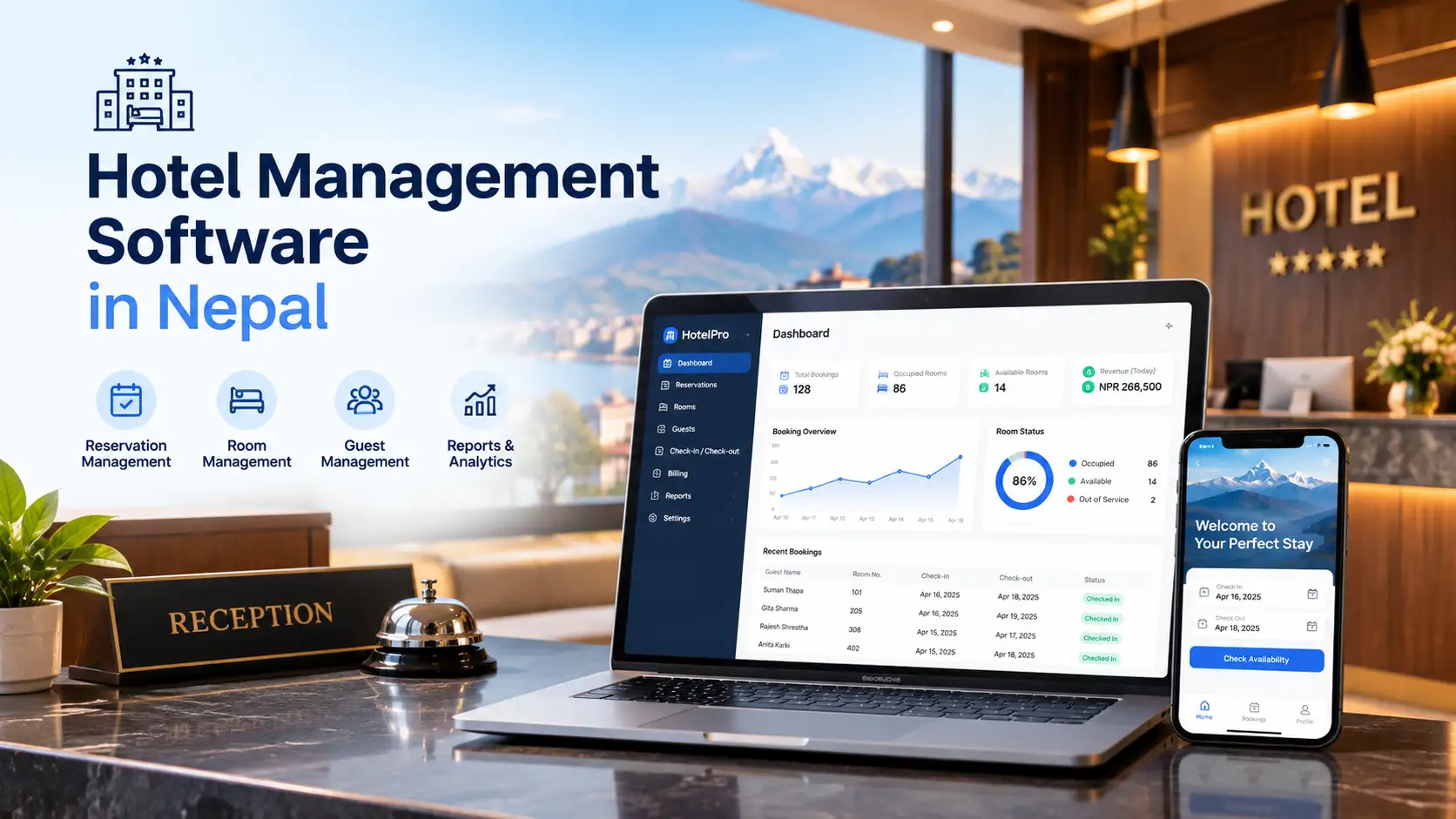
Hotel Management Software in Nepal (2026): Features, Prices, IRD Rules & How to Choose
Updated October 2026 · Written for hotel, resort, guesthouse, homestay and trekking-lodge owners in Nepal
Most hotel software guides you will find online are written by one vendor to sell its own product, or are thin lists copied from global directories. Neither tells a Nepali hotel owner what actually matters here: IRD-approved billing, CBMS sync, 13% VAT and service charge on the same bill, Bikram Sambat dates, foreign guest registration, and a system that keeps working when the internet drops in Pokhara or Namche.
This guide explains what hotel management software (also called a hotel PMS) does, which features a hotel in Nepal genuinely needs, what it costs, which options exist in the market, and a step-by-step way to choose one without regret.
Quick answer
The best hotel management software in Nepal is one that combines reservations, front desk, housekeeping and restaurant POS with IRD-approved billing, handles service charge and 13% VAT correctly, supports Nepali dates and NPR, syncs with Booking.com and Agoda, and comes with local support. Small properties can start on a cloud plan for roughly USD 50–300 a month; larger hotels and groups usually pay more and negotiate custom pricing.
In this guide
What Is Hotel Management Software?
Hotel management software is a single system that runs the daily operations of a hotel: taking bookings, checking guests in and out, assigning rooms, tracking housekeeping, billing the guest, and producing reports for the owner and the tax office. The core of it is the Property Management System (PMS). Around the PMS, most hotels in Nepal also connect:
- Channel manager – keeps room availability in sync across Booking.com, Agoda, Expedia, Airbnb and your own website.
- Booking engine – lets guests book directly on your website, so you pay no OTA commission.
- Restaurant and bar POS – posts food, drink and minibar charges to the guest’s room folio.
- Billing and accounting – produces tax invoices, credit notes and the sales books IRD expects.
- Inventory and purchase – kitchen stock, linen, amenities and supplier bills.
Here is how one guest’s stay moves through a connected system:
OTA, website, phone or walk-in
ID or passport, room assigned, FNMIS entry
Restaurant, laundry and minibar posted to folio
IRD-compliant bill with VAT
CBMS sync, reports, room status reset
If any step lives on paper or in a separate Excel file, that is where errors, double bookings and tax mismatches creep in.
Why Nepali Hotels Need Proper Software Now
Tourism is almost back to its pre-pandemic peak. Nepal received 1,158,459 foreign tourists in 2025, a little above the 1,147,548 who came in 2024, and close to the record 1,197,191 of 2019, according to Nepal Tourism Board figures.
Foreign tourist arrivals in Nepal (NTB)
Bars scaled to the 2019 record. 2025 reached about 97% of the pre-COVID peak.
The bigger operational problem is seasonality. Demand spikes in spring and autumn and drops hard in the monsoon. In 2025, arrivals peaked at 121,687 in March and 128,443 in October, but July saw only 70,193 visitors.
Selected months in 2025: why peak season breaks manual systems
September 2025 fell 18.3% year on year after the Gen-Z protests, then autumn recovered. Source: Nepal Tourism Board via ShareSansar and IANS.
In October a 20-room hotel can receive bookings from four OTAs, phone calls, travel agents and walk-ins on the same afternoon. That is exactly when a paper register or a shared Google Sheet causes an overbooking. Hotel Heranya, a family-run 17-room hotel in Kathmandu that previously ran manually, reports that moving to a cloud PMS solved its overbooking issue and lifted revenue by about 20% (vendor case study, so treat the number as indicative).
Software also lets you do things that are almost impossible by hand: raise rates automatically when occupancy crosses a threshold in peak weeks, push monsoon discounts to every channel at once, and see which channel actually brings profitable guests after commission.
Must-Have Features for Hotel Software in Nepal
Global feature lists are fine, but the items marked Nepal-specific below are the ones international comparison sites almost never mention, and they are often the reason a hotel switches software after a year.
Core PMS features
- Reservation calendar (tape chart) showing every room by date, with drag-and-drop room moves.
- Fast check-in and check-out with ID or passport scan and guest history for repeat visitors.
- Housekeeping module with live room status (clean, dirty, inspected, out of order) on a phone.
- Guest folio that collects room, restaurant, laundry, transport and tour charges into one bill, with split and group billing.
- Night audit and reports: occupancy, ADR (average daily rate), RevPAR, cash book and outstanding receivables.
- Role-based access so a receptionist cannot delete a paid bill or change room rates.
Nepal-specific features (the content most guides skip)
| Feature | Why it matters in Nepal | What to ask the vendor |
|---|---|---|
| IRD-approved billing | Tax invoices from unapproved software can create problems during an IRD audit. | Is this exact product and version on IRD’s approved list? |
| CBMS sync | Larger businesses must push bills to IRD’s Central Billing Monitoring System. | Is CBMS real-time? What happens to bills raised while offline? |
| Service charge + 13% VAT | Service charge is applied first, then VAT on the combined amount. | Can menu prices be set tax-inclusive while the bill still shows the breakdown? |
| BS and AD dates | Bills, VAT returns and fiscal-year reports follow Bikram Sambat (Shrawan to Ashar). | Do sales books and reports run on the Nepali fiscal year? |
| Foreign guest registration | The Department of Immigration’s FNMIS is being rolled out to hotels in phases. | Can I export or reuse passport data for FNMIS entry? |
| Offline mode | Internet drops in hill and mountain areas and during outages. | Can the front desk still check in and bill without internet? |
| Multi-currency | Foreign guests often pay in USD, INR or by card. | Does the bill show NPR with the rate used for conversion? |
| Local payments | Many domestic guests pay by Fonepay QR, eSewa or Khalti. | Can these be recorded as separate payment modes for reconciliation? |
| Nepali-language interface | Housekeeping and kitchen staff may be more comfortable in Nepali. | Is Nepali available for the staff app, not only the bill print? |
Growth features (useful once the basics work)
- Channel manager with two-way sync to Booking.com, Agoda, Expedia and Airbnb.
- Direct booking engine on your website. If you do not have a site yet, see our guide on website design cost in Nepal.
- Rate rules for peak weeks, Dashain and Tihar, and monsoon offers.
- Travel agent and corporate accounts with credit limits, since many Nepali hotels still get a large share of business from agents.
- Multi-property dashboard for owners running, for example, one hotel in Kathmandu and one in Pokhara.
IRD, CBMS, VAT and FNMIS: The Compliance Layer
This is the biggest content gap in competing articles. A hotel can survive with an average channel manager; it cannot afford billing that fails an IRD review.
1. IRD-approved billing software
If your hotel issues VAT bills from software, that software should be approved by the Inland Revenue Department. Always check the vendor against the official list rather than trusting a sales brochure. We keep an updated IRD-approved billing software list in Nepal, and if you are a developer building your own system, read how to get IRD approval for billing software in Nepal.
2. CBMS connection
The Central Billing Monitoring System sends your bills to IRD. Hotels with a busy restaurant face the same CBMS questions as standalone restaurants: real-time vs batch sync, cancelled bills, and credit notes. Our CBMS integration guide for restaurant billing in Nepal covers this in detail, and the same logic applies to your hotel F&B outlet.
3. Service charge and 13% VAT, calculated in the right order
The standard sequence is: apply the 10% service charge on the subtotal, then 13% VAT on subtotal plus service charge. Good hotel software does this automatically. Here is a worked example for one night:
| Room charge (1 night) | Rs 5,000 |
| Service charge 10% | Rs 500 |
| Taxable amount | Rs 5,500 |
| VAT 13% on Rs 5,500 | Rs 715 |
| Total payable | Rs 6,215 |
Watch out: a 2022 Kathmandu District Court ruling held that adding VAT and service charge on top of the displayed menu price misleads consumers, and authorities have since pushed restaurants to show tax-inclusive menu prices. Your software should let you display inclusive prices while the bill still breaks out the taxable value, service charge and VAT. Ask the vendor to show you this on a live demo. This is general information, not tax advice; confirm your setup with your auditor.
4. Foreign guest registration (FNMIS)
Nepal’s Department of Immigration has introduced the Foreign Nationals Management Information System (FNMIS). It started with star-rated hotels in Kathmandu Valley, expanded to all star hotels nationwide from 1 March 2026, and is planned to cover all hotels and guest houses in later phases. If a guest does not self-register through the immigration app, the hotel is expected to do it. Software that already stores clean passport, visa and stay data saves your front desk from typing it twice. Check the latest phase with the Department of Immigration before you buy.
Cloud vs On-Premise Hotel Software in Nepal
Cloud systems run in a browser and are billed monthly. On-premise systems are installed on a local computer or server, often with a one-time licence. Both are common in Nepal.
| Factor | Cloud PMS | On-premise PMS |
|---|---|---|
| Upfront cost | Low, monthly or yearly fee | Higher, licence plus hardware |
| Remote access | Yes, from phone or laptop anywhere | Usually only on the hotel network |
| Internet dependency | High, unless it has an offline mode | Low |
| OTA channel sync | Easy and real-time | Harder, often needs add-ons |
| Backups and updates | Handled by the vendor | Your responsibility |
| Best for | City hotels, owners who travel, OTA-heavy properties | Remote lodges with unreliable internet, owners wanting data in-house |
Practical tip: many Nepali hotels end up with a hybrid: a cloud PMS for bookings and channels, plus a reliable backup internet line (fibre plus a mobile data router) at the front desk. Ask any cloud vendor exactly what happens to check-ins and billing during a two-hour outage.
Hotel Management Software Options Available in Nepal
The market splits into local Nepali vendors (strong on IRD billing and on-site support) and international cloud PMS brands (strong on OTA connectivity and polished apps, usually sold through local partners). The table below summarises publicly stated positioning. It is not a ranking, and no vendor paid to be included.
| Software | Type | What it is known for | Check before buying |
|---|---|---|---|
| Sarvanam Software | Local, cloud | Kathmandu-based hotel PMS and restaurant POS since 2016; says it serves 300+ hotels | Pricing for small properties, channel manager depth |
| SMTECH Smart ERP | Local ERP | POS, restaurant, hotel and accounting modules from one Kathmandu vendor | Depth of front office, housekeeping and night audit |
| NitiERP | Local ERP | Markets itself as IRD-approved and CBMS-connected with industry packs | Hotel-specific PMS features vs general ERP |
| MyHotelLine | Cloud, mobile | NPR currency, Nepali language, OTA links, mobile-first management | IRD approval status and local support coverage in your district |
| Hotelogix | International cloud | Cloud PMS with POS and channel sync; active in Nepal through local partners | How IRD billing and CBMS are handled locally |
| eZee, mycloud, KWHotel | International cloud | Broad PMS, channel manager and POS bundles | Nepal tax invoice format, local onboarding |
| Oracle OPERA | Enterprise | Used by large international chain hotels | Cost and implementation time; overkill for most independents |
Vendor claims are taken from their own websites and listings. Always verify IRD approval on the official list and ask for two references from hotels of your size.
Hotel Management Software Price in Nepal
There is no fixed price. Cost depends on room count, modules, integrations and support. Global cloud PMS market ranges published by one vendor give a useful starting point:
Typical monthly cloud PMS cost by hotel size (USD)
Bar lengths show the upper end of each range on a compressed scale. Source: Hotelogix PMS pricing guide. Multiply by the current NPR/USD rate for a rupee estimate.
Directory listings show some entry plans starting from about USD 3–4 per room per month, and a few desktop systems sold as a one-time licence. Local Nepali vendors usually quote on request, often as a yearly fee plus installation.
Hidden costs to budget for
- Setup and data migration from your old register or Excel.
- Hardware: front-desk PC, thermal or A4 bill printer, KOT printer for the kitchen, tablet for housekeeping.
- Channel manager and booking engine, sometimes priced separately.
- Restaurant POS add-on and extra user licences.
- Annual renewal and support (AMC), including on-site visits outside Kathmandu.
- Training every time staff turn over before the season.
The pattern is similar to what we found for restaurants: the subscription is rarely the biggest number in year one. See our breakdown of restaurant billing software price in Nepal for how to build a true first-year budget, which applies directly to a hotel’s F&B side.
Which Type of Software Fits Your Property?
Homestay or guesthouse (1–10 rooms)
A simple mobile-first cloud PMS or even a channel manager with basic billing. Priority: OTA sync and easy phone use. Make sure bills are IRD-compliant if you are VAT registered.
City hotel (10–50 rooms) in Thamel, Lakeside or Sauraha
Full PMS with channel manager, restaurant POS, housekeeping app and IRD billing. Priority: overbooking control in peak season and travel agent accounts.
Resort or star hotel (50+ rooms)
PMS plus multiple POS outlets, banquet and events, inventory, accounting integration, CBMS and FNMIS workflows. Priority: audit trail and reporting.
Trekking lodge or remote resort
Offline-capable or on-premise billing, with bookings synced whenever internet is available. Priority: works without connectivity, simple training.
Illustrative scenario: a 20-room hotel in Thamel
Picture a typical family-run 20-room hotel. In October the owner gets bookings from Booking.com, Agoda, two trekking agencies and walk-ins. The receptionist updates a paper register and then each OTA extranet by hand. One evening, two OTAs sell the last deluxe room within ten minutes of each other, and a guest arrives after a 12-hour flight to find no room.
With a PMS plus two-way channel manager, the first booking closes that room on every channel within seconds. The restaurant bill posts to the room automatically, the checkout bill calculates service charge and VAT correctly, and the owner sees occupancy and cash on a phone from home. That is the practical difference software makes, not fancy dashboards.
How to Choose Hotel Management Software in Nepal: 7 Steps
- List your real problems first. Overbooking? Lost restaurant bills? Slow checkout? Tax worries? Rank them; they decide which modules you need.
- Shortlist only IRD-approved options. Cross-check names on the IRD-approved software list before any demo.
- Ask for a live demo with your own scenario. A group of 8 trekkers, one room split across two bills, a restaurant charge moved to the room, a cancellation with a credit note.
- Test the bill. Check service charge, VAT order, BS date, PAN number, and how a cancelled bill appears in reports.
- Test the internet failure. Unplug the router during the demo and see what still works.
- Confirm support and data ownership. Response time in peak season, on-site support outside the valley, and whether you can export all guest and billing data if you leave.
- Go live in the off-season. Install in June to August, train staff, run parallel with the old method for two weeks, and be fully ready before the September–November rush.
Red flags
- The vendor cannot show an IRD approval letter for the exact product.
- Bills can be edited or deleted after printing with no trace.
- Data export is “not possible” or charged heavily.
- No references from hotels in Nepal of your size.
- Long lock-in contracts with no trial period.
If your property is mainly a restaurant with a few rooms, a restaurant system may serve you better. Compare options in our guide to restaurant management software for small businesses.
Frequently Asked Questions
What is the best hotel management software in Nepal?
There is no single best system for every property. The best choice for a Nepali hotel is IRD-approved, handles 10% service charge and 13% VAT correctly, supports Nepali dates, syncs with OTAs, and has dependable local support. Small guesthouses need simplicity; resorts need POS, inventory and audit features.
How much does hotel software cost in Nepal?
Cloud PMS plans for small hotels commonly fall around USD 50–300 a month, boutique hotels around USD 300–800, and large hotels much more. Some entry plans start near USD 3–4 per room per month. Add setup, hardware, POS add-ons and annual support to your budget.
Does hotel software in Nepal need IRD approval?
If you issue VAT bills through software, the billing software should be approved by Nepal’s Inland Revenue Department. Verify the product on the official IRD list rather than relying on the vendor’s claim.
How are service charge and VAT calculated on a hotel bill in Nepal?
The 10% service charge is added to the subtotal first, then 13% VAT is charged on the subtotal plus service charge. A Rs 5,000 room becomes Rs 5,500 with service charge and Rs 6,215 after VAT.
Is cloud hotel software reliable in Nepal?
Yes in cities with stable fibre, especially with a backup mobile data connection. For remote lodges, choose software with an offline mode or an on-premise billing component that syncs later.
Do hotels in Nepal have to register foreign guests online?
The Department of Immigration is rolling out FNMIS in phases. Star hotels nationwide were included from 1 March 2026, with all hotels and guest houses planned in later phases. Check the current phase with the Department of Immigration.
Can one software manage both my hotel rooms and restaurant?
Yes. Most hotel PMS options include or integrate a restaurant POS so food and drink charges post to the guest’s room bill, with kitchen order tickets and a single tax invoice at checkout.
Final Thoughts
With arrivals back near record levels and compliance tightening through IRD billing, CBMS and FNMIS, running a Nepali hotel on paper is getting riskier every season. Choose software for the problems you actually have, insist on IRD approval and a correct tax bill, test what happens when the internet fails, and go live before the autumn rush.
For more guides on billing, POS and business tools in Nepal, visit our Web, SEO and Business Software hub.