
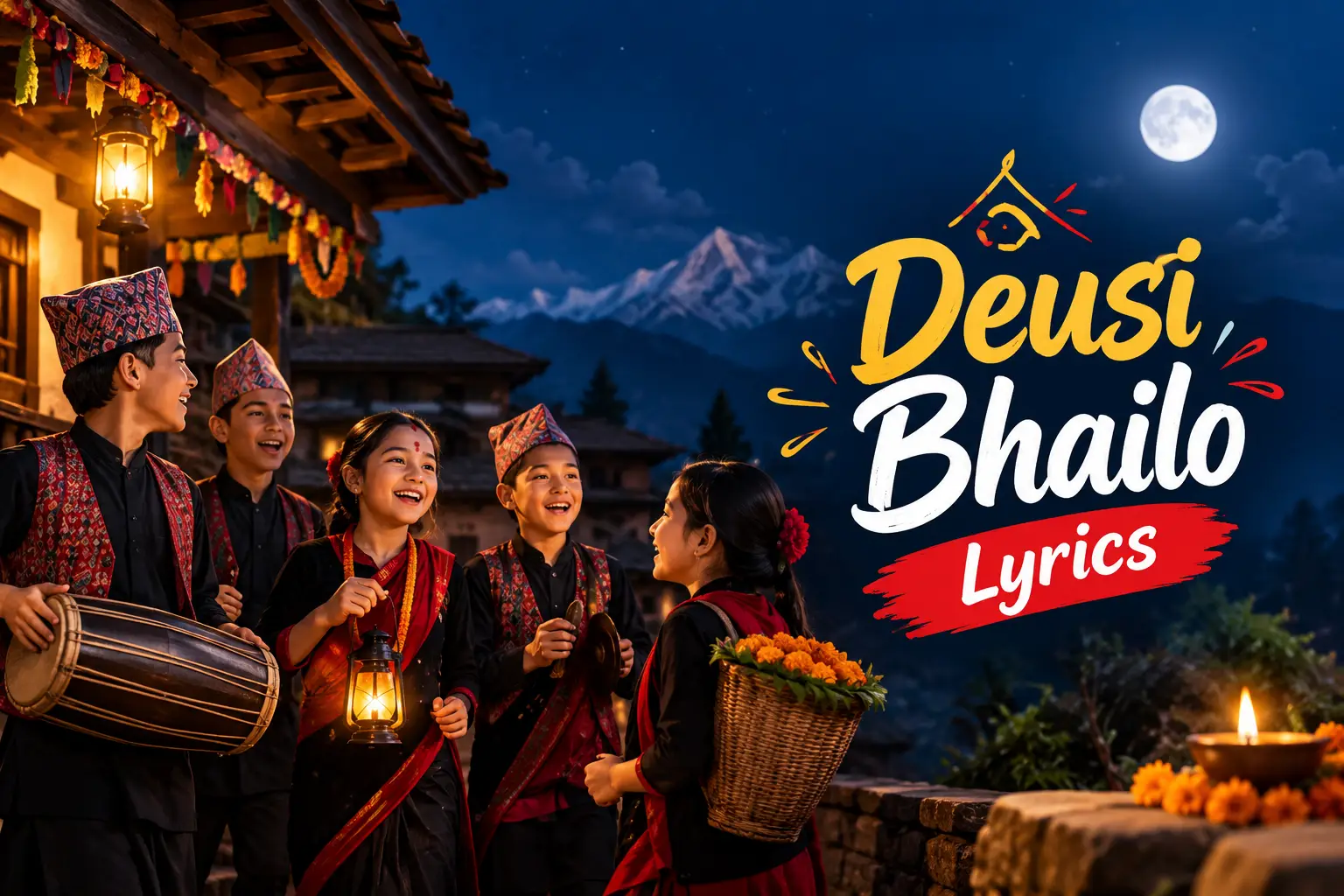
Deusi Bhailo Lyrics (देउसी भैलो): Meaning and How to Sing, Complete 2026 Guide
By Wilson Shrestha, Kathmandu · Updated 6 October 2026 · Devanagari, Romanized and English side by side
Deusi Bhailo is the sound of Tihar, Nepal's five-day festival of lights. After dark, groups of singers go from house to house with a madal and a lead voice, sing for the household, receive blessings and gifts, and sing a blessing back. This guide gives you the traditional Deusi Bhailo lyrics in Devanagari, Romanized text and English meaning, explains what each part means, and covers how to organise and perform your own round.
Tihar 2026 dates for singing
Nepali calendars list these dates for Tihar 2026 (Kartik 2083 BS):
| Day | Date | Nepali date |
|---|---|---|
| Kaag Tihar | Saturday, 7 Nov 2026 | Kartik 21 |
| Kukur Tihar + Laxmi Puja (Bhailo begins) | Sunday, 8 Nov 2026 | Kartik 22 |
| Govardhan Puja / Mha Puja (Deusi begins) | Tuesday, 10 Nov 2026 | Kartik 24 |
| Bhai Tika | Wednesday, 11 Nov 2026 | Kartik 25 |
This year Kukur Tihar and Laxmi Puja fall on the same day, and several calendars list Gai Tihar separately on Monday 9 November. Some Indian-calendar sites also shift Govardhan Puja and Bhai Tika by a day, so confirm with Hamro Patro or your local community committee before you plan the route. Tihar dates follow the lunar calendar and change every year.
Deusi vs Bhailo: what is the difference?
| Bhailo (भैलो) | Deusi (देउसी) | |
|---|---|---|
| Sung by | Traditionally girls and women (bhailini) | Traditionally boys and men (deuse) |
| Starts | Laxmi Puja night | Govardhan Puja night |
| Style | Gentler, sung together with a repeating refrain | Call and response: a lead (bhatyaune) calls, the chorus answers |
| Refrain | "Hey ausiko baaro, gai tiharo bhailo" | "Deusi re!" |
This split is the textbook version. Today, mixed groups are common, many groups sing both forms, and groups often go out on several nights between Laxmi Puja and Bhai Tika. Practice also varies by region and community.
Bhailo the object. In some places "bhailo" also names the bundle of straw or a lit torch that people swing or carry during Tihar. If you search for "bhailo" and find fire and torches, that is why. This guide is about the songs.
Traditional Deusi lyrics (line by line)
A lead singer (bhatyaune) calls each line and the chorus answers "Deusi re!" after every one. These are traditional folk verses passed on orally, so wording differs from village to village. Each line shows the Devanagari, the Romanized text and the English meaning.
Other verses are added or dropped depending on the house and the singer. That variety is normal, because the bhatyaune is expected to improvise (see below).
Traditional Bhailo lyrics
Bhailo verses are shorter and move at an easier pace. Each verse is followed by the same refrain, shown highlighted below.
These are a selection of the best-known verses, not every Bhailo verse that exists. Singers in different regions use different verses.
The blessing (ashish)
After the household gives, the group sings a blessing back. The bhatyaune usually makes these up on the spot, and the best ones mention the family, the house, a recent event or the neighbourhood. These are typical examples in the traditional style, not a fixed script:
Copy-ready lyrics (for printing or sharing)
Need just the words for your group? Select and copy the version you want. For Deusi, the chorus answers "देउसी रे!" (Deusi re!) after every line.
देउसी (Devanagari)
आहै, राम्ररी भन! — देउसी रे!
आहै, स्वर मिलाई भन! — देउसी रे!
आहै, झिलिमिली झिलिमिली! — देउसी रे!
आहै, के को झिलिमिली? — देउसी रे!
आहै, बत्तीको झिलिमिली! — देउसी रे!
आहै, फूलको झिलिमिली! — देउसी रे!
आहै, सयपत्रीको झिलिमिली! — देउसी रे!
आहै, मखमलीको झिलिमिली! — देउसी रे!
आहै, हामी त्यसै आएनौँ! — देउसी रे!
आहै, बलि राजाले पठाको! — देउसी रे!
आहै, हिँड्दै आयौँ डुलिँदै आयौँ! — देउसी रे!
आहै, छाना माथि घिरौँला! — देउसी रे!
आहै, के दिन्छन् हेरौँला! — देउसी रे!
आहै, खरको छानो पातको दलिन! — देउसी रे!
आहै, हामी आएका छौँ दक्षिणा लिन! — देउसी रे!
Deusi (Romanized)
Aahai, ramrari bhana! — Deusi re!
Aahai, swara milai bhana! — Deusi re!
Aahai, jhilimili jhilimili! — Deusi re!
Aahai, ke ko jhilimili? — Deusi re!
Aahai, battiko jhilimili! — Deusi re!
Aahai, phoolko jhilimili! — Deusi re!
Aahai, sayapatriko jhilimili! — Deusi re!
Aahai, makhamaliko jhilimili! — Deusi re!
Aahai, hami tyasai aayenau! — Deusi re!
Aahai, Bali Rajale pathaako! — Deusi re!
Aahai, hindai aayau dulidai aayau! — Deusi re!
Aahai, chhana mathi ghiraunla! — Deusi re!
Aahai, ke dinchhan heraunla! — Deusi re!
Aahai, kharko chhano paatko dalin! — Deusi re!
Aahai, hami aayeka chhau dakshina lina! — Deusi re!
भैलो (Devanagari)
हे औँसीको बारो, गाई तिहारो भैलो ॥
भैलिनी आइन् आँगन, बत्ती बाली हेरन ।
हे औँसीको बारो, गाई तिहारो भैलो ॥
केराको पातमा, सेलरोटी हातमा ।
हे औँसीको बारो, गाई तिहारो भैलो ॥
छाना माथि घिरौँला, के दिन्छन् हेरौँला ।
हे औँसीको बारो, गाई तिहारो भैलो ॥
हामी त्यसै आएनौँ, बलि राजाले पठाको ।
हे औँसीको बारो, गाई तिहारो भैलो ॥
दाम दिनेको हात सुनको, चामल दिनेको हात चाँदीको ।
हे औँसीको बारो, गाई तिहारो भैलो ॥
Bhailo (Romanized)
Hey ausiko baaro, gai tiharo bhailo.
Bhailini aain aangan, batti baali heran.
Hey ausiko baaro, gai tiharo bhailo.
Keraako paatma, selroti haatma.
Hey ausiko baaro, gai tiharo bhailo.
Chhana mathi ghiraunla, ke dinchhan heraunla.
Hey ausiko baaro, gai tiharo bhailo.
Hami tyasai aayenau, Bali Rajale pathaako.
Hey ausiko baaro, gai tiharo bhailo.
Daam dineko haat sunko, chamal dineko haat chandiko.
Hey ausiko baaro, gai tiharo bhailo.
Why "Bali Raja le pathako"? The King Bali story
The line "We did not come for nothing, King Bali sent us" refers to a Hindu legend. King Bali was a generous demon king. Lord Vishnu came to him as a dwarf Brahmin (Vamana) and asked for three paces of land. With two strides he covered the earth and the heavens, and for the third Bali offered his own head. In the common retelling, Vishnu was moved by this devotion and allowed Bali to return to earth once a year. Because he cannot visit every house himself, the singers are said to come in his name, bringing his blessings and asking for gifts on his behalf.
This is one popular framing, not the only one. Another account, retold by Onlinekhabar, links the tradition to a medieval King Bali of Jumla rather than the mythological Bali. Tihar also carries other stories, such as Yama and his sister Yamuna behind Bhai Tika, Krishna and Govardhan on the fourth day, and the Newar celebration of Mha Puja on the same day. You may also hear that the word "Deusi" comes from "Deva Sri" or from the idea of offering one's head. These are folk explanations, and none of them is settled scholarship, so treat them as traditions rather than established etymology.
History and regional variations
Deusi Bhailo is an oral tradition, passed on by ear rather than from a written text, and there is no single authoritative script or documented founding date. What is clear is that it has changed with time. Nepali folk-music figures speaking to SBS Nepali have described how the once solemn songs are now sung in many styles by the younger generation, and diaspora communities carry the tradition abroad every year. Expect differences:
- Verses and refrains. Villages, districts and families have their own lines and tunes. The version here is widely known, not the only correct one.
- Who sings and when. The boys-sing-Deusi, girls-sing-Bhailo split is traditional but loosely followed. Mixed groups are now the norm in many places.
- Newar communities. Newars observe Mha Puja and the Nepal Sambat new year on the same day as Govardhan Puja, with their own rituals, and do not necessarily follow the same Deusi Bhailo pattern.
- Regions. Practice in the hills, the Tarai and western Nepal differs in tunes, instruments and wording. Nepali communities in Darjeeling, Sikkim, Assam and Bhutan keep their own versions too. If you know your community's version, it is worth writing down and preserving.
Improvisation: the bhatyaune's job
The lead singer does more than recite. A good bhatyaune reads the house: they praise the household, mention the family and what they have achieved, and answer a generous gift with a longer blessing. The chorus follows with "Deusi re!". Learn the fixed lines above first, then add your own verses once you are comfortable.
How a visit usually goes
- Arrival. The group stops at the gate or courtyard, and the madal starts.
- Opening. The lead calls "Aahai, bhana mera bhai ho!" and the chorus answers.
- Songs. The group sings the shimmering and "King Bali sent us" verses while the household comes out, often with lamps.
- The ask. The "we have come for our dakshina" verses signal that the group is waiting.
- The gift. The household brings out money, sel roti, fruit, nuts or other offerings, often on a tray.
- The blessing. The group sings the ashish for the family.
- Leaving. The group thanks the household and moves on. Polite groups do not pester a house that does not give, and leave with good wishes.
How to perform: a practical guide
- Roles. One strong lead (bhatyaune), a chorus of at least four to six voices, and one or two madal players. A harmonium or flute is a common addition. Dancers add energy in the courtyard.
- Tempo. Start at a steady walking pace. Call-and-response works best when the lead has a clear, regular call and the chorus answers in unison on the beat.
- Madal. Keep the beat simple and steady. A tidy rhythm matters more than flashy playing.
- Pitch. Choose a key the lead can hold for an hour, then keep the chorus on the same note.
- Rehearse the ending. Agree in advance on the signal that ends a verse and starts the blessing.
- Learn the tune by ear. Written text only gets you so far. Ask older relatives, or listen to community recordings from your own region.
Organising your own troupe
- Size. Eight to fifteen people is manageable. Larger groups can overwhelm a small courtyard.
- Route. Plan the houses in advance and visit friends and neighbours who expect you.
- Time limits. Check local rules. In 2025, Kathmandu and Lalitpur district administrations asked groups to finish by 9 pm, and Bhaktapur barred programmes that block public roads. Watch for the 2026 notices before Tihar.
- Costume. Traditional dress, topis and flower garlands are popular, but there is no fixed uniform.
- Etiquette. Greet respectfully, thank every household whatever they give, and keep the volume reasonable, especially near children and elderly residents.
- Money. Appoint one person to hold the collection and agree beforehand where it will go. Many groups donate to a school, a community project or a charity. Being open about this builds trust.
- Safety. Carry a torch or lamp, keep clear of traffic, never ride in overloaded tractors or trucks between villages, and watch out for open flames and dogs.
- Kids and short versions. For school events or very young singers, use the first eight to ten lines of the Deusi lyrics and the first two Bhailo verses with the refrain.
Modern and popular Deusi Bhailo songs
The folk verses above are traditional. Many modern groups also add popular songs to their round, and Nepali media publish lists of film songs and band numbers that suit a Deusi Bhailo programme, such as Onlinekhabar's list of evergreen songs. Because modern songs are copyrighted, this guide does not reproduce their lyrics. Please listen to them on official channels and credit the writers.
Frequently asked questions
What does "Deusi re" mean?
It is the chorus response in Deusi. It works a little like an "amen": the lead calls a line and the group answers "Deusi re!". The exact origin of the word is not settled.
What does "Aahai, bhana mera bhai ho" mean?
Roughly "Come on, say it, my brothers!" It is the lead's call that tells the chorus to join in.
What does "Hey ausiko baaro, gai tiharo bhailo" mean?
It is the Bhailo refrain, roughly "On the new-moon night, it is Gai Tihar, bhailo!" Laxmi Puja falls on the new moon (aunsi) of Kartik.
When should we start singing in 2026?
Traditionally Bhailo starts on Laxmi Puja night and Deusi on Govardhan Puja night, but many groups go out over several evenings until Bhai Tika. In 2026 that means from Sunday 8 November to Wednesday 11 November. Check your local patro.
Until what time can we play Deusi Bhailo in Kathmandu?
In 2025 the Kathmandu and Lalitpur district administrations asked groups to finish by 9 pm. The 2026 rule is usually announced shortly before Tihar, so check local news.
What do households give?
Money (dakshina), sel roti, fruit, nuts, sweets or other treats, often on a tray, with lamps lit for the visit.
What do we say after receiving a gift?
Thank the household and sing the blessing, such as the ashish lines above, then say goodbye with good wishes for Tihar.
What if a household does not give?
Move on politely. A good-humoured farewell is the tradition, and nobody is obliged to give.
Can girls sing Deusi and boys sing Bhailo?
Yes. The split is traditional, but today mixed groups sing both.
Is Bhailo the same as the torch?
No. Bhailo is a song, and in some places also the name of a torch or bundle played with during Tihar.
Sources and notes
- Tihar 2026 dates: Nepali Calendar: Tihar dates and Public holidays in Nepal (Wikipedia). Sources differ by a day for some days, so check Hamro Patro.
- Background: Deusi/Bhailo (Wikipedia) and Onlinekhabar: Who started Deusi-Bhailo?
- How the tradition is changing: SBS Nepali.
- Lyrics: traditional folk verses from common oral versions. They vary by region.